
Waking up with pain in the right arm and leg at the same time can feel unsettling in a way that ordinary soreness does not. One side hurts, the symptoms don't seem to match a simple strain, and the mind goes straight to the worst possibilities. That reaction makes sense, because when pain tracks down one side of the body, the question is often not which limb is injured, but what part of the spine, nerve system, or blood flow is being affected.
That pattern matters. Right-sided arm and leg pain together can come from something relatively routine, like a muscle or joint problem, but it can also signal a spine-related nerve problem, a vascular issue, or a more serious neurologic event. In a major CDC analysis of U.S. adults, lower-limb pain was reported by 36.5% and upper-limb pain by 30.7% in the prior 3 months, while 58.9% reported some pain in that period, showing that limb pain is common and often overlaps with pain elsewhere in the body (CDC data brief). That doesn't mean every ache is dangerous. It does mean the pattern deserves a calm, structured look instead of guesswork.
The safest way to think about it is simple. First, sort out whether the pain is urgent. Then decide whether the source is more likely spinal, vascular, neurologic, musculoskeletal, or systemic. That step-by-step approach helps separate a sore nerve from a blocked artery or a problem that needs emergency care.
Table of Contents
- Why Right Arm and Leg Pain Together Deserves Attention
- How the Body Creates Pain on One Side
- Common Causes of Pain in the Right Arm and Leg
- Red Flags That Mean Emergency Care Now
- How Doctors Diagnose the Real Source
- Treatment Options From Conservative to Interventional
- Why a Multi-Specialty Pain Practice Changes the Outcome
- Your Next Steps in New Jersey and Staten Island
Why Right Arm and Leg Pain Together Deserves Attention
Waking up with a painful right arm and a painful right leg can feel like two unrelated problems landed on the same day. In practice, that's often not how it works. Pain that appears on the same side of the body can come from a single source higher up the chain, especially in the neck, spine, nerves, or blood vessels.
One pattern, not two separate complaints
A common mistake is to think in terms of “the arm problem” and “the leg problem” as if they must have separate causes. That may be true sometimes, but simultaneous right-sided symptoms often point to one broader pattern. The spine can irritate nerve roots, vessels can reduce blood flow, and some neurologic disorders can affect coordination or sensation in more than one limb on the same side.
Practical rule: when pain travels in a line, spreads in a pattern, or keeps returning on the same side, the source deserves a deeper look than a simple overuse explanation.
The clinical stakes are straightforward. If the source is a pinched nerve, treatment may focus on reducing nerve irritation. If it's vascular, the priority changes to restoring circulation. If it's an emergency neurologic event, waiting at home is the wrong move. That's why pain management physicians, spine specialists, and vascular clinicians look at the whole pattern before settling on a label.
A useful way to read the body is to ask where the pain starts, where it travels, and what triggers it. Arm pain that follows a neck problem can fit one pathway, while leg pain after walking can fit another. When both happen together, the body is often giving a clue that one larger system is involved.
What this article focuses on
This article stays centered on the most important explanations for pain in the right arm and leg. It does not assume every case is a simple strain, and it does not skip the urgent diagnoses that need immediate attention. The goal is to help readers move from fear to a clear plan, starting with what the body is signaling.
How the Body Creates Pain on One Side
Pain follows anatomy, and that's the key to understanding why one compressed nerve or one narrowed artery can affect places that seem far away from the actual problem. A useful mental model is a tree. The trunk is the spine or a major vessel, and the branches are the nerves and smaller blood pathways that reach the arm and leg.
Nerves carry the map
The cervical spine connects most directly to the arm, while the lumbar spine more often relates to the leg. When a nerve root is irritated, the pain can travel along that nerve's path, which is why a neck problem may cause arm symptoms and a low-back problem may cause leg symptoms. The pain can feel sharp, burning, tingling, or electric, and it may show up without obvious weakness at first.
That pattern is why clinicians use terms like radiculopathy. The problem is not always inside the arm or leg itself. The problem can sit higher up, where the nerve exits the spine, and the symptom shows up downstream.
Blood vessels and muscles can imitate nerve pain
Blood flow problems can also create pain that seems to belong to the limb. If an artery is narrowed, the tissue farther down the line can hurt with exertion or feel threatened if circulation drops suddenly. Muscles and tendons can add another layer of confusion, because local inflammation can create pain that spreads or feels deep.
A symptom pattern that seems “limb-based” is not always a limb problem. The neck, lower spine, nerves, and blood vessels can all send pain into the same region.
The reason this matters is simple. A person with pain in the right arm and leg may be dealing with one source, not two. If the source is nerve-related, the workup looks different from a muscle strain. If it's vascular, the urgency changes. If the pain feels diffuse and without a clear trigger, the diagnosis may require a broader clinical exam.
Common Causes of Pain in the Right Arm and Leg
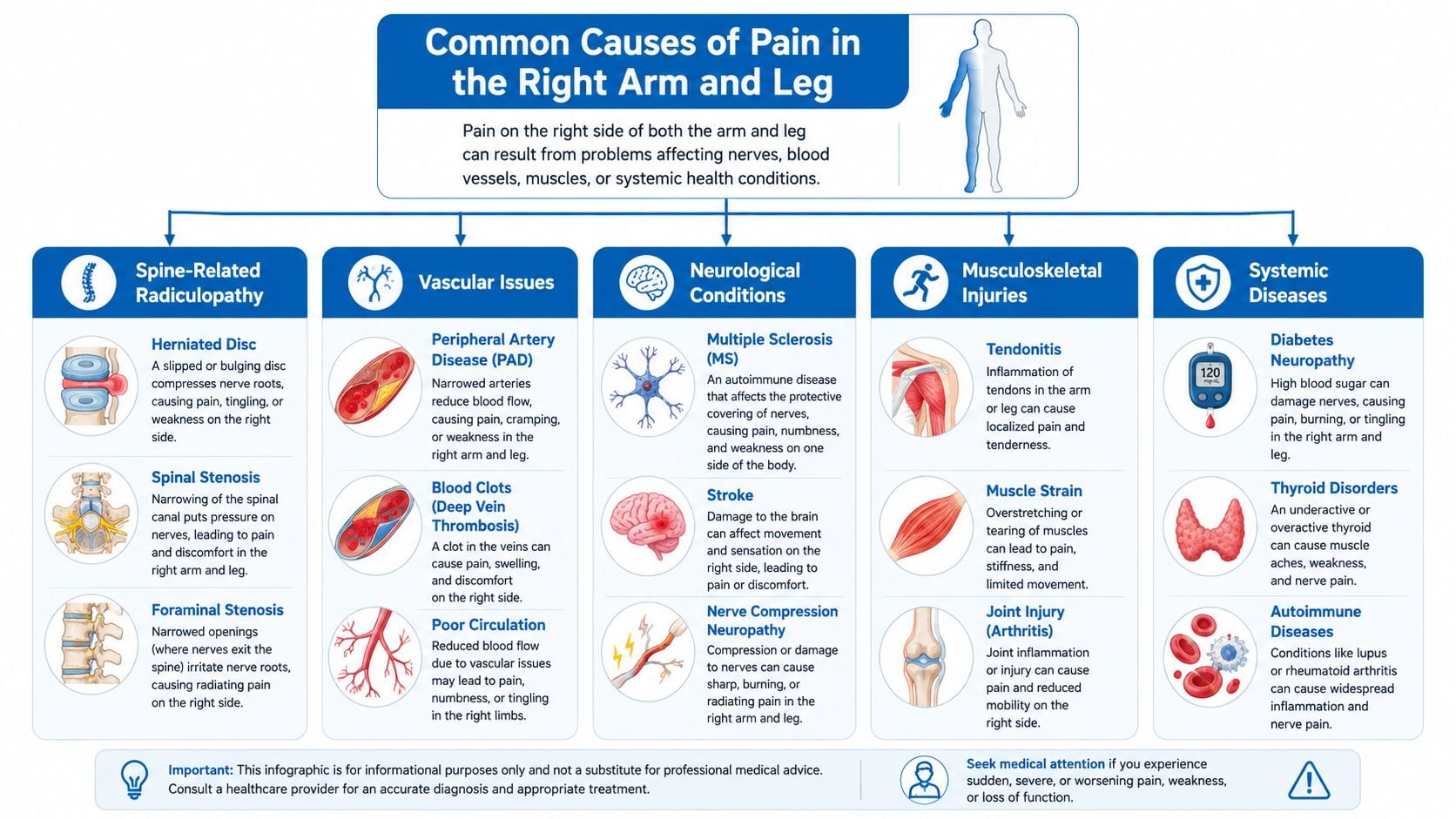
The most useful way to sort causes is by category, not by guessing a single disease from the symptom alone. A right arm and right leg pattern can come from the spine, peripheral nerves, blood vessels, muscles or joints, or a body-wide condition that affects nerve function.
Spine-related problems
A herniated disc or spinal stenosis can irritate a nerve root and cause pain that travels into the arm or leg. Cervical sources usually fit arm symptoms, while lumbar sources usually fit leg symptoms. In spine-related pain, the pain often worsens with certain movements, coughing, lifting, or positions that narrow the space around the nerve.
The important point is that spinal pain doesn't always stay where the injury began. A problem in the neck can send discomfort into the shoulder and arm. A problem in the lower back can send pain into the buttock, thigh, calf, or foot.
Vascular problems
Blood-flow problems need special attention because they can be time-sensitive. Peripheral artery disease can cause exertional leg pain that improves with rest, and Mayo Clinic describes claudication as pain caused by too little blood flow to the legs or arms, usually from atherosclerotic narrowing of the peripheral arteries (Mayo Clinic on claudication). MSD Manuals also flags deep vein thrombosis, acute arterial occlusion, cellulitis, and spinal nerve-root compression among important causes of limb pain, which is why swelling, warmth, color change, or sudden coldness should not be brushed off (MSD Manuals on limb pain).
Musculoskeletal and systemic causes
Joint irritation, tendon problems, and overuse injuries can produce localized pain that feels worse with activity and better with rest. Systemic conditions, especially those that affect nerves or blood sugar control, can create pain, tingling, or reduced sensation in more than one limb. A person may notice that the pain is not tied to one clear injury, which is often the clue that the problem is broader than a single muscle or joint.
A common consumer term that needs translation
Many people say “pinched nerve,” but that phrase is broader than a formal diagnosis. The actual cause may be radiculopathy, nerve entrapment, or another structural issue in the spine or peripheral nerves. For a deeper breakdown of that pathway, the discussion of pinched nerve in this spine-focused overview is a useful reference point.
Red Flags That Mean Emergency Care Now
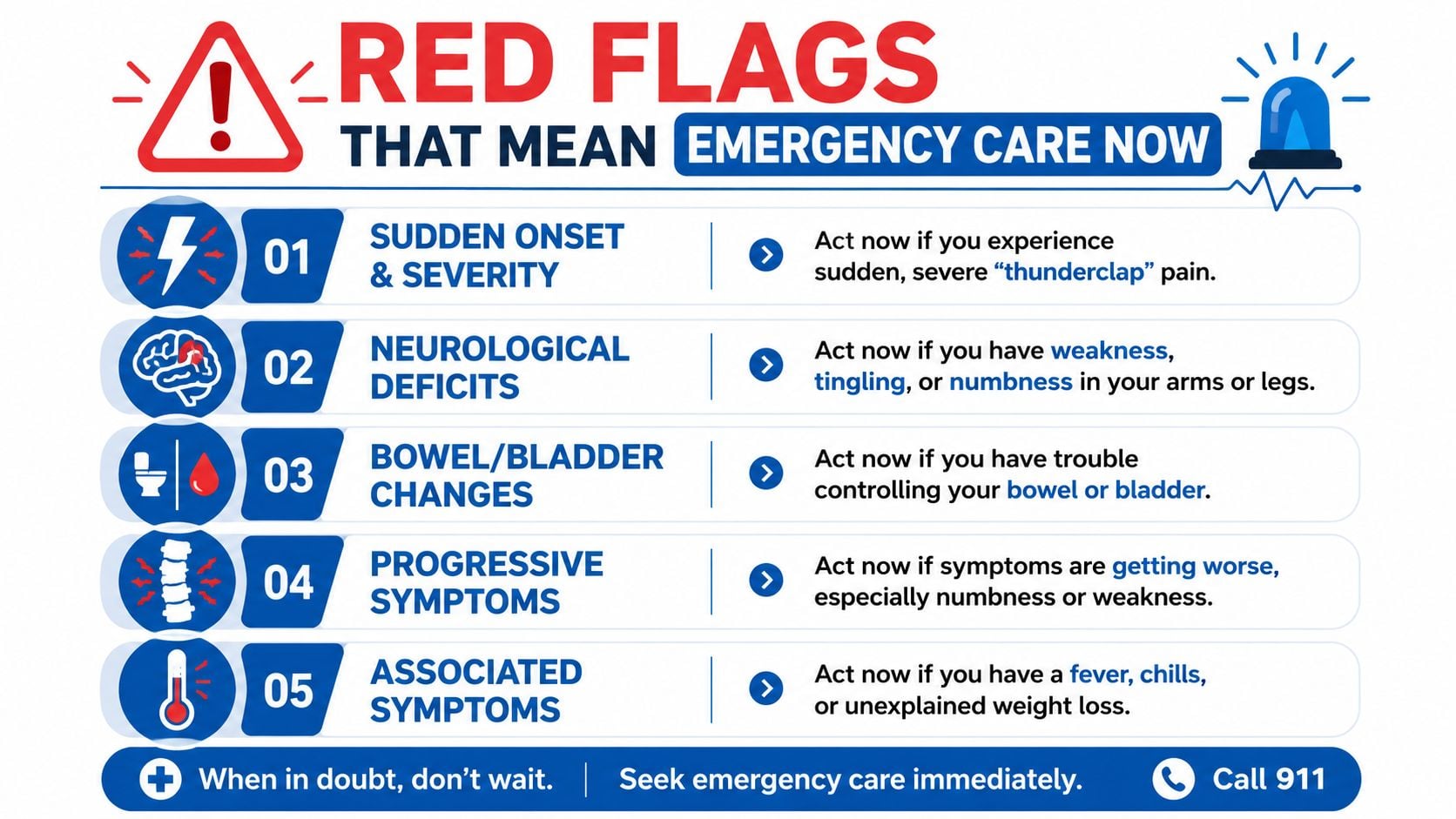
Some combinations of symptoms should be treated as urgent before anyone tries to sort out the exact cause. Sudden severe pain, especially when it appears with one-sided weakness, chest symptoms, color change, or loss of bladder control, needs emergency evaluation. The safest rule is to act fast when pain is paired with a change in function or circulation.
Symptoms that should not wait
- Sudden, severe onset: A thunderclap-like onset of pain, especially if it is unlike prior aches, can signal an acute vascular or neurologic event.
- Weakness or numbness on one side: New arm or leg weakness, facial drooping, or slurred speech needs immediate attention because a stroke or other central neurologic event may be involved.
- Chest pressure or shortness of breath: Pain in the arm with chest symptoms raises concern for acute coronary ischemia, which can refer pain into the limb.
- Cold, pale, or discolored limb: This pattern can fit acute arterial occlusion, where circulation may be compromised.
- Swelling with calf tenderness: This combination can suggest DVT, which deserves urgent evaluation because of clot risk.
- Loss of bowel or bladder control: This can point to cauda equina syndrome or another serious spinal compression problem.
Why one-sided pain can be misleading
The body does not always label emergencies in a neat way. A person may focus on the arm and leg pain while overlooking the subtle speech change, chest tightness, or progressive numbness. That's one reason sudden right-sided limb pain should be viewed in context, not in isolation.
Sudden pain plus weakness, swelling, color change, or chest symptoms is not a “wait and see” situation.
Merck's professional guidance on limb pain emphasizes that the pattern can reflect radiculopathy, acute coronary ischemia, or acute arterial occlusion, which is why the urgent pattern matters more than the location alone (Merck Manuals on limb pain). When the pattern fits, emergency care is the right next step.
How Doctors Diagnose the Real Source
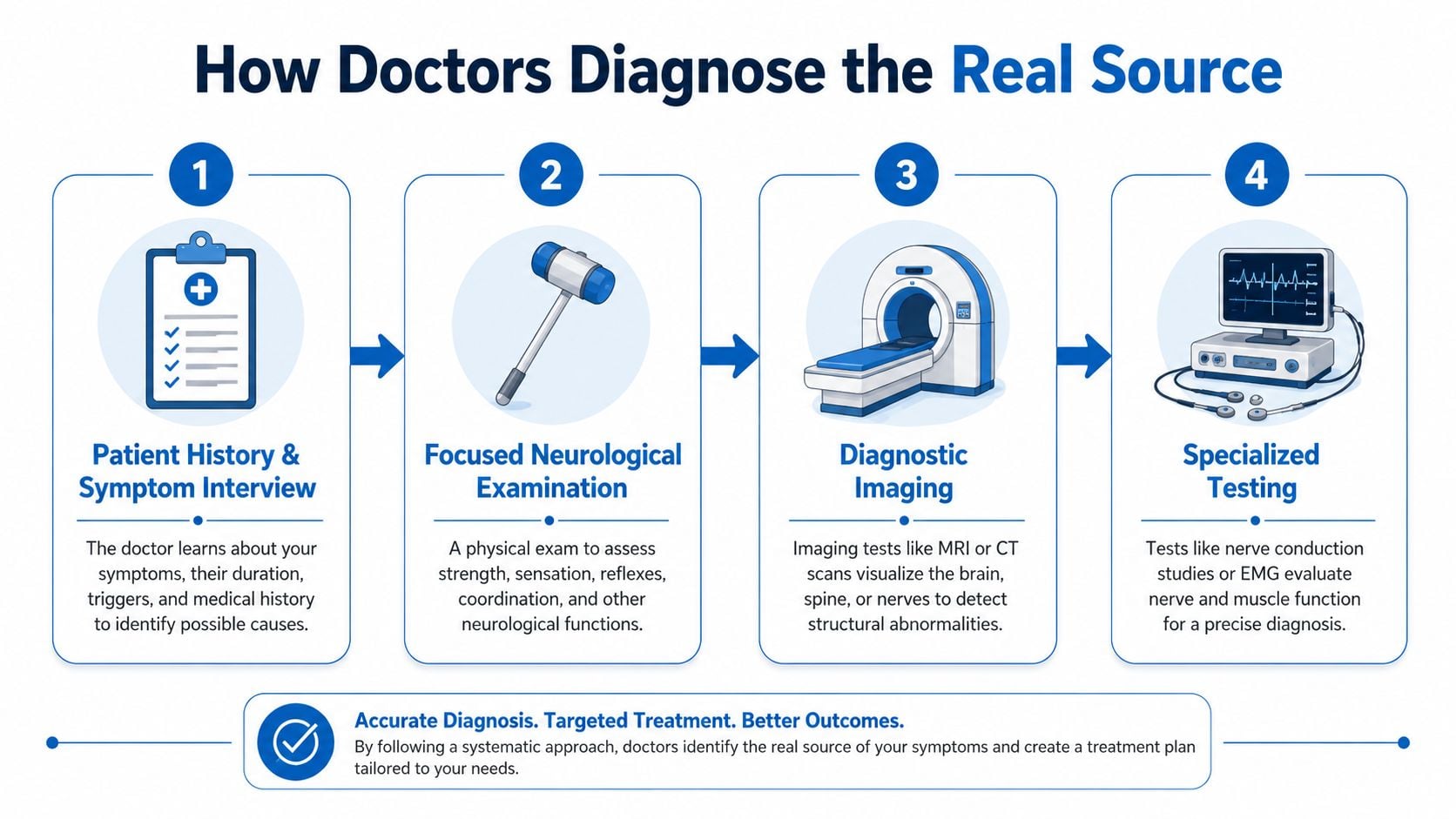
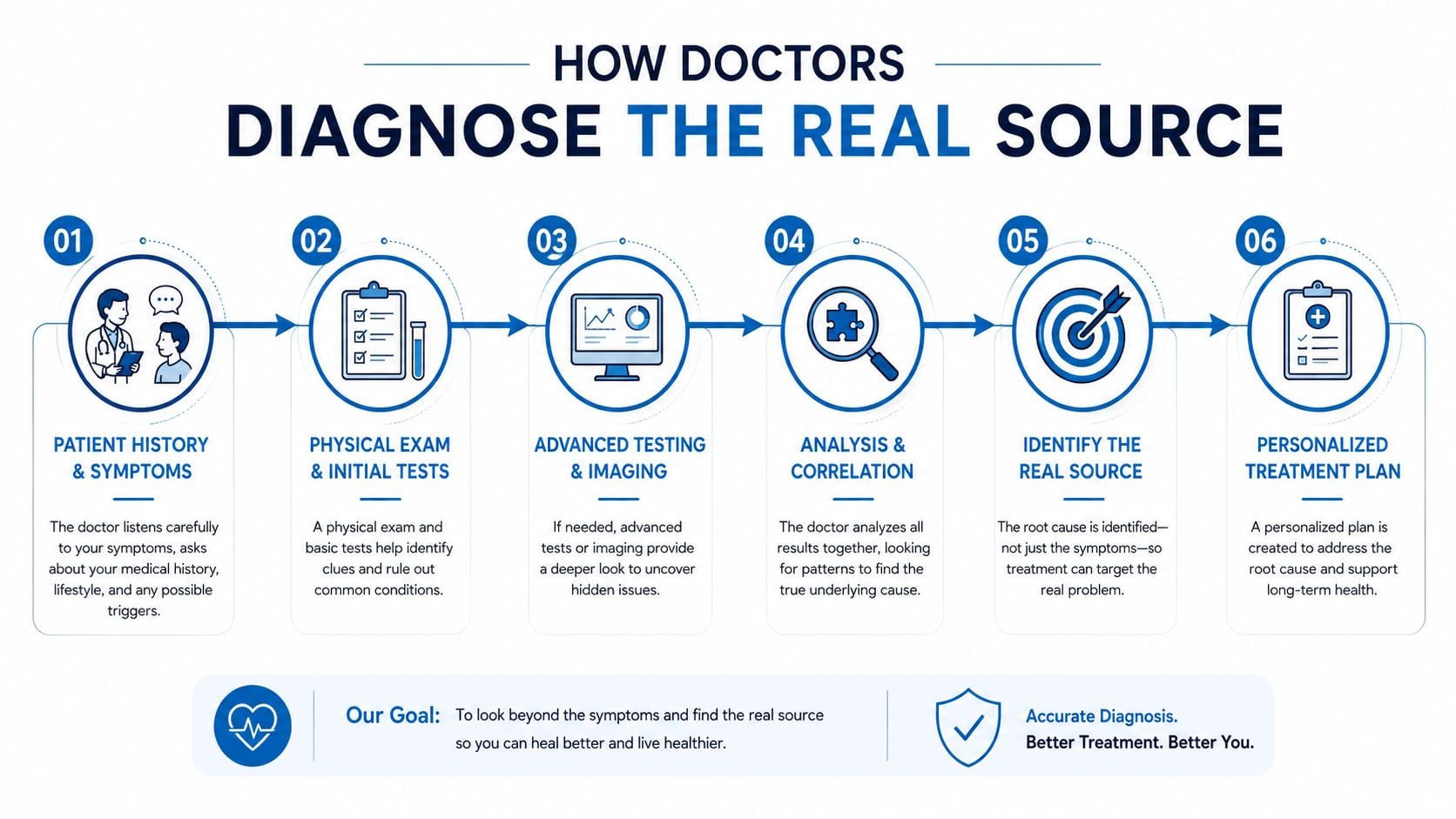
A good diagnosis starts with a careful timeline, not a guess. The first questions are usually about when the pain began, where it travels, what worsens it, and whether it comes with numbness, weakness, swelling, color changes, or chest symptoms. That history often points the clinician toward the right branch of the tree before any testing is ordered.
What the exam is really looking for
A focused physical exam checks strength, sensation, reflexes, gait, pulses, swelling, temperature differences, and range of motion. If the clinician suspects a spinal source, the exam looks for signs that the cervical or lumbar nerve root is irritated. If the clinician suspects blood flow trouble, the exam pays close attention to circulation and limb appearance.
Imaging is chosen based on the pattern. X-rays can help with bone alignment and degenerative changes, while MRI is often used when the concern is nerve compression, disc disease, or spinal stenosis. CT can be useful in certain situations, especially when bone detail matters or MRI is not the right test.
Special tests when the picture is still unclear
Electromyography and nerve conduction studies help localize nerve injury and distinguish between a nerve-root problem and a more peripheral nerve issue. Vascular studies may be added when blood flow is part of the concern. Blood work can also help when inflammation, infection, or clotting risk enters the differential.
Practical advice: bring prior imaging, a list of medications, and a written timeline of symptoms. Clear records make the first visit more productive.
A patient who needs help translating medical terms can also benefit from medical terminology translation support, especially when prior records, imaging notes, or specialist reports are part of the story. That kind of clarity can save time when the symptoms have already been difficult to interpret.
Treatment Options From Conservative to Interventional
Treatment depends on the source. A pain syndrome driven by posture, nerve irritation, or mild inflammation is handled differently from one caused by severe stenosis, clot, or progressive neurologic loss. The right plan usually starts with the least invasive option that matches the diagnosis, then escalates only when the clinical picture calls for it.
Conservative care first when it fits the diagnosis
Activity modification, guided exercise, and physical therapy are common first steps when the pain is stable and there are no emergency signs. Targeted medications may be used to calm inflammation or nerve irritation, depending on the cause. The goal is not to “power through” the pain, it's to reduce the trigger while preserving movement and function.
Interventional procedures when symptoms persist
When conservative care isn't enough, image-guided procedures can target the source more precisely. Epidural steroid injections can reduce nerve-root inflammation in selected spine cases, and nerve blocks can help clarify where pain is coming from. Trigger point injections may help when myofascial pain is part of the problem, and radiofrequency ablation can be considered in carefully selected cases where a specific pain pathway has been identified.
For patients looking into this category, an overview of epidural steroid injections can help explain how this treatment fits into a broader plan rather than standing alone as the answer to every pain complaint.
When surgery or advanced neuromodulation enters the discussion
If imaging and exam findings show a clear structural problem, surgery may be the right next step. Decompression or fusion can be appropriate when there is persistent radicular pain, progressive neurologic deficit, or meaningful functional loss. For chronic neuropathic pain that has not responded to other care, spinal cord stimulation may be part of the discussion, especially when the pain pattern is persistent and nerve-based.
How the options usually stack up
- Conservative care: best when symptoms are stable and there is no red-flag pattern.
- Image-guided injections or blocks: useful when the source is localized and conservative care has fallen short.
- Advanced procedures or surgery: considered when structural compression, disability, or progression changes the risk-benefit balance.
Why a Multi-Specialty Pain Practice Changes the Outcome
Right arm and leg pain is harder to solve when each possible cause gets sent to a different office without a shared plan. A coordinated practice can move from exam to imaging review to treatment planning without forcing the patient to repeat the same story over and over. That matters because the diagnosis often sits at the intersection of pain management, spine care, orthopedics, and vascular evaluation.
A multi-specialty team can compare nerve-related, musculoskeletal, and structural causes in one setting. That makes it easier to decide whether the next step should be therapy, a procedure, surgical review, or vascular workup. It also helps the care team match treatment to the patient's actual function, not just the scan report.
The practical side matters too. Patients often need scheduling that fits work, family, and transportation limits. Access to seven-day availability, multiple locations, help with insurance questions, and support for workers' compensation or motor vehicle cases can reduce the delay between symptom onset and diagnosis.
Interventional Pain Management is one example of a multi-specialty practice model, with board-certified physicians across pain management, anesthesiology, orthopedics, and spine surgery, plus coordinated care for back, neck, joint, and vein conditions. In a complaint like pain in right arm and leg, that kind of structure is useful because the right answer is rarely a single test or a single specialty.
Coordinated care shortens the distance between “what is this?” and “what should be done next?”
Your Next Steps in New Jersey and Staten Island
Before the appointment, write down when the pain started, whether it is constant or comes and goes, and what makes it worse or better. Add details about numbness, tingling, weakness, swelling, color changes, walking tolerance, and any chest symptoms. Bring prior imaging, medication lists, and any notes from recent urgent care or specialist visits.
For patients in Staten Island, the local office information is available through the Staten Island location page, which can help with directions and scheduling details. If insurance is a concern, ask whether the visit is in-network or out-of-network, and request any available fee estimate before the appointment. That keeps the conversation focused on care instead of surprises.
At the visit, ask three direct questions. First, what source best fits the pattern, spine, nerve, vessel, or muscle. Second, what test or exam finding would change the plan. Third, if a procedure is recommended, what outcome should be expected and how recovery is usually handled.
If the pain is sudden, severe, one-sided, or paired with weakness, chest symptoms, swelling, color change, or loss of bladder control, emergency care comes first. If it's stable but unexplained, a pain and spine evaluation is the next step.
Interventional Pain Management helps patients work through complex pain patterns with coordinated evaluation and treatment across pain management, orthopedics, and spine care. For pain in the right arm and leg, that kind of multidisciplinary review can help identify whether the source is spinal, vascular, neurologic, or musculoskeletal, then match treatment to the cause. Visit Interventional Pain Management to learn more and request an evaluation.