
The MRI report lands on the desk, and the words look alarming, disc degeneration, disc bulge, disc narrowing. That can make it feel as if the scan has already explained every ache in the back. It hasn't, and that distinction matters, because pain management for degenerative disc disease works best when treatment follows the pain pattern, not the picture alone.
Many adults see disc wear on imaging long before they feel anything at all. StatPearls notes that asymptomatic adults can show MRI disc abnormalities in wide ranges, including reduced signal intensity, bulges, protrusions, extrusions, disc narrowing, and annular tears, and it also notes that almost everyone has some disc degeneration after age 40, while only about 5% of adults develop pain attributable to degenerative disk disease (StatPearls via NCBI Bookshelf). That mismatch is why the right question is not “What does the MRI show?” but “What is causing the pain, and how is it changing daily life?”
Table of Contents
- Understanding Degenerative Disc Disease and Why Imaging Is Not the Whole Story
- How Clinicians Diagnose the True Source of Your Pain
- Conservative Therapies That Form the Foundation of Treatment
- Interventional Pain Procedures and When Each One Makes Sense
- Surgical Options and the Indications That Warrant Escalation
- When to Seek Specialty Care and How to Access Treatment
- Building Your Personalized Pain Management Plan
Understanding Degenerative Disc Disease and Why Imaging Is Not the Whole Story
A person can walk into a clinic with a fresh MRI and leave more confused than before. The scan may show disc degeneration, but the actual pain may be coming from a nearby nerve, a stiff joint, deconditioned muscles, or a combination of problems. Disc wear is common, especially with age, and wear alone does not prove it is the source of pain.
StatPearls notes that MRI abnormalities are often present in adults without symptoms. In asymptomatic adults, disc findings at any spinal level were reported in wide ranges, including 20% to 83% for reduced signal intensity, 10% to 81% for disc bulges, 3% to 63% for protrusions, 0% to 24% for extrusions, 3% to 56% for disc narrowing, and 6% to 56% for annular tears. That is why a scan can look dramatic while the person feels little or no pain, and why another person can hurt a lot even when the images seem less impressive. The picture does not tell the whole story.
Practical rule: treat the person, not the picture. Imaging supports the diagnosis, but it does not replace symptoms, function, and neurologic findings.
The gray-hair analogy that patients find understandable
Disc degeneration is a bit like gray hair. It is a real change, it can appear early, and it does not automatically mean something is wrong. The difference is that back pain can become disabling, so the goal is not to dismiss the MRI, but to place it in context.
A helpful way to frame it is to compare the scan with the symptom pattern. A person may have aging changes on imaging and still need care only if those findings match the pain, limit walking, sitting, lifting, or sleep, or involve the nerves. For a clearer overview of Understanding Back Pain Causes, it helps to look at how pain patterns and daily function point to the likely source. When the findings do not match the symptoms, the image is a clue, not a verdict.
A scan can say the structure is aging. It cannot tell whether a disc is the source of a person's flare-up that day. Pain management decisions are built around severity, function, and neurologic findings, not imaging alone.
How Clinicians Diagnose the True Source of Your Pain
The diagnosis usually starts with a story, not a machine. A detailed history helps separate a deep aching back pain from nerve-root irritation, and it often gives better clues than the MRI report does. Clinicians pay close attention to where the pain starts, where it travels, what makes it worse, and what eases it.
A person with axial discogenic pain often describes pain that stays in the low back and worsens with loading, bending, or sitting. When the pain travels into the buttock, thigh, calf, or foot, or when numbness, tingling, or weakness appears, the concern shifts toward radicular pain from nerve irritation. That difference matters because the treatment path changes with the pain generator.
The physical examination adds another layer. Range of motion, posture, reflexes, strength, and sensory changes help the clinician decide whether the pain is mechanical, inflammatory, or neurologic. A focused exam can also show when the back pain is being amplified by guarding and altered movement patterns instead of a single structural problem.
What diagnostic testing is trying to prove
Targeted testing is most useful when it answers a specific question. Advanced imaging can help when symptoms suggest nerve compression, instability, or another structural problem that might need a procedure. It can also confuse the picture if it is ordered without a clear clinical question, because degenerative findings are so common in people without pain.
A good spine evaluation lines up three things, the symptom pattern, the exam findings, and the imaging. When those three point in the same direction, treatment decisions get much clearer.
Some clinicians also use diagnostic injections to confirm the pain generator when the picture isn't obvious. That approach is not about chasing every MRI abnormality. It's about checking whether numbing or calming a specific structure changes the pain in a predictable way. When the response fits the anatomy, it helps narrow the next step.
Patients usually do best when they bring the full timeline, when the pain started, what jobs or activities make it worse, what prior treatments helped, and whether there are episodes of weakness or bladder or bowel symptoms. Those details often matter more than the exact wording of the MRI impression. They shape whether the case is treated as discogenic pain, radicular pain, stenosis, instability, or a mixed picture.
Conservative Therapies That Form the Foundation of Treatment
The first treatment layer is usually the least dramatic, and often the most important. For degenerative disc disease related chronic low back pain, the evidence-based starting point is a multimodal conservative program, not an early procedure. The core pieces are patient education, exercise therapy, and cognitive behavioral therapy, which clinical references describe as the cornerstones of chronic low back pain care when used in a multidisciplinary rehabilitation model (Management of Degenerative Disk Disease and Chronic Low Back Pain).
A person often expects rest to be the answer, but prolonged rest usually works against recovery. Degenerated discs are sensitive to load, yet the surrounding muscles and movement patterns can also become deconditioned. Graded activity helps rebuild trunk support, which can reduce mechanical stress even if the disc itself still looks worn on imaging.
What a real conservative plan looks like
A structured physical-therapy course should usually last at least 6 weeks before advanced interventions are considered, and it should focus on core strengthening, stretching, and activity modification (Management of Degenerative Disk Disease and Chronic Low Back Pain). That time frame matters because muscles, movement habits, and tolerance for activity don't change overnight. The point is not to “wait and hope,” it's to give the body a fair chance to respond to the right loading strategy.
Medications are usually adjuncts, not the whole plan. NSAIDs are commonly used for symptom control, while neuropathic agents fit better when the pain has a radicular, nerve-related quality rather than purely axial disc pain (Management of Degenerative Disk Disease and Chronic Low Back Pain). That distinction helps avoid giving nerve-focused medication to someone whose main problem is mechanical back pain.
For readers looking for a broad lifestyle resource alongside spine care, a practical overview such as find the right bone and joint supplement can be useful for general education, but it shouldn't replace a spine-specific treatment plan.
Clinical takeaway: if function is improving, the plan is usually working, even if the MRI still looks unchanged.
The most encouraging part of conservative care is that progress is often measurable in daily life before it shows up anywhere else. Sitting longer without flare-ups, walking farther, bending with less guarding, and sleeping through the night are all meaningful gains. Those changes tell the care team that the spine is tolerating load better, which is the goal.
Interventional Pain Procedures and When Each One Makes Sense
Interventions make the most sense when the pain generator has become clearer and conservative care hasn't done enough. They're not interchangeable, because each one targets a different pain pattern. Matching the procedure to the symptom type is what keeps treatment logical.
Epidural steroid injections are most useful for inflammatory radicular pain, not isolated axial pain. Clinical reviews note they can be considered after about 6 weeks of conservative therapy, because the steroid is placed near the affected nerve root to reduce inflammation and nerve sensitization rather than reverse disc degeneration. That means the goal is calming the irritated nerve, not “fixing” the disc itself.
The procedure list gets broader when the pain is discogenic and not primarily nerve-root driven. Evidence reviews describe percutaneous disc decompression or nucleoplasty in selected cases, and intradiscal electrothermal therapy in younger, active patients with early single-level disease and preserved disc height. Those options are chosen carefully because the structural features of the disc matter.
Interventional procedures by pain type
| Procedure | Best For | Typical Timing |
|---|---|---|
| Epidural steroid injection | Radicular pain with nerve-root irritation | After a fair trial of conservative care, often about 6 weeks |
| Nerve block | Localizing or calming a suspected pain pathway | When the pain generator needs confirmation or temporary relief |
| Trigger point injection | Myofascial pain and muscle guarding around the spine | When muscle spasm is adding a separate pain layer |
| Spinal cord stimulation | Chronic neuropathic pain, especially after prior surgery | After persistent pain that has not responded to simpler treatment |
| Disc-directed procedures | Selected discogenic pain cases | When imaging, symptoms, and exam point to a specific disc source |
For a patient who wants a procedural pathway that begins with image-guided spine care, epidural steroid injections are one commonly discussed option when nerve inflammation is the dominant issue. They fit best when leg symptoms, not just back pain, are driving the complaint.
Spinal cord stimulation sits later in the ladder. It modulates pain transmission in the dorsal columns and is usually used for persistent neuropathic pain or post-surgical pain syndromes rather than straightforward mechanical back pain. That makes it a tool for the hard cases, not the first move for someone with a simple flare.
Surgical Options and the Indications That Warrant Escalation
A scan can look dramatic while pain comes from a different place. That is why surgery is considered only after the clinical picture shows that a structural problem is driving disability, or when conservative and interventional care have not brought enough relief. Degenerative disc disease on MRI alone does not decide the next step.
Clinical references describe surgery as generally reserved for neurologic deficit, instability such as spondylolisthesis, stenosis requiring decompression, or persistent functional limitation after conservative care fails (Management of Degenerative Disk Disease and Chronic Low Back Pain). That sets a practical threshold. When walking, sitting, working, or sleeping remain seriously limited despite real non-surgical treatment, escalation becomes reasonable.
The surgical menu can include minimally invasive techniques, decompression, endoscopic spine procedures, and fusion operations such as ALIF. The right choice depends on whether the main problem is compression, instability, or painful motion at a damaged segment. A decompression helps when nerves are crowded. A fusion addresses instability or painful segment motion. Endoscopic or minimally invasive approaches may reduce tissue disruption in selected cases, but they still need a well-defined indication.
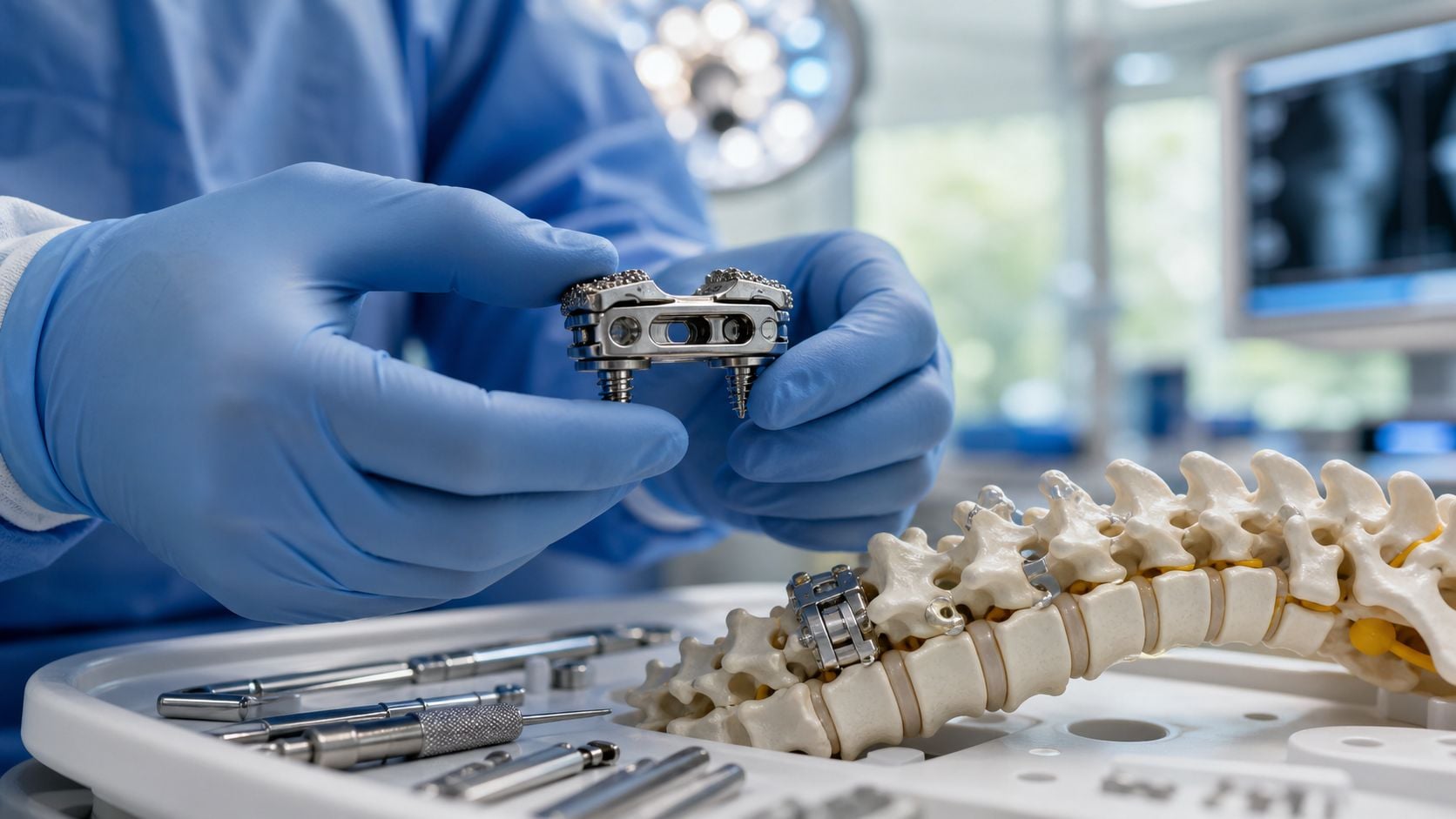
Artificial disc replacement is another option in selected patients, especially when the painful level is isolated and motion preservation is part of the treatment goal. A dedicated overview of artificial disc replacement surgery can help explain how that procedure differs from fusion and why it is not appropriate for every case.
What happens when surgery doesn't fully solve pain
Not every operation ends with complete pain relief. Failed back surgery syndrome can happen when pain persists after a prior procedure, especially if neuropathic pain remains the dominant problem. In those cases, spinal cord stimulation may still have a role, because it targets pain transmission rather than the structural source alone.
Surgery is best viewed as a targeted fix for a targeted problem. When the pain source is mixed, the plan often needs more than one tool.
Readers often fear that choosing surgery means admitting defeat. It doesn't. It means the care team has identified a problem that conservative care can't reasonably solve on its own. The strongest plans keep all options open, including rehabilitation after surgery and additional pain control if pain persists.
When to Seek Specialty Care and How to Access Treatment
Specialty care makes sense when pain starts limiting life instead of just irritating it. Progressive numbness, weakness, worsening leg symptoms, or pain that keeps interfering with walking, work, sleep, or household tasks deserves a more detailed evaluation. Complex cases also need a specialist when more than one pain generator may be involved.
A multidisciplinary pain practice is most useful when it can evaluate the spine from more than one angle. Board-certified physicians across pain management, anesthesiology, orthopedics, and spine surgery can sort out which symptoms belong to which structure and decide whether the next step should be rehab, an injection, or a surgical consult. That approach is especially helpful when imaging and symptoms don't line up neatly.
For patients in New Jersey and Staten Island, access matters as much as diagnosis. Interventional Pain Management offers multi-specialty care with board-certified physicians, several locations, seven-days-a-week availability, and support for workers' compensation and motor vehicle accident cases, along with transportation assistance and insurance navigation. Those logistics can remove delays that otherwise keep people stuck in pain.
Good specialty care should answer three questions quickly, what is the pain source, what has already been tried, and what is the least invasive next step that still makes sense?
The cleanest path is to bring prior imaging, medication lists, therapy notes, and a symptom timeline to the first visit. That helps the specialist avoid repeating old work and focus on the decision point. If the pain has already outgrown primary care management, a coordinated spine evaluation can shorten the path to meaningful treatment.
Building Your Personalized Pain Management Plan
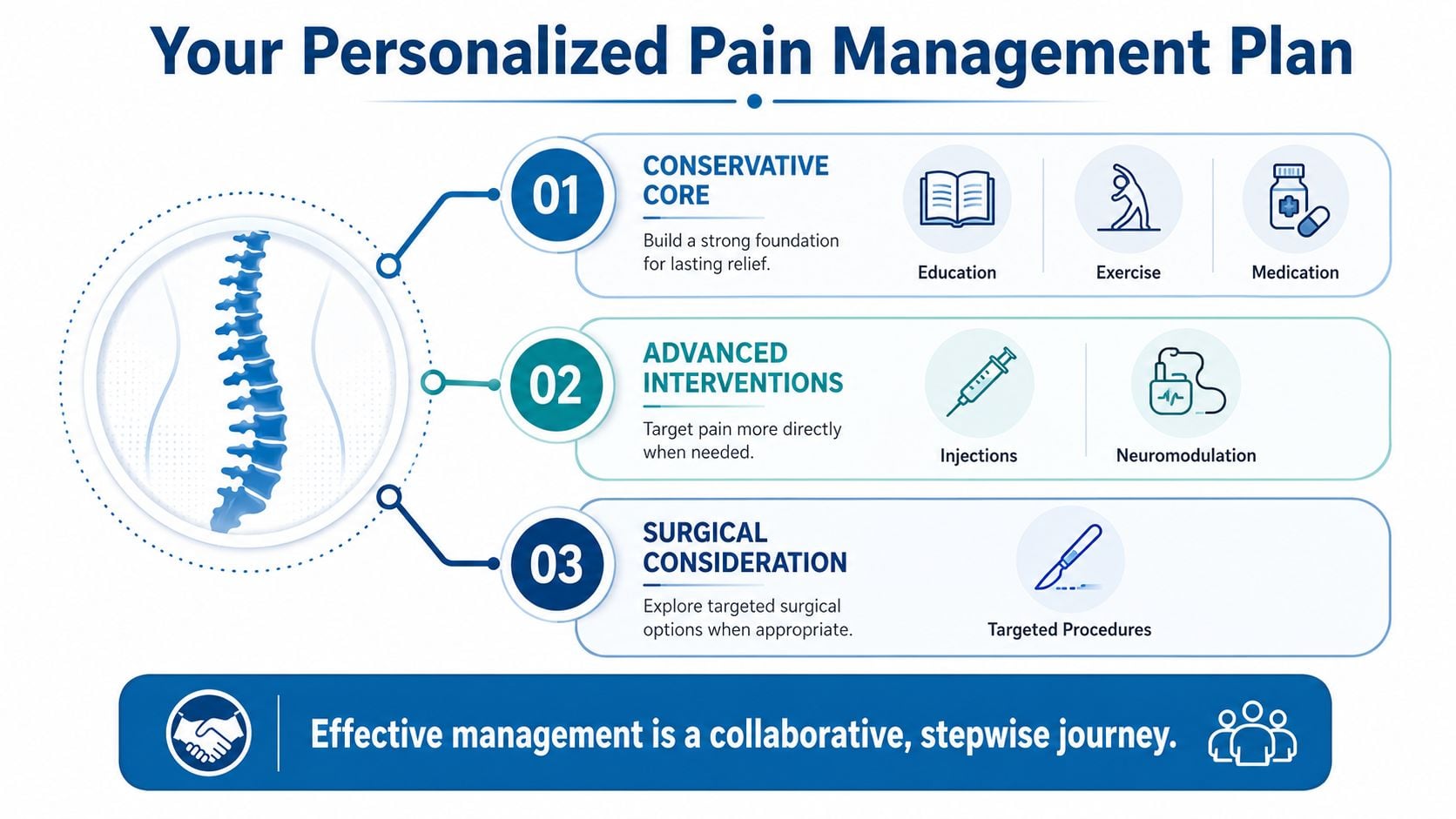
The most effective plan is stepped, not random. It starts with conservative care, moves to targeted interventions when the pain pattern justifies them, and reserves surgery for clearly defined indications. That sequence protects patients from unnecessary procedures while still giving real pain the attention it deserves.
A useful consultation checklist can keep the visit focused:
- What pain pattern is most likely, axial, radicular, or mixed?
- Which findings on exam match the MRI, and which ones don't?
- What conservative treatment has been tried long enough to count as a real trial?
- If an injection is being considered, what pain generator is it meant to target?
- If surgery is discussed, what specific indication makes it appropriate?
The best plans also reflect the person's real life. A warehouse worker, a parent lifting small children, and a desk worker with long sitting tolerance all need different goals, even if the MRI looks similar. That's why individualized planning matters more than a one-size-fits-all protocol.
Pain management for degenerative disc disease works best when the objective is better function, not just a smaller number on a pain scale. Less pain matters, but being able to sit through a commute, stand at work, or sleep without repeated flare-ups matters more. A plan built around those outcomes is far more likely to hold up over time.
If degenerative disc disease is disrupting daily life, Interventional Pain Management can help match the pain pattern to the right next step, whether that means conservative care, image-guided procedures, or surgical evaluation. Visit Interventional Pain Management to learn how a multidisciplinary spine team approaches diagnosis, treatment, and follow-through for back pain that hasn't settled on its own.