
A sneeze, a lift, or even getting out of bed can be enough to turn a normal morning into a sharp, shooting pain that runs from the back into the leg. That pattern catches people off guard because it doesn't feel like a simple sore muscle. It feels like something is pinching, irritating, or lighting up the nerve itself, and that's often the moment a cortisone shot for herniated disc starts showing up in the search history.
The good news is that this problem usually has a stepwise path, not a panic button. A herniated disc can settle down with time, movement, and the right kind of treatment, but when leg pain dominates, the nerve is often the true source of misery. A cortisone shot sits inside that larger recovery plan as a way to calm the irritated nerve long enough for healing, rehab, or a more definite treatment plan to work.
Table of Contents
- When a Herniated Disc Flares Up and You Start Searching for Answers
- What a Cortisone Shot Does Inside Your Spine
- Choosing the Right Epidural Approach for Your Symptoms
- What the Evidence Says About Pain Relief
- What to Expect Before, During, and After the Injection
- Real Risks and When a Cortisone Shot Should Be Avoided
- How Cortisone Shots Fit Into the Broader Treatment Ladder
- Your Next Steps in New Jersey and Staten Island
When a Herniated Disc Flares Up and You Start Searching for Answers
A herniated disc often announces itself in a way that feels unfairly ordinary. A person bends, sneezes, twists, or lifts something light, and then a deep ache becomes a sharp line of pain that tracks into the buttock, thigh, or calf. That leg-dominant pattern matters because it usually points to nerve irritation, not just back strain.
What is happening mechanically
Between the spinal bones sit discs that act like cushions. When the inner material pushes through the outer layer, the disc can irritate a nearby nerve root, especially in the lower back. That's why pain can feel electric, burning, or shooting, and why coughing or sitting often makes it worse.
A simple muscle strain usually stays local. A disc problem often spreads, because the nerve carries the signal farther than the back itself.
Practical rule: when pain travels below the knee, people should think beyond “pulled muscle” and ask whether a nerve root is involved.
Conservative care usually comes first because many disc flares improve without a procedure. Resting too much can backfire, but guided movement, activity changes, and symptom control often help the body cool things down. The difference between a herniated disc and a bulging disc also matters, because the label changes the treatment discussion only when it matches the symptoms and exam.
A cortisone shot enters the picture when inflammation around the nerve keeps blocking recovery. It doesn't mean surgery is inevitable. It means the problem may need a more targeted way to calm the nerve so walking, sitting, sleep, and therapy become possible again.
What a Cortisone Shot Does Inside Your Spine
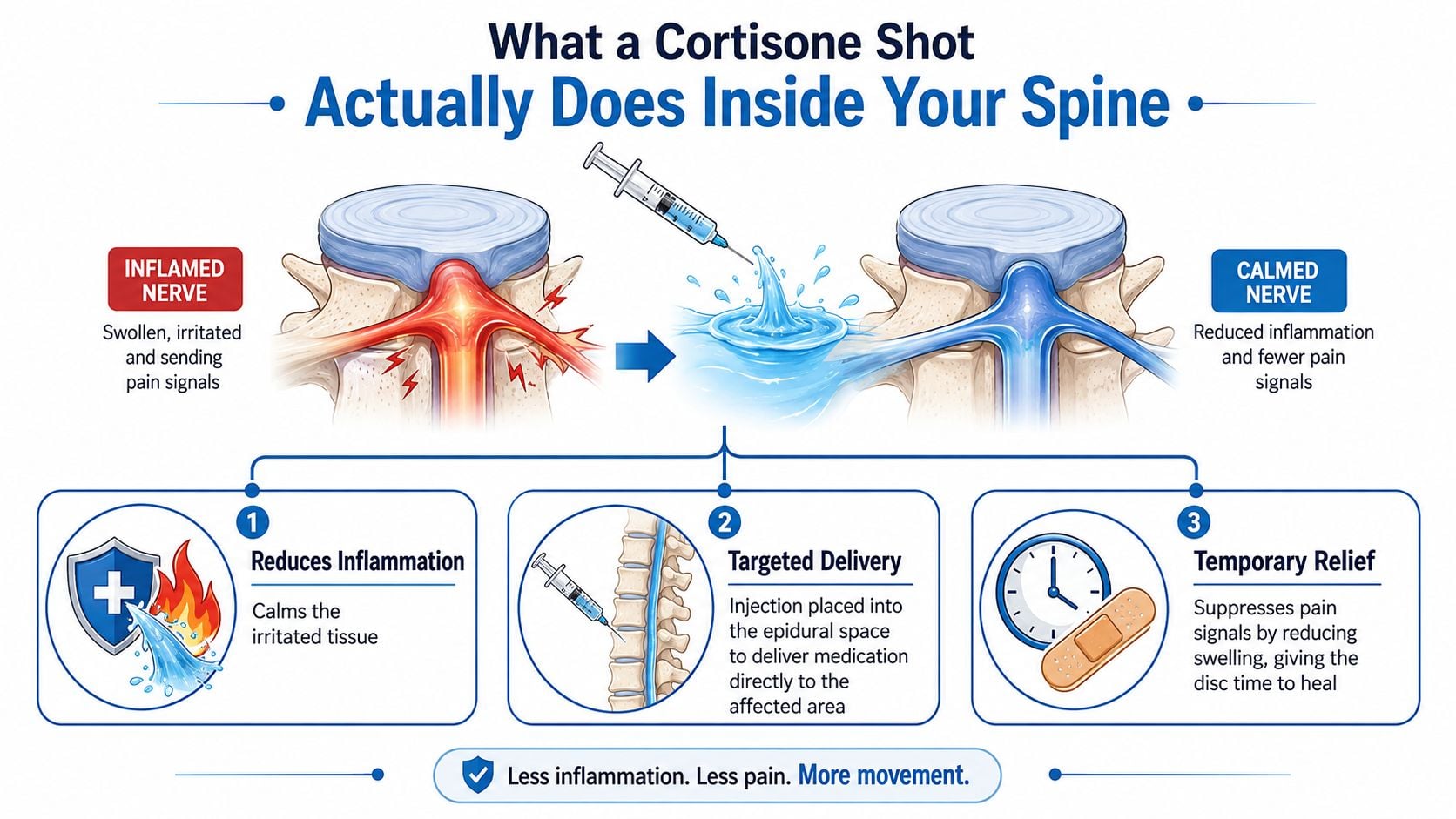
A cortisone shot is really an epidural steroid injection, which means the medicine goes into the epidural space, the area around the irritated nerve, not into the disc itself. That distinction matters because the disc stays herniated, but the nerve-root swelling and chemical irritation can calm down enough for pain to ease.
Why the medicine goes where it goes
The nerve is hot and irritated, not broken. The steroid works like a calming bath around that nerve, reducing inflammation where the pressure and irritation are happening. The goal is not to rebuild the disc or push the material back into place. The goal is to reduce the inflammatory signal that keeps the leg pain going.
Image guidance is used for that reason. When the injection is placed accurately, the medication can reach the area most likely to be producing symptoms. In disc-related sciatica, transforaminal delivery is often chosen because it targets the nerve root more directly in the intervertebral foramen.
What the medication is trying to do
Published reports commonly use methylprednisolone acetate, often around 80 mg, with doses ranging from 40 to 120 mg per injection. The exact drug and dose depend on the approach, the anatomy, and the physician's judgment, as noted in the PMC review. The point is symptom control, not structural repair.
The best way to think about this treatment is as a pressure valve. It can quiet the nerve long enough for healing, exercise, and daily function to get back on track.
That pressure valve can matter a lot when pain is too strong for physical therapy to begin. It can also matter when the clinical goal is to delay or avoid surgery while keeping the patient moving and functioning. Learn more about epidural steroid injections.
Choosing the Right Epidural Approach for Your Symptoms
The phrase “cortisone shot” sounds simple, but the route into the spine changes the result. Some injections cover a broader area, while others are built to reach one irritated nerve root with more precision. That's why the question is often not whether to get an injection, but which epidural approach fits the symptoms.
Interlaminar, transforaminal, and caudal
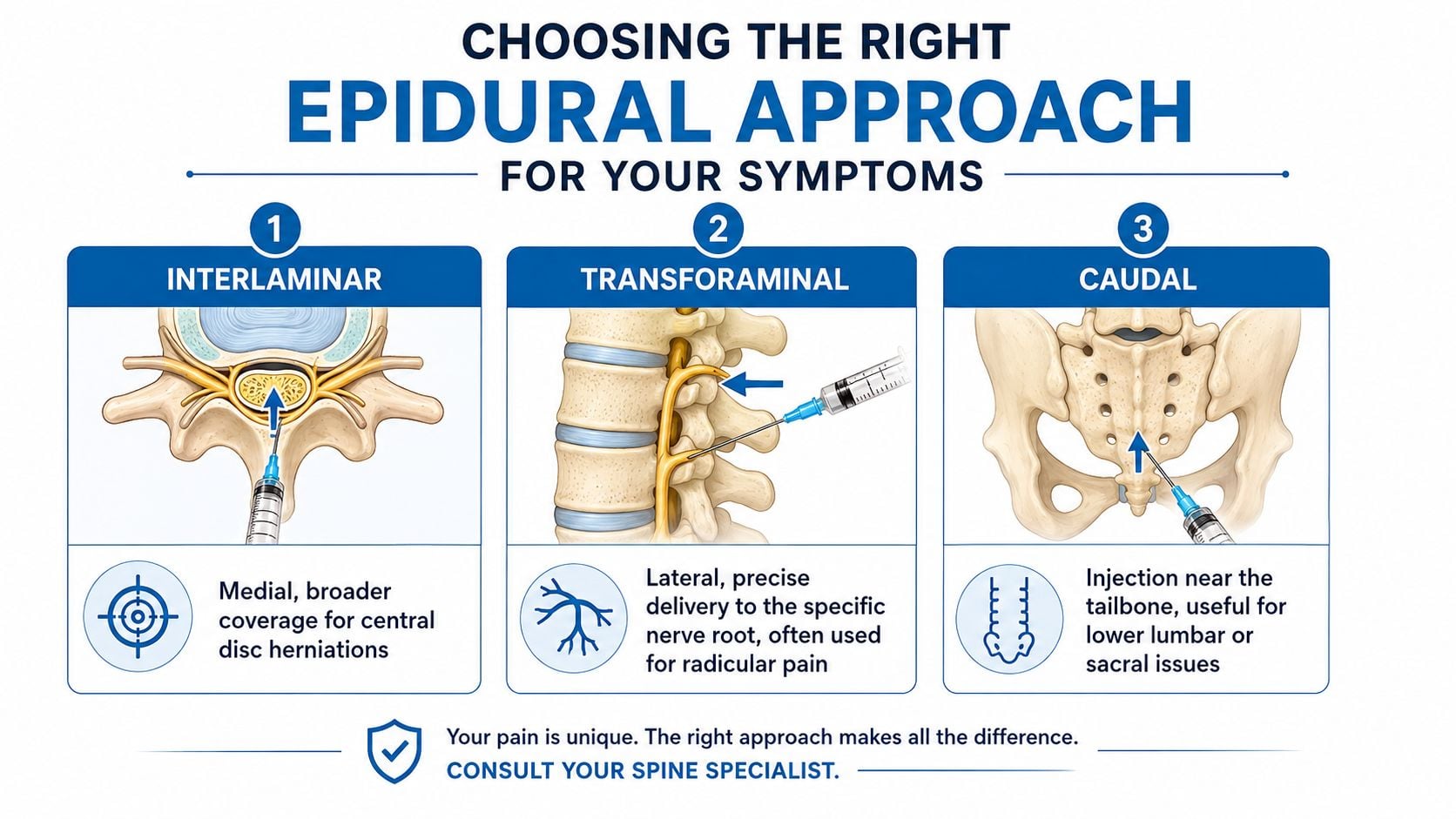
Interlaminar injections go more toward the middle of the spine and can spread medication more broadly. That can make sense when symptoms are less clearly tied to one side or one nerve root.
Transforaminal injections are more targeted. They place medication near the specific nerve root exiting through the foramen, which is why they're commonly used when a herniated disc is causing one-sided radicular pain. For that reason, the transforaminal route is often the most intuitive match for a single compressed nerve.
Caudal injections enter from near the tailbone and move upward. They're useful in some lower lumbar or sacral situations, especially when anatomy or prior surgery makes other approaches less practical.
A 2025 meta-analysis of 41 studies reported clinically meaningful pain and disability reductions, with transforaminal epidural steroid injection showing the largest overall effect size, although the studies varied a lot in design and patient selection (PMC meta-analysis). That doesn't make one route perfect for everyone. It does support a more careful conversation about matching the injection to the pain pattern.
For patients searching the web, the better question is often this, not “Should I get a shot?”:
Which injection type matches this nerve, at this stage of symptoms, with this realistic goal?
The overview of epidural steroid injections helps frame that decision, especially when the pain is clearly radiating and the exam points to one irritated root.
What the Evidence Says About Pain Relief
A herniated disc can leave someone hoping for a quick fix, but the evidence points to a narrower answer. Epidural steroid injections are mainly supported as a way to reduce pain for a limited period, especially when nerve irritation is making it hard to sleep, walk, or start physical therapy. A Cochrane review of 12 trials with 1,367 patients found epidural steroid injections were probably slightly more effective than placebo for disability at short-term follow-up, with a mean difference of −4.18 on a 0 to 100 scale (Cochrane review).
Why short-term relief matters
That size of improvement is modest, not dramatic. Still, a modest change can matter if pain is keeping a person from moving normally or getting through the day. The same review reported no minor or major adverse events at short-term follow-up in the injection or placebo groups, which is reassuring within the time window studied. The tradeoff is that this treatment is not a durable cure, because the benefit often fades after the early phase.
A 2024 meta-analysis found epidural steroid injections improved pain within 3 months and 6 months, but longer-term pain relief was limited, and function did not significantly improve on sciatic nerve function measures. Another review noted that more than 50% of patients may get pain relief lasting longer than 1 month, and about half may still benefit at 1 year, though that kind of summary should be read as a broad clinical estimate rather than a guarantee for any one person (PMC review).
A comparative report cited in the literature found 70% reached 50% pain relief and 50% functional restoration at 6 months after lumbar transforaminal injection. That is encouraging, but it also shows why expectations need to stay grounded. Some people improve a lot, some improve a little, and some do not improve enough to avoid the next step.
The simplest takeaway is this. A cortisone shot can buy time and reduce suffering, but it is usually a bridge, not an ending.
What to Expect Before, During, and After the Injection
The day of the injection usually feels less dramatic than people fear. Most of the stress comes from not knowing the sequence. Once the steps are clear, the procedure becomes easier to picture and easier to tolerate.

Before the appointment
The team usually reviews medications, especially blood thinners, diabetes drugs, and anything that changes bleeding or blood sugar. Transport needs matter too, because a sedating medication or just the day's discomfort can make driving a bad idea. Fasting instructions may also be given, depending on the setting and whether sedation is planned.
During the procedure
The patient lies on the procedure table, and the skin is cleaned and numbed first. Image guidance, often fluoroscopy, helps the physician place the needle in the right location. People usually feel pressure more than pain, and the injection itself is brief.
After the procedure
Monitoring typically follows for a short period before discharge. Mild soreness can happen, which is different from warning signs that should prompt a call. Steroid benefit doesn't usually appear immediately, since the anti-inflammatory effect can take days to build, so patience matters.
A practical way to think about the week after the injection is simple:
- Same day: rest, hydrate, and keep expectations modest.
- First few days: local soreness can happen, and that does not automatically mean the injection failed.
- Several days later: the anti-inflammatory effect may begin to show itself.
- Activity: light movement is usually encouraged rather than bed rest, unless the physician gives different instructions.
That rhythm helps nervous first-timers understand what is normal and what is not. The procedure is meant to support function, not freeze life for a week.
Real Risks and When a Cortisone Shot Should Be Avoided
Every injection has tradeoffs, and honesty about those tradeoffs builds trust. Most side effects are temporary and manageable. The serious risks are less common, but they should still be named clearly so no one is surprised later.
The common issues
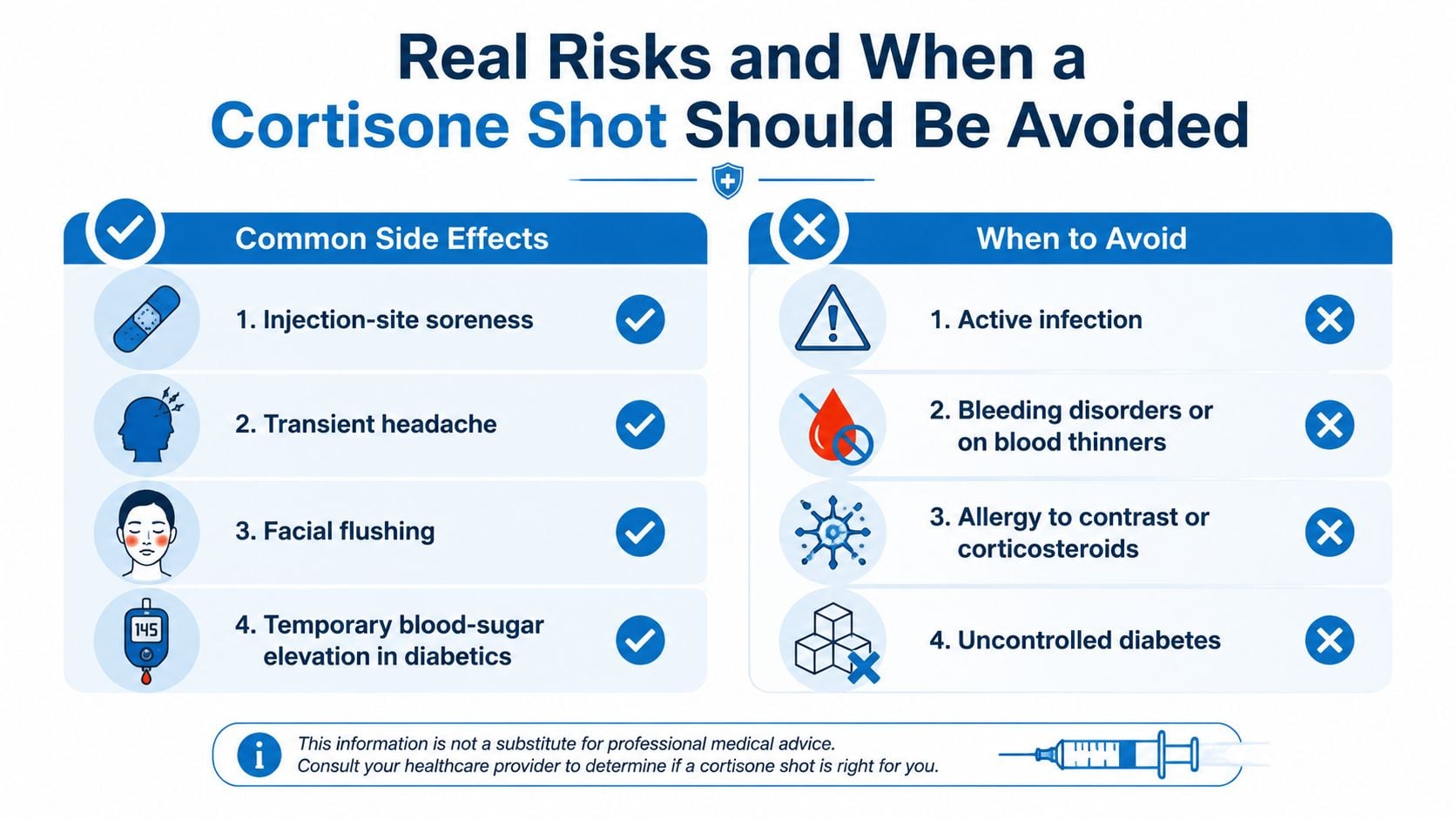
Injection-site soreness is the most ordinary complaint. Some people get a transient headache, facial flushing, or a temporary rise in blood sugar if they have diabetes. A short-lived pain flare can also happen before the steroid begins working.
The serious risks
Infection, bleeding, dural puncture, nerve injury, and vasovagal episodes are the major concerns that need respect, even though they're not the usual outcome. With the transforaminal approach, there is also a small but real vascular risk because the needle works near blood vessels. That is one reason image guidance, careful technique, and proper patient selection matter so much.
When the procedure should be paused or avoided
- Active infection anywhere in the body.
- Bleeding disorders or anticoagulation that can't be safely managed.
- Allergy to contrast material or steroid formulations.
- Uncontrolled diabetes, especially when blood sugar is already difficult to control.
Patients should also mention prior reactions, current medications, recent infections, and any change in leg weakness or walking ability. Those details shape whether the procedure is safe and whether another plan makes more sense.
A clear rule helps here. If the leg pain is severe but the body is medically unstable, the injection is not the first issue. Safety comes before symptom relief.
How Cortisone Shots Fit Into the Broader Treatment Ladder
A cortisone shot usually belongs in the middle of the treatment ladder. It comes after the first round of conservative care and before surgery enters the conversation. That placement matters because the injection can quiet an irritated nerve long enough for the rest of the plan to work, without forcing a patient to jump straight to an operation.
The lower rung, conservative care
Activity modification, physical therapy, anti-inflammatory medicines, and targeted exercise are often the first steps. Oral steroids may also be used in some cases, though they are a different tool with different tradeoffs. The goal at this stage is to keep the patient moving while the disc and nerve settle down.
The middle rung, targeted procedures
Some patients need a procedure that matches the pain source more closely. Nerve blocks, facet-related treatments, or other targeted interventions can make sense when the pain pattern points away from the disc itself. For disc-related radicular pain, a cortisone shot is often the better fit when one nerve root is clearly irritated and the symptoms have not eased enough with conservative care.
The question is usually not whether an injection is possible. The better question is which injection approach fits the symptom pattern, and whether it is being used early enough to help without being relied on as the whole plan. A well-timed epidural can act like a strategic pause, buying time for physical therapy, activity changes, and healing to do their part.
The upper rung, surgery when needed
If pain stays severe or neurological problems progress, surgery becomes part of the discussion. A microdiscectomy is one common option when disc material keeps compressing the nerve despite conservative care.
In some settings, Interventional Pain Management can fit naturally into this ladder because it offers image-guided epidural injections as part of a broader spine care pathway. The point is not to push every patient toward a procedure. The point is to match the level of care to the stage of symptoms, then set realistic expectations about what the shot can and cannot do.
A cortisone shot is one step in a sequence, not a verdict on the whole problem.
Your Next Steps in New Jersey and Staten Island
When leg pain keeps coming back, it's time to escalate beyond hoping it will disappear on its own. Progressive weakness, bowel or bladder changes, or pain that stays intense after several weeks should prompt a spine or pain evaluation sooner rather than later. Persistent radicular pain that refuses to settle can also justify a consultation, especially if sleep, work, or walking are slipping.
What to bring to the visit
A useful consult starts with the basics:
- Recent imaging: bring MRI or other studies if they've already been done.
- Medication list: include blood thinners, diabetes medications, and supplements.
- Symptom diary: note where the pain travels, what makes it worse, and what briefly helps.
- Questions: ask which injection type is being considered, why that route fits, and what steroid dose is planned.
Those details help the physician match the problem to the procedure instead of guessing. Patients often feel calmer when they understand the plan before the needle ever comes out.
Access and insurance questions
For people in New Jersey and Staten Island, scheduling flexibility matters, especially when pain doesn't keep office hours. Transportation help can matter too when sitting hurts or driving is difficult. It also makes sense to ask for a fee estimate if insurance status is uncertain, especially under the New Jersey Out-of-Network Law.
A patient who comes in informed is usually in a better position to choose wisely. The goal isn't to rush into a shot or avoid one out of fear. The goal is to decide whether the injection type, timing, and expected benefit fit the symptoms.
If a herniated disc is sending pain down the leg, Interventional Pain Management can review the imaging, examine the nerve pattern, and talk through whether an epidural steroid injection fits the situation. Visit Interventional Pain Management to schedule a consultation and get a clear, practical plan for the next step.