
A swollen finger after a car-door injury can make even a simple examination feel frightening. A carpenter waiting for tendon repair may have a different concern: whether the hand will be numb enough for the surgeon to work, and whether the pain will return as soon as the procedure ends. In both situations, a hand nerve block can reduce pain without making the entire body unconscious, but the technique isn't the same for every patient or every goal.
The phrase “nerve block hand” describes several targeted procedures, not one universal injection. An emergency clinician may use a short digital block for a fingertip repair. An anesthesia team may choose a forearm or brachial plexus block for surgery. A pain physician may target a particular nerve when chronic hand pain has persisted despite other treatment. The anatomy, medication, timing, and safety plan all change with the situation.
Table of Contents
- What a Hand Nerve Block Actually Is
- The Main Nerve Pathways Targeted in the Hand
- Types of Hand Nerve Blocks Compared
- How the Procedure Is Performed Step by Step
- What It Feels Like and How Long It Lasts
- Real Risks, Side Effects, and Recovery
- Choosing the Right Block for Your Situation
What a Hand Nerve Block Actually Is
A hand nerve block is an injection of local anesthetic near a nerve or group of nerves that carries sensation from part of the hand. The medication temporarily interrupts pain signals, allowing a clinician to clean a wound, repair tissue, perform surgery, or assess a painful condition with less discomfort. The injection isn't the same as placing anesthetic directly into every part of a wound. By working near the nerve, the clinician can numb a broader and more useful area with less distortion of the injured tissue.
Three different clinical goals
Consider the patient with a crushed fingertip in an emergency department. The clinician may block the digital nerves at the base of that finger, wait for numbness, and then examine the nail bed or close a laceration. The purpose is rapid pain control and tolerance of a short procedure, not prolonged numbness after the patient leaves.
Planned hand surgery has a different objective. A block at the wrist, forearm, or a more proximal brachial plexus level may provide surgical anesthesia and postoperative pain relief. Modern reviews describe distal upper-extremity blocks as useful because they can provide targeted anesthesia while avoiding the broader physiologic effects associated with general anesthesia, although the appropriate level depends on the operation and the patient's health (2024 review of hand regional anesthesia).
Chronic hand pain creates a third use case. A targeted injection may be used to test whether a specific nerve contributes to pain, or to create a window in which movement and rehabilitation become more manageable. That approach must be planned differently from an emergency injury block or an operating-room anesthetic.
Practical rule: The right question isn't simply, “Does the patient need a nerve block?” It's, “Which tissue needs to be numb, for how long, and for what purpose?”
Why targeted anesthesia can help
A focused block can limit numbness to the hand or a portion of it. It may also reduce the need for broader anesthesia and support pain control after surgery, but the expected benefit depends on the selected nerve, drug, dose, and clinician's technique. A block can fail or cover only part of the surgical field when the anatomy doesn't match the injection plan, so the team tests sensation before beginning.
Patients should also know that the term “local anesthetic” covers drugs with different durations. In a randomized comparison involving digital anesthesia, 0.5% bupivacaine lasted a mean of 24.9 hours, compared with 10.4 hours for 2% lidocaine with epinephrine and 4.9 hours for plain 2% lidocaine (randomized comparison of digital anesthetics). That difference matters most when the procedure is finished but the hand remains painful.
The Main Nerve Pathways Targeted in the Hand
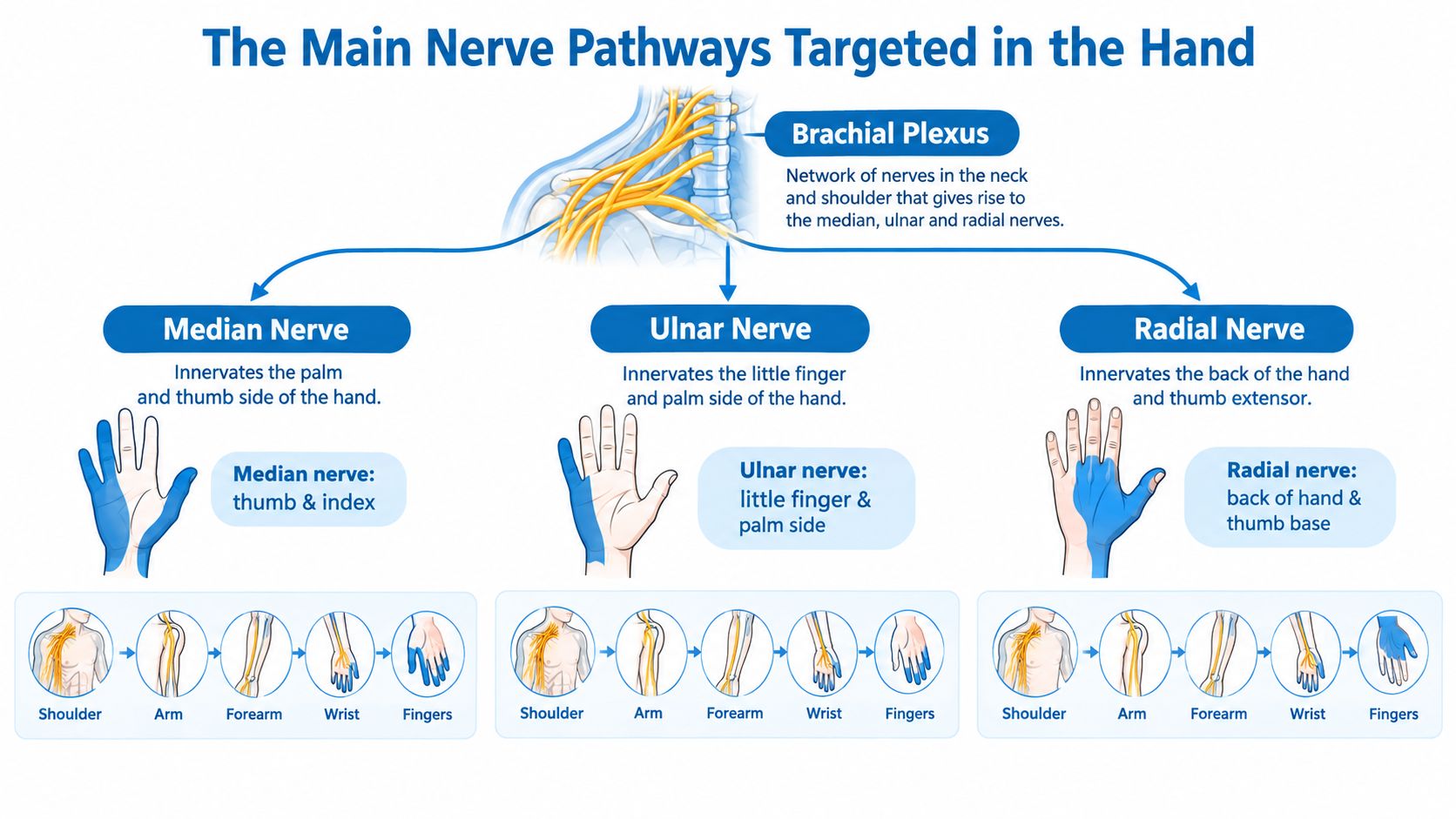
The hand receives most of its sensory and motor supply through three major nerves: the median, ulnar, and radial nerves. All three arise from the brachial plexus, a network that travels from the neck and shoulder toward the arm. A single injection may numb only one territory, which explains why a patient can feel touch on one side of the hand even when the other side is completely numb.
The three major territories
The median nerve supplies sensation to much of the palm side of the thumb, index finger, middle finger, and the radial half of the ring finger. It also supplies many of the muscles that position the thumb. Symptoms involving thumb-side fingers, especially with wrist-related nerve compression, may lead clinicians to assess the median nerve. Patients seeking background on that condition can review this guide to carpal tunnel syndrome.
The ulnar nerve supplies the little finger, the ulnar half of the ring finger, and many of the small muscles that coordinate the fingers. An injury along the little-finger side may therefore need ulnar coverage rather than a median block.
The radial nerve supplies sensation over portions of the back of the thumb, index, and middle fingers, generally extending toward the proximal interphalangeal joints. Its sensory territory doesn't perfectly match the median and ulnar territories, and overlap can occur, especially near the base of the thumb.
From a single finger to the whole hand
Digital nerves are terminal branches that travel into individual fingers. They're the usual target when the injury is confined to one digit, such as a fingertip laceration or nail-bed problem. Because the injection is placed near the finger base, the clinician can numb the injured area without necessarily making the entire hand insensate.
At the wrist or forearm, clinicians can target the median, ulnar, and radial nerves separately or together. The musculocutaneous and medial antebrachial cutaneous nerves can also contribute sensation around the wrist and proximal palm, so the surgical field may require additional planning. A proximal block near the axilla can cover a broader portion of the brachial plexus when the operation involves more of the hand, wrist, or forearm.
A practical wrist-block study involving 155 patients recorded blocks across the median, ulnar, and radial or musculocutaneous distributions, showing why clinicians map the surgical area before choosing the injection site (study of wrist-block anesthesia). The goal isn't to numb every nerve automatically. It's to cover the actual anatomy involved.
Types of Hand Nerve Blocks Compared
The block level should match the size and location of the problem. A digital block is precise and limited. A wrist or forearm block covers more territory. A proximal brachial plexus block provides broad coverage but can affect more of the limb and carries different considerations.
The table below gives a practical comparison. Exact onset and duration vary with the medication, dose, injection method, tissue characteristics, and patient factors. The verified evidence most clearly supports the duration differences between lidocaine and bupivacaine in digital anesthesia, so those figures should be treated as an example rather than a promise for every block.
Hand nerve block comparison
| Block Type | Target | Coverage | Typical Onset | Duration, Lidocaine vs Bupivacaine | Best Setting |
|---|---|---|---|---|---|
| Digital block | Digital nerves at the base of a finger | One finger, or selected adjacent fingers | Rapid, often within minutes | Lidocaine is shorter; bupivacaine is longer. In one digital study, mean durations were 4.9 hours with plain lidocaine and 24.9 hours with bupivacaine (randomized digital study) | Emergency treatment, fingertip repair, nail-bed procedures |
| Wrist block | Median, ulnar, and radial branches near the wrist | Much of the hand, depending on branches included | Minutes, with testing before the procedure | Drug-dependent, with longer effect from long-acting medication | Multiple hand procedures when the forearm isn't part of the field |
| Forearm block | One or more individual nerves higher in the forearm | Selective hand territories, with broader reach than a digital block | Minutes, depending on technique and drug | Drug-dependent; ultrasound can help target the desired nerves | Traumatic injuries, selective surgical coverage, postoperative analgesia |
| Proximal brachial plexus block | A larger portion of the plexus near the axilla or upper arm | Broad coverage of the hand and often forearm | May take longer to establish fully | Drug-dependent and generally selected for longer coverage | Longer hand or wrist operations requiring extensive anesthesia |
Why the block level matters
A patient with a single injured fingertip usually doesn't need a block that numbs the whole arm. Conversely, a repair involving several nerve territories may not be comfortable with one digital injection. A hand-surgery series covering 75 operations found that the median nerve territory was involved in about 60% of cases, the radial territory in 28%, and two adjacent nerve territories in 7%, illustrating how closely the anesthetic plan follows the operative anatomy (hand-surgery nerve distribution series).
Modern reviews also describe a safety tradeoff between proximal and distal approaches. In one 2024 review, supraclavicular blocks were associated with transient Horner syndrome in up to 54% of patients and phrenic nerve palsy in up to 50%, while more distal approaches had lower overall complication rates (review of hand regional anesthesia). Those findings help explain why hand-focused procedures often use wrist, forearm, or digital blocks when broad brachial plexus coverage isn't necessary.
How the Procedure Is Performed Step by Step
The procedure starts before the needle appears. The clinician confirms the correct limb, reviews allergies and medications, documents baseline sensation and movement, and explains what the patient should expect. This baseline examination matters because numbness or weakness after the injection must be interpreted against the hand's condition before treatment.
The clinical sequence
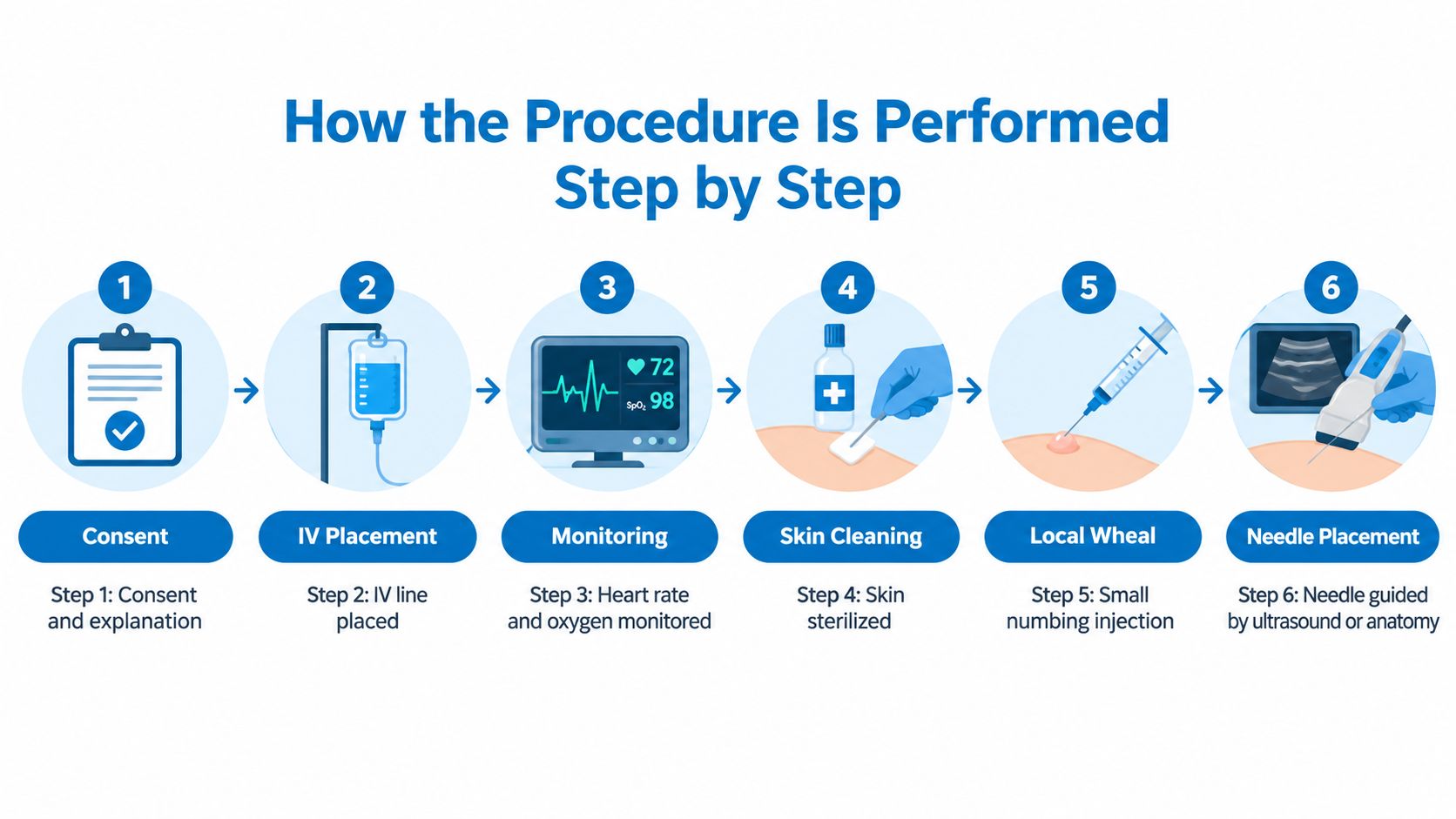
A typical sequence includes:
- Consent and positioning. The patient's arm is supported so the clinician can work comfortably and keep the ultrasound screen in view.
- Monitoring. Depending on the setting and block, the team may monitor heart rate, blood pressure, and oxygen level. An intravenous line may be placed when sedation or a larger regional anesthetic is anticipated.
- Skin preparation. The skin is cleaned with antiseptic solution. The clinician may inject a small amount of anesthetic just under the skin to create a brief local sting relief at the needle entry point.
- Target identification. With landmark guidance, the clinician uses palpable anatomy and known nerve paths. With ultrasound, the clinician can see the nerve, nearby vessels, needle tip, and spread of anesthetic in real time.
- Safe injection. The clinician advances the needle near, but not into, the nerve and draws back before injecting to check that the tip isn't inside a blood vessel. Medication is delivered gradually while the spread is observed.
- Testing. The team waits for the block to develop, then checks sensation and movement in the area that must be treated.
Landmark guidance and ultrasound
Landmark techniques can be useful, especially for simple distal blocks, but ultrasound provides direct visualization of anatomy. In a triple-masked randomized trial, proximal blocks took less performance time than distal blocks, 226.8 seconds versus 408.8 seconds, and sensation returned later after proximal blocks, 358 versus 261 minutes (randomized comparison of proximal and distal blocks). The same evidence base supports the practical value of choosing the target level deliberately rather than assuming that a more distal injection is always better.
The patient may feel pressure, movement, or a brief electrical sensation during needle placement. A sudden sharp or persistent shooting sensation should be reported immediately. After injection, the clinician watches the patient and confirms the hand is becoming appropriately numb before proceeding. Patients can review general information about nerve block treatment before discussing whether it fits their circumstances.
What It Feels Like and How Long It Lasts
Most patients notice several sensations rather than one dramatic change. The skin anesthetic may sting briefly. The deeper needle can create pressure, and the local anesthetic may feel warm as it spreads. Over the next several minutes, the hand becomes heavy, tingling, and less responsive.
The patient shouldn't judge the block by the absence of all sensation immediately after injection. Clinicians test the intended territory with light touch, cold, or another method before surgery or a painful procedure begins. A partially working block may need more time, another targeted injection, or a different anesthetic plan.
Medication determines the recovery window
The duration depends on the drug selected and the purpose of the block. Shorter-acting medication may suit a quick emergency repair, while a longer-acting option may help after outpatient surgery. A randomized double-blind study of digital anesthesia found the clearest example of this tradeoff: plain 2% lidocaine lasted a mean of 4.9 hours, lidocaine with epinephrine lasted 10.4 hours, and 0.5% bupivacaine lasted 24.9 hours (digital anesthesia duration comparison).
| Anesthetic | Onset | Duration | Best For |
|---|---|---|---|
| Lidocaine | Relatively quick | Shorter effect, varying by formulation and site | Brief procedures where rapid recovery is useful |
| Lidocaine with epinephrine | Quick, with a longer effect than plain lidocaine in the cited digital comparison | Mean digital duration of 10.4 hours in the randomized study (source) | Procedures needing more time than plain lidocaine provides |
| Bupivacaine | May take longer to establish fully | Mean digital duration of 24.9 hours in the randomized study (source) | Longer postoperative analgesia when prolonged numbness is acceptable |
What patients should plan for
As the block fades, tingling often comes first, followed by returning pressure and a dull ache. The hand can feel unfamiliar while sensation and strength return at different rates. During that period, patients should protect the limb from heat, sharp objects, accidental impact, and prolonged pressure.
The discharge plan should include pain medication instructions before sensation returns. A person who waits until the block has completely worn off may be trying to control pain after it has already become difficult.
Real Risks, Side Effects, and Recovery
A hand nerve block isn't risk-free, but the common experience is usually limited to temporary soreness, tenderness, or bruising near the injection site. Those effects generally improve without special treatment. The more important safety question is whether numbness or weakness follows the expected pattern and gradually resolves.
Patients often worry that a block will hide a dangerous problem. Evidence in traumatic hand injuries doesn't support a simple “blocks are risky” conclusion. In a randomized trial of painful hand injuries, ultrasound-guided forearm blocks produced significant pain reduction at 15 and 120 minutes, with no reported adverse events; a broader review found no cases of compartment syndrome in the cited hand-injury studies (review of hand-injury nerve blocks).
Warning signs after discharge
The patient should receive clear instructions about what is expected and what requires a call. The following symptoms deserve prompt medical attention:
- Persistent or worsening numbness: Contact the treating clinic if sensation doesn't begin returning as expected or remains abnormal beyond the timeframe provided.
- New weakness: Report weakness that doesn't match the planned motor effect or that persists after the block should be resolving.
- Increasing pain or swelling: A block shouldn't prevent follow-up for a wound, fracture, infection, or surgical complication.
- Signs of infection or severe allergy: Increasing redness, drainage, widespread rash, facial swelling, or breathing difficulty requires urgent evaluation.
Recovery rule: A numb hand can burn, cut, or become compressed without producing the normal warning pain. Until sensation returns, protection is part of the treatment.
Why technique matters
Operator experience, anatomical variation, and the relationship between nerves and nearby vessels affect safety. Ultrasound may help the clinician identify these structures, but it doesn't remove the need for a careful examination, appropriate medication selection, aspiration before injection, and follow-up instructions.
A block is also only one part of care. In acute injuries, the wound, fracture, circulation, tendon function, and nerve function still need assessment. In chronic pain, a temporary response doesn't automatically identify the final diagnosis or guarantee lasting relief.
Choosing the Right Block for Your Situation
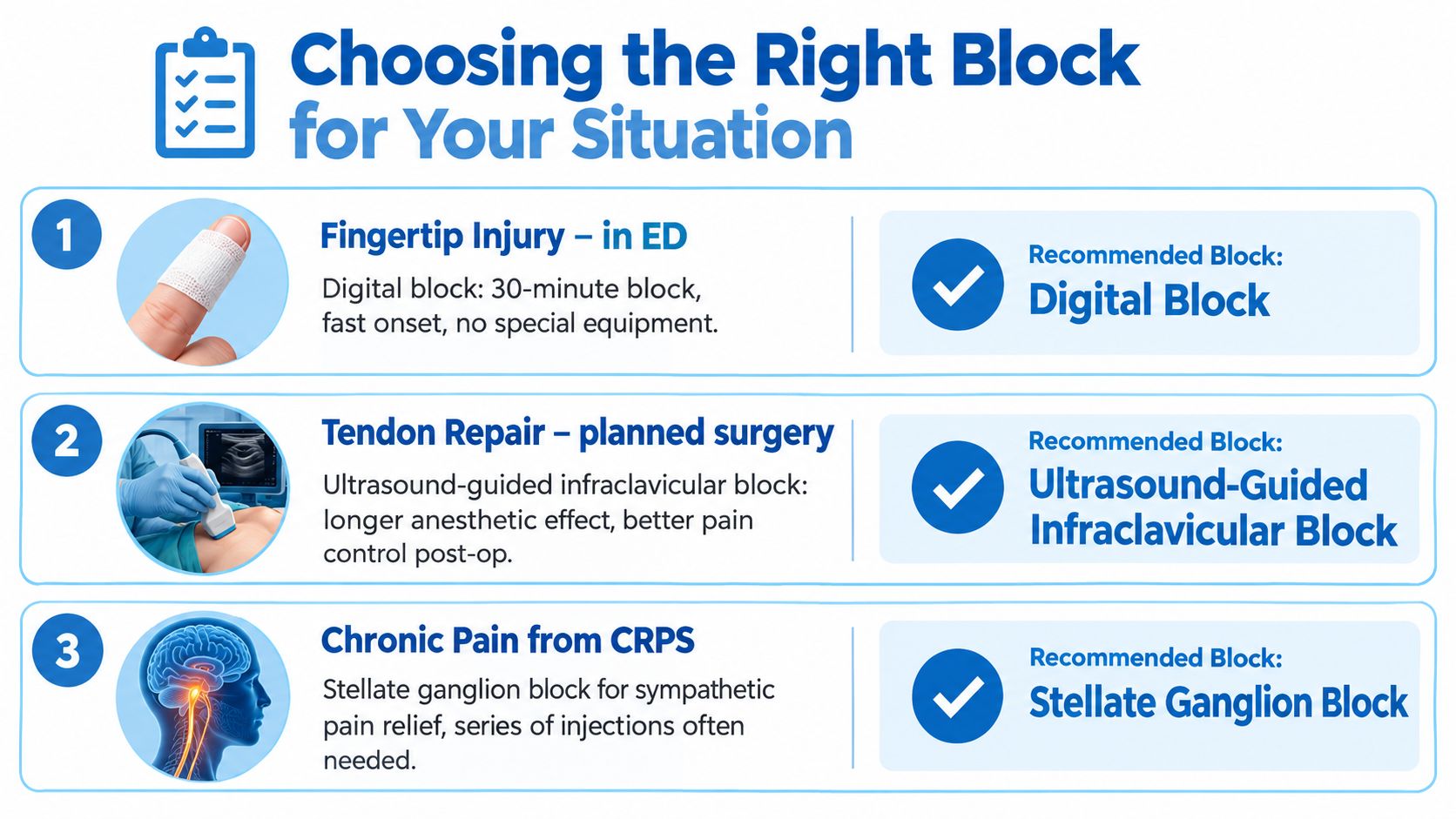
The most useful distinction is the reason for treatment. Acute injury, planned surgery, and chronic hand pain are separate clinical problems, even when all three involve the same median, ulnar, radial, or digital nerves.
Acute injury in the emergency department
A person with a fingertip laceration may need a digital block so the clinician can irrigate, inspect, repair, or treat the nail bed. A larger burn or injury crossing several nerve territories may require selective forearm blocks or more than one target. The clinician should first document circulation, sensation, and movement because the injury itself may already have affected those functions.
Pain relief shouldn't end the evaluation. The patient still needs instructions about wound care, splinting, infection signs, and the timing of reassessment.
Planned surgery in the operating room
A tendon repair or broader hand operation may require a wrist, forearm, infraclavicular, or another proximal approach. The choice depends on the incision, tourniquet, expected duration, postoperative pain plan, and whether sedation or general anesthesia is also planned. Proximal blocks can provide broader coverage, while distal techniques may limit unnecessary numbness when the surgical field is small.
Patients should ask about fasting, medication adjustments, anticoagulants, transportation, and how the team will protect the limb at home. A weak or numb arm may require a sling or other support until strength returns.
Chronic hand pain in a pain clinic
Chronic pain needs diagnostic discipline. A targeted block may be considered for persistent nerve-related symptoms, osteoarthritis-related pain, or other painful hand conditions, but it should sit within a broader plan that may include examination, imaging review, exercise, splinting, medication, and rehabilitation. In a randomized study of hand osteoarthritis, an ultrasound-guided superficial radial nerve block combined with exercise improved pain, function, and quality of life more than exercise alone (study of superficial radial nerve block and exercise).
Patients considering an injection should ask:
- What nerve is being targeted, and why?
- Is the goal short-term pain control, surgical anesthesia, diagnosis, or rehabilitation?
- Which medication will be used, and how long might numbness or weakness last?
- What symptoms require a same-day call?
- How should anticoagulants, diabetes medicines, or other prescriptions be managed?
- What is the next step if the block helps only briefly or doesn't work?
Interventional Pain Management offers evaluation and image-guided nerve block procedures when a targeted injection is appropriate for a painful nerve or hand-related condition. Patients in New Jersey and Staten Island can discuss the diagnosis, medication choices, risks, and follow-up plan with a board-certified pain physician before scheduling treatment.
Adults with hand pain, numbness, or a nerve-related flare can visit Interventional Pain Management to request an evaluation and discuss whether a hand nerve block fits the condition. The clinical team can review symptoms, prior treatment, medications, and functional goals, then outline an appropriate next step.