
You wake up with the same ache in your lower back or neck that has already outlasted the stretches, the pills, and maybe even physical therapy. The pain is still there when you stand at the sink, turn to back out of the driveway, or try to sleep through the night, and now someone has mentioned a medial branch block radiofrequency ablation plan that sounds technical and a little intimidating.
The good news is that this pathway has a very specific purpose. A medial branch block is used to find out whether the small facet joints in the spine are the pain source, and radiofrequency ablation is the longer-lasting treatment that follows if the block gives the right answer. That step-by-step logic matters, because it helps separate people who need a nerve-targeting procedure from people whose pain is coming from somewhere else.
Table of Contents
- When Chronic Back or Neck Pain Leads to Nerve Treatment
- Understanding Medial Branch Nerves and How They Carry Pain
- How Many Diagnostic Blocks Are Needed Before Ablation
- What Happens During the Radiofrequency Ablation Procedure
- Realistic Outcomes and How Long Relief Typically Lasts
- Comparing RFA With Other Treatment Options for Facet Pain
- Recovery Aftercare and When to Contact Your Pain Specialist
When Chronic Back or Neck Pain Leads to Nerve Treatment
A person can do everything “right” and still end up stuck with stubborn spine pain. They may have tried rest, anti-inflammatory medication, guided exercise, or injections aimed at other structures, yet the pain still flares when they lean back, twist, or stay upright too long. That is often the point when a pain specialist starts asking a different question, not just “Where does it hurt?”, but “Which structure is sending the pain signal?”

Facet-joint pain can be quiet and persistent instead of dramatic. It may feel like a deep ache, stiffness, or a sharp catch with extension and rotation, which is why it sometimes gets mistaken for muscle strain or disc pain. In that setting, the medial branch block to radiofrequency ablation pathway gives the clinician a way to test the facet-joint theory before committing to a longer-lasting intervention.
For patients, that is usually the most reassuring part of the process. The first procedure does not burn anything, it only checks whether numbing a tiny nerve changes the pain pattern. If it does, the second procedure can target that same nerve more durably.
An internal overview of spine-related pain care is available at Interventional Pain Management's back and neck pain page, which fits the same general decision-making process used here.
Practical rule: if the pain keeps returning after conservative care, a diagnostic path makes more sense than guessing at the source.
That is why many spine specialists treat this as a two-step plan rather than a single procedure. The block answers the diagnostic question, and the ablation answers the treatment question. When patients understand that difference, the process feels less like delay and more like precision.
Understanding Medial Branch Nerves and How They Carry Pain
The medial branch nerves are small, but they matter a lot. They carry pain signals from the facet joints, the paired joints at the back of the spine that help the neck and low back bend and move. These nerves function like dedicated wires carrying pain signals from specific facet joints to the brain.
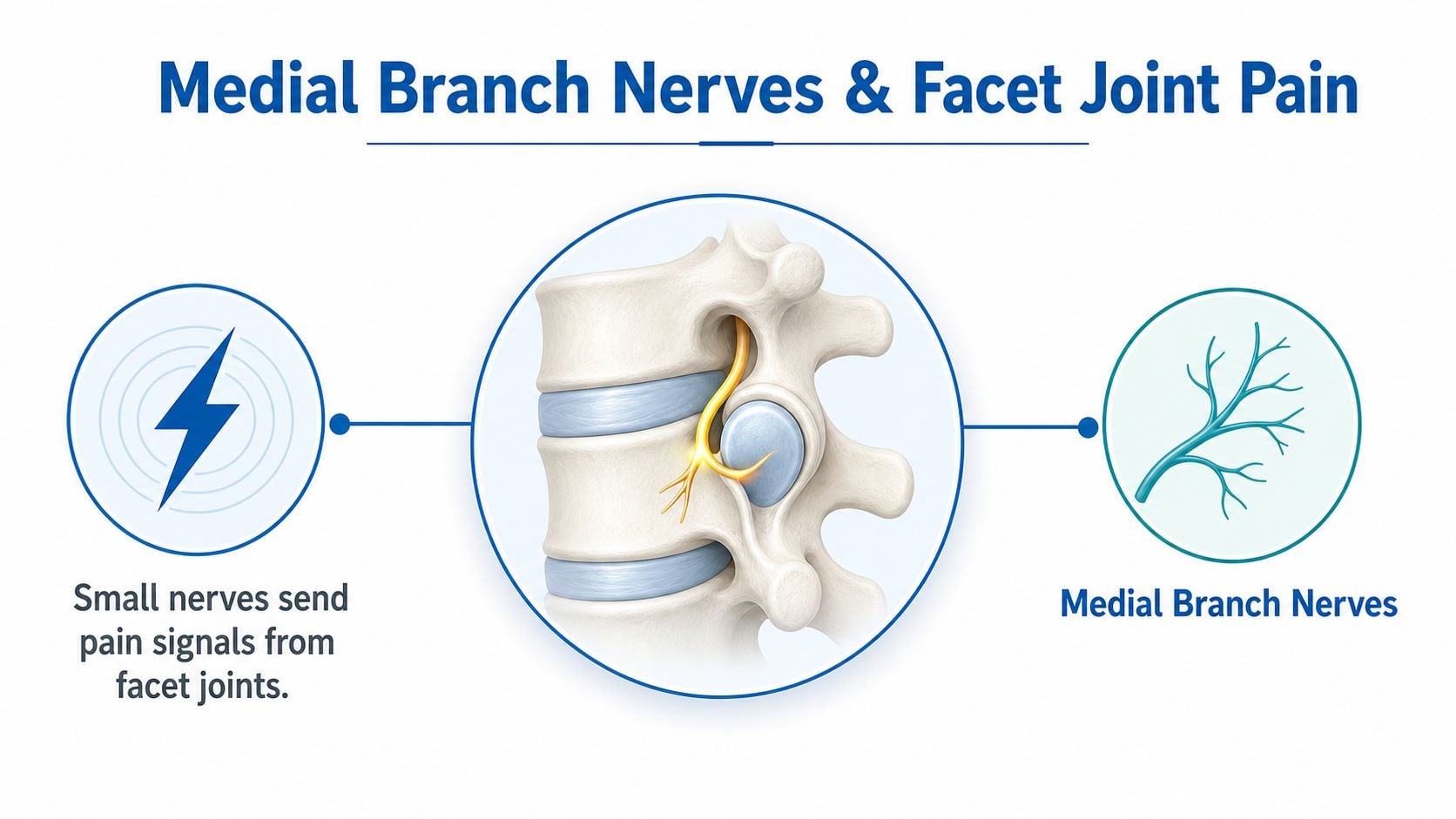
That wiring matters because a facet joint usually gets input from more than one small nerve branch. If a clinician wants to quiet pain from that joint, the target has to be precise. Missing the nerve means the pain signal keeps traveling, and treating the wrong spot can leave the patient frustrated and unchanged.
The diagnostic block and the ablation do different jobs
A medial branch block is the diagnostic part. A clinician injects local anesthetic near the nerve to see whether pain improves for the short time the medication works. If the pain drops in a way that matches the patient's usual pattern, that points toward the facet joints as the source.
Radiofrequency ablation is the therapeutic part. Instead of numbing the nerve for a few hours, it uses heat to create a longer-lasting interruption in that nerve's ability to carry pain. That is why the block and the ablation are related, but not interchangeable.
Patients often hear “nerve block” and assume every injection works the same way. It does not. Some injections are meant to diagnose, some to treat briefly, and some to create a more durable change. In facet-mediated pain, the block is the test, and the ablation is the follow-through.
The cleaner the diagnosis, the easier it is to predict whether the treatment will make sense.
For readers who want a broader look at injection types, this overview of pain management injections helps place medial branch procedures in context without turning every spine injection into the same thing.
A more detailed look at medial branch block care and next-step planning can also help explain why a positive diagnostic response matters before ablation.
How Many Diagnostic Blocks Are Needed Before Ablation
A patient may arrive expecting a simple answer, one block or two blocks, then ablation. The conversation is more nuanced because the medial branch block is doing diagnostic work, and the number of blocks before ablation reflects a clinical judgment about certainty, access, and how much testing is reasonable for the person sitting in front of us.
The policy side tends to be stricter. CMS-linked guidance summarized in the provided material says lumbar medial branch RFA should generally follow two separate diagnostic MBBs with more than 50 to 80 percent pain relief, after conservative therapy for 6 weeks to 3 months, in patients with chronic axial low-back pain without radicular symptoms. That approach is built to reduce the chance of treating the wrong pain generator.
Why some clinicians still prefer one block
Other clinicians use a more practical pathway. The 2020 lumbar facet consensus guidelines recommend a single block, and ASRA's 2024 review says a single set of medial branch blocks with at least 50% concordant pain relief is a reasonable way to select RFA candidates. In everyday care, one clearly positive block can provide enough confidence when the history, exam, and pain pattern all point in the same direction.
That choice is not a shortcut. It reflects a different balance. More blocks can lower the chance of a false-positive result, but each additional procedure adds time, cost, scheduling burden, and another chance for the response to be clouded by temporary factors. A single block is often easier for patients to complete, which is one reason it remains common in practice.
Decision point: the number of blocks is a discussion about accuracy versus practicality, not a judgment about whether the pain is real.
Why the debate matters to patients
The concern behind multiple blocks comes from the fact that a single diagnostic block can sometimes look positive even when the facet joints are not the main pain source. That is why controlled methods were developed in the first place, and why some clinicians still favor a stricter pathway before ablation. The question is not whether the block matters, but how much certainty the care plan needs before the nerve is treated.
A good consultation should explain why one approach was chosen over another. Some patients benefit from a stricter protocol when the diagnosis is unclear or the pain pattern is mixed. Others are better served by a single-block plan when the symptoms are consistent and the next step is meant to be practical rather than overly restrictive. For a plain-language overview of how a nerve block is used in pain care, this explanation of nerve block treatment can help connect the diagnostic step to the ablation that follows.
What Happens During the Radiofrequency Ablation Procedure
By the time a patient reaches the ablation, the hard part is usually the uncertainty. The procedure itself is fairly structured. It is commonly done in an outpatient setting, and the patient is awake enough to communicate, though mild sedation may be used depending on the setting and the person's comfort.
The clinician uses fluoroscopy, which is live X-ray guidance, to place the needle near the targeted medial branch nerve. That precision matters because the nerve is tiny and sits close to other structures that should be avoided. Before the heat is delivered, motor testing is performed to make sure the needle is not too close to muscles or other motor pathways.
The sequence patients can expect
- The skin is cleaned and numbed.
- The needle is guided into the correct position.
- Testing confirms the target is appropriate.
- Heat is applied to create the lesion.
During the heating phase, procedural references describe lesioning at 75 to 80°C for 60 to 120 seconds (NYU/NYSONA procedural reference). That heat disrupts the nerve's ability to transmit pain signals without removing the joint itself. The goal is to interrupt the message, not to “fix” the anatomy.
Patients may feel pressure, warmth, or brief discomfort during the procedure, but it should not be an ordeal. The visit is often shorter than people expect, and the immediate aftermath usually feels more like local soreness than a dramatic recovery.
A helpful way to think about it is this, the block checked the wiring, and the ablation cuts the faulty line for a while. The pain source can still exist, but the nerve is no longer carrying the signal in the same way. That is why the technique is so useful for pain that is persistent but localized.
Realistic Outcomes and How Long Relief Typically Lasts
A patient may walk into clinic hoping radiofrequency ablation will “turn off” the pain for good. The more accurate answer is that RFA can give meaningful relief for a proper subset of patients, but it is not a permanent cure. That is why the diagnostic medial branch block matters so much, it is the step that helps us decide whether the facet joint is the pain source or just one piece of a more mixed pain picture.
Systematic review data found about a 63% chance of achieving 50% pain relief at 3 months after RF neurotomy when patients were selected using a single medial branch block criterion, and some studies in the review reported 57% of patients still achieving 50% relief at 6 months (PMC review). The same review also reported about 43.7% of patients reaching at least 50% numerical pain score reduction at mean follow-up, while 63.4% achieved a clinically meaningful 2-point reduction. Another prospective real-world study reported 77% of patients reaching at least 50% pain reduction at 1 month and 69% still doing so at 12 months. Those findings explain why there is a real clinical debate about how many diagnostic blocks should come before ablation, because the better the diagnosis, the better the odds of a good result.
What those numbers mean in plain English
These results are a range, not a promise. Some people get strong relief, some get partial relief, and some find that their pain pattern points somewhere else. The common thread is that RFA tends to work best when the medial branch block has already shown that the facet nerves are carrying the pain signal.
Relief does not always show up right away. Patient-facing guidance notes that the full benefit may take 10 days to three weeks to appear, and the effect often lasts about 6 to 12 months, though some people report longer relief (CGS guidance). That delay can surprise people who expect the pain to disappear the same day, so clear follow-up instructions matter.
Expectations matter: RFA is a time-limited nerve disruption, not a permanent reset.
As the nerve grows back, pain can return. Guidance tied to the same coverage framework says repeat RFA is reasonable only if the prior procedure gave at least 3 months, preferably 6 months, of relief, and it is generally repeated up to two times per year. That pattern reflects the normal lifespan of the treatment, not a failure of the procedure itself.
For readers who want to understand how different injections fit into the care plan, this overview of types of injections used in pain management can help place medial branch blocks and RFA in context.
Comparing RFA With Other Treatment Options for Facet Pain
A patient with facet pain often wants to know why a medial branch block leads to radiofrequency ablation in one care plan, while another person is steered toward medication, therapy, or a different injection. The answer usually starts with the role of the block itself. A medial branch block is a diagnostic test that helps show whether the facet nerves are carrying the pain signal, while RFA is the treatment that follows when that signal has been confirmed. For a broader look at how injection-based treatments are used in spine care, this overview of pain management injections helps place medial branch procedures in context.
RFA sits in the middle of the treatment ladder. It is more targeted than general medication management, less invasive than surgery, and longer lasting than a temporary anesthetic block. For facet-mediated pain, the decision usually depends on how long relief is needed, how convincing the diagnostic block was, and whether the symptom pattern still suggests a different pain source. A block is like a test light on a circuit, while ablation is the step that quiets the nerve after the source has been identified.
Several options are often discussed before or instead of RFA. Physical therapy and oral medications can help when the diagnosis is still being clarified or when the pain does not look purely facet-driven. Repeated medial branch blocks may provide short-lived relief, but their main value is still diagnostic rather than therapeutic. Intra-articular steroid injections may also be used in some settings, although they serve a different purpose from a nerve-targeting procedure.
Treatment options for facet-mediated pain
| Treatment | Typical Relief Duration | Invasiveness | Best For |
|---|---|---|---|
| Physical therapy and oral medications | Variable, often temporary | Low | Early care, mixed pain patterns, or support while diagnosis is still being clarified |
| Medial branch block | Short-term | Low | Confirming whether facet nerves are the pain source |
| Radiofrequency ablation | Often months, sometimes longer | Moderate | Confirmed facet-mediated pain after a positive diagnostic block |
| Surgery | Depends on the underlying problem | Higher | Cases with structural problems beyond isolated facet pain |
RFA is usually not the right first step for radicular pain, meaning pain that travels down a leg or arm. It is also a poor fit when conservative care has not been tried long enough or when the pain generator still seems uncertain. In those situations, a broader diagnostic approach or a more conservative treatment plan makes more sense. The clinical question is not whether a procedure can be done, but whether it matches the pain pattern in front of you.
The reason the number of medial branch blocks before ablation is debated is that the block is doing two jobs at once. It helps confirm the diagnosis, and it also gives a preview of whether nerve-directed treatment is likely to help. Some clinicians want more certainty before proceeding, while others accept a single convincing block in the right patient. That difference is not confusion, it reflects how pain specialists weigh accuracy, access to care, and the risk of treating the wrong pain source.
Recovery Aftercare and When to Contact Your Pain Specialist
Patients typically leave the procedure with mild soreness at the needle site and a plan to take it easy for a short period. Activity is often limited for the first 24 to 48 hours, and the pain relief can come on gradually rather than all at once. That timing can be frustrating if a patient expects instant change, so it helps to know ahead of time that improvement may unfold over days or weeks.
A pain diary is one of the most useful tools after treatment. It gives the clinician a clear picture of whether the pain is easing, whether the usual trigger movements are easier, and whether the response fits the expected pattern. That record is especially helpful if another treatment decision needs to be made later.
Call the clinic promptly if any of these appear
- Fever or chills, especially if they start after the procedure.
- Unusual or worsening pain that feels different from ordinary soreness.
- Redness, drainage, or swelling at the injection site.
- New weakness or numbness that was not present before.
In New Jersey and Staten Island, Interventional Pain Management and Ortho-Spine Center offers board-certified pain management physicians across multiple locations with seven-days-a-week scheduling availability, which can make follow-up easier when questions come up after a procedure. That kind of access matters when a patient is trying to decide whether a symptom is normal recovery or needs a call.
If chronic facet-type neck or back pain has reached the point where a targeted diagnostic pathway makes sense, Interventional Pain Management can evaluate whether a medial branch block and possible radiofrequency ablation fit the clinical picture. Visit Interventional Pain Management to learn how its board-certified physicians approach spine pain, clarify next steps, and help patients in New Jersey and Staten Island move from uncertainty toward a practical treatment plan.