

A large retrospective study of 277,941 adults found that 97.0% of lumbar disc herniation cases were managed successfully without surgery, while only 3.0% eventually needed lumbar microdiscectomy after conservative care failed (study). That single statistic changes the conversation. For a person with a herniated disc, the right question is not whether surgery is inevitable, but which non-surgical steps should happen first, how long to wait, and when to escalate if pain or weakness does not settle.
The challenge is timing. Some patients improve quickly, some need a longer runway, and a smaller group needs injections or surgical evaluation sooner because their symptoms are not following the usual pattern. A practical plan starts with conservative care, watches the neurological picture closely, and moves up only when the body is not responding the way it should.
Table of Contents
- Why Most Herniated Discs Heal Without Surgery
- Understanding Disc Herniation Types and Healing Potential
- First-Line Conservative Treatments and When to Use Them
- Interventional Pain Procedures for Persistent Symptoms
- Red Flags That Require Urgent Surgical Evaluation
- How a Multidisciplinary Pain Center Coordinates Your Care
- Your Recovery Timeline and Next Steps
Why Most Herniated Discs Heal Without Surgery
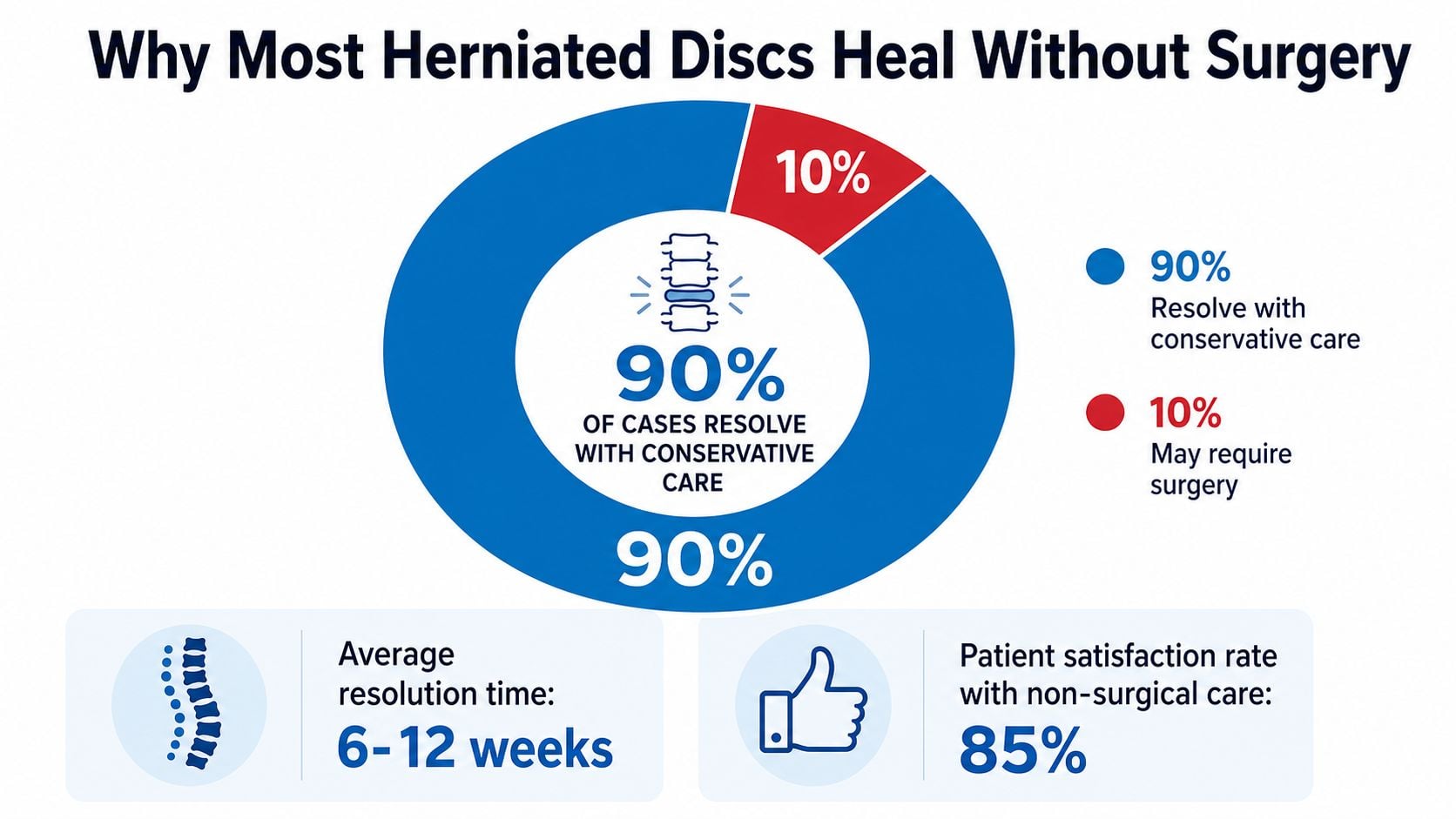
The first thing to keep in mind after a disc diagnosis is that surgery is not the usual outcome. In a large 2021 cohort, 269,713 out of 277,941 adults, or 97.0%, were managed successfully with nonoperative care, and only 8,228 patients went on to lumbar microdiscectomy after maximal conservative treatment failed (study). That result matters because it shows how often the body can settle a herniation without an operation.
What that means in real life
Recovery is usually measured in weeks, not in a single appointment. The same study found that symptom relief from first-line conservative measures, including analgesic medications, steroid injections, and physical therapy, usually occurred in more than 90% of patients within 12 weeks of symptom onset (study). The point is not that every day feels better. The point is that there is often enough time for the irritated nerve to calm down and for inflammation to decrease before surgery enters the picture.
Practical rule: if the pain is steady or slowly improving, conservative care usually deserves time. If the pain is getting worse, strength is slipping, or bladder or bowel changes appear, the plan needs to change right away.
A stepped approach fits most patients. The first step is usually activity modification, pain control, and guided movement. If those measures do not give enough relief, the next step can be an image-guided procedure that targets the inflamed nerve more directly.
For patients trying to make sense of MRI results and treatment choices, a clear explanation of a herniated or bulging disc can help connect the scan to the symptoms. That is often easier to follow when the information is organized clearly, and a practical resource like the Webflow homepage can be useful for teams building patient education materials.
The hard part for many readers is patience. The scan can look dramatic, but the symptoms often improve long before the anatomy looks perfect again. That is why non-surgical care is usually the starting point.
Understanding Disc Herniation Types and Healing Potential
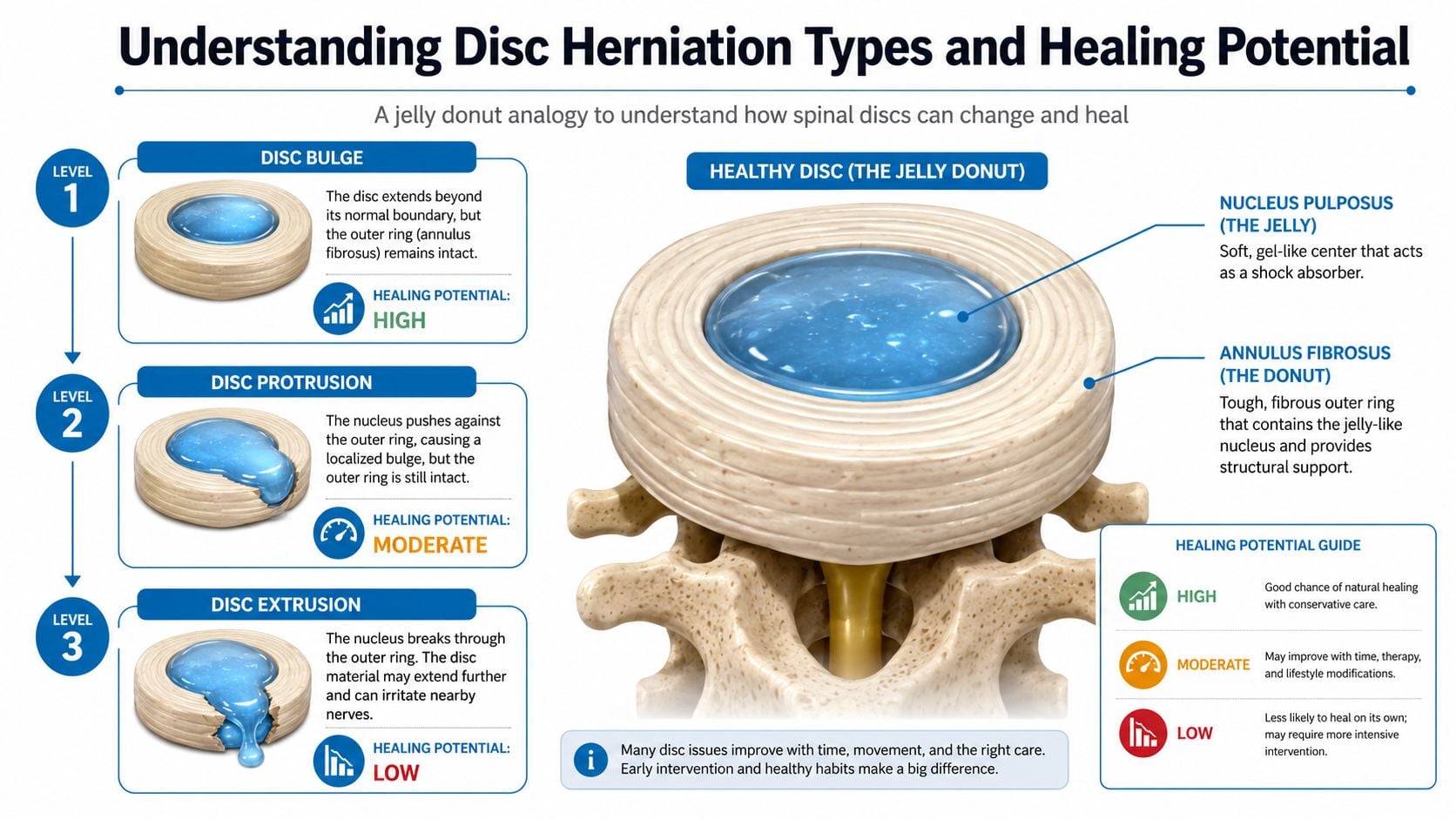
A disc herniation can look alarming on paper, but the label by itself does not tell you how the story will unfold. The spinal disc works like a jelly donut. The outer ring is tough, the center is soft, and trouble starts when the inner material pushes outward through a weak spot in that outer wall. When that material reaches a nearby nerve root, it can cause pain, numbness, or weakness in the arm or leg, depending on where the disc sits.
Why the MRI label does not tell the whole story
MRI reports usually describe a disc as a bulge, protrusion, extrusion, or sequestration. Those words are easy to confuse, so the simplest way to read them is this. A bulge stays contained, a protrusion pushes farther out, an extrusion breaks through the outer wall, and a sequestration means a fragment has separated.
The part that surprises many patients is that the more dramatic-looking herniations can sometimes improve more readily. In the PubMed-indexed review, spontaneous regression varied by morphology, with 96% for disc sequestration, 70% for disc extrusion, 41% for disc protrusion, and 13% for disc bulging. The same review reported complete resolution rates of 43% for sequestrated discs and 15% for extruded discs.
Why some discs heal faster than others
That pattern seems backward until you think about how the body responds to material that has moved outside its usual space. Once disc tissue sits where it does not belong, the immune system may treat it as something to clear. That response is one reason non-surgical treatment often works, even when the MRI looks severe.
The same review also cited an overall 63% regression rate after conservative treatment in a systematic review and meta-analysis of 2,219 non-surgically treated symptomatic lumbar disc herniation patients. For patients trying to understand a report, that matters because it shows the disc is not always a fixed problem.
A large extrusion is not automatically a surgery case. The MRI shape matters, but symptoms, strength, and response to treatment matter just as much.
For day-to-day decisions, the scan is only one part of the picture. A person with a severe-looking MRI may improve steadily, while someone with a smaller herniation may struggle if the nerve irritation is more active. A clear explanation of a herniated or bulging disc can help connect the report to what is happening in the room, which makes follow-up conversations easier to understand.
First-Line Conservative Treatments and When to Use Them
The first several weeks are about lowering irritation without letting the spine shut down. That usually means short-term pain control, smart activity changes, and movement that stays inside a tolerable range. It does not mean lying in bed and waiting for the nerve to magically calm down.
What belongs in the early phase
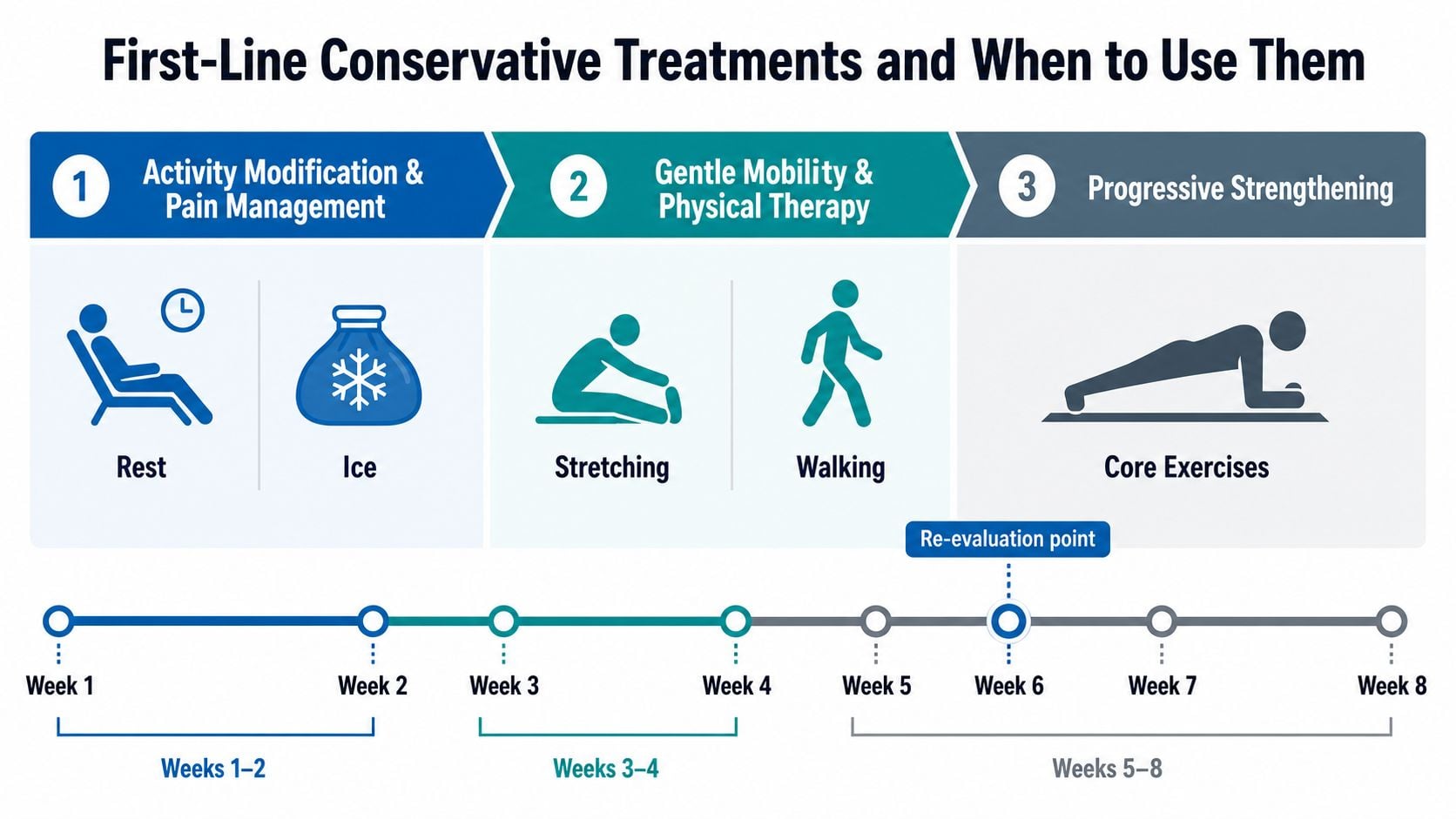
The earliest phase usually focuses on activity modification. That means avoiding repeated bending, twisting, heavy lifting, or long periods in positions that reliably worsen symptoms, while continuing safe movement such as short walks and position changes. The point is not to test the nerve all day. The point is to reduce mechanical stress enough that inflammation can settle.
Medication can help during that window. NSAIDs are commonly used to reduce pain and inflammation, and short courses of oral steroids may be considered in selected cases by a treating clinician. Those options don't fix the disc itself, but they can make it easier for a person to keep moving and start therapy.
Why physical therapy is not just “exercise”
Physical therapy gives the patient a structured way to rebuild tolerance. A good program usually emphasizes core stabilization, hip and trunk control, and gentle nerve-friendly movement, all matched to the patient's pain pattern. That is very different from random stretching or trying to “push through” symptoms.
If a movement causes a sharp increase in leg pain or progressive numbness, it should not be treated as a good stretch. It should be treated as a signal to adjust the plan.
The common confusion is thinking that rest and movement are opposites. They are not. Graded movement is the middle ground. It keeps the spine from stiffening up while avoiding overload, which is why bed rest is usually outdated advice for most disc problems.
A practical way to think about the timeline is this. Early care is for calming things down, the middle phase is for restoring motion, and the later phase is for rebuilding strength and confidence. If symptoms are not trending in the right direction by the re-evaluation point, that is when escalation starts to make sense.
Interventional Pain Procedures for Persistent Symptoms
Some patients do everything right and still hit a wall. Pain that remains stubborn after about 4 to 6 weeks is one reason to consider interventional care, because targeted procedures can calm the irritated nerve more directly and may give recovery a better opening (guideline review). These procedures are not a sign that treatment has failed. They are a more focused part of the same plan.
How the procedures differ
An epidural steroid injection places anti-inflammatory medicine near the irritated nerve root, which can help reduce swelling around the pain generator. A selective nerve root block aims at a specific nerve level with more precision. A trigger point injection addresses muscle pain that often appears when the back or leg tightens up to protect itself from the disc irritation.
Patient information on epidural steroid injections explains how image guidance helps place medication where it is most likely to help.
Why timing matters
These procedures are usually considered after conservative care has not created enough of a recovery window. The goal is to make physical therapy and daily movement more tolerable, because pain relief can let a patient walk farther, sleep better, or sit long enough to participate in rehab. That is often the point where progress starts to show up in real life, not just on paper.
The guideline review on lumbar disc herniation with radiculopathy places epidural injections and nerve-root blocks as second-line options after the initial conservative trial, which usually lasts about 6 weeks to 2 months (guideline review). That timing fits a simple clinical sequence, calm inflammation first, then use the pain relief to restore function.
Steroid concerns come up often, and that concern is reasonable. The right response is to match the procedure to the patient's symptoms, review the risks carefully, and avoid repeating injections unless there is a clear reason to do so.
A plain-language way to judge the next step looks like this:
- Pain is still limiting sleep or walking: an image-guided injection may be worth discussing.
- Symptoms are improving but slowly: conservative care may still be the better fit.
- Strength is dropping: the patient needs a physician review, not just another week of waiting.
Interventional care sits in the middle of the treatment ladder. It is neither the first move nor the last one. Used well, it can keep a patient moving long enough for the nerve to calm down and the spine to recover.
Red Flags That Require Urgent Surgical Evaluation
Most herniated discs cause pain, stiffness, and nerve irritation, but they do not automatically point to an emergency. The warning signs are different. They suggest nerve compromise that needs urgent evaluation, especially when symptoms are progressive instead of steady.
What common symptoms are not emergencies
Leg pain, tingling, and numbness can feel alarming, but they are not automatically signs that surgery is needed. A person can have sharp sciatica, a sore back, or numbness in one foot and still remain in the usual non-surgical pathway if the symptoms stay stable and strength is unchanged.
What changes the plan
The symptoms that call for urgent evaluation are different. Loss of bowel or bladder control, progressive weakness in the legs, numbness in the saddle area, and foot drop are serious warning signs that can point to a condition such as cauda equina syndrome. Severe, unrelenting pain also deserves prompt medical attention when it does not ease and begins to interfere with ordinary function.
A study in a large cohort also found that male sex and chronic opioid use were associated with failure of nonoperative care. That does not mean surgery is inevitable. It does mean the follow-up should be closer, and the treatment plan may need to move sooner if recovery stalls. (study)
When weakness gets worse, waiting is no longer a neutral choice.
The decision point is practical. If symptoms are painful but stable, a scheduled spine visit is usually appropriate. If bladder changes, saddle numbness, or worsening weakness appear, the person should seek urgent evaluation right away. Those are not symptoms to watch for a week and hope they fade.
For patients who are already working through conservative care, a pain specialist can help sort out whether symptoms still fit the expected recovery pattern or need faster escalation, and Interventional Pain Management can be part of that next step.
How a Multidisciplinary Pain Center Coordinates Your Care
A herniated disc is rarely just a disc problem. It affects walking, sleep, work, mood, and the ability to move without fear. That is why coordinated care matters, especially when the treatment plan has to shift from simple conservative measures to procedures or surgical review.
Interventional Pain Management brings pain physicians, orthopedic specialists, and spine surgeons into the same care pathway, which helps keep imaging review, physical examination, and treatment planning connected instead of scattered.
How coordination changes the experience
A multidisciplinary team can review the MRI, examine the patient, and decide whether the next move is continued conservative care, an injection, or a surgical consult. That avoids redundant testing and lowers the chance that each specialist is working from a different version of the story. It also makes it easier to match the treatment to the symptom pattern, not just the scan.
For patients in New Jersey and Staten Island, practical access matters too. The practice offers multiple office locations and seven-days-a-week scheduling, and it also provides support such as insurance navigation and transportation assistance. Those services don't change the disc, but they remove barriers that often delay care.
The other advantage is sequencing. A patient can start with conservative measures, move to an injection if symptoms persist, and still stay in the same coordinated system if surgery ever becomes necessary. That continuity helps patients avoid starting over each time the plan changes.
When care is connected, the conversation stays focused on function, pain, and the next decision point. That is the kind of structure people need when symptoms are messy and the recovery curve is hard to predict.
Your Recovery Timeline and Next Steps
Many patients want a clear timetable, but herniated disc recovery usually moves in stages rather than in a straight line. Early on, pain often flares while the irritated nerve settles, so the first focus is gentle movement, medication when appropriate, and avoiding positions that keep pressing on the nerve. After that, the goal shifts from calming symptoms to rebuilding tolerance for everyday activity.
In the first 1 to 2 weeks, discomfort often feels sharpest, and that can be discouraging even when healing is beginning underneath the surface. By weeks 3 to 4, many people notice that sitting, walking, and sleeping are easier, and physical therapy can become more active. It helps to think of recovery like a sprained ankle that still feels fragile at first, then gradually tolerates more use as irritation drops.
By weeks 5 to 8, strengthening and functional work usually become the focus, and daily routines often start to feel more predictable again. Some patients still have symptoms at the 4 to 6 week mark, and that is a practical decision point for a specialist visit if pain is keeping them from moving forward. The evidence also shows that relief from first-line conservative care usually appears in more than 90% of patients within 12 weeks of symptom onset, as noted earlier.
A useful way to prepare for that visit is to write down three things, what makes the pain worse, what eases it, and whether strength feels normal in both legs. Short, clear communication also helps patients stay on track between visits, and the findings on SMS in healthcare show why simple reminders and follow-up messages can support better care coordination.
A basic recovery checklist looks like this:
- Follow the physical therapy plan: consistency matters more than intensity.
- Practice good posture: small position changes can reduce repeated irritation.
- Listen to your body: worsening weakness or bladder and bowel changes need immediate attention.
Recovery without surgery is common, but it goes better when the next step is chosen at the right time. Interventional Pain Management can evaluate your symptoms, coordinate imaging and treatment, and build a stepwise plan that fits the way the pain is affecting your life. If you're ready to talk through your options, visit Interventional Pain Management and schedule a visit so the next step is based on your symptoms, not on guesswork.