
You know the routine. Reaching into an overhead cabinet sends a sting through the shoulder, putting on a jacket takes longer than it should, and sleeping on that side keeps waking the body up. For many people, that pattern isn't a mystery injury, it's a tendon that's been overloaded and needs a smarter loading plan, not just more rest.
Table of Contents
- Why Your Shoulder Hurts and How Exercise Fits In
- Anatomy and Common Causes of Shoulder Tendonitis
- What the terms really mean
- Pain-Relieving Stretches to Start With
- Progressive Strengthening Exercises With Reps, Sets, and Frequency
- How to Adjust When Pain Persists or Flares Up
- Warning Signs You Should Not Push Through
- Self-Care, Adjuncts, and When to See a Specialist
Why Your Shoulder Hurts and How Exercise Fits In
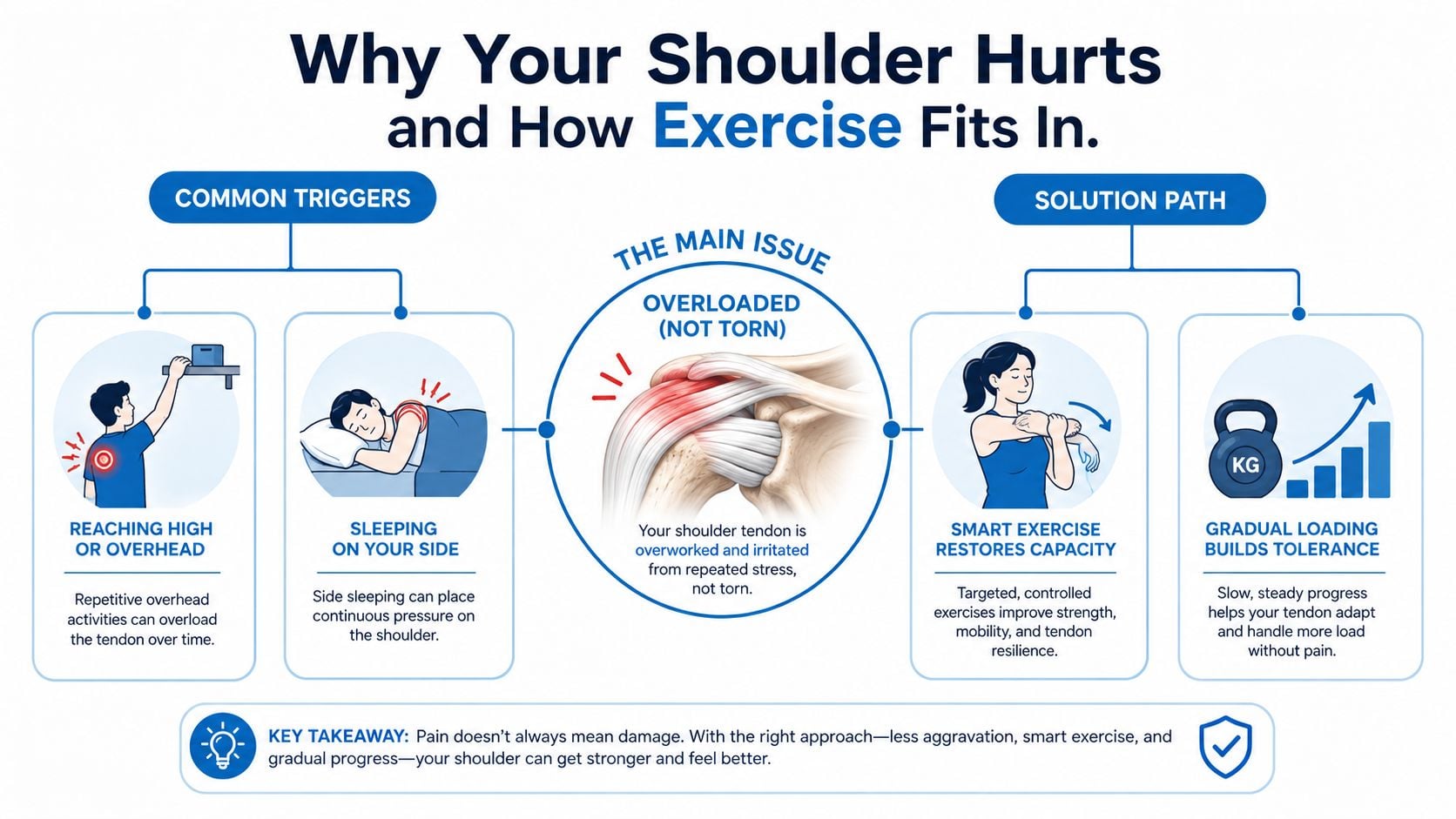
A shoulder that hurts on the top shelf, the seatbelt, or the mattress edge is usually acting like a tendon that's been asked for too much, too often. In clinical practice, that pattern commonly involves the rotator cuff tendons or the long head of the biceps tendon, and those tissues often live in a crowded subacromial area where repeated overhead work can make symptoms flare.
That's why the answer isn't to baby the shoulder forever. A 2017 systematic review and meta-analysis in adults with shoulder impingement found exercise was better than non-exercise care for pain, with an SMD of -0.94 across 5 studies and improvement in function and active range of motion, which is why exercise sits at the center of conservative care for tendon overload problems like shoulder tendonitis and impingement overlap (British Journal of Sports Medicine).
Why rest alone falls short
Tendons adapt slowly. If the shoulder stops moving and loading completely, pain can settle down for a bit, but the tendon doesn't relearn how to tolerate reaching, lifting, or overhead work.
Structured loading is what pushes the tissue toward remodeling. That's the practical reason exercises for shoulder tendonitis matter, they give the tendon a controlled dose of stress, enough to stimulate change without provoking a flare. A 2024 systematic review and network meta-analysis found specific shoulder exercises produced modest but measurable benefits for rotator cuff-related shoulder pain, with pain improving on the SMD -0.31 scale and function improving on the Constant-Murley Scale and DASH, with slightly better benefits within 2 months (PMC12011739).
Practical rule: the goal is not zero pain at all times. The goal is a shoulder that can tolerate more activity next week than it could last week.
A useful mental model is simple. Rest can calm the alarm, but loading teaches the tissue how to work again. That's why the first line of care is usually a staged home program, not a long break from movement.
Anatomy and Common Causes of Shoulder Tendonitis
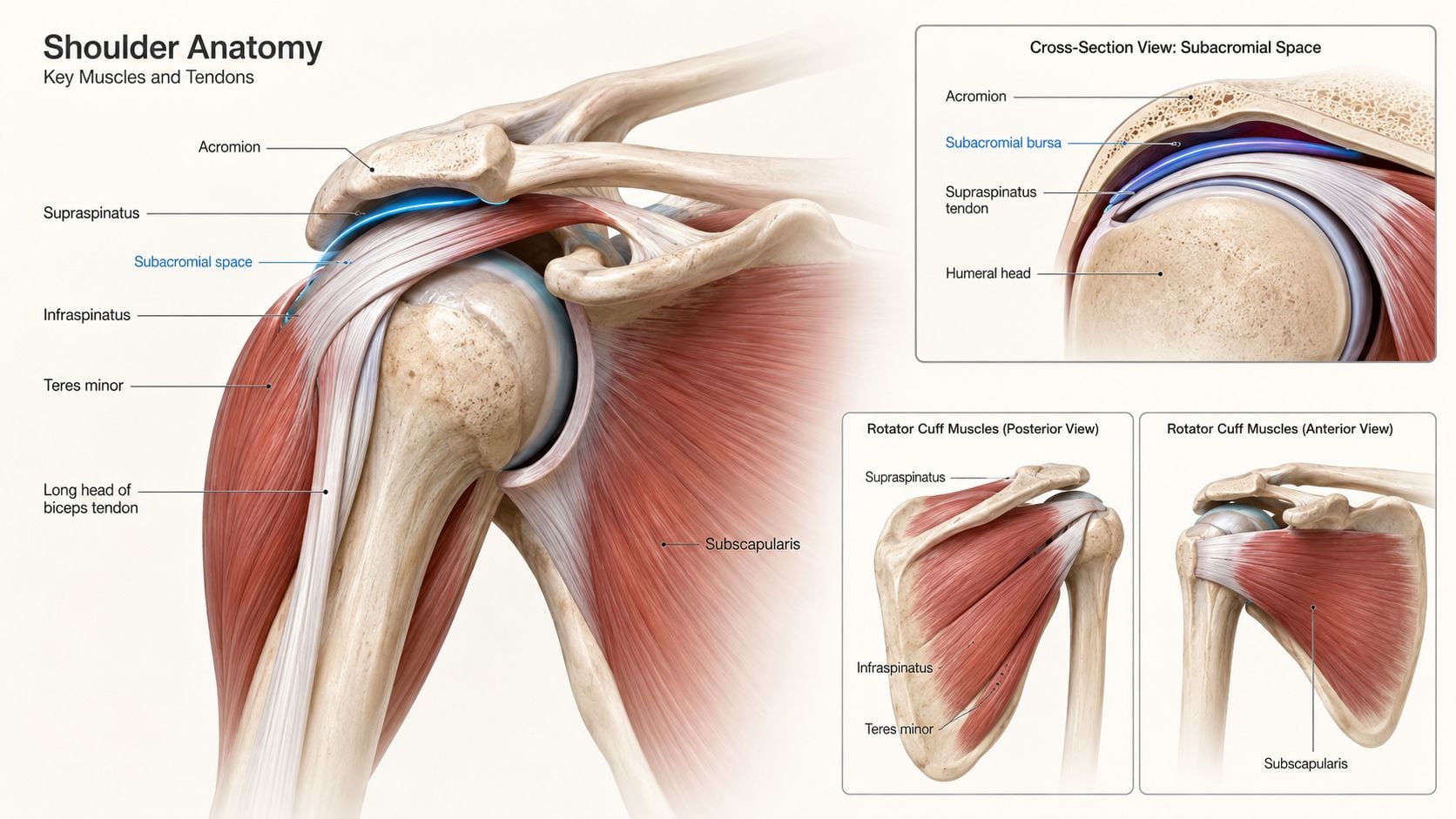
The shoulder is not one tendon with one job. It's a team. The supraspinatus, infraspinatus, teres minor, and subscapularis stabilize the joint as the arm moves, and the long head of the biceps tendon can also become a pain generator in front-of-shoulder pain patterns.
What the terms really mean
People often use tendonitis, tendinosis, and impingement as if they're the same thing. They overlap in daily language because they can feel similar, but they're not identical. Tendonitis implies irritation and pain, tendinosis points more toward chronic tendon change, and impingement describes a mechanical pinch pattern that can aggravate the same tissues.
That overlap matters because it affects how the shoulder responds to movement. A person who hurts during overhead reaching may not need complete avoidance of arm use, but they usually do need cleaner mechanics and lower-irritation loading. For a plain-language medical overview of tendon and bursa irritation, the tendinitis and bursitis overview is a useful reference point.
Common drivers that keep the tendon irritated
Repetitive overhead work is an obvious trigger, but it's not the only one. Throwing sports, sudden jumps in training load, rounded-shoulder posture, and poor scapular control can all increase the tendon's workload.
Age-related tendon change also lowers the margin for error. That doesn't mean the shoulder is “broken,” it means the same load that used to be fine may now be too much if it arrives without preparation. In clinic, the pattern is often a combination of one main trigger and several smaller ones, like desk posture, weekend lifting, and sleeping on the painful side.
A quick self-check helps separate likely tendon pain from something more serious. Tendon pain usually gets worse with reaching, lifting, or lying on that side, but still allows some movement. A true tear, dislocation, or neck-related referral often brings different features, such as sudden loss of strength, obvious deformity, or symptoms that travel farther down the arm. Imaging and a hands-on exam are what sort that out for real.
A shoulder diagnosis based on one painful movement is shaky ground. The history matters, the exam matters, and the tissue response to loading matters.
Pain-Relieving Stretches to Start With
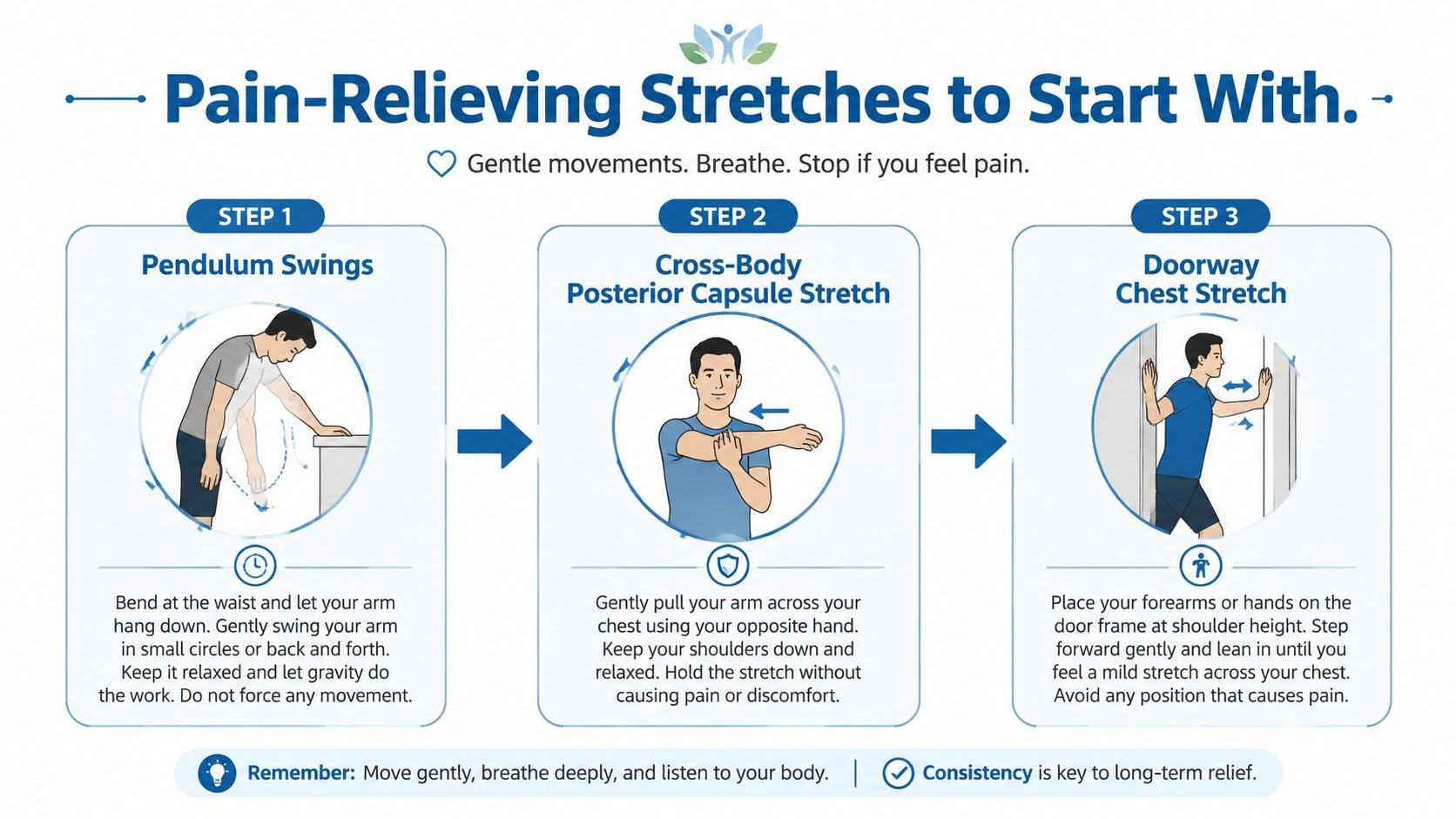
Early-stage mobility work should feel like a mild pull, not a jab. The point is to restore motion and reduce guarding without forcing the shoulder into a position that narrows the space under the acromion or ramps up irritation.
Pendulum swings and cross-body work
Pendulum swings are the easiest place to start. Bend forward at the hips, support the other hand on a counter, and let the sore arm hang loose while the body creates a small, gentle swing. The arm should stay passive, because the body is supposed to move it, not the shoulder muscles.
Cross-body stretching comes next if the shoulder tolerates the first movement. Bring the affected arm across the chest and use the opposite hand to guide it until the back of the shoulder feels a steady pull. Keep the elbow from drifting far away from the body, because that habit tends to turn a stretch into a cranky compression pattern.
Sleeper and doorway stretch details
The sleeper stretch is useful when the back of the shoulder feels tight, but it needs a careful setup. Lie on the painful side with the shoulder and elbow bent, then gently guide the forearm downward only until a mild stretch appears. If the front of the shoulder pinches, the setup is wrong or the shoulder is being pushed too far.
The doorway pectoral stretch helps if the chest is pulling the shoulder forward. Forearms on the frame, small step through the doorway, and a calm breath out is usually enough. The stretch should be brief and controlled, matching common protocol ranges of 15 to 30 seconds per hold, with repetition used more often than long grinds.
Form errors that make symptoms worse
- Using the shoulder in a pendulum: the arm should dangle, and the trunk should create the swing.
- Letting the elbow flare during cross-body or band work: that often increases rotator cuff demand.
- Pushing into a pinch: a stretch is supposed to feel like length, not a sharp catch.
Short daily sessions tend to work better early on than occasional aggressive stretching. The shoulder usually responds better to repeated small wins than to one long battle.
Progressive Strengthening Exercises With Reps, Sets, and Frequency
Strengthening should be phased, not random. The shoulder doesn't need every exercise on day one, it needs the right exercise at the right irritability level, then gradual progress once the tissue settles.
| Shoulder Tendonitis Strengthening Progression | ||||
|---|---|---|---|---|
| Phase | Focus | Sample Exercises | Sets x Reps | Frequency |
| Phase 1 | Control and low-irritation loading | Scapular retraction, low row, band external rotation with elbow tucked at 90 degrees | 2 to 3 sets of 8 to 15 repetitions | 2 to 3 times per week on non-consecutive days |
| Phase 2 | Build endurance and mechanics | Rows, serratus punches, prone Y to W patterns | 2 to 3 sets of 8 to 15 repetitions | 2 to 3 times per week |
| Phase 3 | Higher-load function | Overhead press variations, heavier band or dumbbell work | Progress only if symptoms stay quiet | Non-consecutive loading days |
Phase 1, calm the joint and wake up the cuff
Scapular retraction is the simplest start. Sit or stand tall, gently draw the shoulder blades back and slightly down, and avoid shrugging into the neck. The movement should feel small and clean, because the goal is control, not force.
Band external rotation with the elbow tucked at 90 degrees is one of the most useful rotator cuff drills. Keep the upper arm close to the torso, rotate the forearm outward, and return slowly. That elbow position matters because it keeps the movement honest and avoids turning it into a whole-shoulder compensation.
Phase 2, add load without losing position
Once motion is less reactive, rows and serratus punches help restore better shoulder blade mechanics. Rows teach the upper back to support pulling, while serratus work improves upward rotation and control during reaching. Prone Y to W patterns can be added if the shoulder tolerates prone positions without a flare.
The dosage stays grounded in the same window, 2 to 3 sets of 8 to 15 repetitions, done 2 to 3 times per week on recovery days. That spacing matters because tendons need time between strengthening sessions.
Phase 3, earn overhead work
Overhead press variations belong later, not early. If the shoulder stays calm with lower-level loading, then a carefully reduced-range press can become part of the plan.
That's also where broader fitness planning helps. A practical exercise library can make it easier to build a weekly routine, and the exercise and fitness resources page can be useful for general program ideas once the shoulder is ready for more structured training.
Clinical cue: if the shoulder can't stay aligned during a small external rotation, it's not ready to be asked for overhead strength.
How to Adjust When Pain Persists or Flares Up
Most online lists stop at “do the exercises gently.” That's not enough. The body needs decision rules, especially when pain persists after a session or feels different from day to day.
Three rules that make progress safer
Rule 1, adjust the load. If pain climbs hard during a set or stays raised long after the session, reduce resistance or shorten the range before reducing frequency. Cutting the weight or the motion usually solves the problem faster than doing the same thing less often.
Rule 2, respect the range. A pain-free endpoint beats pushing into a pinchy position. The shoulder doesn't get extra credit for reaching farther if the last part of the movement is the part that keeps irritating the tendon.
Rule 3, keep recovery built in. Strengthening works best on non-consecutive days. A 24 to 48 hour gap between resistance sessions gives the tendon time to settle and adapt, which is why repeated hard loading on back-to-back days usually backfires.
What acceptable soreness looks like
Mild muscle effort, a brief ache that fades, and temporary stiffness after exercise can all be part of rehab. Sharp catching pain, escalating night pain, or soreness that gets worse every session points in the wrong direction.
If the program stalls, the first move is usually to simplify, not quit. Switch to a lower-irritation exercise, trim the range, and then rebuild. For cases where pain seems driven by muscle guarding or surrounding soft tissue sensitivity, the myofascial pain syndrome resource can help explain why the surrounding muscles matter too.
When pain changes the way the shoulder moves, the exercise dose needs a change before the tissue does.
Warning Signs You Should Not Push Through
A shoulder rehab session should not become a test of endurance against bad symptoms. Sharp catching pain, sudden weakness, visible swelling, bruising, or numbness and tingling down the arm are not normal training signals, and they're not things to keep “working through.”
Night pain that keeps disrupting sleep despite position changes is another reason to stop pushing. So is a clear loss of function, like suddenly not being able to lift the arm the way it moved earlier in the week. Those patterns can reflect a tear, another structural problem, or pain coming from a different source altogether.
The usual early response to good conservative care is some improvement in 2 to 6 weeks, with fuller return to loading taking longer. If the shoulder is not trending better by the six-week mark, or if red flags show up sooner, the case needs an in-person assessment.
Push-through advice can turn a manageable tendon problem into something much harder to calm down. The body gives a different signal for effort than it does for injury, and learning that difference protects the shoulder.
Self-Care, Adjuncts, and When to See a Specialist
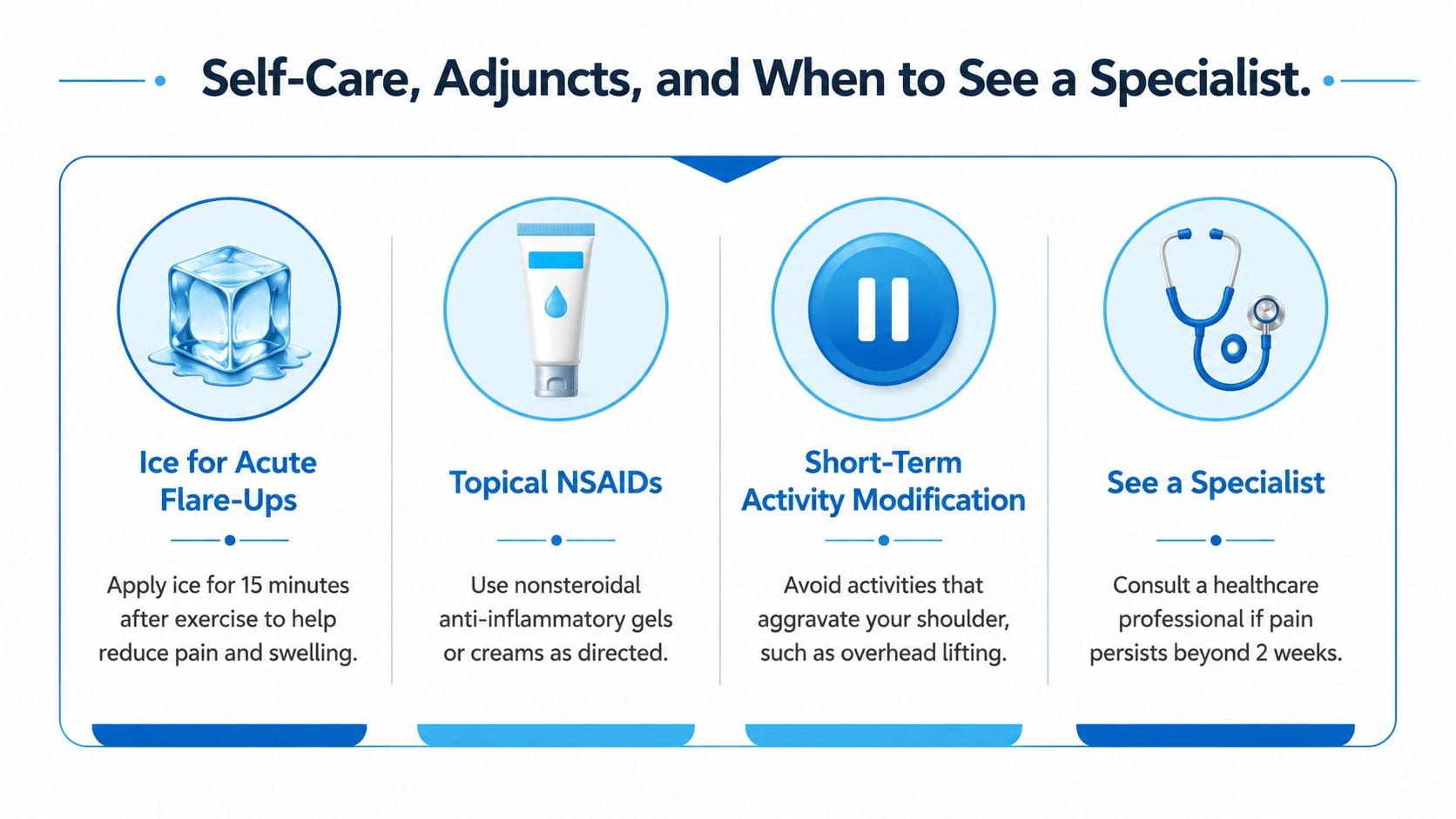
Exercise is the foundation, but it doesn't have to stand alone. Short-term activity modification, ice after a flare, and sleep positioning that supports the arm can all lower the irritability enough for the exercise plan to work.
What can help without taking over the plan
Ice is useful after a spike in symptoms, especially when the shoulder feels hot or reactive. Topical NSAIDs can also be part of symptom control when they're appropriate and used as directed. If overhead reaching keeps provoking pain, temporary avoidance of that motion gives the tendon room to settle without forcing total rest.
Sleep matters more than people think. Supporting the affected arm with a pillow often reduces the pull that happens when the shoulder hangs forward overnight. That simple change can cut down on waking pain and make the next day's exercises more tolerable.
When adjuncts become reasonable
Some shoulders need more than home care. If pain keeps blocking movement, a clinician may consider imaging, injection-based care, or other procedures depending on the exam findings. The corticosteroid injection overview explains one commonly discussed option when inflammation is standing in the way of rehab.
A broader conversation can also include other modalities, but they should complement loading rather than replace it. For people curious about light-based adjuncts, the red light therapy for tendonitis discussion is a reasonable starting point for understanding where it may fit, if at all, alongside a structured program.
When specialist evaluation makes sense
Persistent weakness, suspected tear, pain that limits basic daily tasks, or a shoulder that won't progress all justify specialist review. That's where a multidisciplinary clinic can sort out whether the issue is mainly tendon overload, bursitis, joint irritation, or something that needs procedural care.
Interventional Pain Management evaluates joint and spine-related pain with the goal of matching treatment to the actual problem, whether that means conservative care, imaging, injections, or another next step. For shoulder tendonitis that won't settle, a focused exam can keep the recovery plan from drifting.
If shoulder pain is still getting in the way of sleep, work, or lifting after you've tried a structured program, it's time to have it examined. Interventional Pain Management offers diagnosis and treatment options for joint and soft tissue pain, including evaluation when exercise alone isn't enough, so visit Interventional Pain Management to discuss the next step.