
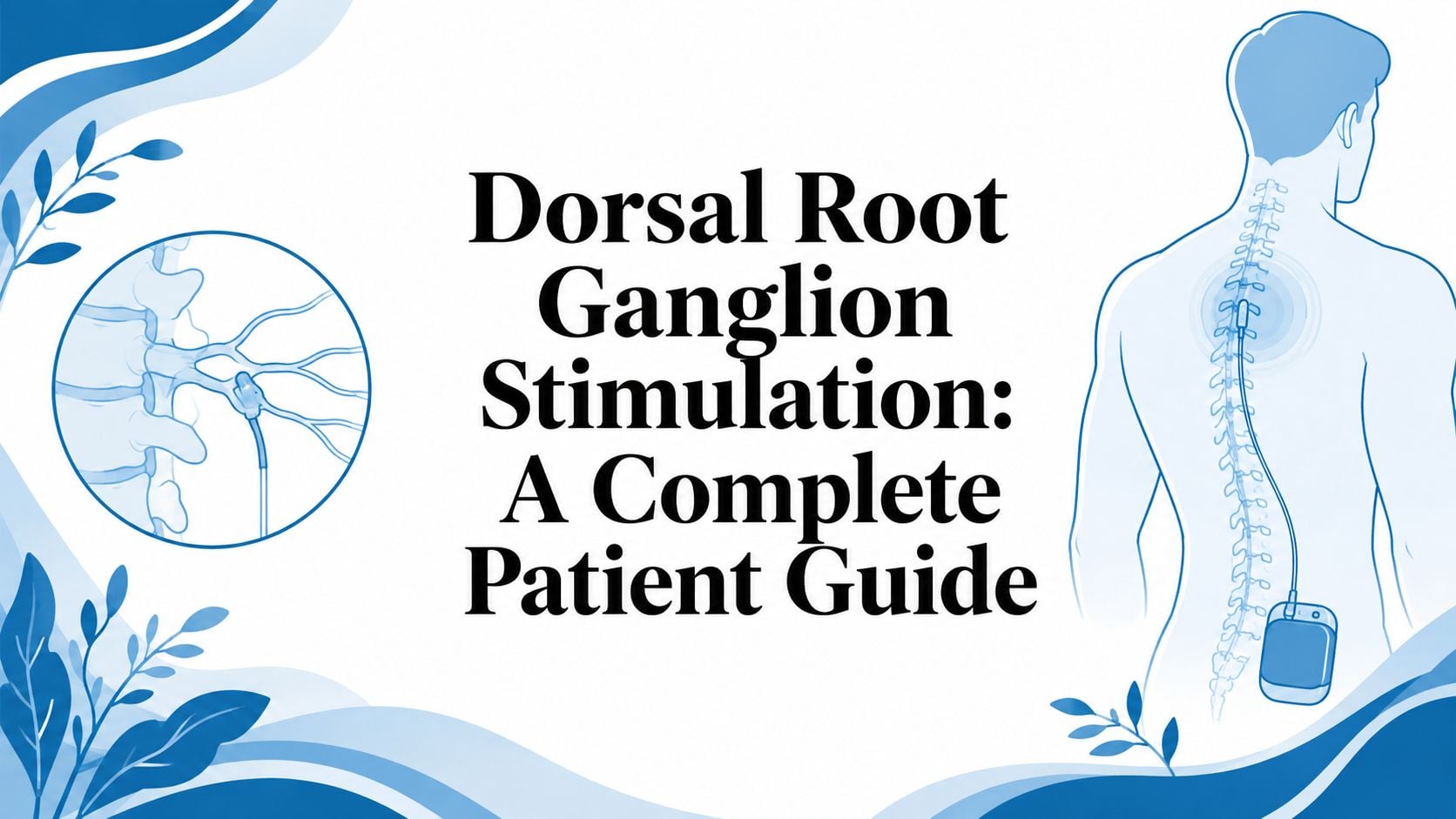
Burning pain in one foot, deep groin pain after surgery, or a patch of leg pain that never really matched the scan can leave a person stuck between two bad options. Medications blur the pain but do not solve it, injections may help briefly, and surgery can still leave the same nerve pain behind. Dorsal root ganglion stimulation is different because it tries to treat a specific nerve junction, not the whole pain area.
That precision is why this therapy gets its own conversation. It sits inside the broader world of neuromodulation, which means using an implanted device to change pain signaling before those signals keep traveling upward. For some patients, that is the first treatment that finally fits the shape of the pain.
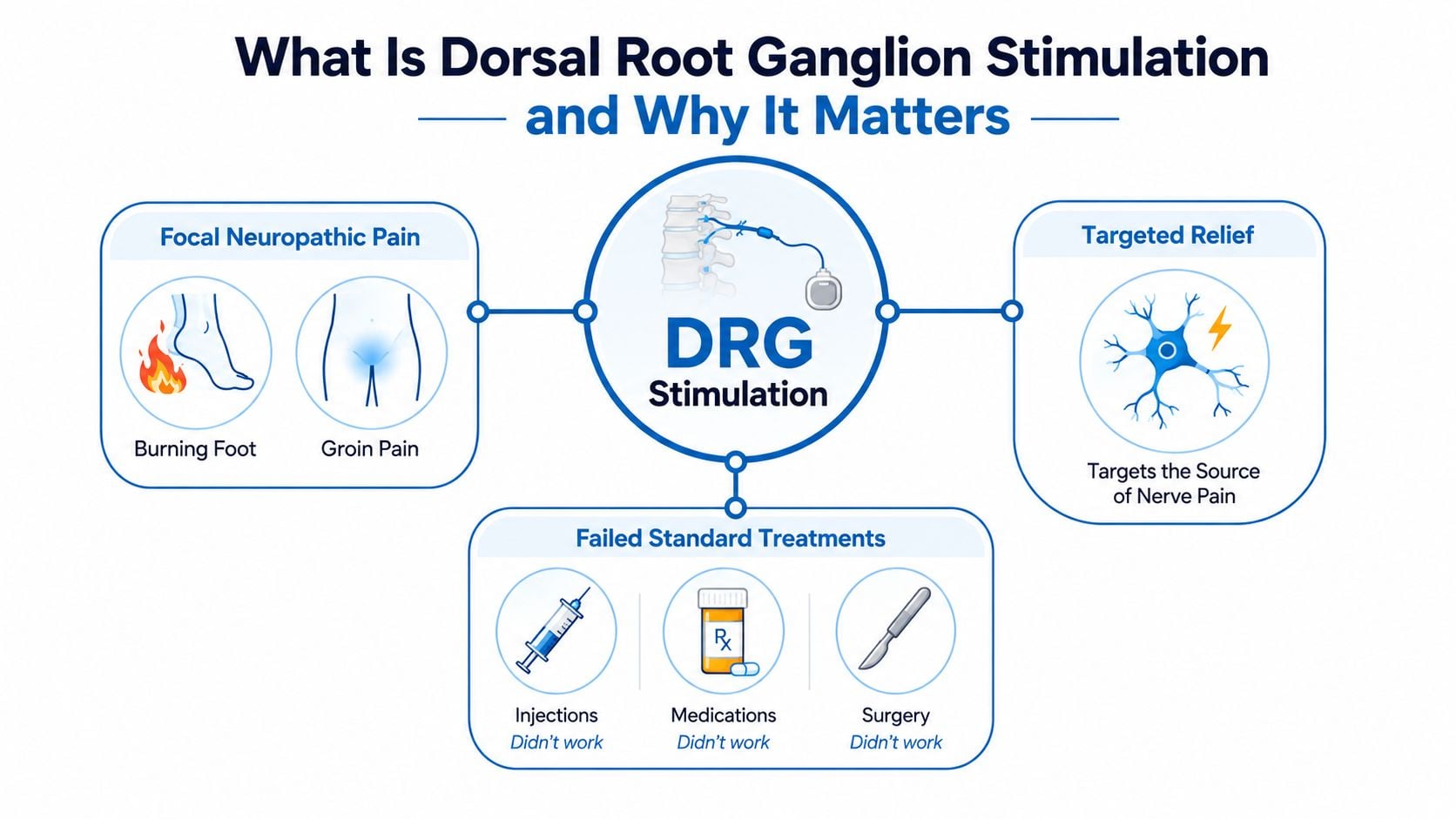
Table of Contents
- What Is Dorsal Root Ganglion Stimulation and Why It Matters
- How DRG Stimulation Works and How It Differs from Spinal Cord Stimulation
- Clinical Indications and Who Makes a Good Candidate
- What the Evidence Actually Shows About Outcomes
- The Trial Period, Implant Procedure, and Recovery
- Benefits and Risks Compared to Spinal Cord Stimulation
- Follow-Up Care, Device Management, and Long-Term Realities
- Insurance, Scheduling, and Your Next Steps
What Is Dorsal Root Ganglion Stimulation and Why It Matters
A person with burning foot pain, groin pain, or a stubborn post-surgical nerve injury often reaches a familiar point. The usual treatments have already been tried, the pain still has a sharp edge, and the question becomes whether a more exact option is available.
Dorsal root ganglion stimulation is that more exact option. It places a small implanted system near the dorsal root ganglion, a cluster of sensory nerve cell bodies just outside the spinal cord, and uses electrical signals to change how pain is carried forward. The therapy moved into mainstream clinical use after the U.S. Food and Drug Administration approved it in February 2016 (PMC review).
That milestone matters for a practical reason. It means this is a real part of routine pain care, not a theory sitting outside everyday practice. At the same time, it remains a selective form of neuromodulation, and that selectivity is the reason clinicians often describe it as a precision tool for focal neuropathic pain, especially when the painful area maps cleanly to one nerve root or a narrow region of the body.
Why patients hear about it separately
The therapy gets discussed apart from other nerve stimulation options because it does one job very specifically. It does not try to cover a broad area at once. Instead, it targets a small nerve junction so the electrical field stays tight and anatomically meaningful, which is why it is often raised for foot, groin, and knee pain.
That narrow focus is useful when pain behaves like a small, well-drawn map rather than a wide, blurry zone.
Practical rule: if the pain can be drawn on one small map, a focal therapy has a better chance of matching it.
The evidence base also explains why people hear about it. Early work showed 8 of 10 trialed subjects achieved pain relief with no adverse events, and later multicenter work reported efficacy in 32 patients followed for 6 months (PMC review). That history helped establish dorsal root ganglion stimulation as a credible option when standard measures have not been enough.
How DRG Stimulation Works and How It Differs from Spinal Cord Stimulation
A patient with pain confined to the foot, groin, or one side of a limb often wants a therapy that reaches the right spot without spreading everywhere else. Dorsal root ganglion stimulation is built for that kind of problem. Spinal cord stimulation covers a broader area, while DRG stimulation acts more like a focused beam aimed at a single nerve junction.
The anatomic difference explains the clinical difference. The dorsal root ganglion sits at the edge of the spinal canal, close to the point where sensory signals enter the nervous system. Because the electrical field is delivered there, the coverage is usually more focal than traditional spinal cord stimulation, which can help when the painful area is a small patch of skin, a toe, a groin region, or one side of a limb (anatomy and technique review).
What patients usually notice
Patients often hear about DRG stimulation when broader coverage would be too diffuse or harder to place cleanly. That narrower field can also stay steadier in anatomically tricky zones, where ordinary stimulation may shift when a person bends, sits, or walks.
The effect is not only about where the lead sits. Low-frequency stimulation has been shown to increase Ca2+ influx in DRG neurons, reduce repeated action potentials, and slow conduction velocity, which can dampen pain signaling before it reaches the spinal cord (mechanism and best-practice review).
A simple way to explain it
- Broad coverage helps when pain is spread out.
- Targeted coverage helps when pain stays in one region.
- Exact placement matters because the lead must sit near the ganglion, so the procedure is more anatomy-driven than a standard place-it-and-see approach.
The best candidates usually have pain that behaves like a nerve-root problem, not a whole-body pain problem.
That is why clinicians separate these therapies. They can overlap, but they are not interchangeable. The main question is which one matches the pain pattern more closely.
Clinical Indications and Who Makes a Good Candidate
A patient with a small, stubborn pain pattern is often the kind of case where dorsal root ganglion stimulation gets considered. The clearest fit is complex regional pain syndrome, especially in the lower limb, along with other focal neuropathic pain syndromes that stay tightly localized. In a careful CRPS evaluation, the therapy usually enters the discussion after conservative care, injections, and medication strategies have not produced durable relief. For a plain-language overview of CRPS itself, see complex regional pain syndrome care.
The evidence becomes less certain as the pain pattern gets broader or less classic. Pelvic pain, groin pain, phantom limb pain, trunk pain, and axial back pain have all been studied, but the support is thinner and often comes from case series or cohort reports rather than large controlled trials (PubMed review). That does not mean the therapy never helps in those situations, only that the confidence level is lower and counseling should say that plainly.
What a good candidate usually looks like
A sensible candidate often has pain that is:
- Well localized, so the target can be identified.
- Neuropathic in character, meaning burning, shooting, or electrical.
- Refractory to standard care, including medications, injections, or other conservative treatment.
- Compatible with a trial procedure, because the trial is how benefit gets tested before a permanent implant.
Pain that spreads across the back, both legs, or several unrelated regions is less likely to fit this approach. The lead has to sit near the ganglion that matches the painful territory, so diffuse pain gives the therapy a blurry target, much like trying to tune a single radio station in a room full of static.
Technique matters here. Leads are usually placed through the foramen near the ganglion, and best practice emphasizes fluoroscopic optimization, curved sheaths, and tension-loop methods to keep the lead stable, especially at challenging levels such as S1. Those details matter because the implant is a precision therapy, not a broad field treatment.
Who usually should not move forward right away
Some patients need other issues addressed first. Untreated infection, unstable psychiatric comorbidity that would interfere with coping or follow-up, and pain that is too diffuse for focal targeting all weaken the case for proceeding. A trial only helps when the anatomy and the symptom map line up.
A focused consultation should sort out whether the pain matches the tool. CRPS remains one of the clearest use cases for this therapy, while pelvic, axial, and salvage situations still require more careful counseling about how much the evidence can support.
What the Evidence Actually Shows About Outcomes
A patient with focal CRPS pain often wants the same practical answer before committing to a device. Will this help enough to matter in daily life, and is the evidence strong enough to justify the procedure? The best-known study that moved dorsal root ganglion stimulation into mainstream pain practice was the ACCURATE randomized trial, published in 2017. It enrolled 152 patients and showed treatment success at 3 months in 81.2% of DRG patients (56/69) versus 55.7% of spinal cord stimulation patients (39/70), a statistically significant difference with P < 0.001 (ACCURATE trial).
That early advantage did not fade right away. Follow-up data reported in the trial literature showed treatment success of 74.2% for DRG stimulation versus 53.0% for spinal cord stimulation at 12 months, along with meaningful quality-of-life gains (ACCURATE trial). Separate pooled efficacy reporting found mean pain scores dropping from 7.8 at baseline to 3.4 at 12 months, and 63% of patients achieved at least 50% pain relief (ACCURATE trial).
What “success” means in real life
Those numbers matter because they connect to everyday function, not just charted pain scores. For many patients, success means walking farther, standing longer, sleeping better, or relying less on rescue measures. A review of the field classified the evidence as Level II, moderate, because the base rests on one high-quality randomized controlled trial plus two lower-quality studies (PMC review).
Success is still a clinical judgment, not a single score on a page. A person can have less pain and still feel disappointed if the improvement does not translate into movement, sleep, or enough control to leave the house more often.
Important limit: strong short-term and one-year results do not automatically tell the full story about durability beyond the early years.
That limit matters most outside CRPS. The evidence for pelvic pain, groin pain, trunk pain, phantom limb pain, and diabetic neuropathy is much weaker, so outcomes there are less predictable and should be framed carefully (PubMed review). The same is true for salvage use after a prior neuromodulation failure, which may be clinically reasonable but still sits outside the strongest evidence base.
A safety analysis reported an overall incidence rate of 3.24% for DRG stimulation, compared with 3.09% for fully implantable spinal cord stimulation systems in the same reporting framework (ACCURATE trial). That does not remove risk, but it helps explain why the therapy earned credibility in major pain practices.
The Trial Period, Implant Procedure, and Recovery
The process usually starts with a screening visit. A pain specialist reviews imaging, prior treatments, pain location, and the general fit for a focal neuromodulation approach, then decides whether a trial makes sense. The trial matters because it gives a real-world answer before anyone commits to a permanent implant.
During the trial, a temporary lead is placed through a needle, usually under light sedation, and the patient goes home for roughly a week with an external controller. The goal is simple, but strict, meaningful pain reduction during ordinary activities. A successful trial is generally defined by at least 50% pain reduction with stable coverage.
What happens next if the trial works
If the trial helps, the permanent implant is scheduled. A small generator is placed under the skin, often in the buttock or abdomen, and the lead is connected and tunneled beneath the skin to the device. The procedure is usually outpatient, and the patient goes home with wound care instructions and early activity limits.
If the trial does not work, that is useful information too. It means the pain map, the anatomy, or the stimulation pattern did not line up well enough to justify permanent implantation.
A practical summary of the workflow is below.
| Step | What the patient experiences | Why it matters |
|---|---|---|
| Screening | Review of history, imaging, and pain pattern | Confirms whether the target is focal enough |
| Trial | Temporary lead for about a week | Tests relief during normal life |
| Implant | Permanent device placed under the skin | Makes the therapy durable |
| Recovery | Short period of healing and restrictions | Protects the lead and incision sites |
After implant, recovery is usually measured in weeks rather than days. Early follow-up is used for wound checks, initial programming, and fine-tuning. That adjustment period matters because the first setting is rarely the last setting.
The procedure itself is not a magic switch, it is a staged test of fit. Patients who understand that sequence tend to judge the therapy more realistically and handle the follow-up period with less frustration.
Benefits and Risks Compared to Spinal Cord Stimulation
The main benefit of dorsal root ganglion stimulation is precision. Compared with spinal cord stimulation, it tends to place the electrical field where the pain is, which can make it useful for focal nerve pain that would otherwise be hard to capture. It also tends to show less positional variability, so the coverage is less likely to feel like it changes every time the body position changes.
That said, precision has a cost. Lead placement is more technically demanding because the foramen and ganglion must be accessed accurately, and the system may require more careful procedural planning than broader stimulation. The early literature also raised meaningful revision and lead-management concerns, which is why the follow-up burden should never be glossed over.
The tradeoffs patients should weigh
- More focused relief: a better match for small, anatomically defined pain regions.
- Less diffuse stimulation: less need to cover the entire spinal cord.
- More technical complexity: the lead path is tighter and more anatomy-sensitive.
- Device commitment: follow-up, reprogramming, and possible revisions are part of the deal.
MRI and device-access questions also matter. Some systems have more limited imaging flexibility than modern spinal cord stimulation systems, so the patient's likely future imaging needs should be discussed before any implant decision is made. That conversation is especially important for people with spine disease, joint disease, or other conditions that may require repeated imaging later.
A good implant discussion includes lifestyle, future imaging, and willingness to return for programming, not just the chance of pain relief.
The comparison with spinal cord stimulation should stay honest. DRG stimulation can be the better fit for a small, stubborn pain territory, but it is not universally superior for every neuropathic pain problem. A focused option only wins when the target is focal.
spinal cord stimulation guidance is often part of that decision process when the pain pattern is broader or the anatomy is less clear.
Follow-Up Care, Device Management, and Long-Term Realities
An implant does not end treatment, it begins a maintenance relationship. The device has to be checked, adjusted, and matched to real life, because pain rarely stays perfectly still. Patients often return several times during the first year for reprogramming and incision checks, then come back later as needed if activity, posture, or symptom behavior changes.
The practical goal is to keep the stimulation useful without making the system more complicated than it needs to be. The best-practice review recommends programming the therapy below sensory perception and using the lowest possible efficacious dose, because energy use affects both comfort and device performance (best-practice review). The settings should do their job without drawing unnecessary power or creating a distracting sensation.
A good follow-up plan usually includes several parts:
- Reprogramming visits: to refine coverage when pain shifts.
- Battery management: to keep the system working efficiently.
- Imaging planning: to confirm which scans are allowed with the implanted system.
- Troubleshooting: to look for lead migration or loss of benefit.
Long-term care also comes with uncertainty. Some patients keep a strong response, some need occasional adjustments, and some notice the benefit fading over time. Reviews of the therapy describe the evidence base as still maturing, especially for later outcomes, so long-term expectations should stay realistic rather than rosy (PMC review).
Salvage use after a failed spinal cord stimulator is discussed more often now, but the evidence is still weaker than it is for classic CRPS and other focal limb pain patterns. That difference matters. A salvage attempt may still be reasonable, but it should be framed as a more uncertain path, not a guaranteed second chance. DRG stimulation can still help some patients in that setting, yet the level of confidence is lower than in the better-validated uses.
The same honesty applies to day-to-day device decisions. MRI access, reprogramming needs, and the possibility of revision should be part of the conversation before any implant is placed. Patients who understand that tradeoff usually make better choices, because they are deciding about a therapy that works more like an adjustable tool than a one-time fix.
A successful implant is a structured way to manage a focal pain problem with ongoing follow-up and realistic expectations. It can be a good fit when the pain target is narrow and the patient is willing to stay engaged with the device over time.
Insurance, Scheduling, and Your Next Steps
For a patient in New Jersey or Staten Island, the next step is usually a pain consultation with a clear pain map and complete records. Prior imaging, procedure notes, and a medication list help the team decide whether the pain is focal enough to justify trial planning. Insurance carriers usually want documentation that conservative treatment has failed, plus psychosocial screening, before authorization moves forward.
Practical preparation helps the visit go faster. A short written description of where the pain starts, where it spreads, what makes it worse, and what has already been tried is often more useful than a long symptom story. Patients who are also wondering how prior imaging authorizations work can review get MRI authorization tips before the appointment, because imaging rules often affect the broader workup.
Interventional Pain Management offers a multi-specialty approach with pain management, orthopedics, and spine surgery under one roof, which can help when the diagnosis is still being sorted out. The practical advantage is coordination, not just convenience, especially when the question is whether a focal neuromodulation therapy fits the pain pattern.
If dorsal root ganglion stimulation sounds like it may fit a stubborn, focal pain pattern, schedule an evaluation with Interventional Pain Management. Their team can review your records, discuss whether a trial makes sense, and help you understand the options for targeted nerve pain care in New Jersey and Staten Island.