
The most common advice for elbow pain after weight training is also the weakest: rest, ice, and hope it disappears. That can help a flare settle, but it doesn't answer the underlying question, which is why a specific lift, grip, or elbow position keeps reproducing the pain in the first place. When that pattern is ignored, lifters often cycle between “feels better” and “hurts again,” because the load problem never gets solved.
A better approach starts with the movement that hurts, not just the side of the elbow. Inner-elbow pain during curls, outer-elbow pain on rows, pain that shows up with gripping, and pain that appears only at the bottom of a press are not the same problem even when they all get called “tennis elbow” or “golfer's elbow.” The job is to identify which movement triggers symptoms, which loads are too provocative, and which variations stay trainable while the tendon adapts.
Table of Contents
- Why Your Elbow Pain Is Not Always Tennis Elbow
- The Underlying Causes of Post-Lifting Elbow Pain
- How to Evaluate Your Elbow Pain Severity
- Immediate Self-Care and Load Management Rules
- Progressive Rehab Exercises and Return-to-Lifting Protocol
- When to Seek Professional Treatment Options
- Prevention Strategies for Long-Term Training Health
Why Your Elbow Pain Is Not Always Tennis Elbow
The side of the pain is a clue, not a diagnosis. Post-lifting elbow pain gets labeled too quickly because “tennis elbow” and “golfer's elbow” are familiar terms, but pain location alone does not tell the whole story. Pain on the inside of the elbow can come from flexor-pronator overload, but it can also reflect other irritated structures, especially when the symptom only appears in certain positions or under specific loads.
The lift matters more than the label
A more useful lens is to ask what movement brings the pain to life. Gripping a bar, curling a dumbbell, locking out a press, or row variations with hard wrist extension can all shift stress to different tissues around the elbow. That is why pain location is not the diagnosis, and why generic rest-and-ice advice often misses the mark.
The most useful question is not “Which side hurts?” It's “Which lift, grip, and elbow angle reproduce the pain?”
That question separates tendon irritation from joint or nerve-related pain patterns far better than a quick glance at the inside or outside of the elbow. It also explains why a lifter can feel fine during one exercise and get sharp symptoms on another movement with the same muscle group. In practical terms, the body is tolerating some patterns and rejecting others.
When pain shows up only with certain grips, ranges, or elbow positions, the working diagnosis usually gets clearer. If a movement-specific pattern keeps repeating, the fix is usually movement-specific too. That means the solution is rarely complete shutdown, and it's rarely random stretching.
Why the same ache can mean different problems
Inner-elbow pain after curls is not automatically golfer's elbow. Repetitive loading, a wrist that collapses back, or even nerve irritation can mimic tendon pain, which is why self-diagnosis based only on the painful side is unreliable. Pain with bending versus straightening can point toward very different causes, including tennis elbow, golfer's elbow, biceps tendinitis, bursitis, ulnar nerve entrapment, or elbow osteoarthritis.
That distinction matters because the next step changes depending on the source. Tendon pain responds to load management and progressive adaptation, nerve pain often needs a different clinical workup, and joint pain can require a different treatment path entirely. The wrong label leads to the wrong rehab plan, then the same pain comes right back.
The Underlying Causes of Post-Lifting Elbow Pain
Pain location alone does not provide a diagnosis. After lifting, elbow pain is usually a tendinopathy or overuse problem, not a primary joint problem. The elbow often functions as the transfer point between the hand, forearm, and upper arm, so repeated pressing, pulling, gripping, dips, curls, and shoulder-press patterns can create microscopic tendon injury at the medial or lateral epicondyle. The tendon is not failing all at once, it is getting irritated faster than it can recover.
What overload looks like in real training
The tendon usually complains when load, volume, or frequency outpace recovery. Poor form, insufficient rest, and sudden load jumps are the mechanical drivers that show up again and again in lifters. That can mean too many hard sets of curls in one week, too much gripping in rows, or pressing volume that never gives the forearm tissues a quiet day.
Inner-elbow pain during gripping or curling often points toward medial epicondylitis, which reflects flexor-pronator overload. Outer-elbow pain with wrist extension or heavy curls and rows more often points toward lateral epicondylitis, which reflects wrist extensor overload. That pattern is clinically useful because the stress is usually at the tendon insertion, not the elbow capsule itself.
The tendon behaves like a rope with a fixed number of hard pulls before it starts to fray. More force is not always the problem. Too much force too often is.
The population burden is real, not just gym folklore. In one population-based study of 6,038 adults, 636 people reported elbow pain in the prior week, while 0.7% were diagnosed with lateral epicondylitis and 0.6% with medial epicondylitis; 5% of adults with epicondylitis also reported sickness absence, with a median of 29 days off work. A sports medicine review also found lateral elbow pain affects about 3% of the general population and is most common between ages 45 and 64, while symptoms may last up to 24 months in some cases even though about 80% improve by 1 year regardless of treatment, according to the review at PubMed.
Why lifters keep triggering the same tissue
Weight training is a recognized source of elbow injuries, but the elbow is still a minority site overall. In a U.S. analysis of weightlifting-related injuries, estimated annual injuries increased from 86,910 in 2010 to 109,961 in 2016, and the elbow accounted for 2.6% of weightlifting-related sprains and strains, according to PubMed. That matches what gets seen in the clinic, which is that the elbow becomes a recurring problem when upper-extremity loading is frequent, repetitive, and difficult to deload.
A practical point matters here. Pain often signals stress at the tendon insertion, not damage to the entire elbow joint. That is why correcting mechanics, reducing provocative loads, and allowing tendon adaptation usually matter more than waiting for pain to disappear.
For readers who want a broader clinical framework, internal pain pattern guidance and related elbow care concepts can help place tendon-driven symptoms in context.
How to Evaluate Your Elbow Pain Severity
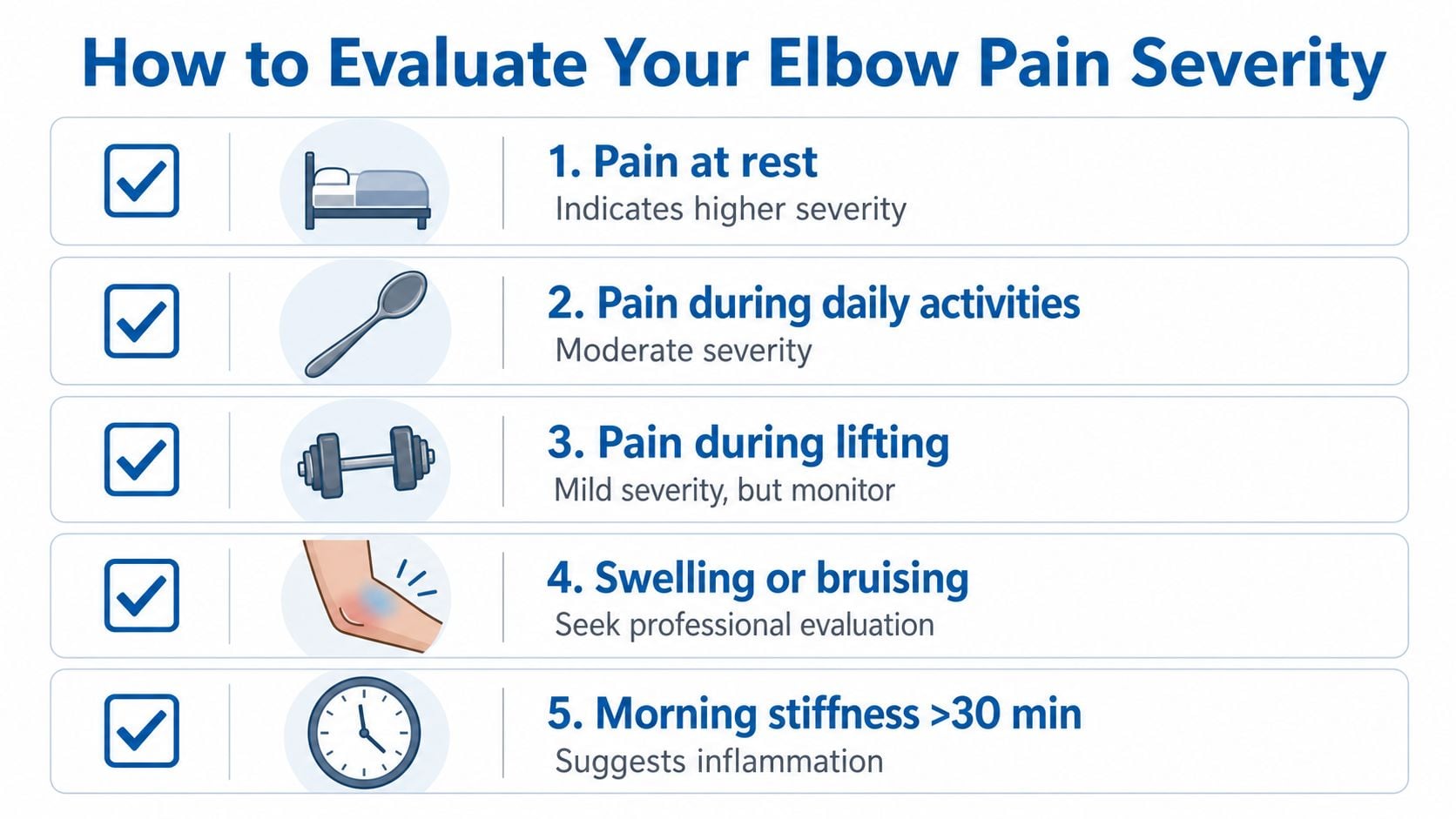
A practical check starts outside the gym. If the elbow hurts at rest, during routine daily tasks, or keeps getting worse instead of easing, that deserves more concern than soreness that only appears during one specific lift. The more the elbow complains in ordinary life, the less likely it is to be a simple training nuisance.
Simple movement checks that narrow the source
Two common provocation patterns help separate likely tendon sources. Pain with resisted wrist extension points more toward lateral epicondylitis, while pain with resisted wrist flexion points more toward medial epicondylitis. Those tests aren't perfect, but they are practical because they reproduce the same line of stress that weight training often irritates.
A 0 to 10 pain scale makes the response easier to track. A number that stays low during the movement and settles soon after points to a different problem than pain that spikes, lingers, or spreads into daily activities. If the elbow only hurts when lifting, that usually calls for load management. If the elbow hurts with simple tasks, the tissue is more irritated.
Red-flag symptoms matter more than any self-test:
- Sudden swelling or visible bruising needs prompt evaluation.
- Inability to bend or straighten the arm is not normal training soreness.
- Visible deformity suggests something more serious than overuse.
- Numbness radiating down the forearm raises concern for nerve involvement.
If the elbow changes shape, loses motion, or starts going numb, home care is the wrong plan.
Pain that shows up as morning stiffness, a sharp response to a grip test, or a weak squeeze on an everyday object helps build the picture, but it does not replace an exam when the pattern is unclear. A clinician can sort tendon, nerve, and joint sources more reliably than a mirror check or a quick internet search, especially when general elbow pain and related tissue patterns overlap with one another in a way that feels confusing at home.
For lifters who want a broader clinical frame, Interventional Pain Management's overview of general elbow pain and related tissue patterns can help place tendon-driven symptoms in context. For broader everyday joint wellness support, steady load control and symptom tracking matter more than guessing which tissue is angry.
Immediate Self-Care and Load Management Rules
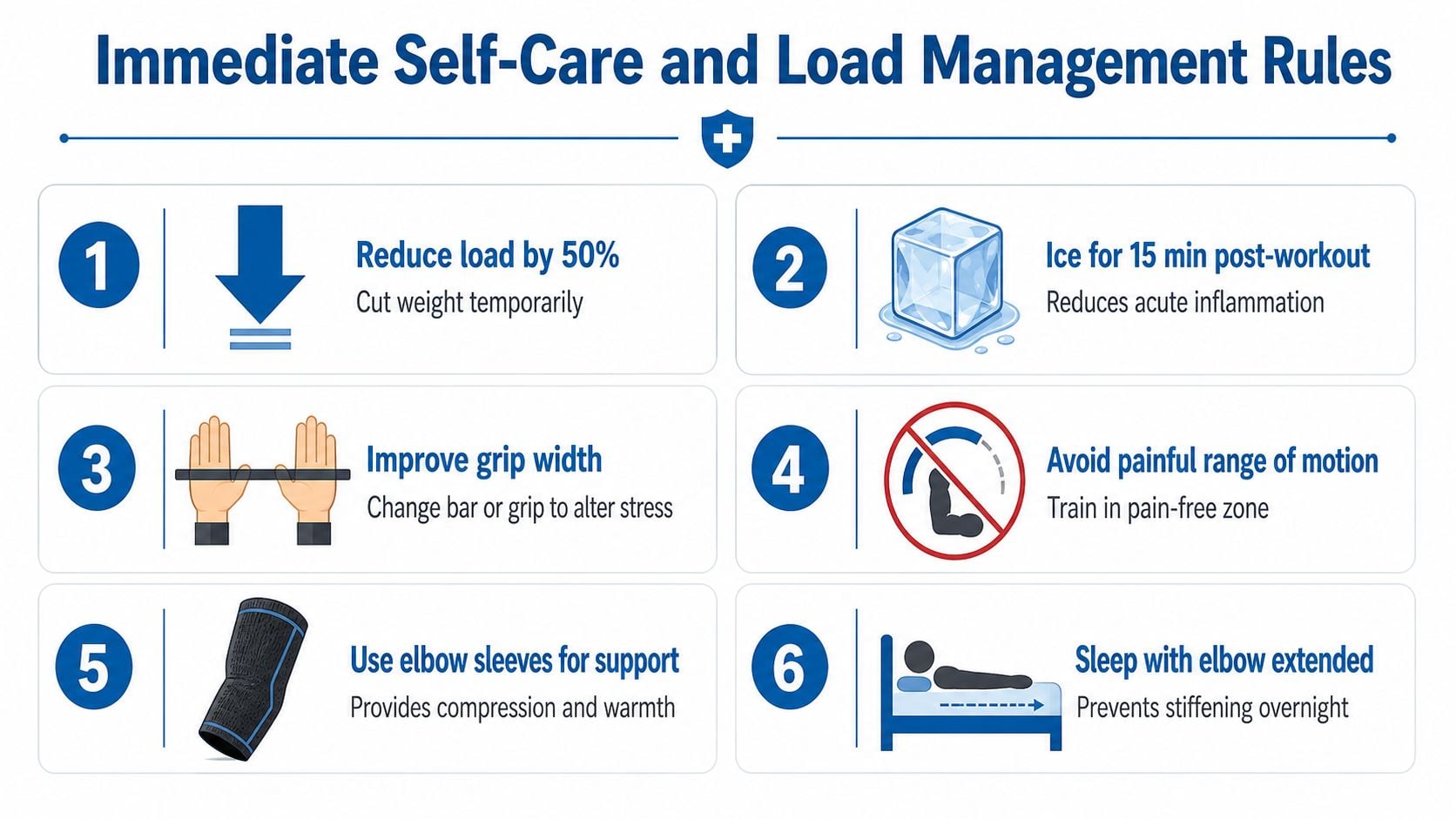
Total shutdown is usually the first mistake. Stopping every lift is often unnecessary, and for many lifters it slows the return because the elbow loses conditioning without getting a clear training signal. Keep training, but cut out the exact inputs that keep poking the irritated tissue.
What to change first
Start by reducing the aggravating lift by about 20 to 30%. Keep pain during exercise at 3/10 or lower, and watch the next day closely. If symptoms are still present or clearly worse within 24 hours, the dose was too high. That rule keeps rehab honest because the elbow has to settle before the next increase.
Use these adjustments before you scrap the session:
- Change grip width, because a narrower or neutral grip often reduces elbow stress.
- Shorten range of motion, especially on pressing movements that bother the bottom position.
- Slow the tempo, so the tendon gets a controlled dose instead of a sudden yank.
- Swap the exercise, not just the load, when one pattern keeps flaring the pain.
- Avoid the painful range, then bring it back later in small steps.
Pain that stays controlled and settles by the next day usually means the tissue is tolerating the load. Pain that lingers means the dose was too high.
A better first week protects the elbow without wrecking the whole program. Neutral grips, shallower pressing depth, and less rowing volume often keep most of the session intact. Compression sleeves can add warmth and a sense of support, but they do not replace load control.
The goal is to keep the lifter training enough to preserve strength while avoiding the movement pattern that keeps irritating the same tissue. That trade-off is usually better than chasing short-lived relief and then re-aggravating the elbow every time the bar gets heavy. For readers who want a simple everyday reference on joint comfort and recovery habits, everyday joint wellness support can be a useful general resource alongside a proper exercise plan.
Progressive Rehab Exercises and Return-to-Lifting Protocol
Rehab should feel like training, not punishment. The elbow usually responds better to a graded load it can tolerate, then a slightly bigger one once the prior dose settles cleanly. A phased plan is more useful than random rest days and guesswork, because it lets you see exactly what the tissue can handle.
Phase 1 to phase 4
Phase 1, pain relief. Start with isometric holds and keep aggravating lifts out of the picture. The goal is not to fix the tendon in a day. It is to calm the tissue enough that it can accept work again without getting louder afterward.
Phase 2, strength recovery. Add slow eccentric loading and light resistance. This is the stage where the tendon gets a more structured signal to remodel, but the loads stay modest and controlled. If the elbow reacts the next day, the dose was still too aggressive.
Phase 3, functional training. Bring back sport-specific or lift-specific movements, increase range gradually, and reintroduce the positions that had been provoking symptoms in smaller doses. Grip choice, bar path, and pressing depth start to matter as much as the exercise itself.
Phase 4, return to lifting. Increase load step by step, monitor symptoms closely, and keep the 24-hour response rule in place. The return-to-lifting question centers on whether the tissue tolerates the next dose without complaining for the next 24 hours. If the elbow flares the next day, the previous jump was too big.
The classic mistake is skipping straight from “feels better” to “full training week.” Tendons usually do not appreciate sudden surprises. They respond better to predictable repetition, steady exposure, and enough recovery time between sessions.
A simple session structure can keep rehab from taking over the whole workout:
- Two or three short rehab blocks, inserted after warm-up or at the end of the session.
- Slow tempo work, especially on the eccentric phase.
- Controlled grip work, since grip tolerance often tells the truth before the main lift does.
That structure keeps the athlete moving while still respecting the tendon's recovery capacity. It also reduces the temptation to chase a pain-free day, which is often unrealistic in a lifter who trains consistently.
When to Seek Professional Treatment Options
Elbow pain after weight training is not always a simple overload story. If pain keeps limiting lifting, starts affecting daily function, or fails to improve after careful load management over several weeks, a professional evaluation is the better move. The same applies when the pain pattern is inconsistent, the location keeps shifting, or it is hard to tell whether the source is tendon, nerve, or joint related.
What conservative care can and can't do
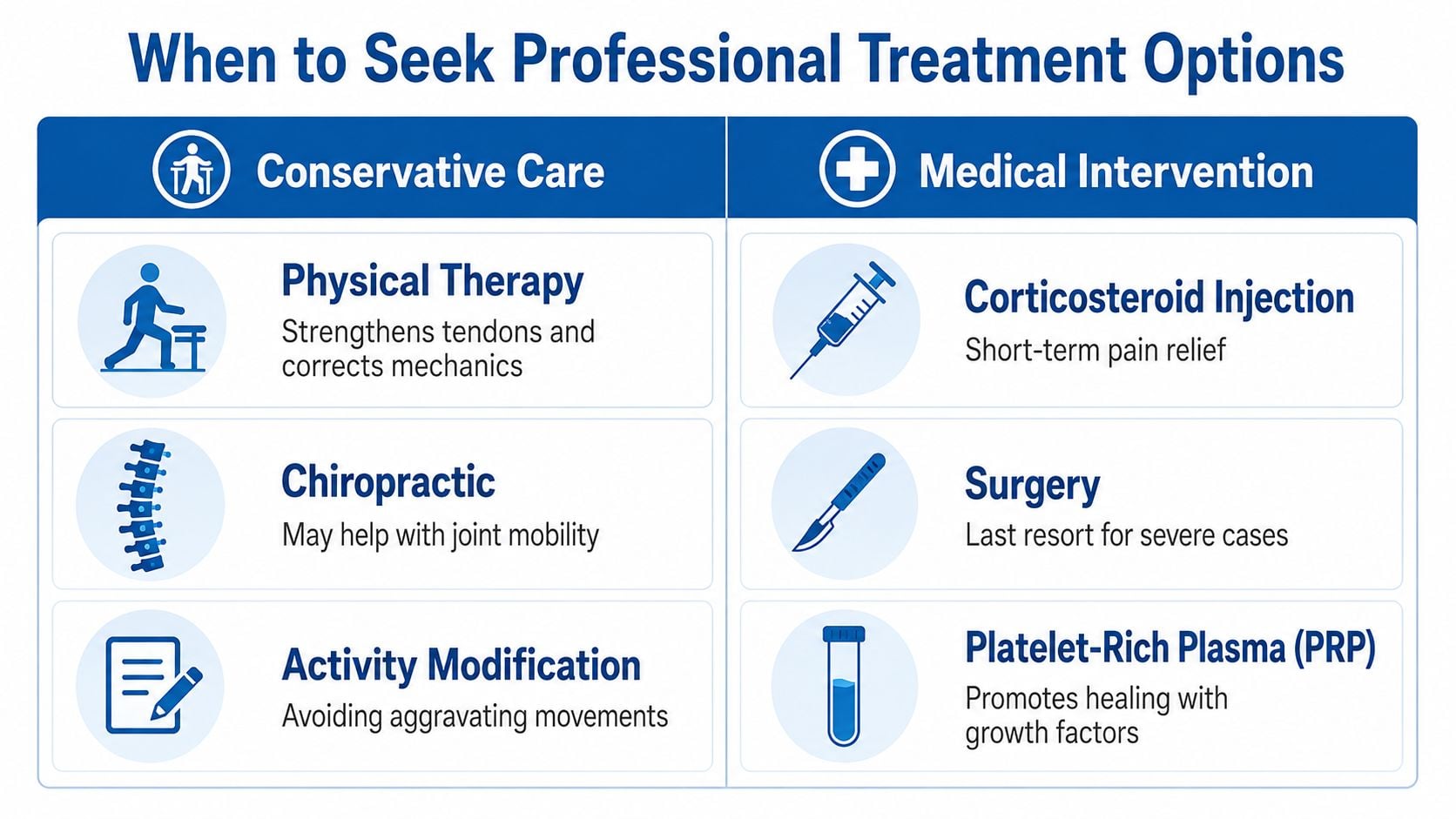
Conservative care usually starts with physical therapy, activity modification, and movement correction. These steps aim at the mechanics driving the pain, not just symptom suppression, which is why they are often the first step for lifters whose symptoms still behave like an overload problem. When the elbow responds to those changes, the tissue is still in a range where recovery is realistic.
Persistent cases call for a different conversation. A corticosteroid injection can reduce pain for the short term, but the trade-off is clear, pain relief does not correct the movement problem that created the irritation in the first place. For a closer look at that trade-off and when it fits, corticosteroid injection guidance can help frame the discussion before a consultation.
Platelet-rich plasma, extracorporeal shockwave therapy, or surgical consultation may enter the picture when symptoms have become chronic or imaging shows a structural problem that is not settling with conservative treatment. Those options are not first-line fixes for every lifter, but they matter when the tendon has stopped responding to standard progression.
Decision points that matter
Professional evaluation should move up the list when:
- Symptoms persist despite proper load management, especially if the elbow keeps flaring after training volume has already been reduced.
- Daily function is limited, because the issue has moved beyond a training annoyance.
- Numbness, visible swelling, bruising, or motion loss appears, since those patterns deserve an exam.
- The pain pattern is atypical, which raises the possibility of nerve or joint involvement.
The most useful clinic conversation stays specific. Which lift hurts, which grip hurts, which range hurts, and what happens the next day after training all tell more than a vague “my elbow hurts.” That level of detail helps decide whether the next step is more rehab, imaging, an injection, or referral for a specialist exam.
Prevention Strategies for Long-Term Training Health
The best prevention is boring in the best way. Keep the elbow in a training program that respects recovery, don't let volume jump without warning, and vary exercises enough that the same tendon isn't taking the same punishment week after week. When the elbow gets stuck doing the same job too often, it usually lets the lifter know.
Technique matters too. Keep the wrist stacked in pressing and curling patterns, avoid excessive valgus stress on pulls, and use straps when heavy pulling would otherwise turn the forearm into the limiting factor. Balancing pushing and pulling volume also helps prevent one side of the elbow from getting all the stress while the rest of the chain stays underused.
Recovery habits are part of injury prevention, not a luxury. Sleep, nutrition, and stress control all affect how well tissues tolerate training load, even when the programming is good. Deloads and exercise variation help too, because tendons adapt best when they get load, then time to recover, then another controlled dose.
The lifter who stays healthy usually does three things well. The program progresses gradually. The movement patterns stay honest. The elbow never gets asked to tolerate the same mistake for months.
Interventional Pain Management treats musculoskeletal pain with a practical, movement-based approach that fits lifters who need more than generic rest advice. If elbow pain keeps coming back after weight training, visit Interventional Pain Management to discuss a structured evaluation and treatment plan that matches the way the injury behaves.