
A sudden back pain after lifting a grocery bag, coughing hard, or stepping awkwardly off a curb can feel like the body “gave out” without warning. For many people, that's the moment a vertebral compression fracture enters the conversation, and the next question is simple: does cement injection in spine help, or is it just another procedure with a reassuring name?
The short answer is that cement injection is a targeted stabilization procedure, not a generic back-pain fix. It can make sense when a specific vertebral fracture is the pain source, but the right decision depends on fracture timing, imaging findings, bone quality, and the tradeoff between potential relief and leakage risk. That's why the most useful conversation is usually not “should cement be done,” but “is this the kind of fracture that's likely to benefit.”
Table of Contents
- What Cement Injection in Spine Treats
- Vertebroplasty and Kyphoplasty Explained Side by Side
- Who Is a Good Candidate for Spinal Cement Injection
- What Happens on the Day of the Procedure
- Benefits and Real Risks of Cement Injection in Spine
- Does Cement Injection Beat Conservative Care
- Alternatives Worth Considering Before or Instead of Cement
- Preparing, Recovering, and Accessing Care in New Jersey and Staten Island
What Cement Injection in Spine Treats
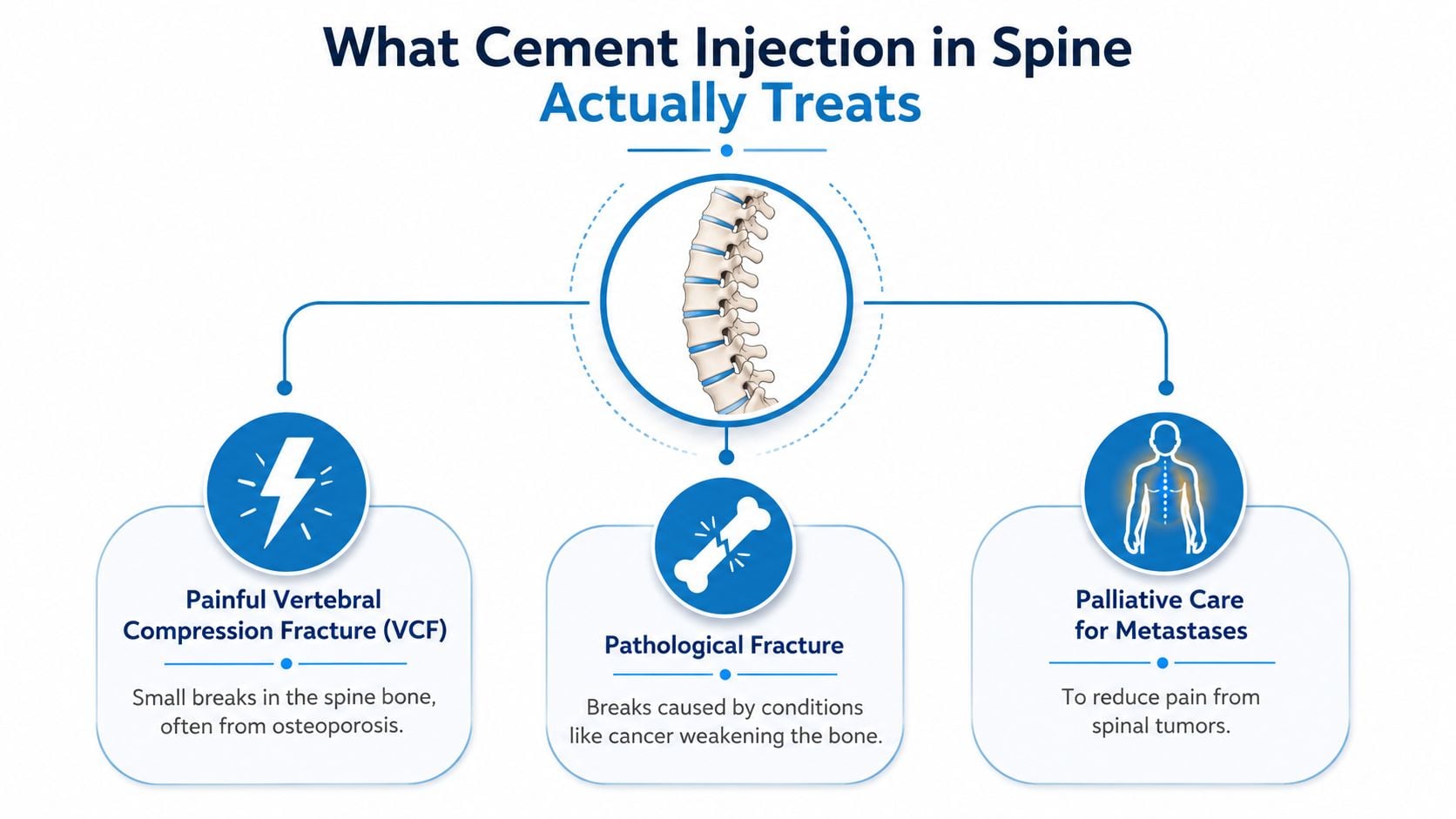
A person can be fine one minute, then feel a sharp, deep pain in the mid or lower back after a small movement the next. That pattern often points to a vertebral compression fracture, which means one of the spine bones has collapsed or cracked enough to hurt when it bears weight. Cement injection is meant to stabilize that broken bone, not to treat every cause of back pain.
The basic injury pattern
A vertebral compression fracture is different from a muscle strain. The pain comes from a damaged bone that moves microscopically every time the person stands, rolls over, or changes position. That motion irritates the fracture site, which is why pain can feel intense even when the injury itself looks small on a scan.
Bone quality matters because weak bone breaks more easily. Osteoporosis is the common setting, but fractures can also happen when a vertebra has been weakened by disease. In that setting, cement injection is used to give the bone internal support so the person can move with less pain and less mechanical stress on the collapse.
Where cement fits in the care plan
Cement injection is one tool in a larger fracture strategy. Some people do well with time, pain medicine, bracing, and osteoporosis treatment, while others keep hurting because the fracture remains unstable enough to keep flaring with movement. The procedure belongs in the second group, where the pain source is specific and imaging lines up with the symptoms.
Practical rule: if the pain sounds like a broken bone and the scan confirms an active compression fracture, cement injection becomes a question worth asking. If the pain pattern does not fit that picture, the procedure is much less likely to help.
That distinction matters for day-to-day care in New Jersey and Staten Island, where many patients first hear the term after a primary care visit, emergency evaluation, or spine consultation. A careful spine exam and imaging review usually decide whether the problem is a fracture that needs stabilization or something else entirely.
For patients comparing treatment paths, a review of kyphoplasty options can also help explain when height restoration is part of the discussion and when simple stabilization is the better fit.
Vertebroplasty and Kyphoplasty Explained Side by Side
Both procedures use bone cement to reinforce a weakened vertebra, but they don't get there the same way. Vertebroplasty places cement directly into the fracture. Kyphoplasty adds a balloon step first, creating a cavity before cement is injected, which can help restore some lost height in the vertebra.
The difference sounds technical, but it matters because technique changes both the mechanical goal and the procedure feel. Vertebroplasty is usually the more direct stabilization approach, while kyphoplasty adds an extra reconstruction step that may matter more when the vertebra has visibly compressed.
| Feature | Vertebroplasty | Kyphoplasty |
|---|---|---|
| Main goal | Stabilize the fracture | Stabilize the fracture and potentially restore some height |
| Technique | Cement is injected directly | A balloon creates space, then cement is placed |
| Structural effect | Reinforces the collapsed bone | Reinforces the bone and may improve shape |
| When it is often considered | When height restoration is not the main goal | When height loss or posture change matters |
| Shared principle | Both rely on image-guided cement placement | Both rely on image-guided cement placement |
Under the skin, both procedures are about geometry and control. In vertebroplasty and related spinal cement procedures, operators typically place the needle tip in the anterior one-third to one-fourth of the vertebral body and inject cement under continuous fluoroscopic control (procedure technique review). That placement helps the cement spread forward and across the midline, which supports the bone more evenly while keeping a close eye on where the material is going.
That imaging guidance is not just a formality. Cement that wanders too far can leak toward veins, discs, or the spinal canal, which is why a careful operator watches the injection live rather than filling blindly. For a broader patient overview of the balloon-based option, this kyphoplasty overview can help frame how the two approaches are related.
Who Is a Good Candidate for Spinal Cement Injection
The best candidates usually share one thing, the fracture is still the likely source of pain. That usually means a recent or still-active compression fracture, pain that matches the injured level, and imaging that shows the bone is not an old healed deformity. MRI is especially useful when it shows marrow edema, because that suggests the fracture is still active rather than a quiet old finding.
The decision hinges on pain, timing, and imaging
A patient with back pain and a known compression fracture is not automatically a candidate. If the fracture is old, stable, and no longer inflamed, cement is much less likely to add value. If the pain is coming from arthritis, a disc, or a muscle spasm pattern instead, treating the vertebra won't solve the problem.
Bone health context also matters. Osteoporosis makes a compression fracture more plausible, while malignancy changes the conversation because the bone may be weakened by tumor rather than low density alone. In either case, the question is whether the fracture is mechanically unstable enough to justify cement.
Who is usually excluded
Certain situations push a clinician away from cement injection. An asymptomatic fracture usually doesn't need it, and a chronic deformity that has already stabilized often doesn't benefit from it. Active infection is another major red flag, and a known cement allergy would obviously change the plan.
A helpful way to think about candidacy: the vertebra has to be both broken enough to hurt and recent or active enough to still be causing the pain. That's why consultation day usually focuses on the story, the imaging, and the exam together.
Age by itself is rarely the deciding issue. Frailty may affect anesthesia planning or recovery support, but it doesn't automatically rule the procedure in or out. The more important question is whether the fracture is still the active pain generator, because that's the piece cement can address.
What Happens on the Day of the Procedure
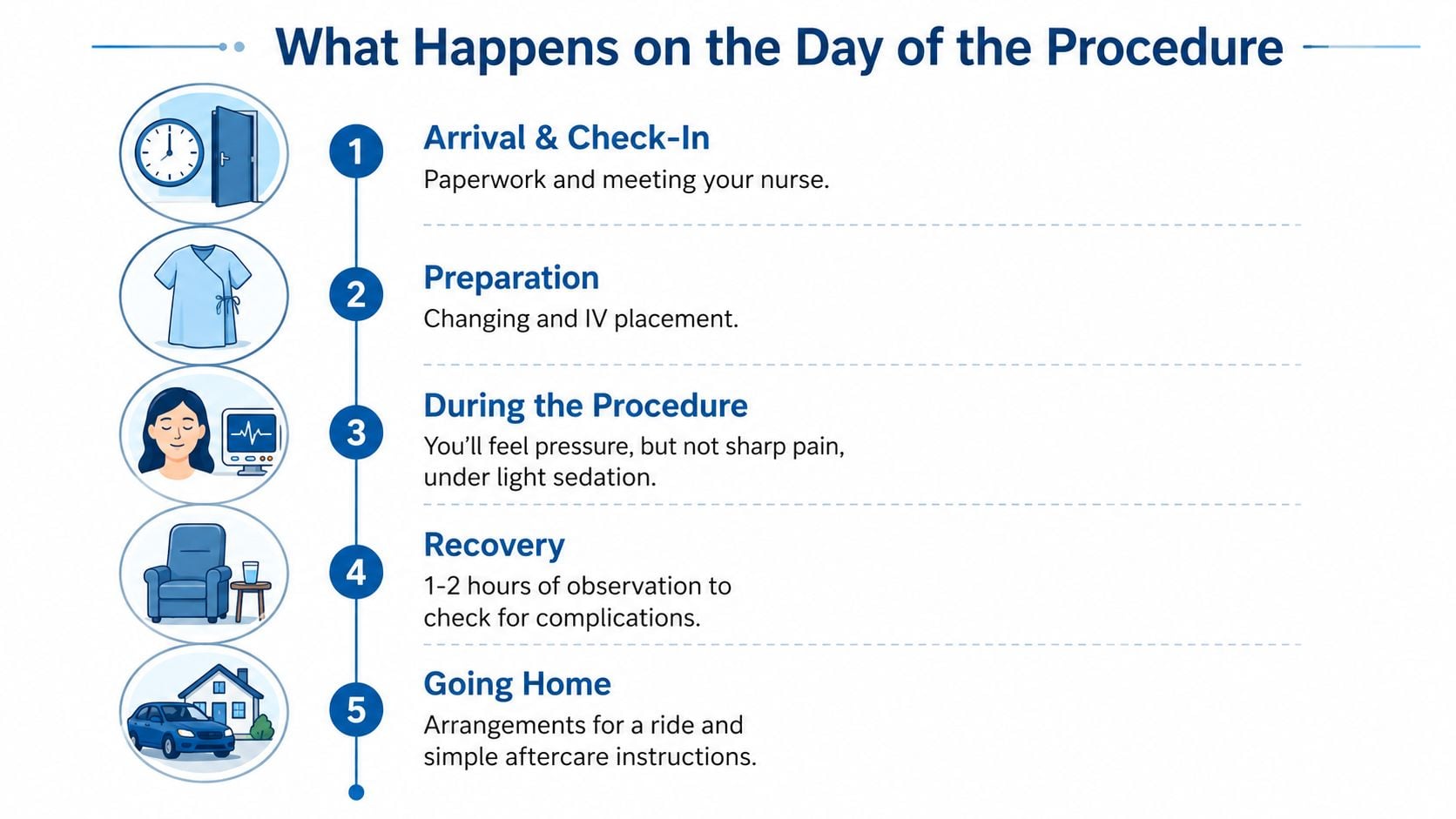
The day usually starts with review, not action. The care team checks the imaging again, confirms the target vertebra, and makes sure the patient's symptoms still match the planned level. That review matters because the procedure only helps if the right bone is being treated.
From check-in to the table
After check-in, the patient changes, gets an IV if needed, and talks through the sedation plan. Some people do fine with local anesthetic plus light sedation, while others need a deeper level of anesthesia depending on anxiety, anatomy, and overall health. The procedure itself is done face-down on the table so the spine is accessible through a small skin opening.
The needle goes through the back muscles into the vertebra under live X-ray. Patients often describe pressure more than pain once anesthesia is working, and the team keeps watching the cement as it thickens and is injected in small amounts. That slow, controlled pace is part of what makes the procedure safe when it's done well.
Recovery usually starts right away
After the cement is placed, the patient spends a short time in recovery while the team checks vital signs, pain, and basic movement. Many people can walk the same day after observation, though the exact discharge plan depends on sedation and how the body responds. The main goal before going home is making sure there's no sign of a complication and that the patient understands activity instructions.
What patients usually remember most: the waiting is often worse than the procedure itself. Once the sedation starts and the table setup is complete, the process is usually much more straightforward than people expect.
The experience is often easier when the patient has already arranged a ride, knows what to wear, and comes in understanding that the visit is usually same-day rather than overnight.
Benefits and Real Risks of Cement Injection in Spine
The main benefit patients usually care about is straightforward, less pain from a broken vertebra. When the fracture is the pain source and the case has been selected well, cement can steady the segment enough to make standing, turning, and walking less painful. For someone who has been limiting movement because every shift in position hurts, that change can feel significant.
The risk side deserves the same attention. A U.S. evidence review found cement leakage per treated vertebra or level ranged from 14.0% to 72.4% across five randomized trials totaling 508 vertebrae or levels, and the range remained 49.3% to 72.4% even when only the three fair-quality trials were included. A separate clinical study found extraosseous leakage in 33 of 158 patients (21%), with asymptomatic pulmonary embolism in 2.5%, epidural venous spread in 2.5%, and disk-space leakage in 11%.
The tradeoff in plain language
Cement is useful because it hardens quickly and supports the injured vertebra from the inside. That internal support can make movement easier and help protect the bone from further collapse. The same liquid-to-solid process that makes it useful also creates the chance that cement can escape before it sets.
A later imaging-based study showed how technique affects the result. The investigators reported a mean vertebral volume of 26.1 cm³, a mean injected cement volume of 2.0 cm³, and a mean filling percentage of 9%, with 15 cement leaks in 41 vertebrae (37%) and a finding that filling above 40.5% of vertebral volume was associated with adjacent vertebral fractures (AJNR study). That is one reason experienced operators focus on planned volume, not just on putting in more cement.
A balanced view of benefit and risk
| Potential benefit | Real risk or limitation |
|---|---|
| Stabilizes a painful fracture | Cement can leak outside the vertebra |
| May improve mobility sooner | Leakage can enter veins, discs, or the canal |
| Can reduce movement-related pain | Overfilling can create new mechanical problems |
| May help selected patients avoid prolonged immobility | A leak is not always dangerous, but it always matters |
The core idea is that cement injection is a balance, not a guarantee. It can be a strong option when the pain is coming from an active fracture, but it needs careful imaging, careful dosing, and an operator who treats leakage risk as part of the plan rather than an afterthought.
Does Cement Injection Beat Conservative Care
A patient may arrive after weeks of aching from a compression fracture, hoping cement injection will be the clear answer. Sometimes it is helpful. Sometimes time, bracing, pain medicine, and bone-health treatment do enough on their own, especially if the fracture is settling and the pain is already easing. The central question is not whether the procedure sounds advanced, it is whether the fracture is the kind that is likely to benefit from being stabilized.
The evidence gap patients should know about
The Mayo Clinic has pointed to sham-controlled studies in which pain and function improved in both vertebroplasty and simulated vertebroplasty, and it has also stressed careful patient selection (Mayo Clinic vertebroplasty overview). That does not mean cement injection has no role. It means the benefit is not guaranteed, and the patients most likely to improve are the ones whose symptoms and imaging point to an active fracture that still needs support.
The fracture itself matters more than the procedure name. A recent vertebra that remains painful and mechanically unstable is a different problem from a healed or partly settled fracture that no longer matches the pain pattern. If the bone has already quieted down, cement may add little. If the fracture is still active, cement can be a reasonable way to stabilize it.
The decision is really about selection
Patients often want a simple yes or no, but the decision is usually more conditional. Cement injection tends to fit best when pain is persistent, clearly tied to movement, and linked to a fractured vertebra that has not yet cooled off on imaging. It becomes a weaker choice when the symptoms are vague, longstanding, or do not match what the scan shows.
That is why the most useful question is not, “Does it work?” It is, “Does it work for this fracture, at this stage, in this body?” In practice, that means a spine specialist should review the pain story, the exam, and the imaging together before recommending anything. A fracture that looks mild on the scan but causes severe focal pain may still be worth discussing. A vertebra that has already settled and no longer appears active may not.
For some patients, the next step is not cement at all, but another type of image-guided pain procedure. A separate overview of epidural steroid injections is available in this epidural steroid injection guide, which may be useful when pain is coming from irritation around the spine rather than from the fracture itself.
The safest takeaway is this. Cement injection is a selected-patient procedure, not a default answer for every spinal fracture. That framing helps patients ask a better question, not whether the procedure exists, but whether it matches the fracture pattern, the timing, and the person sitting in the office today.
If the scan and the pain story do not line up, the odds of benefit drop quickly. That is why careful review by a spine specialist matters more than the label on the procedure.
Alternatives Worth Considering Before or Instead of Cement
A good fracture plan starts with the full menu of options, not with a single procedure. For many people, activity modification, bracing, pain medicine, and osteoporosis treatment are the first steps while the bone starts to heal. Those measures can be enough when the fracture is stable and the pain is easing.
Non-surgical options can be enough
Bracing can be reasonable when the fracture is expected to settle without intervention and the main goal is limiting painful motion. Analgesics may be used to keep someone mobile enough to breathe normally, sleep, and move safely. Physical therapy is usually added later, once the acute pain settles enough to tolerate it.
For persistent pain that seems to be coming from irritated structures around the fracture rather than the fracture itself, image-guided injections may also have a role. A broader pain plan can include procedures such as epidural steroid injections, and a separate overview of those is available in this epidural steroid injection guide.
When surgery enters the picture
If the fracture is mechanically unstable or causing neurologic compromise, cement alone may not be enough. In that setting, a structural spine opinion becomes more important than asking only about vertebral augmentation. The same is true when a patient has a tumor-related lesion where the plan is palliative support rather than simple fracture repair.
Cement injection can still be used in metastatic or primary bone lesions, but the counseling changes because the goal may be pain reduction and support, not restoration of normal bone. That is also where leakage risk needs especially careful discussion, since the surrounding anatomy and tissue quality may be different from osteoporosis alone.
Preparing, Recovering, and Accessing Care in New Jersey and Staten Island
Before the visit, patients should bring imaging reports, a medication list, allergy information, and any prior spine notes. Fasting instructions depend on sedation, and a ride home is usually needed if sedation is planned. After the procedure, soreness at the puncture site can linger for a few days, and return to usual activity is often gradual rather than instant.
Recovery usually means walking the same day, then building activity over the following weeks while the fracture settles. Bone-health follow-up matters because preventing the next fracture is part of treating the current one. For practical office logistics, teams that manage complex practices often benefit from a good administrative setup, and Titanium Computing's practice guide is a useful resource for understanding how coordinated medical offices keep scheduling and patient communication organized.
For local access, Interventional Pain Management's Staten Island location is one point of evaluation for New Jersey and Staten Island patients who need spine, pain, or orthopedic review. The practice also works across multiple specialties, which matters when a fracture needs more than a single narrow opinion.
New weakness, numbness, bowel or bladder changes, or fever shouldn't wait for a routine appointment. Those symptoms need urgent evaluation, because they can signal a problem that's bigger than a simple fracture follow-up.
If a vertebral fracture has changed daily life, Interventional Pain Management can help sort out whether cement injection, another spine procedure, or a more conservative plan makes the most sense. Visit Interventional Pain Management to request an evaluation and get a treatment plan that matches the fracture, the imaging, and the goals of recovery.