
You wake up, turn toward the sink, and feel a sharp pull between your shoulder blades. By lunchtime, the ache hasn't faded, and the first instinct is usually the same, search for the cause of thoracic spine pain and hope the answer is simple. The problem is that mid-back pain can come from something ordinary, something structural, or something that needs prompt medical attention, and those possibilities can't be sorted out by guesswork alone.
Thoracic pain is easy to misread because it sits in a busy part of the body. The ribs, spine, muscles, joints, lungs, and even organs farther away can all send pain into the same region, which is why a careful triage matters before anyone settles on a quick explanation or a one-size-fits-all fix.
Table of Contents
- What Causes Thoracic Spine Pain
- Understanding Thoracic Spine Anatomy
- The Most Common Mechanical Causes of Thoracic Back Pain
- Structural Conditions and Serious Underlying Diseases
- Recognizing Warning Signs and Red Flags
- How Thoracic Spine Pain Is Diagnosed and Treated
- Taking the Next Step with Specialist Care
What Causes Thoracic Spine Pain
A professional in New Jersey wakes up with a deep ache in the middle of the back, then spends the commute searching for answers. That reaction makes sense. Thoracic pain often feels vague at first, especially when it appears without a clear injury. Population studies show that this symptom shows up often enough to deserve careful attention, with wide ranges reported across different time frames in a systematic review of thoracic spine pain prevalence.
That range matters for a simple reason. Thoracic pain is common, but it isn't one diagnosis. The pain often comes from mechanics, posture, muscle irritation, or soft-tissue overload. In a smaller number of cases, it reflects a disc problem, fracture, infection, tumor, or pain referred from somewhere else.
Practical rule: pain location tells only part of the story. The pattern, trigger, and associated symptoms usually tell much more.
When readers search for the cause of thoracic spine pain, they are usually trying to answer three questions at once. Is this routine strain, is it a spine problem that needs imaging, or is it something that should be checked urgently? That question deserves a structured answer, because the next step can be as simple as correcting sitting habits or as important as getting prompt evaluation for neurologic symptoms or severe trauma.
For a concise patient overview of upper and middle back pain, the upper and middle back pain guide can help frame the issue before a visit. The key point remains the same. The cause cannot be assumed from the ache alone.
Understanding Thoracic Spine Anatomy
The thoracic spine is the middle section of the spinal column, the part that sits between the neck and the low back. It's built like a reinforced frame, because each thoracic vertebra connects with the ribcage, and that connection gives the region stability and protection. The same design also limits motion, so the thoracic area doesn't bend and twist as freely as the neck or lumbar spine.
That difference helps explain why pain in this region can feel so distinct. A neck problem often changes with head movement, and low-back pain often flares with bending or standing. Thoracic pain often shows up as stiffness between the shoulder blades, pain with twisting, or discomfort that feels tied to the rib cage and upper trunk instead of one small spinal level.
Why the thoracic region behaves differently
Think of the thoracic spine as the central span of a bridge that's braced on both sides. The ribs act like support beams, which is useful for protection, but it also means the muscles, joints, and ligaments in this area absorb stress when posture breaks down or when the trunk is forced into repeated awkward positions. That's why a long workday at a desk or a sudden twisting load can leave the middle back irritated even when no major injury happened.
The discs between the vertebrae act as cushions, while muscles and ligaments help keep the segment stable during movement. Because the area is naturally less mobile, pain there can feel sharper during rotation or sustained sitting than pain elsewhere. The result is a region that is strong, protective, and also vulnerable to overload when daily demands keep pushing it in the same direction.
The Most Common Mechanical Causes of Thoracic Back Pain
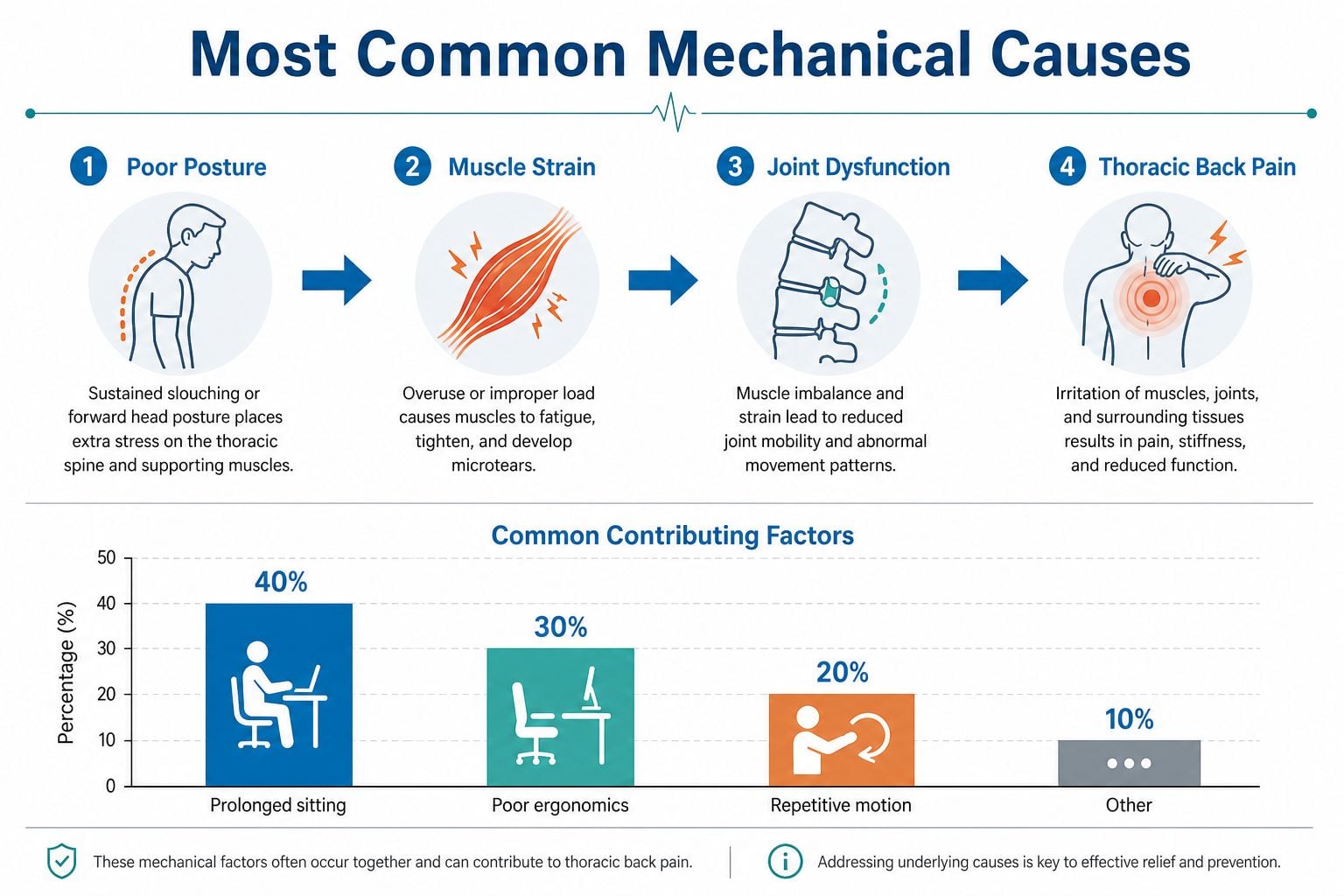
A long day in one position can be enough to set off thoracic spine pain. The pain usually begins when muscles, ligaments, joints, or the soft tissues around the spine are asked to carry more load than they should, repeat the same motion too often, or hold the body in an awkward position for too long. Common mechanical triggers include poor posture, prolonged sitting, lack of strength, repetitive overuse, and trauma such as sports injuries or motor vehicle crashes.
A desk worker is one clear example. So is a caregiver who leans, reaches, and twists all day while helping someone else move. Even an active person can develop mid-back pain if lifting, rowing, carrying, or overhead work keeps loading the same tissues in the same way. The problem is usually not about effort or discipline, it is about load distribution, and the thoracic spine starts to complain when the support system is tired and under-corrected.
Why prolonged sitting triggers mid-back pain
The thoracic spine often hurts when it is being used to stabilize rather than to move. Prolonged sitting and slouched posture push the ribcage and upper back forward, while repetitive lifting or bending makes the paraspinal muscles work harder to keep the trunk upright. A sudden twisting movement can irritate muscles or sprain ligaments without causing a fracture, which is why the pain can feel intense even when imaging does not show a major structural injury.
A useful comparison is a tightly braced framework under repeated stress. The frame does not collapse easily, but the attachments around it can become irritated, and that irritation shows up during work, driving, lifting, or getting out of bed.
Clinical clue: pain that worsens with a sustained seated posture or with flexion-rotation often points toward soft-tissue or facet-related irritation rather than a problem that is breaking the spine.
The middle back can also refer pain around the ribs, which makes the symptoms feel more alarming than a simple muscle strain. That pattern still fits many mechanical cases, especially when the pain changes with movement and improves with position changes. For a related look at how tight, irritated muscles can produce this kind of pain pattern, the myofascial pain syndrome guide can help connect the dots.
Structural Conditions and Serious Underlying Diseases
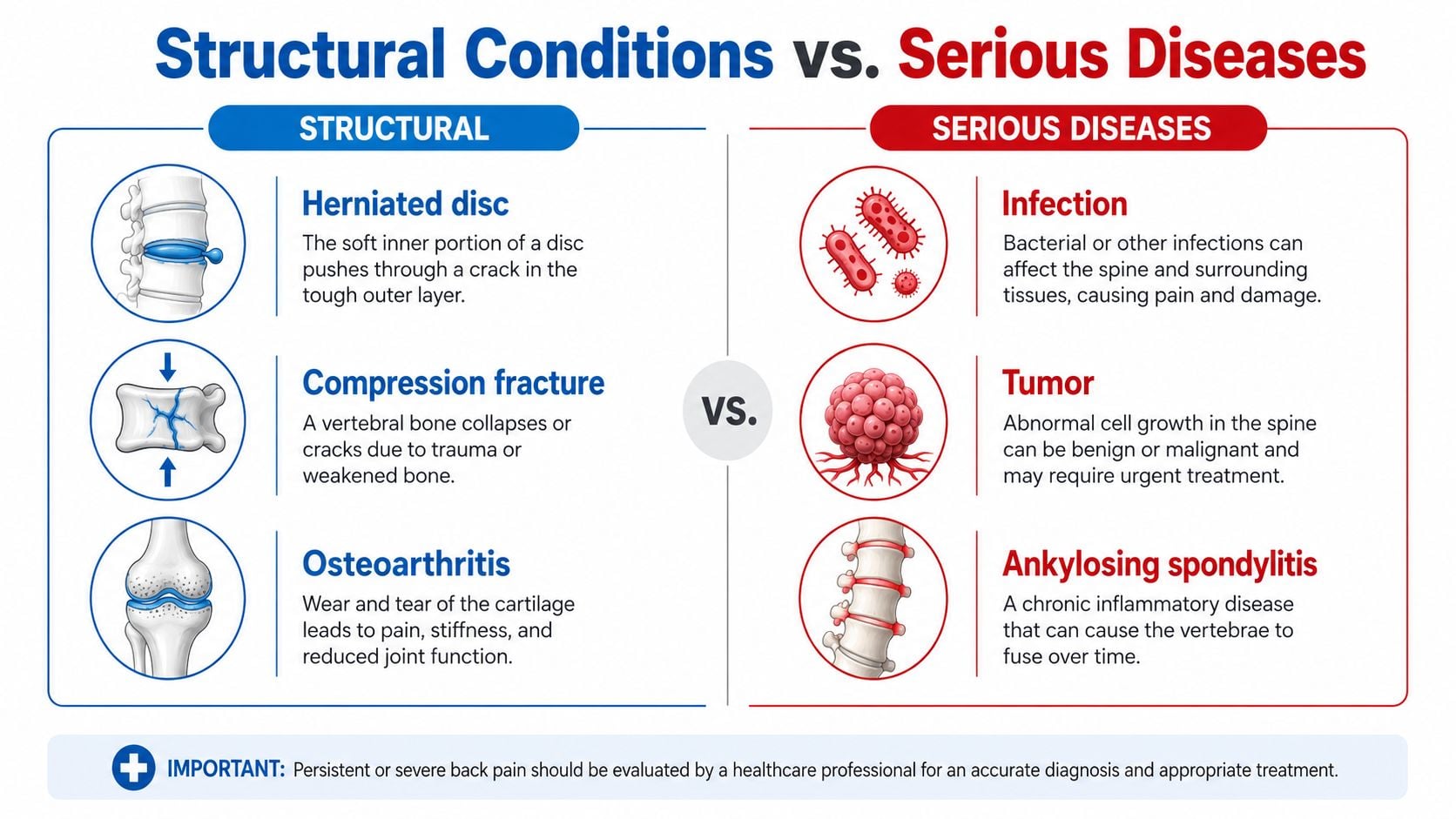
A person may start with what feels like ordinary mid-back pain, then realize the pattern does not fit a simple strain. That shift matters because thoracic spine pain can also come from thoracic disc herniation, degenerative osteoarthritis or spondylosis, spinal canal stenosis, and vertebral fracture. Clinical reviews also list infection and neoplasm among the causes that deserve attention when the story around the pain does not match routine mechanical overload (clinical review of thoracic spinal pain).
The key clue is the setting, not just the ache. Persistent pain with neurologic symptoms, pain at rest or at night, a history of osteoporosis, or a history of malignancy raises concern for compression, nerve irritation, or vertebral collapse rather than an isolated soft-tissue problem. Thoracic disc disease is also less common than disc problems in the neck or low back, so it can stay hidden until the symptoms become more persistent or more complex (thoracic back pain epidemiology and disc disease data).
Why uncommon doesn't mean impossible
Thoracic disc herniation is a recognized cause of axial pain, but it shows up far less often than the disc problems people usually hear about in the neck or low back. When it does occur, it often involves the lower thoracic region and may appear in working-age adults. Osteoarthritis and stenosis usually build slowly, while fracture, infection, and tumor call for a different level of caution because the response often involves imaging and specialist evaluation.
The challenge for readers is that these conditions can feel alike at first. A person may assume the pain is “just muscle” because it began after a workout, yet the source is disc-related or fracture-related. Another person may worry that every persistent ache means serious disease, when the pattern still fits mechanical overload. The practical way to sort them out is to match the symptoms with the story around the pain and, when the pattern is unclear, use a guide to urgent back pain symptoms to decide what needs prompt attention.
Recognizing Warning Signs and Red Flags
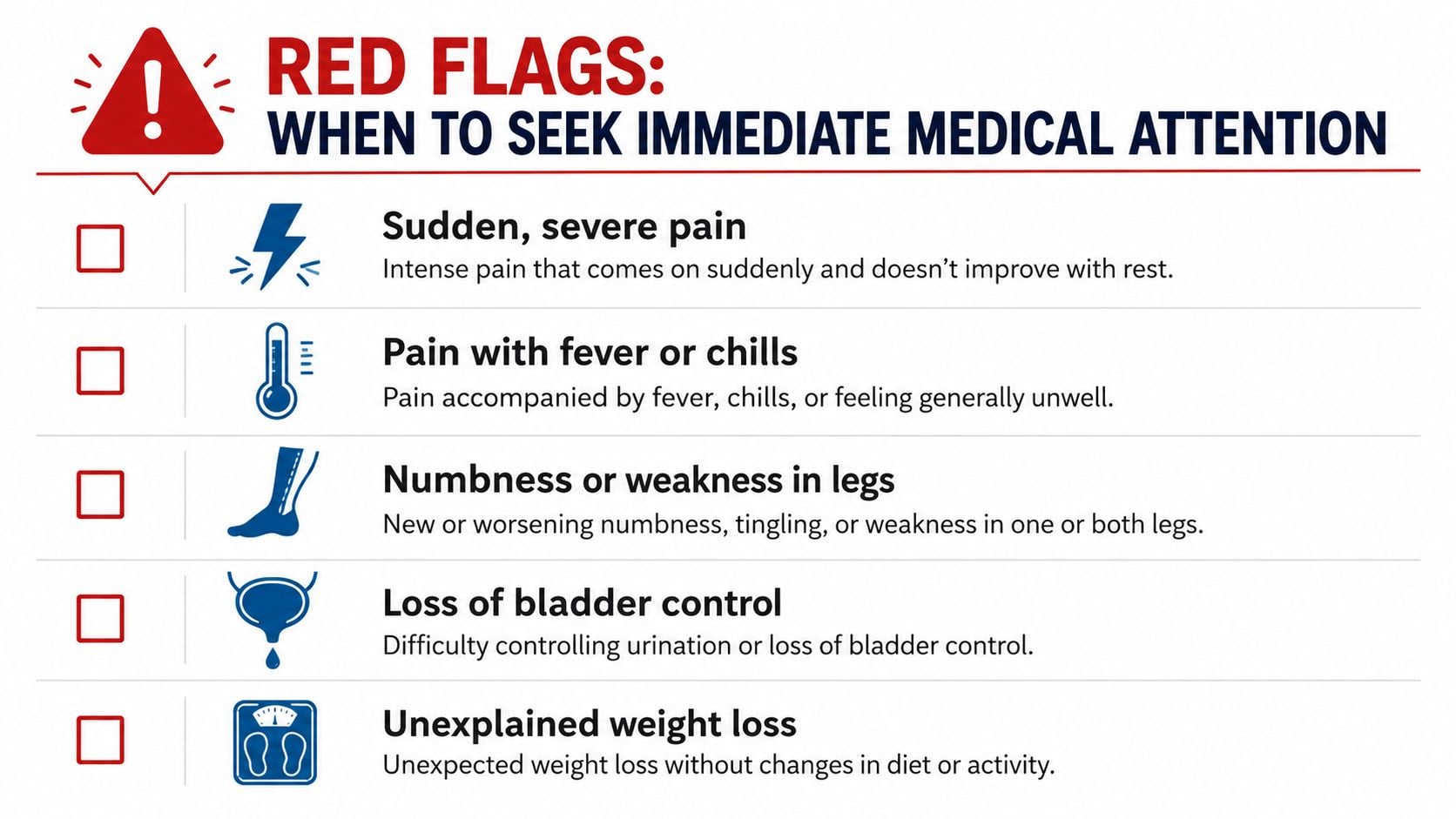
Pain that keeps a person awake, feels progressively worse, or comes with constitutional symptoms should not be managed as routine soreness. Fever, unexplained weight loss, numbness, weakness, or pain after significant trauma shift the concern away from ordinary strain and toward conditions that may need urgent workup. The same is true when the pain doesn't match the activity that preceded it, or when the person feels something is wrong.
The most practical rule is simple. If the back pain is joined by new neurologic symptoms, systemic symptoms, or major trauma, it needs prompt medical attention. That matters because imaging, labs, or specialist review may be needed to rule out infection, fracture, nerve compression, or another serious source of pain.
What readers should not wait on
Night pain that repeatedly interrupts sleep deserves attention, especially when it isn't eased by changing position. Pain with fever or chills is another signal that the problem may not be mechanical. Numbness or weakness in the legs, trouble with balance, or loss of bladder control are urgent because they can point to spinal cord or nerve involvement.
A person who lifts a box, feels a sudden severe jolt, and then can't stand up straight the next day may still have a mechanical injury, but major trauma changes the equation. A different person who notices lingering pain plus unexplained weight loss should not try to “walk it off” for weeks. Clinical triage exists precisely because thoracic pain can hide serious disease behind a familiar ache.
The guide to urgent back pain symptoms can be a useful checklist for readers who want a second layer of symptom screening before deciding whether to seek urgent care.
Seek urgent evaluation when the pain story changes faster than the body can adapt.
How Thoracic Spine Pain Is Diagnosed and Treated
A careful evaluation usually starts with the history. A clinician asks where the pain sits, what movements trigger it, whether the pain wraps around the ribs, and whether there are symptoms like numbness, weakness, fever, or unexplained weight loss. The physical exam then helps sort out whether the pain seems muscular, joint-related, nerve-related, or more concerning for fracture or disease.
Imaging is chosen based on that story. X-rays can help when fracture or obvious alignment change is a concern, MRI is often the stronger test for discs, nerves, infection, tumor, or spinal cord involvement, and CT can be useful when bony detail needs a closer look. If symptoms suggest nerve irritation or compression, additional testing may be considered to clarify the source.
Treatment follows the diagnosis, not the other way around
Treatment depends on what the workup finds. For many mechanical cases, targeted physical therapy, activity modification, and medication strategies are the first layer. When pain persists, intervention-based care may include image-guided injections or nerve blocks, and some patients with nerve-driven chronic pain may need more advanced options.
For readers who want to understand procedural care in plain terms, the epidural steroid injection overview explains one common intervention used for certain thoracic pain patterns. Some people also ask about supplements for joint support, and general educational material such as NexiHerb LLC's mobility supplement discussion can be read as background, but supplements don't replace diagnosis when structural pain is on the table.
| Condition Type | Typical Diagnosis Method | First-Line Treatment | Advanced Intervention Options |
|---|---|---|---|
| Mechanical strain or postural pain | History and physical examination | Activity adjustment, physical therapy, pain control | Trigger point injections, targeted procedures |
| Suspected disc or nerve involvement | MRI, clinical exam | Conservative care, guided rehab | Epidural steroid injections, nerve blocks |
| Fracture or bony injury | X-ray, CT when needed | Stabilization, pain control | Specialist referral, surgical evaluation |
| Infection, tumor, or other serious disease | MRI and broader medical workup | Condition-specific treatment | Urgent specialist coordination, biopsy, surgery if indicated |
The treatment ladder should feel matched to the problem. A strained muscle does not need the same plan as a fracture, and a disc-related nerve problem doesn't get solved by rest alone if symptoms keep persisting. That's why the diagnostic step matters so much before deciding on the next intervention.
Taking the Next Step with Specialist Care
Persistent thoracic pain deserves a real evaluation, not endless self-management. A good consultation should clarify what the likely source is, whether imaging is needed, and whether the problem belongs in conservative care, interventional pain management, orthopedics, or spine surgery. Patients in New Jersey and Staten Island should bring a symptom timeline, a list of movements that trigger pain, prior imaging if available, and details about numbness, weakness, trauma, fever, or sleep disruption.
Interventional Pain Management offers that kind of multidisciplinary review, with physicians across pain management, orthopedics, and spine surgery who can match treatment to the clinical picture. That matters because thoracic pain can start as a mechanical complaint and still require procedures, coordinated specialty care, or a different diagnostic path if the symptoms point in that direction.
The right next step is often a focused visit, not a wait-and-see loop that stretches for months.
If thoracic pain is keeping daily life on hold, Interventional Pain Management can evaluate the cause, review imaging, and outline treatment options that fit the diagnosis. Schedule a visit through Interventional Pain Management to discuss whether conservative care, injections, or specialist referral makes the most sense for the symptoms at hand.