
The sling is on, the ice machine keeps humming, and week two feels less like healing and more like waiting. Pain may be quieter than it was right after surgery, but the arm still feels unreliable, sleep is broken, and everyday tasks take planning. That slow middle stretch is normal after labrum tear surgery recovery, because the tissue is only beginning to reattach and the body is still protecting the repair.
What helps most at this point is a realistic map. Recovery moves through immobilization, gentle motion, strengthening, sport-specific loading, and only then clearance, with the timeline driven by biology rather than pain alone. Shoulder and hip labrum repairs follow the same basic logic, but the details are different enough that the wrong calendar can create false expectations. The sections below walk through the first six months step by step, including when lingering pain can mean stiffness, guarding, or a separate spine, neck, or myofascial pain source instead of a failed repair.
Table of Contents
- What the First Six Months After Labrum Surgery Actually Look Like
- Why Labrum Healing Is Measured in Months, Not Weeks
- The Staged Rehabilitation Protocol From Week One to Month Six
- Shoulder Labrum Repair vs Hip Labrum Repair Recovery
- Return to Work, Driving, and Sport Milestones
- When Lingering Pain Is Not a Failed Repair
- Warning Signs and How Our Team Can Help
- Frequently Asked Questions About Labrum Tear Surgery Recovery
What the First Six Months After Labrum Surgery Actually Look Like
A patient in week two usually sits in a familiar posture, shoulder protected in a sling, ice machine cycling on and off, and a long list of simple things feeling strangely complicated. Reaching for a glass, getting dressed, or finding a sleeping position can take more effort than expected. That's not a sign that recovery is failing, it's the normal result of a repair that is still biologically fragile.
The recovery arc patients can hold onto
The first half-year usually has a predictable shape. The early stage is about protection, the middle stage is about motion and control, and the later stage is about load tolerance and sport readiness. Johns Hopkins notes that the labrum typically needs 4 to 6 weeks to reattach to bone and another 4 to 6 weeks to gain strength, while many postoperative protocols still use 6 months for full clearance to most sports and 12+ months for overhead athletes such as baseball pitchers, because the tissue needs time to tolerate higher demand in a safe way (Johns Hopkins).
Practical rule: if a movement feels better because of pain medication, that does not mean the tissue is ready for it.
That logic applies to the hip too, but the details differ. In the hip, the repair often needs a longer protected ramp before impact or twisting returns, especially for people who pivot, cut, or run. The big takeaway is simple, recovery is a sequence of checkpoints, not a single finish line.
What this guide is built to answer
Readers usually want to know three things right away. When does the sling come off, when does normal life feel normal again, and when is the repair strong enough for training. Those are reasonable questions, and they are answered best when the biology comes first and the calendar comes second.
The article also addresses the confusing middle period, when pain fades slowly and confidence lags behind imaging or exam findings. That is the point where people start wondering whether they did something wrong, or whether the surgery failed. The sections that follow break down what is expected, what is not, and which warning signs need reassessment.
Why Labrum Healing Is Measured in Months, Not Weeks
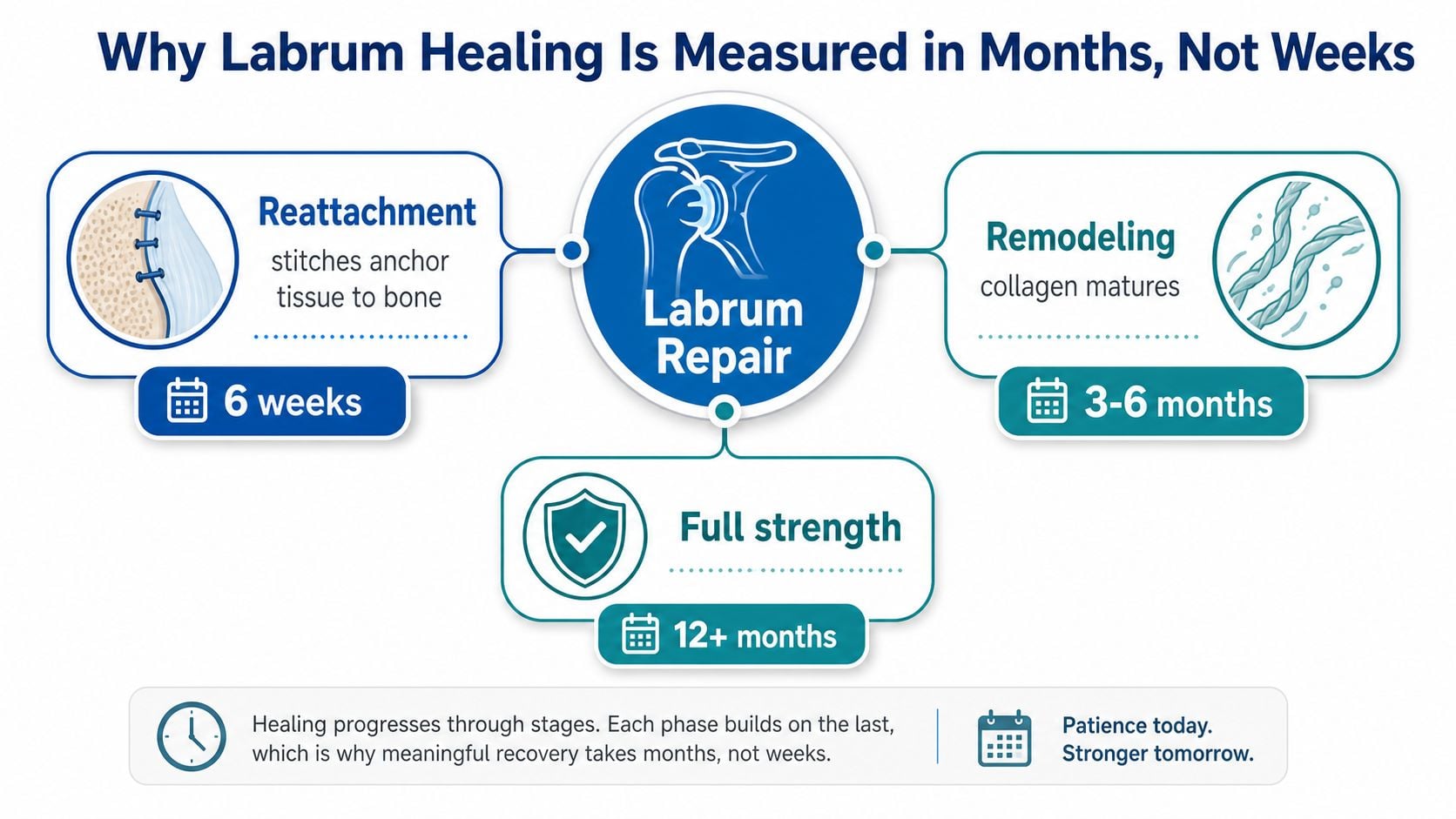
A repaired labrum does not become strong the moment the incision closes. First it has to reattach to bone, then it has to remodel, and only after that can it tolerate higher loads without reopening. The process works like a repaired joint in a structure, the early hold comes from stitches and scar formation, then the tissue gradually matures as controlled stress is added. That is why labrum tear surgery recovery is measured in months, not weeks, and why the long middle stretch can feel slow even when healing is on track.
Reattachment comes first, strength comes later
Johns Hopkins describes the early healing window clearly, the labrum usually takes 4 to 6 weeks to reattach to the bone rim, then another 4 to 6 weeks to gain strength (Johns Hopkins). Cleveland Shoulder Clinic gives a similar picture, describing 12 to 16 weeks for initial healing and 5 to 6 months minimum before contact sports or overhead activity. Those timelines explain why the first phase of healing is protected so carefully, even when the shoulder feels quiet enough to test.
The repair is strongest when it is respected before it feels strong.
Pain and tissue readiness are not the same thing. A shoulder can feel calmer long before it is safe for lifting, throwing, or collision. The reverse can happen too, where the repair is progressing but nearby muscles still feel tight, guarded, or easily irritated. For a simple overview of the condition itself, the Interventional Pain Management page on labral tears gives useful context.
Hip recovery follows the same biology, with different stressors
Hip labral repair follows the same healing biology, but the joint faces different loads. A rehabilitation review summarized by a 2022 study found partial healing by about 12 weeks post-op, and patients in a structured 5-phase program returned to play at 6 months (SAGE review). That pattern fits a gradual build, not a quick finish.
The hip often needs extra caution because flexion, twisting, and impact load the repaired rim in ways that can irritate the tissue before it has matured. Early rehab protects motion while avoiding too much torsion or depth. For patients who want the broader clinical picture, the practice's page on labral tears gives a useful context for the condition itself.
Lingering pain after the labrum has healed does not always mean the repair failed. In the shoulder, pain can come from the neck, the upper back, or myofascial trigger points that keep referring symptoms into the joint. That is one reason a patient can feel stuck even when the surgical site itself is doing its job. If soreness from the surrounding muscles is becoming part of the picture, recovery for less soreness can help explain why soft tissue symptoms may linger longer than the repair itself.
The Staged Rehabilitation Protocol From Week One to Month Six
The safest rehab plans don't jump from surgery to strength training. They move through a graded sequence, and each phase has a different job. In the early weeks, the goal is to calm tissue stress. Later, the goal shifts to restoring motion, then rebuilding strength, then teaching the joint to handle real-life positions again.
What patients usually do in each phase
A common shoulder protocol starts with immobilization, then gentle movement, then active control, then loading. Patients may be taught pendulum work, scapular squeezes, and assisted range-of-motion drills before progressing to light tubing for external rotation or closed-chain shoulder control. Hip patients often see a parallel progression with protected walking, basic trunk control, then single-leg balance, banded walks, and gradual return to jogging mechanics.
The timing matters, but so do the criteria. TriHealth patient guidance notes that sling use commonly runs 4 to 6 weeks, and strengthening is often delayed until 8 to 12 weeks, around 3 months (TriHealth PDF). That delay is frustrating, but it protects the repair from forces it cannot yet tolerate.
A useful shorthand is below.
| Typical Phased Recovery Milestones After Labrum Repair | Typical Timeframe | Key Goals | Sample Exercises |
|---|---|---|---|
| Protection and immobilization | Week 0 to 6 | Protect the repair, reduce irritation, control swelling | Sling use, pendulums, posture work |
| Early mobility | Week 2 to 6 | Restore safe motion without stressing the repair | Assisted range of motion, gentle scapular motion |
| Strength foundation | Week 8 to 12 | Rebuild basic control and muscle endurance | Scapular squeezes, light tubing, hip bridge variants |
| Functional loading | Month 3 to 4 | Improve coordination and joint tolerance | Closed-chain control, balance drills, step patterns |
| Sport preparation | Month 4 to 6 | Reintroduce task-specific stress | Sport-specific drills, gradual impact or throwing progressions |
Why criterion-based progression matters
The best rehab programs do not move forward because the calendar says so. They move forward because pain is settling, motion is controlled, and the joint can handle the current load without a flare. That is where a patient often benefits from a practical soreness-management plan, including a separate resource on recovery for less soreness when general muscle irritation makes rehab feel harder than it should.
Clinical checkpoint: if the same exercise still triggers the same pain pattern every time, the problem usually isn't “not enough grit,” it's that the tissue isn't ready for that dose yet.
That is why a well-run program feels repetitive at times. Repetition is not stalling, it is how the nervous system and soft tissue learn that the joint is safe again.
Shoulder Labrum Repair vs Hip Labrum Repair Recovery
Shoulder and hip labrum repairs share the same name, but they do not live in the same mechanical world. The shoulder has to balance stability and mobility for reaching, lifting, and overhead work. The hip has to tolerate weight bearing, torsion, and impact while supporting walking, squatting, and running.
How the timelines differ in practice
For the shoulder, initial healing commonly sits in the 12 to 16 week range, with 4 to 6 weeks of strict immobilization and 5 to 6 months minimum before contact sports or overhead activity in many protocols. Johns Hopkins also notes that many athletes are not fully cleared for their highest-demand sports until 6 months or longer, and overhead throwers may need 12+ months (Johns Hopkins).
For the hip, the main issue is not sling time, it's how long the joint needs before it can tolerate deep flexion, internal rotation, and impact. The rehabilitation review cited earlier describes partial healing by about 12 weeks and a 6-month return to play in a structured program (SAGE review). That is why many hip patients feel progress in daily function earlier than they can safely run or cut.
What restrictions mean in plain language
A shoulder patient usually needs to avoid early lifting that pulls the repaired tissue away from the socket rim. A hip patient usually needs to avoid positions that pinch or rotate the joint too aggressively before the repair has matured. The spirit of the restriction is the same, which is to avoid overloading tissue that looks better before it is ready.
That also means someone comparing their recovery to a friend's may end up confused for no good reason. A shoulder patient may be off the sling but still not cleared for work overhead. A hip patient may walk well before they are allowed to jog. Same general biology, different mechanical demands.
Return to Work, Driving, and Sport Milestones
Daily life returns in stages, not all at once. Many patients focus on sports, but the true test begins earlier, with work, driving, and basic self-care. Those milestones matter because they show whether the repair is tolerating real-world movement without a flare.
What usually happens outside the gym
Desk work often returns earlier than manual labor because sitting and typing can be adapted around pain and protection. Light duty for more physical jobs usually takes longer, because lifting, pushing, pulling, or repeated reaching can outpace the repair. For a practical framework on modified job demands, the light duty work guide by Mattiacci Law is a helpful reference point for the idea of restricted tasks and temporary duty changes.
Driving depends on whether the operated arm is in a sling and whether pain or medication would interfere with safe reaction time and control. That means the question is not only “how many days have passed,” but “can the patient steer, brake, and react without compensation.” Clearance is usually tied to functional control, not just the date on the calendar.
Sport return follows a wider range. Non-contact sports often resume around the 4 to 6 month window, while contact, overhead, or cutting sports often need 6 to 9+ months. High-demand throwing athletes may need 12+ months before full clearance, because the shoulder has to tolerate repetitive force at speed, not just casual motion (Johns Hopkins).
Home check: if the patient still cannot perform basic daily tasks without guarding, then sport return is too soon, even if the calendar looks tempting.
A better way to track progress is to ask whether each step is stable, repeatable, and pain-limited in a controlled way. If walking, reaching, or light lifting still triggers a setback the next day, the body is saying that the next milestone has not been earned yet.
When Lingering Pain Is Not a Failed Repair
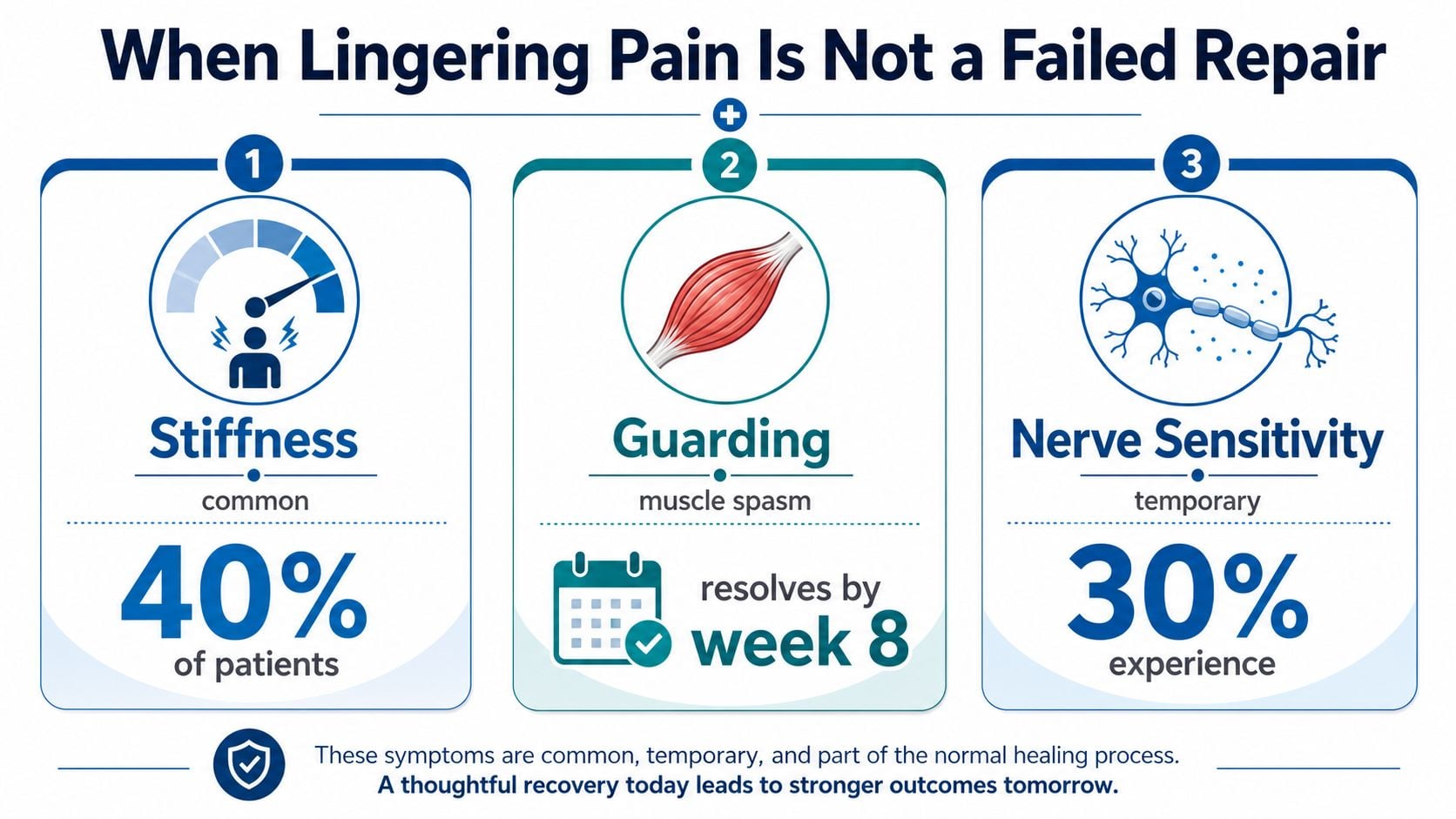
Pain that lasts longer than expected is unsettling, but it does not automatically mean the surgery failed. Stiffness can make motion feel sharp. Guarding can keep muscles braced around the joint for weeks. Scapular dysfunction can make the shoulder work inefficiently. In the hip, altered movement patterns can irritate nearby structures while the repair itself is still healing.
Why pain can linger even when the labrum is healing
Long-term outcomes are generally favorable, but they are not perfect. One orthopedic summary reports 85% to 90% success rates for first-time shoulder repairs, with 10% to 15% recurrence risk after the first surgery and 20% to 30% recurrence after revision surgery. Another guide reports 90%+ success in appropriate candidates and 5% to 10% re-tear rates. For the hip, a 2022 study summarized by Healio found 86% excellent results at 7 years after labral repair, with 13% failure, compared with 48% excellent results and 30% failure after debridement (Healio summary).
Those numbers are reassuring because they show most patients improve, but they also set a realistic expectation, some pain during recovery is not unusual. The body may be dealing with stiffness, protective muscle tone, or temporary nerve sensitivity, especially if the person has a prior history of neck, spine, or myofascial pain.
When to think beyond the repaired joint
Persistent pain should be reassessed when it feels out of proportion to the expected phase, moves into the neck, upper back, or arm, or keeps returning even as the repair itself seems to be healing. Adults with overlapping pain generators can flare during the long protective window because they are moving differently for weeks or months. That is where a team may need to look for a second source of symptoms rather than assuming the repair has failed.
For patients who need a broader pain workup, the practice's pain management page fits this situation because the issue may involve more than one tissue. Sometimes the labrum is only part of the story, and the surrounding muscles, joints, or nerve pathways are doing their own thing.
Lingering pain deserves attention, but it deserves a diagnosis, not a panic.
That distinction helps patients stay engaged in rehab without ignoring a real problem. A thoughtful reassessment can separate healing discomfort from a repair that needs another look.
Warning Signs and How Our Team Can Help
Some symptoms should not be brushed off as normal recovery. Fever, calf swelling, worsening pain after an initial improvement, new numbness or weakness, sudden loss of motion, or repeated instability episodes all deserve a call to the surgical team right away. Those changes can point to infection, a clot, nerve irritation, or a mechanical problem that should be checked promptly.
If the recovery picture is unclear, the next step is often a multidisciplinary evaluation instead of a single narrow visit. Interventional Pain Management and Ortho-Spine Center serves New Jersey and Staten Island with board-certified pain management, orthopedic, and spine care, and the practice lists seven-days-a-week availability. Patients can be seen for image-guided injections, nerve blocks, spinal cord stimulation for persistent post-surgical pain, and orthopedic follow-up under one roof. The our team page shows the breadth of clinicians available when recovery is not following the expected pattern.
If any warning sign has appeared, or if pain is drifting outside the repaired joint and not settling, contact the surgical office and ask for reassessment. If the problem looks more complex than a routine post-op flare, a coordinated pain, spine, and orthopedic review can help clarify the next step.
Frequently Asked Questions About Labrum Tear Surgery Recovery
How long until the sling can come off?
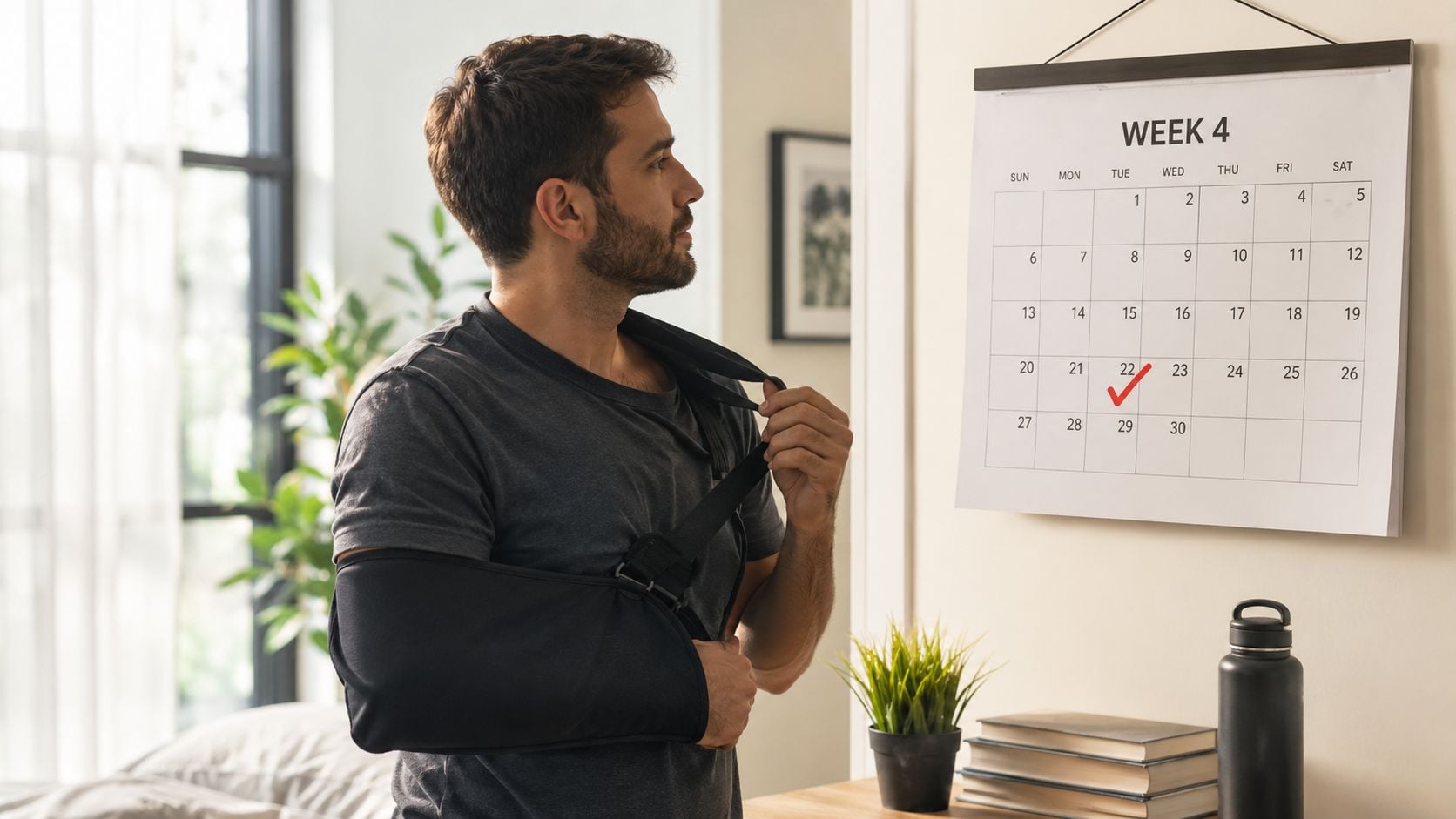
For many shoulder patients, sling use commonly lasts 4 to 6 weeks (TriHealth PDF). The exact date depends on the surgeon's protocol and how stable the repair looks clinically.
Is it normal to still have pain at three months?
Yes, it can be. At that point, the repair may be strengthening, but surrounding stiffness, guarding, or another pain generator can still be active.
How can a re-tear be suspected?
A re-tear is more concerning when pain, instability, or motion loss worsens after a period of improvement, especially if symptoms return with simple activities. That pattern should be reported for reassessment.
When is it safe to lift or run again?
Lifting usually returns before running or sport, but only after the joint shows control and the rehab phase has progressed. Running and heavier loading are often delayed until later phases, with many sports return pathways landing around 4 to 6 months or longer depending on the joint and the demand.
For patients whose recovery is drifting away from the expected curve, the next step is a coordinated review with Interventional Pain Management and Ortho-Spine Center.
Interventional Pain Management helps patients sort out persistent pain, post-surgical flare patterns, and overlapping spine or joint symptoms that can complicate labrum tear surgery recovery. If the repair has healed but pain is still getting in the way, visit Interventional Pain Management to connect with a team that can evaluate the problem and map the next step.