
For many endoscopic spine patients, the first meaningful milestones happen quickly: walking the same day or next morning, wound healing in roughly a week, and return to light work in about 6 to 9 days when the outcome is excellent or good, while heavy work often takes about 20 days and sometimes longer. That's why the most honest answer to “how long is recovery?” isn't one number. It's a timeline of separate milestones.
Most readers asking about endoscopic spine surgery recovery time are in the same spot. Surgery is scheduled, symptoms have already disrupted sleep and work, and the main question is practical: when can normal life start again? Not “when is the incision closed,” but when can sitting feel tolerable, when can driving resume, and when can a paycheck restart without making the back worse.
That question deserves a clear answer. Recovery after endoscopic spine surgery is usually faster than recovery after traditional open surgery, but fast doesn't mean identical for every patient. A person with leg pain relieved immediately after a straightforward decompression and a desk job may move through milestones very differently from a warehouse worker after a technically successful procedure who still has irritated nerve tissue that needs time to settle.
Recovery isn't one event. It's a series of checkpoints: discharge, wound healing, pain control, narcotic independence, driving, and return to work.
Table of Contents
- What Recovery Really Looks Like After Endoscopic Spine Surgery
- How Endoscopic Spine Surgery Works and Why It Changes the Healing Equation
- The Evolution of Endoscopic Techniques and Recovery Benchmarks
- A Phase by Phase Recovery Timeline From Day Zero to Week Twelve
- How Endoscopic Recovery Compares With Open Surgery
- Patient and Procedure Factors That Change Your Personal Timeline
- Pain Control, Rehab, and Red Flags During Recovery
- Common Misconceptions and a Realistic Bottom Line
What Recovery Really Looks Like After Endoscopic Spine Surgery
Two patients can have the same operation on the same day and still have different answers to the question, “How long is recovery?” One is hoping to get back to a desk and drive school pickup. The other lifts equipment for work and needs to be off pain medication before returning to the jobsite. Both are recovering. They are just measuring different milestones.
That is the right way to look at endoscopic spine surgery recovery time. Recovery is not one finish line. It is a series of checkpoints that happen on different clocks. Discharge comes first. Wound healing follows. Then come narcotic independence, safe driving, and return to work. Each milestone matters for a different reason, and each can shift based on the procedure, the job waiting for you, and how fully the leg or back symptoms improve.
The milestones patients actually care about
After an uncomplicated endoscopic decompression or discectomy, walking often starts within hours. In some endoscopic series, patients go home the same day. In thoracic cases, a review of broader endoscopic spine literature reported a mean postoperative stay of 2.65 days for endoscopic cases versus 10.5 days for open surgery (NIH review of recovery endpoints).
Walking early is not just a nice sign. It is one of the first practical tests of recovery. It shows whether pain is controlled enough to move, whether the legs are functioning well, and whether home recovery is realistic if no warning signs appear.
The next milestone is wound healing. Historical comparisons in the literature report wound healing around 5 ± 2 days after endoscopic surgery versus 12 ± 3 days after open surgery. That benchmark helps patients understand what the smaller access portal often changes. The skin opening may settle quickly, but that does not mean every deeper tissue has fully calmed down.
That distinction causes a lot of confusion.
A small incision can look good while the irritated nerve is still settling, the deeper tissues are still stiff, and certain movements still feel guarded. Recovery works like a set of dials, not a single light switch. One dial may turn to normal quickly, while another lags behind for days or weeks.
Why one recovery number is often the wrong question
Patients often ask for one date because planning life requires something concrete. The more useful question is, “Recovered enough for what?”
Being off narcotic pain medication is different from being comfortable enough to sit through a workday. Driving is different from walking around the house. Returning to a computer-based job is different from returning to plumbing, warehouse lifting, landscaping, or roofing. A technically successful surgery can still leave temporary nerve irritation, and that alone can slow one milestone while others move along on schedule.
Here is the practical framework I use with patients:
- Discharge milestone: often same day or the next morning if walking is safe, pain is controlled, and there are no immediate concerns.
- Wound milestone: the small access site often settles within about a week, though the tissues underneath may still be healing.
- Medication milestone: narcotic independence usually matters more than the calendar because it affects alertness, reaction time, and safety.
- Driving milestone: patients should wait until sedating medication is no longer needed and braking, twisting, and getting in and out of the car feel controlled.
- Work milestone: timing depends heavily on whether the job is sedentary, mixed-duty, or physically demanding.
That last point is where expectations often need the most adjustment. A patient with strong symptom relief and light work may move through recovery quickly. A patient with a more physical job, slower nerve recovery, or lingering inflammation may still be on a normal course even if return to full duty takes longer.
So the honest answer is not a single number of days. It is a map of milestones, with each marker influenced by what was done in surgery, what your body is healing from, and what your daily life requires next.
How Endoscopic Spine Surgery Works and Why It Changes the Healing Equation
Endoscopic spine surgery changes recovery because it changes what the surgeon has to disturb in order to reach the problem.
Open decompression usually requires broader exposure. That often means stripping or retracting muscle away from bone, maintaining a larger working corridor, and creating more tissue trauma on the way to the disc or nerve. Even when the operation itself goes well, those tissues then have to calm down.
Endoscopic surgery uses a much narrower access route. Through a small portal, the surgeon works with a camera and specialized instruments while preserving more of the normal supporting tissues. Patients considering this option can review the basics of endoscopic spine surgery to understand how the approach differs from standard open exposure.
Two main access routes
The two most common families are transforaminal and interlaminar approaches.
- Transforaminal access: reaches the disc or foramen from a posterolateral path. This is especially useful when the target sits off to the side where the exiting or traversing nerve is being compressed.
- Interlaminar access: approaches from the back of the spinal canal through the natural window between laminae. This can be helpful when anatomy or pathology makes a direct posterior route more practical.
The key point isn't the name of the corridor. It's what happens to muscle, fascia, bone, and ligament on the way in.
Why less disruption changes recovery
When less muscle is detached or heavily retracted, postoperative soreness usually comes less from the exposure itself. When less bone is removed, structural settling tends to be easier. When the skin opening is small, superficial healing is simpler.
A small incision isn't the whole story. The larger advantage is that the surgeon can often decompress the nerve without creating the same amount of collateral tissue injury.
That's why many patients notice an odd but encouraging pattern after endoscopic surgery. The leg pain that came from nerve compression may improve early, while local back soreness from the procedure remains present but manageable. Those are two different pain generators, and they resolve on different clocks.
This mechanical difference, not marketing language, is what compresses the recovery curve.
The Evolution of Endoscopic Techniques and Recovery Benchmarks
A patient often asks one simple question before surgery: “How long is recovery?” History shows why that question needs a more precise answer. As endoscopic spine surgery matured, the change was not just a shorter overall timeline. The meaningful change was earlier progress across several milestones, including wound closure, comfort with activity, and return to work.
The field developed in steps. Dr. Parviz Kambin helped establish the transforaminal, posterolateral route to the lumbar disc, and Kambin with Brager described the anatomic basis for percutaneous posterolateral discectomy in 1987. Yeung later advanced endoscopic disc surgery into a more standardized system in 1999. That sequence matters because surgery becomes easier to recover from when the technique becomes more reproducible. Better visualization, more controlled access, and more reliable instruments usually lead to less tissue disruption and a more predictable early course after surgery.
Historical benchmarks reflect that shift. Published reports described wound healing at 5 ± 2 days after endoscopic surgery versus 12 ± 3 days after open surgery. Return to work was reported at 4.0 ± 1.5 weeks versus 6.5 ± 2.0 weeks with open surgery. Another historical report noted that by 1993, 95% of patients returned to their previous occupations after endoscopic treatment.
Those numbers are helpful, but they need interpretation.
Wound healing is not the same as being ready to drive. Being back at work is not the same as being back to unrestricted lifting. A desk worker, a delivery driver, and a nurse may all have the same procedure and reach very different “recovery times” because the benchmark itself is different.
A practical way to view the evolution of endoscopic surgery is this: the operation improved the early checkpoints first. Patients often went home sooner, the incision settled sooner, and work return happened sooner in appropriate cases. The later checkpoints still depended on nerve recovery, baseline conditioning, the exact pathology treated, and how physically demanding life was waiting on the other side of surgery.
That is why modern expectations should be built around milestones rather than one number on a calendar. The history supports faster recovery in many patients. It also supports a more honest question: faster back to what, exactly?
A Phase by Phase Recovery Timeline From Day Zero to Week Twelve
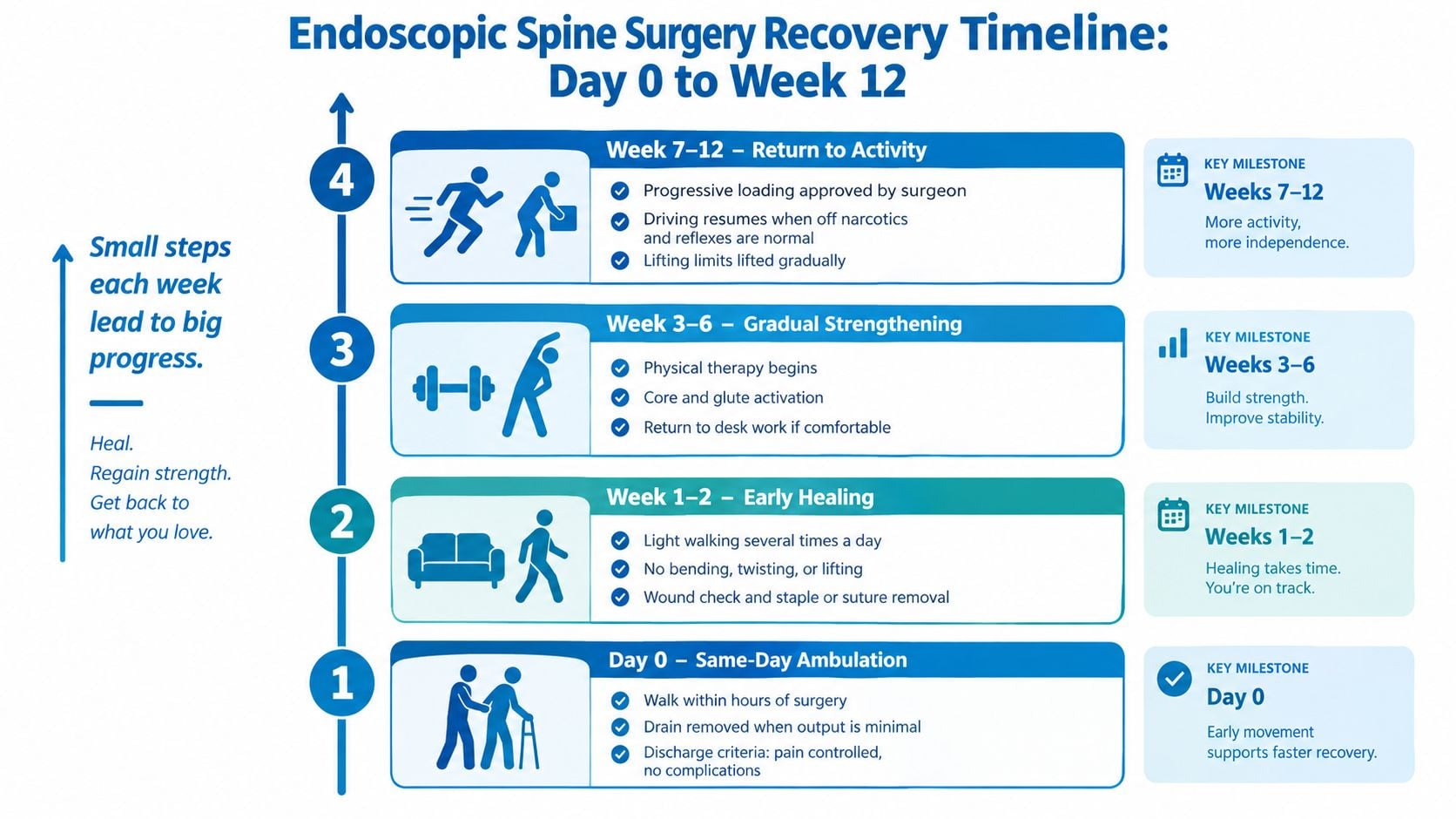
Recovery is easiest to understand when it's framed as phases rather than one vague promise.
Day zero and the first forty eight hours
The first phase is about stability, mobility, and safe discharge. Most patients are encouraged to stand and walk the day of surgery or by the next morning. The goal isn't exercise. The goal is proving that pain is controlled enough to move, the legs are responding normally, and basic function is intact.
A typical discharge checklist includes the ability to walk, urinate normally if applicable, tolerate oral intake, and manage pain with a home medication plan. Some patients also benefit from added home support during the first days. For readers arranging practical help, a guide to professional post operative nursing care can help clarify what kinds of assistance matter after surgery.
Week one and week two
This is the early-healing phase. The incision usually becomes less tender, walking tolerance improves, and many patients start spacing out pain medication. Sitting is often the most misunderstood activity. A patient may walk fairly well yet still dislike prolonged sitting because flexed posture loads the lower back differently.
Key goals during this window include:
- Short frequent walks: several easy walks usually beat one long walk.
- Movement control: avoiding repeated bending, twisting, and awkward lifting protects the decompressed area while tissues quiet down.
- Medication taper: sedating pain medicine should steadily decrease if recovery is on track.
Patients often feel “better” before they are ready for unrestricted activity. That gap is where preventable setbacks happen.
Weeks three through six
At this stage, the question shifts from healing to capacity. Light desk work may already be underway if sitting tolerance and focus are good. Driving may also resume once narcotics are no longer needed and trunk movement is quick and comfortable enough for braking, checking mirrors, and entering or exiting the car safely.
A simple way to judge progress is by function, not optimism. Can the patient sit through a normal work block, get up without guarding, walk without a limp, and sleep without escalating pain the next day? If yes, activity can usually advance gradually.
Weeks six through twelve
This final phase is where many patients feel substantially improved but still aren't fully “finished.” Heavier loading, repetitive lifting, and athletic movements need progressive reintroduction. The person with a physically demanding job often uses this phase to rebuild tolerance, not just pain relief.
A structured recovery plan often includes:
- Increasing walking distance and pace
- Adding core and hip stabilization
- Testing work-specific movements in a graded way
- Returning to heavier activity only after surgeon clearance
The calendar matters less than the trend. Smooth progress is the target. Sudden jumps in load usually create more trouble than steady consistency.
How Endoscopic Recovery Compares With Open Surgery
The biggest recovery advantage of endoscopy usually appears early, not necessarily at the very end of the healing arc.
A comparative review of endoscopic versus open lumbar decompression found a weighted mean difference of about 15.45 days favoring endoscopy for functional recovery. One cited comparison reported 1.1 ± 1.1 weeks to return to work after endoscopic decompression versus 5.4 ± 2.1 weeks after open surgery. Another report summarized wound healing at about 5 ± 2 days for endoscopic surgery versus 12 ± 3 days for open surgery, with return to work around 4.0 ± 1.5 weeks versus 6.5 ± 2.0 weeks in the open cohort.
That doesn't mean every open procedure is inferior or avoidable. Some anatomy, instability patterns, recurrent pathology, or multilevel disease still push the surgeon toward a more traditional operation. The right operation is the one that addresses the pathology safely and completely. Patients comparing options should understand how a laminectomy fits into treatment planning when decompression requires a broader approach.
Where the time savings really show up
The earliest differences tend to show up in three places:
- Soft-tissue recovery: less muscle disruption often means less postoperative soreness from the approach itself.
- Wound recovery: smaller access sites usually settle faster.
- Functional restart: walking, discharge, and early return to daily tasks often happen sooner.
Heavy labor is different. Once lifting, carrying, and repetitive load enter the picture, the recovery curves can start to look less dramatically separated because the job itself becomes the rate-limiting step.
Endoscopic vs Open Lumbar Decompression Recovery Metrics
| Recovery Metric | Endoscopic Approach | Open Microdiscectomy/Laminectomy |
|---|---|---|
| Functional recovery | Weighted mean difference favored endoscopy by about 15.45 days | Slower in the comparative review |
| Return to work in one cited comparison | 1.1 ± 1.1 weeks | 5.4 ± 2.1 weeks |
| Wound healing in one cited comparison | 5 ± 2 days | 12 ± 3 days |
| Return to work in another cited comparison | 4.0 ± 1.5 weeks | 6.5 ± 2.0 weeks |
Patient and Procedure Factors That Change Your Personal Timeline
A common pre-op question sounds simple: “How long will recovery take?” In clinic, that question usually turns into five separate timelines. When will I go home? When will the incision settle down? When can I stop narcotic pain medicine? When can I drive? When can I work?
Two patients can have the same endoscopic procedure and still reach those milestones on different days. Recovery after spine surgery works less like a stopwatch and more like an itinerary. The destination may be the same, but the stops along the way depend on what was treated, how demanding your daily life is, and how strongly your symptoms improve in the first few weeks.
Outcome quality changes more than the calendar
Early outcome quality has a direct effect on function. In the outpatient endoscopic series discussed earlier, estimated median return to work was 6 days for Excellent outcomes, 9 days for Good, 17 days for Fair, and 18 days for Poor outcomes.
That pattern makes clinical sense. A patient with an excellent early result often improves in several linked ways at once. Leg pain settles, walking becomes more natural, sleep improves, and confidence returns. Once those pieces line up, practical milestones tend to move faster too.
A fair or poor early result does not mean the surgery failed. It often means the timeline stretches. Ongoing nerve irritation, residual numbness, weakness, guarding, or slower pain relief can all delay driving, work clearance, and medication reduction even if the incision itself looks fine.
Job demands set a different finish line
Work status is not a single category. A person who answers email from home, a nurse who transfers patients, and a mechanic who works in awkward positions are recovering toward very different physical targets.
The same study reported median return-to-work times of 6 days for light work, 13 days for medium work, and 20 days for heavy work. That is why two patients may both say, “I feel much better,” while only one is ready for full duty. Symptom improvement matters, but work capacity also depends on repetition, load, posture tolerance, and reaction time.
Return-to-Work Medians by Early Outcome
| Outcome Grade | Median Return to Work (days) |
|---|---|
| Excellent | 6 |
| Good | 9 |
| Fair | 17 |
| Poor | 18 |
Return-to-Work Medians by Job Demand
| Work Demand | Median Return to Work (days) |
|---|---|
| Light | 6 |
| Medium | 13 |
| Heavy | 20 |
Footnote: These tables present two separate findings from the same outpatient endoscopic discectomy return-to-work analysis discussed earlier in the article. One set of medians is grouped by early outcome grade, and the other is grouped by occupational demand.
Procedure details matter too
The phrase “endoscopic spine surgery” covers more than one situation. A focused single-level decompression for a straightforward disc herniation usually follows a different path than a revision case, multilevel disease, or a procedure performed after long-standing nerve compression. The skin incision may be small in both cases, but the biology underneath is not identical.
Patients sometimes get confused here, so I explain it this way. The approach can reduce access-related tissue trauma, but it does not erase the underlying problem the surgery had to solve. A nerve that has been compressed for months may calm down more slowly than one decompressed early. A patient with weakness before surgery may need more time for function to return than a patient whose main issue was pain.
Personal factors can speed recovery or slow it down
Several patient-specific variables shape the timeline between surgery day and real-life independence:
- Baseline health: diabetes, smoking, poor sleep, and low conditioning can slow healing and reduce activity tolerance.
- Nerve condition before surgery: long-standing compression often improves in stages. Pain may improve first, while numbness or weakness lags behind.
- Age and reserve: older adults often recover well, but many need a steadier ramp in walking, stamina, and strength.
- Activity judgment: patients who increase activity in measured steps usually do better than those who swing between prolonged rest and sudden overexertion.
- Revision versus first-time surgery: scar tissue and more complex anatomy can make the recovery curve less predictable.
The practical takeaway is straightforward. “Recovery time” is not one number. It is a series of milestones, and your personal timeline depends on the interaction between the procedure, the quality of early symptom relief, your job demands, and your baseline health. Average numbers are useful for orientation. They are less useful than knowing which milestone matters most for your life right now.
Pain Control, Rehab, and Red Flags During Recovery
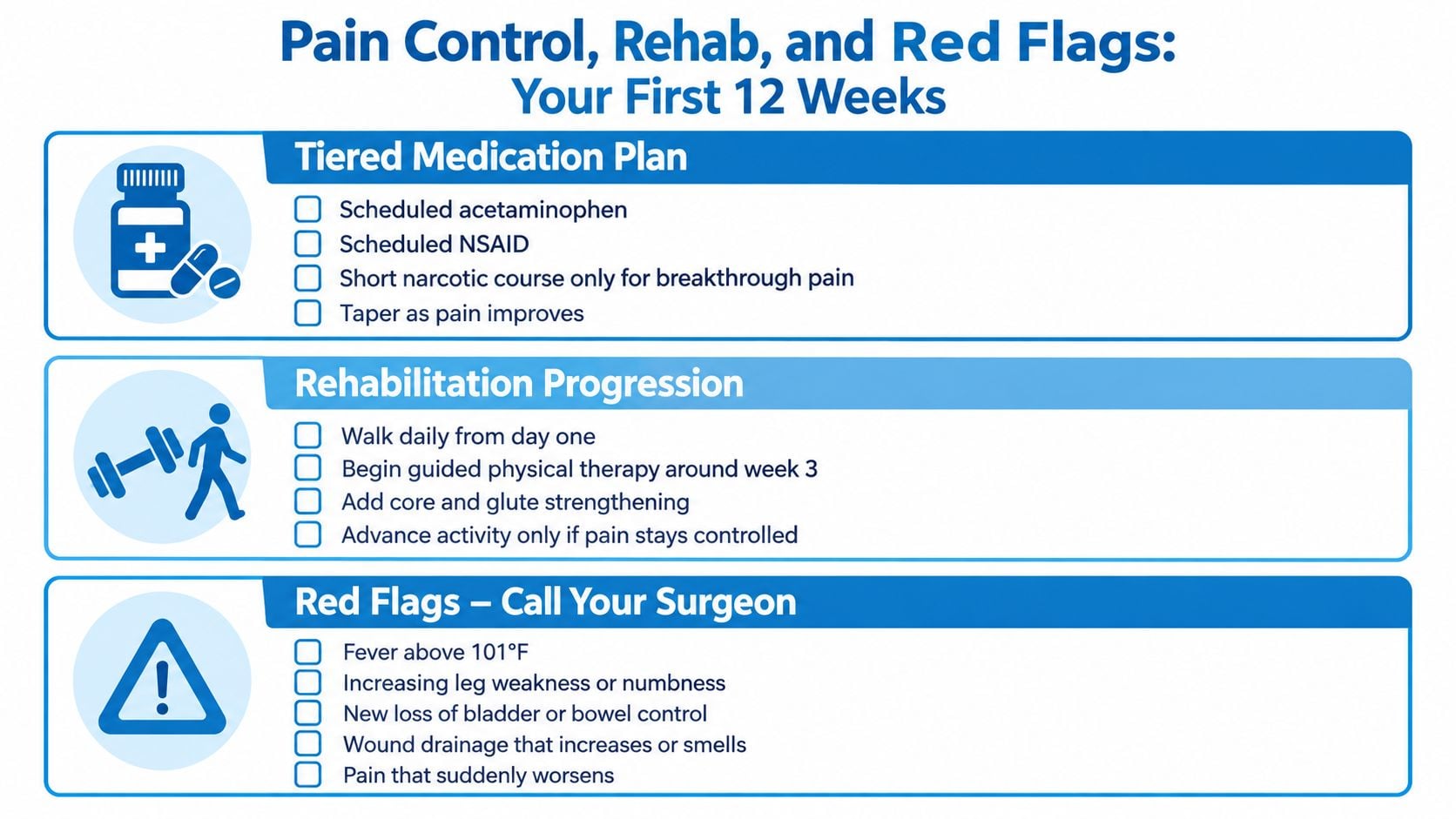
Pain control works best when it is layered. The goal is to keep pain manageable enough that walking, sleep, and basic function improve steadily, while reducing reliance on sedating medication as soon as it is safe.
A common approach starts with non-opioid medication, then uses a short narcotic course only for breakthrough pain if needed. In the endoscopic return-to-work study discussed earlier, patients with excellent or good outcomes generally reached narcotic independence within about 10 days or less as part of that favorable early recovery pattern. Some patients also receive muscle relaxants or a short steroid taper when postoperative spasm or nerve irritation is a major issue.
A practical rehab progression
Walking usually starts immediately and remains the backbone of early rehab. Formal therapy often becomes more useful after the first couple of weeks, once pain is controlled enough to work on movement quality, trunk stability, and hip strength instead of getting through the day.
Some patients also need nonsurgical support during recovery or if symptoms persist before surgery is chosen. Readers comparing care pathways can review different types of injections for pain management to understand where image-guided treatment may fit before or after a surgical discussion.
Useful recovery habits include:
- Frequent walking: regular movement helps prevent stiffness and deconditioning.
- Thoughtful sitting: long flexed sitting sessions often aggravate the low back early on.
- Gradual strengthening: core and glute activation should build progressively, not all at once.
Red flags that warrant an early call
Some symptoms should not be watched casually at home.
- New or worsening leg weakness
- Bladder or bowel changes
- Escalating pain after an initial plateau
- Fever above 101.5°F
- Wound drainage
- Rapidly expanding calf swelling
Calling early is safer than waiting. A small problem is easier to sort out than a delayed one.
Common Misconceptions and a Realistic Bottom Line
Fast recovery doesn't mean trivial healing. That misunderstanding causes many avoidable setbacks.
The first myth is that driving resumes in a few days no matter what. It doesn't. Driving depends on being off sedating medication, having normal enough reflexes, and being able to turn, brake, and enter or exit the car without hesitation.
The second myth is that lifting limits disappear once the skin looks closed. They don't. Small portal healing happens sooner than deeper tissue adaptation, especially when the spine has to tolerate repeated bending or load.
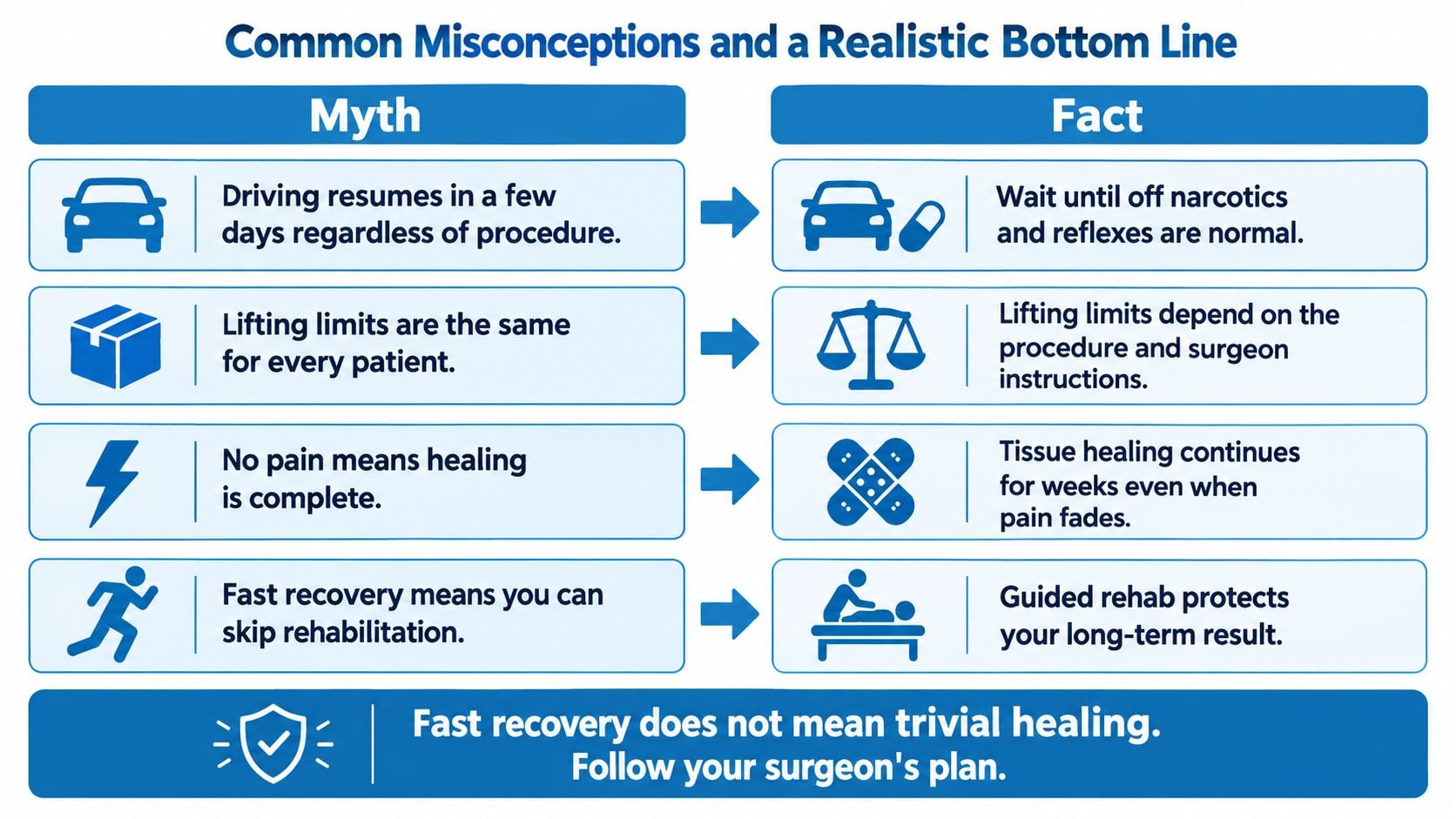
A third myth is that scar care doesn't matter because the incision is small. Small wounds still need clean healing and routine observation. A fourth is that any symptom flare after an initially good week means the operation failed. Often, it means activity outpaced tissue tolerance or a nerve is still calming down.
Fast improvement is real. Complete healing still takes time.
A realistic bottom line is this: many patients walk the same day, many with good outcomes are off narcotics and back to light duty within about one to two weeks, and patients with light work may return in as little as 6 days, while heavy work commonly tracks closer to 20 days and sometimes extends into the six- to twelve-week range for full unrestricted loading depending on demands and healing course. The right benchmark isn't someone else's timeline. It's steady progress through the milestones that fit the actual procedure and the actual job.
Interventional Pain Management offers evaluation and treatment across the full spine-care pathway, including image-guided pain procedures, orthopedic and spine consultation, and endoscopic spine surgery when it fits the problem being treated. For readers trying to understand whether symptoms may improve with nonoperative care or whether a minimally invasive surgical option is appropriate, Interventional Pain Management is a practical place to start.