
A common moment of panic happens like this. Recovery seemed to be moving along, then months after fusion surgery a patient rolls over in bed, feels a click in the low back, and suddenly wonders whether a screw came loose.
That concern is understandable. The tricky part is that postoperative pain has many causes, and spinal fusion hardware failure symptoms can overlap with normal healing, nonunion, adjacent-level wear, or infection. What matters most isn't just whether pain exists. It's the pattern of pain, whether new mechanical symptoms show up, whether nerve function changes, and what imaging shows.
Many patient guides stop at “returned pain” or “clicking.” That's incomplete. One of the most useful decision anchors in spine imaging is whether there is a radiolucent rim of at least 2 mm around hardware, especially if it enlarges over time, because that's a concrete sign that loosening may be present on imaging (diagnostic imaging review of postoperative spinal instrumentation). That imaging detail helps separate suspicion from guesswork.
Table of Contents
- What Spinal Fusion Hardware Failure Really Means
- The Symptom Categories That Should Raise Concern
- Hardware Failure Versus Other Causes of Post-Fusion Pain
- How Doctors Confirm Hardware Failure on Imaging
- When New Symptoms Need Urgent Attention
- Treatment Options Once Hardware Failure Is Diagnosed
- Practical Next Steps and Common Questions
What Spinal Fusion Hardware Failure Really Means
Months after lumbar fusion, some patients notice a new sound, a shifting sensation, or pain that feels different from the expected soreness of recovery. That doesn't always mean something has broken. But it does mean the hardware may no longer be doing its job the way it should.

Spinal fusion hardware failure means the screws, rods, plates, or cages used to stabilize the spine have stopped providing reliable support. In plain language, the internal brace is no longer holding the segment as intended while the bones fuse. Patients reading about spinal fusion surgery often assume the implants are meant to permanently carry the spine's load. They aren't. The hardware is more like scaffolding around wet concrete. It holds things still while the bone heals. If the bone doesn't heal well, or the mechanical forces are too great, the scaffold can loosen or fail.
The main ways failure happens
There are three broad patterns clinicians think about.
- Screw loosening happens when the bone-screw interface loses grip. The screw may not visibly “fall out,” but even small motion can irritate tissues and reduce stability.
- Rod or connector breakage is a more obvious mechanical failure. If a rod cracks, stress transfers abnormally across the fusion site.
- Cage migration means the spacer placed between vertebrae shifts from where it was intended to sit, sometimes narrowing space for nearby nerves.
Each mechanism interferes with the same goal. The fused segment needs stability long enough for bone healing to occur.
Why failure is not always the hardware's fault
When hardware loosens or breaks, people often assume the implant itself was defective. Usually, that's not the main issue. More often, the hardware is signaling a biologic or biomechanical problem, such as poor bone quality, incomplete fusion, or stress concentration across the construct.
A broad imaging review notes that hardware-related complications after spinal fusion aren't rare and can present with recurrent back pain, pain at a different level, crepitus, and new numbness or tingling. That same literature summary describes complication rates ranging roughly from 2% to 40% overall, and it highlights that poor bone quality can sharply raise the risk of loosening, with some reports in osteoporosis approaching 60% compared with under 15% in healthier bone (problem-solving approach to postoperative spinal imaging).
Practical rule: Hardware doesn't replace healing. When the fusion mass is strong, the implants become less important. When the fusion mass is weak, the implants carry more stress and symptoms become more likely.
Some failures are dramatic. Others are quiet. A screw can gradually loosen without causing much at first, while a broken rod may produce a sudden change. That's why symptom timing and pattern matter so much.
The Symptom Categories That Should Raise Concern
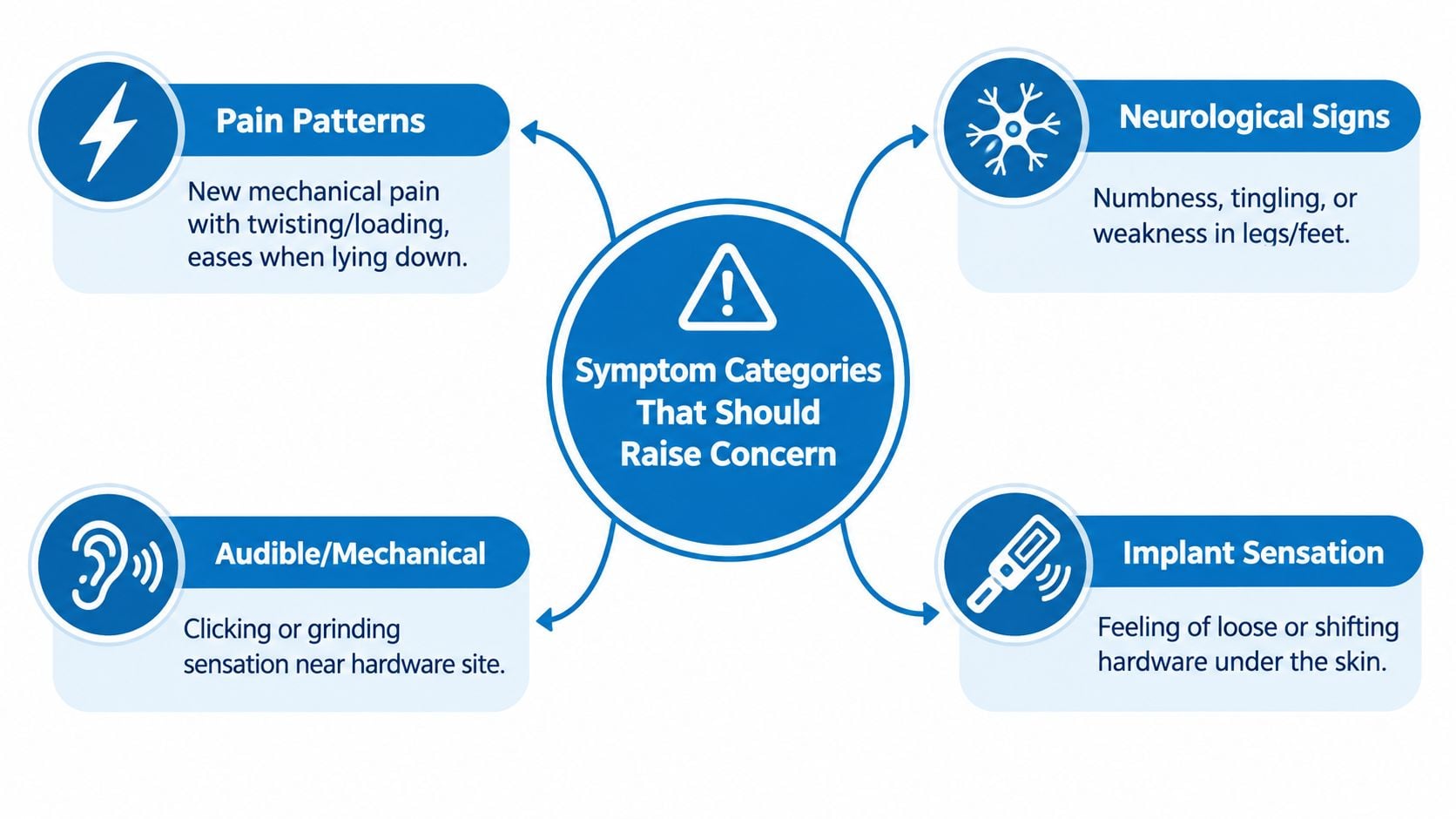
Patients often ask a simple question. “What does hardware failure feel like?” The honest answer is that it doesn't feel just one way. The warning signs make more sense when grouped into four categories.
Pain patterns
The first bucket is pain behavior. Concerning pain is usually new, more focal, and more mechanical than the expected ache of recovery. Patients may say it hurts when standing from a chair, rolling in bed, twisting to reach something, or loading one leg more than the other. Often that pain eases when lying flat.
This kind of pain raises suspicion because movement is stressing something that should be rigid.
- Returned pain after improvement: Pain that improved, then came back, carries more weight than pain that has been slowly fading.
- Focal pain near the fused level: A patient can often point to one area instead of describing a broad diffuse ache.
- Pain tied to motion or loading: Twisting, bending, getting up, or walking may trigger it.
Mechanical sensations
Some of the most memorable spinal fusion hardware failure symptoms are mechanical.
A patient may feel or hear clicking, grinding, scraping, or a sense of “give.” There can also be a new bump or prominence near the incision. Those clues don't prove hardware failure, but they do move it higher on the list.
A clicking back isn't automatically a broken implant, but a new clicking sensation after fusion deserves a closer look when it appears with focal pain or changing nerve symptoms.
Neurologic changes
The third bucket is nerve-related symptoms. New numbness, tingling, weakness, radiating leg pain, balance changes, or trouble walking can mean that shifting hardware, recurrent narrowing, or instability is affecting a nerve.
These symptoms matter more when they are:
- New rather than residual
- Progressive rather than stable
- Paired with mechanical pain or unusual movement sensations
Wound and infection-type signs
The fourth bucket is less discussed but important. Late swelling, redness, warmth, or drainage from the incision can point toward infection around instrumentation. Sometimes a low-grade infection and loosening travel together, because inflammation weakens fixation.
A classic review of pedicle screw loosening also makes an important point. Some patients with screw loosening have symptoms, but many are asymptomatic and only identified on follow-up imaging (pedicle screw loosening study). That's why combinations of symptoms matter more than any one complaint by itself. Pain alone can come from many causes. Pain plus mechanical sensation, or pain plus new neurologic deficit, deserves more urgent attention.
Hardware Failure Versus Other Causes of Post-Fusion Pain
Not all pain after fusion comes from the implants. That's where confusion starts. A patient may have real postoperative pain, but the source may be nonunion, stress at the next level, scar-related nerve irritation, infection, or ordinary healing rather than a screw backing out.
The most useful question isn't “Is the hardware bad?” It's “Which pain pattern best fits the problem?”
A few practical distinctions
Hardware failure usually feels mechanical. Motion provokes it. Patients may notice clicking, grinding, or a focal painful spot over the construct. A visible or palpable prominence can also appear.
Pseudarthrosis, or failed fusion, often behaves like deep instability. The patient may not feel a single dramatic click. Instead, the back may feel unreliable, activity-sensitive, and better supported with a brace or reduced activity.
Adjacent-segment disease tends to produce symptoms just above or below the fused area. The pain may look more like a familiar disc or stenosis pattern, with leg symptoms tied to the neighboring level rather than the fused segment itself.
Infection usually adds a different layer. Redness, drainage, fevers, chills, or escalating tenderness around the wound shift concern away from pure mechanics.
For patients dealing with lingering postoperative pain in general, a broader overview of pain after back surgery can help frame what belongs on the differential diagnosis.
Differentiating Causes of Pain After Spinal Fusion
| Feature | Hardware Failure | Pseudarthrosis | Adjacent-Segment Disease | Postoperative Infection | Normal Recovery |
|---|---|---|---|---|---|
| Typical onset | Often after a period of improvement or with a new mechanical event | Often becomes clearer as activity increases and fusion fails to mature | Often later, when neighboring levels become stressed | Can appear early or later | Gradual improvement over time |
| Pain character | Focal, sharp, motion-related, load-sensitive | Deep aching instability, activity-related | Pain above or below fusion, often familiar disc or stenosis-like symptoms | Constant pain with inflammatory quality | Soreness, stiffness, muscular pain |
| Mechanical signs | Clicking, grinding, palpable prominence, sense of shift | Less often obvious clicking, more a feeling of instability | Usually no implant sensation | Usually no clicking, may have swelling | No true instability signs |
| Neurologic findings | Can cause new numbness, tingling, weakness | Can overlap if instability irritates nerves | Often follows a root pattern from the adjacent level | May occur if infection compresses tissue | Mild residual irritation may slowly improve |
| Imaging clues | Loosening, breakage, migration, changing alignment | Lack of solid fusion, motion across intended fusion level | Degeneration or stenosis next to the construct | Fluid collection or inflammatory changes | Stable postoperative appearance |
The same symptom can fit more than one diagnosis. That's why surgeons compare the story, the exam, and the scans before labeling pain as hardware failure.
How Doctors Confirm Hardware Failure on Imaging
A common office visit goes like this. A patient says, “My back still hurts. How can you tell whether it is normal healing, a nearby level wearing out, or the hardware itself?” The answer usually comes from matching the symptom pattern with the right images, then comparing those images with earlier ones.
The usual imaging pathway
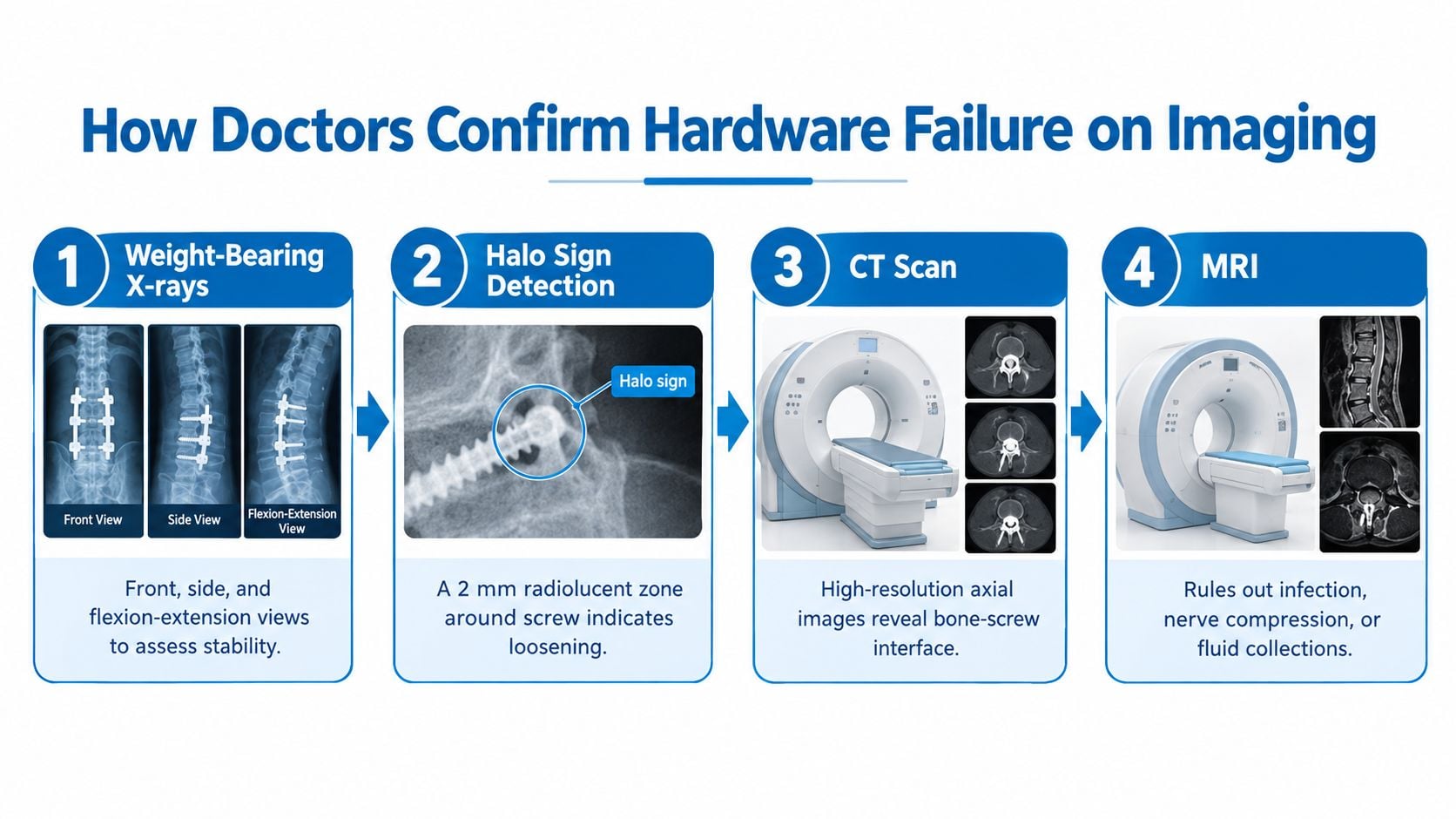
Doctors usually begin with standing X-rays. That first step matters because hardware problems are often mechanical. A construct can look acceptable when a person is lying down, yet show a shift in alignment or screw position when the spine is carrying body weight. If symptoms suggest motion at the fused level, flexion and extension films may also be ordered to look for movement that should no longer be there.
If the X-rays do not fully answer the question, CT often comes next. CT shows the contact point between bone and metal more clearly than plain films. It can reveal a broken rod, a screw that has started to back out, or a fusion mass that never became solid.
MRI answers a different question. It is less about the hardware itself and more about what the hardware may be affecting, such as nerves, nearby soft tissues, or a fluid collection that raises concern for infection. That distinction helps separate hardware trouble from adjacent-segment disease, which often shows up as stenosis or disc problems above or below the fusion rather than a change around the implants.
Patients reviewing hardware-related treatment options sometimes find it helpful to understand the basics of spinal instrumentation, because the implant design influences what a surgeon looks for on each scan.
The 2 mm radiolucent rim matters
One imaging finding gives doctors a concrete anchor: a radiolucent rim of 2 mm or more around a screw or other implant raises concern for loosening. In plain language, the dark halo around the hardware is wide enough that it may reflect motion at the bone-implant interface, not just a minor postoperative change.
That 2 mm mark helps because patient symptoms alone are rarely specific. Muscle soreness after surgery can hurt. Adjacent-level arthritis can hurt. A loose screw often hurts in a more focal, load-sensitive way, but the scan helps confirm whether the bone is holding the hardware tightly or allowing it to toggle with motion.
The trend matters as much as the measurement. A small questionable halo on one study may be watched. A halo that becomes clearer or wider on later images is more worrisome.
Why comparison matters more than one scan
One postoperative scan is a snapshot. Spine surgeons often need a short movie.
A single image can show expected healing changes that look alarming to patients but remain stable and harmless over time. Comparing current films with older ones helps answer the question: Has anything changed? A screw that sits in the same position on repeated studies is less concerning than one that has shifted. The same logic applies to alignment, rod contour, and the appearance of the fusion mass.
Doctors often look for a few practical patterns:
- Serial X-rays: Changes in alignment, hardware position, or an enlarging halo around a screw
- CT: Breakage, incomplete fusion, or clearer evidence that an implant is loosening from bone
- MRI: Nerve compression, soft-tissue inflammation, or fluid that points toward another diagnosis
This is why imaging works best when it is read alongside the exam and the timeline of symptoms. The goal is not just to spot metal on a scan. The goal is to tell whether the pictures fit normal recovery, a hardware problem, or a different source of post-fusion pain.
When New Symptoms Need Urgent Attention
Some symptoms can wait for an office call. Others should move to the top of the list immediately.
Go now
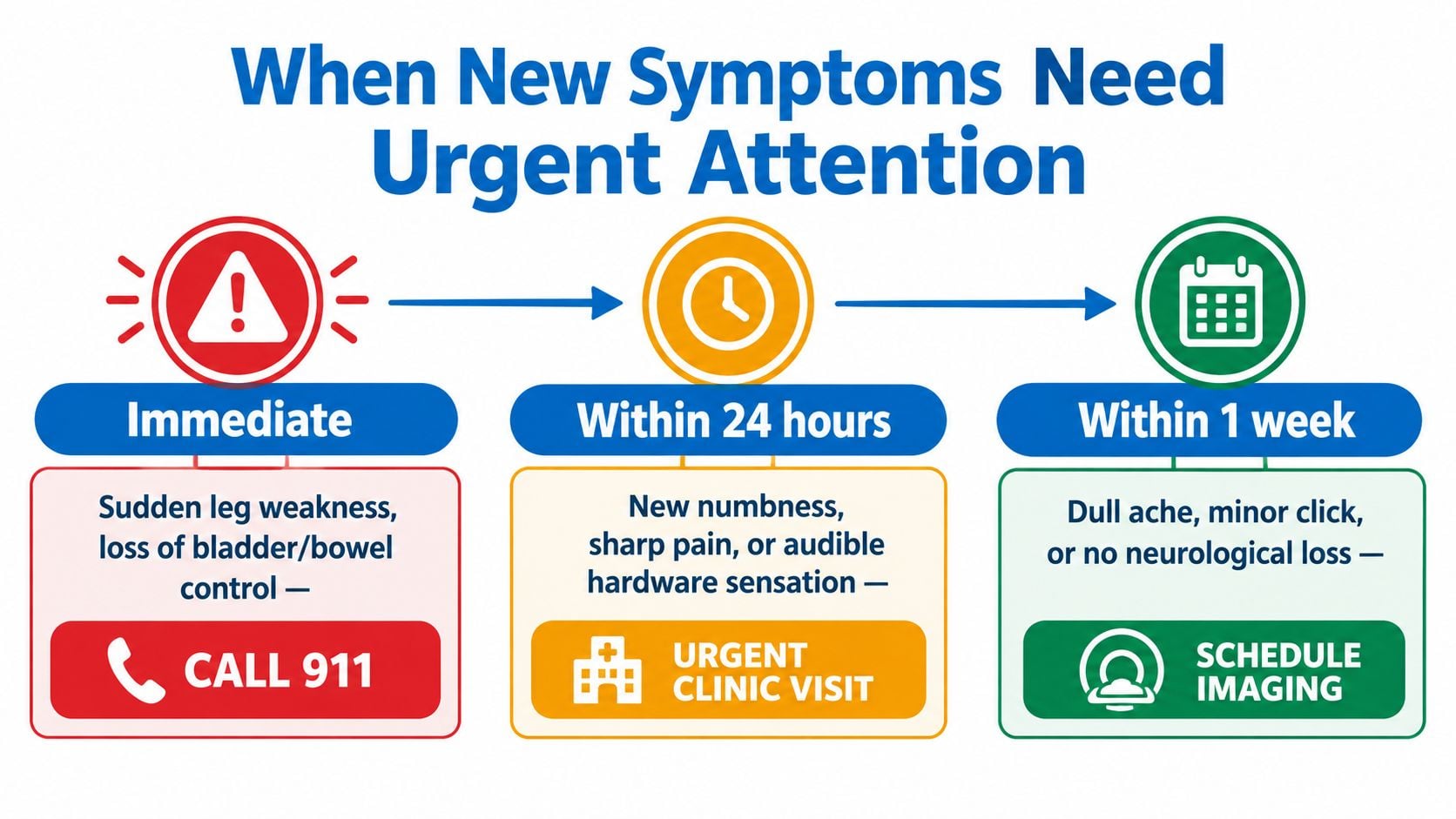
A patient should seek urgent assessment right away for:
- Sudden leg weakness: Especially if walking suddenly becomes difficult or the foot starts slapping.
- Bowel or bladder changes: Loss of control or inability to void needs immediate attention.
- Rapidly worsening numbness: Particularly when it spreads or is paired with weakness.
- Fever with wound drainage or redness: This raises concern for infection.
- A new visible deformity or major shift: A dramatic change in posture or implant prominence isn't routine.
These symptoms may reflect nerve compromise, infection, or a major mechanical problem.
Call within a day
A second group is urgent, but not necessarily an ambulance situation.
A patient who develops a new clicking sensation, pain after a fall, a palpable bump near the incision, or a clear increase in focal back pain over a few days should contact the spine team promptly. These symptoms deserve timely review, especially if they are new after a period of relative stability.
A multicenter review in spinal metastatic disease found a 3.1% risk of hardware failure requiring reoperation, which is a reminder that true catastrophic failure is uncommon compared with the number of people who report pain after surgery (review of hardware failure and revision patterns). That's reassuring, but it shouldn't lead anyone to ignore red flags.
Schedule follow-up soon
Some situations are concerning without being emergencies. Examples include a slowly rising ache with activity, one isolated minor click, or increased soreness after overdoing activity with no neurologic changes and no wound problem. Those patients still need follow-up, but the timeline is usually measured in days rather than minutes.
New neurologic loss, infection signs, and sudden structural change are the three patterns that shouldn't be watched at home.
The basic triage rule is straightforward. The more a symptom suggests nerve injury, infection, or loss of spinal stability, the faster the response should be.
Treatment Options Once Hardware Failure Is Diagnosed
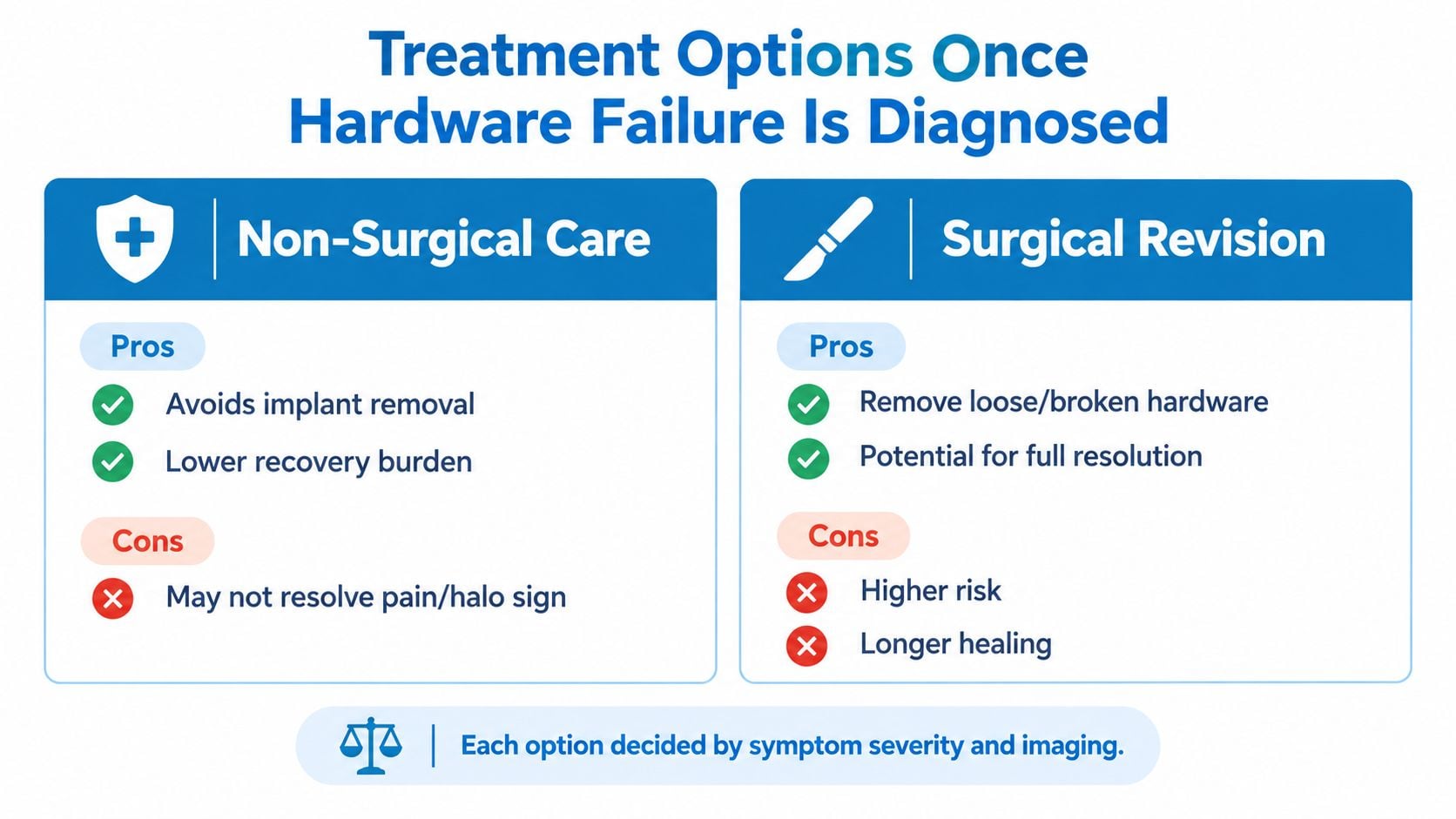
A confirmed hardware problem does not automatically mean another operation. The right treatment depends on symptoms, bone healing, implant stability, and the patient's overall health.
When observation or non-surgical care makes sense
Some loose screws are found on imaging in patients who feel little or nothing. In that setting, careful monitoring may be reasonable.
Non-surgical care can include:
- Activity modification: Reducing motions or loads that repeatedly provoke the fused area.
- Bracing: Sometimes used to reduce painful micro-motion.
- Physical therapy: Focused on safe movement, conditioning, and support around the construct.
- Bone health optimization: Important when poor bone quality is contributing to loosening.
- Injections or pain procedures: Used in selected cases when pain is present but surgery is not clearly indicated.
For patients trying to manage discomfort while sorting out the diagnosis, practical self-care ideas such as SunnyBay back pain relief tips can be useful as comfort measures, though they should never replace a medical evaluation when symptoms suggest implant or nerve problems.
In the broader pain-management setting, Interventional Pain Management is one example of a practice that offers image-guided procedures and multidisciplinary spine care for persistent pain after surgery, which can help when the goal is symptom control, diagnostic clarification, or support before and after revision decisions.
When revision surgery becomes the better option
Surgery moves higher on the list when hardware failure causes significant pain, progressive deformity, neurologic symptoms, clear instability, or when imaging shows a problem that is unlikely to improve without correction.
Revision strategies vary:
| Situation | Common surgical response |
|---|---|
| Single loose screw with otherwise solid construct | Exchange or revise the involved fixation |
| Broken rod with nonunion | Rebuild the construct and address the failed fusion |
| Adjacent level now involved | Extend the fusion to include the unstable or degenerated segment |
| Widespread construct failure | Larger revision with fresh fixation and renewed fusion strategy |
Not every revision is larger than the original surgery, but many are more technically demanding because scar tissue, altered anatomy, and prior implants are present.
The decision is individualized
An asymptomatic patient with a loose screw may be observed. A patient with weakness, recurrent instability, and clear nonunion usually can't be managed the same way.
The final recommendation depends on four things more than anything else:
- Symptom severity
- Whether the fusion has healed
- Bone quality
- General medical fitness for another procedure
Practical Next Steps and Common Questions
When a patient suspects a hardware problem, the most useful first step is organization, not guessing. Surgeons make better decisions when they can compare time points, symptoms, and prior studies.
A short checklist before the visit
Bring or request the following:
- Symptom timeline: When did the pain improve, return, or change?
- Trigger pattern: Does it hurt with twisting, standing, walking, coughing, or rolling over?
- Neurologic changes: Any new numbness, weakness, gait change, or bladder issues?
- Operative records if available: The fused levels and implant type matter.
- Serial imaging: Old X-rays are often as important as the newest scan.
A second opinion is often most useful when the reviewing specialist regularly handles revision cases, not just primary fusions.
Bring the actual imaging discs or electronic files, not just the report. Reports summarize. Side-by-side image review shows progression.
Common questions patients ask
Do loose screws always cause pain
No. Some patients with screw loosening are found only on follow-up imaging. Symptoms depend on whether the hardware is moving enough to irritate tissue, destabilize the segment, or affect nearby nerves.
How quickly do symptoms usually appear
There isn't one fixed timeline. Some hardware-related problems show up early, while others appear after an initial pain-free period. What matters more than the calendar is a change in pattern, especially pain that returns after improvement or new mechanical symptoms.
Is revision surgery riskier than the original fusion
Revision surgery is often more complex because there is prior scar tissue and existing instrumentation. That doesn't mean it is the wrong choice. It means the decision should be deliberate and based on a clear explanation of the goal, the likely pain generator, and the patient's health status.
What does recovery look like the second time around
Recovery depends on what is revised. A small focused hardware correction is different from a larger reconstructive revision. Patients should ask what part of the plan is meant to relieve pain, what part restores stability, and what limits are expected during bone healing.
Which specialist should evaluate suspected failure
A spine-focused surgeon with revision experience is usually the right lead evaluator. In many cases, pain specialists, radiologists, physical therapists, and the original surgeon all contribute useful pieces.
The main takeaway is simple. Patients don't have to decide on their own whether a symptom means hardware failure. They do need to recognize patterns that deserve review, document them clearly, and bring the imaging history that allows a surgeon to compare change over time.
Interventional Pain Management evaluates persistent and recurrent spine pain with coordinated review of symptoms, imaging, and prior treatment history, including situations where hardware failure, adjacent-level disease, or failed fusion may all be in the differential. Patients who need non-surgical care, image-guided pain treatment, or referral for surgical review can learn more by visiting Interventional Pain Management.