
Most single-shot nerve blocks using long-acting anesthetics provide 8 to 14 hours of sensory numbness, while continuous catheter techniques can extend meaningful pain relief for up to 72 hours. The exact timeline varies because numbness, weakness, and pain relief don't always end at the same moment.
A patient may wake after shoulder, knee, or hand surgery with an arm or leg that feels heavy, distant, or completely absent. The first question is usually simple: when will feeling come back, and what will happen when the block wears off? The safest answer is reassuring but not rigid. A nerve block fades gradually, and the experience depends on the medication, dose, injection location, technique, and the person receiving it.
Table of Contents
- What to Expect From Nerve Block Duration
- How Local Anesthetics Determine Block Length
- Single-Shot Blocks Versus Continuous Catheter Techniques
- Factors That Extend or Shorten Nerve Block Duration
- Your Recovery Timeline After a Nerve Block
- Planning Your Follow-Up and Next Steps
What to Expect From Nerve Block Duration
A patient waking after shoulder surgery may notice that the arm feels warm, heavy, and numb. Movement can feel awkward, and the lack of pain may seem almost too complete. In most cases, this is the expected effect of a single-shot block using a long-acting local anesthetic such as bupivacaine or ropivacaine, which typically lasts about 8 to 14 hours according to clinical evidence on peripheral nerve block duration.
A continuous catheter changes the timeline. Instead of receiving one dose, the patient has a thin catheter near the targeted nerve that allows medication to continue flowing. This approach can provide pain relief for up to 72 hours, or roughly 2 to 3 days, depending on the procedure and the care plan, as described in patient guidance about common nerve blocks.
The word duration causes much of the confusion. It can refer to several separate experiences:
- Sensory block: The period of numbness or reduced ability to feel pain, temperature, and touch.
- Motor block: The period of weakness or difficulty moving the affected limb.
- Analgesia: The period when pain remains controlled, even though normal sensation or movement may already be returning.
A patient might regain the ability to move a hand before feeling has completely returned. Another patient may feel tingling and pressure but still have useful pain relief. The end of complete numbness, therefore, isn't always the end of the block's benefit.
Practical rule: A fading block should usually feel gradual. Tingling, warmth, returning pressure sensation, and progressive strength are common parts of recovery.
The exact medication matters. Patients who want additional background on the commonly used long-acting anesthetic can review the MedTrack bupivacaine page. A broader explanation of targeted injections is also available through Interventional Pain Management's nerve block information.
How Local Anesthetics Determine Block Length
Local anesthetics work by temporarily interrupting electrical signaling in nerve fibers. In simple terms, the medication binds to sodium channels, which nerves need to transmit an impulse. When those channels are blocked, pain signals can't travel normally toward the brain.
A useful consultation-room analogy is a lock and key. Each anesthetic molecule acts like a key that fits into a channel on the nerve. Some molecules leave the lock relatively quickly, while others bind more firmly and remain active longer before local blood flow carries them away.
Short-acting and long-acting choices
Short-acting agents such as lidocaine generally produce a shorter period of blockade, often about 1 to 3 hours, while long-acting agents such as bupivacaine are commonly estimated at 6 to 12 hours in peripheral nerve block references. Practical anesthesia benchmarks place bupivacaine in a broader 4 to 16 hour range and lidocaine at about 1 to 3 hours, reflecting the variation created by dose, location, and technique. These reference ranges are summarized in anesthesia guidance on local anesthetic onset and duration.
Ropivacaine and bupivacaine are often selected when longer postoperative pain control is useful. The clinician chooses between agents based on the procedure, the desired sensory and motor effect, safety considerations, and the patient's medical history.
Why binding and lipid solubility matter
Protein binding helps explain why some drugs remain active longer. An anesthetic that binds more strongly to proteins around the nerve tends to stay associated with the target tissue for longer before it is cleared. Lipid solubility also influences how readily the drug enters nerve membranes, contributing to potency and the pattern of onset.
Duration doesn't come from one molecular property alone. The total amount delivered, the tissue surrounding the nerve, local blood flow, and the distance between the medication and the target all influence the result. The comparison of bupivacaine with other anesthetics can provide general medication context, but the anesthesiologist's chosen dose remains specific to the patient and procedure.
Patients considering different injection approaches can also review types of injections used in pain management. The key question isn't just which anesthetic lasts longest. It is whether the selected formulation provides the right balance of pain relief, strength, mobility, and safety.
Single-Shot Blocks Versus Continuous Catheter Techniques
A single-shot block delivers one carefully calculated dose near the target nerve. A continuous catheter places a small tube near that nerve, allowing an infusion to continue after the initial injection. Both approaches can be effective, but they create different recovery patterns.
| Feature | Single-Shot Block | Continuous Catheter |
|---|---|---|
| Medication delivery | One injection | Ongoing infusion through a catheter |
| Typical role | Shorter procedures and many same-day operations | Major surgery or recovery requiring prolonged analgesia |
| Sensory relief | Often strongest during the early block, then fades | Can continue while medication is infused |
| Motor effect | May accompany numbness and gradually resolve | Can persist or fluctuate while the infusion continues |
| Pain relief window | Commonly about 8 to 14 hours with long-acting agents, depending on the block | Can continue for up to 72 hours in appropriate cases |
| Main patient task | Protect the numb limb and prepare for pain as sensation returns | Manage the catheter and follow pump and dressing instructions |
The single-shot timeline
After injection, the block develops as the anesthetic reaches the nerve. Patients may experience progressive warmth, tingling, heaviness, and weakness before the area becomes fully numb. The most complete sensory and motor effect often occurs during the early postoperative period, followed by a gradual return of function as the medication leaves the nerve.
The return isn't always abrupt. A patient may first notice pressure, then temperature, then sharper sensation. Motor control can return on a different schedule, which matters for walking, using crutches, lifting an object, or protecting a repaired joint.
The catheter timeline
A catheter can maintain analgesia after a single dose would have faded. This can be useful after major joint surgery or when postoperative pain is expected to continue beyond the first day. The catheter doesn't guarantee that every sensation disappears, and the infusion may be adjusted to balance pain relief with movement.
Continuous delivery also requires more instructions. Patients need to protect the insertion site, avoid pulling the catheter, monitor the dressing and infusion system, and contact the clinical team if the device becomes displaced or symptoms change unexpectedly.
Pain relief is the treatment goal. Complete numbness isn't always necessary, and prolonged weakness may be undesirable if early walking or physical therapy is important.
Factors That Extend or Shorten Nerve Block Duration
The anesthetic is only one part of the duration equation. Total dose, not concentration alone, is a major determinant, and local blood flow can remove medication more quickly from highly vascular tissues. Faster absorption can shorten the block while also increasing the amount of drug entering the circulation, which is why clinicians treat dosing as a safety calculation rather than a simple way to make numbness last longer.
Formulation and additives
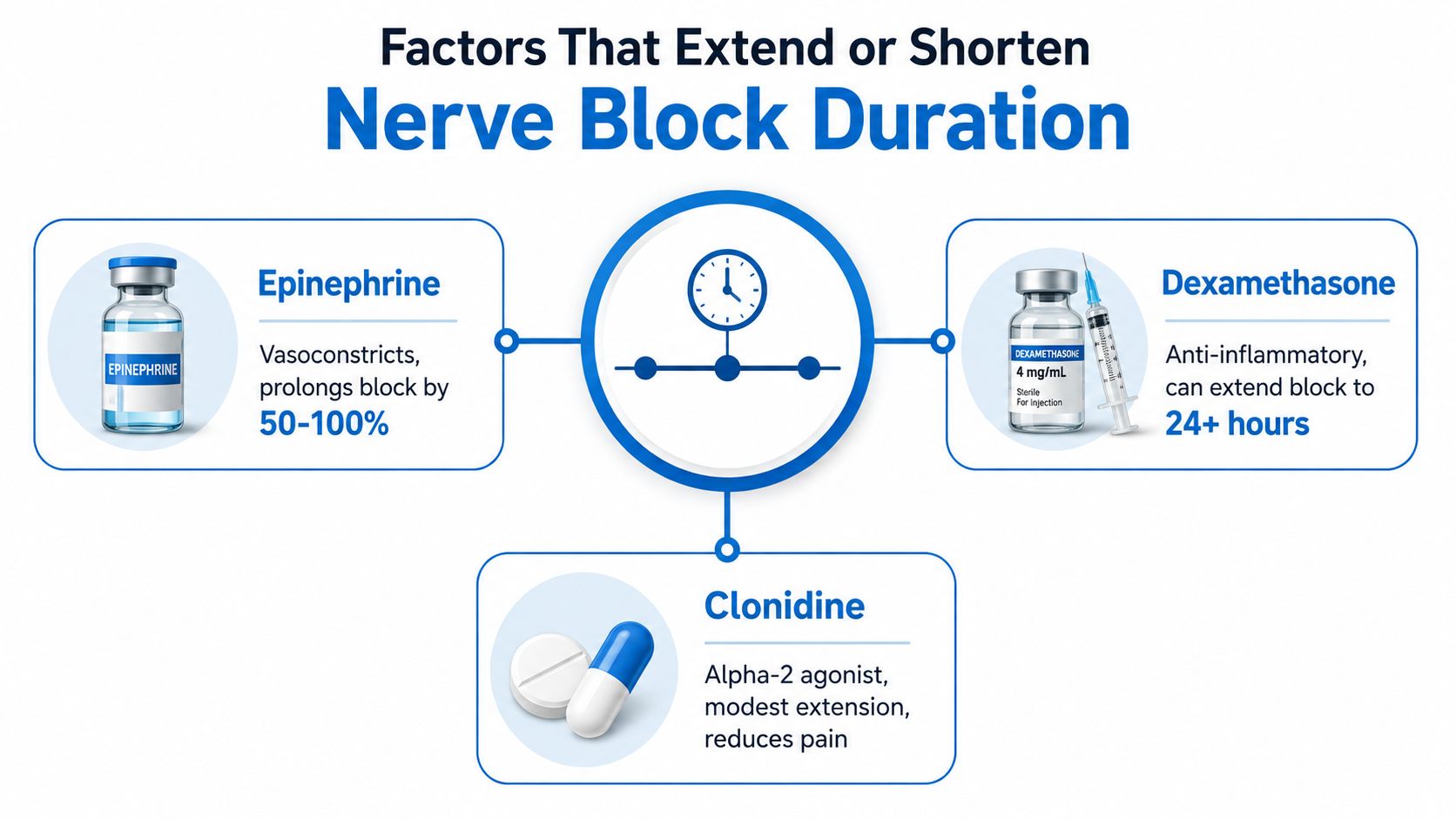
Additives can change the local environment around the nerve. Epinephrine causes vasoconstriction, which can slow local absorption. Dexamethasone has been used as an adjunct to extend analgesia, although the benefit varies by technique and route. Clonidine may provide a more modest extension in selected settings.
Evidence illustrates why these choices matter. In a retrospective study of 1,027 brachial plexus block patients, more than 90% received perineural dexamethasone at a median dose of 2 mg, and its use was associated with longer block duration. Another analysis found that adding dexamethasone to ropivacaine prolonged median peripheral nerve block duration by 37%. These findings appear in the PubMed analysis of factors affecting block duration.
The same analysis found that increasing ropivacaine volume from 10 mL to 40 mL raised median duration from 10.0 hours to 15.0 hours, while increasing concentration from 0.375% to 0.75% raised it from 10.75 hours to 13.75 hours. These are study findings, not a promise for an individual patient.
Anatomy and patient variation
A block placed in a more vascular area may wear off sooner because blood flow clears the medication faster. The nerve's size, the surrounding tissue, and the location's vascularity all influence how medication spreads and remains near the target. Lower-extremity blocks can last longer than upper-extremity blocks in some clinical contexts because nerve size and regional vascularity differ.
Patient physiology also matters. Liver function, concurrent medications, body composition, metabolic differences, and the condition of the tissues near the injection can alter drug handling. These factors don't allow a clinician to calculate an exact end time before the block begins.
Technique and the intended endpoint
Ultrasound or other imaging guidance helps the clinician place medication accurately around the target. Precise placement can improve spread without requiring unnecessary volume, while an injection that doesn't reach the intended tissue may provide incomplete or shorter relief. Medication placed inside a nerve is not a strategy for extending duration and carries safety concerns, so experienced clinicians deliberately avoid intraneural injection.
A 2025 systematic review found that mixing short or intermediate-acting anesthetics with long-acting agents modestly shortened sensory block duration by about 226 minutes and motor block duration by about 259 minutes, without clearly improving time to a request for additional analgesia. The review is available through the published evidence on mixed local anesthetics and nerve block duration.
Your Recovery Timeline After a Nerve Block
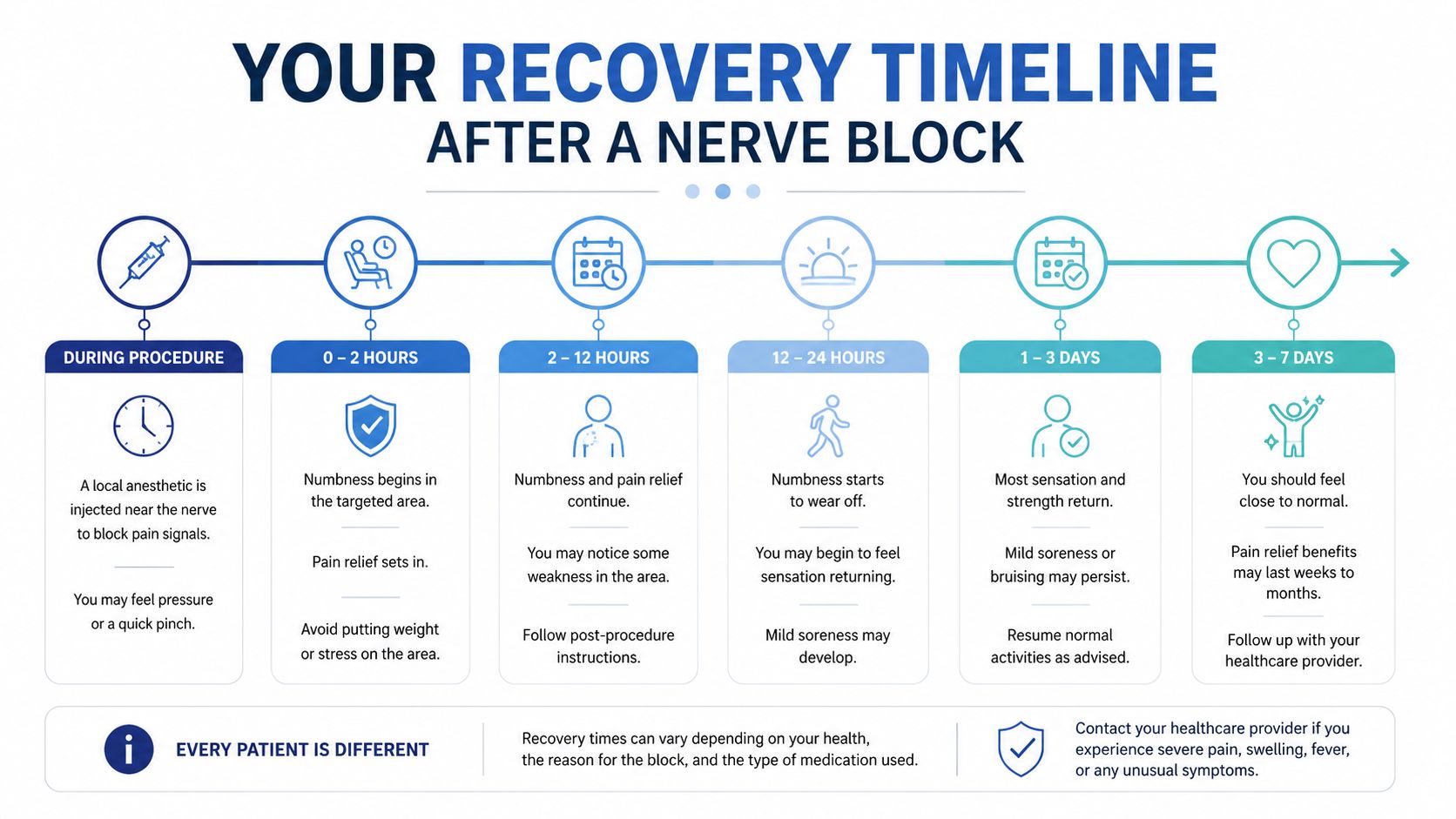
Recovery usually feels like a gradual return rather than a switch turning off. Immediately after the injection, the patient may notice warmth, tingling, heaviness, or a spreading sense of numbness. The limb can feel unfamiliar even when the block is working normally.
The early phase
During the first part of recovery, the block may become denser. Sensation and movement can diminish progressively, and the patient may not realize how much strength has been affected until trying to stand, walk, grip, or lift. A limb without normal sensation is vulnerable to burns, pressure injuries, falls, and accidental overuse.
Patients should follow the procedure-specific instructions, protect the affected area, and avoid relying on the numb limb for balance. Driving, climbing, operating machinery, and returning to physical work should wait until the treating team confirms that strength, coordination, and sensation are adequate.
The fading phase
With a long-acting anesthetic, meaningful sensory relief commonly continues for about 8 to 14 hours, though the patient's actual experience can fall outside that window. A prospective analysis found a mean sensory block duration of 380 minutes on day one, with duration 55 minutes shorter on day two, demonstrating that even similar injections can vary within the same person. The findings are reported in the prospective study of sensory block variability.
Tingling, warmth, mild hypersensitivity, or a pins-and-needles sensation can occur as nerve function returns. Patients should follow the prescribed plan for oral pain medicine and ask the surgical or anesthesia team when to take it. Waiting until severe pain appears can make the transition more difficult, especially after a large operation.
When symptoms need urgent attention
Unexpected symptoms require a call to the clinical team or emergency evaluation, depending on severity. Concerning signs include:
- Breathing difficulty: New shortness of breath or trouble taking a full breath needs urgent assessment.
- Progressive spread: Numbness or weakness that spreads unexpectedly should be reported.
- Cardiovascular symptoms: Fainting, severe palpitations, chest symptoms, or marked dizziness require immediate medical attention.
- Severe neurologic symptoms: Severe headache, seizure-like activity, or sudden persistent weakness isn't part of routine block recovery.
The anesthesiology or pain team should provide location-specific instructions before discharge. A patient who isn't sure whether a symptom is expected should contact the team rather than trying to interpret it alone.
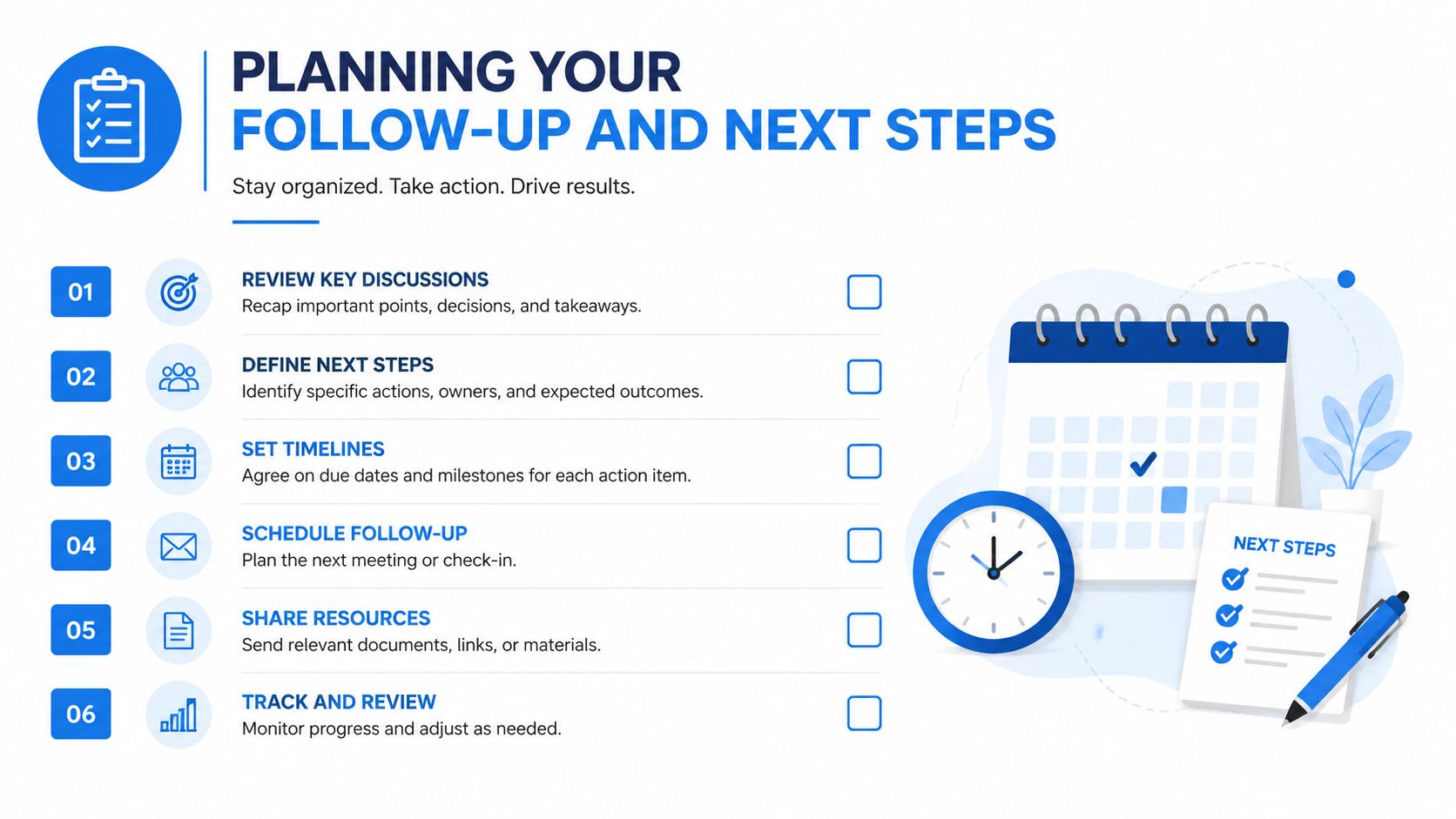
Planning Your Follow-Up and Next Steps
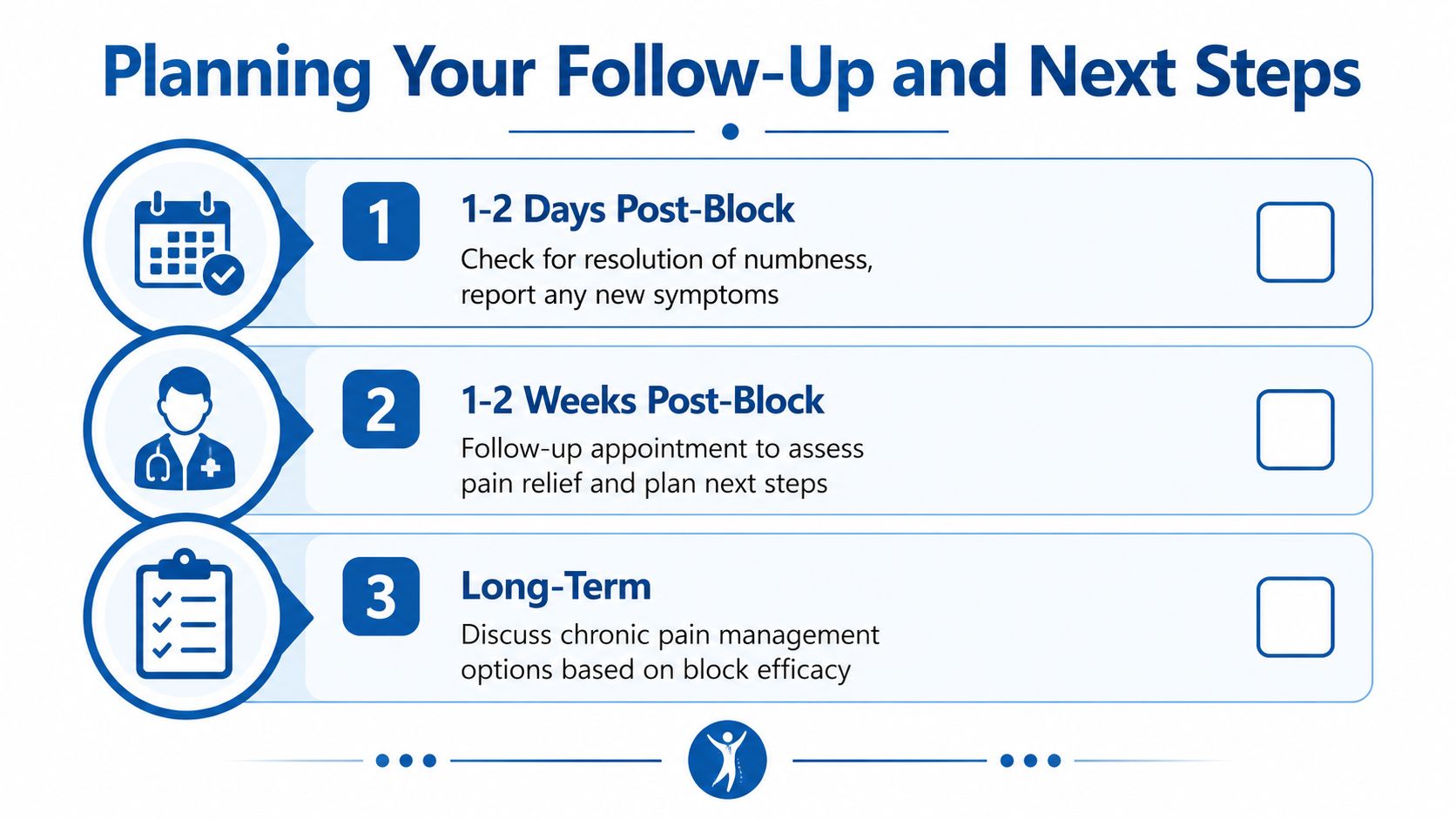
A nerve block becomes more useful when the patient records what happened after the injection. A simple diary can note when numbness began, when movement returned, when pain relief was strongest, when pain started to return, and which activities became easier. Functional details, such as walking, sleeping, climbing stairs, or participating in therapy, can be more informative than a single pain score.
Match follow-up to the purpose
A diagnostic block is judged by the relationship between the injection and the targeted pain. The care team may ask whether the familiar pain changed during the expected anesthetic window and whether movement that normally provokes symptoms became easier. A therapeutic block requires a broader review, including relief quality, duration, medication use, sleep, and function.
The next appointment should be scheduled according to the clinician's plan and the treated condition. A patient should contact the pain team sooner if pain returns abruptly, numbness persists unexpectedly, the injection site becomes increasingly painful or inflamed, or new weakness develops.
Use the response to guide care
A short-lived diagnostic response may still answer an important clinical question. If the targeted pain improves clearly during the block, the team may discuss whether another intervention, rehabilitation plan, or surgical opinion is appropriate. A block can provide information without becoming a permanent solution.
Patients may also need coordinated planning with physical therapy, medication management, or work restrictions. The relief window can be used to restore movement and practice prescribed exercises, but activity should remain within the surgeon's or pain specialist's limits.
For broader options involving spine, joint, nerve, and chronic pain conditions, pain management services from Interventional Pain Management can be part of a coordinated evaluation. Interventional Pain Management provides image-guided nerve blocks and other interventional, orthopedic, and spine care based on the patient's diagnosis and functional goals.
Patients who want a personalized answer to how long a nerve block may last can schedule an evaluation with Interventional Pain Management. The practice can assess the pain source, explain whether a single-shot block or catheter-based approach fits the procedure, and coordinate follow-up around recovery, rehabilitation, and daily activity goals.