

A 2023 meta-analysis found that trigger point injections reduced acute myofascial pain more than medication alone, with a standardized mean difference of -2.09 and P = 0.001. The evidence for chronic pain is far less consistent, so the honest answer is yes for short-term relief in selected patients, but not yet proven for lasting functional recovery.
That distinction matters because “working” can mean two different things. A procedure may lower pain enough to let someone move, sleep, or begin physical therapy, yet still fail to change the underlying drivers of a chronic pain syndrome. Trigger point injections appear most useful when a clinician identifies a discrete painful muscle focus and uses the injection as part of a broader recovery plan.
Table of Contents
- The Honest Short Answer From the 2023 Evidence
- What a Trigger Point Actually Is and Why an Injection Helps
- Comparing the Injectates and Needling Options
- What the Research Shows for Acute Versus Chronic Pain
- Who Tends to Benefit and Who Usually Does Not
- Non-Injection Alternatives Worth Considering First or Alongside
- Fitting Trigger Point Injections Into an Integrated Treatment Plan
The Honest Short Answer From the 2023 Evidence
A 2023 systematic review and meta-analysis of four randomized controlled trials found a substantial short-term pain benefit from trigger point injections in adults with acute myofascial pain. Compared with medical treatment alone, injections produced greater pain reduction, with a standardized mean difference of -2.09, a 95% confidence interval from -3.34 to -0.85, and P = 0.001 (2023 systematic review and meta-analysis). The result supports using injections selectively when pain is acute, localized, and consistent with a myofascial source.
The result has a narrower meaning than “the condition is cured.” The trials mainly measured pain, not durable restoration of strength, movement, sleep, or work capacity. A lower pain score can create time for physical therapy, normal movement, and improved sleep. It does not establish that the factors sustaining chronic pain have been removed.
Relief is not the same as recovery
A useful response is measured by function as well as symptoms. Can the patient rotate the neck, lift an arm, walk, exercise, sleep, or complete work tasks more consistently after treatment? Evidence for these outcomes is thinner than evidence for short-term pain reduction, so the injection should be judged by what it makes possible outside the clinic.
Chronic pain requires a different level of caution. A 2009 systematic review found inconsistent evidence for trigger point injections in chronic non-malignant musculoskeletal pain involving the head, neck, shoulder, and back, without a clear conclusion that treatment was beneficial or ineffective (2009 systematic review). The studies used different medications, injection techniques, patient groups, and definitions of a trigger point. Those differences limit how confidently one chronic-pain result can be applied to another.
The practical conclusion is conditional: trigger point injections can reduce pain in the short term for selected patients with acute or localized myofascial pain. Evidence is weaker for chronic syndromes and does not show that injections alone restore lasting function.
Practical rule: A clear short-term response can support the working diagnosis and create an opportunity for rehabilitation. If function does not improve, repeating the procedure should prompt reassessment rather than automatic continuation.
What a Trigger Point Actually Is and Why an Injection Helps
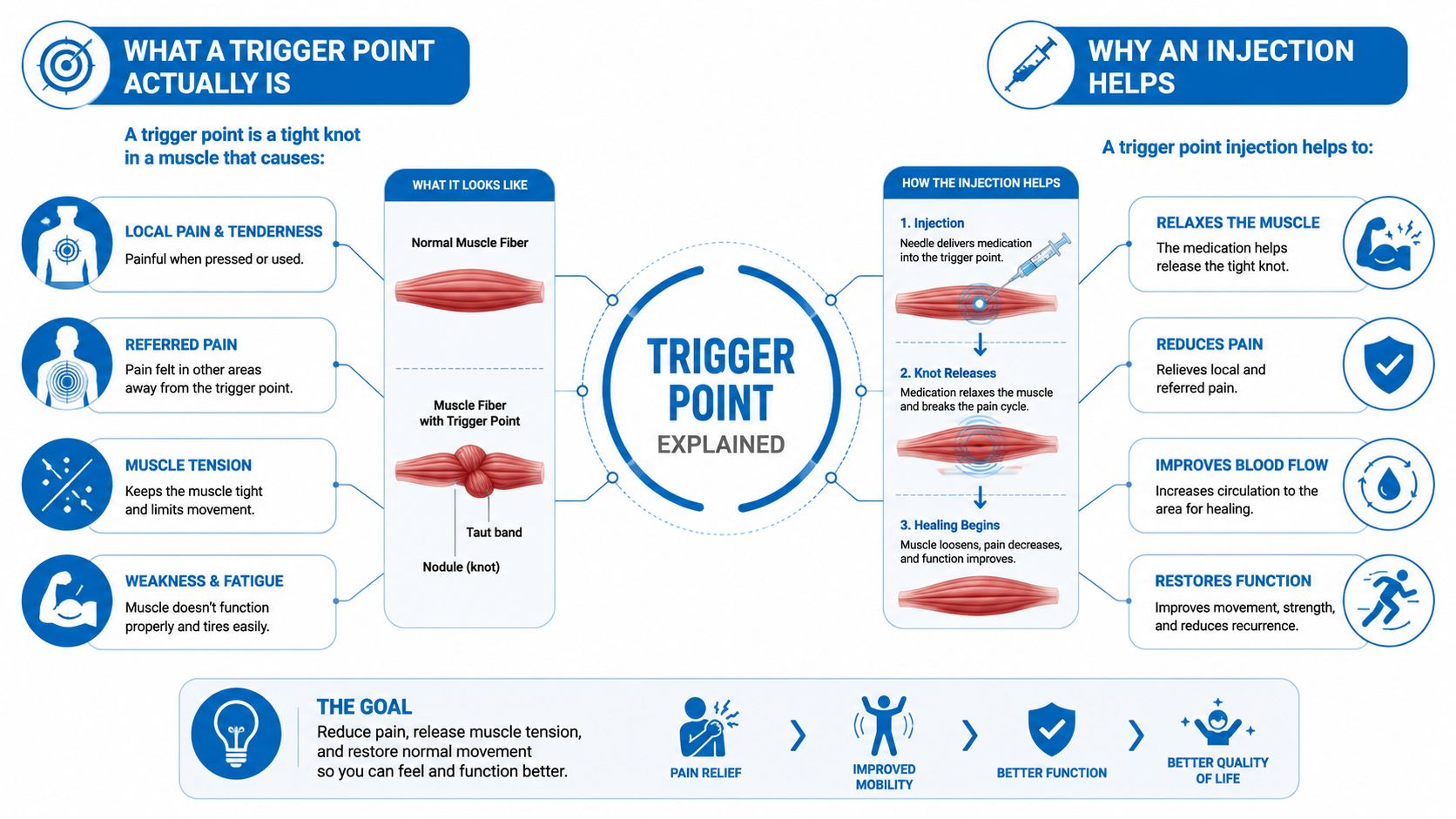
A trigger point can be understood as a knot in a taut muscle rope. Within a larger muscle, a small area of fibers remains contracted and develops a tender, palpable band or nodule. Pressing that spot may reproduce local pain or send pain into a predictable nearby region, a pattern called referred pain.
This isn't the same as ordinary muscle stiffness. A trigger point may limit movement, alter how surrounding muscles work, and maintain a cycle in which pain causes guarding while guarding increases muscle sensitivity. A patient seeking more background on the condition can review this overview of myofascial pain syndrome.
Three procedures that patients often confuse
A trigger point injection places a solution into the painful muscle focus. The solution may contain a local anesthetic, another medication, or no medication at all. Dry needling uses a needle without an injected substance, so any benefit must come from the mechanical needle stimulus and the tissue response.
An epidural steroid injection is different again. It targets structures around the spinal canal or irritated spinal nerves, not a palpable knot inside a muscle. Similar-sounding procedures can therefore address entirely different pain generators.
Why the needle may help
Clinicians propose several overlapping mechanisms:
- Mechanical disruption: Needle movement may disturb the contracted taut band.
- Pain interruption: Local anesthetic can temporarily block pain signals and reduce the pain-spasm cycle.
- Local chemical change: Needling or fluid placement may dilute or wash away substances that sensitize nearby nerve endings.
The response can also provide diagnostic information. If the familiar pain disappears during the local anesthetic phase, that supports the idea that the treated muscle contributed to the symptoms. It doesn't prove that the muscle is the only cause, particularly when spinal, joint, nerve, or widespread pain processes coexist.
Comparing the Injectates and Needling Options
The injectate may matter less than patients expect. Historical evidence reaches back to 1955, when saline injections were introduced to deactivate myofascial trigger points. In one classic comparison, saline produced pain relief in 80% of patients, compared with 52% after mepivacaine. That difference suggests the needle and tissue response may account for a substantial part of the benefit (historical review).
A later review of 13 studies found pain reduction with local anesthetics, botulinum toxin A, and dry needling, without a significant difference between groups. It still favored local anesthetic injections as a first-line option because they cost less and caused less post-treatment soreness than dry needling. Botulinum toxin was more expensive and associated with more mild, self-limited adverse events. The review supports choosing an injectate for safety, practicality, and the clinical target rather than assuming the most complex option works best.
Injectate and Needling Options Side by Side
| Option | Onset of Relief | Typical Duration | Relative Cost | Notable Side Effects |
|---|---|---|---|---|
| Local anesthetic | Often immediate during the anesthetic phase | Usually short term, with durability varying by condition | Lower relative cost | Temporary soreness, bruising, or anesthetic-related effects |
| Botulinum toxin A | Delayed compared with local anesthetic | May last longer for some conditions, but durability is inconsistent | Higher relative cost | Mild self-limited adverse events and possible neuromuscular effects |
| Corticosteroid | Variable | Not clearly superior for muscle trigger points | Variable | Soft-tissue concerns, including possible atrophy |
| Dry needling | Immediate mechanical response is possible | Short-term relief is common, with variable persistence | Lower relative cost | Post-treatment muscle soreness |
Corticosteroid is not automatically the stronger choice for a muscle trigger point. Recent guidance favors local anesthetic alone over routine steroid use for chronic pain, with technique selected according to anatomy and risk. Deeper muscles or higher-risk anatomy may justify ultrasound guidance, while a superficial, easily identified muscle may not require it.
Patients comparing procedure categories can review types of injections for pain management. The relevant comparison is between a focal treatment and its intended goal. Local anesthetic may create a short diagnostic and therapeutic window. Dry needling emphasizes mechanical stimulation. Botulinum toxin may be considered when longer muscle relaxation is a specific aim, although durability remains inconsistent. These options work best when paired with a measurable rehabilitation target, such as improved movement or exercise tolerance, rather than used as stand-alone pain control. A broader explanation of point injection therapy for recovery can also help patients understand how point-based procedures fit within recovery planning.
What the Research Shows for Acute Versus Chronic Pain
Acute and chronic myofascial pain belong to different evidence categories. Acute findings are more persuasive. The 2023 meta-analysis discussed earlier found greater pain reduction with trigger point injections than with medical treatment alone, with a standardized mean difference of -2.09 and P = 0.001 (acute pain meta-analysis).
Chronic pain presents a harder test. Persistent symptoms may involve altered movement, poor sleep, fear of activity, nerve sensitivity, stress-related guarding, or multiple pain sources. An injection can reduce pain from one involved muscle without resolving the wider syndrome.
Evidence Strength by Pain Condition and Duration
| Condition | Acute Relief | Chronic Relief | Functional Recovery |
|---|---|---|---|
| Localized neck or shoulder myofascial pain | More supportive evidence for short-term reduction | Mixed and technique-dependent | Not consistently established |
| Myofascial back pain | Possible short-term benefit | Inconsistent evidence | No reliable proof of lasting improvement |
| Head and neck pain with a discrete muscular trigger | May respond when the trigger is clearly identified | Durability remains uncertain | Limited direct evidence |
| Widespread fibromyalgia-spectrum pain | A focal trigger may improve | Weakest and least consistent signal | Broad recovery isn't established |
The older chronic-pain review, noted earlier, reached no clear conclusion about overall benefit or ineffectiveness. A more recent review also found no consistent superiority among local anesthetic, botulinum toxin A, and dry needling. As discussed in the injectate comparison, that pattern supports a mechanism-dependent effect rather than one universally superior injection.
The practical distinction is between symptom change and functional recovery. Research does not reliably establish fewer missed workdays, sustained return to activity, durable opioid reduction, or restoration of normal physical capacity after injections. Small studies and differing techniques can make early improvement appear more consistent than it is. Publication bias may also leave unsuccessful studies less visible.
For acute pain, a focal injection may provide a useful short-term window. For chronic pain, its value depends more on what happens during that window, such as restoring movement, tolerating exercise, or progressing rehabilitation. The procedure should therefore be judged by a defined functional target, not pain relief alone.
A lower pain score is encouraging. A better squat, longer walk, improved neck rotation, or completed therapy session is more clinically meaningful.
Who Tends to Benefit and Who Usually Does Not
The strongest candidate usually has localized pain, a palpable taut band, and a familiar pain pattern reproduced when the clinician examines that muscle. The case is less convincing when pain is diffuse, poorly localized, or accompanied by symptoms pointing toward a nerve, joint, inflammatory, or systemic disorder. The diagnosis matters more than the medication placed in the syringe.
A recent, mechanically triggered problem may respond differently from a long-standing syndrome with widespread sensitivity. An injection can reduce a local pain signal, but it cannot correct poor movement patterns, deconditioning, ergonomic strain, or ongoing tissue overload. Conservative care remains relevant before and after the procedure.
A useful responder profile
- Focal examination finding: Palpation reproduces the patient's familiar pain, rather than causing only nonspecific tenderness.
- A defined functional target: The patient aims to rotate the neck, reach overhead, walk farther, or complete prescribed exercises.
- A rehabilitation plan: The lower-pain period will be used for stretching, strengthening, movement retraining, or graded activity.
- A reassessment point: The clinician and patient agree in advance on what counts as meaningful improvement.
People with widespread nonspecific muscle pain or prominent central sensitization features may be less likely to obtain durable benefit from a focal injection. Expectations also matter. If the procedure is expected to replace active treatment, or psychosocial and environmental barriers prevent rehabilitation, short-term pain relief may not translate into better function.

Repeat injections should be tied to measurable progress. If each treatment provides relief without creating enough capacity to move differently, exercise, or train the affected region, the clinician should reconsider the diagnosis and treatment plan rather than repeat the procedure automatically. The meaningful test is whether a focal reduction in pain supports recovery, not whether tenderness briefly decreases.
Non-Injection Alternatives Worth Considering First or Alongside
The most durable strategy usually combines symptom control with a method that changes how the body moves and loads tissue. Structured exercise and stretching generally take longer to produce meaningful change than an anesthetic injection, but they address strength, mobility, endurance, and confidence with movement. Those gains are more relevant to long-term function than a temporary reduction in tenderness.
Manual therapy, including myofascial release and ischemic compression, may provide short-term relief and can work well when paired with exercise. Dry needling offers a non-injection alternative that uses the mechanical component of needling without pharmacologic exposure. The comparative literature found similar pain reduction across dry needling and injection approaches, without a significant difference between groups.
Alternatives Compared to Trigger Point Injections
| Option | Evidence Strength | Time to Relief | Durability |
|---|---|---|---|
| Structured exercise and stretching | Stronger for functional improvement over time | Gradual | Better when maintained |
| Manual therapy | Moderate for short-term symptom relief | Often prompt | More durable when combined with exercise |
| Dry needling | Comparable short-term pain signal in selected trigger points | Often prompt | Variable |
| Topical or oral anti-inflammatory medication | Useful for symptom control, with individual limitations | Variable | Usually depends on continued use |
| Cognitive behavioral therapy or graded activity | Valuable when chronic pain includes fear, avoidance, or central features | Gradual | Can support sustained activity |
| Trigger point injection | More supportive for selected acute myofascial pain | Often rapid | Uncertain in chronic syndromes |
Medication can help a patient tolerate rehabilitation, but it doesn't automatically restore capacity. Exercise may feel slower and less dramatic, yet it targets the physical limitations that an injection leaves untouched. Dry needling may also produce post-treatment soreness, while injections add medication-specific considerations.
For patients evaluating supplements as an adjunct rather than a replacement for assessment and rehabilitation, a stiffness relief supplement guide can help frame the distinction between symptom support and treatment of a defined pain generator. Most patients should discuss a period of conservative care before proceeding to an injection, unless severe pain prevents basic movement or therapy.
Fitting Trigger Point Injections Into an Integrated Treatment Plan
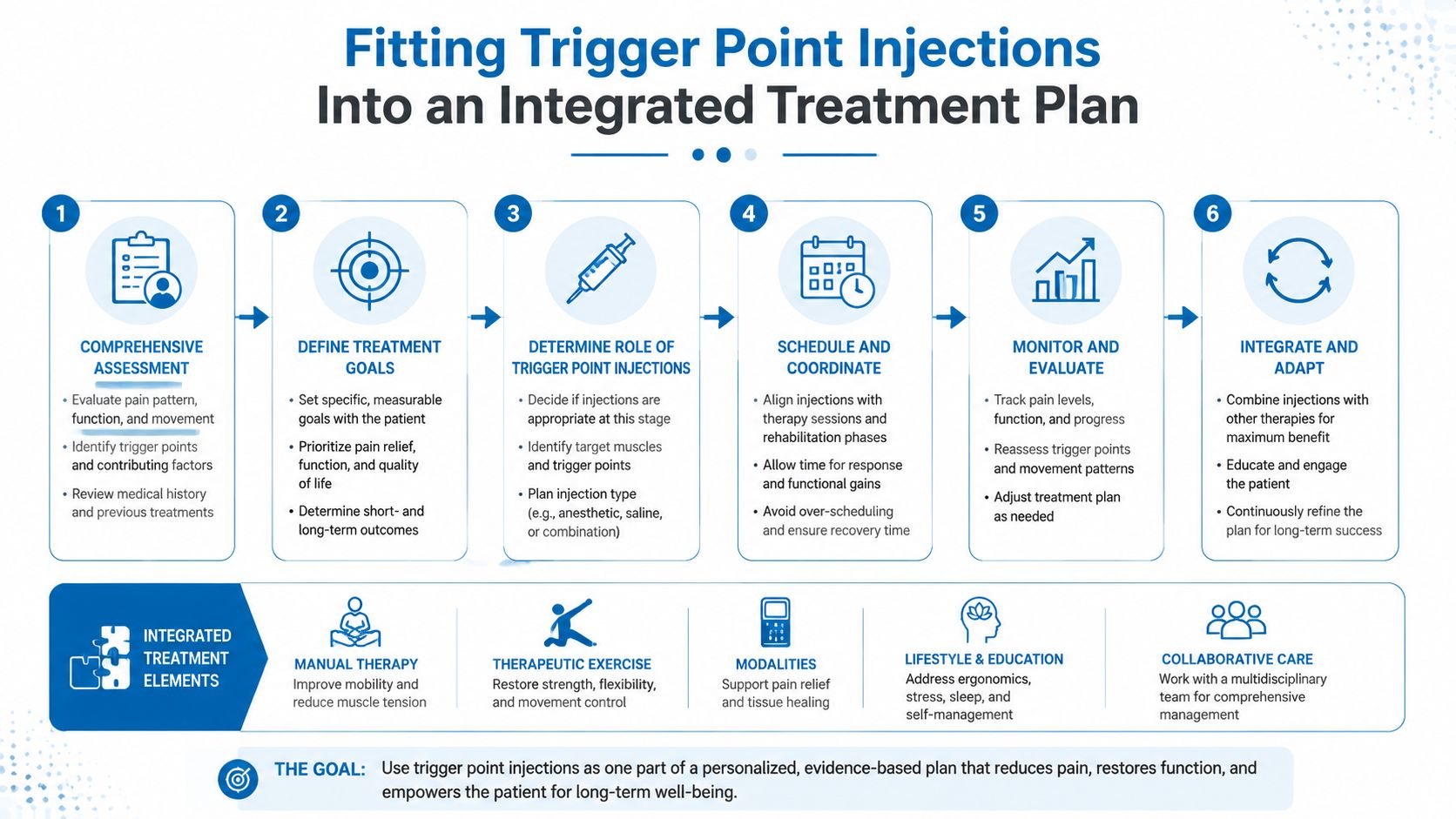
A trigger point injection is most defensible as a window of reduced pain, not a stand-alone treatment. That window should support a defined functional objective, such as restoring range of motion, tolerating strengthening, or resuming graded activity. Pain scores alone provide a weak test of success if movement and capacity do not improve.
A practical sequence
- Confirm the target. Examination should identify a discrete muscular source while considering joint, nerve, and spinal causes.
- Define the goal. Specify what the patient needs to do more easily, rather than focusing only on the desired pain reduction.
- Use the procedure selectively. Local anesthetic alone may suit diagnostic clarification or short-term interruption of pain. Technique and guidance should match the muscle's location and procedural risk.
- Start active rehabilitation promptly. Follow the clinician's instructions for gentle mobility, then add strengthening and movement retraining as tolerated.
- Measure function. Track range of motion, walking, lifting, sleep, exercise participation, or work tasks.
- Reconsider when the logic fails. If relief does not enable rehabilitation progress, repeating the same procedure warrants reassessment of the diagnosis and plan.
The treatment discussion can set a time-limited review point, such as assessing whether relief lasts two to six weeks, movement improves enough for exercise, and flares become less disruptive over a three-month tracking period. These are planning targets, not universal outcomes. Expectations should follow the diagnosis, examination findings, and response to rehabilitation.
Patients can ask:
- What functional goal will the injection support?
- How many injections are planned before reassessment?
- What will change if pain improves but rehabilitation does not?
The practical standard is functional progress before repeating an injection, consistent with the policy direction discussed earlier and the 2024 multi-society guideline in Section 3. Temporary pain reduction alone is weaker evidence of value. Patients seeking assessment of myofascial pain can review pain management services as part of a broader diagnostic and rehabilitation pathway.
Interventional Pain Management evaluates whether localized muscle pain is an appropriate injection target and connects procedure decisions with rehabilitation goals. Patients in New Jersey and Staten Island can visit Interventional Pain Management to request an assessment and discuss whether an injection, conservative care, or another pathway fits the diagnosis.