
A patient scheduled for spine surgery often hears two very different stories. One person describes an operation that restored walking and sleep. Another mentions infection, a spinal fluid leak, or a second operation. Both accounts can be accurate, because spine surgery complications don't come from one universal risk profile. The operation, spinal region, surgical approach, prior procedures, medical conditions, and length of follow-up all change what can happen.
The most useful question isn't “What's the complication rate?” It's, “Which complications matter for this exact procedure, when could they appear, and what can be done to prevent or detect them early?” That shift helps patients participate in consent, prepare more intelligently, and recognize warning signs without treating every normal symptom as an emergency.
Table of Contents
- Why Complication Awareness Changes the Surgery Conversation
- What Counts as a Spine Surgery Complication
- The Most Common Complications Patients Should Know
- How Complication Rates Vary by Procedure and Approach
- Risk Factors That Shape Your Personal Complication Profile
- Prevention Strategies Before, During, and After Surgery
- Warning Signs at Home and When to Seek Care
- Making Informed Decisions and Moving Forward
Why Complication Awareness Changes the Surgery Conversation
Maria has lived with lumbar spinal stenosis for years. Physical therapy, injections, and activity changes helped for a while, but now her right leg gives way after a short walk, and numbness interrupts sleep. Her surgeon has discussed a two-level decompression with fusion.
Maria's neighbor knows someone who had a similar operation and developed an infection requiring prolonged treatment. A friend underwent a smaller disc procedure and returned quickly to running. Those stories feel comparable, but they describe different operations, different bodies, and different recovery demands. A decompression with instrumentation places different stresses on bone, nerves, muscles, and wound healing than a limited discectomy.
The historical evidence also shows why general reassurance isn't enough. A systematic review covering 105 articles and 79,471 patients identified 13,067 reported complications, producing an overall complication incidence of 16.4% per patient. The same review found a higher incidence in thoracolumbar procedures than cervical procedures, 17.8% versus 8.9%, a statistically significant difference associated with spinal region and procedural complexity (2010 systematic review of spine surgery complications).
That information doesn't predict Maria's outcome. It gives her a better vocabulary for discussing it.
Practical rule: A risk estimate becomes useful only when it identifies the procedure, approach, patient factors, and follow-up period behind the number.
Complication literacy changes consent from passive acceptance into active matching. A patient who understands the difference between a temporary nerve irritation and a lasting motor deficit can ask better questions. Someone with prior lumbar surgery can ask specifically about scar tissue and dural-tear risk. Someone considering fusion can ask how bone healing, implants, and adjacent levels will be monitored.
Preparation isn't pessimism. It's a way to make the decision fit the patient rather than relying on someone else's surgical story.
What Counts as a Spine Surgery Complication
A complication is an adverse event that departs from the expected recovery and requires additional treatment, extends recovery, or creates lasting harm. The definition matters because surgery normally causes pain, fatigue, swelling, sleep disruption, and temporary activity restrictions. Those symptoms can be uncomfortable without representing a surgical failure.
Clinicians usually classify problems by when they happen and which body structure is involved.
- Intraoperative complications occur during surgery. Examples include a dural tear, nerve-root injury, unexpected bleeding, or an implant-positioning problem.
- Early postoperative complications appear during the first days or weeks. Examples include infection, hematoma, blood clot, wound breakdown, or a cerebrospinal fluid leak.
- Late complications can develop months or years later. Examples include non-union after fusion, hardware loosening, adjacent segment disease, or progressive deformity.
A layered model can make the timing easier to understand. The skin must close, soft tissues must recover, nerves must tolerate decompression and manipulation, bone must heal, and implants must remain stable while that healing occurs. Each layer has a different vulnerability window, so a reassuring incision doesn't prove that fusion has consolidated, and an early pain flare doesn't automatically mean the hardware has failed.
A patient should also distinguish a symptom from a complication. New numbness is a symptom. The cause might be expected nerve irritation, postoperative swelling, recurrent compression, or a more serious neurologic event. The clinical team determines whether it represents a complication by examining its severity, progression, timing, and relationship to the operation.
That distinction prevents two common errors: dismissing a meaningful change as ordinary recovery, or assuming every unpleasant sensation means something went wrong.
The Most Common Complications Patients Should Know
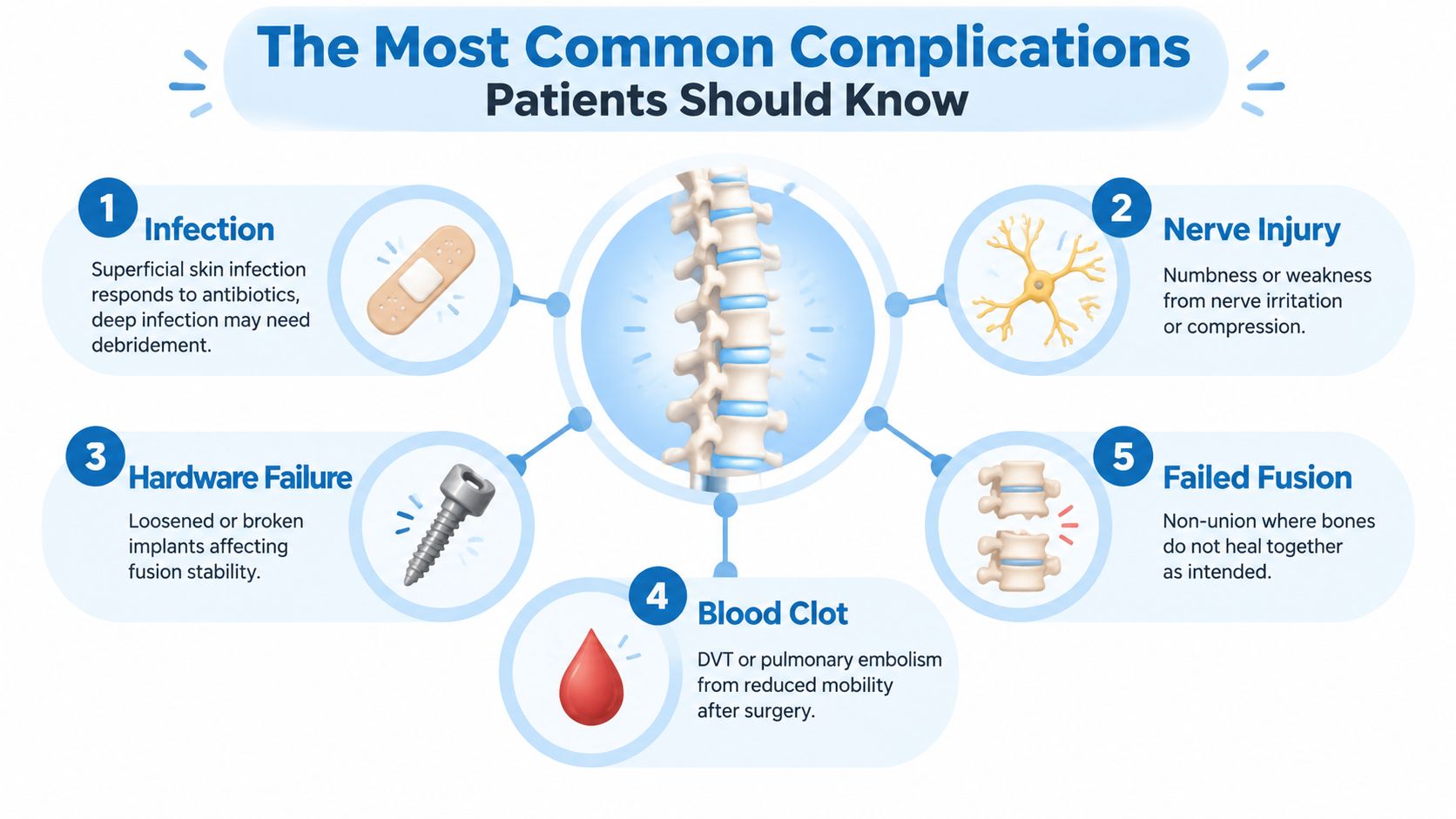
The word “infection” covers more than one clinical problem. A superficial infection affects the skin or tissue near the incision and may respond to medication and local care. A deep infection can involve the surgical bed, disc space, bone, or implants, and may require drainage, operative washout, or prolonged targeted antimicrobial treatment. Patients can review practical prevention information in this BacteriaFAQ.com evidence-based SSI resource.
A dural tear, also called an incidental durotomy, opens a pathway for cerebrospinal fluid to escape. It can cause a positional headache, wound drainage, pseudomeningocele, delayed healing, meningitis, or a need for additional closure. A 2025 systematic review and meta-analysis found postoperative infection in 13.1% of patients with an incidental dural tear versus 5.4% without one, with pooled odds ratios for surgical-site infection in included studies (2025 lumbar surgery durotomy meta-analysis). The same review reports that incidental durotomy commonly occurs in 3% to 5% of primary lumbar procedures and rises to 7% to 17% in revision cases, where scar tissue and adhesions obscure normal tissue planes.
Neurologic complications range in severity. A nerve root may become temporarily irritated, causing burning pain, tingling, or weakness that improves as swelling settles. More serious injury can produce persistent weakness or sensory loss. A new inability to lift the foot, often called foot drop, deserves prompt medical assessment rather than watchful waiting. Patients can learn more about that symptom through this foot drop clinical resource.
Hardware problems include screw malposition, rod fracture, cage migration, loosening, or loss of alignment. These events don't always cause immediate catastrophe. Some produce new pain, while others appear on follow-up imaging before symptoms become severe. Pseudarthrosis, or failed fusion, means the intended bone bridge hasn't consolidated. Persistent or returning pain months after surgery can prompt evaluation, particularly after a multilevel construct or in a patient whose bone-healing capacity is reduced.
Adjacent segment disease describes degeneration above or below a fusion. It reflects both altered mechanics and the spine's underlying degenerative process. It shouldn't be confused with an immediate postoperative problem, because it usually belongs to a later follow-up window.
Anterior cervical surgery has its own profile. Dysphagia, or difficulty swallowing, and hoarseness can follow esophageal retraction or irritation near the recurrent laryngeal nerve. A 2025 systematic review found dysphagia rates ranging from 2.3% to 87.5%, depending on the timing of assessment and the study definition. The same review reported ranges of 0.4% to 32% for adjacent segment disease and 0.25% to 31% for pseudarthrosis, illustrating why a single generic rate can mislead (2025 systematic review of anterior cervical surgery complications).
How Complication Rates Vary by Procedure and Approach
A single “spine surgery complication rate” hides the variables that make a risk estimate meaningful. A limited decompression, a revision discectomy, a multilevel fusion, and adult deformity reconstruction don't expose the patient to the same blood loss, operative duration, neural manipulation, or implant-related risk.
The historical review of spine surgery complications found an overall incidence of 16.4%, with 17.8% in thoracolumbar procedures and 8.9% in cervical procedures (regional comparison in the systematic review). Adult spinal deformity surgery carries a heavier burden. A systematic review reported perioperative complications in 24.2% to 36.4% of cases, depending on approach, with late complications adding 11.1% to 15.4%. Even minimally invasive deformity procedures in that review had perioperative complications of 24.2% and late complications of 14.0% (adult spinal deformity surgery review).
| Procedure type | Overall complication range | Common specific complication | Why the estimate varies |
|---|---|---|---|
| Minimally invasive spine surgery | 10% overall | Dural tear, disc reherniation, or revision surgery | The pooled data combine different minimally invasive procedures and follow-up periods |
| Anterior lumbar surgery | 13.1% overall | Access-related or postoperative complications | The anterior route creates a distinct risk balance involving access structures and recovery |
| Adult spinal deformity correction | 24.2% to 36.4% perioperative | Neurologic, wound, implant, or medical complications | Long constructs, osteotomies, staging, and surgical complexity change exposure |
| Primary versus revision lumbar surgery | Durotomy commonly 3% to 5% in primary and 7% to 17% in revision | Incidental dural tear and CSF leak | Scar tissue and adhesions make revision planes harder to identify |
The minimally invasive meta-analysis reported 10% overall complications, including dural tears at about 4%, nerve injuries at about 1%, hematoma at about 1%, infection at about 1%, revision surgery at about 2%, and disc reherniation at about 3%. A separate review of anterior lumbar surgery reported 13.1% overall complications, including 3.8% intraoperative complications, 7.4% postoperative complications, 1.5% infection, and 1.7% reoperation (meta-analysis of minimally invasive and anterior lumbar surgery outcomes).
The key point is not that one approach is automatically safer. The approach changes which risks receive emphasis. A posterior operation may raise concern about muscle disruption or dural exposure, while an anterior route can create access-specific vascular, visceral, swallowing, or voice considerations. Patients should ask how the selected approach fits the anatomy and pathology, not assume that “minimally invasive” eliminates meaningful risk. A detailed discussion of spinal fusion treatment and expectations can help frame that conversation.
Risk Factors That Shape Your Personal Complication Profile
Two patients can undergo the same operation and face different risks. The surgeon evaluates the procedure, but the patient's physiology determines how well the body tolerates anesthesia, closes the wound, heals bone, and responds to infection or blood loss.
Factors the patient can't change
Age, bone quality, spinal anatomy, inflammatory conditions, and prior surgery may not be reversible before the operative date. Prior surgery is especially important because scar tissue and adhesions can obscure the dura and nerve roots, which helps explain the higher revision durotomy rates described in the clinical evidence above.
Osteoporosis can reduce implant purchase and weaken the foundation needed for fusion. Anatomic variation, deformity, and the number of spinal levels involved can make positioning, decompression, and instrumentation more demanding. A history of ankylosing spinal disease or major deformity also changes planning because the spine may behave differently under surgical correction and postoperative loading.
Factors that can often be improved
Smoking and nicotine exposure can impair blood flow and bone healing. Diabetes, particularly when poorly controlled, can interfere with immune response and wound repair. High body weight can increase mechanical load and make positioning, mobility, and wound management more difficult. Malnutrition, anemia, opioid tolerance, and untreated sleep apnea can each affect recovery in different ways.
A patient can ask the surgical team to identify which issue matters most before proceeding:
- Glucose control: The team can review diabetes management and determine whether optimization or postponement is appropriate.
- Nicotine exposure: Stopping smoking and other nicotine products supports wound and bone-healing efforts.
- Bone health: Screening and treatment may matter before an instrumented fusion.
- Nutrition and anemia: Protein intake, iron status, and other deficiencies can be assessed and addressed.
- Medication and breathing review: Opioids, blood thinners, sedatives, and sleep apnea may require a coordinated perioperative plan.
Risk factors often interact rather than behave like isolated checkboxes. A patient with diabetes, nicotine exposure, poor nutrition, and weak bone may have a more fragile recovery than a patient with only one of those concerns.
Prevention Strategies Before, During, and After Surgery
Prevention begins before the patient enters the operating room. The surgical team should review medical conditions, medications, nicotine exposure, nutrition, anemia, bone health, and any active infection. A patient shouldn't stop anticoagulants, anti-inflammatory medicines, biologics, or other prescriptions without explicit instructions, because the safest plan depends on the drug and the operation.
Before surgery
A practical preparation plan may include:
- Medical optimization: Diabetes, blood pressure, sleep apnea, heart disease, and lung conditions should be identified and managed.
- Nicotine cessation: Patients should ask how long nicotine must be avoided before and after surgery, particularly when fusion is planned.
- Nutrition support: Adequate protein and correction of relevant vitamin or mineral deficiencies can support tissue and bone healing.
- Anemia evaluation: Low blood counts may need investigation and treatment before an operation with expected blood loss.
- Conditioning: Appropriate walking, strengthening, and physical therapy can help preserve function without worsening neurologic symptoms.
- Infection review: Skin, dental, urinary, or other active infections should be disclosed and managed according to the surgeon's instructions.
During surgery
Technique should match the anatomy. Navigation, imaging, and neuromonitoring may be useful when instrumentation or neural structures create a higher technical risk. A surgeon may choose a minimally invasive route when it offers a meaningful advantage without compromising decompression or alignment goals. If a dural tear occurs, careful recognition and repair reduce the chance that a persistent CSF leak will develop.
After surgery
The postoperative plan should address mobility, clot prevention, wound checks, pain control, drains, braces when indicated, and follow-up imaging. Early movement is often balanced against protection of the repair. Patients need clear written instructions about medication side effects, activity limits, showering, dressing changes, and who answers urgent questions after discharge.
A good discharge plan doesn't merely say “call if concerned.” It identifies the symptom, the contact route, and the urgency.
Warning Signs at Home and When to Seek Care
Normal recovery can include incisional tenderness, muscle soreness, stiffness, fatigue, bruising, constipation, and medication-related nausea or drowsiness. These symptoms should gradually become more manageable, even if improvement isn't perfectly linear. A stable symptom that responds to the prescribed plan is different from a new or steadily worsening deficit.
Patients should contact the surgeon's office or on-call service for increasing incision redness, warmth, swelling, drainage, persistent fever, chills, worsening pain, or a headache that becomes much worse when upright. The exact temperature threshold should come from the discharge instructions, because protocols vary. Any foul-smelling drainage or separation of the wound deserves prompt clinical guidance.
Symptoms requiring urgent assessment
- New weakness: A new inability to lift the foot, worsening leg weakness, or difficulty walking should be reported promptly. Progressive weakness may require same-day assessment.
- Bowel or bladder change: New loss of bladder or bowel control, inability to urinate, or numbness in the saddle area requires emergency evaluation.
- Possible clot symptoms: One-sided calf swelling or pain, sudden shortness of breath, chest pain, fainting, or coughing blood warrants emergency care.
- Severe neurologic change: Rapidly increasing numbness, severe new pain, or weakness in multiple limbs should not wait for a routine appointment.
- Wound deterioration: Spreading redness, heavy drainage, or systemic illness requires prompt contact with the surgical team.
The first weeks are best judged by direction rather than a rigid calendar. A patient may have good and bad days, but the overall pattern should be stable or gradually improving. Pain that suddenly escalates after a period of improvement, or weakness that progresses instead of settling, carries more significance than soreness that remains similar after activity.
Patients should keep the surgical office's daytime number and after-hours contact available. If a symptom could represent spinal cord or nerve compression, severe infection, or a blood clot, emergency services are more appropriate than waiting for a callback. For persistent pain after the initial recovery period, the discussion may involve recurrent compression, non-union, adjacent-level disease, hardware issues, or a separate pain generator. A clinical overview of pain after back surgery can help patients understand why continued symptoms need evaluation rather than automatic repeat surgery.
Making Informed Decisions and Moving Forward
A strong surgical consultation should produce a personal risk map, not just a consent form. The patient should leave knowing what operation is planned, which levels are involved, why that approach was selected, and which complications are most relevant to that anatomy.
Useful questions include:
- Procedure: Is the operation decompression alone, fusion, deformity correction, or a combination?
- Approach: Why is the operation anterior, posterior, lateral, open, or minimally invasive?
- Revision status: How does prior surgery change the likelihood of scar-related problems, dural tear, or incomplete decompression?
- Bone healing: What is the plan for assessing bone quality and monitoring fusion?
- Neurologic risk: Which new symptoms should trigger same-day contact or emergency care?
- Recovery: What restrictions, walking plan, wound checks, and imaging schedule will apply?
- Alternatives: What could continued nonsurgical treatment accomplish, and what symptoms would make delay unsafe?
The evidence supports asking for procedure-specific figures rather than accepting a generic percentage. Adult deformity surgery, for example, carries a substantially different complication burden from a limited decompression, while revision lumbar surgery has a different dural-tear profile from primary surgery. Timing also matters. A swallowing complaint assessed immediately after anterior cervical surgery isn't equivalent to one assessed much later, just as early wound concerns aren't the same as delayed fusion failure.
Most patients want a balanced answer, not either alarm or reassurance. Complication awareness helps patients prepare for ordinary recovery, identify meaningful changes earlier, and decide whether the expected benefit justifies the specific risks. The protective factor isn't anxiety. It's preparation, clear communication, and a plan built around the patient's medical condition and surgical goals.
Interventional Pain Management evaluates spine and musculoskeletal conditions through coordinated pain management, orthopedic, and spine services, including nonsurgical care, image-guided procedures, and surgical consultation when appropriate. Patients in New Jersey and Staten Island can visit Interventional Pain Management to discuss symptoms, review imaging, and clarify treatment options before or after spine surgery.