
The appointment ended, but the questions followed the patient home. How much pain relief counts as a successful spinal cord stimulator trial? Can a few better days really predict years with an implanted device? What happens if the temporary leads shift, the results are mixed, or the trial helps at first but the benefit fades?
Those questions deserve clear answers. A spinal cord stimulator trial procedure is a carefully designed screening step, not a promise of permanent relief. It gives a patient and pain specialist useful information about pain control, daily function, and tolerance of the therapy, while still leaving uncertainty about how benefit will hold up after implantation.
Table of Contents
- Understanding the Spinal Cord Stimulator Trial Procedure
- Who Is a Candidate for Spinal Cord Stimulation
- What Happens During the Trial Procedure
- Why Trial Success Does Not Always Mean Long-Term Relief
- Managing Daily Life During Your Trial Period
- Interpreting Your Trial Results and Next Steps
- Insurance Coverage and Accessing Care in New Jersey
Understanding the Spinal Cord Stimulator Trial Procedure
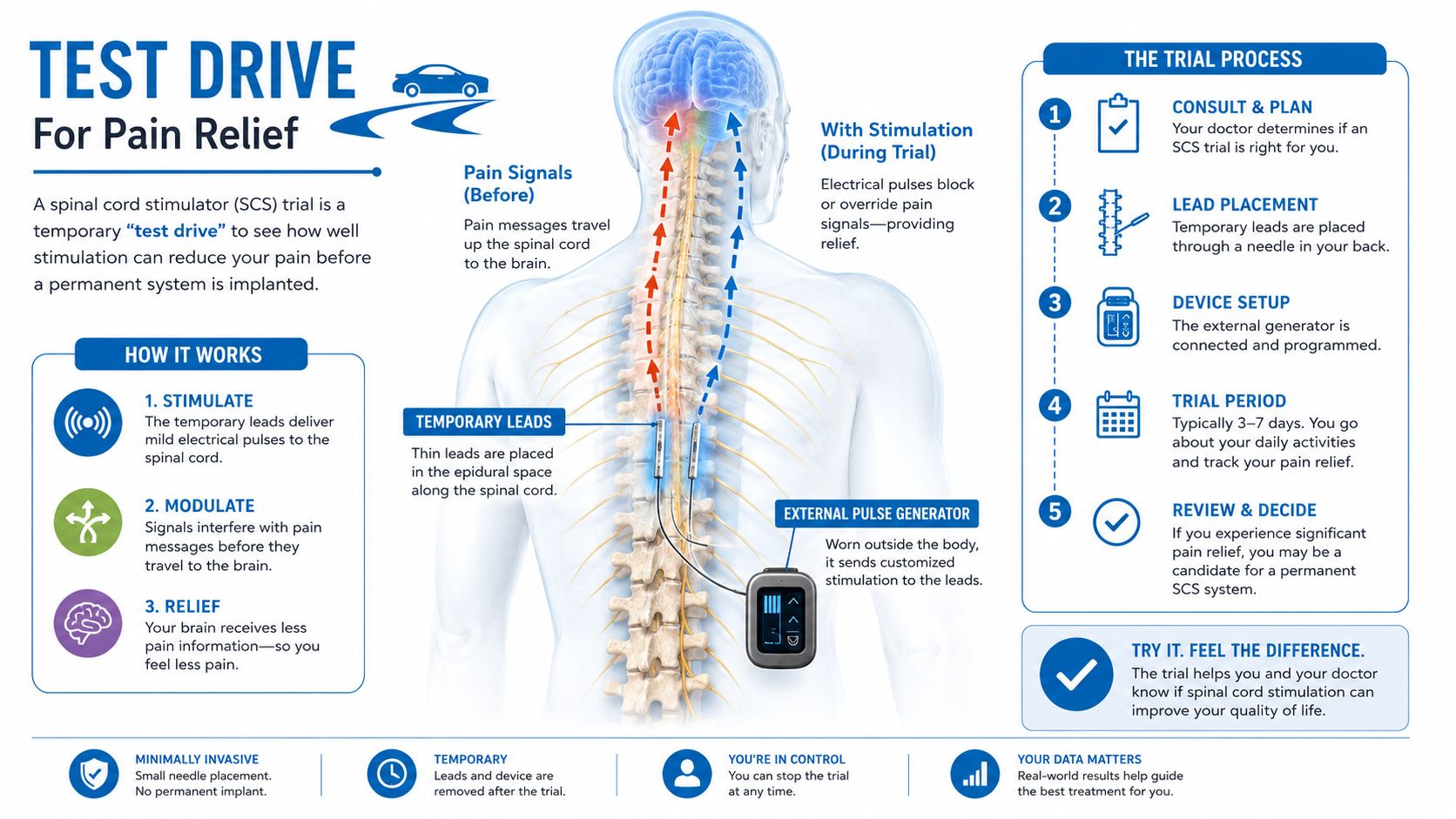
A patient with persistent nerve pain may have tried medication, physical therapy, injections, or surgery without achieving enough relief. At that point, a specialist might describe spinal cord stimulation as a “test drive” for the nervous system. Temporary leads deliver carefully programmed electrical stimulation near the spinal cord, allowing the patient to observe whether pain becomes easier to manage during ordinary activities.
The device doesn't remove the original source of pain. Instead, stimulation changes how pain signals are processed before they reach the brain. The exact experience varies by diagnosis, pain pattern, lead position, and programming, so the trial is performed before a permanent system is considered. More background about the therapy is available through spinal cord stimulation services.
A temporary screening, not a miniature implant
During the trial, thin epidural leads remain connected to an external pulse generator. The leads are temporary, and the generator stays outside the body. The arrangement approximates the intended therapy closely enough to assess whether stimulation reaches the painful areas and supports meaningful improvement.
The screening period is usually brief. Evidence-based consensus guidance reports that studies most commonly use five to seven days, while accepted trial durations generally fall around three to eight days. Some clinicians may extend a trial longer in selected circumstances, but the treating team determines the schedule based on the patient's situation and safety considerations. These ranges are described in the 2023 consensus guideline on patient selection and trial stimulation.
A useful distinction helps prevent disappointment: the trial answers, “Does this therapy appear to help this patient's pain under real-life conditions?” It doesn't answer with certainty, “Will the permanent implant provide the same benefit indefinitely?” That second question requires careful follow-up and realistic expectations.
Who Is a Candidate for Spinal Cord Stimulation
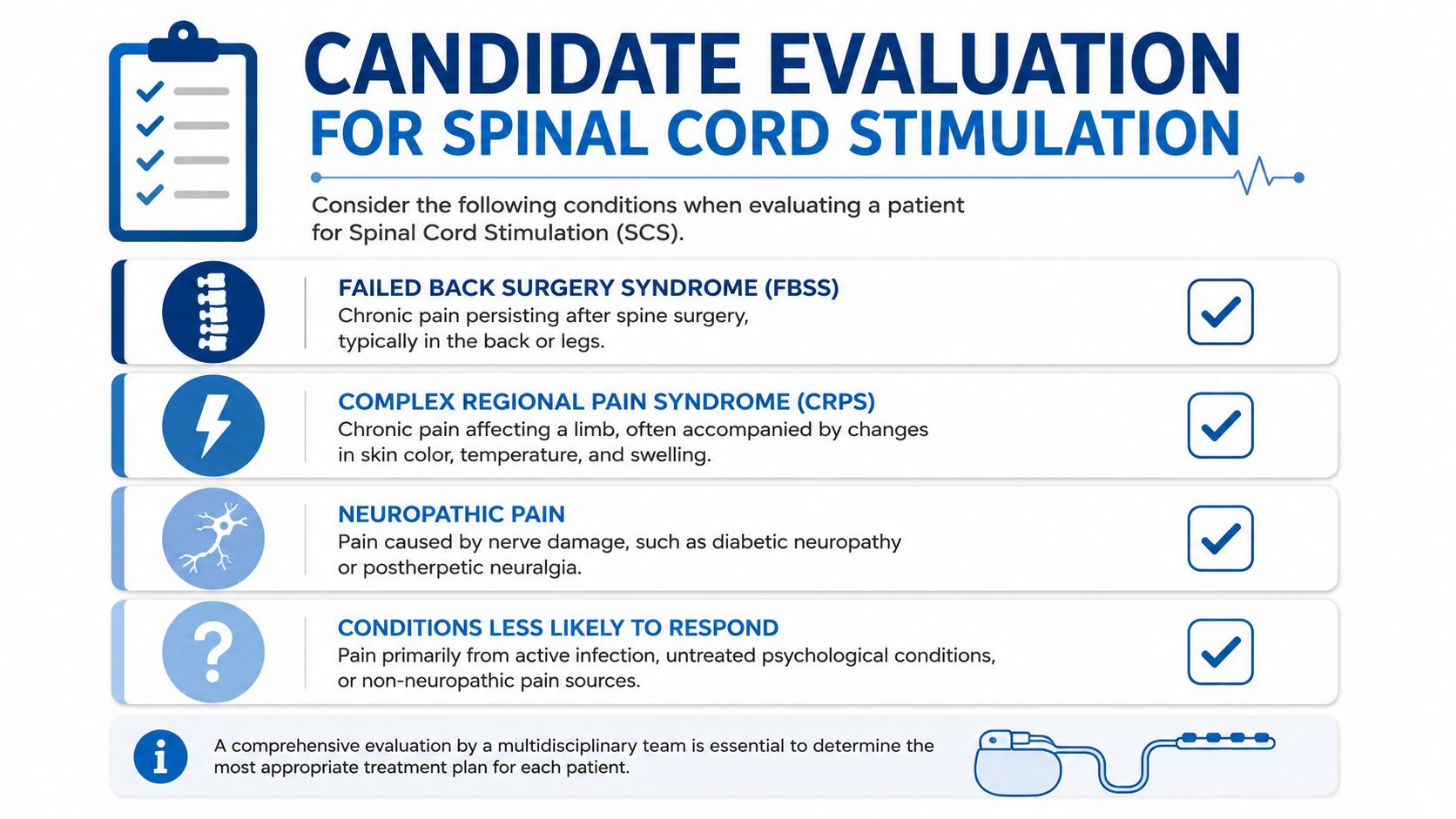
Spinal cord stimulation is generally considered for carefully selected patients with chronic pain that has a significant nerve-related component. Common clinical situations include persistent pain after back surgery, complex regional pain syndrome, and other chronic neuropathic pain patterns. A diagnosis alone isn't enough. The pain distribution, previous treatments, functional limitations, medical history, and goals all influence whether a trial makes sense.
A pain specialist may review imaging, operative history, medication response, physical findings, and prior interventions. The evaluation may also identify conditions that require treatment before stimulation, such as uncontrolled infection, poorly managed medical illness, or an inability to safely follow temporary-lead instructions. A broader pain management evaluation can help place the trial within the patient's full treatment plan.
The relief benchmark matters
Trial success is commonly judged by at least 50% patient-reported pain relief during the screening period. The result is more convincing when relief continues while the patient performs activities that normally provoke symptoms, and when pain medication use remains stable or decreases. The benchmark and related selection principles are described in the evidence-based consensus recommendations from the American Society of Regional Anesthesia and Pain Medicine.
Pain intensity is only one part of candidacy. A patient who reports lower pain but still can't sleep, walk, work, or participate in essential activities may not be experiencing the kind of benefit needed to justify implantation. Conversely, a smaller change in a numeric pain score may be meaningful if it allows a person to stand longer, reduce reliance on rescue medication, or complete basic tasks more comfortably.
Psychosocial assessment is clinical preparation
Guidelines recommend objective psychosocial screening before trial stimulation, including validated assessment of depression. This isn't a test of whether pain is “real,” and it shouldn't be treated as a judgment about character. Depression, anxiety, coping difficulties, unrealistic expectations, and untreated substance-use concerns can affect device management, perceived benefit, and long-term treatment engagement.
The assessment gives the care team an opportunity to address barriers before the trial begins. It also helps the patient clarify what success should look like. A written list of functional goals is often more useful than a general hope to “feel better.”
What Happens During the Trial Procedure
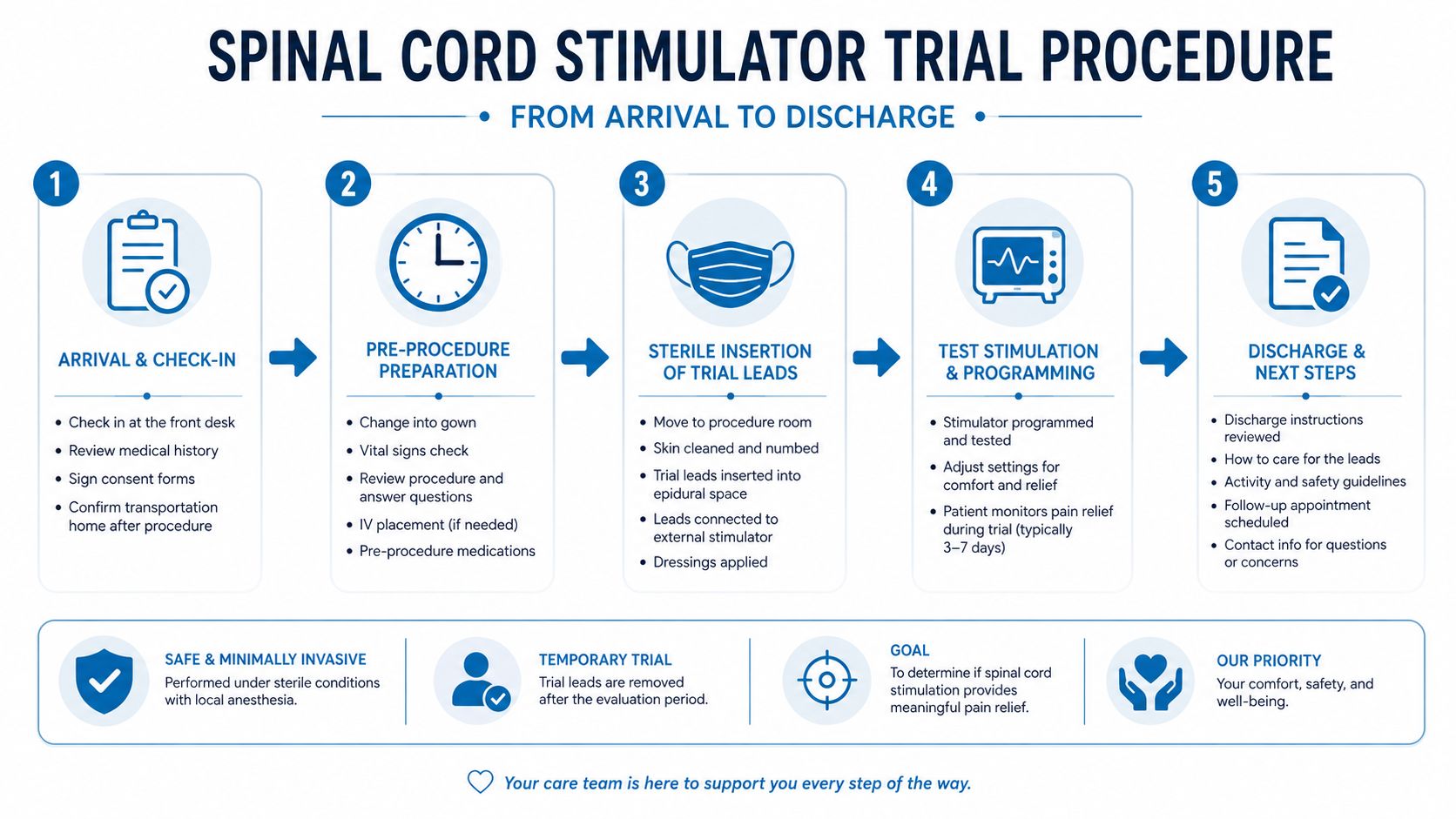
The spinal cord stimulator trial procedure is usually organized as an outpatient experience, although preparation and discharge rules vary by practice. The team reviews medical history, current medicines, allergies, and the pain pattern before proceeding. Patients should follow their own instructions about fasting, medication adjustments, arrival time, and transportation because sedation or other medications may affect safe driving afterward.
Before lead placement
After check-in, the clinical team confirms the planned treatment area and reviews consent. Monitoring equipment is applied, and the patient is positioned carefully, usually face down or in another posture that allows access to the spine. Sterile preparation reduces infection risk, while local anesthetic numbs the skin and deeper tissues.
Mild sedation may be used, but patients are often awake enough to communicate. That communication can help the physician understand what sensations occur during stimulation and whether the coverage appears consistent with the painful region. The goal isn't to create an uncomfortable examination. It's to place the leads accurately while keeping the patient relaxed and responsive.
Positioning the temporary leads
The physician advances thin leads through a needle into the epidural space under imaging guidance. Fluoroscopy helps confirm the path and position, because the leads need to sit near the spinal cord in a location that can address the patient's pain pattern.
Some patients feel pressure, brief soreness, or an unusual sensation during placement. Local anesthetic generally limits sharp discomfort, but the experience isn't identical for everyone. Patients should report significant pain, new weakness, or another unexpected sensation immediately so the team can assess it.
Connecting and securing the system
Once the leads are positioned, they're connected to an external pulse generator. The team programs initial settings and may make adjustments based on the patient's feedback. The leads are then secured and covered with a dressing so they can remain in place during the temporary testing period.
Before discharge, staff review how to carry the external generator, use the controller within prescribed limits, protect the dressing, and contact the office. The patient should leave with written instructions and a clear plan for the return visit. The procedure tests stimulation, but the days at home provide the key evidence about whether it helps with walking, sitting, sleeping, working, or other personally important activities.
Why Trial Success Does Not Always Mean Long-Term Relief
A favorable trial is encouraging, but it isn't a guarantee. The temporary leads and the permanent system are related, yet the procedures aren't identical. Lead placement, final hardware, programming, healing, activity level, the underlying condition, and changes in pain over time can all influence the result after implantation.
Lead migration is especially important. If a lead shifts, stimulation may no longer cover the painful area as intended. Published literature has reported overall spinal cord stimulation complication rates ranging from 31.9% to 43%, with lead migration described as the most common issue in the cited review literature. The same review discusses trial and implant risks that can include procedural pain, infection, lead fracture, headache after dural puncture, cerebrospinal fluid leakage, and, less commonly, spinal cord injury. These figures and complications are summarized in the consensus guidance on patient selection and trial stimulation.
What the trial can and cannot predict
The trial is strongest as a short-term test of whether stimulation can reduce pain and improve function. It's weaker as a promise about durability. A patient may feel better because the stimulation works, because activity temporarily changes during the trial, or because expectations and close clinical attention affect the experience. The reverse can also occur. A technically imperfect trial, lead migration, anxiety, poor sleep, or an inability to perform usual activities may make a potentially useful treatment look ineffective.
Practical rule: A successful trial should lead to a discussion about durability, programming, complications, and alternatives, not an automatic assumption that permanent implantation is the only reasonable next step.
Newer waveforms and closed-loop systems may change how clinicians interpret consistency and satisfaction, but they don't eliminate the need for individualized counseling. Patients should ask what evidence supports the recommendation in their particular pain condition, how the permanent leads will differ, and what the plan will be if benefit later declines.
Managing Daily Life During Your Trial Period
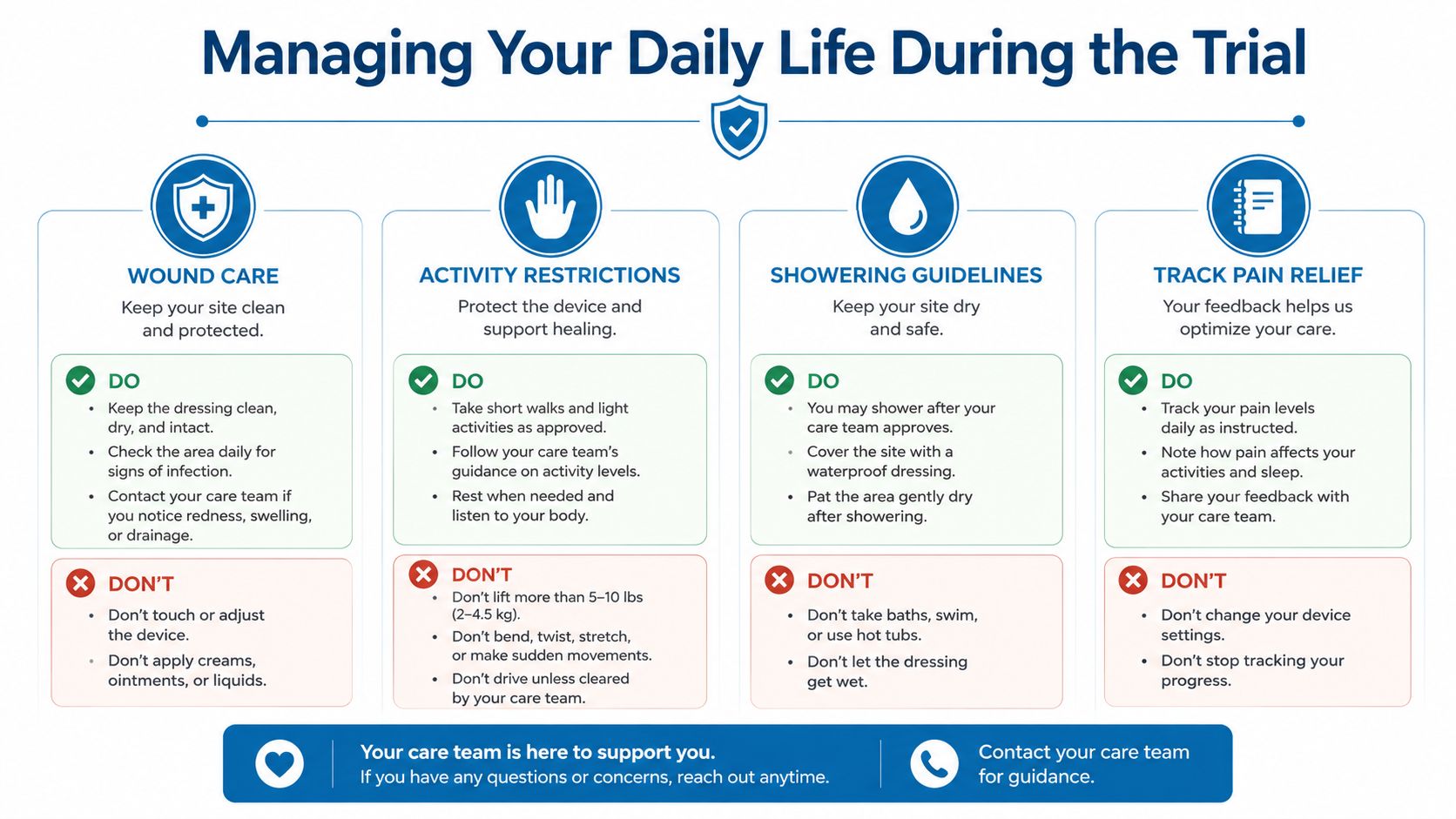
The trial becomes meaningful when the patient can observe pain and function in ordinary life, but the temporary leads need protection. Written instructions from the treating practice take priority because restrictions can vary with lead placement, dressing type, medical history, and procedural findings.
Protecting the leads
Bending, twisting, stretching, lifting, or making sudden movements can place stress on the temporary leads. The purpose of these restrictions is practical. A patient needs enough normal activity to judge benefit, but not so much strain that the hardware shifts and confuses the result.
The external generator can usually be carried in a pocket, pouch, or belt attachment as instructed. The controller should be used only within the settings approved by the care team. Patients shouldn't independently alter the system in ways they haven't been taught to use.
Caring for the dressing and insertion site
The insertion site may become sore after the local anesthetic wears off. Minor discomfort doesn't necessarily mean something is wrong, but worsening pain, spreading redness, drainage, fever, or a dressing that becomes loose or wet requires a call to the provider.
Showering and bathing rules must be followed precisely. Many temporary systems shouldn't be submerged, and the dressing may need to stay dry until the leads are removed. Sleeping positions should avoid pulling on the external wires or compressing the insertion area.
Tracking useful evidence
A brief daily record can make the follow-up much more productive. It should compare pain and function with the patient's usual baseline rather than focusing only on stimulation sensations.
- Pain pattern: Record the painful areas, intensity changes, and whether relief is consistent or intermittent.
- Functional goals: Note walking, sitting, sleeping, household tasks, work duties, or other activities that became easier.
- Medication use: Document breakthrough medication and any change from the usual routine.
- Device experience: Record comfortable settings, unpleasant sensations, and times when coverage seemed incomplete.
Patients should contact the care team promptly for new weakness, loss of bladder or bowel control, severe headache, significant bleeding, fever, drainage, or sudden loss of stimulation accompanied by worsening symptoms. Those signs require professional assessment rather than a trial-period adjustment at home.
Interpreting Your Trial Results and Next Steps
At the scheduled follow-up, the temporary leads are removed and the clinician reviews the patient's record. Removal is generally simpler than placement, but the team still examines the dressing and insertion area and provides additional care instructions. The central question is not merely whether the patient had a good day. It's whether stimulation produced meaningful, repeatable improvement in pain and daily function.
A recent real-world study of 505 patients reported an 86.1% trial success rate, defined as at least 50% pain relief at lead removal. Among those who underwent a trial, 77.0% proceeded to permanent implantation. Those findings come from the 2025 real-world study of spinal cord stimulation outcomes00112-0/fulltext). They describe a patient population and a specific clinical experience, not an individual guarantee.
Four questions shape the decision
The follow-up discussion should connect the trial result to the patient's goals.
- Was pain relief sufficient? The clinician considers the patient's reported change, painful areas, and consistency of benefit.
- Did function improve? Better sleep, walking, sitting, work tolerance, or personal activities may matter more than a score alone.
- Did medication use change? A stable or reduced need for analgesics can support the interpretation, although medication decisions remain individualized.
- Were the results reliable? Lead position, activity restrictions, programming, complications, and unusual circumstances may make the trial difficult to interpret.
A clear success usually leads to a discussion of permanent implantation, including surgical details, expected recovery, programming, and long-term maintenance. A poor result may lead to alternative treatments rather than immediate implantation.
An inconclusive trial needs careful analysis
A failed or unclear trial doesn't always prove that spinal cord stimulation can never help. The team may review whether the leads covered the correct pain region, whether migration occurred, whether the patient could perform normal activities, and whether the pain diagnosis matched the treatment target. In selected cases, a specialist may discuss a different lead strategy or reassessment of candidacy, but repeating a trial isn't automatic.
“The most useful result is an honest result.” A trial should help the patient avoid an unnecessary implant as well as identify a reasonable path toward one.
Insurance Coverage and Accessing Care in New Jersey
Insurance approval for spinal cord stimulation commonly requires prior authorization and detailed documentation. The record may need to show the diagnosis, previous conservative treatments, response to earlier therapies, functional limitations, psychological assessment, and the medical rationale for a trial. Requirements differ among plans, so the office and insurer should confirm the exact submission criteria before scheduling.
An initial denial isn't always the final decision. Patients can ask whether the practice will submit additional documentation, request a peer review, or support an appeal. A fee estimate should also separate professional, facility, anesthesia, device, and follow-up costs when applicable. New Jersey patients may ask how the New Jersey Out-of-Network Law affects care and request written estimates before proceeding.
Access matters as much as authorization. Patients in New Jersey and Staten Island can review office locations and scheduling information when distance, work obligations, transportation, or follow-up visits create barriers. Interventional Pain Management offers multidisciplinary evaluation involving pain management, orthopedic, and spine expertise, along with insurance benefit navigation and scheduling availability seven days a week.
Interventional Pain Management evaluates chronic neuropathic and post-surgical pain, discusses whether a spinal cord stimulator trial is appropriate, and helps patients understand authorization and follow-up requirements. Patients in New Jersey and Staten Island can visit Interventional Pain Management to request an evaluation and discuss realistic next steps before committing to permanent implantation.