
A lot of readers arrive at this question at the same point in the journey. They've tried medications, physical therapy, injections, maybe even prior spine surgery. Someone finally brings up a spinal cord stimulator, and for the first time in a while the treatment sounds both hopeful and unsettling.
The hesitation usually starts after the first online search. The brochure says “trial first” and “reversible.” The search results add words like lead migration, revision surgery, infection, and explant. That gap between the simple sales pitch and the more complicated reality is exactly where patients tend to get stuck.
Table of Contents
- Why Patients Search for Spinal Cord Stimulator Side Effects Before Saying Yes
- How a Spinal Cord Stimulator Actually Works
- The Most Common Spinal Cord Stimulator Side Effects Reported in Recent Evidence
- Hardware Complications That Drive Repeat Surgeries
- Procedure-Related and Neurologic Risks Worth Understanding
- MRI, Daily Activity, and Long-Term Device Considerations
- Managing Side Effects and Deciding Whether SCS Is Still Worth It
Why Patients Search for Spinal Cord Stimulator Side Effects Before Saying Yes
In the exam room, this decision rarely feels abstract. A patient may be holding a printout about spinal cord stimulation while also wondering whether agreeing to a trial means signing up for years of maintenance, future procedures, and hardware problems that nobody fully explained at the first visit.
That concern makes sense. A spinal cord stimulator isn't just a medication with a list of temporary symptoms. It's an implanted system. It has wires, a battery, connection points, a programming process, and a procedure that starts as a trial but can become permanent. That changes the kind of risk conversation patients need.
Why this search feels more urgent than other pain-treatment searches
Side effects for a pill usually raise the question, “Will this make me sleepy, nauseated, or dizzy?”
When they search spinal cord stimulator side effects, they're often asking a broader set of questions:
- Will the device move? If pain relief shifts after a good trial, patients want to know whether the lead changed position.
- Will this mean more surgeries later? A treatment can help and still create future revision decisions.
- What counts as normal soreness versus a real problem? Many early issues overlap with routine post-procedure discomfort.
- Can the device stop working without warning? Patients often worry about sudden loss of coverage, uncomfortable stimulation, or battery-related problems.
Many patient-facing summaries focus on tingling and temporary soreness. Patients usually want to know something else first. What sends people back to the procedure room, and how quickly would they know?
What the evidence suggests patients shouldn't gloss over
Modern evidence shows that side effects aren't limited to minor annoyances. A 2026 systematic review and meta-analysis of 33 studies involving 3,445 patients found a pooled adverse-event burden of 0.35 events per patient, with 24% of patients experiencing at least one adverse event and 3% experiencing at least one serious adverse event, according to the 2026 systematic review and meta-analysis on spinal cord stimulation adverse events. The same analysis estimated 34.5 adverse events per 100 patient-years in that evidence base.
That doesn't mean spinal cord stimulation is a poor option. It does mean the conversation should be more honest. The question isn't whether side effects exist. It's which side effects matter most, how often hardware drives the problem, and what symptoms should push a patient to call the physician sooner rather than later.
How a Spinal Cord Stimulator Actually Works
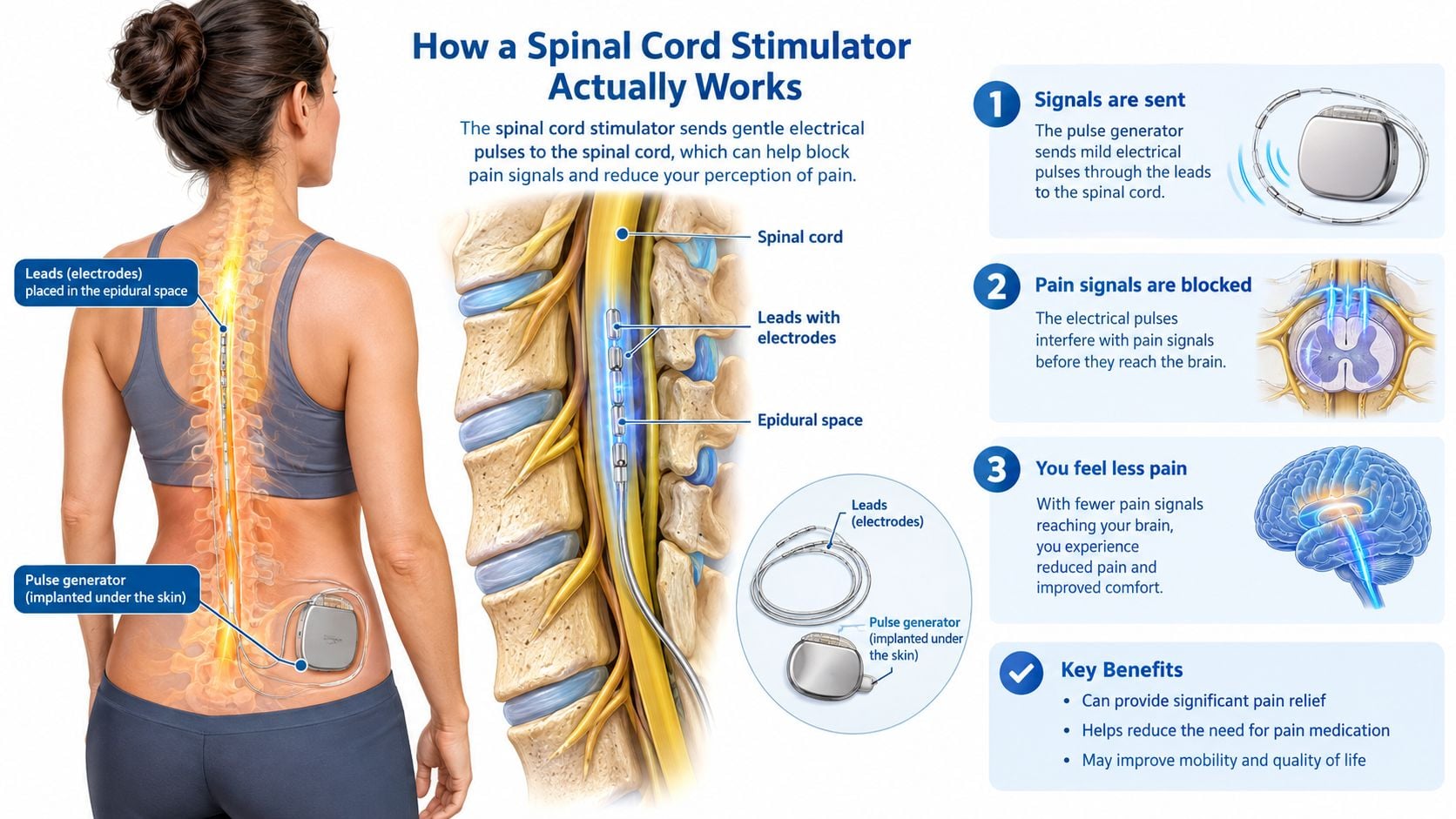
Before the risks make sense, the device itself has to make sense. A spinal cord stimulator is a system designed to change how pain signals are processed before the brain interprets them as pain.
Readers who want a broader overview of treatment indications can review spinal cord stimulation options.
The three main parts of the system
A standard SCS system usually includes three basic components.
- Leads or electrodes. These are thin insulated wires placed near the spinal cord, usually in the epidural space. Their job is to deliver electrical pulses to a targeted area.
- The implantable pulse generator. This is the battery and computer portion of the system. It's commonly placed under the skin in the lower back or buttock region.
- A handheld controller or programmer. This lets the patient adjust settings within physician-set limits.
The easiest way to picture it is as a small internal circuit. The battery creates the signal. The leads carry it. The controller fine-tunes it.
Trial first, then possible permanent implant
One detail confuses many patients. The trial phase and the permanent implant aren't the same thing.
During the trial, temporary leads are placed and connected to an external battery. The patient goes home and tests whether the therapy meaningfully reduces pain and improves function. If the trial helps enough, the patient may choose a permanent system.
During the permanent implant, the leads remain in place and the battery is implanted under the skin. That's the point at which hardware-related side effects become much more important over the long term.
Practical rule: If a patient understands where the leads sit and where the battery pocket sits, many later side effects become easier to recognize. A shifted lead changes coverage. A sore battery pocket hurts where the generator was implanted.
What the stimulation actually does
The device doesn't “fix” a structural pain source. It changes how pain signaling is perceived. In plain language, the stimulator sends mild electrical pulses that compete with or modulate pain signals traveling toward the brain.
Older systems often produced a tingling sensation called paresthesia. Some newer programming approaches may work below conscious sensation, so the patient doesn't necessarily feel buzzing or tingling even when the device is active.
This body map matters because the hardware sits in moving tissue. The spine bends. The torso twists. Skin and scar tissue shift. A device that lives inside an active human body can develop problems that a medication never would. That's why lead migration, wire fracture, connector strain, and battery-pocket pain aren't side notes. They're built into the practical reality of implanted therapy.
The Most Common Spinal Cord Stimulator Side Effects Reported in Recent Evidence
When patients ask about side effects, many expect a short list of temporary symptoms. The evidence paints a broader picture. In recent syntheses, the burden includes not only stimulation sensations and wound issues, but also hardware problems that may lead to repeat procedures.
A 2026 review highlighted an overall adverse-event range of 31.9% to 43% across trial and permanent implants, and noted that lead migration occurred more often than infection while revision procedures outnumbered explants, according to the 2026 review of spinal cord stimulation adverse events and revisions.
What tends to show up most often
The most important pattern is that hardware-related events often dominate the conversation once the initial procedure is over.
That includes:
- Lead migration, where the wire shifts enough to change the location or quality of pain relief
- Lead fracture or connection failure, where the electrical pathway no longer works as intended
- Pocket pain, where the battery site remains uncomfortable or irritated
- Need for reprogramming, because stimulation no longer covers the original painful area
- Revision procedures, when symptoms or device failure can't be solved by programming alone
Biologic and procedure-related issues still matter. Infection, wound problems, cerebrospinal fluid leak, and post-dural puncture headache can all occur. But many patient summaries understate how often the long-tail problem is mechanical rather than purely medical.
Why different studies can sound inconsistent
Patients often notice that one article says complications are “uncommon” while another makes them sound frequent. Part of the confusion comes from how studies define an event.
Some count only events requiring surgery. Others include reprogramming visits, temporary uncomfortable stimulation, or minor wound problems. Some combine trial and permanent implants. Others separate them. So the exact wording varies, even when the practical lesson is similar.
If the relief pattern suddenly changes, that's not just a comfort issue. Clinicians often have to consider whether the hardware position or hardware function changed.
Common SCS Side Effects and Reported Frequency Ranges
| Side Effect | Typical Reported Range | Clinical Significance |
|---|---|---|
| Any adverse event | 24% of patients had at least one adverse event in a 2026 meta-analysis | Broad category that includes both minor and more consequential problems |
| Serious adverse event | 3% of patients had at least one serious adverse event in the same meta-analysis | Less common, but important because these may require urgent treatment or surgery |
| Overall adverse-event rate across trial and permanent implants | 31.9% to 43% in a 2026 review | Shows how often side effects enter the treatment course in real-world SCS care |
| Lead migration | Qualitatively reported as more common than infection in recent review | Major reason for loss of coverage, need for imaging, reprogramming, or revision |
| Infection | Qualitatively less common than lead migration in recent review | Can range from superficial wound problems to deeper device-threatening infection |
| Revision procedures | Qualitatively reported as more common than explants in recent review | Suggests many problems are managed by correcting hardware rather than removing the system entirely |
For patients, the takeaway is simple. The most common spinal cord stimulator side effects aren't always the most dramatic ones. The events that disrupt treatment most often are the ones that alter coverage, force reprogramming, or raise the question of revision.
Hardware Complications That Drive Repeat Surgeries
Once a permanent spinal cord stimulator is implanted, hardware becomes the main long-term variable. The device may still help, but the part most likely to bring a patient back for another procedure is often the system itself.
Historical reviews help frame that pattern. A 2004 evidence review reported an overall complication rate of 34%, and a later review found 43%, with common complications including lead or electrode dysfunction at 27%, extension cable problems at 10%, cerebrospinal fluid leaks at 7%, and infections at 6%, according to the Pain Physician review on spinal cord stimulation complications. The same source reported more recent single-institution data showing overall complication rates fell from 38.9% in 1999-2015 to 14.0% in 2016-2021.
Why hardware fails in everyday life
Leads sit in a place that moves every day. Bending, twisting, scar formation, and simple body motion can all put stress on the system.
Common hardware problems include:
- Lead migration. The lead shifts enough that stimulation no longer reaches the same painful area.
- Lead fracture. The wire develops a break, which can interrupt the circuit.
- Connector or extension problems. The transition points between components can become weak spots.
- Battery-pocket pain or generator trouble. The implanted battery can become uncomfortable, prominent under the skin, or mechanically unreliable.
Patients looking for context on broader spine hardware concepts may find spinal instrumentation useful background reading.
Percutaneous versus paddle leads
Not all leads are the same. Percutaneous leads are placed through a needle and are less invasive to insert. Paddle leads require a more surgical placement but may behave differently from a stability standpoint.
That distinction matters because not every revision has the same cause. A patient with excellent initial coverage and sudden loss of that pattern may be dealing with migration. Another patient with intermittent stimulation may have a connection or integrity problem instead.
Hardware Complications and Revision Impact
| Hardware Issue | Reported Frequency | Typical Revision Impact |
|---|---|---|
| Lead or electrode dysfunction | 27% in historical review data | Often prompts reprogramming, imaging, and possible surgical revision if function can't be restored |
| Extension cable problems | 10% in historical review data | May require component repair or replacement when the connection pathway fails |
| Lead migration | Qualitatively highlighted as a central hardware risk in recent evidence | Common reason pain coverage shifts after a good initial response |
| Battery-pocket pain or generator malfunction | Qualitatively common in clinical practice discussions | May lead to pocket revision, repositioning, or generator replacement |
The practical point is this. A patient can have a technically successful implant and still need another procedure later because the long-term challenge isn't always the pain condition alone. It's how well the implanted hardware continues to behave in a moving body.
Procedure-Related and Neurologic Risks Worth Understanding
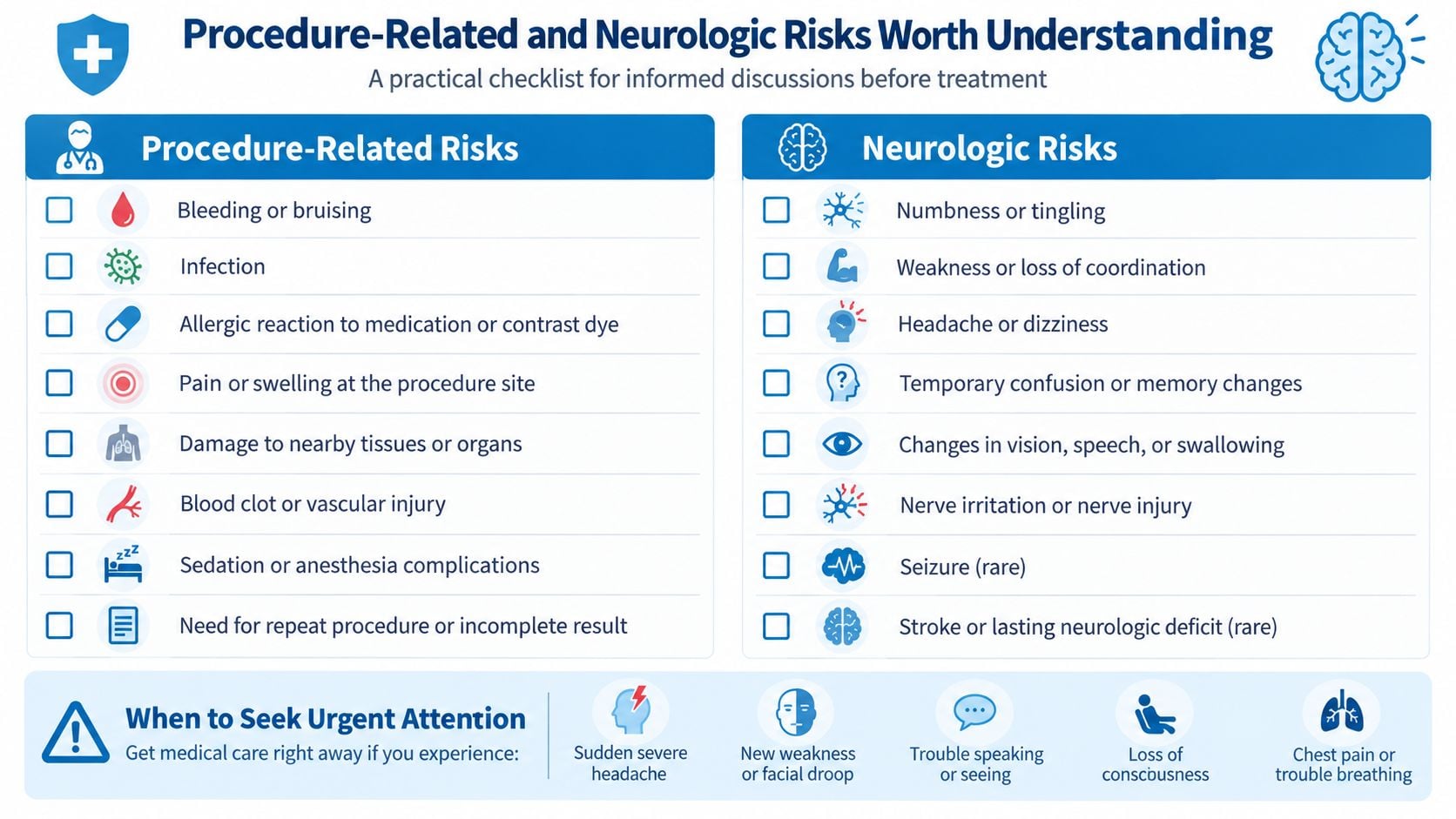
Some spinal cord stimulator side effects happen because a device stays in the body for years. Others are tied more directly to the implantation procedure itself. Those risks deserve their own attention because the warning signs are different.
Infection, bleeding, and fluid leak
Any implanted device creates an infection pathway. Some infections stay superficial around the incision. Others can track deeper along hardware, which raises the stakes because bacteria on implanted material are harder to manage.
Other procedure-related risks include:
- Cerebrospinal fluid leak after an unintended dural puncture. This often causes a headache that is worse when upright and better when lying flat.
- Hematoma or bleeding near the procedure area. This may present as swelling, pressure, worsening pain, or neurologic symptoms.
- Seroma around the battery pocket. This is a fluid collection that can create swelling and discomfort.
- Wound healing problems. These can look deceptively mild at first, especially when patients assume redness is “just post-op irritation.”
Rare but serious neurologic problems
Most patients won't experience major neurologic injury. Still, it's important that the risk discussion stays honest. A spinal cord stimulator involves work near the spine and epidural space. Rare complications can include nerve root injury, spinal cord compression, or severe neurologic deficit.
Certain patients need a more careful risk-benefit discussion, especially those with diabetes, immune suppression, prior spine surgery, or blood-thinner use. In those settings, the procedure may still be appropriate, but the margin for error is smaller and the threshold for urgent follow-up is lower.
New weakness, new numbness that's spreading, bowel or bladder change, and fever with increasing back pain should never be treated as routine recovery symptoms.
Symptoms that deserve urgent evaluation
Patients are often unsure what can wait until the next appointment. These symptoms usually deserve faster contact with the treating team:
- Fever with incision redness or drainage
- Progressive weakness
- Sudden severe headache after the procedure, especially one that changes with position
- Escalating back pain that feels out of proportion to routine soreness
- New bowel or bladder problems
A short period of soreness near the incisions can be normal. Worsening neurologic function is not.
MRI, Daily Activity, and Long-Term Device Considerations
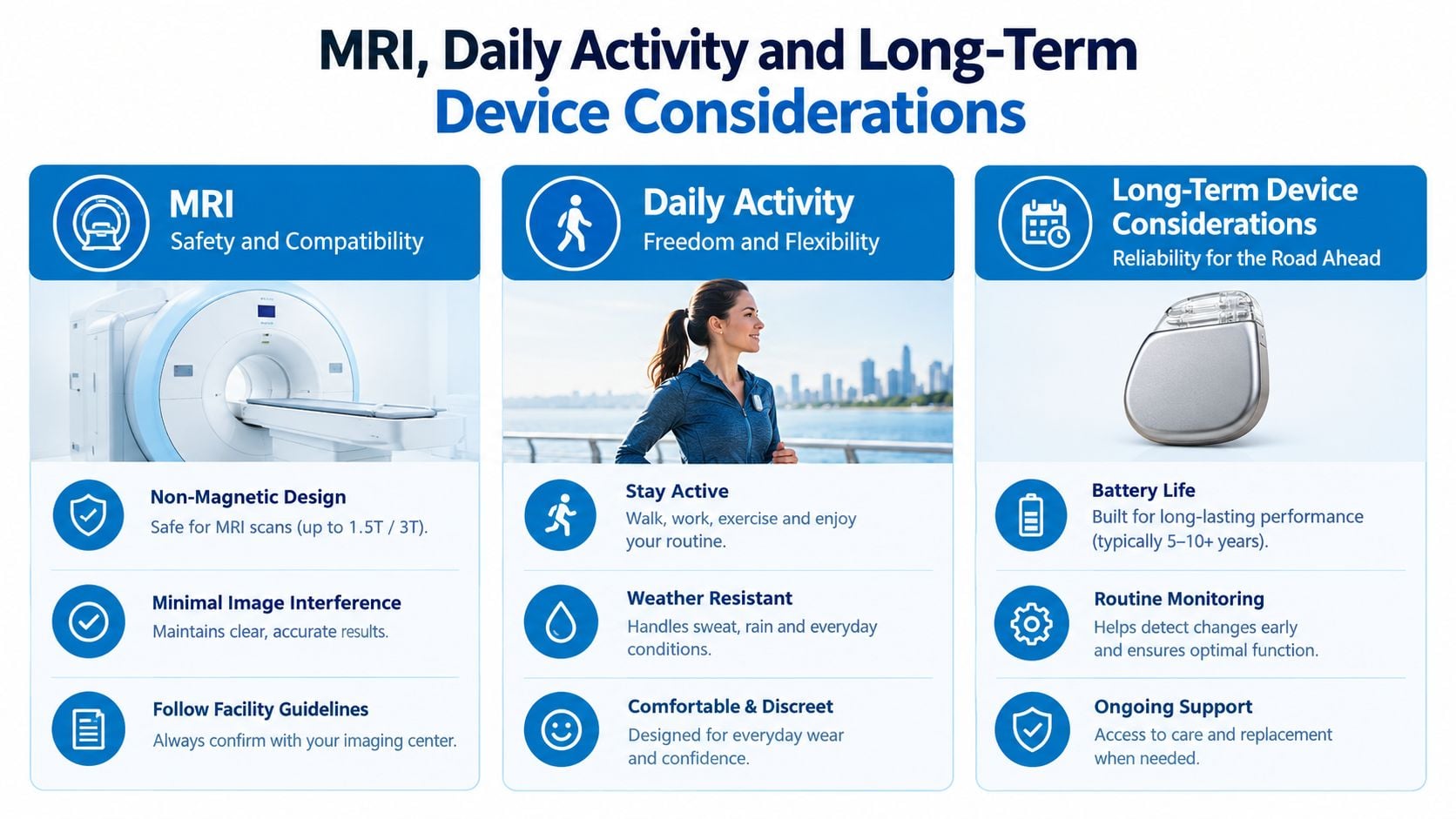
For many patients, the biggest long-term questions aren't about the procedure day. They're about ordinary life afterward. Can the patient get an MRI? Exercise normally? Drive without worrying about a sudden stimulation change? Live with the battery comfortably for years?
MRI access is not a simple yes-or-no question
Patients often hear “MRI compatible” and assume that settles it. It doesn't. The more accurate term is usually MR-conditional.
That means the scan may be allowed only under specific conditions such as certain body regions, certain machine settings, certain lead configurations, or certain device modes. A patient with an implanted stimulator should carry device information and confirm MRI details before the scan is scheduled, not at the radiology desk.
Daily life trade-offs that matter more than patients expect
These practical issues often shape satisfaction as much as pain relief does:
- Driving during programming changes. If stimulation can shift suddenly, driving may need extra caution, especially during early adjustment periods.
- Exercise and twisting motion. Returning to activity often happens in stages because abrupt motion can stress fresh hardware placement.
- Airport and security screening. Patients may need a device card and should expect occasional screening questions.
- Sexual activity and sleep position. These don't usually disappear from life, but they may need temporary adjustment after implantation.
- Rechargeable versus non-rechargeable systems. Convenience, charging habits, and future replacement planning all matter.
Device life is a quality-of-life issue
A battery-powered system eventually requires ongoing management. Even when the stimulator works well, the patient is still living with an implanted device that may need charging, reprogramming, or later replacement.
That's one reason some patients decide the treatment is worthwhile while others don't. The pain benefit may be meaningful, but the daily burden varies from person to person. A patient who values MRI flexibility, minimal maintenance, and low tolerance for future procedures may weigh the choice differently from someone whose pain relief during trial was strong and functionally important.
Managing Side Effects and Deciding Whether SCS Is Still Worth It
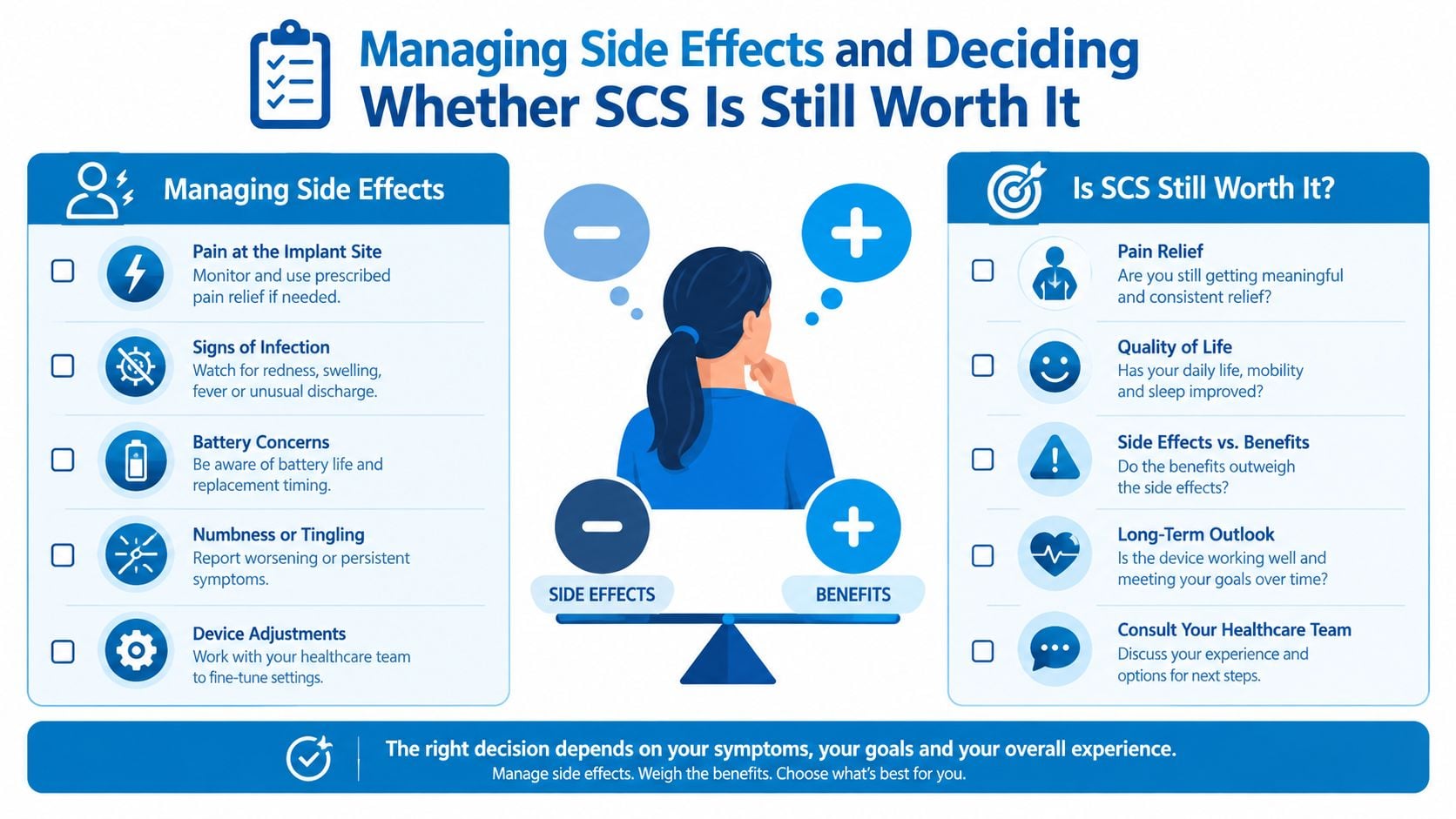
Once a stimulator is in place, decision-making becomes less about “good or bad treatment” and more about response over time. Some side effects are manageable. Some signal a failing system. Some mean the original goals are no longer being met.
Patients looking for broader care options can review pain management services.
A practical symptom triage approach
Some problems shouldn't wait.
- Call urgently for sudden weakness, fever with wound changes, drainage from the implant site, sudden loss of stimulation paired with new pain, or bowel and bladder symptoms.
- Call soon but not necessarily emergently for major shifts in coverage, repeated uncomfortable jolts, persistent pocket pain, or a device that seems to cycle unpredictably.
- Bring to the next planned visit mild stimulation changes, small skin irritation from external accessories, or questions about charging and programmer use.
A simple symptom log helps more than patients expect. Dates, body position, activity at onset, whether the problem is constant or intermittent, and what the programmer showed can all help the treating team sort out whether the issue is programming, healing, or hardware.
How clinicians usually re-evaluate the system
When symptoms appear, the sequence usually matters.
- Confirm the device is functioning. The first question is whether the system is on, charging properly, and communicating with the controller.
- Review the pain pattern. If the pain moved or changed character, the issue may not be identical to the original pain problem.
- Try reprogramming first when appropriate. Coverage problems aren't always surgical problems.
- Use imaging when hardware shift is suspected. Sudden change after a period of stable benefit raises concern for migration or structural device trouble.
- Discuss revision or explant. If benefit falls away and the device creates more burden than relief, removal becomes a reasonable conversation.
The most useful question isn't “Does the stimulator still do something?” It's “Does it still help enough to justify the maintenance, restrictions, and risk?”
When the treatment is still worth it
A spinal cord stimulator is usually judged against two practical goals:
- Meaningful pain reduction
- Improved function
If a patient has less pain but still can't sleep, walk, work, or reduce other care burden, the result may not feel like success. If a patient has moderate residual pain but has regained daily function, the treatment may still be worthwhile.
This is also the point where a multidisciplinary review can help. Interventional Pain Management is one example of a practice type that evaluates chronic pain across noninvasive, interventional, and surgical pathways, which can be useful when a patient needs to decide whether reprogramming, revision, or a different strategy makes more sense.
Patients often benefit from bringing direct questions to the next visit:
- What do these symptoms suggest first, programming issue or hardware issue?
- Would imaging help clarify whether the lead moved?
- At what point would revision make more sense than repeated reprogramming?
- If the device were removed, what options would still remain?
- How does this practice decide when the benefit is no longer enough?
A calm, useful side-effect conversation doesn't focus only on whether something can go wrong. It focuses on whether the patient would recognize it early, know whom to call, and understand the next decision if the device stops delivering enough value.
Interventional Pain Management evaluates chronic pain with the full decision in mind, including whether spinal cord stimulation fits, how side effects are monitored, and what alternatives remain if hardware problems or limited benefit change the picture. Patients in New Jersey and Staten Island who want a careful review of spinal cord stimulator side effects, trial planning, or next-step treatment options can visit Interventional Pain Management.