

The first time a patient sits down asking about shots for joint pain, the question usually isn't “Should a shot be done?” It's, “Which shot, for which joint, and what is it supposed to do?” That distinction matters, because a knee swollen from osteoarthritis, a stiff thumb, and a painful shoulder tendon are not the same problem, and they shouldn't be treated as if they are.
A good injection plan starts with the diagnosis, not the preference for one brand of shot over another. Some injections are meant to calm inflammation, some are meant to change the joint fluid environment, some are used to nudge tissue repair, and some are mainly diagnostic. When the match is wrong, the result is usually disappointment, not because injections never work, but because the wrong tool was used for the wrong job.
Table of Contents
- What Counts as a Shot for Joint Pain
- Comparing the Main Injection Options
- What Happens During the Procedure
- Matching the Shot to the Joint and the Diagnosis
- Safety, Risks, and Smart Use of Repeat Shots
- Alternatives and Adjuncts Worth Considering
- Your Decision Checklist Before Booking a Consultation
What Counts as a Shot for Joint Pain
A patient in a New Jersey orthopedic office often hears a simple phrase like “we can try a shot,” then assumes there's one standard procedure waiting behind it. In reality, joint injections fall into several families, and each family serves a different purpose. That is why the name on the consent form matters more than the casual shorthand in the hallway.
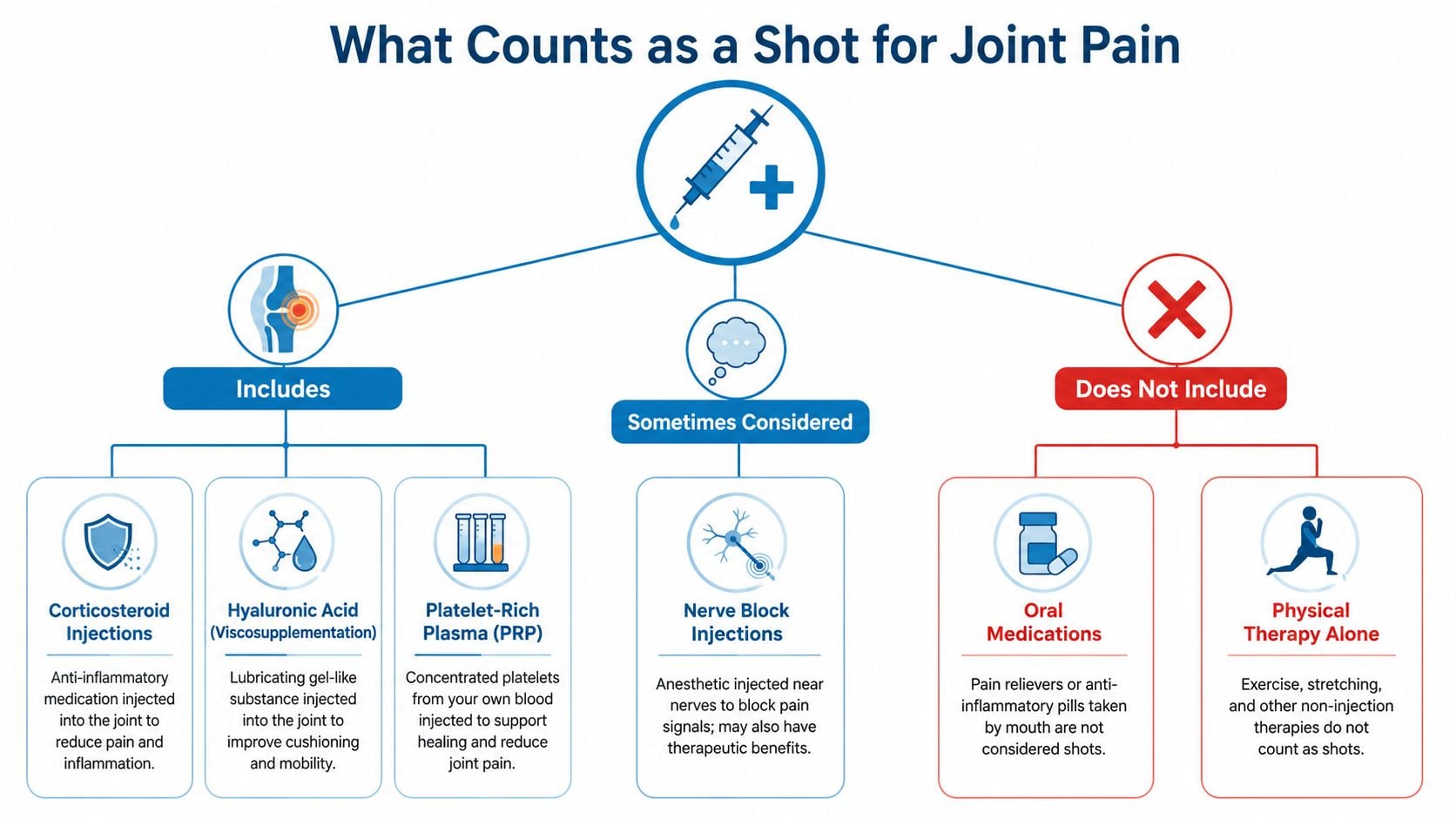
The main families patients hear about
The most common therapeutic options are corticosteroid injections, hyaluronic acid injections, platelet-rich plasma, and dextrose prolotherapy. Corticosteroids are used to quiet inflammation. Hyaluronic acid is intended to improve the joint's lubrication environment, especially in knee osteoarthritis. PRP and prolotherapy are usually discussed when the goal is to encourage a healing response rather than suppress symptoms.
Some injections are more about clarifying the source of pain than treating it long term. A local anesthetic injection can help determine whether pain is really coming from inside the joint. That is why the diagnosis has to come first. A stiff, painful joint from inflammatory arthritis is not approached the same way as a tendon problem or degenerative osteoarthritis.
The phrase “shot for joint pain” also leaves out a few things on purpose. Oral medications and physical therapy are not injections, even though they are often part of the same treatment plan. A clinic may also recommend a nerve block, but that sits in a different category because it targets pain transmission rather than the joint surface itself. For a broad overview of how these procedure types are grouped in practice, a useful reference is this guide to injection types in pain management.
Practical rule: the right injection is chosen by joint, diagnosis, and treatment goal, not by whichever shot sounds strongest.
Comparing the Main Injection Options
A patient often asks for “the strongest shot,” but strength is the wrong starting point. The better question is which injection matches the diagnosis, the joint involved, and the time frame for relief. A treatment that works fast can still be a poor fit if the benefit fades before rehab has a chance to help. A slower option may make more sense when the goal is steadier symptom control. The main mistake is treating every injection as if it belongs in the same bucket.
Joint Injection Options at a Glance
| Injection Type | Onset of Relief | Typical Duration | Best-Fit Diagnosis |
|---|---|---|---|
| Corticosteroid | Fast, often within days | Short-term, usually temporary | Inflammatory flares, osteoarthritis, bridge to rehab |
| Hyaluronic Acid | Slower than steroid | Often months, especially in knee OA | Knee osteoarthritis |
| PRP | Variable | Variable | Selected chronic tendon and joint problems |
| Prolotherapy | Gradual | Variable | Chronic pain patterns, especially some tendon-related cases |
Corticosteroid injections are the classic option for calming a flare quickly. They have been studied for decades and remain a standard interventional tool because they can produce measurable short-term benefit. A meta-analysis reported improvement at 16 to 24 weeks with a pooled relative risk of 2.09, a number needed to treat of 4.4, and benefit within the first two weeks with a pooled relative risk of 1.66 PMC review. For a patient who needs enough relief to start moving again, that timing can matter a lot.
Steroid injections work best as a bridge, not as the whole plan. The goal is usually to quiet pain and inflammation enough to let physical therapy, activity changes, or a more durable treatment take hold. A clear overview of corticosteroid injections helps explain why clinicians use them so often and why they are rarely the answer to every joint problem.
Hyaluronic acid sits in a different lane. It is usually used for knee osteoarthritis when the goal is symptom control over a longer window, not immediate rescue. Expert reviews describe moderate benefit, with a typical window of 3 to 12 months and local side effects more common than systemic ones Arthritis.org. A 2022 review summarized in STAT also found the average pain effect was small relative to placebo, even though some pooled analyses show measurable benefit in selected regimens STAT review summary.
PRP and prolotherapy are usually discussed in a more selective way. They are often considered when the treatment goal is to encourage a healing response rather than reduce inflammation, and the details depend heavily on the diagnosis, the joint, and the clinic's treatment philosophy. For some patients, that makes them reasonable to consider. For others, the evidence and the fit are less clear than with steroid or hyaluronic acid.
The basic pattern is simple. Steroid often plays the bridge role, hyaluronic acid is often the longer-game knee option, and PRP or prolotherapy are more selective choices that only make sense when the diagnosis lines up with the intended effect.
What Happens During the Procedure
Most patients worry about the unknown, not the needle itself. Once the visit is broken down into plain steps, the procedure usually feels less intimidating than expected. For many joints, the total time in the clinic is short, and the actual injection takes only moments.
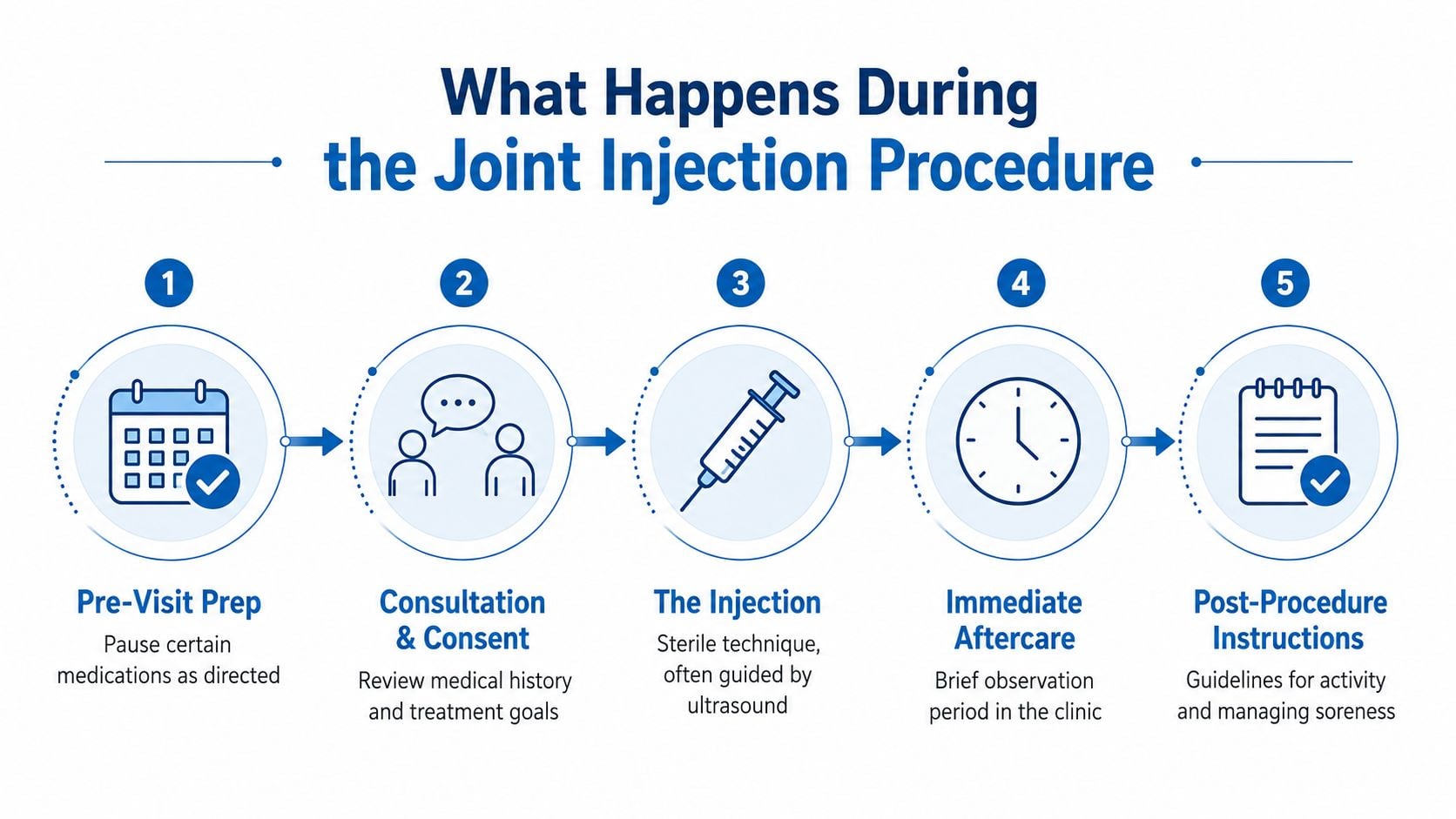
Before the needle goes in
The visit starts with a medication review, because some blood thinners or anti-inflammatory drugs may need special instructions. Fasting usually doesn't matter for a straightforward joint shot, though the clinic may give different instructions if sedation is part of the plan. Transportation is sometimes a good idea if the patient is anxious, has had a painful flare before, or is receiving an injection in a hard-to-reach joint.
The clinician then confirms the target joint, the reason for the injection, and the expected goal. That's the moment where informed consent should feel practical rather than legalistic. The question to ask is not, “Is this a shot?” It's, “What is this shot supposed to change, and how will success be measured?”
During and after the injection
The skin is cleaned carefully, and the joint may be numbed with local anesthetic first. Image guidance, usually ultrasound or fluoroscopy, is used when accuracy matters more because the joint is deep, small, or anatomically tricky. The injection itself is brief, and the immediate soreness usually comes more from the needle than from the medicine.
Afterward, the clinic commonly gives instructions about icing, activity reduction, and what soreness is normal. Many clinicians ask patients to take it easy for the rest of the day, then gradually return to movement. Physical therapy often follows, because a pain reduction that opens the door to better motion is more useful than a shot alone.
A good joint injection visit should end with a plan, not just a prescription. If the next step after pain relief is stronger movement, the procedure is doing its job as a bridge.
Matching the Shot to the Joint and the Diagnosis
A runner with knee pain, a tennis player with shoulder pain, and a desk worker with thumb pain can all walk into the same clinic, but they do not all need the same injection. That's the central mistake many generic guides make. The joint matters, but the cause of pain matters even more.
Three common patterns clinicians sort through
A 52-year-old recreational runner with early knee osteoarthritis often wants enough relief to keep training and to stay in physical therapy. In that setting, a corticosteroid injection can make sense as a bridge, especially when the knee is inflamed and movement is limited. If the runner expects a cure, the shot will disappoint. If the goal is to settle symptoms so rehab can happen, the plan is more realistic.
A 44-year-old tennis player with persistent lateral shoulder tendinopathy is a different story. Repeating cortisone over and over near tendon tissue can be a poor long-term habit, so a clinician may discuss more selective options such as PRP or prolotherapy, depending on the exam and imaging. The evidence is less standardized here, but the reasoning is straightforward. The target is not generalized joint inflammation, it's a load-related tendon problem.
A 61-year-old teacher with thumb CMC arthritis may be offered bracing, hand therapy, and sometimes a diagnostic anesthetic injection rather than a routine steroid first. If the pain source is confirmed, that can help decide whether a therapeutic shot, splinting, or surgery belongs next. For that kind of patient, the first decision is often diagnostic clarity, not symptom suppression.
The question “what shot should be used?” shifts to “what problem is being treated?” In the hand, shoulder, knee, and hip, the same word injection can mean very different clinical intentions. A clinic that treats these as interchangeable is missing the point.
For patients who want a broader knee-focused overview, the hyaluronic acid injection guide is useful because it shows how a lubrication-based approach fits when the diagnosis is osteoarthritis rather than a tendon flare or a vague ache.
Safety, Risks, and Smart Use of Repeat Shots
A repeat injection should be treated like a decision point, not a reflex. If the same joint keeps asking for relief, the question is whether the shot is still helping the larger plan or only postponing it. The 2025 multisociety guidance on corticosteroid injections reflects that shift, because dose, interval, and patient selection matter more than a one-size-fits-all routine multisociety guideline.
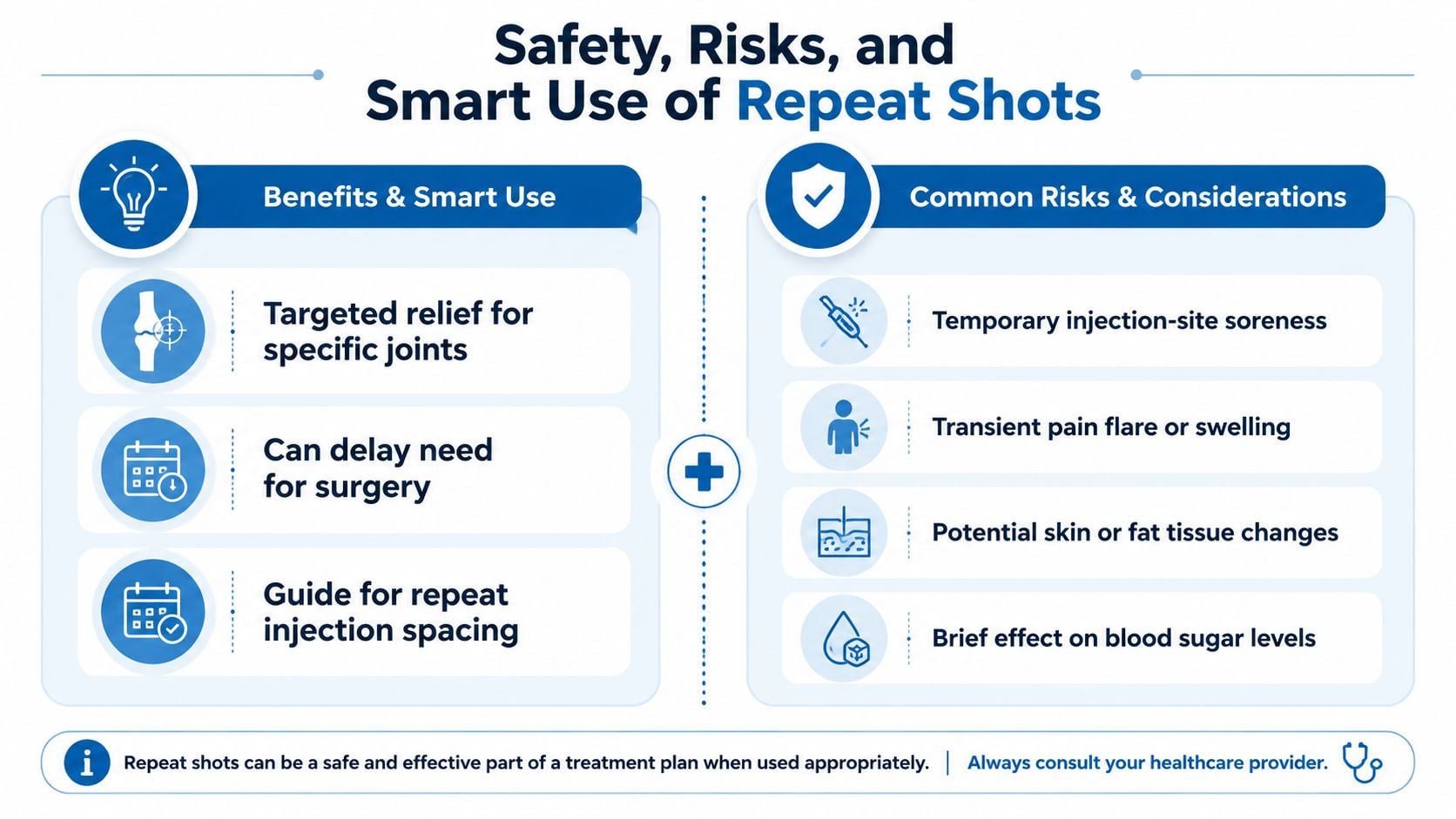
What is common, and what is rare
The usual short-term issues are local. Patients may notice soreness at the injection site, a brief pain flare, or mild swelling. Skin changes can happen, and people with diabetes may see a temporary rise in blood sugar after steroid exposure. These are the effects patients are most likely to bring up at follow-up, because they show up quickly and usually stay limited to the treated area.
The rarer problems are the reason repeat injections deserve restraint. A joint steroid injection is better viewed as a bridge, not a standing routine that gets repeated on schedule. A separate PMC review describes infection as uncommon, which helps explain why the procedure remains widely used, but uncommon does not mean irrelevant when the same joint keeps being injected again and again.
When repeat use becomes a poor trade-off
If the relief fades fast and the patient keeps coming back within a short interval, the plan needs to be reconsidered. At that point, the key questions are whether the diagnosis is correct, whether rehabilitation has been fully used, or whether a different procedure fits the problem better. Repeat exposure near tendons or other load-bearing structures also deserves caution, because tissue weakening becomes part of the risk discussion.
Timing matters before surgery as well. Many surgeons prefer to avoid steroid injections close to a joint replacement because of infection concerns. That is why a “just give another shot” habit can cause trouble later, even if the injection helped for a while. A shot that buys time can still be the wrong choice if it delays a better next step.
The safest repeat injection strategy is the one with a clear stop point. If the last shot barely helped, repeating it usually will not solve the underlying problem.
If the pain pattern is pushing the plan in circles, it is reasonable to revisit the noninjection side of care too. Strength work, joint protection, and activity changes often determine whether a shot becomes a brief pause or part of a more durable plan. For patients who want to understand supportive options in that broader context, the natural pain reliever options overview can help frame the discussion.
Alternatives and Adjuncts Worth Considering
A joint injection rarely stands alone in a good plan. If the surrounding muscles are weak, the joint is overloaded, or activity habits are driving the pain, the shot may calm symptoms without changing the reason they keep coming back. That's why the treatment ladder matters as much as the procedure itself.
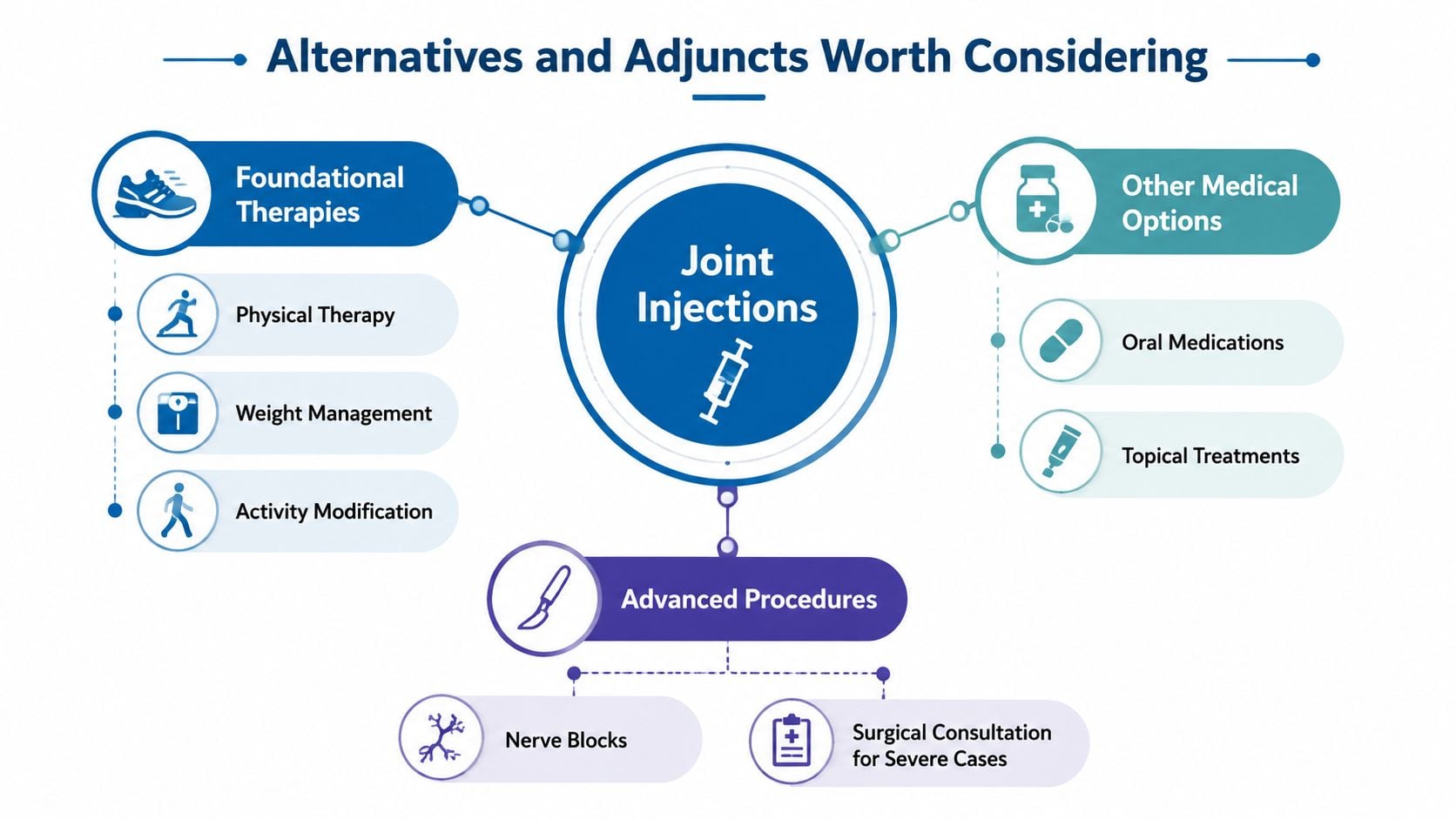
The non-injection ladder that still matters
Foundational care usually includes targeted physical therapy, weight management when relevant, and activity modification. Those steps don't sound dramatic, but they often determine whether a shot translates into better function. A patient whose pain improves but who never rebuilds strength often ends up back at square one.
Supportive treatments also belong in the conversation. Bracing, orthotics, and topical or oral anti-inflammatory medication can all reduce strain or make movement more tolerable. For people who want to understand broader self-care choices, this overview of natural pain reliever options can be a useful adjunct, as long as it's treated as supportive information rather than a substitute for diagnosis.
Where injections sit in the ladder
Some procedures sit alongside injections when the problem is more complex. Nerve blocks can help clarify a pain source or reduce pain that has a strong nerve component. Surgical consultation belongs on the table when the joint is structurally failing, function is dropping, or conservative care has stopped being useful.
One practical example is the patient with knee osteoarthritis who gets a short-term injection and then uses that window to engage in strengthening work. Another is the shoulder patient whose pain is better managed with a tendon-focused plan rather than repeated cortisone. The key idea is not that injections are bad. It's that they work best when they buy time for the right next step.
Interventional Pain Management is one option for patients who need a combined evaluation of pain, joint, and spine problems in one setting, because the practice coordinates diagnostic review, image-guided procedures, and orthopedic or spine input when needed. That kind of structure matters when the diagnosis isn't obvious and the treatment choice has to be made carefully.
Your Decision Checklist Before Booking a Consultation
A useful consultation starts with a few direct questions. The patient does not need to know the technical details of every injection, but the patient should know what problem is being treated and why that procedure fits.
Bring these questions to the visit
- What diagnosis is causing the pain? The answer should name the joint or structure, not just “arthritis” or “inflammation.”
- Which injection is being recommended, and why that one? The choice should match the diagnosis, not just the desire for a quick fix.
- What result is realistic, and how soon should it show up? A short-term bridge and a longer-lasting change are not the same goal.
- What happens if the first injection doesn't help enough? A good plan includes a backup, not just repetition.
- How often can this be repeated safely? The answer should reflect the joint, the medicine, and the larger treatment plan.
- What non-injection work should happen at the same time? Rehab, bracing, and activity changes should not be optional afterthoughts.

A clinic visit in New Jersey or Staten Island should leave the patient with a clear diagnosis, a realistic expectation, and a plan that makes sense beyond the injection itself. Interventional Pain Management and Ortho-Spine Center brings together board-certified pain, orthopedic, and spine specialists across multiple locations with seven-day scheduling, so the evaluation can match the joint problem to the right treatment path. If joint pain is limiting work, sports, or daily movement, a focused consultation can help decide whether a shot belongs in the plan or whether another step makes more sense.
If joint pain keeps sending the same message every time the patient walks, lifts, or climbs stairs, a careful evaluation can sort out whether a steroid bridge, a hyaluronic acid option, or a different strategy fits the diagnosis. Visit Interventional Pain Management to review the pain pattern, discuss realistic options, and build a treatment plan that matches the joint, the cause, and the next step.