
A 50-year-old professional notices that one shoulder sits higher than the other. By evening, an ache spreads across the lower back, standing through a meeting feels harder, and a previously comfortable walk now requires frequent pauses. The first question is often whether the curve can be corrected without surgery, followed by a more difficult one: if surgery is recommended, will the improvement justify the recovery and long-term risks?
Scoliosis correction in adults isn't a single procedure or a single decision. Adult scoliosis may reflect a curve that began during adolescence, or it may develop as discs, joints, and vertebrae deteriorate. Treatment therefore has to address more than the visible bend. It must account for pain, nerve irritation, balance, bone quality, physical conditioning, work demands, and the person's tolerance for rehabilitation.
This guide explains the treatment spectrum, from physical therapy and targeted pain procedures to fusion and complex deformity correction. It also examines candidacy, expected outcomes, surgical risks, patient decision-making, and the long-term rehabilitation habits that help protect function after treatment.
Table of Contents
- Introduction and Overview
- Understanding Adult Scoliosis
- Conservative and Interventional Treatment Options
- Surgical Correction Techniques
- Surgical Candidacy and Decision Factors
- Expected Outcomes Risks and Rehabilitation
- Patient Case Examples and Lessons
- Conclusion and Next Steps
Introduction and Overview
Adult scoliosis differs from adolescent scoliosis in an important way. In younger patients, the central concern may be preventing a developing curve from worsening while the spine is still growing. In adults, the curve often interacts with disc degeneration, arthritis, loss of flexibility, spinal stenosis, and nerve compression. Pain and reduced function commonly become more important than appearance.
That distinction changes the purpose of treatment. A straighter spine on an X-ray may matter, but it isn't the only measure of success. A patient may care more about walking farther, standing through a workday, sleeping comfortably, or reducing leg pain than about achieving a perfectly straight spine.
A practical principle: The right treatment improves the activities that matter to the patient while limiting avoidable risk.
Some adults benefit from exercise-based care, medication, bracing, or image-guided injections. Others have progressive imbalance, severe mechanical pain, or neurological symptoms that make surgery more reasonable. A balanced plan doesn't treat every curve as a surgical problem, and it doesn't assume that surgery is unnecessary because less invasive options exist.
The sections ahead follow that decision in sequence. They begin with how adult scoliosis develops, then compare conservative and interventional care, explain major surgical techniques, outline candidacy factors, and describe recovery. Patient examples at the end show why two people with similar-looking curves may reasonably choose different paths.
Understanding Adult Scoliosis
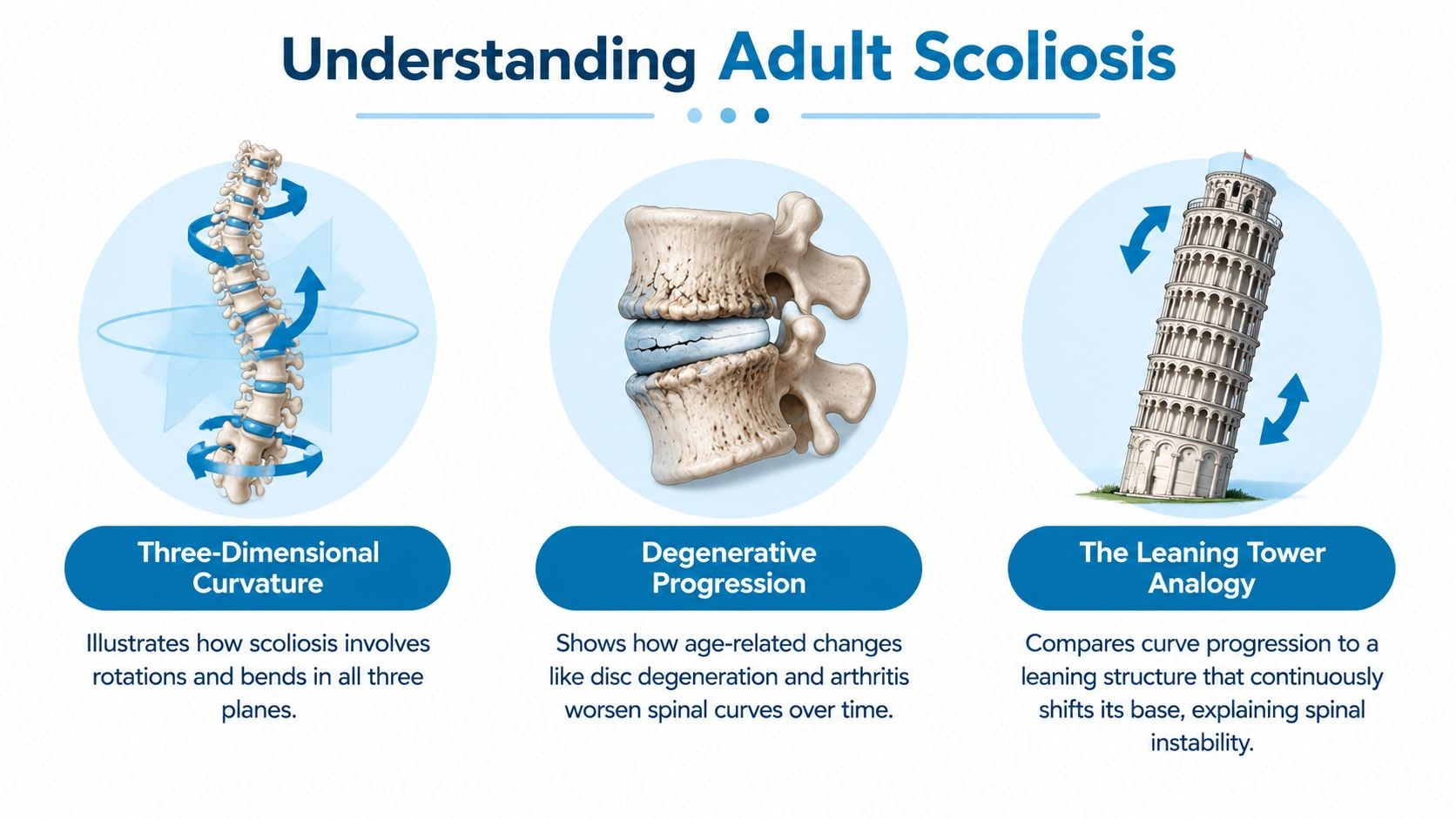
Scoliosis is a three-dimensional spinal deformity, not merely a sideways bend. The vertebrae can curve from side to side, rotate around their central axis, and change the spine's forward and backward alignment. This is why a person may show an uneven shoulder, a prominent rib area, a shifted waist, or a head that sits forward of the pelvis.
The Cobb angle provides a standard way to describe the size of a curve on a standing X-ray. It measures the angle between selected vertebrae, giving clinicians a consistent radiographic reference. Yet the number doesn't tell the whole story. Two adults with a similar Cobb angle may have very different symptoms because their balance, nerve compression, flexibility, and muscle conditioning differ.
How degeneration changes the spine
Adult-onset or degenerative scoliosis often begins when discs and facet joints lose height or become arthritic. If one side of a disc collapses more than the other, the vertebrae gradually tilt. Nearby muscles then work unevenly to keep the trunk upright, which can create fatigue and pain.
A useful analogy is a leaning tower. If the foundation shifts, the upper floors don't merely lean sideways. The structure also twists, and its center of gravity moves away from the base. The adult spine behaves similarly when degeneration alters the discs, joints, and supporting tissues. The body may compensate by bending the hips, knees, or pelvis, but those adjustments can increase muscular effort and discomfort.
Why symptoms vary
Symptoms can arise from several mechanical sources:
- Back pain: Uneven loading can strain muscles, joints, discs, and ligaments.
- Leg pain: Narrowing around a nerve root can produce sciatica-like pain, tingling, or numbness.
- Weakness: Persistent nerve compression may affect strength and walking ability.
- Fatigue: Muscles may remain active for long periods to keep the head and torso balanced.
- Reduced endurance: Standing, cooking, shopping, or working at a desk may become increasingly difficult.
Adult curves rarely self-correct because the underlying drivers are often structural. Degenerative discs don't automatically regain lost height, and arthritic joints don't restore normal alignment without targeted treatment. The clinical question is therefore not only how large the curve is, but how the curve affects balance, nerves, movement, and daily life.
Conservative and Interventional Treatment Options
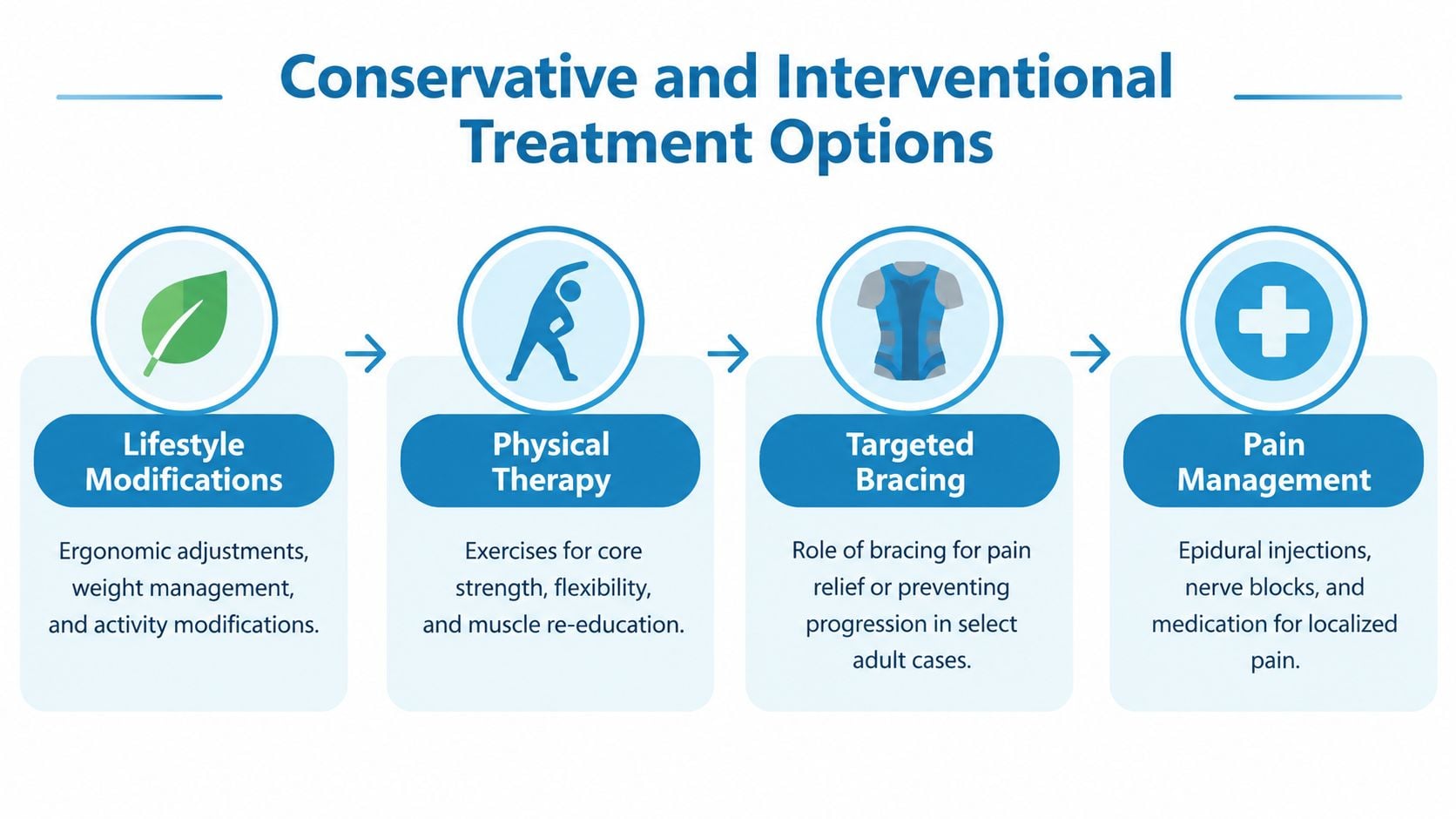
Treatment often begins with the least invasive option that matches the person's symptoms and physical findings. Conservative care aims to improve strength, mobility, tolerance for activity, and pain control. It generally doesn't remove a fixed structural curve, but it may help an adult function better without exposing that person to surgical recovery.
Physical therapy is usually more useful when it is individualized. A therapist may work on trunk and hip strength, flexibility, posture, breathing mechanics, and movement habits. Programs inspired by three-dimensional scoliosis rehabilitation can help patients recognize asymmetric loading and practice more efficient positions. The practical goal is better control and less strain, not a promise that exercises will straighten a rigid adult spine.
Lifestyle changes support that work. Ergonomic seating, frequent position changes, gradual conditioning, and activity modification can reduce repeated stress. Low-impact movement may be easier to tolerate than prolonged bed rest, which can lead to deconditioning and greater dependence on pain medication.
Comparing nonsurgical choices
| Option | Most useful for | Important limitation |
|---|---|---|
| Physical therapy | Weakness, stiffness, poor movement control, and fatigue | Requires consistent participation and may not resolve structural compression |
| Bracing | Selected adults who need support or short-term symptom relief | Often uncomfortable and less capable of changing an established adult curve |
| Medication management | Flares of inflammatory or mechanical pain | Side effects and incomplete relief can limit long-term use |
| Manual therapy or acupuncture | Some patients with muscular pain or stiffness | Should complement, not replace, diagnostic evaluation |
| Targeted procedures | Nerve-root, facet, or localized pain sources | Relief may be temporary and doesn't correct the deformity |
Interventional procedures can clarify which structure is generating pain while providing relief. An epidural steroid injection may be considered when inflammation around a nerve contributes to leg pain. A selective nerve block can test whether a particular nerve root is involved. Radiofrequency ablation may be discussed for facet-mediated pain in carefully selected patients.
For more information about the procedure and its common uses, patients can review epidural steroid injections.
A 2024 systematic review found that limited interventions can provide symptomatic relief in balanced deformities. It described decompression as most appropriate when neurological pain is the main problem, while short fusion can carry risks of adjacent segment disease and correction loss. More extensive long-segment surgery may provide stronger radiographic correction but also brings higher perioperative morbidity, as reported in the review of selective treatment pathways.
The transition to surgery becomes more reasonable when pain remains disabling despite appropriate care, neurological symptoms progress, the deformity compromises balance, or the spine has become too unstable or narrow for symptom control through limited procedures.
Surgical Correction Techniques
An adult who has tried injections and rehabilitation may still face a difficult choice when pain, weakness, or loss of balance continues. Surgery is not one standard operation. It is a group of techniques selected according to curve flexibility, the location of degeneration, spinal alignment, nerve compression, bone quality, and the amount of correction required. The aim may include symptom relief, better posture, and more durable function, rather than the straightest possible image on an X-ray.
Posterior fusion and instrumentation
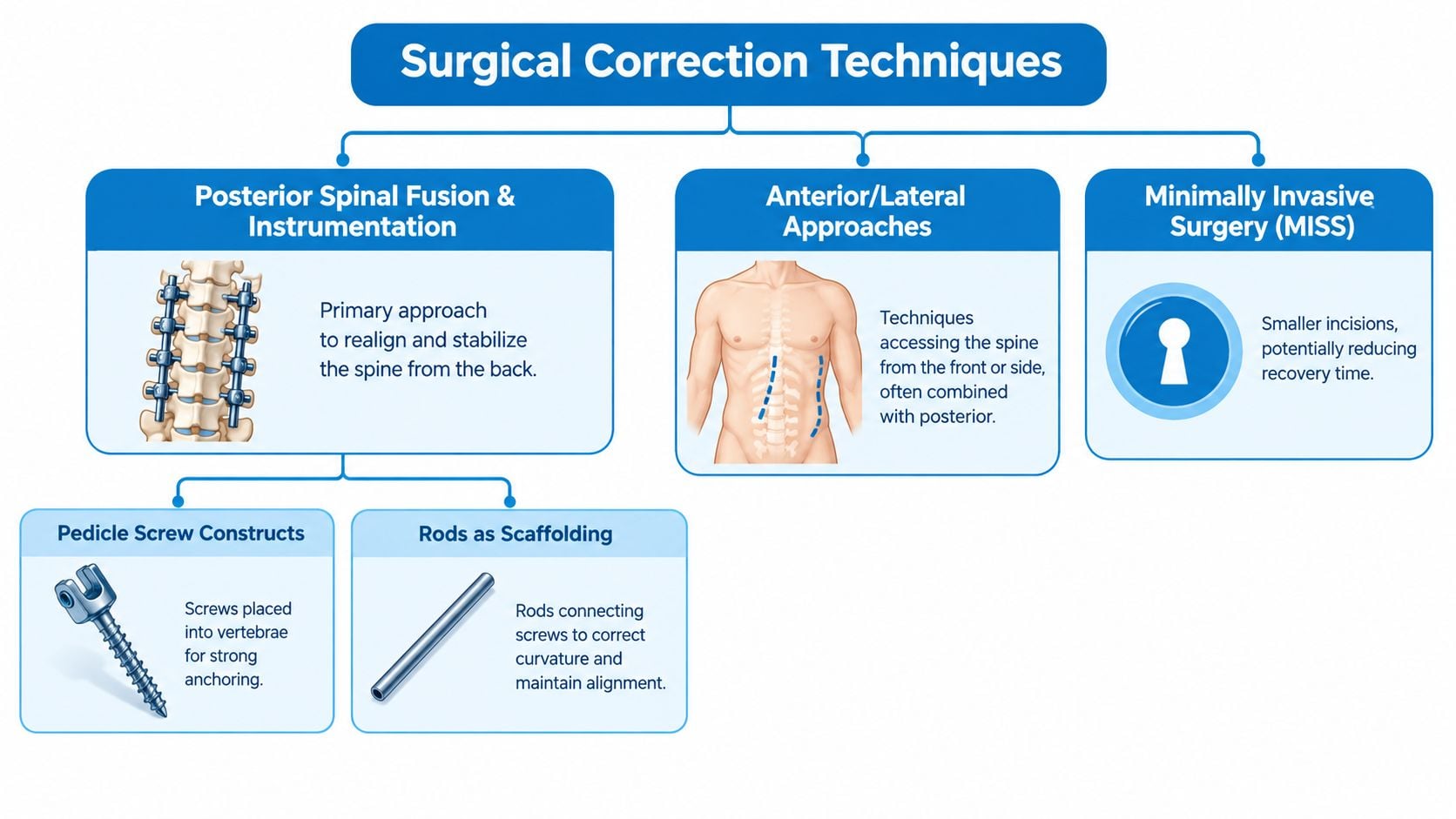
Posterior spinal fusion reaches the spine from the back. The surgeon places pedicle screws into selected vertebrae, connects them with rods, and prepares the bone surfaces so the vertebrae can fuse into a stable construct. The hardware works like temporary scaffolding. It holds the spine in its planned position while new bone grows across the treated levels.
A railroad track provides a useful comparison. If the track has developed a crooked route, connected supports can guide it toward a steadier path. The surgeon may correct curvature while also restoring forward alignment, reducing rotation, opening space for nerves, and spreading forces across the construct. The operation therefore addresses the spine as a three-dimensional structure.
Posterior surgery may suit adults with degeneration across several levels, substantial imbalance, or curves requiring direct nerve decompression and broad stabilization. Recovery commonly involves early movement, pain control, progressive walking, and a gradual return to strengthening. Rehabilitation may last months, and its pace depends on the number of levels treated, the patient's health, and the surgeon's fusion precautions.
Anterior and lateral reconstruction
An anterior lumbar interbody fusion, or ALIF, reaches the disc space from the front. Removing a damaged disc and placing a structural implant can restore disc height and contribute to alignment correction. An anterior or lateral approach may be combined with posterior screws and rods when one direction cannot provide enough stability or correction.
Lateral approaches reach the disc from the side and may allow larger interbody implants. They can help restore disc height and indirectly enlarge space around compressed nerves in selected cases. They may also reduce the need for extensive posterior muscle dissection, although anatomy, prior operations, and curve pattern determine whether the approach is suitable.
Small incisions do not necessarily mean a minor operation. A minimally invasive access route can still involve fusion across several levels, substantial bone healing, and a long rehabilitation plan. Patients should discuss how the surgical approach affects mobility, restrictions, and the time needed to resume work or daily activities.
Osteotomies for rigid deformity
A flexible curve may respond to positioning, disc reconstruction, and instrumentation. A rigid deformity may require an osteotomy, in which the surgeon removes or reshapes bone to create controlled mobility. The amount of bone removed depends on the planned correction and the safety of nearby nerves and blood vessels.
Complex osteotomies are reserved for carefully selected cases because they increase technical demands and physiological stress. Patients should ask how much correction is planned, which levels will be treated, what alternatives exist, how blood loss and neurological protection will be addressed, and what rehabilitation will involve. Further spinal osteotomy treatment information can help patients prepare questions for the surgical consultation.
A 2010 systematic review pooled 49 studies and 3,299 patient data points. The mean patient age was 47.7 years, and mean follow-up was 3.6 years. Across 2,188 patients, the average major curve correction was 26.6 degrees, while the mean Oswestry Disability Index fell by 15.7 points, according to the systematic review of adult scoliosis surgery. The findings support meaningful radiographic and functional improvement, while also showing why the largest possible correction is not automatically the best choice. A smaller operation may reduce rehabilitation demands, whereas a larger reconstruction may be considered when alignment and function cannot be addressed through limited techniques.
Surgical Candidacy and Decision Factors
A surgical consultation should answer a more useful question than “Is the curve large enough?” The better question is whether the deformity, symptoms, health status, and goals combine to make the expected benefit worth the burden and risk of treatment.
The symptom and function test
Pain deserves detailed description. Mechanical pain that worsens with standing and improves with rest may point toward instability or alignment stress. Leg pain, numbness, or weakness may indicate nerve compression. A surgeon also needs to know what the symptoms prevent. Difficulty walking, working, sleeping, lifting, or caring for family members can be more decision-relevant than a radiographic measurement alone.
Progressive neurological decline deserves prompt attention. New or worsening weakness, impaired balance, changes in bowel or bladder control, or severe numbness require urgent medical assessment rather than routine self-management.
The structural review
Imaging usually includes standing radiographs and may include advanced imaging when the team needs to evaluate discs, nerves, bone, or prior hardware. The clinician may assess:
- Curve flexibility: Flexible curves may respond to less extensive correction.
- Sagittal balance: Forward trunk shift can increase energy demands during standing.
- Coronal balance: Side-to-side displacement may affect posture and walking.
- Stenosis: Narrowing may explain leg symptoms and guide decompression.
- Bone quality: Fragile bone can compromise screw fixation and fusion.
- Prior surgery: Revision anatomy can increase complexity and alter available options.
Curve magnitude matters, but it isn't a stand-alone indication. A smaller curve with severe nerve compression can cause more disability than a larger, balanced curve.
The health and goal review
Smoking, osteoporosis, poor nutrition, diabetes, heart or lung disease, and limited conditioning can change healing and complication risk. These factors don't automatically exclude surgery, but they may need treatment before an operation. Bone-health evaluation can be especially important when a long construct or extensive correction is under consideration.
Shared decision-making should include a clear comparison between limited decompression, short fusion, long-segment correction, and continued nonoperative care. The discussion should cover what each choice may improve, what it won't improve, the possibility of additional surgery, and the rehabilitation time required.
Recent reviews report an overall complication rate around 34.5%, with pooled neurological complications of 10.8%, infection of 3.6%, and cardiac or pulmonary complications of 4.8%, according to the review of adult spinal deformity complications. Those figures describe populations, not an individual prediction. A personal risk estimate should reflect age, health, bone quality, smoking status, revision history, surgical approach, and correction goals.
A useful consultation question: “Which part of the planned operation is intended to improve pain, which part protects the nerves, and which part changes alignment?”
Expected Outcomes Risks and Rehabilitation
Successful scoliosis correction in adults has several measures. Pain may ease, walking may become more comfortable, posture may require less effort, and ordinary activities may feel safer. Surgery also creates new responsibilities, including fusion healing, muscle recovery, activity limits, follow-up imaging, and the possibility of later mechanical problems. Quality of life depends on how these changes fit together over time, not only on how straight the spine looks.
What improvement can mean
Radiographs can show a clear correction, yet a better image does not automatically produce a better daily life. Earlier review findings described both curve improvement and lower disability scores, alongside substantial complications and nonunion. The combination explains why patients should assess success through structure and function.
A review of adult degenerative scoliosis surgery reported mean improvements of about 11.1 degrees in Cobb angle, 7.674 millimeters in coronal balance, 3.24 points on a visual analogue pain scale, and 27.18% in the Oswestry Disability Index, with the reported changes statistically significant at p < .001, as described in the review of degenerative scoliosis outcomes. These findings do not mean that every patient will receive the same result. They show that pain and function may improve when better balance reduces mechanical stress, even if the curve is not completely removed.
Patients can ask the surgical team to separate the intended goals:
- Pain relief: Which pain source is being treated? Is nerve pain expected to respond differently from back pain?
- Function: Which activities might improve first, such as standing, walking, sleeping, or household tasks?
- Alignment: How much correction is needed for balance, rather than appearance alone?
- Durability: What problems could develop as the construct and nearby spinal segments age?
- Rehabilitation: What will the patient need to do after leaving the hospital?
This discussion helps prevent a common misunderstanding. A technically successful correction may still require months of effort before strength, confidence, and endurance return.
The correction and risk trade-off
A larger correction may suit severe imbalance or a rigid deformity, but a more extensive operation can increase blood loss, healing demands, neurological exposure, implant stress, and recovery time. A limited procedure may be a better fit when focal nerve compression causes the main disability, although it may leave a wider alignment problem untreated.
Recent evidence describes continued pain and disability improvement through 5 to 7 years. One longitudinal cohort reported a 24% cumulative prevalence of mechanical failure at 10 years, according to the long-term adult spinal deformity data. Mechanical failure can involve implants, junctional areas, alignment, or fusion integrity. This finding is a population result, not a personal prediction. It supports careful goal-setting and long-term follow-up rather than automatic acceptance or rejection of surgery.
A patient whose main problem is nerve pain may choose symptom relief over complete curve correction. Someone with severe forward imbalance may accept a longer recovery to stand and walk more comfortably. Interventional treatments, such as targeted injections or limited decompression when appropriate, can sometimes address a dominant pain source without committing the patient to the demands of a full reconstruction. Their benefit and limits depend on the pain generator, nerve findings, alignment, and expected durability.
The operation should match the mechanical problem. The patient should define which improvements justify the restrictions, risks, and rehabilitation work.
Rehabilitation starts before surgery
Preparation can make the postoperative period easier to manage. A preoperative program may address walking tolerance, hip and trunk strength, nutrition, smoking cessation, sleep, and home safety. The care team should also review medications, transportation, work duties, and the support available during the early recovery period.
After surgery, rehabilitation usually advances in stages:
- Early mobility: Walking, safe position changes, breathing exercises, and incision protection help limit problems related to immobility.
- Controlled endurance: Short, frequent walks often provide a manageable starting point before longer activity.
- Movement education: Patients learn how to hinge, sit, stand, and lift while reducing repeated stress on the healing spine.
- Strength rebuilding: Core, hip, and leg exercises progress only as healing and clinical instructions permit.
- Functional retraining: Therapy connects exercises with stairs, work duties, household activities, and community walking.
- Long-term maintenance: The aim is a routine that can continue after formal therapy ends.
Fusion does not mean the whole back should become rigid in daily behavior. The treated levels need protection while biological healing takes place. Returning to heavy lifting too early, pushing through significant pain, or avoiding movement altogether can each create difficulty. A rehabilitation clinician can change the plan when symptoms, strength, or healing progress changes.
Monitoring healing and warning signs
Follow-up imaging helps clinicians assess alignment, hardware, and fusion development. The timing differs by operation and surgeon, so patients should ask what each appointment is checking. Persistent or worsening pain does not always indicate failure, but it should be assessed rather than diagnosed at home.
Urgent evaluation is appropriate for new weakness, worsening numbness, loss of bladder or bowel control, fever with wound changes, sudden swelling, chest symptoms, or severe calf pain. Exercise instructions should also state when to stop an activity and contact the clinical team.
Clear communication is part of rehabilitation. Patients who receive instructions in another language or depend on translated discharge materials should verify every restriction, medication direction, and warning sign. Misunderstood lifting or wound-care guidance can cause serious harm. Information about the dangers of medical translation errors underscores why qualified communication and teach-back matter.
Bone health and fusion biology
Bone quality affects how securely implants hold and how reliably fusion develops. Clinicians may review osteoporosis risk, nutrition, vitamin status, smoking, medication use, and medical conditions that interfere with healing. Depending on the findings, bone-health treatment may begin before or after surgery.
The biological side of fusion deserves attention equal to the hardware. Earlier pooled review data reported 897 complications among 2,175 patients, or 41.2%, and 319 pseudarthroses among 2,469 patients, or 12.9%, as documented in the adult scoliosis surgery review. A pseudarthrosis is an incomplete or failed fusion. These historical pooled benchmarks do not predict one person's result, but they show why construct planning, bone quality, fusion biology, and follow-up belong in the main treatment discussion.
Patients preparing for consultation can read this explanation of spinal fusion care for general background. The treatment team must still adapt recommendations to the patient's imaging, medical history, symptoms, and proposed operation.
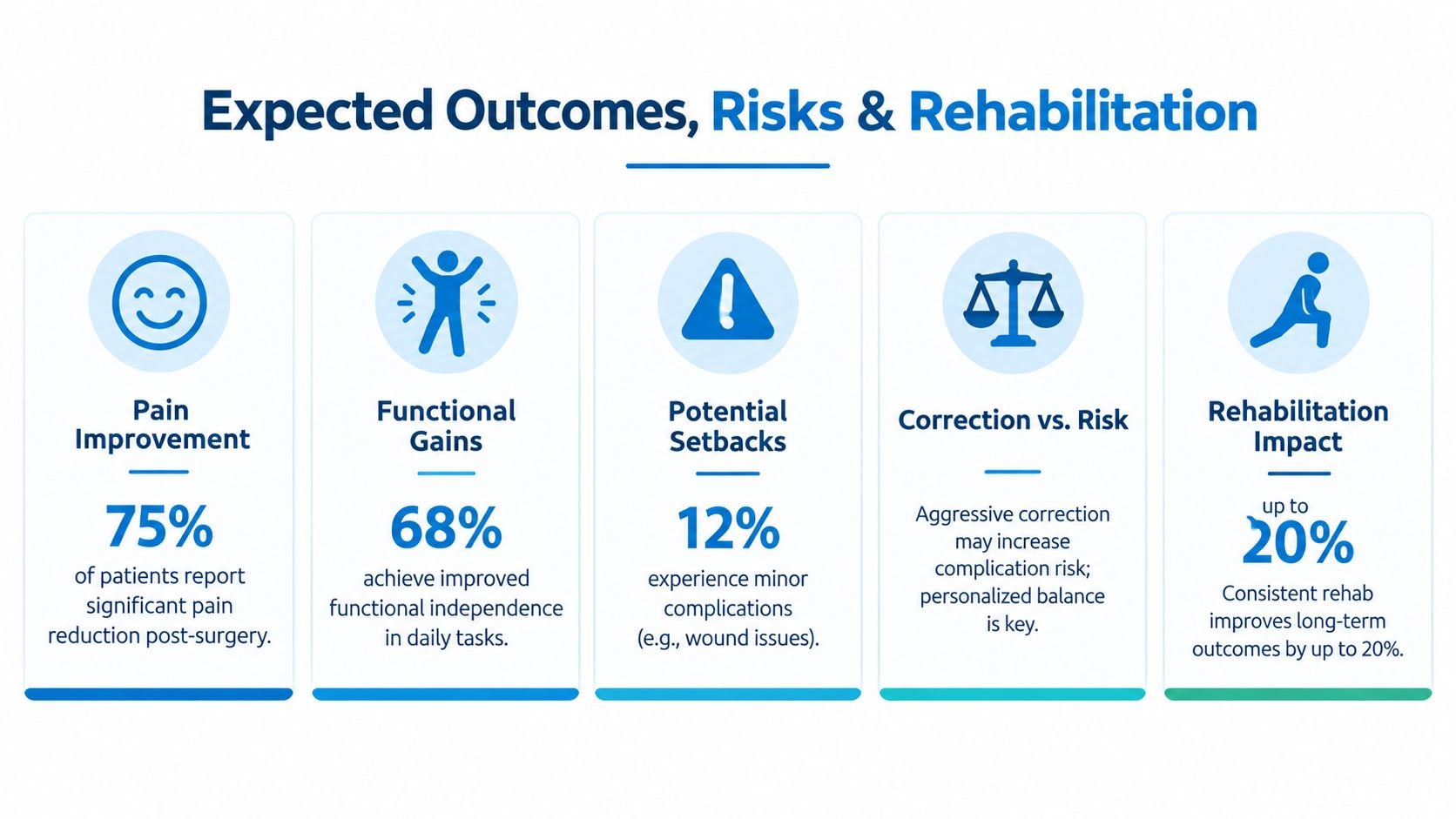
The strongest recovery plan is a planned sequence. It begins with an accurate diagnosis, considers interventional or nonoperative care when those options fit the problem, selects the least extensive treatment capable of addressing the main cause, prepares the body for recovery, and continues monitoring after early improvement. The goal is a more usable, sustainable life, not correction at any cost.
Patient Case Examples and Lessons
The following vignettes are educational examples, not documented patient case studies. They illustrate how symptoms, imaging, goals, and risk tolerance can lead to different treatment choices without assigning invented outcome scores or unsupported statistics.
A 60-year-old choosing structured nonoperative care
A 60-year-old adult has a degenerative curve, evening back fatigue, and stiffness after standing. The spine remains reasonably balanced, there is no progressive weakness, and the main goal is to continue working and walking comfortably. The care plan emphasizes individualized physical therapy, ergonomic changes, gradual conditioning, medication review, and follow-up evaluation.
The lesson is that a visible curve doesn't automatically require correction surgery. A balanced adult with manageable symptoms may gain more from improving capacity and controlling pain than from accepting the risks of a large operation.
A 45-year-old treating nerve pain with limited surgery
A 45-year-old adult has severe leg pain caused by localized nerve compression near a degenerative curve. Back pain is limited, balance remains acceptable, and imaging identifies a focused area that can be addressed without correcting the entire spine. The consultation compares decompression and short fusion with broader reconstruction.
The lesson is to match the procedure to the dominant symptom. A limited operation may be reasonable when neurological pain is the primary problem, but the patient should understand the possibility of correction loss or adjacent segment disease over time.
A 52-year-old considering long-segment correction
A 52-year-old adult has progressive forward imbalance, disabling mechanical pain, and difficulty remaining upright. Several levels are degenerated, the curve is relatively rigid, and conservative measures no longer provide adequate function. The surgical discussion focuses on alignment goals, bone health, staged preparation, complication prevention, and a lengthy rehabilitation commitment.
The lesson is that long-segment surgery should be chosen for a clear mechanical and functional reason, not just because a larger correction looks preferable on an image. The patient needs a realistic plan for work, transportation, home support, therapy, and long-term surveillance.
Across all three examples, the same questions remain central: What symptom is limiting life? What structure is causing it? How flexible is the deformity? What treatment burden can the patient safely manage? Those answers matter more than applying a single standard pathway to every adult curve.
Conclusion and Next Steps
Adult scoliosis correction spans a broad range, from exercise-based rehabilitation and targeted injections to decompression, short fusion, and complex long-segment reconstruction. The best choice depends on the relationship between symptoms and anatomy, not on the curve's appearance alone.
Patients preparing for evaluation should take four practical steps:
- Schedule a spine assessment with standing imaging and a review of neurological symptoms.
- Document functional limits, including walking tolerance, sleep disruption, work difficulty, and activities that trigger pain.
- Review conservative and interventional options before assuming that full deformity correction is necessary.
- Seek a second opinion for major surgery, especially when the proposed operation involves extensive fusion or osteotomy.
- Plan rehabilitation early, including home support, transportation, bone-health optimization, and follow-up visits.
A thoughtful plan may reduce symptoms without surgery, or it may show that surgery offers the most reasonable path to restored function. The decision should be specific, shared, and honest about both improvement and long-term risk.
Interventional Pain Management evaluates spine and nerve-related pain through noninvasive care, image-guided procedures, and surgical coordination when indicated. Adults considering scoliosis correction can visit Interventional Pain Management to learn about evaluation and treatment options in New Jersey and Staten Island.