
Radiofrequency ablation typically provides 6 to 12 months of meaningful pain relief, although some patients maintain improvement for several years. The time until another treatment varies, and a recent real-world study found an average repeat interval of 380.6 days in lumbar facet pain. https://www.sciencedirect.com/science/article/pii/S2772594425000378
A patient usually asks this question while sitting in the consultation room, often after trying medication, physical therapy, injections, or activity changes without lasting control. The question sounds simple, but “how long does radiofrequency ablation last” doesn't have one dependable answer. The more useful question is: how long will meaningful relief last before the original pain begins affecting daily function again?
The answer depends on the pain source, the nerve treated, the accuracy of the lesion, the technique used, and the pace of nerve regeneration. This guide focuses on realistic timelines, not the longest possible result, so patients can measure improvement, recognize gradual wear-off, and plan the next conversation with a pain physician.
Table of Contents
- What You Really Want to Know Before the Procedure
- How RFA Interrupts Pain Signals
- What the Research Says About How Long Relief Lasts
- Factors That Push Relief Longer or Shorter
- When Pain Starts Returning and What It Feels Like
- Your Options if the Pain Comes Back
- Tracking Your Own Results and Planning Ahead
What You Really Want to Know Before the Procedure
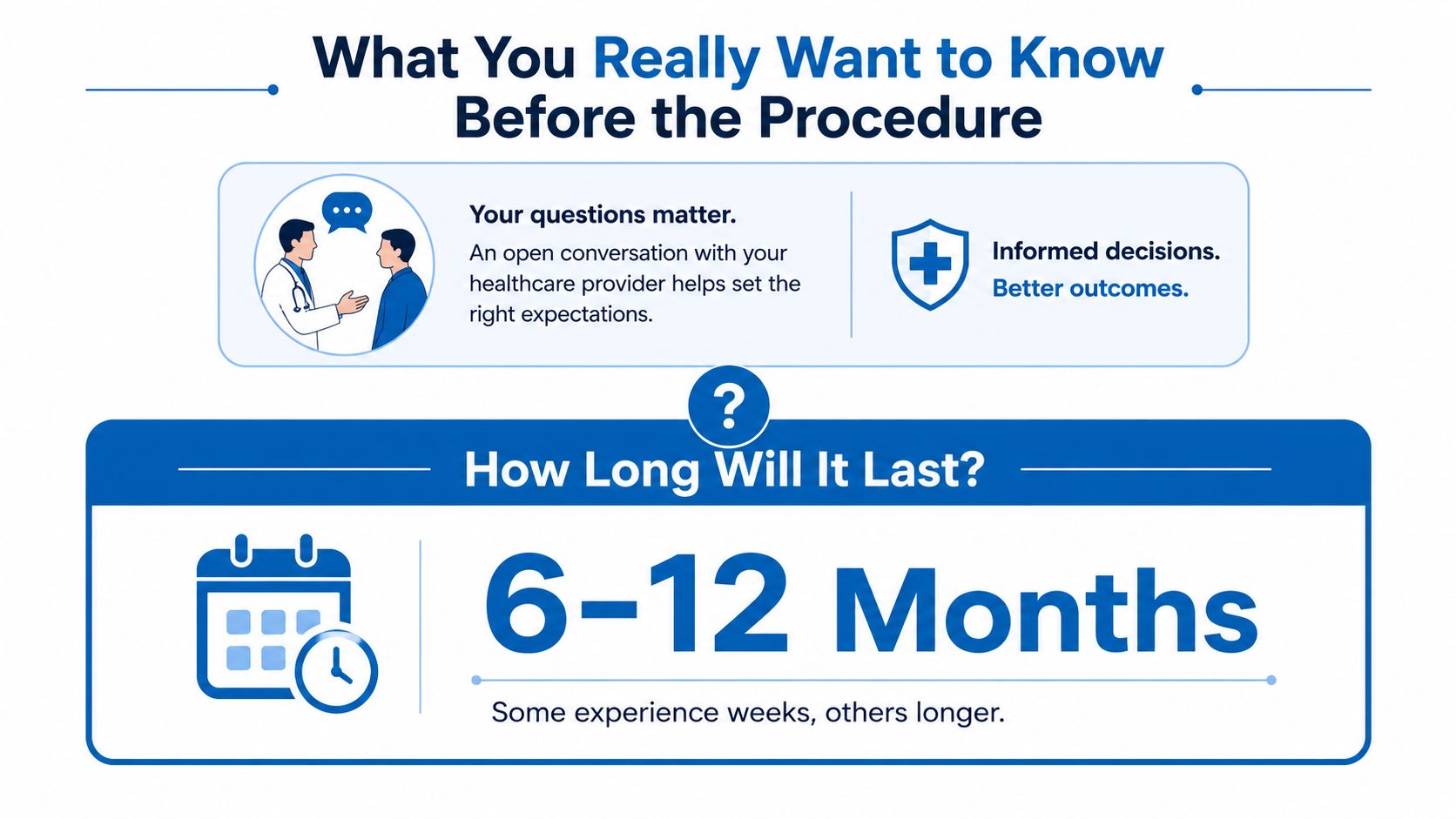
“Will this last long enough to make the procedure worthwhile?” That's often the question behind a patient's direct request for a timeline. A reasonable starting point is 6 to 12 months of relief, but actual experiences vary widely. Some patients get only a shorter window, while others continue to benefit for years.
That range matters because radiofrequency ablation is usually a medium-duration treatment, not a permanent cure. It can create a valuable period in which walking, sleeping, working, exercising, or reducing reliance on pain medication becomes easier. The value isn't measured only by the number of pain-free months. It's also measured by what the patient can do during those months.
Patients comparing ablation with other procedures may benefit from reviewing how treatments differ in the broader field of pain management injections. A nerve block, epidural injection, and RFA target different pain mechanisms, so their expected timelines shouldn't be treated as interchangeable.
A practical baseline
Before treatment, the patient and clinician should identify:
- The target pain: Which movement, location, or activity is being treated?
- The functional goal: Is the priority better sleep, longer walking, work tolerance, or exercise?
- The tracking method: How will improvement be measured after the procedure?
- The recurrence plan: What level of returning pain should prompt a follow-up?
- The alternative path: What happens if the first procedure provides little or no relief?
This approach prevents a common mistake, anchoring on an upper-end claim such as “up to two years.” A longer result can occur, but it shouldn't be treated as the expected guarantee for every diagnosis.
Practical rule: The most useful prediction is the patient's time to meaningful symptom return, not the maximum duration reported in a study.
The sections that follow explain why the relief eventually fades, what published evidence shows across different body regions, which factors shorten or extend the benefit, how returning pain usually feels, and what options exist if symptoms come back.
How RFA Interrupts Pain Signals
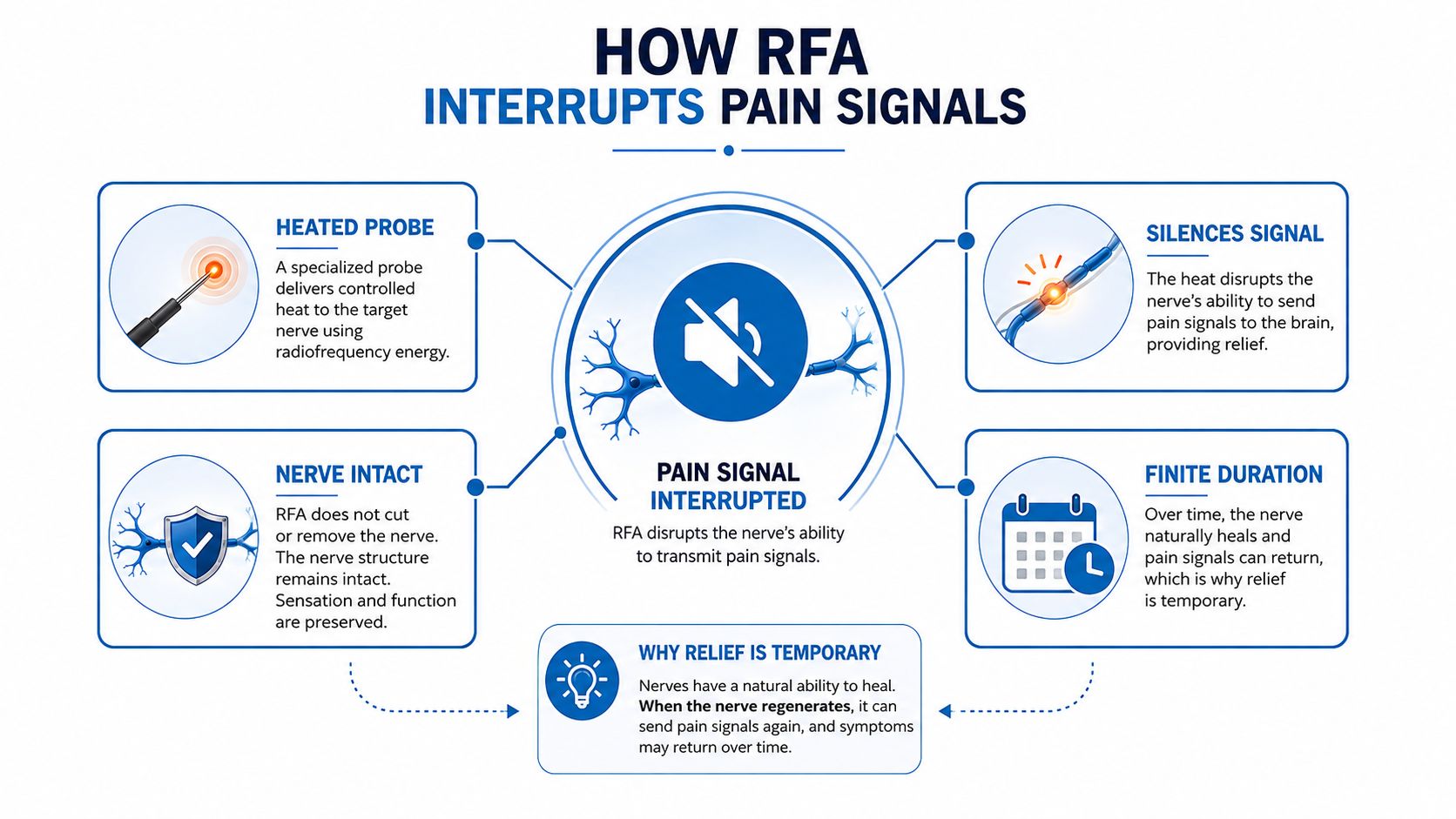
Radiofrequency ablation works somewhat like placing a temporary mute button on a nerve. A physician guides a probe near a carefully selected sensory nerve and uses radiofrequency energy to create a controlled thermal lesion. The goal is to interrupt the nerve's ability to transmit pain signals from a joint or other pain-generating structure.
The nerve usually isn't removed. It remains in the body and may gradually recover or regenerate. That distinction explains why RFA has a finite duration. The treatment interrupts transmission for a period of time, but it doesn't permanently rewire every part of the pain system.
Conventional and pulsed approaches
Conventional thermal RFA uses continuous energy to create a more defined heat lesion. It's commonly used when the treatment plan calls for interrupting a specific sensory nerve, such as a nerve supplying a painful spinal facet joint.
Pulsed RFA delivers energy in bursts and generally produces a different tissue effect. It may be considered in selected situations, especially when the pain has neuropathic characteristics or the clinician wants a less destructive approach. The right choice depends on the diagnosis, anatomy, prior response, and treatment objective.
Patients often confuse RFA with a procedure that permanently destroys a nerve. That expectation can lead to disappointment when symptoms eventually return. The treated nerve can regain function, and other pain generators may also become more prominent during follow-up.
A diagnostic nerve block is often used to test whether a suspected nerve is contributing to the pain before ablation is considered. Patients who want to understand that evaluation can review the role of a diagnostic nerve block, including how it differs from a longer-lasting treatment.
The healing process also matters. Relief can begin quickly for some patients, while others may need up to 3 weeks for the full effect to appear. https://my.clevelandclinic.org/health/treatments/17411-radiofrequency-ablation Once the nerve begins recovering, the return of pain may be gradual rather than sudden.
What the Research Says About How Long Relief Lasts
Published results show why a single lifespan number can mislead. Outcomes differ by the treated anatomy and the definition of success. A lumbar medial branch study reported that 63.2% of patients reached at least 50% pain reduction at 6 to 12 months, 65.6% met that threshold at 12 to 24 months, and 44.1% still met it beyond 24 months. https://academic.oup.com/painmedicine/article/21/5/902/5586928?login=true
Those figures don't mean every patient receives two years of relief. They describe outcomes among a defined study group, using a specific pain-reduction threshold. A separate cohort of 191 patients reported average improvement lasting 137.52 days, while the group that didn't receive steroids averaged 126.10 days of relief. The same study reported average improvement of 48.48% overall and 46.36% without steroids. https://academic.oup.com/painmedicine/article/21/5/902/5586928?login=true
Because the source URL has already been used, the cohort figures above should be read as part of the same evidence summary rather than as a promise about an individual result. They illustrate an important clinical point: some real-world experiences cluster closer to 4 to 5 months, while selected patients maintain meaningful benefit much longer.
Duration by treatment setting
| Indication | Evidence source | Success at 3 months | Success at 6 months | Success at 12 months | Median duration |
|---|---|---|---|---|---|
| Lumbar medial branch pain | Long-term lumbar medial branch cohort | Not specified | 63.2% | 65.6% | Not specified |
| Knee genicular nerve pain | Review of genicular nerve RFA | Relief reported among responders | 95% of those relieved at 3 months remained relieved | Not specified | Not specified |
| Knee pain treated with cooled RFA | Retrospective follow-up | Not specified | Not specified | Mean relief over 12 months | Not specified |
| Sacroiliac joint pain | Systematic review | Benefit reported in selected patients | Benefit varies by study | Evidence beyond 12 months limited | Not specified |
For knee pain, one cooled RFA assessment found a mean duration of greater-than-50% relief of 12.5 months, with a range from 0 to 35 months. https://pmc.ncbi.nlm.nih.gov/articles/PMC4197759/ A review of genicular nerve RFA found that, among patients who still had relief at 3 months, 95% continued to report relief at 6 months, with average pain relief of 64% during that period. https://pmc.ncbi.nlm.nih.gov/articles/PMC4197759/
A systematic review of RFA for chronic low back pain found evidence for lumbar facet and sacroiliac joint pain, but noted that randomized trial evidence available at that time was generally short-term and under 1 year. https://pmc.ncbi.nlm.nih.gov/articles/PMC4197759/ A separate review summarized common relief as 6 to 24 months, while also emphasizing that repeat treatment may become necessary as nerves regenerate. https://journals.lww.com/ijpn/fulltext/2022/36001/radiofrequency_ablation_in_chronic_pain_syndromes_.2.aspx
Patients comparing the duration of RFA with shorter-acting local anesthetic procedures may find a lidocaine relief duration guide useful for understanding why different treatments produce different timelines.
The clearest interpretation is month by month. Early follow-up establishes whether the procedure worked. The middle period shows whether function remains improved. Later follow-up focuses on whether the original pain is beginning to return and whether a repeat procedure remains appropriate. “Up to two years” describes a possible upper tail, not a guaranteed average.
Factors That Push Relief Longer or Shorter
Two patients can receive technically similar RFA yet have different time-to-return. One may regain useful function for longer, while another notices the original limitation sooner. The procedure's durability reflects the treated nerve, the pain source, and what continues to load that area, not a fixed lifespan number.
Five variables clinicians weigh
Target accuracy comes first. If the probe creates an effective lesion across the intended medial branch nerve, relief may be more complete and last longer. A lesion that only partly reaches the target can produce brief or incomplete improvement. Ask how the target was identified and how imaging guided probe placement.
The pain generator changes the forecast. Facet-related axial back pain, sacroiliac pain, and genicular knee pain do not behave identically. One systematic review found limited evidence beyond 12 months for sacroiliac pain, while selected knee and lumbar groups showed benefit during longer follow-up. https://pubmed.ncbi.nlm.nih.gov/42183005/
Nerve anatomy matters. A small sensory branch may recover differently from a larger or mixed nerve. Weight-bearing joints and mechanically stressed regions also keep experiencing movement and load after treatment, which can shorten the practical period of improvement.
Patient health and daily demands shape recovery. Smoking, poorly controlled diabetes, active inflammation, and physically demanding work may complicate healing or keep stressing the original pain source. These factors do not automatically rule out RFA, but they can affect when symptoms begin interfering with activity again.
Technique affects lesion characteristics. Conventional thermal, pulsed, and cooled approaches create different treatment effects. A 2025 review found wide variation in current RFA techniques and no established consensus on the ideal duration and temperature combination. https://www.sciencedirect.com/science/article/pii/S2772594425000378
| Factor | Shorter relief | Longer relief |
|---|---|---|
| Target placement | Incomplete or off-target lesion | Precise treatment of the confirmed pain pathway |
| Diagnosis | Multiple or competing pain generators | A clearly identified, nerve-mediated source |
| Anatomy | Rapidly recovering or mechanically stressed nerve | Suitable sensory target with effective lesion coverage |
| Patient factors | Ongoing inflammation, smoking, uncontrolled diabetes, high physical demand | Fewer untreated contributors and manageable loading |
| Technique | Mismatch between method and anatomy | Technique selected for the target and clinical goal |
This table is not a calculator. It helps structure the pre-procedure discussion. Ask which factors apply to your diagnosis, whether the pain source has been confirmed, and what would make the clinician reconsider the target if the first result is weak. In practice, the useful question is often how long activity remains better and when reassessment or repeat treatment might reasonably enter the plan.
When Pain Starts Returning and What It Feels Like
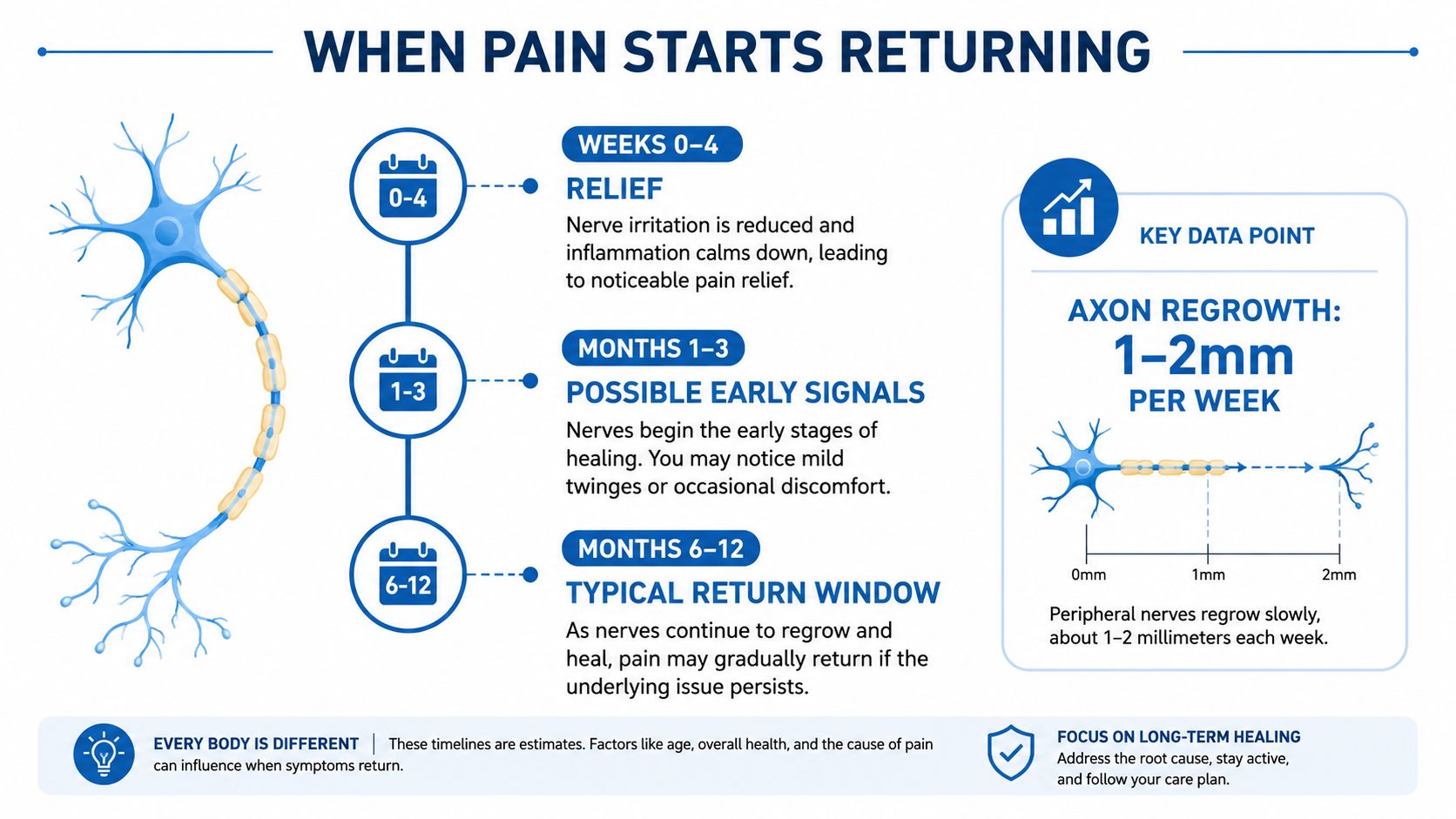
After a period of easier movement, you may notice the original pain returning during a longer walk, a demanding workday, or a poor night of sleep. That pattern often develops gradually rather than appearing on a fixed date.
Radiofrequency ablation does not stop nerve recovery permanently. As the treated sensory nerve regains enough function to transmit signals, symptoms can reappear. Nerve recovery and pain return do not always occur at the same pace, so an early change does not necessarily mean the treatment has ended.
A faint version of the original pain may come first, often in the same location. Painless periods can then become shorter, while activity-related flares occur more often. This gradual change is more useful than a single lifespan estimate when you and your clinician assess durability.
Wear-off versus procedural failure
A gradual return in the same pain distribution often fits nerve recovery, although a clinician still needs to assess the cause. If the procedure never provided meaningful relief, symptoms returned within days, or the pain changed immediately, the explanation may be different.
Contact the clinic sooner if the pain changes sharply or no longer resembles the pre-procedure problem. Warning signs include:
- Rapid escalation: Pain intensifies quickly instead of building gradually.
- Neurological changes: New weakness, numbness, or coordination problems appear.
- Systemic symptoms: Fever or other signs of illness accompany the pain.
- A different distribution: Symptoms spread into an unfamiliar area or develop a new quality.
Patient-facing timelines often describe relief as lasting 6 to 12 months, while some people report benefit for a few years. These ranges describe possibilities, not a promise. Relief may also take up to 3 weeks to become complete, so judging the result too early can cause confusion.
A symptom diary can show whether relief is fading slowly or the problem changed suddenly. Record pain location and intensity, triggers, sleep disruption, and activity tolerance. That history helps the pain physician determine whether the treated nerve has recovered, another structure is contributing, or a new problem needs attention.
Your Options if the Pain Comes Back
Pain returning after RFA does not automatically mean the procedure failed. Start with what happened after treatment. If the first procedure brought meaningful relief, improved function, and the same pain pattern gradually returned, repeating RFA at the same target may be reasonable.
A prospective study of lumbar facet pain found that repeat RFA occurred, on average, after 380.6 days. That timing supports planning around the point when function and comfort begin to decline, rather than assuming relief will last a fixed two years. Patient-facing ranges such as 6 to 24 months describe possible time to return, not a dependable average for every patient. Before repeating treatment, the clinician must confirm that the pain generator is still the same and that another procedure fits the patient's goals.
The decision tree
- Repeat the same RFA: This may fit someone who had clear improvement, regained useful activity, and later developed a similar pattern as the effect faded.
- Reassess the target: Pain that never improved may reflect incomplete treatment, a nearby nerve, or more than one source.
- Consider another RFA approach: The clinician may review pulsed treatment for selected neuropathic features or cooled treatment when a broader lesion is appropriate.
- Discuss neuromodulation: Peripheral nerve stimulation or spinal cord stimulation may be considered when relief periods keep shrinking, pain spreads, or the nervous system remains sensitized.
- Seek surgical evaluation: Examination findings, imaging, progressive neurological symptoms, or structural compression may point toward spine or orthopedic evaluation instead of another ablation.
A procedure such as an epidural steroid injection may make more sense when nerve-root irritation is suspected, rather than facet or joint-mediated pain typically treated with RFA. The diagnosis should guide the treatment choice, not merely the fact that a previous procedure has worn off.
There is no fixed number of successful RFA cycles that automatically means an implant or surgery is needed. A second opinion is reasonable when the diagnosis remains uncertain, symptoms and imaging do not match, relief is absent, or the recommended procedure changes without a clear explanation.
Tracking Your Own Results and Planning Ahead
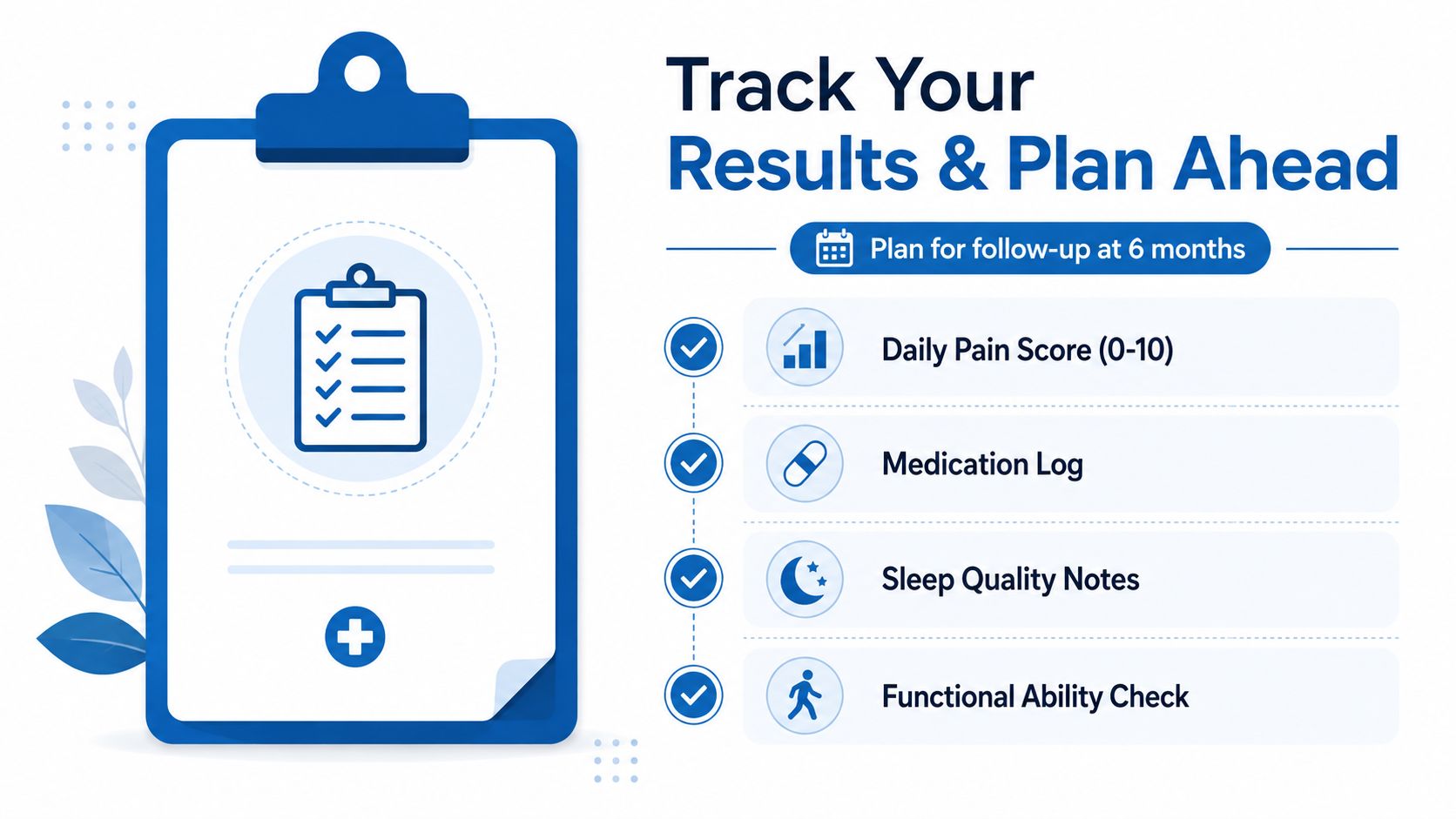
The most useful record measures time to return, not just pain on the day of treatment. A patient who knows when function improved, when medication use changed, and when symptoms first reappeared can have a much more productive follow-up discussion.
A simple diary can remain practical:
- Daily pain score: Record a score from 0 to 10 and note whether the pain is in the original location.
- Medication log: Track changes in prescribed or over-the-counter medication use.
- Sleep quality: Note whether pain interrupts sleep or limits comfortable positions.
- Functional checkpoint: Record walking, work, exercise, household tasks, or other personally important activities.
A planning checklist
Before a follow-up appointment, patients should bring:
- The baseline problem: What activities were limited before RFA?
- The best response: What improved, and how long did the improvement remain meaningful?
- The first return signal: When did the original pain begin to reappear?
- The current impact: Is pain now affecting sleep, work, movement, or medication use?
- The next decision: Would repeat RFA address the same confirmed source, or does the examination suggest another option?
A repeat interval should be based on function and symptom pattern, not on an automatic date. A patient doesn't need to wait until pain reaches its worst level, but a clinician should confirm that the returning symptoms match the original diagnosis before scheduling another treatment.
The goal isn't to predict a perfect expiration date. It's to recognize when meaningful benefit is fading and act before lost function becomes the new baseline.
Interventional Pain Management evaluates back, neck, joint, and nerve-related pain through diagnostic review, interventional procedures, and coordinated orthopedic or spine care when appropriate. Patients can visit Interventional Pain Management to discuss whether RFA, repeat treatment, or another individualized option fits the pattern of returning pain.