
Yes, carpal tunnel release can be followed by trigger finger in about 7.7% to 8.5% of cases, so the association is real. But the better answer is that surgery doesn't always “cause” a brand-new problem. In many patients, it likely unmasks an existing tendency while also changing tendon mechanics in a way that can make catching or locking show up during recovery.
A common version of this story goes like this: hand numbness improves after carpal tunnel surgery, then a few weeks or months later a thumb starts clicking, or a finger seems to stick when opening the hand. That change often alarms patients because it feels like one surgery fixed one problem and created another.
That concern is understandable. Trigger finger after carpal tunnel release is recognized often enough that it belongs in pre-op counseling and post-op follow-up, not in the category of strange bad luck. At the same time, it's often misunderstood. Many patients assume it means something went wrong in the operating room. The evidence suggests the picture is more nuanced than that.
The hand's tendons, pulleys, and nerve spaces are closely related. Carpal tunnel syndrome and trigger finger also tend to travel together in the same patient. So when a finger begins catching after surgery, the question isn't only “Can carpal tunnel surgery cause trigger finger?” It's also “Was that finger already vulnerable, and did surgery make the timing more obvious?”
Table of Contents
- Introduction to Trigger Finger After Carpal Tunnel Release
- Understanding Carpal Tunnel and Trigger Finger Together
- How Often Trigger Finger Occurs After Surgery
- Why Carpal Tunnel Release May Lead to Trigger Finger
- Who Is Most at Risk and What Influences It
- Prevention Recognition and Treatment Options
- Key Takeaways and When to Seek Care
Introduction to Trigger Finger After Carpal Tunnel Release
Someone recovering from carpal tunnel release may notice an odd new symptom while doing something simple, like gripping a coffee mug or buttoning a shirt. The numbness in the hand is better, but now the thumb clicks, or the ring finger hesitates before straightening. That sequence is unsettling because it feels backward. Recovery was supposed to move in one direction.
That pattern is real enough that it has been studied closely. A systematic review summarized in The Open Orthopaedics Journal review on trigger finger after carpal tunnel release found 483 trigger digits among 5,654 carpal tunnel release procedures, for an overall incidence of 8.5%, and a separate pooled analysis of 9,207 releases found an incidence of 7.7%. Those numbers place trigger finger firmly in the category of a recognized post-release issue.
Why the question gets confusing
Patients often use the word “cause” in a very direct sense. They mean, “Did the surgeon injure something?” Most of the time, that isn't what the evidence points to.
There are at least two different ideas wrapped into the same question:
- Direct mechanical effect: releasing the carpal tunnel changes how the flexor tendons move.
- Shared predisposition: the same hand that developed carpal tunnel syndrome may already have tendon and pulley problems waiting to declare themselves.
- Recovery timing: after surgery, patients watch the hand more closely and use it differently, so subtle triggering becomes easier to notice.
Trigger finger after carpal tunnel surgery is usually better understood as a mix of timing, tendon mechanics, and patient biology, not proof of surgical error.
What patients usually want to know
Individuals searching this topic are trying to answer a practical concern.
- Is this a known problem or just coincidence?
- How soon can it happen?
- Who's more likely to develop it?
- What should be done if clicking or locking starts?
Those are the right questions. A calm, accurate answer helps more than a simple yes or no.
Understanding Carpal Tunnel and Trigger Finger Together
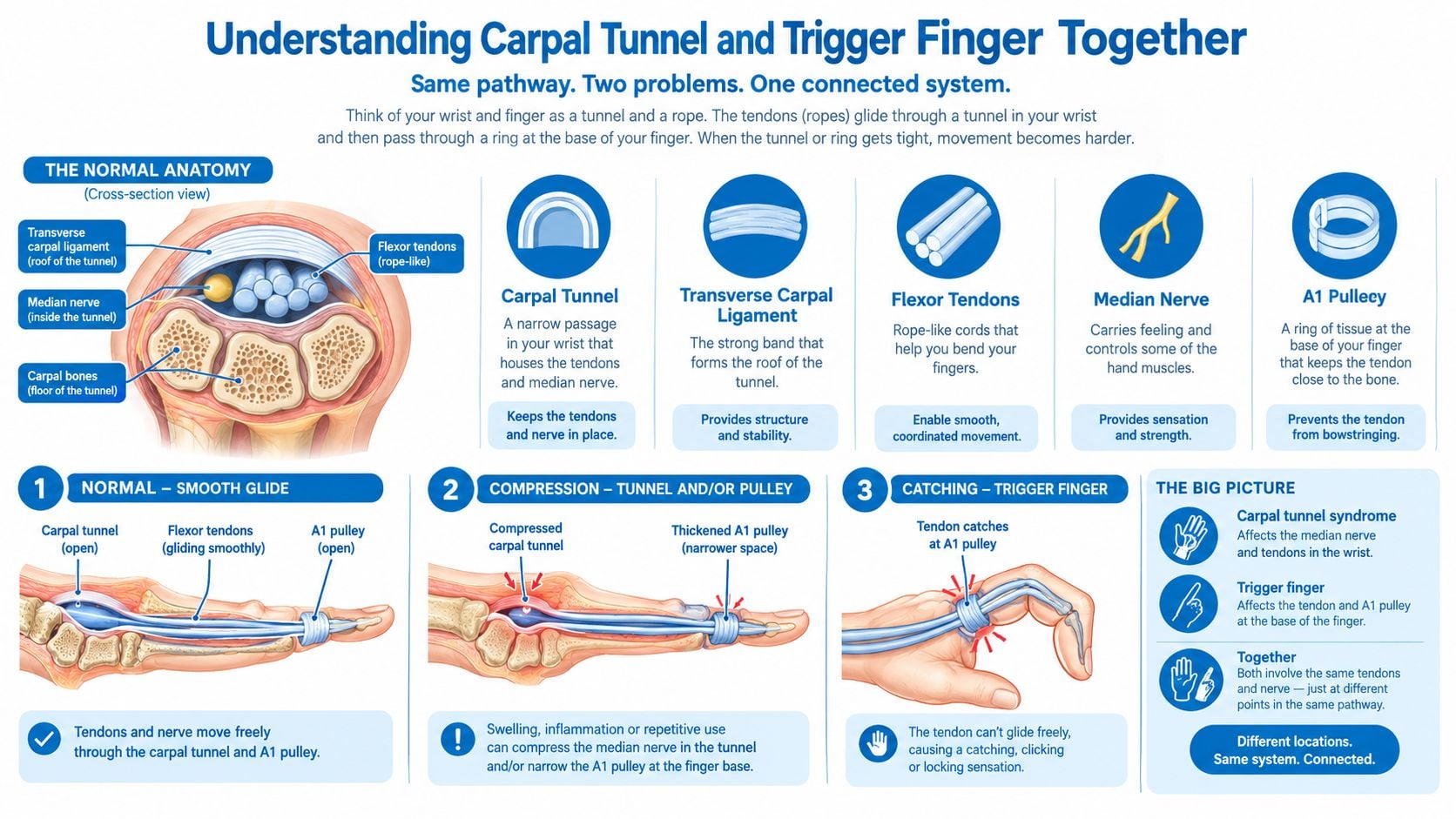
The easiest way to understand the connection is to think of the hand as a system of ropes moving through tunnels and rings.
At the wrist, the flexor tendons and the median nerve pass through a tight space called the carpal tunnel. The “roof” of that tunnel is the transverse carpal ligament. Carpal tunnel syndrome happens when pressure in that space irritates the median nerve.
Farther down, each finger tendon passes under small pulley structures that keep it tracking close to the bone. The first pulley near the base of the finger is the A1 pulley. Trigger finger happens when the tendon and pulley stop gliding smoothly together. The tendon catches, then releases with a click or snap.
Same hand system, different bottlenecks
Carpal tunnel syndrome is mainly a nerve compression problem at the wrist. Trigger finger is mainly a tendon-pulley mismatch problem at the base of a thumb or finger. Different structures are involved, but the flexor tendon system links them.
That's why these conditions can coexist before any surgery happens. The person who has swelling, tendon sheath irritation, or general wear in the hand may develop one problem first and the other later.
Core concept: carpal tunnel syndrome and trigger finger are different diagnoses, but they live in the same mechanical neighborhood.
A patient may have numbness from median nerve compression that gets all the attention before surgery. Once the nerve symptoms improve, a pre-existing tendon catching problem may become more noticeable. For some patients trying to reduce strain during recovery, workstation and keyboard adjustments matter too. Practical workflow changes for wrist relief can reduce repetitive hand stress during that period.
Why treating one can reveal the other
Carpal tunnel surgery releases pressure at the wrist. It doesn't directly operate on the A1 pulley in the finger. But changing one part of a tendon pathway can alter how another part behaves.
For readers who want a broader overview of the wrist condition itself, this page on carpal tunnel syndrome care explains the symptoms, diagnosis, and treatment context around release surgery.
Three simple examples often help:
- A narrowed tunnel at the wrist can hide a second problem farther down the line.
- Improved numbness after surgery makes smaller clicking symptoms easier to detect.
- A tendon that glides differently after release may irritate a pulley that was already borderline.
That doesn't mean every post-op trigger finger was inevitable. It means the relationship is close enough that a single-cause explanation usually misses part of the story.
How Often Trigger Finger Occurs After Surgery
The best answer comes from pooled studies, not isolated stories. Across larger reviews, trigger finger after carpal tunnel release shows up often enough to be clinically relevant, but not so often that it should automatically scare someone away from surgery.
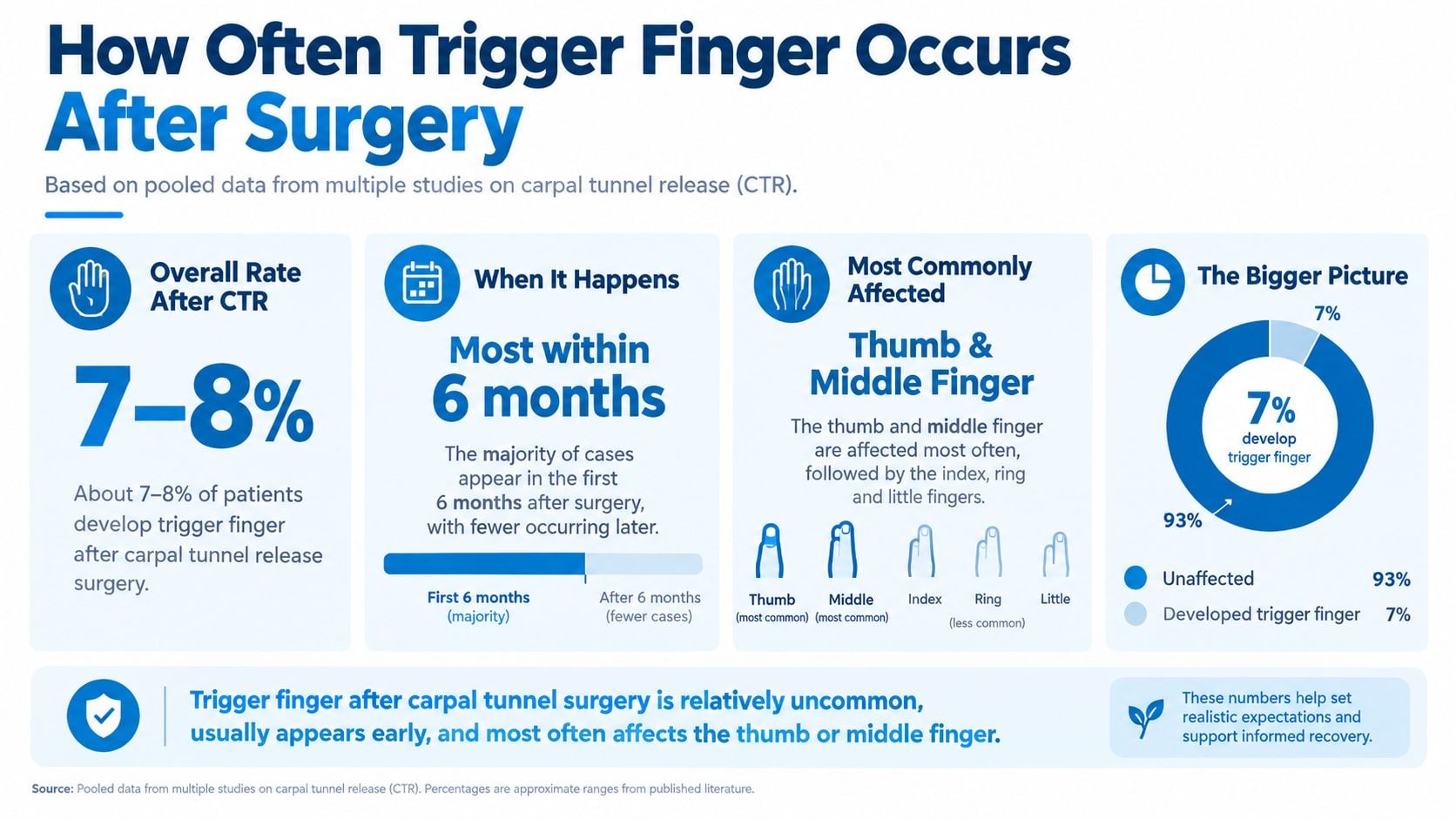
A systematic review and meta-analysis summarized in this pooled analysis of post-CTR trigger finger incidence found a pooled incidence of 7.7% after carpal tunnel release. The same evidence set also reported that carpal tunnel release increased the odds of trigger finger by 2.67 times with 95% CI 2.344–3.043; P<0.001, and women had higher risk with OR 2.02, 95% CI 1.054–3.873; P=0.034. An earlier pooled review in that same source found 483 patients developed trigger digits after 5,654 releases, for an overall incidence of 8.5%, with study rates ranging from 5.2% to 31.7%.
What those numbers mean in plain language
The headline number is roughly 7% to 8.5% overall. The wide range between studies matters just as much. It means risk isn't the same in every clinic, every patient group, or every follow-up period.
A high study number doesn't mean every patient faces that level of risk. It often reflects who was included, how long they were followed, and which associated conditions were present.
When it tends to show up
Timing matters because patients often expect post-surgical problems to appear immediately if they're related. Trigger finger doesn't behave that way. It commonly appears within months.
A retrospective series summarized in this review of carpal tunnel release and trigger digit timing found trigger finger after open release in 31 of 229 patients (13.5%), with thumb triggering most common at 42.22%. Onset was earlier for the trigger thumb, at a mean of 3.5 months, compared with 7.5 months for other digits. Another study in that same review reported ipsilateral trigger fingers in 38 of 556 carpal tunnel release cases, or 6.83%, occurring at an average of 228.1 days after surgery, compared with 2.7% in the nonoperative hand.
When catching begins several months after surgery, that timing still fits the known pattern. It doesn't rule out a connection.
A practical reading of the evidence
Patients can take away three points:
- It's recognized: this isn't just anecdote.
- It's variable: some people are more prone than others.
- It's usually not immediate: symptoms often emerge during recovery rather than on day one.
That variability is why the next question matters more than many articles acknowledge: who is at higher risk?
Why Carpal Tunnel Release May Lead to Trigger Finger
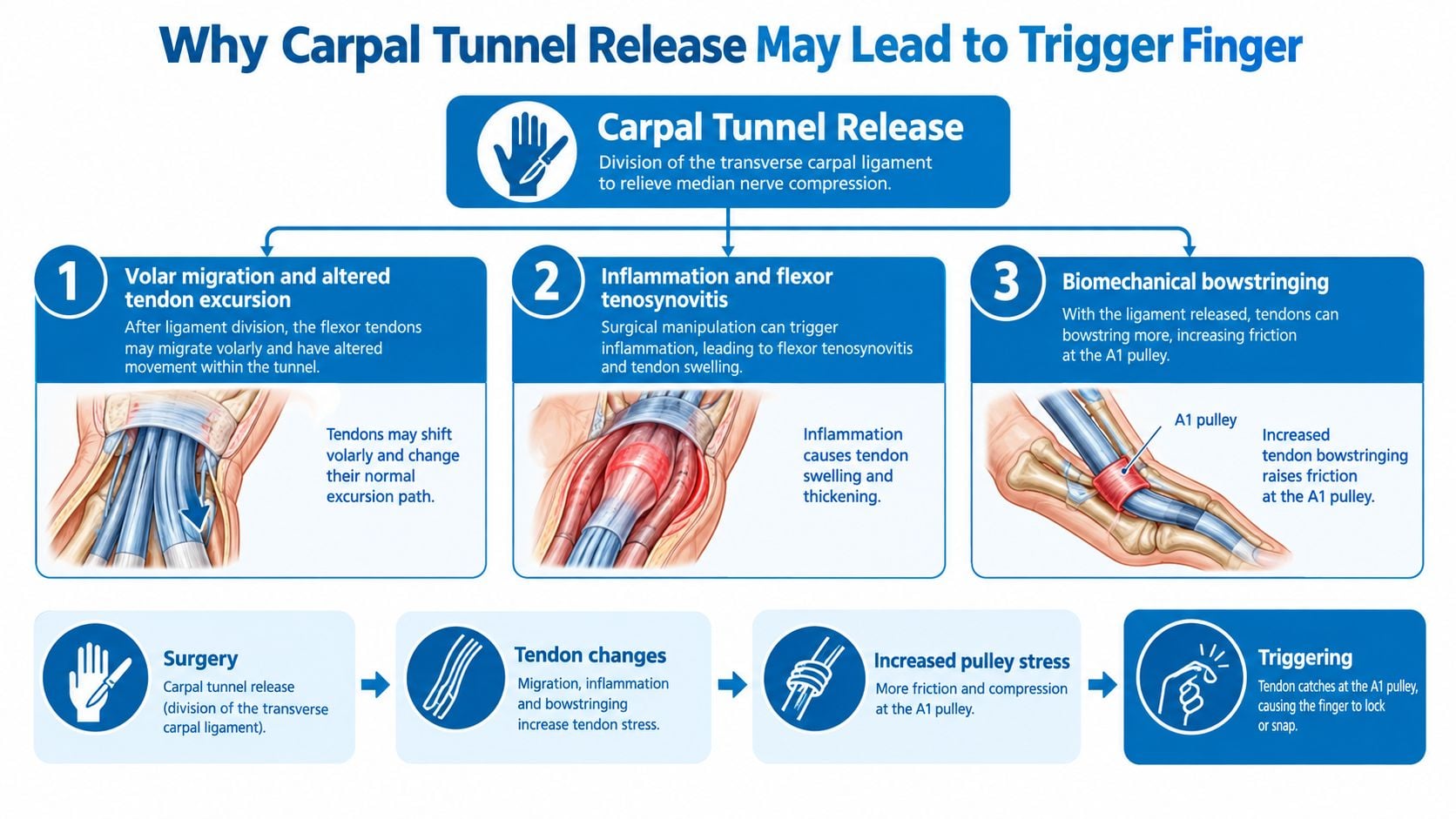
The leading mechanical explanation starts with what surgery changes. In carpal tunnel release, the transverse carpal ligament is divided to decompress the median nerve. That helps nerve symptoms, but it also changes the path the flexor tendons travel.
One observational study discussed in this mechanistic review of trigger finger after release found that trigger finger correlated with greater volar migration of the flexor tendons after release. In plain language, the tendons can shift slightly forward after the tunnel roof is opened. That shift may alter tendon excursion and increase load where the tendon passes through the A1 pulley, which is the place that catches in trigger finger.
The biomechanics in simple terms
A useful analogy is a rope running under guide loops.
If the roof over part of the rope's path is released, the rope may bow forward a bit. The rope still works, but the angle and pressure can change downstream. If one guide loop was already a little tight, the rope may start rubbing there more.
That doesn't mean the surgery was done poorly. It means successful decompression can change force distribution.
Unmasking may be just as important as causing
A second explanation is that surgery doesn't always create a new problem. Sometimes it reveals one that was already brewing.
A population-level study in this PubMed-indexed analysis of trigger finger before and after release found trigger finger was diagnosed in 5.8% of hands in the year after release versus 10.6% in the year before surgery, and the authors concluded that carpal tunnel release did not appear to create a new operative-hand trigger-finger risk so much as reveal an existing predisposition.
A finger that starts triggering after surgery may reflect shared biology plus altered mechanics, not a direct injury from the operation.
Many patient explanations become too simple. The hand that needs carpal tunnel surgery may already be a hand with tendon sheath inflammation, age-related tissue changes, metabolic stress, or osteoarthritic changes. Surgery can change motion enough to make that vulnerability visible.
For readers interested in the broader category of tendon irritation and inflammation, this overview of tendinitis and bursitis helps place tendon-based symptoms in context.
Who Is Most at Risk and What Influences It
Risk isn't evenly distributed. Some patients are more likely to develop post-release trigger finger, and that matters more than a blanket statement that surgery either does or doesn't cause it.
A review summarized in this risk-focused analysis from the International Journal of Surgery reported an overall post-release trigger-finger incidence of 7.7% across more than 9,000 releases, while individual studies ranged from 5.2% to 31.7%. That same source notes several signals clinicians pay attention to: older age, female sex, osteoarthritis, and possible differences by procedure type, with one study finding endoscopic release and osteoarthritis as independent predictors, while another found age increased risk by about 2% per year after open release.
Risk Profile Comparison for Trigger Finger After Carpal Tunnel Release
| Risk Factor | Higher Likelihood Profile | Lower Likelihood Profile |
|---|---|---|
| Sex | Female patients appear to have higher odds in pooled analysis | Male patients appear to have lower odds in pooled analysis |
| Age | Older adults, especially when other hand conditions coexist | Younger adults without other joint or tendon issues |
| Joint health | Osteoarthritis present | No known osteoarthritis |
| Procedure context | Cases where tendon mechanics or technique-related factors may raise risk | Cases without additional identified procedural risk signals |
| Hand history | Prior stiffness, clicking, or multiple hand tendon complaints | No known catching, locking, or pulley symptoms before surgery |
How to use risk information without overreacting
Risk factors help frame follow-up. They don't predict exactly what will happen in one person.
A patient with several risk factors shouldn't assume trigger finger is inevitable. A patient with none of them shouldn't ignore new clicking either. The most useful approach is to combine risk profile with laterality, timing, and specific symptoms.
Three questions often sharpen the discussion at follow-up visits:
- Which hand is involved? The operated side is more suggestive than the opposite side.
- When did the catching start? Symptoms arising during the recovery window deserve attention.
- Which digit is affected? Thumb symptoms often show up earlier than other digits.
Prevention Recognition and Treatment Options
Most patients don't need to do anything dramatic after carpal tunnel release. They do need to pay attention to what the hand is telling them. Early recognition usually makes treatment simpler.
The practical goal is to watch for painful clicking, catching, morning stiffness, or locking at the base of a finger or thumb. If those symptoms appear during recovery, they should be discussed rather than dismissed as normal post-op soreness.
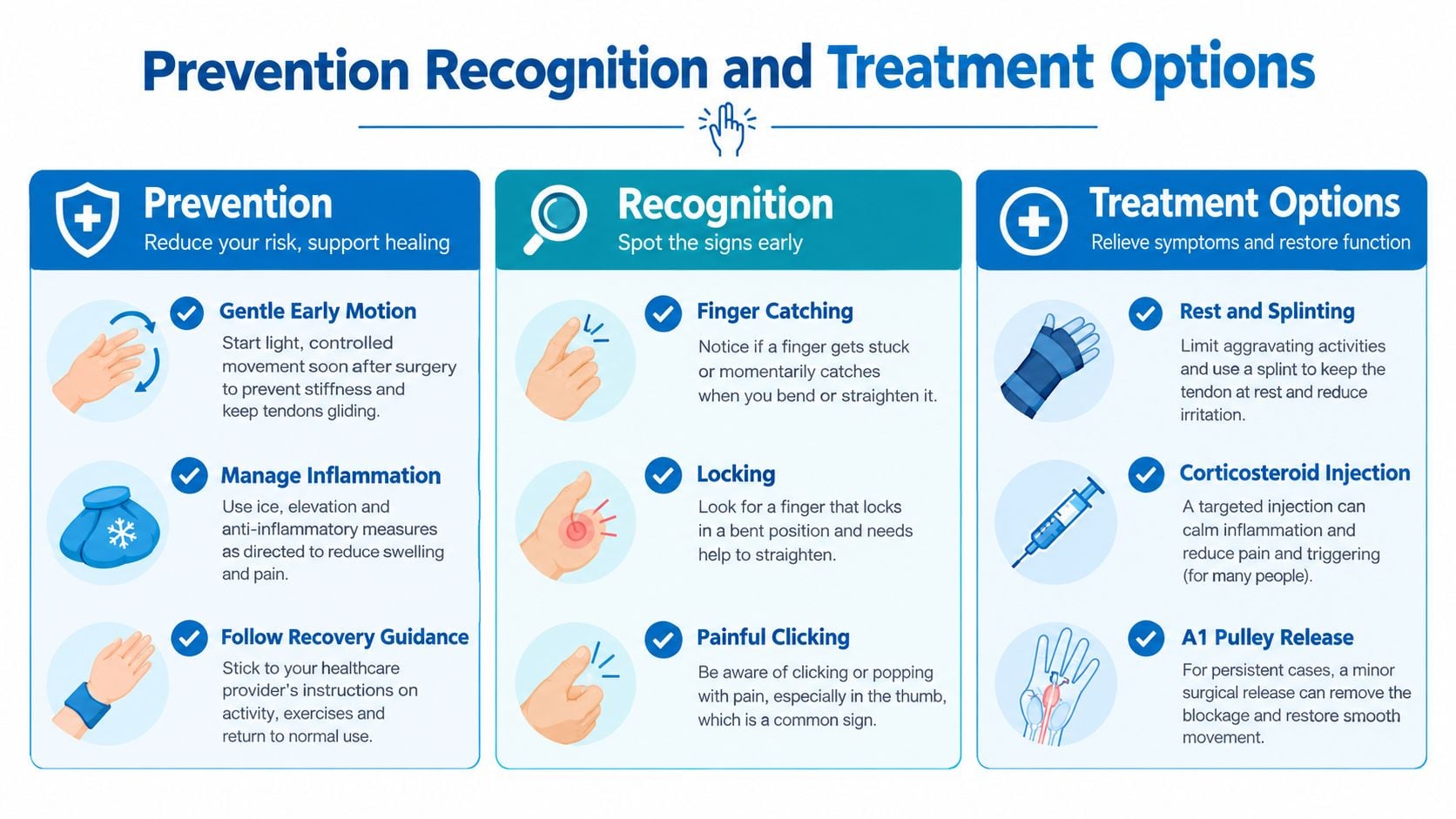
Prevention around surgery
Prevention doesn't mean guaranteeing it won't happen. It means lowering irritation and catching symptoms where possible.
- Gentle motion matters: guided early finger motion can help tendons glide without excessive stiffness.
- Inflammation should be monitored: swelling, overuse, and forceful gripping can aggravate tendon-pulley friction.
- Activity changes help: repetitive gripping and pinching may need to be scaled back during recovery.
Patients who also have joint stiffness or arthritic hand pain sometimes benefit from broader hand-comfort strategies. This resource on effective hand arthritis relief may help readers understand supportive measures that reduce day-to-day strain.
Recognizing the pattern early
The thumb often becomes symptomatic earlier. Other digits may declare themselves later in recovery. The key is the pattern, not just the presence of soreness.
Common signs include:
- A click at the base of the digit when opening the hand.
- Morning stiffness that eases a little with motion.
- A finger that hesitates before fully straightening.
- Locking that requires the other hand to help straighten it.
New numbness points back toward nerve issues. New clicking or locking points more toward a tendon-pulley problem.
Treatment usually moves in steps
Most treatment plans start conservatively and escalate only if symptoms persist.
- Rest and activity modification: useful when symptoms are early and intermittent.
- Splinting: can reduce repetitive catching in selected cases.
- Injection treatment: for many patients, a clinician may consider corticosteroid injections to calm inflammation around the tendon sheath.
- A1 pulley release: if locking persists or conservative care fails, a small release procedure may be appropriate.
In New Jersey and Staten Island, Interventional Pain Management is one option for evaluation when post-operative hand symptoms need coordinated orthopedic and pain-focused assessment.
The most important mistake to avoid is waiting too long after a digit begins locking regularly. A catching finger is easier to address than a finger that has become stiff and functionally limited.
Key Takeaways and When to Seek Care
The most accurate answer to can carpal tunnel surgery cause trigger finger is yes, but not in the simple way many people mean. Trigger finger can show up after release surgery, and the association is established. At the same time, the evidence suggests that many cases reflect a combination of shared predisposition and changed tendon mechanics, rather than a technical mistake or direct damage.
That distinction matters because it changes how patients interpret symptoms. A clicking thumb or locking finger after surgery isn't something to panic about, but it also shouldn't be ignored. It deserves evaluation in the same calm, practical way any new recovery symptom does.
A useful way to prepare for that visit is to track a few details:
- Which digit is involved
- Which hand it's in
- When it started after surgery
- Whether it clicks, catches, or locks
- Whether pain or stiffness is getting worse
Patients should contact a hand specialist promptly if a finger begins locking, if pain at the base of the digit is increasing, or if function is slipping during daily tasks. Assessment usually focuses on the location of tenderness, the motion pattern, and whether symptoms fit tendon catching, recurrent nerve issues, or another hand condition.
With timely care, trigger finger after carpal tunnel release is usually manageable, and most patients can get back to smoother, more comfortable hand use.
Patients in New Jersey and Staten Island who develop clicking, catching, or hand pain after carpal tunnel treatment can seek evaluation through Interventional Pain Management, where orthopedic, pain, and surgical services are coordinated based on the specific problem. Their team evaluates conditions such as carpal tunnel syndrome, post-surgical hand symptoms, and related musculoskeletal issues, then matches care to the patient's diagnosis, function, and recovery needs.