
You know the feeling. The back is stiff before the day even starts, the neck is tight after a long drive, or a hamstring tugs every time someone bends to tie a shoe. In that moment, the temptation is to force a long stretch and hope the tension gives way. Active Isolated Stretching takes a different path, it uses brief, controlled movement to work with the body instead of fighting it.
Table of Contents
- A Gentle Approach to Reclaiming Your Mobility
- Understanding the Core Principles of AIS
- A Step-by-Step Guide to Key AIS Exercises
- How to Build Your Own AIS Routine
- Safety First When Stretching with Pain
- Frequently Asked Questions About AIS
A Gentle Approach to Reclaiming Your Mobility
A common pattern shows up in clinic. A person wakes up stiff, tries to stretch hard through the first few painful seconds, and ends up feeling more guarded afterward. Another person is recovering from a workout or a minor strain and wants movement, but not the kind that leaves the tissue irritated for the rest of the day. Active Isolated Stretching exercises fit that middle ground better than aggressive flexibility work because the method is built around short, repeated, low-load movements.
Why the method matters
A controlled study found that AIS produced statistically significant increases in active range of motion and passive range of motion in the hamstrings, with AROM improving at p < 0.05 and PROM at p < 0.001 (PubMed study on AIS and hamstring range of motion). That doesn't mean every tight area responds the same way, but it does support AIS as a practical mobility tool when the goal is to move more freely without turning the stretch into a strength contest.
For patients with back, neck, or joint pain, the appeal is simple. AIS is usually easier to titrate than a long hold, and the brief reps make it easier to stop before irritation builds. In the right context, that can make a stretch feel more usable, especially early in the day or during recovery after activity.
Practical rule: if a stretch feels like a test of endurance, it's probably no longer AIS.
The best candidates are the people who need mobility but can't tolerate a hard push. That includes many adults with stiffness, but it also includes people who need a more careful approach because of symptoms that flare when they hold one position too long.
Understanding the Core Principles of AIS
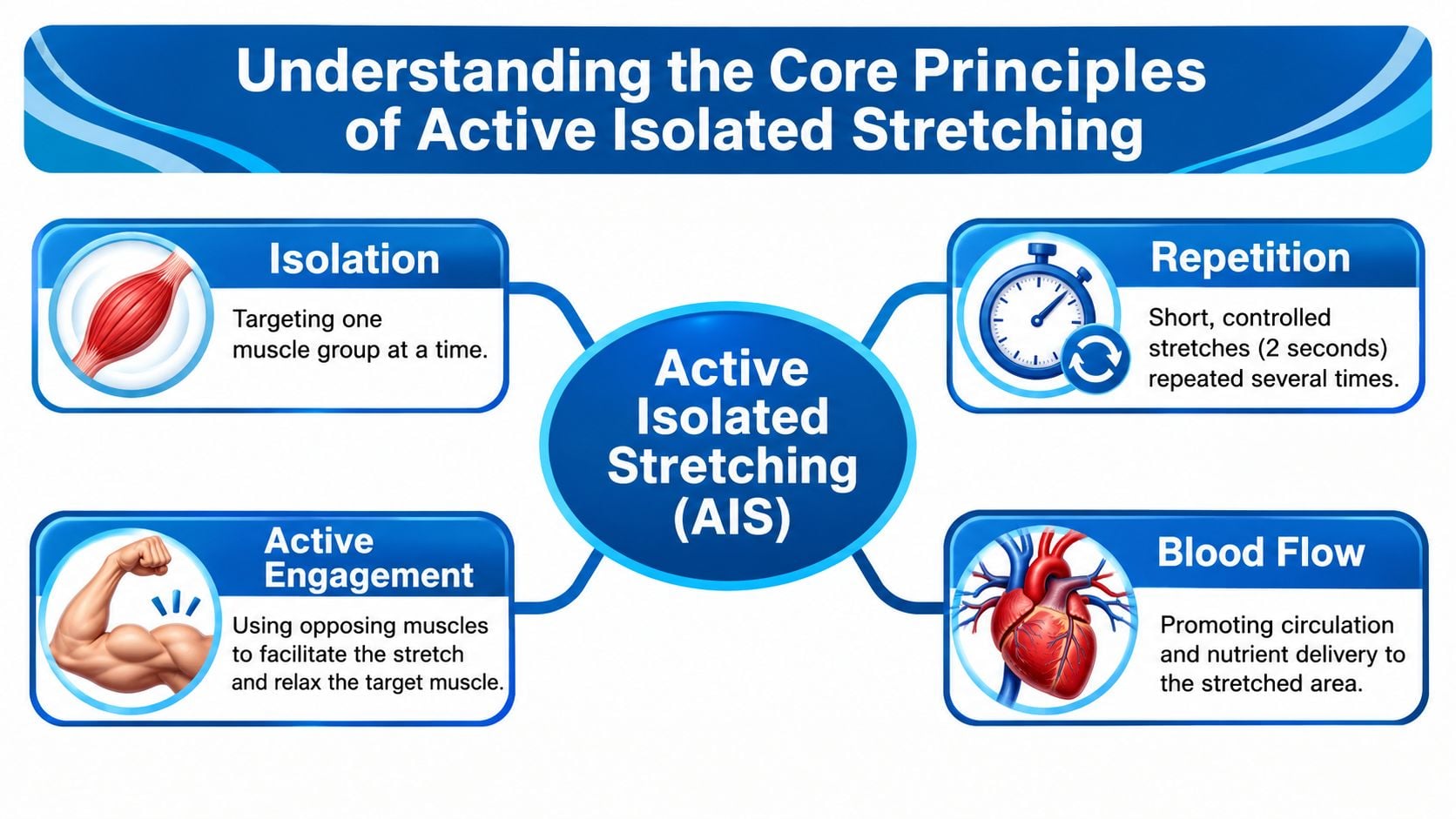
AIS works because it changes the usual stretching equation. Instead of settling into one long hold, the body is moved gently into range, released, then brought back in again. That repeated pattern matters because a scientific review described the optimal AIS stretch as very light, around 2 Nm of torque, with an upper force limit of less than 1 lb and about 4.5 Nm, while static stretching protocols in the literature reached much higher maximal torques, from 26 to 149 Nm (ASEP review on AIS stretch loading). The numbers are a reminder that AIS is a low-load method, not a force-based one.
How the sequence works
The technique is built on controlled sequencing. The target muscle is isolated, the opposing muscle is activated, the body is assisted gently into range, the position is held for no more than 2 seconds, and the motion is repeated. That short hold is central, because the aim is to avoid the body's protective response that often shows up when a stretch is pushed too long or too hard.
Breathing also matters. Smooth exhalation helps keep the movement soft, and a strap, gravity, or a small external assist can make the stretch more reproducible. In a clinical setting, the most common mistake is not a lack of effort, it's too much effort. Jerky movement, bouncing, or heavy passive force can tighten the tissue instead of freeing it.
Clinical cue: stable setup first, then light movement, then repeat. Depth comes later, if it comes at all.
AIS is best understood as a mobility drill with precision. It's not about seeing how far a person can force the tissue, and it's not the same as a long static stretch. For readers trying to connect the method to broader muscle pain management, a related discussion of soft tissue pain patterns is available in this overview of myofascial pain syndrome.
A Step-by-Step Guide to Key AIS Exercises
A good AIS session feels organized, not dramatic. The body is positioned so the target area can move without the spine, pelvis, or rib cage stealing the work. That's where the stretching becomes useful, because the motion stays where it belongs.
Hamstrings
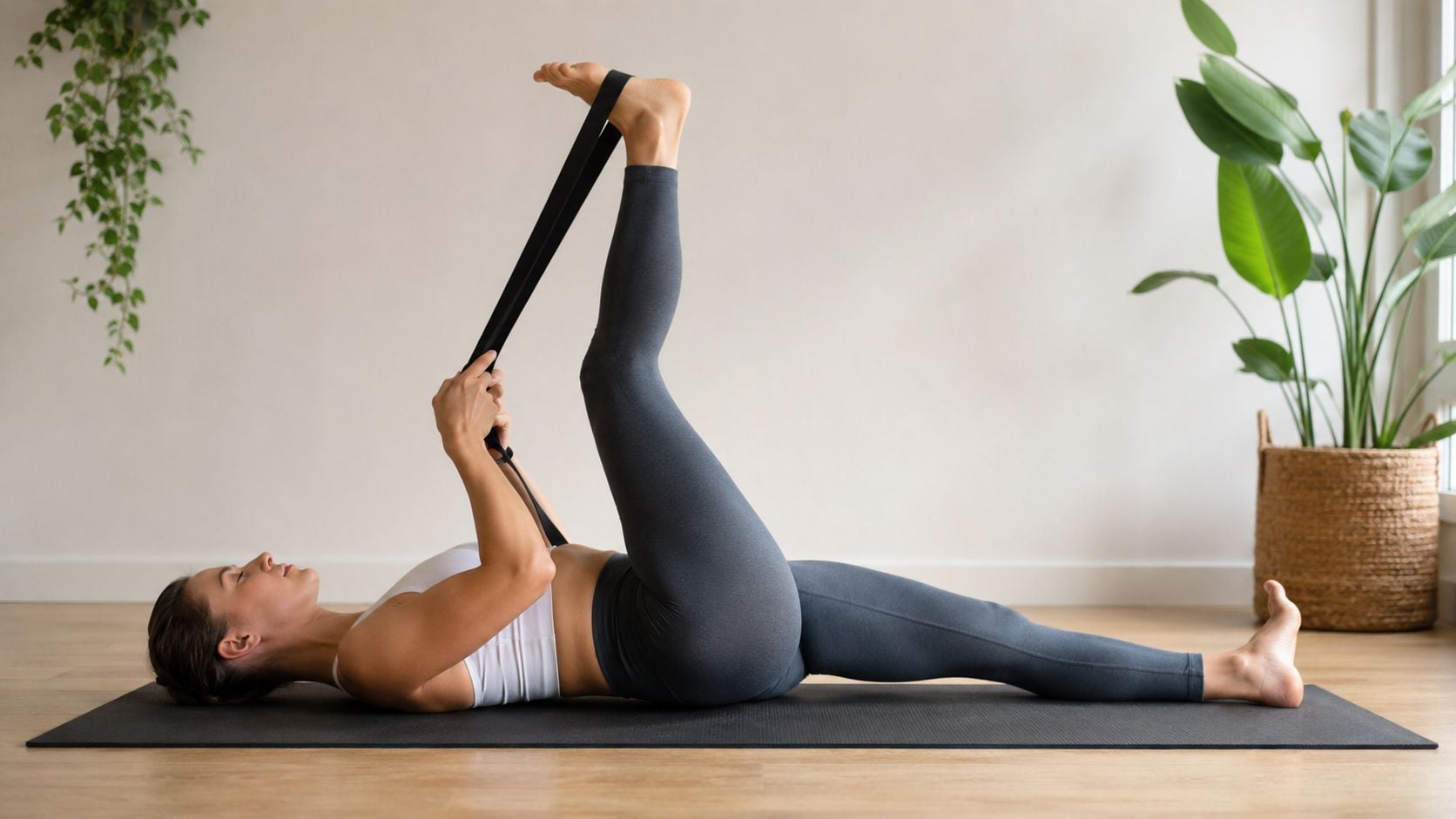
Lie on the back and keep one leg relaxed while the other lifts with control. The quad on the lifting side does the work, and the leg should rise only until a gentle stretch appears behind the thigh. Hold briefly, release, and repeat with the same easy rhythm.
The most common error here is pulling the leg so high that the pelvis rolls or the low back arches. That turns a hamstring stretch into a spine compensation pattern. A strap can help keep the motion smooth, especially for people who can't comfortably reach the ankle.
Hip flexors
A half-kneeling setup usually works well, as long as the trunk stays upright. The glute on the kneeling side lightly engages to shift the pelvis forward, then the stretch is released before the low back takes over. This should feel controlled, not like a deep lunge.
Shoulders and upper back
For shoulder work, the torso needs to stay still enough that the arm, not the trunk, creates the stretch. A small assist from the opposite hand or a strap can guide the arm through range without jerking. If the neck starts bracing, the setup is too aggressive.
Lower back and trunk
Trunk movements should be especially conservative in people with pain. The goal is small, smooth motion with the pelvis and rib cage organized, not a side bend or twist that collapses into the spine. When the lower back is sensitive, the best stretch is often the one that looks almost too small to matter.
A useful reminder from practitioner guidance is that AIS should follow the same sequence every time, isolate, activate the antagonist, assist gently, hold no more than 2 seconds, then repeat for about 8 to 12 repetitions while keeping the core stable (practical AIS guidance). For patients who need careful progressions around tendon or bursa irritation, a related overview is available in this guide to tendinitis and bursitis.
Form check: if the movement gets bigger because the body is twisting, bracing, or bouncing, the stretch has already lost its purpose.
How to Build Your Own AIS Routine
AIS works best when it's matched to a clear goal. A morning routine should be short and forgiving, a warm-up should wake up the hips and shoulders without fatigue, and a recovery sequence should feel even lighter. The same exercise can fit all three roles, but the dose and intent should change.
| Routine Goal | Target Areas | Suggested Exercises (Sets x Reps) | Frequency |
|---|---|---|---|
| Morning stiffness relief | Hamstrings, hip flexors, upper back | 1 set of 8 to 12 controlled reps per area | As needed in the morning |
| Pre-workout warm-up | Hips, shoulders, calves | 1 set of 8 to 10 controlled reps per area | Before activity |
| Post-activity recovery | Hamstrings, hip flexors, trunk | 1 to 2 gentle sets of 8 to 12 reps | After training or demanding days |
| Ultra-gentle rehab style routine | The specific region cleared by a clinician | Small-range, low-effort reps only | Only as prescribed |
A person who just wants to loosen up before breakfast might spend a few minutes on the hamstrings and hip flexors, then stop. Someone preparing for exercise can use AIS as a bridge into movement, not a replacement for warm-up. In a recovery context, the session should be calmer still.
For readers who like to pair mobility work with broader body preparation, a useful reference point is top vinyasa and hot yoga options, but AIS remains its own method, focused on brief isolation and repeated control rather than sustained holds. That distinction matters for people who flare with longer stretches.
Routine rule: match the stretch to the day's demand. Stiffness, workout prep, and recovery should not get the same dosage.
People recovering from procedures should not guess. The safest version of AIS in that setting is the one the surgeon, physical therapist, or pain clinician has already cleared.
Safety First When Stretching with Pain
Pain changes the rules. A stretch that would be reasonable for a healthy hamstring can be a poor choice for someone with sciatica, spinal stenosis, radicular symptoms, or a fresh surgical repair. That's why the clinical gap around AIS matters so much, because repeated end-range movement, even when gentle, can stress irritated neural tissue if screening and modification are missing (clinical caution on AIS and spine or nerve pain).
When to pause or avoid AIS
AIS should not be used as a self-directed experiment when symptoms are sharp, shooting, numb, or getting weaker. Those patterns suggest the issue may be more than stiffness, and stretching through them can delay evaluation. The same caution applies when pain spreads, changes character, or gets worse after each rep instead of settling.
Red flags also include symptoms that feel electric, burning, or unstable around the spine or limb. Those signs need clinical screening, especially if there's a history of surgery, nerve irritation, or chronic spinal disease. A controlled movement routine is not a substitute for a medical workup when the tissue response is suspicious.
How to modify the approach
For someone who has been cleared to stretch, the safest version is the smallest one that still feels controlled. The range should stay below the point where guarding starts, and the motion should stop before the body begins to brace. A clinician may also limit which regions are stretched, because not every painful area should be addressed directly.
The general safety rules are straightforward.
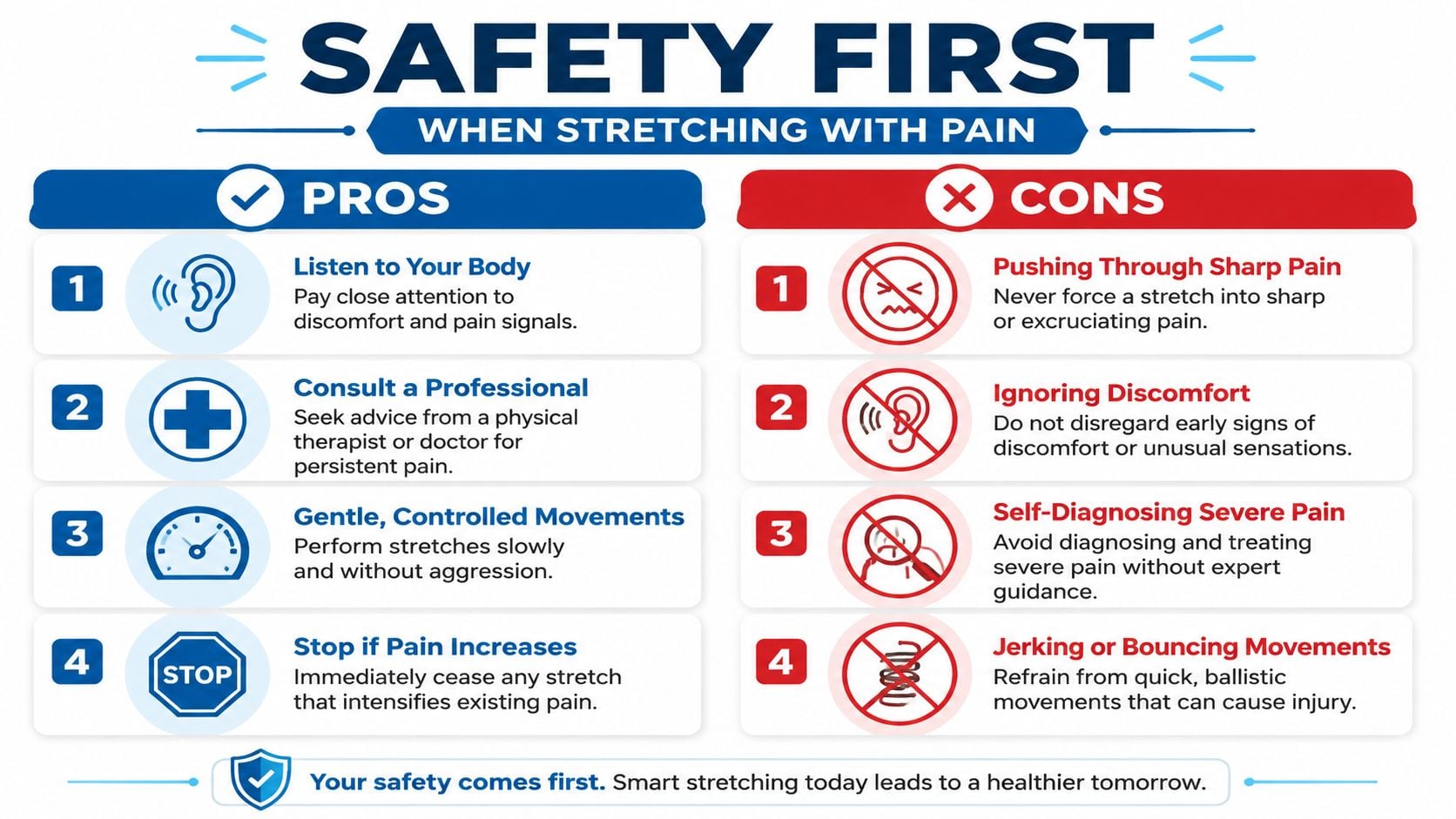
- Listen to body signals: discomfort that rises with each repetition is a warning, not a cue to push further.
- Use gentle movement only: if a rep feels forced, the setup needs to change.
- Stop when pain increases: pain that escalates during the set means the stretch is no longer helpful.
- Get medical guidance early: persistent back, neck, nerve, or post-surgical pain deserves a professional exam.
For people whose pain patterns have become complicated, Interventional Pain Management can evaluate the source of the symptoms and help determine whether stretching belongs in the plan at all. That kind of triage matters more than any single technique.
Non-negotiable: sharp pain, numbness, or worsening weakness means stop, not modify and continue.
Frequently Asked Questions About AIS
AIS is usually best as a brief, repeatable practice rather than a long session. The amount of work should match the goal, with just enough reps to create motion without provoking irritation. A strap can help, but it isn't mandatory if the body can stay controlled without one.
The difference between a productive stretch and pain is fairly simple. A productive stretch feels local, mild, and under control, while pain tends to sharpen, spread, or trigger guarding. If breathing changes because the body is bracing, the stretch has crossed the line.
Is AIS better than static stretching? Not universally. Systematic reviews of stretching literature do not establish AIS as clearly superior to static stretching for flexibility gains in most adults, so it's better to think of AIS as one effective option among many rather than a magic answer (stretching review discussion).
For the right person, that's still valuable. AIS offers a controlled way to practice mobility without long holds, which is exactly why it's often useful in people who need caution as much as flexibility.
If back, neck, or joint pain is limiting movement, Interventional Pain Management can help sort out whether the problem is muscular, joint-related, nerve-related, or post-surgical, then build a treatment plan around that diagnosis. Visit Interventional Pain Management to learn how clinical evaluation, pain procedures, and rehabilitation guidance can fit together when stretching alone isn't enough.