
The shoulder often doesn't freeze all at once. It starts with a nagging ache when reaching into the back seat, fastening a bra, pulling on a jacket, or lifting a bag into the car. Then sleep becomes difficult. Then simple movements feel blocked, not just painful. By the time many people look for help, they're no longer asking, “Did I sleep on it wrong?” They're asking, “Why can't I move my arm?”
That pattern is common in Frozen Shoulder, also called adhesive capsulitis. It can feel alarming because the stiffness seems out of proportion to any obvious injury. The good news is that it's a recognized condition with a typical course, and individuals typically improve. The part that often gets missed is timing. Waiting too long to escalate care can make recovery slower and harder than it needs to be.
Table of Contents
- That Nagging Shoulder Pain Might Be More Than a Strain
- Understanding Frozen Shoulder and Its Causes
- The Three Stages of Frozen Shoulder Explained
- How We Diagnose Frozen Shoulder at IPM Health
- Comparing Your Treatment Options From Injections to Surgery
- Recovery Expectations and Life After Treatment
- Frequently Asked Questions About Frozen Shoulder
That Nagging Shoulder Pain Might Be More Than a Strain
A very typical story goes like this. A person notices shoulder pain after a minor strain, a period of inactivity, or no clear trigger at all. At first, it seems manageable. Then reaching overhead gets harder. Turning the arm outward feels sharply limited. Eventually, even getting dressed or sleeping on that side becomes frustrating.

That pattern often points to Frozen Shoulder, not a simple pulled muscle. It's common enough that clinicians see it regularly, especially in adults who are surprised by how quickly daily function can change. According to lifetime prevalence and risk patterns described here, Frozen Shoulder affects approximately 2% to 5% of the general population over a lifetime, rises to 10% to 20% in people with diabetes, appears most often between 40 and 60 years old, and women account for about 70% of clinical presentations.
Why patients often dismiss it at first
Early Frozen Shoulder can mimic several other problems. People may assume it's bursitis, tendinitis, overuse, poor posture, or a gym injury that just needs rest. The trouble is that rest alone often doesn't solve it, and prolonged guarding can make the stiffness worse.
Common clues include:
- Pain with ordinary tasks like reaching for a shelf, fastening a seatbelt, or tucking in a shirt
- Loss of motion in multiple directions, especially turning the arm outward
- Night pain that interrupts sleep and leaves the shoulder feeling constantly irritable
- A gradual progression rather than one dramatic injury
Practical rule: If shoulder pain is steadily turning into shoulder stiffness, and both active movement and assisted movement feel limited, it's time to think beyond a strain.
Why this deserves attention early
Frozen Shoulder is treatable, but timing matters. The most effective plan depends on where the shoulder is in its course. Some people do well with home stretching and medication. Others benefit from targeted physical therapy, image-guided injections, or a more structured escalation plan before the shoulder becomes stiff.
The key is to stop guessing. A careful diagnosis can confirm whether this is Frozen Shoulder and, just as important, whether it's still early enough to intervene before the stiffness becomes harder to reverse.
Understanding Frozen Shoulder and Its Causes
Frozen Shoulder happens when the capsule around the shoulder joint becomes inflamed and then tightens. A useful way to picture it is shrink-wrap around a ball-and-socket joint. As that capsule thickens and contracts, movement becomes restricted in a very specific pattern.
The biology behind that tightening isn't just “wear and tear.” According to the pathophysiology summary in StatPearls, Frozen Shoulder is driven by an immune-mediated inflammatory cascade with overexpression of cytokines such as IL-1, IL-6, and TNF-α, which then leads to capsular fibrosis and contracture. That process produces a hallmark 50 to 70% loss of passive and active external rotation motion.
What the pain and stiffness actually mean
In the painful phase, inflammation is usually the louder signal. The shoulder aches, sharpens with movement, and often hurts at night. As the condition evolves, fibrosis becomes more dominant. That's when many patients notice something important: pain may ease somewhat, but the shoulder still won't move.
This difference matters because treatment should match the problem in front of the patient. A highly inflamed shoulder isn't managed the same way as a mostly stiff shoulder.
Primary and secondary Frozen Shoulder
Clinicians often think about Frozen Shoulder in two broad categories:
-
Primary Frozen Shoulder
This develops without one clear event. The shoulder gradually becomes painful and stiff, seemingly out of nowhere. -
Secondary Frozen Shoulder
This follows another issue, such as surgery, injury, or a period of immobilization. Sometimes the shoulder starts to freeze because it hasn't been moved enough after another painful condition. -
Systemic contributors
Diabetes has a particularly strong association. Other medical conditions can also shape risk and recovery, which is why a full history matters.
Some people initially assume they have an overuse problem such as tendinitis or bursitis care options. That overlap is one reason self-diagnosis can be misleading. Tendon and bursa problems can hurt with motion, but Frozen Shoulder stands out because the joint capsule itself becomes restricted.
The shoulder doesn't just hurt. It stops cooperating.
Why risk factors matter
Risk factors don't guarantee the diagnosis, but they raise suspicion. Middle age, female sex, diabetes, prior immobilization, and recent surgery all make Frozen Shoulder more likely in the right clinical setting. That background helps explain why two people with similar shoulder pain may need very different treatment plans.
Understanding the cause also helps patients avoid one common mistake. They often keep trying to “push through” with random exercises from the internet. If the capsule is inflamed and tightening, aggressive unsupervised stretching can flare symptoms instead of helping.
The Three Stages of Frozen Shoulder Explained
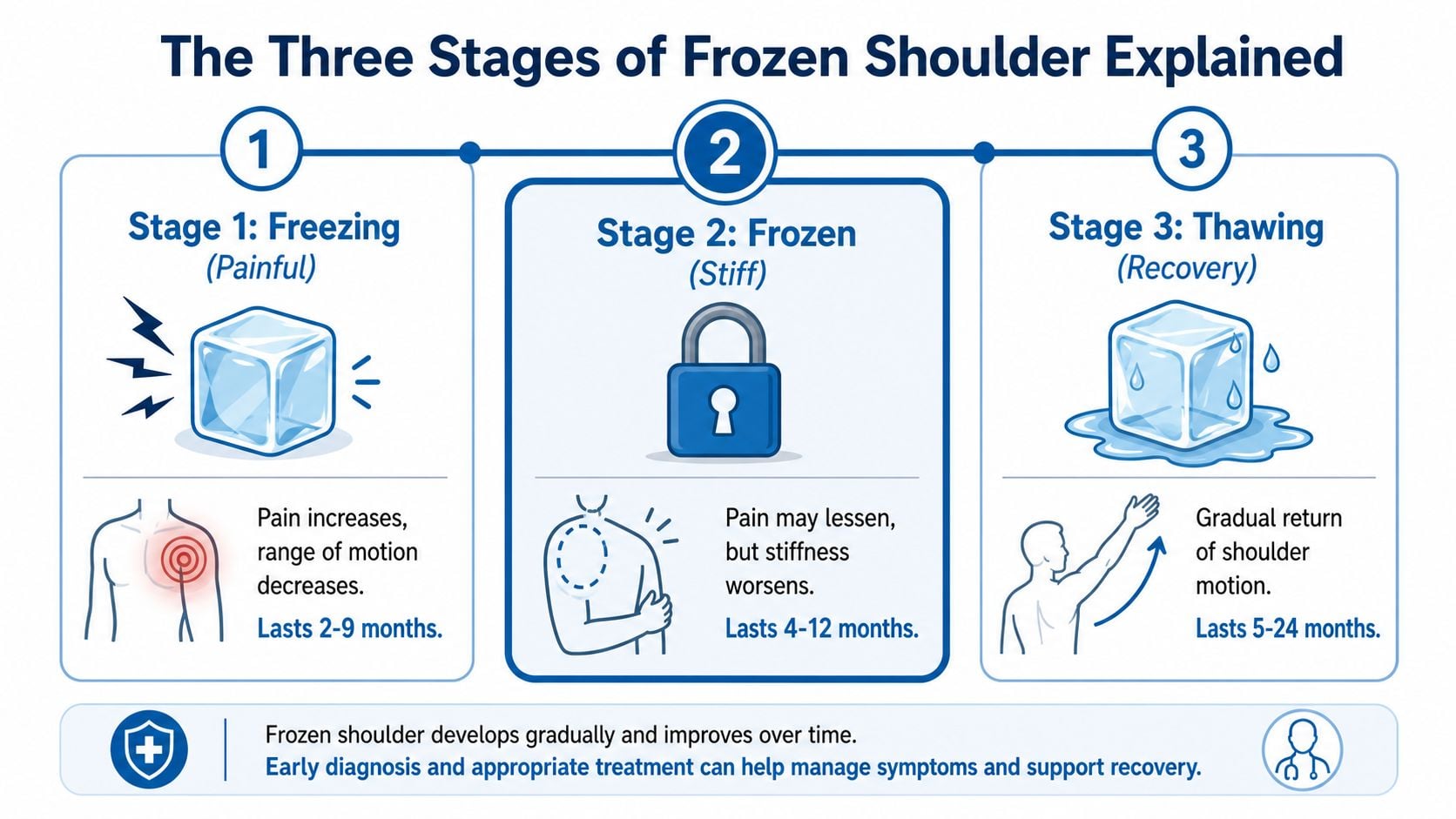
Frozen Shoulder usually follows a recognizable sequence. Knowing the stage helps explain why the shoulder feels the way it does and why recommendations change over time. According to this clinical overview of disease progression, the condition moves through three overlapping phases: a freezing phase lasting 2 to 9 months, a frozen phase where pain may lessen while stiffness worsens, and a thawing phase with gradual return of motion over a total natural history of 1 to 3 years.
Freezing stage
This is the phase that catches people off guard. Pain builds gradually, then starts dictating behavior. Sleep suffers. Reaching becomes unpredictable. Patients often say the shoulder feels both sore and “stuck.”
Typical features include:
- Pain first, stiffness second
- Night waking
- Sharp pain at the end of motion
- Growing hesitation to use the arm
This is also the stage where timing-sensitive treatment decisions matter most.
Frozen stage
The shoulder often becomes less dramatically painful here, but everyday function may worsen. The problem is no longer just pain with movement. It's the absence of movement.
A person may be able to tolerate the shoulder better at rest, yet still struggle with:
- Putting on a coat
- Washing hair
- Reaching behind the back
- Lifting the arm away from the body
That trade-off confuses patients. They assume less pain means improvement, but function may still be highly restricted.
A quieter shoulder isn't always a better shoulder. Sometimes it's simply a stiffer one.
Thawing stage
This is the recovery phase. Motion gradually returns, often slowly enough that progress is easiest to notice over weeks rather than days. The shoulder starts to respond better to stretching, and activities become less guarded.
A simple way to think about the stages is this:
| Stage | What dominates | What patients notice most |
|---|---|---|
| Freezing | Inflammation and pain | Sleep disruption and painful movement |
| Frozen | Capsular stiffness | Major loss of mobility |
| Thawing | Gradual remodeling | Slow return of motion |
Why stage matters for treatment
The same exercise program doesn't fit every stage. In the early phase, pain control and preserving motion usually take priority. In the middle phase, treatment focuses more on restoring mobility without provoking major flares. In the thawing phase, stretching tolerance often improves, and that changes what home care can realistically accomplish.
This is why “just wait it out” is incomplete advice. Some waiting is part of the natural course. Passive waiting without a stage-specific plan often leads to unnecessary disability.
How We Diagnose Frozen Shoulder at IPM Health
A proper diagnosis starts with the story. How the pain began, whether there was surgery or injury, whether sleep is disrupted, and which movements are blocked all matter. Frozen Shoulder is often suspected before any imaging is ordered because its pattern is so characteristic.

The exam matters more than the scan
The key physical finding is loss of both active and passive range of motion. In plain terms, the patient can't move the shoulder normally, and the clinician can't move it normally either. External rotation is usually the clearest giveaway.
That distinction helps separate Frozen Shoulder from problems where pain limits motion but the joint itself isn't mechanically tight. For readers who want a practical overview of how clinicians think about joint mobility, mastering range of motion measurement gives helpful background.
What imaging is for
X-rays or advanced imaging may still be useful, but usually not because they “show” Frozen Shoulder directly. Their role is often to rule out other conditions such as arthritis, fracture, calcific changes, or a significant rotator cuff problem that changes the plan.
The diagnostic process typically includes:
-
History
Onset, progression, prior injury, surgery, diabetes, and the impact on sleep and daily tasks -
Focused shoulder exam
Comparison of active and passive motion, especially external rotation and elevation -
Selective imaging
Used when another diagnosis needs to be excluded or when symptoms don't fit the typical pattern
Clinical focus: The most important question isn't just “Does the shoulder hurt?” It's “Is the joint capsule functionally restricted?”
Why expertise changes the plan
Frozen Shoulder can overlap with several shoulder disorders. A rushed visit may label all shoulder pain the same way, which leads to treatment that's either too passive or aimed at the wrong structure. A more complete evaluation helps determine whether the patient needs time, therapy, an injection, or referral for more advanced intervention.
Patients looking into credentials and multidisciplinary care can review the physician team at IPM Health. That kind of coordinated evaluation is especially helpful when the diagnosis is straightforward clinically but the treatment path is not.
Comparing Your Treatment Options From Injections to Surgery
Individuals often do not require surgery first. What they need is the right treatment at the right phase. That sounds simple, but it's where many care plans go off course. Some patients are told to wait too long with home care that isn't working. Others are pushed into overly aggressive therapy while the shoulder is still highly inflamed.
The most useful way to think about treatment is as a ladder. Each step has a role. The decision depends on pain level, stiffness, function, stage, and how much progress the shoulder is making.
The timing issue most patients never hear
One of the most important facts about Frozen Shoulder is that timing can change the result. According to the timing-specific treatment guidance summarized here, there's a critical 3 to 6 month window in which corticosteroid injections can significantly improve long-term mobility compared with delayed treatment. The same source notes that early hydrodilatation or distension injections during the freezing phase can reduce the need for surgical release in refractory cases by up to 40%.
That doesn't mean every painful shoulder needs an injection immediately. It means persistent early Frozen Shoulder shouldn't be left to drift for months without reassessment.
The treatment ladder
Some patients improve with a simple program. Others need escalation because pain is preventing useful therapy or stiffness is progressing despite solid effort.
Home care and activity modification
This is the starting point for many people. It usually includes stage-appropriate stretching, avoiding forceful painful motions, and using the shoulder in daily life without repeatedly provoking it. Home care helps, but it has limits. If pain is climbing and motion is falling, home care alone may stop being enough.
Physical therapy
Therapy works best when it's targeted and realistic. In early painful cases, the job is often to preserve motion and calm irritability, not to force dramatic gains. In later stiff cases, the emphasis shifts toward gradual capsular stretching and functional recovery.
Medication support
Nonprescription or prescribed anti-inflammatory medication may help some patients tolerate movement better. It can reduce suffering, but it usually doesn't solve the underlying restriction by itself.
Image-guided corticosteroid injection
This is often the most useful escalation when inflammation is dominant and progress is stalled. The goal isn't to replace therapy. It's to lower pain enough that therapy becomes productive again. Patients considering this option can learn more about corticosteroid injection treatment.
Hydrodilatation or distension injection
This approach aims to expand the tight capsule while also addressing inflammation. It's most compelling when used early enough to influence the course, rather than after many months of entrenched stiffness.
Nerve-focused pain procedures
In select cases, nerve-targeted interventions may help when pain is severe and limiting participation in rehabilitation. These aren't first-line for everyone, but they can be useful in carefully selected patients.
A helpful visual reference for movement-based support is this image on osteopathic support for back and shoulder. The key point is that hands-on and movement-based care work best when the shoulder is ready for them.
Frozen Shoulder Treatment Comparison
| Treatment | Goal | Best For Stage | Invasiveness | Recovery |
|---|---|---|---|---|
| Home stretching and activity changes | Maintain function and reduce guarding | Early mild symptoms, later maintenance | Low | Gradual, depends on consistency |
| Physical therapy | Restore motion and improve mechanics | All stages when matched to irritability | Low | Ongoing, progressive |
| Medication support | Reduce pain enough to keep moving | Pain-dominant periods | Low | Short-term symptom relief |
| Corticosteroid injection | Calm inflammation and improve therapy tolerance | Freezing stage, especially when pain blocks progress | Minimally invasive | Often paired with prompt rehab |
| Hydrodilatation | Address tight capsule and reduce progression | Early freezing stage or refractory stiffness | Minimally invasive | Requires follow-through with mobility work |
| Surgery | Release severe persistent capsular restriction | Refractory cases after failed nonsurgical care | More invasive | Requires structured rehab afterward |
What works and what usually doesn’t
The biggest treatment mistake is mismatch. A severely inflamed shoulder usually won’t respond well to brute-force stretching. A severely stiff shoulder usually won’t recover from rest alone.
In practical terms:
- Works better when the plan matches the stage and the patient follows through with mobility work
- Works poorly when treatment is delayed for too long despite clear loss of motion
- Works poorly when care stops after an injection and the shoulder is never retrained
- Works poorly when pain is ignored and therapy becomes intolerable
When surgery enters the conversation
Surgery is usually reserved for stubborn cases that fail a structured course of conservative and interventional care. It can be effective, but it isn’t a shortcut around rehabilitation. If the shoulder capsule is released but postoperative motion work doesn’t happen, the gain can be lost.
That’s why the best strategy is usually earlier recognition, stage-specific treatment, and timely escalation before the shoulder becomes an entrenched surgical problem.
Recovery Expectations and Life After Treatment
Patients often want one answer to the question, “How long until this is normal again?” Frozen Shoulder rarely gives a neat answer. Recovery tends to be gradual, with progress measured in sleep quality, easier dressing, better reach, and less guarding before it shows up as fully normal motion.

What to expect after treatment
An injection may reduce pain and improve tolerance for therapy, but it doesn’t automatically restore full mobility by itself. A procedure can open a window. The patient still has to use that window well through guided motion and regular follow-through.
After any meaningful treatment, recovery usually depends on three things:
-
Consistency with stretching
The capsule needs repeated, sensible mobility work over time. -
Not overreacting to every sore day
Some fluctuation is normal. Temporary soreness doesn’t always mean harm. -
A plan that evolves
The exercises that fit a very painful shoulder aren’t the same as the exercises that fit a thawing one.
Therapy is not optional
This is the part many people underestimate. Whether the patient had conservative care, an image-guided injection, or surgery, physical therapy and home mobility work are central to the outcome.
Improvement usually comes from the combination of pain relief and restored movement, not from either one alone.
Functional milestones matter more than perfection
Many patients judge recovery only by whether the shoulder feels exactly like the other side. That’s understandable, but it’s not the only measure that matters. Better sleep, easier hygiene, less pain while driving, and more confidence using the arm are meaningful signs that treatment is working.
Common goals include:
- Sleeping with fewer interruptions
- Reaching overhead with less hesitation
- Improved behind-the-back motion
- Returning to work tasks and exercise with modifications as needed
Life after the stiff phase
As motion returns, the focus shifts from just moving the shoulder to moving it well. Patients may need to rebuild coordination and strength after months of guarding. That takes patience, but many individuals can return to ordinary activities with a structured plan and realistic expectations.
The most important mindset is simple. Recovery is rarely instant, but steady progress counts. A shoulder that’s moving better month by month is usually on the right path, even if it still has work to do.
Frequently Asked Questions About Frozen Shoulder
Can Frozen Shoulder go away on its own
Sometimes it can. The condition often improves over time, but “on its own” can still mean a long period of pain, sleep loss, and restricted function. However, some patients miss the period when earlier intervention could make recovery smoother. If the shoulder is steadily worsening, passive waiting isn’t always the best strategy.
When should someone see a specialist
A specialist evaluation makes sense when pain is persistent, sleep is affected, range of motion is clearly shrinking, or home exercises aren’t helping. It’s especially important when daily tasks are becoming difficult or the person has risk factors such as diabetes. A diagnosis made early gives more room for useful nonoperative treatment.
Should the shoulder be pushed hard to break the stiffness
Usually not. Forced stretching at the wrong stage can make an already irritated shoulder even harder to treat. The better approach is stage-specific progression. Pain control and guided mobility come first. Intensity comes later, when the shoulder is ready.
Is heat or ice better
This is one of the most confusing parts of home care because generic advice tends to blur the stages together. According to this treatment guidance on stage-specific heat and ice use, recent data from 2024 to 2025 shows that applying heat during the thawing phase (5 to 24 months) enhances tissue elasticity and stretching success, while ice is only beneficial immediately after physiotherapy sessions to reduce acute inflammation.

A practical way to use that information is:
- Use heat when the shoulder is in the more stiffness-dominant recovery phase and stretching tolerance is the goal
- Use ice after therapy if the joint feels acutely irritated
- Don’t assume one rule fits every stage
What is the next step if Frozen Shoulder is suspected
The next step is a proper shoulder evaluation that identifies whether this is Frozen Shoulder, which stage it appears to be in, and whether the current approach is still appropriate. Patients who’ve been trying to manage it alone for weeks or months often benefit most from clarifying that timing question. Is this still a home-care problem, or has it become an injection-and-rehab problem?
If shoulder pain is turning into stiffness, waiting longer may not help. Interventional Pain Management & Ortho-Spine Center offers evaluation and treatment for joint pain, including image-guided options and coordinated orthopedic care, so patients in New Jersey and Staten Island can get a clear diagnosis and a plan that fits the stage of recovery.