
The appointment is on the calendar, the procedure sounds straightforward, and then one question keeps returning: what could go wrong with a nerve block? A patient may hear about numbness, weakness, bleeding, infection, or even nerve damage and wonder whether normal recovery will feel like a complication. The most useful answer isn't a list of frightening possibilities. It's a clear way to separate the intended effects, minor temporary events, and symptoms that need prompt medical attention.
Nerve blocks are used for surgical anesthesia, postoperative pain, and chronic pain treatment. Serious problems are uncommon, but no injection is risk-free. Understanding where risk enters, how block type changes the risk profile, and what recovery should look like helps patients make decisions without either dismissing warning signs or assuming every unusual sensation means permanent injury.
Table of Contents
- What Counts as a Nerve Block Complication
- How Often Nerve Block Complications Happen
- The Four Main Categories of Nerve Block Complications
- How a Nerve Block Is Performed and Where Risk Enters
- Warning Signs and How Complications Are Managed
- Why Complication Rates Differ by Block Type
- Long-Term and Delayed Symptoms After a Nerve Block
- Practical Steps to Lower Your Risk
What Counts as a Nerve Block Complication
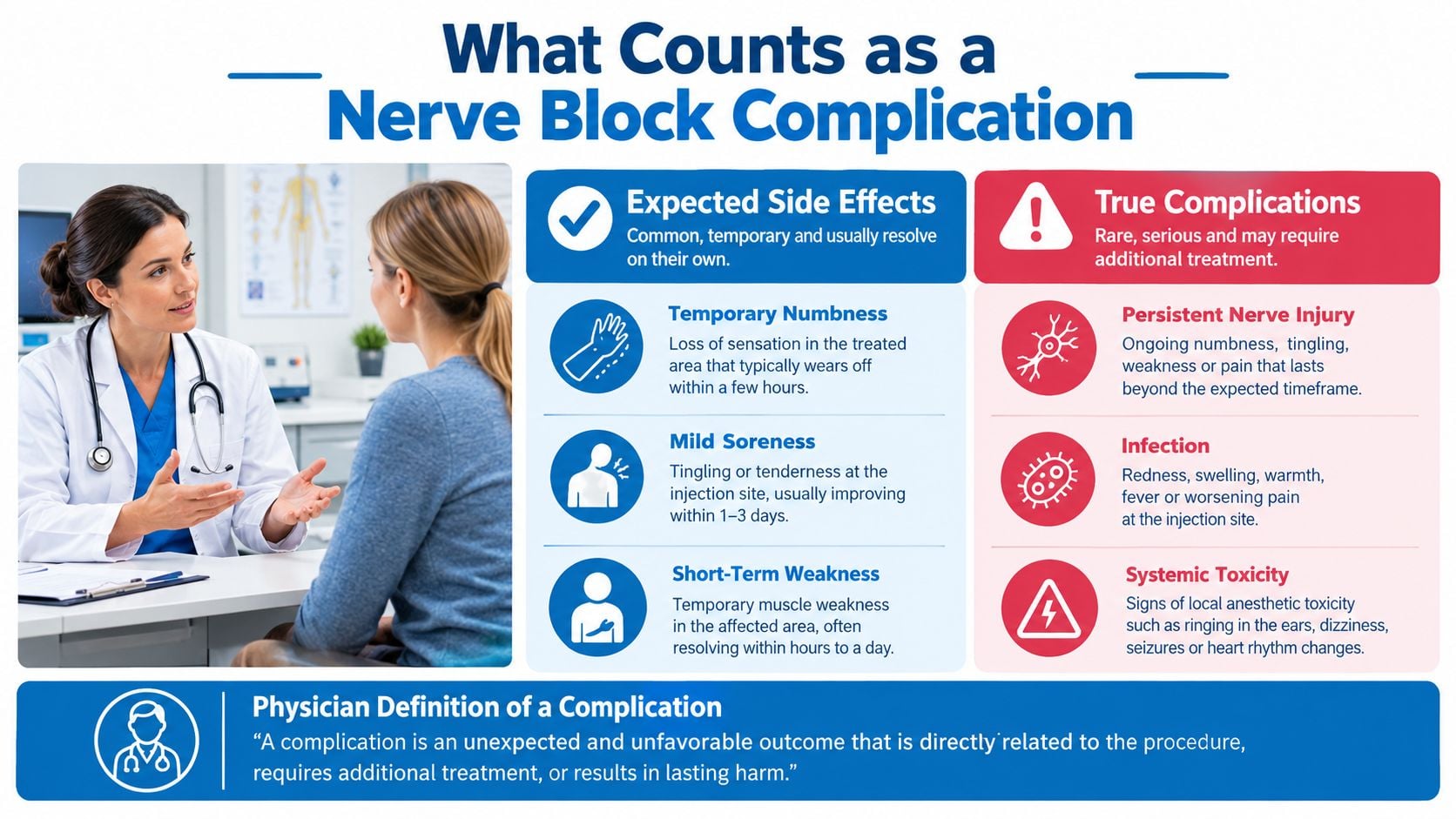
A patient considering a block usually wants a simple answer: will the procedure help, and what could go wrong? Before discussing rates, clinicians define the word complication carefully. A planned effect, such as temporary numbness, isn't usually classified as a complication. An unintended event that requires treatment, changes the planned course, or causes lasting harm is different.
Expected effects versus unintended events
Local anesthetic temporarily interrupts nerve signaling. As a result, the treated area may feel numb, heavy, tingly, or weak. A mild ache or small bruise where the needle entered can also occur as the tissues settle. For example, a patient receiving a leg block before surgery may briefly struggle to lift the foot because the targeted motor nerves are working less effectively. That weakness is expected while the medication is active, provided it follows the clinician's instructions and improves as the block wears off.
A minor event can still be uncomfortable without representing nerve injury. A vasovagal reaction may cause lightheadedness, nausea, sweating, or fainting during needle placement. A patient might also experience short-lived nerve irritation, such as pins and needles that improve over the following days. These events deserve observation and communication, but they don't automatically indicate permanent damage.
Practical rule: A symptom's meaning depends on its timing, severity, progression, and relationship to the expected duration of the block.
What makes an event a true complication
Major nerve block complications include persistent neurologic deficit, deep infection, significant bleeding, and local anesthetic systemic toxicity, often called LAST. A patient with an expanding neck collection after a deep block may have a bleeding complication because swelling can threaten nearby structures. A patient who develops ringing in the ears, a metallic taste, or seizure-like activity during injection may have systemic toxicity and needs immediate treatment.
The distinction matters because treating every episode of soreness or transient numbness as a serious injury can create unnecessary fear. At the same time, labeling progressive weakness or fever as “normal” can delay urgent care. The right approach is neither blanket reassurance nor alarm. It's a time-based assessment supported by the procedural team.
How Often Nerve Block Complications Happen
A patient may notice soreness at the needle site, bruising, brief tingling, or light-headedness after a nerve block. Those everyday effects are more common than lasting nerve injury. The available numbers become useful only when separated by symptom type, timing, and the kind of block performed.
In a prospective audit of 7,156 peripheral nerve blocks in 6,069 patients, 30 patients, or 0.5%, required neurologic assessment. Three patients had a block-related nerve injury. Systemic local anesthetic toxicity occurred at 0.98 per 1,000 blocks. The authors found serious complications uncommon, and postoperative neurologic symptoms were more often unrelated to the block itself. The prospective peripheral nerve block audit
Temporary symptoms occur more often than lasting injury. Prospective studies estimated long-term neurologic injury at roughly 2.4 to 4 per 10,000 blocks, while transient neurologic deficits lasting up to two weeks occurred in 8.2% to 15% of cases. A later review described a decline in peripheral block-related neurologic deficit from about 1% before two weeks to about 3 per 10,000 by one year. That time course helps explain why an early symptom does not automatically represent permanent damage. The review of risk factors and neurologic recovery
Minor soreness, bruising, brief tingling, and vasovagal reactions may be noticed more often than major injury, although their exact frequency varies with the procedure and reporting method. Ask the treating team for the expected rate and duration for your specific block.
| Complication Type | Approximate Incidence | Typical Duration |
|---|---|---|
| Neurologic assessment after a peripheral block | 0.5% in a prospective audit | Often temporary, with evaluation guided by symptoms |
| Block-related nerve injury | 3 cases in 7,156 blocks | May resolve gradually, persistent injury is uncommon |
| Systemic local anesthetic toxicity | 0.98 per 1,000 blocks | Immediate emergency requiring treatment |
| Transient neurologic deficit | 8.2% to 15% | Up to two weeks in the cited studies |
| Long-term neurologic injury | Roughly 2.4 to 4 per 10,000 blocks | May persist, though uncommon |
The Four Main Categories of Nerve Block Complications
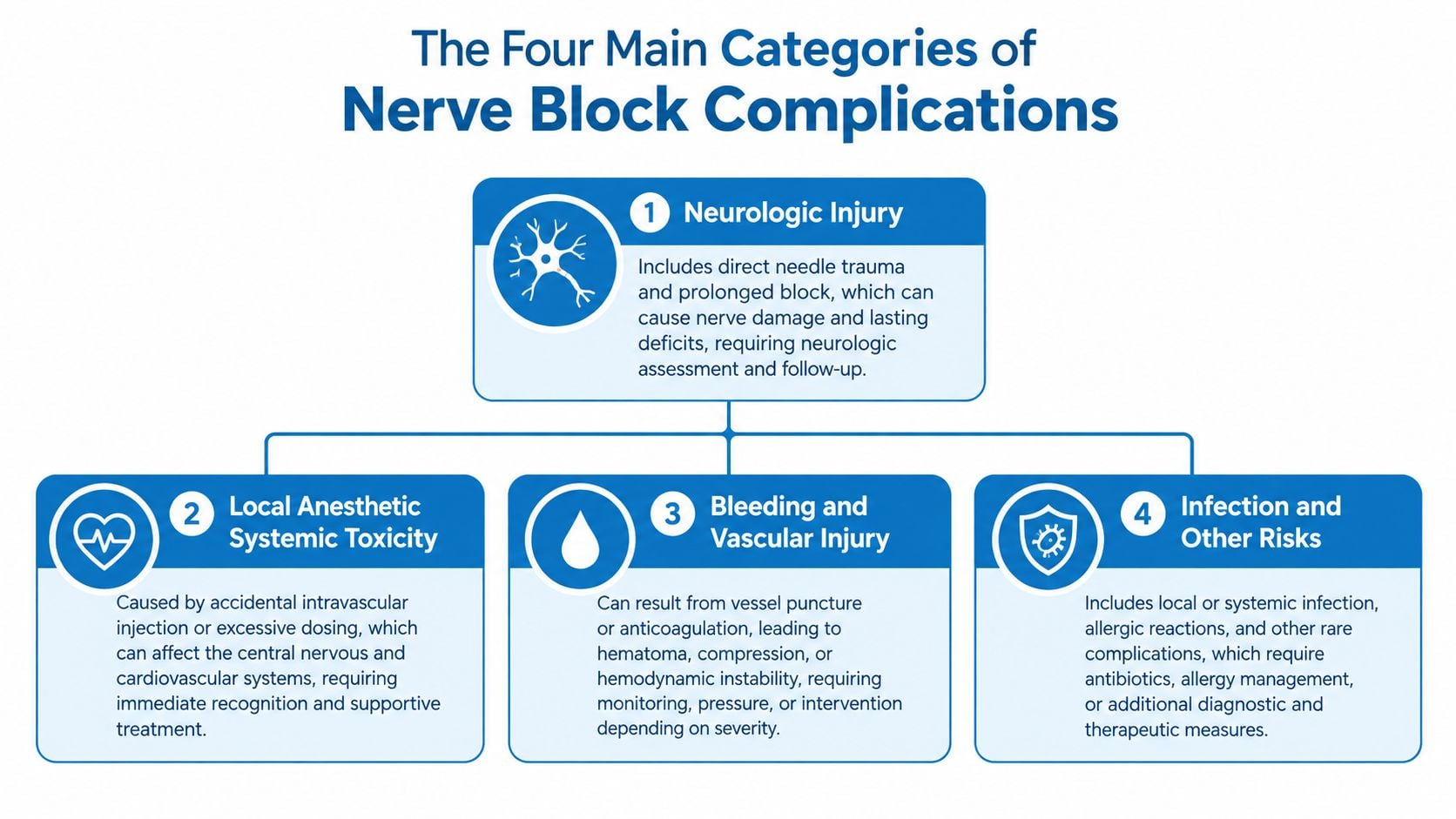
A patient may feel numbness, weakness, soreness, or dizziness after a nerve block. Those sensations do not all mean the same thing. Weakness can be the intended motor effect, a nerve problem, or pressure from bleeding. Dizziness may follow a vasovagal reaction or medication effect, while certain early symptoms suggest local anesthetic toxicity. Clinicians separate these possibilities by timing, examination findings, block location, and accompanying symptoms.
Neurologic injury
A needle can irritate a nerve, enter a nerve fascicle, or deliver medication at excessive pressure. Reduced blood flow can also injure nerve tissue. The warning pattern is numbness that persists beyond the expected block, worsening weakness, or severe pain that does not follow the usual recovery course. A large review found postoperative neurologic dysfunction near 1% before two weeks, decreasing to about 3 per 10,000 by one year. The block-related neurologic deficit review discusses possible mechanisms and recovery over time.
Ultrasound, aspiration, incremental injection, and stopping when pain or paresthesia occurs can reduce exposure to these risks. They cannot remove every risk.
Hemorrhagic complications
Bleeding is more concerning when the injection is near a major vessel or in a deep space that cannot be compressed easily. Anticoagulants, antiplatelet medicines, and bleeding disorders may change whether, when, or how the block is performed. New swelling, severe pressure, weakness, or breathing difficulty requires urgent assessment.
Regional anesthesia guidance describes these events as extremely rare. Historical neuraxial data in the same guidance estimated hematoma at 1.3 to 2.7 per 100,000 neuraxial anesthetics. The regional anesthesia bleeding guidance also stresses assessment based on the specific procedure and the patient's bleeding risk.
Infection
An infection may stay in the skin, causing redness and tenderness, or spread into deeper tissue. Fever, drainage, increasing warmth, escalating pain, or a new neurologic deficit after a spinal or deep procedure should prompt medical review. Sterile preparation, checking the skin beforehand, and reporting a worsening wound help clinicians identify this complication early.
Toxic complications
Local anesthetic systemic toxicity, or LAST, occurs when too much anesthetic enters the circulation. Inadvertent injection into a blood vessel and excessive absorption are common pathways. Early symptoms may include numbness around the mouth, tinnitus, a metallic taste, agitation, or unusual anxiety. Seizures and cardiovascular collapse can follow, making this an emergency.
Weight-conscious dosing, aspiration, incremental injection, monitoring, and immediate access to lipid emulsion therapy are key safeguards. A contemporary ultrasound-guided series reported a 0.4% overall complication rate and a 0.04% major complication rate across 2,742 blocks, providing context for standardized image-guided practice.
How a Nerve Block Is Performed and Where Risk Enters
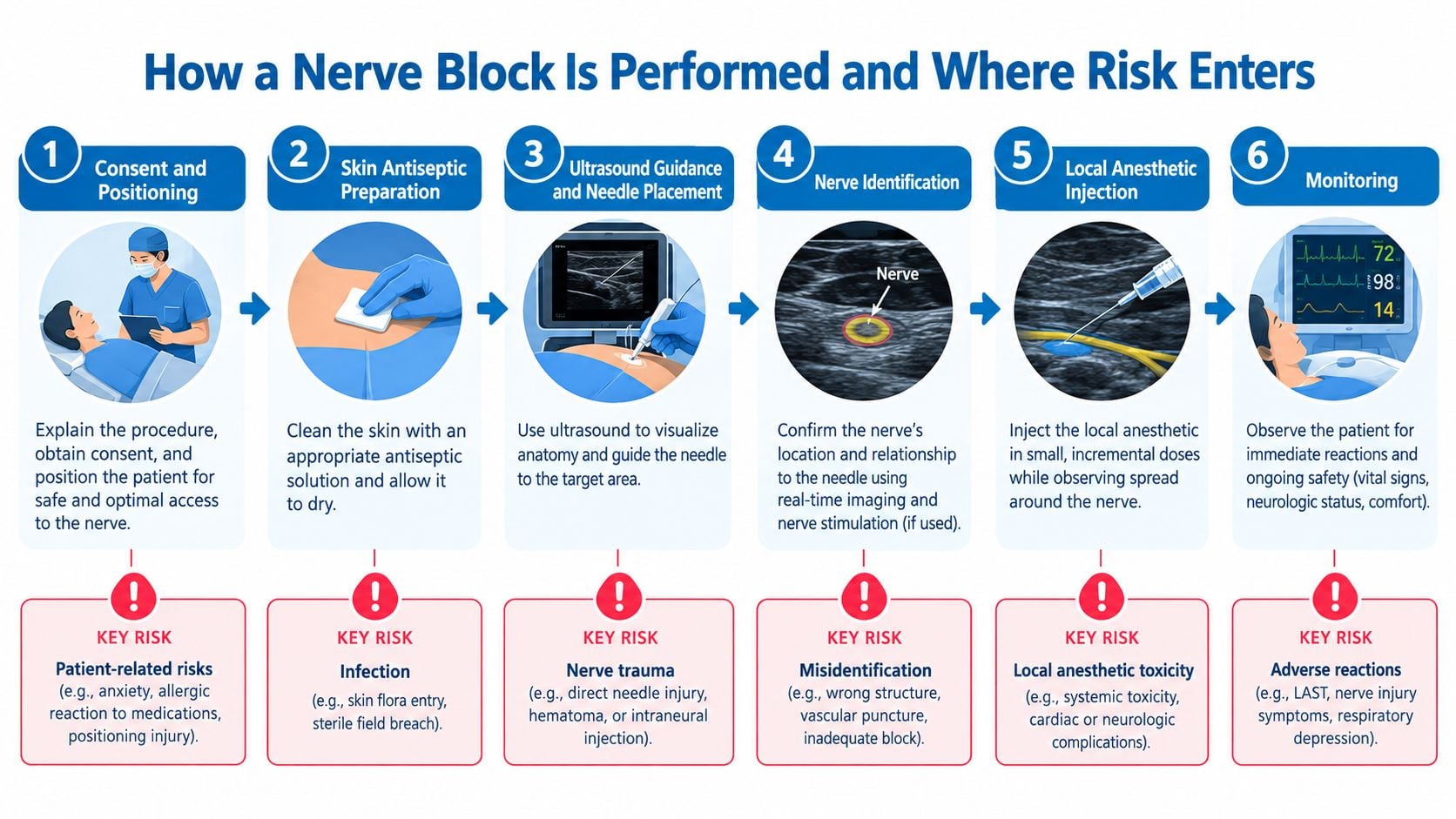
A typical ultrasound-guided peripheral block follows a sequence designed to make anatomy visible and complications recognizable early. The patient first reviews the indication, alternatives, medicines, allergies, and possible effects, then takes a position that gives the clinician stable access to the target area. Consent isn't paperwork alone. It gives the patient a chance to clarify how long numbness may last and which symptoms should trigger a call.
From skin preparation to needle placement
The clinician cleans the skin, applies a sterile drape, and uses a small amount of local anesthetic to numb the skin. That surface injection may sting briefly and can leave mild tenderness or bruising. Ultrasound then helps identify the nerve, surrounding muscles, vessels, and nearby structures before the block needle advances.
The needle may be guided within the ultrasound plane or approached across it. Either way, the clinician watches the needle tip rather than advancing blindly. Contact with the nerve, intraneural placement, or injection under high pressure can cause injury, which is why patients should report sharp pain, intense pressure, or an electrical sensation immediately.
During injection: Sharp pain or a strong electric sensation is information the clinician needs at once, not something a patient should tolerate quietly.
Why the injection is incremental
The anesthetic is delivered in small portions, with aspiration and pauses used to reduce the chance of injecting into a blood vessel. The team may monitor pressure and stop if the pattern of spread isn't appropriate. If a catheter is placed for continuous analgesia, its position is checked because migration, dislodgement, and infection create additional considerations.
After injection, staff observe the patient while the block begins. They assess sensation, movement, vital signs, and symptoms such as dizziness or ringing in the ears before discharge. Patients seeking background on the procedural and billing terminology may also review 2026 occipital block coding, while clinical indications and treatment context are discussed in the nerve block patient guide.
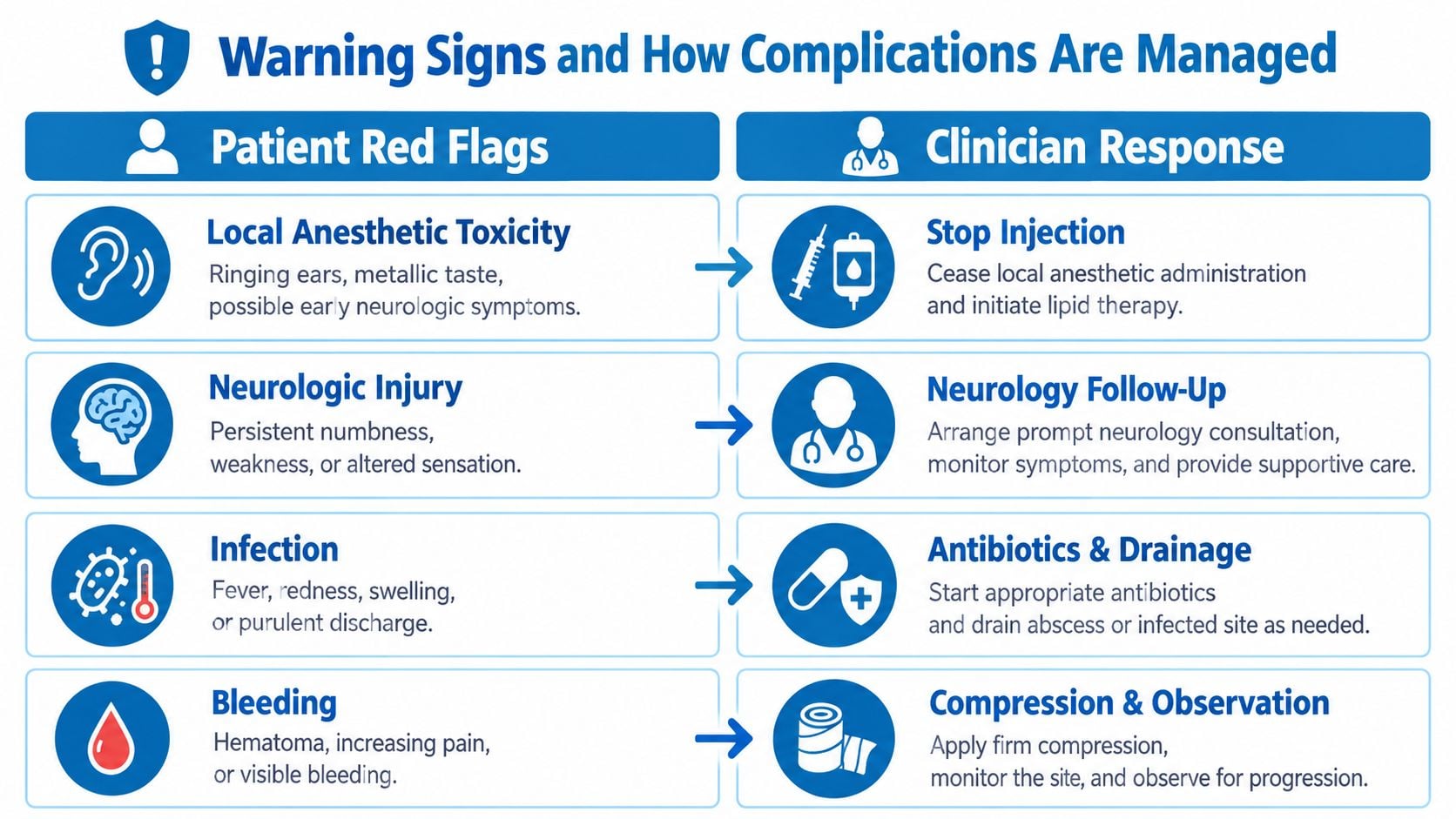
Warning Signs and How Complications Are Managed
Warning signs aren't a fear list. They form a shared checklist so the patient and clinical team can recognize a problem while treatment is still effective. The most important threshold is simple: a symptom that is new, worsening, severe, or unexpected for the block's location and duration deserves a call to the procedural team.
Symptoms that suggest toxicity
Perioral numbness, tinnitus, a metallic taste, unusual agitation, or sudden anxiety during or shortly after injection can signal LAST. Seizures, marked drowsiness, abnormal heart rhythm, or collapse are emergencies. The clinician stops injecting, supports the airway and circulation, treats seizures when needed, and administers 20% lipid emulsion according to emergency protocols.
Symptoms that suggest nerve injury
Persistent tingling, severe burning pain, a dense motor block that lasts beyond the expected period, or progressive weakness needs assessment rather than passive waiting. The response may include repeated neurologic examinations, specialist consultation, and imaging such as MRI when the findings suggest structural compression or another urgent cause.
Symptoms that suggest bleeding or infection
An expanding hematoma, neck or back swelling, severe pressure, or airway difficulty requires urgent evaluation. Depending on location, clinicians may use ultrasound, compression, medication review or reversal, and surgical support. Infection may present with fever, spreading redness, drainage, increasing tenderness, or a new neurologic deficit. Evaluation can include cultures, imaging, and intravenous antibiotics, with drainage when an abscess is present.
A 2025 scoping review of lumbar selective nerve root blocks identified 145 complication types across 72,518 procedures. The adjusted overall complication rate was 5.4% per procedure and 5.8% per patient, while severe events such as infection and paralysis were rare at 0.03% or less. The lumbar selective nerve root block review shows why minor events and severe events should be discussed separately.
For pain diagnosis, image-guided procedures, and follow-up planning, patients can review the pain-management services available through a multidisciplinary practice.
Why Complication Rates Differ by Block Type
A nerve block is not one standardized injection. The target may lie beside a large artery, near the spinal canal, next to the pleura, or within a compact plexus where swelling has little room to spread. Anatomy shapes which complications deserve the closest attention.
Older aggregate data reported neuropathy rates of 2.84% after interscalene block, 1.48% after axillary brachial plexus block, and 0.34% after femoral nerve block. These figures come from different bodies of evidence, so they cannot predict an individual patient's outcome. They do show why consent should match the specific block rather than rely on one universal risk number. The review of block-specific neurologic risk examines anatomical and technical reasons for this variation.
An interscalene block sits near a compact brachial plexus and structures that can affect breathing or voice. An axillary block generally avoids the diaphragm more effectively, but the axillary artery is nearby, so vascular puncture receives more attention. A femoral block is usually easier to compress and has a different neurologic risk profile.
Lumbar plexus and lumbar selective nerve root procedures enter deeper anatomical spaces closer to the neuraxis. A lumbar selective nerve root block may involve structures near the spinal canal and meninges, raising concerns such as dural puncture or bleeding. Those concerns do not apply in the same way to a superficial limb block. Patients considering a lumbar epidural approach can review this lumbar epidural steroid injection guide.
| Block Type | Distinctive Complication Risk | Approximate Incidence |
|---|---|---|
| Interscalene | Neurologic dysfunction and nearby respiratory or sympathetic effects | 2.84% neuropathy rate in older aggregate data |
| Axillary brachial plexus | Vascular puncture near the axillary artery and neurologic symptoms | 1.48% neuropathy rate in older aggregate data |
| Femoral | Local vascular or neurologic complications in the groin region | 0.34% neuropathy rate in older aggregate data |
| Lumbar selective nerve root | Intravascular injection, dural or neuraxial events, and deep bleeding | 5.4% adjusted overall complication rate per procedure, scoping review |
Long-Term and Delayed Symptoms After a Nerve Block
After a block, a patient may notice numbness, weakness, soreness, or bruising before the anesthetic wears off. These findings can be expected when they match the intended nerve and the clinician's time estimate. Concern increases when symptoms fail to improve, worsen after initial recovery, or appear with fever, increasing pain, or new loss of function.
Long-term neurologic injury is uncommon. Prospective evidence estimated it at roughly 2.4 to 4 per 10,000 blocks, while transient deficits lasting up to two weeks occurred more often. A later review found the overall deficit rate had fallen to about 3 per 10,000 by one year, suggesting that many early symptoms resolve. The neurologic recovery review supports follow-up based on the symptom pattern and its progress, rather than assuming that an early deficit will be permanent.
What delayed symptoms can mean
Persistent tingling or burning pain can result from needle or injection-related injury, inflammation around the nerve, pressure from a hematoma, or a separate condition. Surgery, positioning, tourniquet use, tissue injury, and the original disease can also affect nerves during the same period. Clinicians therefore compare the affected nerve's distribution with the surgical field and the original pain pattern.
The available long-term evidence remains limited. In a 2025 pediatric orthopedic systematic review, long-term follow-up appeared in only 16 of 158 studies. Among studies reporting persistent problems, chronic pain occurred in 5% of 352 patients, strength deficits in 10% of 466, reduced range of motion in 12% of 135, and sensory deficits in 0.07% of 15,387. The pediatric long-term follow-up review shows why these figures require careful interpretation, especially because follow-up methods and patient groups differed.
The practical rule is simple: expected symptoms should gradually follow the planned recovery curve. A symptom that is new, progressive, or function-limiting deserves clinical review.
| Symptom | Typical Duration | Resolution by 6 Weeks | When to Escalate |
|---|---|---|---|
| Numbness or weakness from the intended block | Depends on the medication and target | Should follow the clinician's expected course | Call for dense or progressive symptoms beyond the expected period |
| Mild soreness or bruising | Usually short-lived | Generally improves | Call if swelling, redness, or pain increases |
| Tingling or paresthesia | May resolve gradually | Improvement is reassuring | Request assessment if persistent, worsening, or function-limiting |
| Burning pain or new weakness | Not an expected routine recovery pattern | Requires clinical interpretation | Contact the team promptly, and seek emergency care for bowel, bladder, or severe neurologic changes |
| Fever, drainage, or spreading redness | Not expected | Doesn't require waiting | Seek prompt evaluation for possible infection |
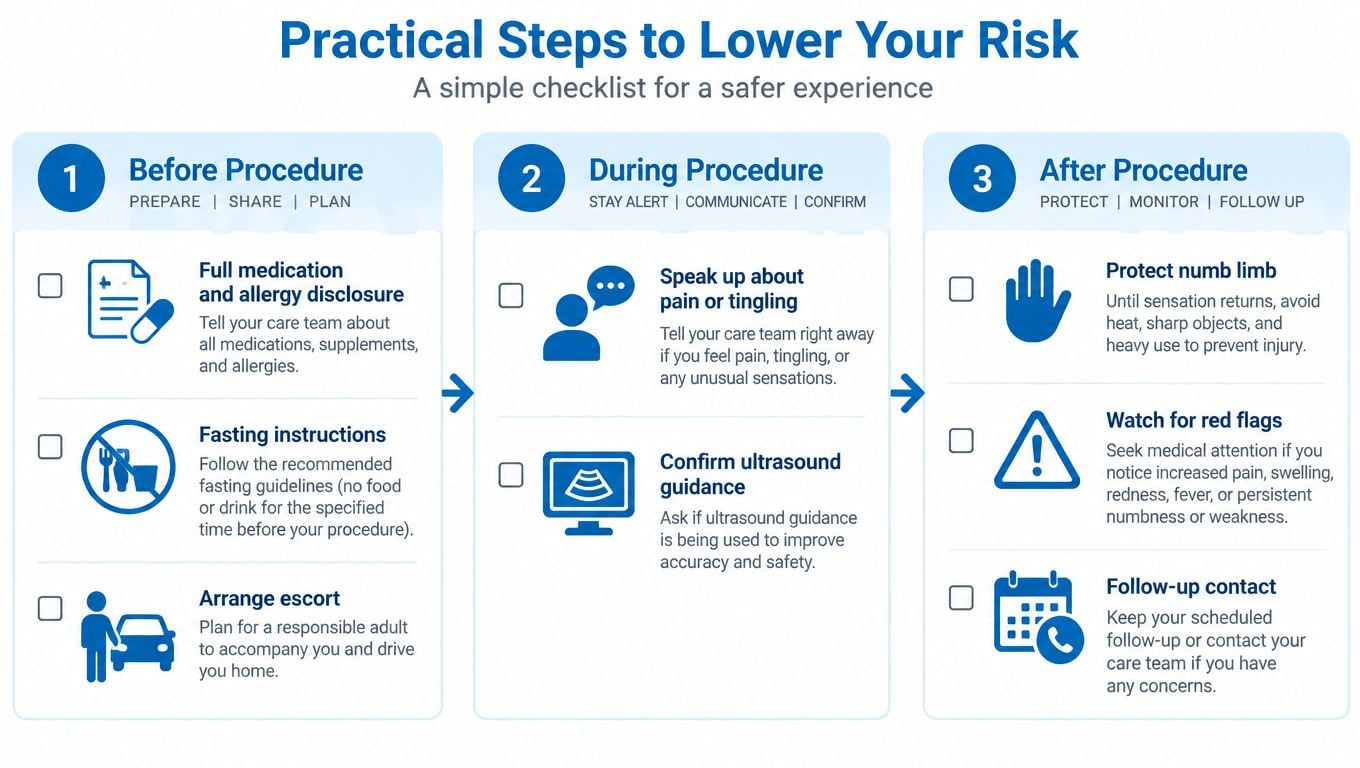
Practical Steps to Lower Your Risk
Risk reduction starts before the needle appears. The clinician needs a complete medication list, including anticoagulants, antiplatelet medicines, supplements, and herbal products. Prior neurologic problems, diabetes, bleeding disorders, allergies, and previous reactions to anesthesia can change the plan. Fasting instructions and transportation arrangements also matter when sedation is planned.
Before the procedure
- Share the complete medication list: The procedural team needs to know about blood-thinning medicines and supplements before deciding whether changes are safe.
- Describe baseline symptoms: Existing numbness, weakness, or neuropathic pain should be documented so new symptoms can be recognized accurately.
- Follow preparation instructions: Fasting, medication timing, and escort requirements should be confirmed rather than guessed.
- Ask block-specific questions: Patients should ask how long numbness and weakness are expected to last, which symptoms require a call, and whom to contact after discharge.
During the procedure
Patients should stay as still as comfortably possible and answer the clinician's questions clearly. Sharp pain, electric sensations, intense pressure, dizziness, tinnitus, or a metallic taste should be reported immediately. These observations help the clinician pause, reposition, reassess, or stop the injection.
Ultrasound guidance, sterile technique, trained personnel, incremental injection, aspiration, appropriate dosing, monitoring, and access to emergency treatment address the main procedural risks. Patient participation doesn't replace those safeguards. It helps the team detect a problem at the moment when changing technique may prevent escalation.
After discharge
A numb limb needs protection from heat, pressure, falls, and accidental injury until sensation and strength return. Patients should follow instructions about movement, walking, wound care, and medication, then record when the block starts to fade. A new or worsening symptom is more important than a fixed clock, because block duration varies by procedure and medication.
Bring this checklist to the appointment: medicines and allergies, baseline numbness or weakness, fasting confirmation, escort plan, expected block duration, emergency contact, and instructions for reporting red flags.
Interventional Pain Management evaluates pain through medical history, examination, imaging, and targeted treatment planning, including image-guided nerve blocks and other interventional options when clinically appropriate. Patients with questions about nerve block complications or persistent symptoms can visit Interventional Pain Management to request an evaluation and discuss next steps with a qualified care team.