
Early symptom improvement after anterior cervical discectomy and fusion often begins within 2–6 weeks, while radiographic fusion commonly takes 3–6 months and can extend to 6–12 months. Recovery is measured in weeks to months, not days, because feeling better happens well before the neck bone fully heals.
A patient may wake after surgery relieved that the arm pain has eased, then feel frustrated by throat soreness, neck stiffness, fatigue, or activity restrictions at home. That combination is normal for many people because ACDF recovery runs on several overlapping clocks. Pain, daily function, work, bone fusion, and nerve recovery don't all improve at the same speed.
The practical question isn't just, “How long does ACDF recovery take?” A more useful question is, “Which part of recovery is being measured?” The timeline below separates those milestones so patients can make sensible plans without mistaking early comfort for complete healing.
Table of Contents
- What to Expect Right After Anterior Cervical Discectomy and Fusion
- How ACDF Healing Works From Symptom Relief to Solid Fusion
- Week by Week Recovery Timeline and Key Milestones
- Factors That Can Speed Up or Slow Down Your Recovery
- Managing Pain and Rebuilding Strength Safely at Home
- Returning to Work Driving and Everyday Activities
- Your Next Steps Toward a Smooth and Lasting Recovery
What to Expect Right After Anterior Cervical Discectomy and Fusion
The first morning at home often feels less dramatic than expected. A patient may walk carefully from the bedroom to the kitchen, take prescribed medication, and notice that the original arm pain has changed, while the front of the throat feels sore and swallowing takes more effort. Energy can be limited, and the neck may feel guarded even when the surgery has addressed the original nerve compression.
Hospital care focuses on stability, comfort, and basic movement. The team checks vital signs, manages pain, observes the incision, and evaluates neurological function. Depending on the operation and the surgeon's instructions, a patient may use a cervical collar, sit up, and walk with assistance before discharge.
The ACDF procedure overview can help patients understand why the early experience includes both symptom changes and temporary surgical discomfort. The operation removes the damaged disc from the front of the neck, relieves pressure around affected nerves, and places a spacer or graft between the vertebrae.
The first days are about protection
At home, the priority is controlled movement rather than testing the neck. Short walks, prescribed medication, careful wound care, and adequate rest usually matter more than trying to resume a normal schedule. Sudden neck movements, lifting, repeated bending, and strenuous chores can place unnecessary stress on the healing area.
Mild throat soreness, shoulder tightness, fatigue, and incision discomfort can occur during early healing. The care team should be contacted promptly for breathing difficulty, worsening weakness or numbness, increasing rather than improving pain, or concerning incision changes such as marked redness or drainage.
Practical rule: Feeling better is encouraging, but it doesn't prove that the fusion is solid.
The recovery timeline becomes easier to follow when each milestone is matched with the right question. Early appointments focus on symptoms, wound healing, and safe activity. Later visits may assess strength, function, work demands, and imaging. By the end of this guide, patients should be able to plan daily activity, communicate with employers, and recognize when a symptom needs professional review.
How ACDF Healing Works From Symptom Relief to Solid Fusion
ACDF treats a painful or compressed disc through the front of the neck. The surgeon removes the disc material that is contributing to nerve irritation, places a graft or spacer in the empty space, and uses hardware to hold the neighboring vertebrae in position.
A useful analogy is a bridge under construction. The graft is the material that eventually becomes part of the bridge, while the plate and screws provide early support and keep the vertebrae aligned. The body then grows bone across the space. This biological process is the fusion, and it continues after the patient has gone home and resumed selected daily activities.
The spinal fusion guide provides broader context for why stabilization and bone growth are different from immediate pain control. Hardware can support the area right away, but it doesn't mean the bone has already united.
Five recovery clocks
Pain relief can begin early when the compressed nerve has been decompressed. Surgical soreness may temporarily compete with the original symptoms, so improvement isn't always linear.
Function measures what a patient can do, such as walking, dressing, preparing food, or sitting at a desk. Function may improve while the neck remains restricted.
Return to work depends on job demands, medication use, concentration, commute, and the ability to move safely. A desk job and heavy physical work don't place the same load on the healing neck.
Radiographic fusion refers to what imaging shows as bone grows across the treated space. Cleveland Clinic explains that solidification can take 6 months to 1 year after ACDF (Cleveland Clinic's ACDF recovery guidance).
Neurologic recovery involves nerves regaining function after compression. Pain may improve before numbness or weakness, and nerve-related changes can continue for months.
These clocks overlap, but they aren't interchangeable. Restrictions protect the developing bridge from excessive motion while the body builds the permanent connection.
Week by Week Recovery Timeline and Key Milestones
Recovery after anterior cervical discectomy and fusion follows several clocks. Pain, daily function, work readiness, nerve recovery, and bone fusion may change at different speeds. The timeline below helps with planning, but it does not replace the surgeon's clearance. The number of levels treated, the original diagnosis, examination findings, and follow-up imaging all affect the pace.
Days 1–2 and the hospital phase
Right after surgery, the care team checks vital signs, pain, swallowing, the incision, and movement in the arms and legs. Some patients sit or walk soon after the procedure. The aim is safe mobility, not endurance training.
Neck and throat soreness are common, and fatigue may be strong. Discharge depends on clinical safety and whether the patient can manage basic needs under the treating team's instructions. Early walking shows that movement is possible, not that the neck has finished healing.
Weeks 1–2 and the first home routine
At home, recovery usually combines rest with brief, gentle walks. Medication timing, sleep, hydration, incision care, and collar use become part of the daily routine when a collar has been prescribed.
Help may be needed for errands, heavier household work, and transportation. A good day should not trigger a sudden jump in activity. Symptoms can flare when effort increases faster than the healing tissues can tolerate.
Weeks 2–6 and early functional gains
A recent study found that disability improved rapidly through 4–6 weeks, then more gradually until approximately 3–4 months, with symptoms reaching a plateau after about 4 months (the PubMed-indexed ACDF recovery study). The study also reported that patients typically returned to activities within 2–6 weeks, while multilevel procedures generally progressed more slowly than single-level cases.
That pattern explains an apparent contradiction. A patient may walk farther, manage personal care, or tolerate desk tasks during the first month while still following lifting and neck-motion restrictions. Follow-up decisions may consider the incision, neurological symptoms, activity tolerance, and work demands.
Six weeks to 3 months and rebuilding capacity
During this interval, selected patients may progress toward light work, longer walks, and rehabilitation directed by the clinical team. The main change is improved tolerance. It is not permission to disregard restrictions.
Sedentary work may be reasonable around this period for some patients, while heavy labor requires a separate assessment. Follow-up can include an examination and imaging. Symptoms and evidence of healing matter more than the calendar by itself.
Three to 6 months and structural progress
Radiographic fusion commonly takes about 3–6 months, although solid confirmation can require longer, particularly after multilevel surgery or slower healing. High-impact exercise and jogging are often postponed until approximately 6 months or until the surgeon confirms adequate fusion.
Pain may have settled by this stage, while strength, stamina, confidence, and nerve function continue to change. Feeling better is an early signal of progress. It does not prove that the bone bridge is complete.
Six to 12 months and longer-term consolidation
Some patients reach solid fusion during this window. Others need continued monitoring because bone healing can take longer. Ordinary activities may feel comfortable before imaging confirms a stable connection, so scheduled follow-up remains important.
A follow-up study of workers reported 77.9% back at work by 3 months, 82.4% by 6 months, and 82.4% by 9 months. Among those working at 9 months, 80.4% had returned to their previous work. These figures show why resuming activity and sustaining a full work return are separate milestones.
Factors That Can Speed Up or Slow Down Your Recovery
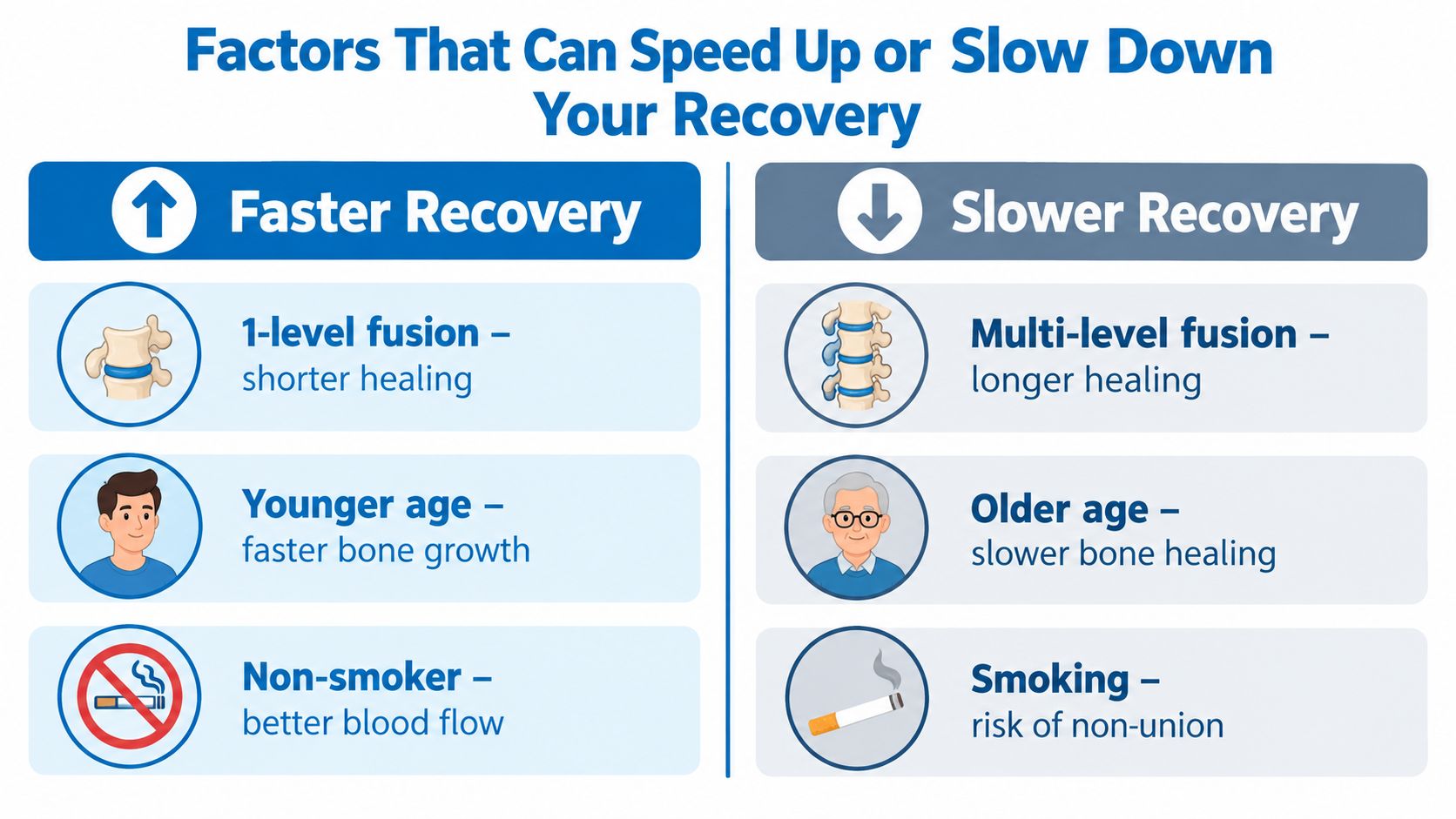
A patient may notice less arm pain within one recovery clock while the fusion follows another. Two people with similar operations can therefore progress at different speeds. The number of fused levels is one reason. Patients with multilevel ACDF generally return to activities more gradually than those with a single-level procedure, according to recent ACDF outcomes research.
The diagnosis also shapes the timeline. Someone treated mainly for radiating arm pain may regain function differently from a patient with spinal cord-related symptoms. Function can continue improving through 6 months, while patient-reported improvement may peak at 1 year, particularly after multilevel ACDF or with myelopathy, as reported in ACDF recovery outcomes research. These findings explain how early symptom relief, functional progress, and radiographic fusion can occur on separate schedules.
What patients can influence
Patients cannot change the number of surgical levels or the original nerve injury. They can, however, support the conditions needed for recovery by following restrictions, attending recommended therapy, avoiding nicotine, maintaining adequate nutrition, and reporting new symptoms promptly.
Bone health needs individual review. The surgeon may consider medical history, medications, bone density, and other healing risks when setting restrictions or ordering imaging. A slower timeline does not automatically mean the operation failed. Sometimes symptoms are improving while the bone bridge still needs more time to mature.
| Factor | Tends to speed recovery | Tends to slow recovery |
|---|---|---|
| Number of levels | Single-level surgery often allows a simpler progression | Multilevel surgery may require a slower return |
| Diagnosis | Less extensive nerve involvement may permit earlier functional gains | Myelopathy or prolonged neurological symptoms may recover gradually |
| Bone health | Healthy bone supports graft incorporation | Poor bone quality can delay solid fusion |
| Nicotine exposure | Avoiding nicotine removes a preventable healing obstacle | Smoking and nicotine can impair fusion biology |
| Activity choices | Following restrictions reduces unnecessary loading | Premature lifting or impact can increase motion at the fusion site |
Your personal estimate comes from combining these factors with examination findings and follow-up imaging. A general anterior cervical discectomy and fusion recovery time provides orientation, while clearance for specific activities depends on your healing evidence.
Managing Pain and Rebuilding Strength Safely at Home
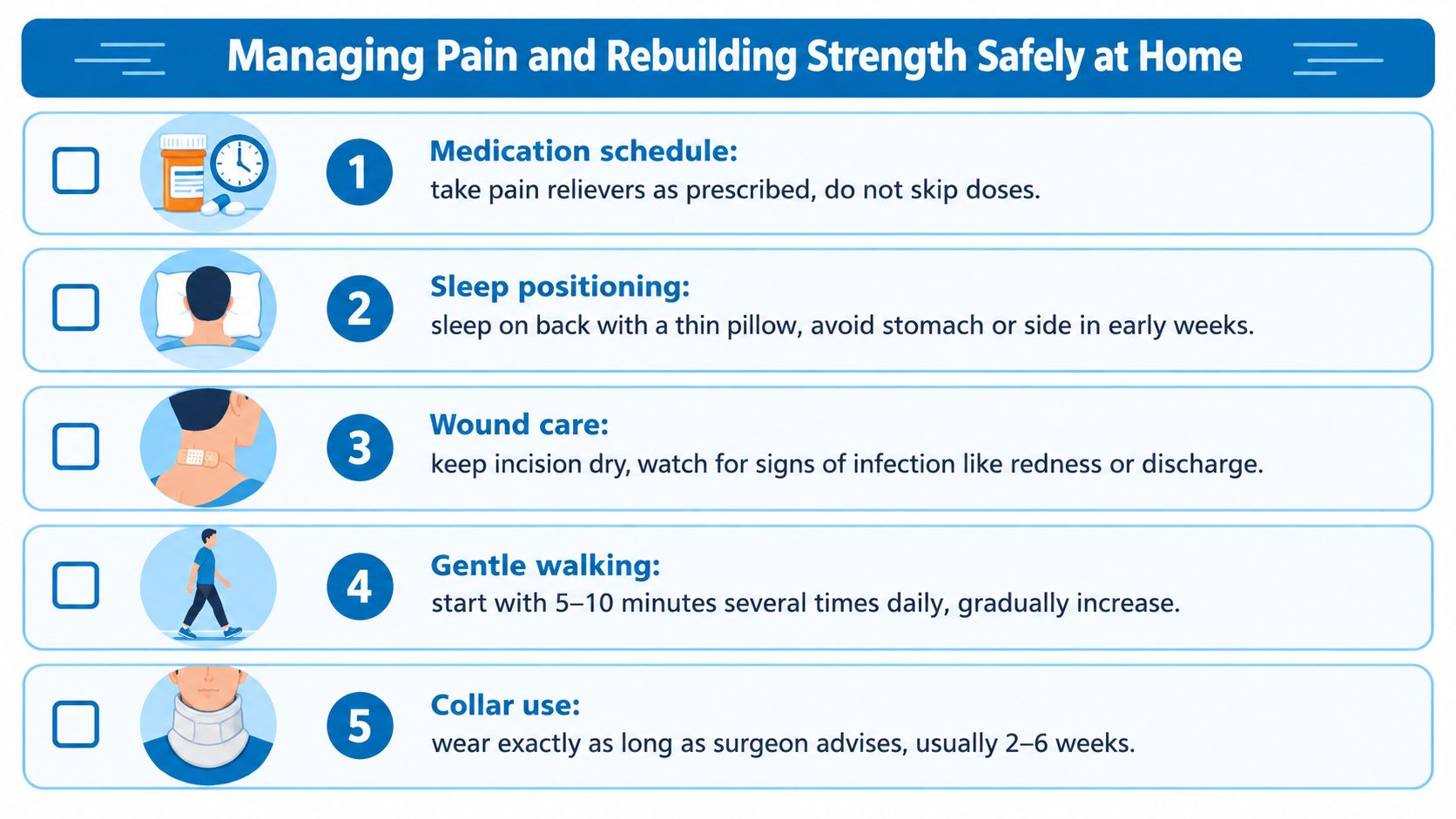
Home recovery works best when the patient treats the neck as protected, not immobilized. Prescribed medication should be taken exactly as directed, while short walks provide controlled movement without asking the healing area to carry heavy loads.
Sleep positioning can affect comfort. Many patients find it easier to rest on the back with support that keeps the neck neutral, but the surgeon's instructions should take priority. A collar, when prescribed, should be worn for the duration and situations specified by the surgical team.
A practical daily rhythm
A safe routine may include:
- Medication timing: Follow the prescription schedule and ask the care team before changing doses or combining medicines.
- Incision observation: Keep the wound care routine consistent and report increasing redness, warmth, drainage, or separation.
- Gentle walking: Begin with brief walks and increase duration only when symptoms remain controlled and the surgeon permits progression.
- Position changes: Alternate rest with standing and walking rather than staying in one position for long periods.
- Ergonomic setup: Keep reading material and screens at a comfortable height so the patient isn't repeatedly bending the neck.
Pain after spine surgery can be confusing because operative soreness and the original nerve symptoms may feel different. The pain after back surgery resource offers related education, but ACDF patients should still follow the specific plan issued by the operating team.
Building strength without challenging the fusion
Walking is generally the first form of activity because it allows the patient to control pace and distance. Physical therapy, when prescribed, usually advances gradually and may address posture, shoulder mechanics, stamina, and supporting muscles.
Lifting, pushing, pulling, repetitive bending, and sudden neck rotation should remain within the surgeon's limits. Restrictions exist because excessive movement can create micromotion at the fusion site and slow arthrodesis, even when the patient feels relatively comfortable.
New weakness, worsening numbness, loss of coordination, breathing difficulty, or significant swallowing problems deserve prompt contact with the surgical team.
A fever, worsening wound appearance, unusual drainage, or pain that escalates instead of settling also warrants medical advice. Emergency symptoms should be handled through emergency services rather than waiting for a routine appointment.
Returning to Work Driving and Everyday Activities
Returning to activity is governed by several recovery clocks. Pain may settle before the neck is ready for repeated loading, and basic function may improve while bone fusion remains incomplete. A desk worker may manage brief computer sessions before a warehouse worker can safely lift, carry, or climb. The decision depends on neck demands, head movement, medication effects, and signs of structural healing, not motivation alone.
For sedentary work, the surgeon may approve a gradual schedule with shorter work periods, regular position changes, and a workstation that keeps the screen at a comfortable height. Temporary restrictions can include remote work, reduced hours, or light duties. Heavy labor often requires a longer delay, 4–16 weeks or longer, based on postoperative ACDF guidance, but the actual timing depends on the person's examination and job demands.
Driving requires alertness and safe vehicle control. The patient should not drive while medication impairs attention or reaction time. They also need enough comfortable neck movement to check the surrounding traffic and control the vehicle without provoking symptoms. Findings from ACDF patients showed that some resumed driving and work early, yet those results do not provide automatic clearance for every patient. Early activity can coexist with a much longer fusion clock (ACDF work and driving outcomes).

Everyday activity needs a clearance test
Separate light household tasks from activities that load the neck and shoulders. Preparing a simple meal may be manageable before vacuuming, carrying laundry, reaching overhead, or moving furniture. Use fatigue and discomfort as signals to pause, not as a test of endurance.
High-impact exercise, jogging, and heavy resistance training are commonly postponed until about 6 months or until imaging documents solid fusion. The surgeon may review imaging, strength, neurological status, pain control, and movement quality before approving higher-load activity.
A return-to-work visit should examine the actual task list rather than the job title. Bring written details about lifting, driving, standing, climbing, and repetitive motion so restrictions fit the work environment. These activities represent separate checkpoints: work capacity may return before radiographic fusion, while neurologic recovery can continue after pain and daily function have improved.
Your Next Steps Toward a Smooth and Lasting Recovery
Recovery becomes easier to judge when you separate its five clocks. Pain may ease and function may improve within weeks. Work can return in stages, while bone fusion continues for 6–12 months. Neurologic recovery may take longer, particularly when nerve symptoms existed before surgery. These timelines can overlap without indicating a problem.
Follow-up visits and imaging provide checkpoints for the wound, neurological examination, hardware, and fusion. A good week does not replace those checks. Activity should progress according to the care team's findings and instructions.
Bring useful information to each appointment: a symptom record, medication effects, walking tolerance, and the physical demands of work or sports. Ask about driving, lifting, collar use, therapy, and numbness that persists or changes.
A lasting recovery means matching activity to the slowest healing clock, especially while the fusion remains vulnerable. Report new or worsening symptoms early. Patients in New Jersey and Staten Island can contact Interventional Pain Management for individualized spine evaluation, postoperative pain guidance, and coordination with appropriate orthopedic or spine care.
Interventional Pain Management offers multidisciplinary evaluation for neck and spine conditions, including pain management, orthopedic, and spine surgery services for individual needs. Visit Interventional Pain Management to request guidance about persistent symptoms, recovery planning, or the next follow-up step.