
A patient with low back pain and burning leg symptoms may leave a consultation hearing two phrases, epidural injection and nerve block, and assume they're interchangeable. They aren't. The useful question isn't which needle is better. It's which structure is producing the pain, whether the procedure is meant to diagnose that source or treat inflammation around it, and how broadly the medication needs to spread.
A disc herniation irritating one spinal nerve calls for a different strategy than multilevel stenosis, facet-joint pain, or a peripheral nerve disorder. The decision also depends on the spinal level, examination findings, imaging, medication risks, and whether the expected benefit is a brief diagnostic answer or a therapeutic window for rehabilitation.
Table of Contents
- A Realistic Moment in the Pain Clinic
- What Epidural Injections and Nerve Blocks Are
- How the Two Techniques Compare on Target and Durability
- Clinical Indications That Drive the Decision
- Safety, Risks, and the Steroid Choice Question
- Procedure Day and Recovery Differences
- Choosing the Right Option for Your Pain Pattern
A Realistic Moment in the Pain Clinic
A patient sits in the examination room with MRI images displayed nearby. The scan shows a disc problem, but the symptoms don't say “disc pain.” There's numbness down one leg, pain that follows a recognizable path, and weakness that may or may not match the level visible on the image. The physician has mentioned both an epidural injection and a nerve block, so the patient asks the natural question: “Which one should be done?”
The clinician usually starts somewhere else: Which pain generator fits the history, examination, and imaging together?
Suppose the scan shows a herniated disc at L5-S1 pressing on the traversing S1 nerve root, and the patient has pain extending through the back of the leg in a pattern consistent with S1 irritation. A transforaminal epidural steroid injection directed toward that level may be considered because it can deliver anti-inflammatory medication around the affected root.
Now change the presentation. The patient has focal pain near the lower back that worsens with extension and rotation, with no convincing radiating leg symptoms. If the examination and imaging suggest an L4 facet source, a medial branch block may be more appropriate. That procedure targets the small nerves supplying the facet joint and can help determine whether that joint is contributing to the pain.
The anatomy comes first
The syringe, steroid, and needle approach matter, but they come after the clinical question. A physician generally weighs:
- Pain distribution: Does the pain follow a single nerve pattern, affect several levels, or remain mostly axial?
- Neurological findings: Are there sensory changes, reflex differences, or weakness that correspond to a specific root?
- Imaging correlation: Does the MRI or other imaging show compression or inflammation at the same level suggested by the examination?
- Diagnostic uncertainty: Would temporarily numbing one nerve clarify the next treatment decision?
- Treatment objective: Is the goal to reduce broader inflammation, confirm a target, facilitate therapy, or guide surgery?
Practical rule: A scan alone doesn't select the injection. The best procedure is the one that matches the patient's symptoms to the structure most likely generating them.
That approach prevents a common mistake. A patient may have an abnormal MRI and still have pain from a different structure, or from several structures at once. In the same way, calling every spinal injection a “nerve block” can obscure whether the procedure is intended to test one nerve or treat inflammation across an epidural space.
What Epidural Injections and Nerve Blocks Are
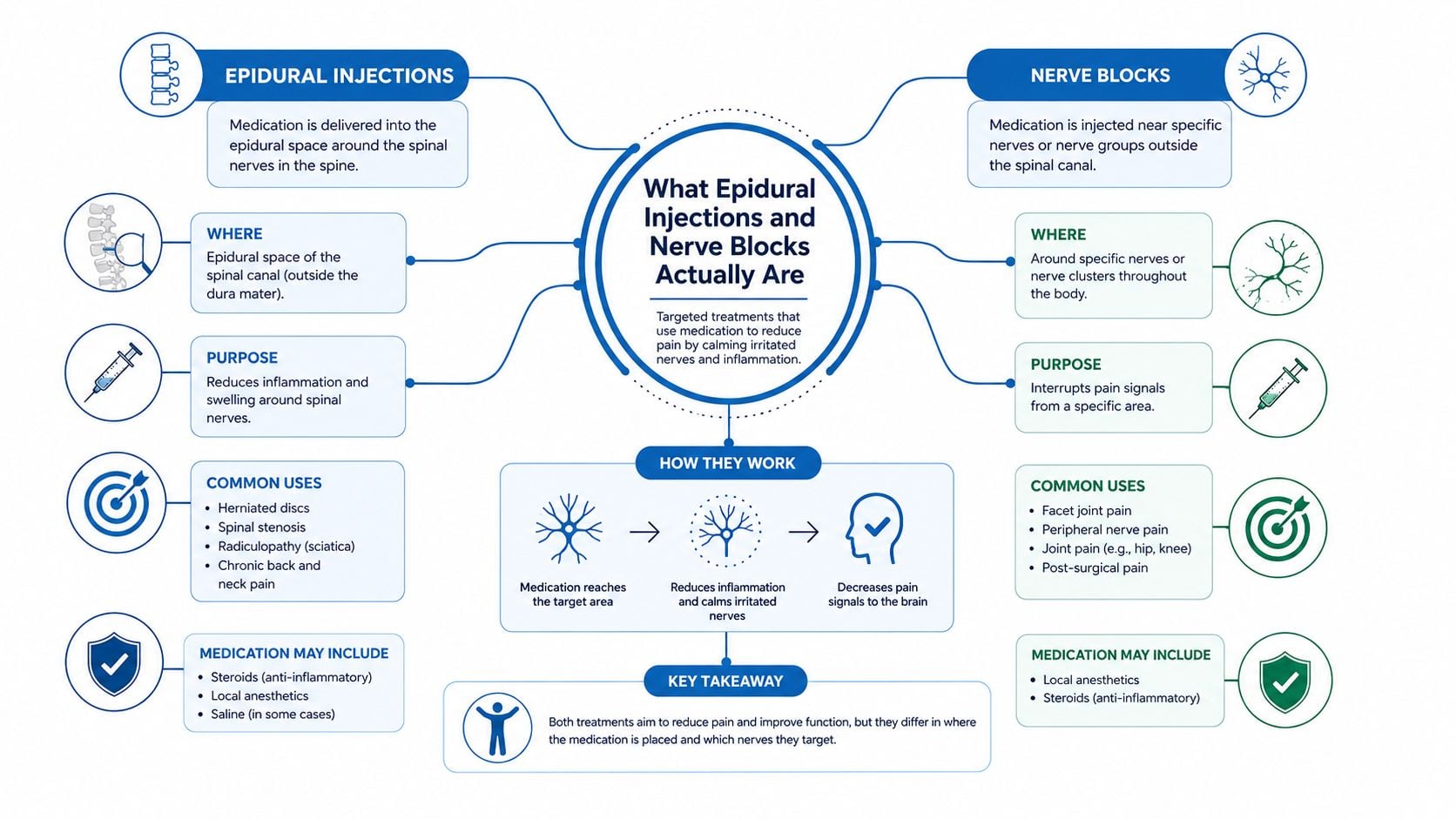
An epidural steroid injection delivers corticosteroid, often with local anesthetic, into the epidural space around the dural sac. The medication does not enter the spinal cord. It is placed around the structures carrying spinal nerve roots to reduce inflammation near an irritated root.
The route determines where medication can spread:
- Interlaminar: The needle passes between adjacent vertebrae, allowing medication to spread from a central position.
- Transforaminal: The needle approaches through the opening where a nerve root exits, providing more level-specific epidural delivery.
- Caudal: Medication enters through the sacral opening and can travel toward lower lumbar and sacral roots.
A transforaminal approach can concentrate medication near one symptomatic root. An interlaminar or caudal approach may cover a broader region. Patients can review the purpose and approaches on the epidural steroid injection service page.
A nerve block targets a named structure
A nerve block places local anesthetic, steroid, or both beside a named nerve, nerve root, nerve group, or sympathetic structure. Examples include a selective nerve root block, medial branch block, occipital nerve block, and paravertebral block.
A selective nerve root block addresses a specific clinical question: is this root generating the patient's familiar symptoms? The physician places medication beside the suspected root instead of relying on broader epidural spread. A medial branch block addresses a different source, the small nerves supplying a facet joint.
The purpose may be therapeutic, diagnostic, or both:
- Therapeutic intent: Reduce inflammation or interrupt pain transmission so the patient can move, sleep, and participate in rehabilitation.
- Diagnostic intent: Temporarily quiet a suspected structure and assess whether the patient's familiar pain changes as expected.
These categories can overlap. A selective root block may include steroid and provide treatment, while an epidural injection may offer clues about the spinal pain generator. They remain different procedures, however, because their targets and interpretation differ. The decision should follow the suspected nerve or spinal level, not just the fact that both procedures use image guidance and medication near neural structures.
How the Two Techniques Compare on Target and Durability
The practical choice depends on the suspected pain generator. An epidural steroid injection covers the epidural space around one or more irritated roots, while a selective nerve root block concentrates medication beside one named root. Both can address radicular pain, but they answer different clinical questions.
| Attribute | Epidural Steroid Injection | Selective Nerve Root Block |
|---|---|---|
| Primary target | The epidural space around one or more irritated spinal nerve roots | A specific spinal nerve root |
| Medication spread | Broader, depending on the route and volume | Narrower and more concentrated near the selected root |
| Typical intent | Primarily therapeutic, especially for radicular inflammation | Diagnostic, therapeutic, or both |
| Best fit | Broader or multilevel radicular inflammation | A single suspected root with a clear clinical match |
| Diagnostic clarity | Limited because medication may reach more than one structure | Greater level-specific information |
| Durability | Can last from weeks to several months, but varies by indication and technique | Diagnostic relief is temporary. Therapeutic duration depends on the condition and medication |
| Main trade-off | More coverage, less precise interpretation | More precision, less coverage |
What the comparative evidence suggests
A systematic review of lumbar transforaminal epidural steroid injections reported that about 60% of patients achieved at least 50% pain relief at one to two months (The clinical review of epidural steroid injections). Roughly 40% maintained that degree of relief at 12 months in the reviewed evidence. These figures describe a particular evidence synthesis, not a promised result for an individual patient. The review also emphasizes that outcomes vary with the diagnosis, technique, and medication choice.
A comparative lumbar radiculopathy study found that caudal epidural steroid injection produced better short-term pain relief and functional improvement than selective nerve root block for the indication studied. In that dataset, more than 50% pain reduction lasted up to one year in the epidural group and up to six months in the selective root block group. Functional improvement, measured with the Oswestry Disability Index, was about 59.6% at three months and 65.4% at one year after epidural treatment, compared with about 52.8% at three months and 46.7% at one year after root block treatment (The comparative study). The findings provide context, not a rule that an epidural will outperform a targeted block for every pain generator.
Precision versus coverage
A targeted block can answer a narrow question quickly. If imaging shows degeneration at several levels but the symptoms suggest one root, temporary relief that matches the patient's familiar pain can clarify which level deserves attention. That information may guide a later targeted procedure or a surgical discussion.
An epidural fits better when inflammation involves several roots or when the symptoms do not isolate one level cleanly. Broader spread can improve therapeutic coverage, yet it reduces diagnostic clarity because medication may reach multiple structures. Relief after an epidural supports an inflammatory spinal component, but it does not prove that every treated structure caused the pain.
Durability follows the same logic. Diagnostic relief from local anesthetic is expected to be brief. Steroid-related improvement may last weeks to several months, depending on the pain generator, route, and response. A temporary response can still be useful if it identifies the symptomatic root or creates enough comfort for rehabilitation.
Clinical Indications That Drive the Decision
The procedure should follow the pain pattern, not the other way around. A patient with unilateral leg pain that follows a single dermatome and matches a foraminal disc herniation may be considered for a selective nerve root block. A patient with bilateral leg heaviness from multilevel lumbar stenosis may need medication distributed across a broader epidural region.
| Clinical Indication | Preferred Procedure | Rationale |
|---|---|---|
| Single-level unilateral radiculopathy | Selective nerve root block or targeted transforaminal epidural | Focuses on the root that matches the symptoms and imaging |
| Multilevel lumbar radicular inflammation | Interlaminar or caudal epidural injection | Allows broader medication spread across affected levels |
| Bilateral leg symptoms with neurogenic claudication | Epidural approach may be considered | Broader coverage can fit multilevel disease better than a single-root target |
| Facet-mediated axial pain | Medial branch block | Tests the nerves supplying the suspected facet joint |
| Pain after shingles | Targeted block in selected cases | A systematic review found benefit from some paravertebral and continuous or repeated epidural approaches, but not from every epidural technique |
| Nonspecific axial low back pain | Neither automatically | Epidural steroid injections aren't appropriate for axial or nonspecific pain without radiating symptoms under major coverage guidance |
Radiculopathy and stenosis aren't the same problem
Radiculopathy usually means a spinal nerve root is irritated or compressed, producing pain, numbness, tingling, or weakness along a recognizable distribution. If one root clearly matches the clinical findings, a selective block can provide focused treatment and useful diagnostic information.
Stenosis tends to create a broader pattern. When several levels narrow the space around the nerve roots, especially with symptoms in both legs during walking or standing, an epidural route may fit better because a single-root injection could leave other symptomatic levels untreated. Evidence and guidelines still describe the benefit as variable and often time-limited. Guideline-level evidence on epidural injections and nerve blocks reports relief lasting 8 to 12 weeks in some cervical radiculopathy cases, while also emphasizing that results vary by indication and technique.
Postherpetic pain requires a different question
Nerve blocks and epidural procedures are not interchangeable for postherpetic neuralgia. In a systematic review of nine trials involving acute herpes zoster, nerve blocks reduced the duration of zoster-related pain and lowered postherpetic neuralgia incidence at three, six, and 12 months. The same review found that a single epidural injection and stellate ganglion block did not prevent postherpetic neuralgia, while paravertebral block and continuous or repeated epidural blocks reduced incidence at three months.
That distinction shows why diagnosis matters more than the label. A clinician considering nerve block procedures at IPM needs to identify whether the target is a spinal root, peripheral nerve, sympathetic chain, or another structure.
Safety, Risks, and the Steroid Choice Question
In the exam room, the safety discussion starts with the target. A cervical epidural, a thoracic epidural, and a peripheral nerve block do not carry the same risk profile, because the needle path, nearby vessels, and nearby nerves are different. That is why image guidance and sterile technique are standard, but they do not erase the need to match the procedure to the pain generator.
Large observational safety reviews found neurological complications were reported more often with steroid use than without it, and more often with particulate steroids than with nonparticulate steroids. The concern rises when the injection is close to critical arteries, which is why steroid formulation is part of the planning visit, not an afterthought. For patients who need a closer look at steroid formulation choices and corticosteroid injections, the decision usually turns on the spinal level, the route, and how much spread is needed.
Why steroid formulation matters
Particulate steroids contain particles that raise concern if medication enters a vessel. Nonparticulate options are often favored in higher-risk epidural settings, especially in the cervical spine and with transforaminal approaches, because clinicians want a wider safety margin when the anatomy is tight.
Consent should cover the main trade-offs plainly:
- Neurological injury: Rare, but more concerning when the target sits near major vessels or dense neural structures.
- Bleeding: Anticoagulants and clotting disorders can change whether the procedure is appropriate and how it should be planned.
- Infection: An active local or systemic infection can make an injection unsafe.
- Dural puncture: If the dura is entered, a positional headache can follow.
- Systemic steroid effects: Temporary blood-glucose elevation, flushing, sleep disturbance, and mood changes can happen.
- Local anesthetic effects: Numbness, heaviness, or weakness may show up in the treated distribution.
The medication choice should fit the anatomy. A clinician should explain why one formulation is safer for a given level or approach, and why a different target might call for a different plan.
If the first injection does not help, the next step should be to ask whether the pain generator was identified correctly. Repeating the same treatment without revisiting the source can add risk without improving the result. Current policy guidance commonly expects fluoroscopic or CT guidance with contrast, limits repeated sessions by spinal region, and does not treat injections as a long-term stand-alone strategy. The current policy guidance should be read alongside the patient's diagnosis and medical history.
Procedure Day and Recovery Differences
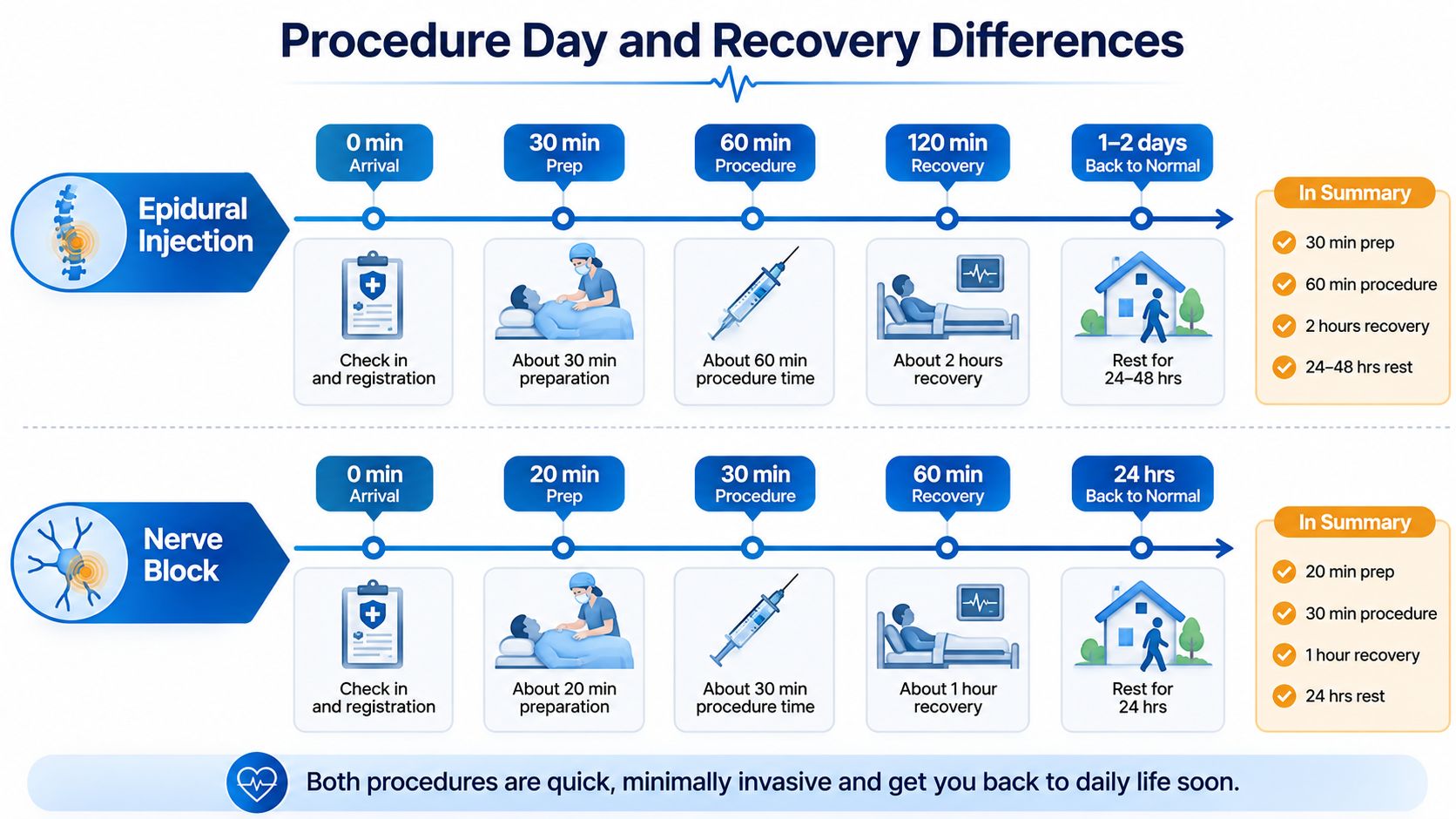
The day-to-day experience is similar in broad outline. The patient checks in, reviews medications and allergies, changes into procedure clothing, and is positioned for image-guided treatment. Fluoroscopy or ultrasound helps the physician identify the intended anatomy, and sterile preparation occurs before the needle advances.
Most interventionalists use local anesthetic alone or minimal sedation when accurate neurological feedback matters. A fully sedated patient may not be able to describe whether the familiar pain has been reached during a diagnostic block. An anxious patient may still be offered carefully selected sedation, with transportation arranged in advance.
What patients may notice afterward
A selective nerve root block can create a focused area of numbness or weakness that corresponds to the treated root. The physician may ask the patient to perform a movement that normally triggers symptoms, because the response helps document whether the targeted nerve was covered and whether the familiar pain changed.
An epidural injection may produce a broader sense of heaviness or numbness in an arm or leg for a short period, depending on the route and spread. Patients shouldn't drive until the temporary effects have fully worn off, and they should arrange a ride home if the treating facility requires it or if sedation is used.
The recovery window
Mild soreness at the injection site is common. Light activity can often resume the next day, but the treating team's instructions take priority, especially when temporary weakness or numbness persists.
Local anesthetic may provide early relief that fades as it wears off. Steroid benefit, when it occurs, generally develops over several days rather than immediately. A diagnostic block is judged by the temporary response during the anesthetic window, while a therapeutic injection is evaluated by pain, function, walking tolerance, sleep, and participation in rehabilitation over the following period.
Choosing the Right Option for Your Pain Pattern
A practical way to understand the decision is to map distribution, number of levels, and clinical purpose.
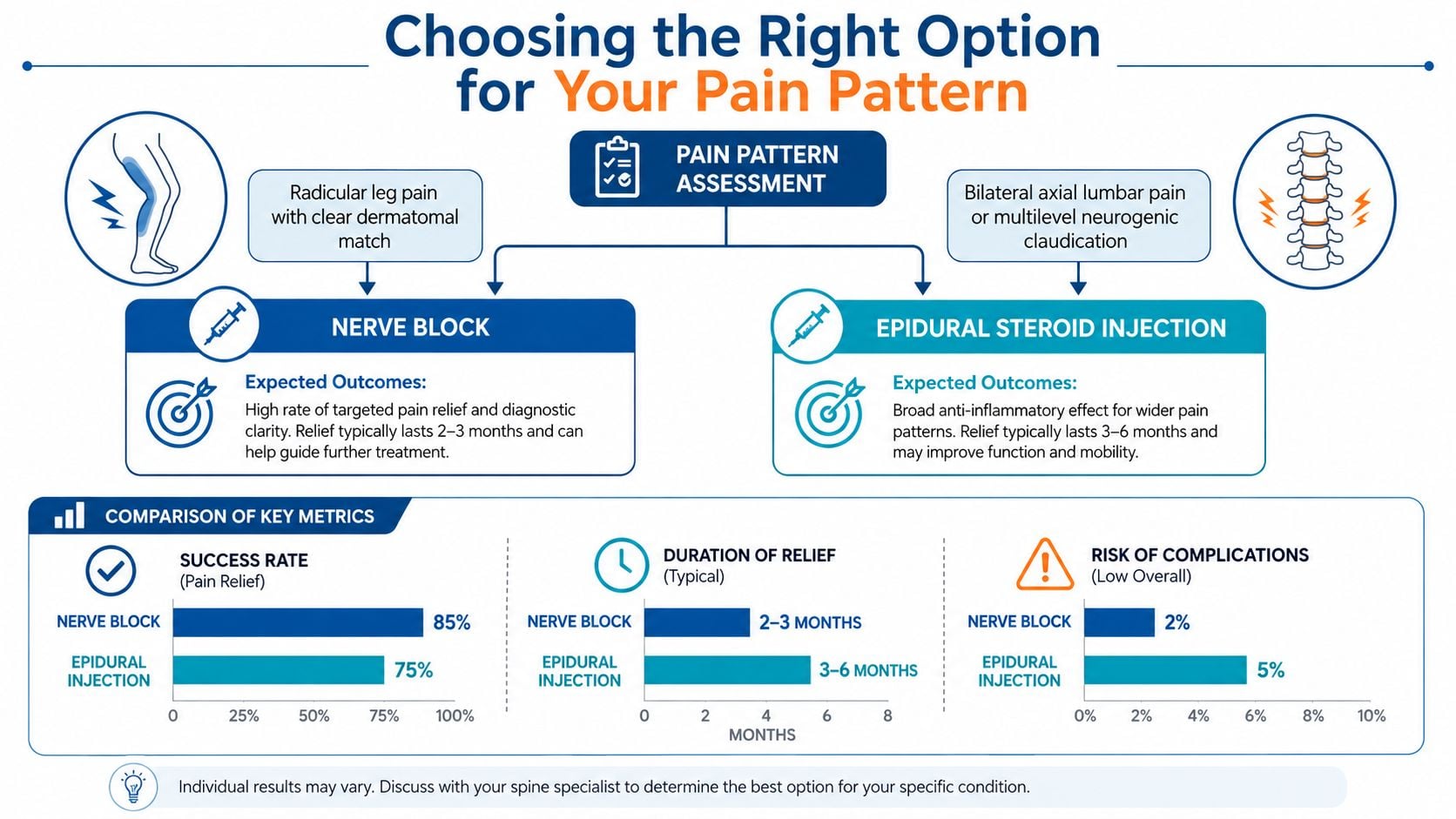
A single, well-localized pain pattern with a clear dermatomal match points toward a selective nerve root block. The procedure can focus on the suspected root and help answer whether that root is clinically relevant, particularly when imaging shows abnormalities at more than one level.
Bilateral symptoms, multilevel inflammation, or neurogenic claudication may favor an epidural approach because broader medication coverage can fit the anatomy better. That doesn't guarantee longer relief, and it doesn't make an epidural appropriate for nonspecific axial pain without radiation. The pain generator still has to support the treatment.
Three questions clarify the pathway
- Is there a single suspected nerve? If yes, a targeted block may provide the most useful diagnostic information.
- Are several roots involved? If yes, an epidural route may offer more practical coverage.
- Is the pain mostly axial? If yes, neither procedure should be selected automatically, because the source may be a facet joint, sacroiliac joint, muscle, disc, or another structure.
Patients with pain after shingles may need a targeted paravertebral or other regional approach rather than a standard single epidural. Patients with persistent pain after spine surgery may require a broader reassessment that includes scar-related nerve irritation, recurrent compression, and non-spinal pain mechanisms.
The best consultation ends with a measurable plan. The patient and clinician should define what improvement would count as meaningful, which activities should be tracked, when the response will be reviewed, and what the next step will be if the injection fails. An epidural injection vs nerve block decision is most useful when it guides rehabilitation or clarifies the next treatment, not when it becomes an isolated attempt to suppress symptoms.
Interventional Pain Management evaluates back, neck, joint, and nerve pain through medical history, examination, imaging review, and image-guided treatments such as epidural injections and nerve blocks. Adults in New Jersey and Staten Island can visit Interventional Pain Management to discuss which procedure matches the suspected pain generator and what the next step should be if relief is incomplete.