
A person with scoliosis may reach a frustrating point: the curve is worsening, pain interrupts sleep, standing for work takes more effort, and physical therapy or medication no longer restores normal activity. Yet the decision about scoliosis correction surgery rarely comes down to whether an X-ray can look straighter. The more important question is whether the likely improvement in pain, balance, walking, work, or independence justifies a major operation with meaningful risks.
Surgery can improve deformity and disability, but it can't guarantee that every aspect of daily life will improve in equal measure. Patient age, curve flexibility, neurologic symptoms, bone quality, overall alignment, medical health, and the specific goals of treatment often matter more than whether a procedure is described as open, minimally invasive, or fusionless.
Table of Contents
- When Scoliosis Correction Surgery Becomes the Right Conversation
- Understanding Scoliosis Severity and Surgical Indications
- Comparing Scoliosis Surgery Techniques and Approaches
- What the Evidence Shows About Outcomes and Complications
- Bridging the Gap Between X-Ray Results and Daily Function
- Navigating Recovery and Long-Term Follow-Up
- How a Multidisciplinary Center Approaches Patient Selection and Care
When Scoliosis Correction Surgery Becomes the Right Conversation
A typical decision point develops gradually. An adult may have managed back pain for years with exercise, targeted injections, physical therapy, and changes in activity. Then walking becomes limited, standing causes increasing discomfort, or the torso leans far enough that ordinary tasks require constant adjustment. The person may not be seeking a “perfect” spine. They may want to cook, work, travel, or sleep without organizing the day around pain.
That distinction matters. Scoliosis correction surgery isn't usually an early treatment for a manageable curve. Observation, rehabilitation, medication, and other nonoperative care can remain appropriate when symptoms are controlled and the deformity isn't progressing in a clinically important way. A surgical consultation becomes more relevant when conservative treatment no longer addresses the combination of deformity, pain, nerve symptoms, or loss of function.
The decision involves more than the curve measurement
Surgeons assess the shape of the spine in several dimensions. A patient may have a sideways curve, loss of normal lumbar alignment, vertebral rotation, spinal stenosis, or nerve compression. These problems can interact. Decompression may relieve a pinched nerve, but decompression alone may not correct the structural imbalance or may destabilize an already compromised segment.
The practical question is therefore not, “How many degrees is the curve?” It is, “What is causing the limitation, and what operation can address that cause safely?” A patient with severe leg pain from nerve compression may prioritize walking. Another may be more concerned about progressive leaning, loss of standing tolerance, or inability to maintain a horizontal gaze.
A useful expectation: The strongest surgical goal is often improved stability, alignment, and function, not an idealized X-ray.
Why honest counseling matters
Scoliosis surgery has developed from early fusion attempts into modern instrumented correction. The historical record from the Scoliosis Research Society's surgical timeline attributes the first attempted surgical correction to Jules Guerin in 1839, the first spinal fusion surgeries in scoliosis patients to Fritz Lange in 1909, and a major turning point to the Harrington rod in 1962. That progression improved structural control and early mobilization compared with fusion without instrumentation.
Modern methods are more predictable than those early procedures, but they remain substantial operations. A responsible consultation should identify the expected benefit, the limits of correction, the possibility of additional surgery, and the recovery demands before a patient commits.
Understanding Scoliosis Severity and Surgical Indications
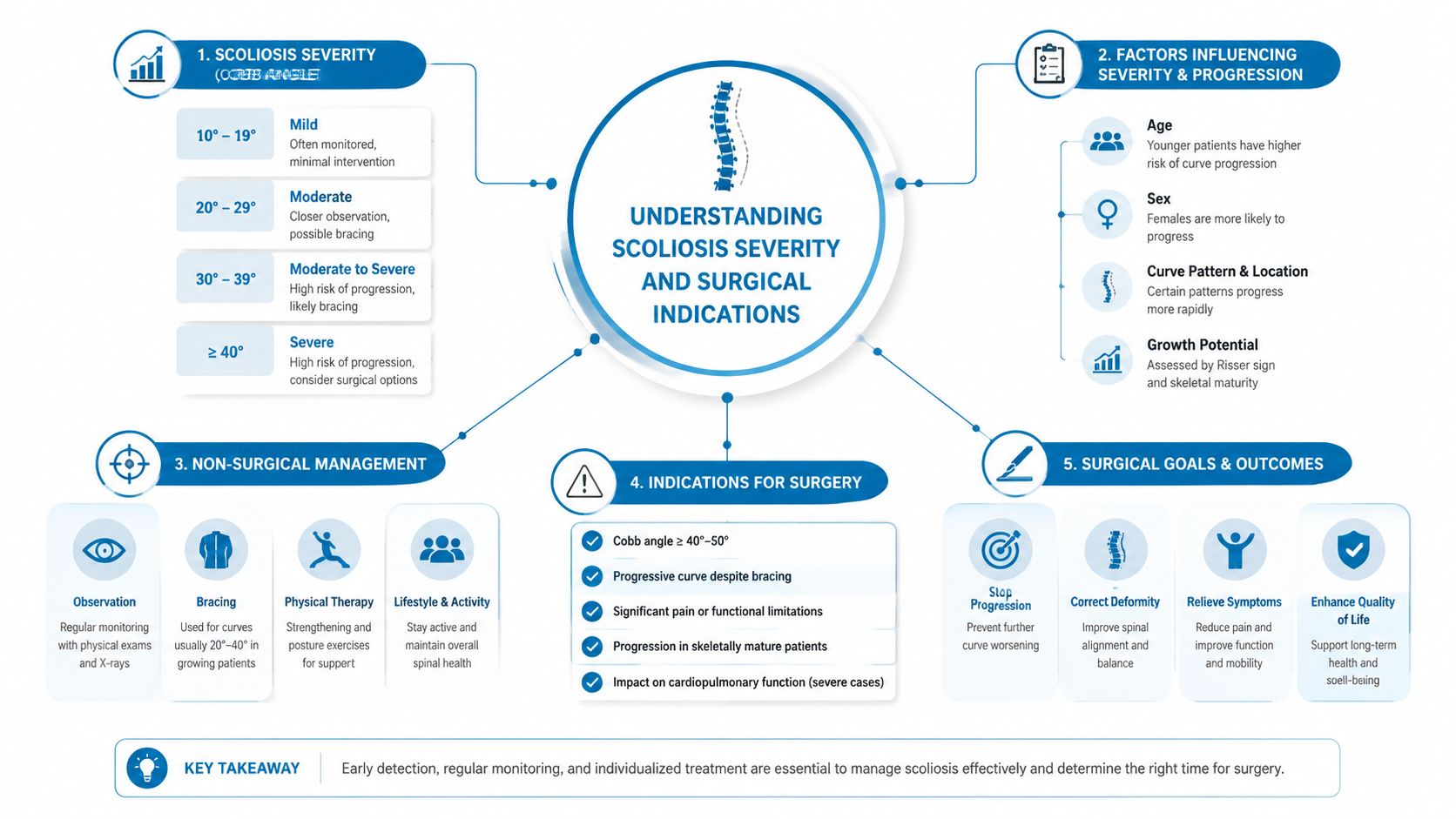
The spine can be compared with a tower. A slight lean may remain stable and require observation. A progressing lean with damaged supports, uneven loading, and symptoms may need structural reinforcement. Scoliosis assessment follows a similar logic. The Cobb angle describes the curve on an X-ray, but the surgical decision also depends on progression, flexibility, alignment, symptoms, neurologic findings, and the patient's physical demands.
The Cobb angle is measured between selected vertebrae that define the upper and lower ends of a curve. It gives clinicians a consistent way to track change. It doesn't, by itself, predict pain or determine whether surgery is necessary. Two people with similar measurements can have very different symptoms and functional goals.
Curve type changes the treatment logic
Adolescent idiopathic scoliosis develops during growth without an identified underlying cause. The key concern is often progression before skeletal maturity. Bracing or observation may be appropriate for less severe or stable curves, while a progressive curve approaching the surgical range may prompt a fusion discussion.
Adult degenerative scoliosis usually involves age-related changes in discs, joints, and vertebrae. The deformity may combine coronal curvature with loss of sagittal balance, stenosis, nerve irritation, and back pain. In these cases, the operation may need to address both the curve and the conditions that make standing or walking difficult.
A specialist may also evaluate congenital, neuromuscular, or previously treated curves. Each category changes the risks, the available correction, and the need for multidisciplinary planning.
When specialists usually consider surgery
Surgery is commonly discussed when one or more of these conditions are present:
- Progressive deformity: The curve continues to worsen despite appropriate nonoperative care or observation.
- Significant symptoms: Pain, fatigue, imbalance, or reduced endurance interferes with work, self-care, sleep, or mobility.
- Neurologic compromise: Numbness, weakness, radiating pain, or changes in walking suggest nerve or spinal cord involvement.
- Structural severity: Curves in the range of 40 to 50 degrees may enter a surgical discussion, depending on age, progression, skeletal maturity, symptoms, and alignment. This threshold comes from the clinical criteria summarized in the scoliosis surgery guidance.
The operation becomes more complex when the spine is rigid, the bone is weak, or the deformity extends across several regions. Some patients may require a spinal osteotomy, a controlled bone cut used to restore alignment in selected rigid deformities. A detailed explanation of that procedure is available through spinal osteotomy information.
Comparing Scoliosis Surgery Techniques and Approaches
No technique is universally superior. The surgeon chooses an approach based on the curve pattern, flexibility, skeletal maturity, bone quality, nerve compression, sagittal balance, and the amount of correction required. A procedure that suits a flexible adolescent curve may be unsuitable for an adult deformity with stenosis and forward imbalance.
Posterior spinal fusion is a common foundation for structural correction. The surgeon approaches the spine from the back, places instrumentation, prepares the fusion surfaces, and uses bone graft to encourage the vertebrae to grow together. This approach can correct and stabilize a broad range of curves, but the fusion sacrifices motion across the treated levels and recovery can be demanding.
An anterior or combined approach may be selected when the surgeon needs access to the front of the spine, disc spaces, or a rigid curve. Interbody work can help restore disc height and alignment, while a posterior construct adds fixation and correction. Combined procedures may be appropriate when one approach alone cannot meet the alignment goal.
Minimally invasive and lateral interbody techniques use smaller access corridors and may preserve more posterior muscle. Evidence summarized in a systematic review found a mean Cobb-angle decrease of 9.5 degrees after minimally invasive lumbar interbody fusion, and reviews describe long-term clinical improvement comparable to open surgery in selected settings, with lower morbidity and complication rates in some patients. The same evidence also supports caution: minimally invasive methods may not match open correction for every curve pattern. These findings are discussed in the systematic review of adult deformity techniques.
Vertebral body tethering is a fusionless, growth-modulating option for selected skeletally immature patients. NICE guidance describes its use for patients aged 8 to 17 with flexible curves, commonly with Cobb angles up to 60 degrees that bend down to 30 degrees or less. It isn't a general replacement for fusion, especially in adults or patients whose growth is nearly complete.
Scoliosis surgery techniques at a glance
| Technique | Best For | Correction Potential | Recovery Considerations |
|---|---|---|---|
| Posterior spinal fusion | Many structural curves requiring durable stabilization | Strong correction and control across planned fusion levels | Substantial recovery, permanent fusion across treated segments |
| Anterior or combined surgery | Rigid curves, disc-space reconstruction, or complex alignment goals | Can combine anterior release or interbody correction with posterior fixation | More extensive planning and recovery when approaches are combined |
| Minimally invasive interbody surgery | Selected adult deformities with suitable anatomy and alignment goals | Can improve disc height and reduce Cobb angle, but correction varies by curve | Smaller access corridors may reduce tissue disruption, yet staged or additional procedures may be needed |
| Vertebral body tethering | Selected skeletally immature patients with flexible curves | Growth modulation may preserve motion in appropriate candidates | Requires continued monitoring, with possible complications or unplanned reoperation |
For adults seeking information about stabilization, spinal fusion treatment can help clarify what fusion does and why its extent matters. The label of a technique should never replace a discussion of the intended correction and the functional problem being treated.
What the Evidence Shows About Outcomes and Complications
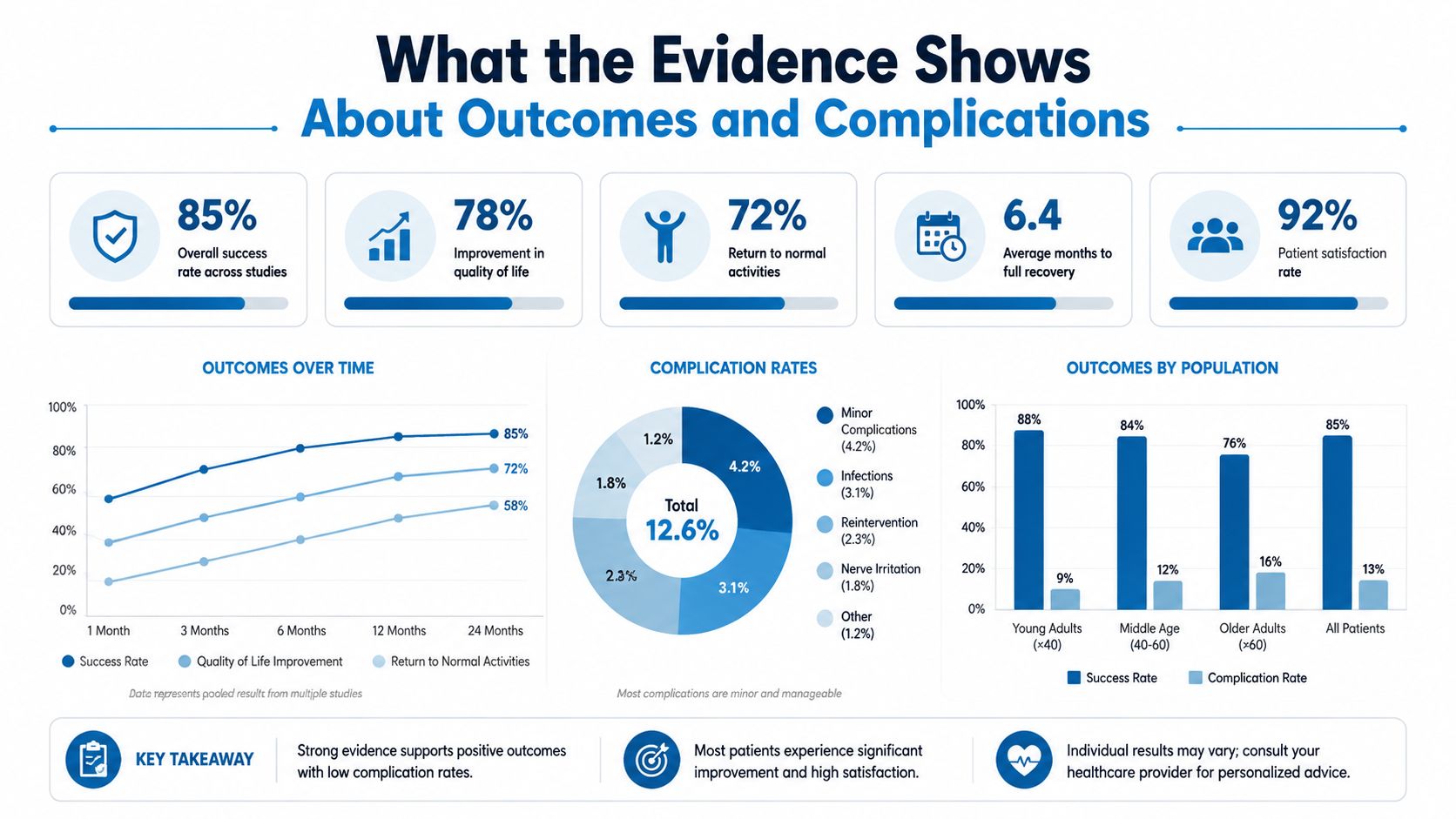
The best evidence presents scoliosis surgery as a trade-off, not a guarantee. A large systematic review of adult scoliosis surgery included 2,188 patients and found a mean major-curve correction of 26.6 degrees, representing an average 40.7% reduction in curvature. Follow-up averaged 3.6 years, and the review found a mean improvement of 15.7 points in the Oswestry Disability Index among patients with available data. These results are reported in the systematic review of adult scoliosis surgery outcomes.
The numbers describe average results across varied patients and operations. They don't predict what one individual will experience. A flexible curve with good bone quality may respond differently from a rigid, multiplanar deformity in an older patient with medical comorbidities.
The risk figures deserve equal attention
The same review reported 897 complications among 2,175 patients, a 41.2% complication rate, and 319 pseudarthroses among 2,469 patients, or 12.9%. Pseudarthrosis means that the intended fusion doesn't become solid. It can contribute to persistent pain, implant stress, loss of correction, or revision surgery.
A separate evidence summary described perioperative adverse events in more than 40% of adult scoliosis cases and pseudarthrosis in about 13%, reinforcing why fixation planning, fusion length, and bone-quality optimization matter. The review also emphasized that decompression alone usually produces little Cobb-angle change compared with fusion-based deformity correction when the goal is to realign the spine. Further discussion appears in the adult scoliosis surgical evidence review.
What patients should ask about their own risk
Population-level data provide context, but a consultation must translate that context into an individual plan. Useful questions include:
- What problem is the operation treating? Pain from nerves, mechanical back pain, imbalance, progression, or several issues may require different strategies.
- How much correction is necessary? More correction isn't automatically better if it increases mechanical stress or risk.
- What could cause nonunion? Bone density, smoking status, nutrition, medication use, and construct design may affect fusion healing.
- What happens if symptoms persist? The plan should distinguish expected postoperative pain from signs of infection, nerve problems, hardware issues, or nonunion.
A surgical recommendation is strongest when the predicted functional benefit is specific. “The spine will be straighter” is incomplete. “The operation aims to improve standing tolerance and relieve nerve compression, while preserving safe alignment” gives the patient a meaningful basis for consent.
Bridging the Gap Between X-Ray Results and Daily Function
A straighter spine and a better life are related, but they aren't identical outcomes. X-rays measure alignment, curvature, implant position, and fusion progress. They don't directly measure whether a person can walk through a grocery store, sit through a workday, sleep comfortably, or participate in family activities.
Evidence in adolescent idiopathic scoliosis shows a similar distinction. Fusion reliably improves pain, self-image, and satisfaction, while long-term functional gains are less consistent. One review found that function was the only SRS-22 domain that didn't clearly exceed the minimally clinically important difference after 60 months, as reported in the review of long-term scoliosis outcomes.
Why correction may not solve every limitation
Pain can come from several sources, including discs, facet joints, muscles, nerves, and areas outside the curved segment. Surgery may correct the deformity without eliminating pain generated by another condition. Likewise, weakness from long-standing nerve compression may recover incompletely even after the nerve has been decompressed.
Adults also bring different expectations than adolescents. An adolescent may care most about self-image and avoiding progression during growth. An adult may care more about walking, standing, work capacity, sleep, or independence. Those goals should shape the operative plan and the way success is measured.
Functional goals should be documented before surgery
Patients and clinicians can make expectations more concrete by recording baseline abilities. A useful discussion might include:
- Walking: Distance, pace, need for rest, and whether leg symptoms limit movement.
- Standing: Tolerance for cooking, showering, shopping, or work.
- Sitting and sleep: Positions that trigger pain and whether discomfort causes repeated waking.
- Work and caregiving: Lifting demands, commuting, household responsibilities, and available support.
- Personal priorities: Exercise, travel, social activities, or moving without fear.
The practical test: A successful operation should be judged against the patient's starting limitations, not only against the postoperative X-ray.
Adult scoliosis surgery can produce meaningful radiographic and clinical improvement, but the complication burden remains substantial in older populations. That is why patient selection drives results more than a technique label. The right procedure is the one that addresses the dominant source of disability at an acceptable level of risk.
Navigating Recovery and Long-Term Follow-Up
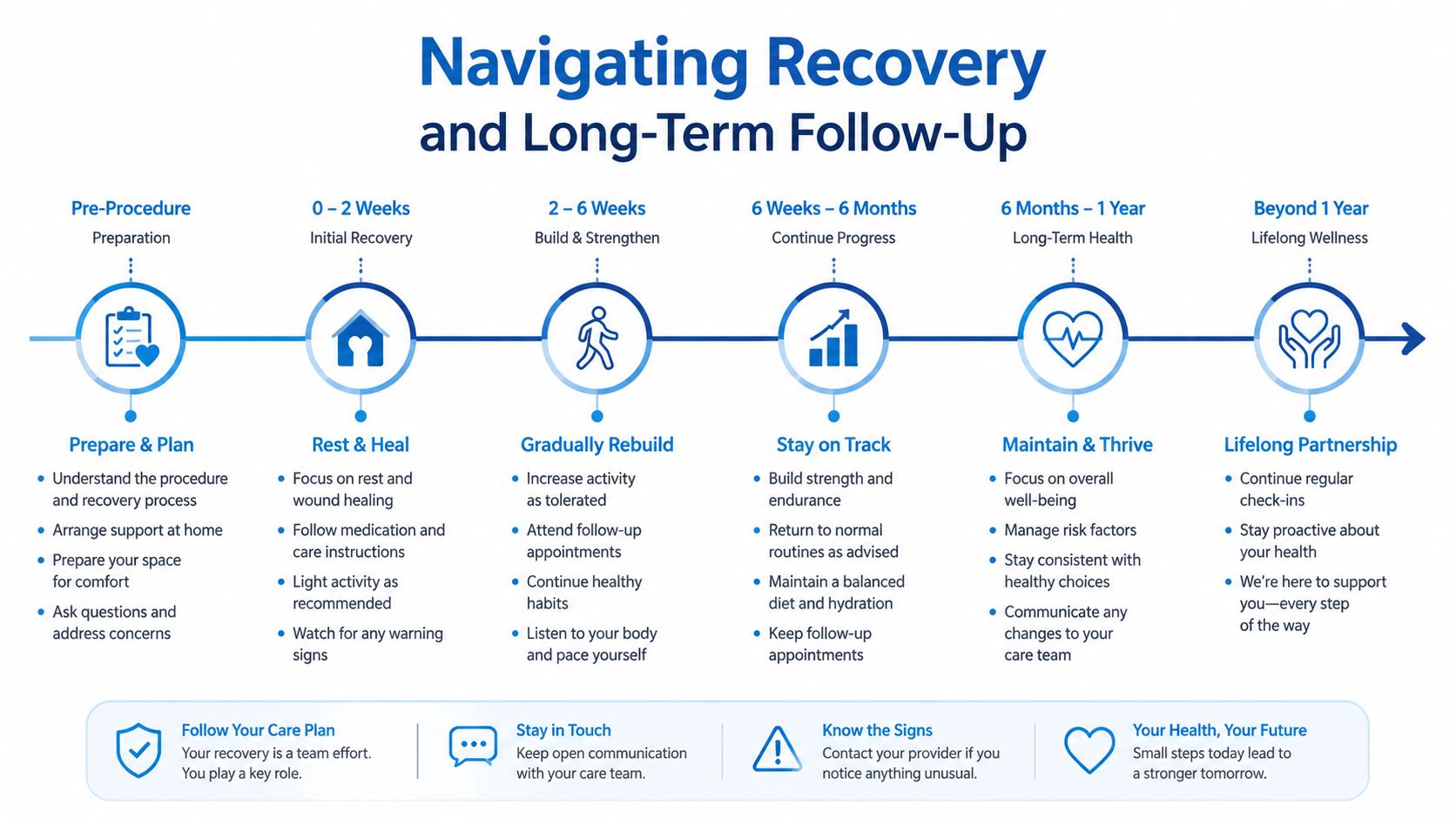
Recovery begins with safe mobilization, pain control, neurologic monitoring, and protection of the incision. The hospital team typically checks strength and sensation, helps the patient get out of bed, and adjusts medication so movement is possible without excessive sedation. The exact discharge plan depends on the operation, medical condition, home support, and ability to walk safely.
The early phase requires structure
At home, patients often need help with meals, transportation, bathing, shopping, and household tasks. Bending, lifting, and twisting restrictions are common early precautions, but the surgeon should define them for the specific construct. Walking is generally introduced gradually, while formal therapy is added when the treating team believes the healing spine can tolerate it.
The first follow-up visits assess the wound, pain pattern, neurologic status, mobility, and early imaging. Patients shouldn't use improved comfort as proof that the fusion is complete. Bone healing continues after the initial surgical pain fades.
Activity returns in stages
Driving, lifting, work, and exercise depend on medication use, reaction time, strength, wound healing, restrictions, and the type of job. Desk work may resume before heavy physical work, but prolonged sitting can still be uncomfortable. Sports and strenuous exercise require explicit clearance rather than a calendar-based assumption.
Patients should contact the surgical team promptly for worsening weakness or numbness, new bowel or bladder changes, increasing drainage, fever, spreading redness, severe escalating pain, shortness of breath, or a sudden change in wound appearance. General information about persistent or worsening symptoms is available in this discussion of pain after back surgery.
Long-term follow-up matters even when daily symptoms improve. Imaging can show whether alignment and instrumentation remain stable, while clinical visits help identify adjacent-segment problems, nonunion, or functional issues that an X-ray alone can't explain. Recovery is best viewed as a continuing process of gradual conditioning, reassessment, and adjustment.
How a Multidisciplinary Center Approaches Patient Selection and Care
A complex scoliosis decision benefits from more than a single measurement or a single specialty. A multidisciplinary center can review medical history, physical findings, full-spine imaging, bone quality, neurologic symptoms, prior operations, work demands, and the patient's own definition of success. That process may lead to surgery, but it may also support targeted pain procedures, rehabilitation, observation, or a less extensive operation.
Interventional Pain Management and Ortho-Spine Center provides care across pain management, orthopedics, anesthesiology, and spine surgery, with options ranging from interventional treatment to minimally invasive and complex surgical techniques. For patients evaluating a practice, operational details also affect the experience, so resources such as hospital front desk KPIs and training can offer useful context about communication, scheduling, and patient flow.
The consultation should end with a clear explanation of the structural problem, the functional target, the proposed procedure, alternatives, recovery demands, and risks. That individualized reasoning is more useful than choosing a technique because it sounds newer or less invasive.
Interventional Pain Management evaluates scoliosis alongside pain generators, neurologic findings, alignment, and daily functional goals, then discusses nonoperative, minimally invasive, and surgical paths when appropriate. Patients in New Jersey and Staten Island can visit Interventional Pain Management to request a spine evaluation and discuss whether scoliosis correction surgery fits their condition and priorities.