
The morning after a permanent spinal cord stimulator implant, a patient may be lying carefully on one side, feeling soreness at the back incision and the generator pocket, while asking a deceptively simple question: “When can normal life start again?” The safest answer isn't a single date. Spinal cord stimulator surgery recovery runs on several clocks, and each clock controls a different decision.
Incision healing determines when the dressing can come off and when bathing is safe. Lead stabilization determines when bending, twisting, reaching, and lifting become reasonable. Medication effects determine when driving is safe, while a separate function clock governs work, exercise, and household tasks. The sections below walk through those clocks in practical terms, with particular attention to what can hurt, what should improve, and what deserves a prompt call to the implanting team.
Table of Contents
- What Recovery After a Spinal Cord Stimulator Actually Involves
- Before Surgery Day, Know the Trial and Permanent Implant Stages
- The First Two Weeks After Implant
- Why the First Six Weeks Are About Lead Stabilization, Not Pain
- Weeks Three Through Six, Resuming Activity
- Device Programming and Follow-Up Appointments
- Returning to Work, Driving, and Exercise Safely
What Recovery After a Spinal Cord Stimulator Actually Involves
A patient who wakes up the day after implantation often notices incisional soreness, bruising, swelling, tightness, or pulling around the generator and lead sites. That discomfort can feel different from the pain that led to the implant, and it may be more noticeable during the first several days. Mild soreness that gradually settles usually fits the healing process, but worsening pain, drainage, fever, new weakness, loss of bladder or bowel control, or a severe headache after a cervical procedure needs urgent medical assessment.
Four clocks, four decisions
The first clock is incision protection. It governs dressing care, showering, and the need to keep the surgical areas dry. Cleveland Clinic guidance notes that patients generally need to avoid bending, heavy lifting, stretching, and intense exercise after both the trial and permanent implant, and that healing around the generator and leads can take four to six weeks after permanent implantation. The same guidance emphasizes avoiding swimming, hot tubs, and baths until the care team clears those activities, as described in this clinical overview of biologic complications after cylindrical-lead implantation.
The second clock is lead stabilization. The patient may feel capable of more before the leads are secure, which is why the absence of pain doesn't automatically mean the spine can tolerate lifting or twisting. The third clock is medication-related. Opioids, sedating muscle relaxants, and other alertness-impairing medicines can make driving unsafe even if the incisions look good.
The fourth clock is graded function. Walking usually returns before lifting, desk work before manual labor, and low-impact exercise before running or contact sport. Persistent pain after back surgery can also complicate the picture, so patients should distinguish the new surgical soreness from the earlier condition and review both during follow-up. Guidance about pain after back surgery can help place those symptoms in context.
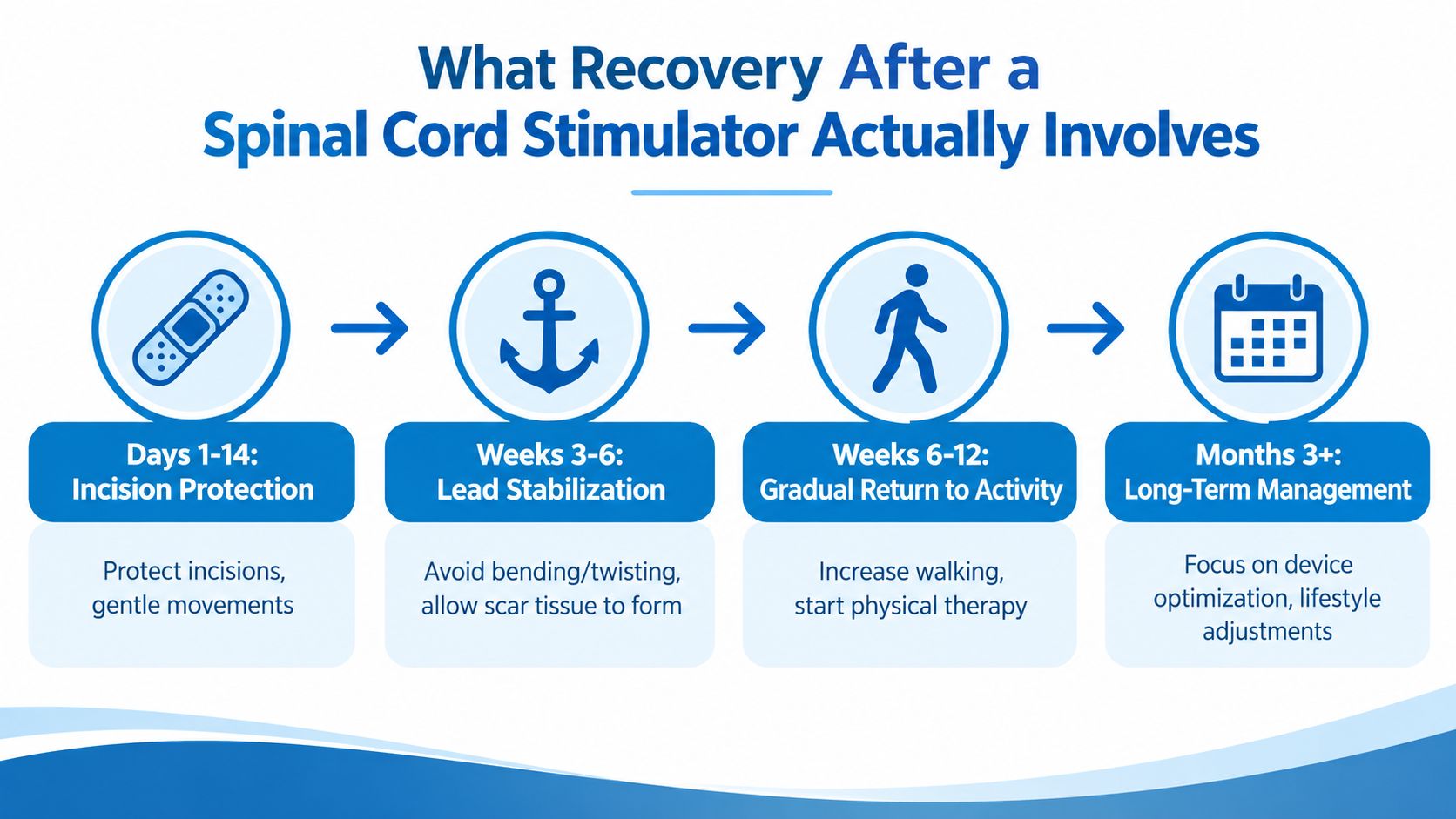
Practical rule: A calendar milestone matters less than the condition of the wound, the stability of the leads, the medication list, and the activity being attempted.
Programming adds another milestone. The device may require adjustments as symptoms and coverage change, so recovery isn't complete because the skin has closed. The meaningful endpoint combines wound healing, stable hardware, useful stimulation, and a controlled return to daily life.
Before Surgery Day, Know the Trial and Permanent Implant Stages
Spinal cord stimulation commonly has two distinct stages, and confusing them can create unrealistic expectations. The trial places temporary leads through the skin and connects them to an external generator for a short evaluation period. The permanent procedure places the leads and a pulse generator beneath the skin, often in the buttock or abdomen, creating a larger recovery obligation.
The trial can involve smaller access sites, but it still requires careful wound protection and motion control. Patients should ask how to keep the dressing dry, when it can be removed, whether the device remains active during the trial, and which symptoms require an after-hours call. The trial tests whether stimulation helps during ordinary activities, but it doesn't eliminate the need for a separate discussion about permanent surgery.
A permanent implant may involve more than one incision, a generator pocket, and tunneled leads. That means soreness when sitting, lying on the generator side, or wearing a tight waistband can be part of the early experience. Patients should arrange transportation, meals, and help with chores before the procedure, rather than assuming they can manage normally once they get home.
The instructions worth confirming
The implant team should provide written answers to these questions:
- Lifting: Is the limit 5 pounds, and for how long? University of Wisconsin aftercare guidance describes avoiding lifting above that limit and restricting bending, twisting, and overhead reaching while the leads heal. The postoperative spinal cord stimulator instructions also emphasize short walks and activity pacing.
- Movement: Which motions are prohibited, including reaching overhead, pushing, pulling, bending at the waist, or rotating to check a blind spot?
- Wound care: Who changes or removes the dressing, and when can showering begin?
- Driving: Which medicines prohibit driving, and what examination or movement clearance is required?
- Follow-up: When will the incision be checked, and when will programming begin?
| Factor | Trial stimulator | Permanent implant |
|---|---|---|
| Hardware | Temporary leads connected to an external generator | Implanted leads connected to a generator under the skin |
| Main purpose | Evaluate whether stimulation helps daily pain | Provide ongoing neuromodulation after an acceptable trial |
| Wound concerns | Small access sites still need protection | Incision and generator-pocket healing require broader precautions |
| Activity concern | Protect temporary leads and dressing | Protect implanted leads, generator, and healing tissue |
| Planning question | How will the trial be removed and monitored? | What are the lifting, bathing, driving, and follow-up rules? |
Patients should also review prescribed medicines with the surgical team. Medication changes, including stopping a drug before implantation, shouldn't be made independently. For an explanation of the treatment itself and the difference between temporary testing and implantation, patients can review this overview of spinal cord stimulation.
The First Two Weeks After Implant
The first 14 days are primarily about protecting the wound and preventing unnecessary stress on the leads. A patient may feel tired, sore, and less mobile than expected, especially when the generator pocket is pressed by a chair, mattress, waistband, or seatbelt. That doesn't mean the procedure has failed. It does mean the day should be organized around short periods of movement, comfortable positioning, medication safety, and careful observation.
Daily wound care
Keep the dressing clean and dry unless the surgical team has supplied different instructions. Don't apply creams, powders, or adhesive products over an unhealed incision. Inspect the visible area daily for spreading redness, warmth, increasing swelling, foul-smelling drainage, wound separation, or fever, and report concerning changes rather than waiting for the next routine appointment.
Showering and dressing removal are individualized. Until the clinic confirms that the skin has sealed, soaking in a bath, pool, or hot tub is generally avoided. This protects both the incision and the implanted hardware during a period when the skin barrier is still vulnerable.
Movement without strain
Short, level walks are usually preferable to prolonged bed rest or sitting. The patient can walk around the home first, then add distance gradually, stopping if dizziness, increasing pain, drainage, or new neurologic symptoms appear. Walking keeps the body moving without the same lead stress caused by bending, twisting, forceful reaching, or lifting.
Comfort without compromise: A pillow under a supported surgical area or between the shoulder blades may reduce pressure, but remaining in one position for hours can increase stiffness. Change position carefully, keeping the spine as neutral as possible.
The lifting limit is often 5 pounds, but the implanting clinician's written restriction controls. A full grocery bag, laundry basket, vacuum cleaner, pet, or small suitcase can exceed that limit. Patients should also minimize pushing, pulling, overhead reaching, and repeated trips up and down stairs when help is available.
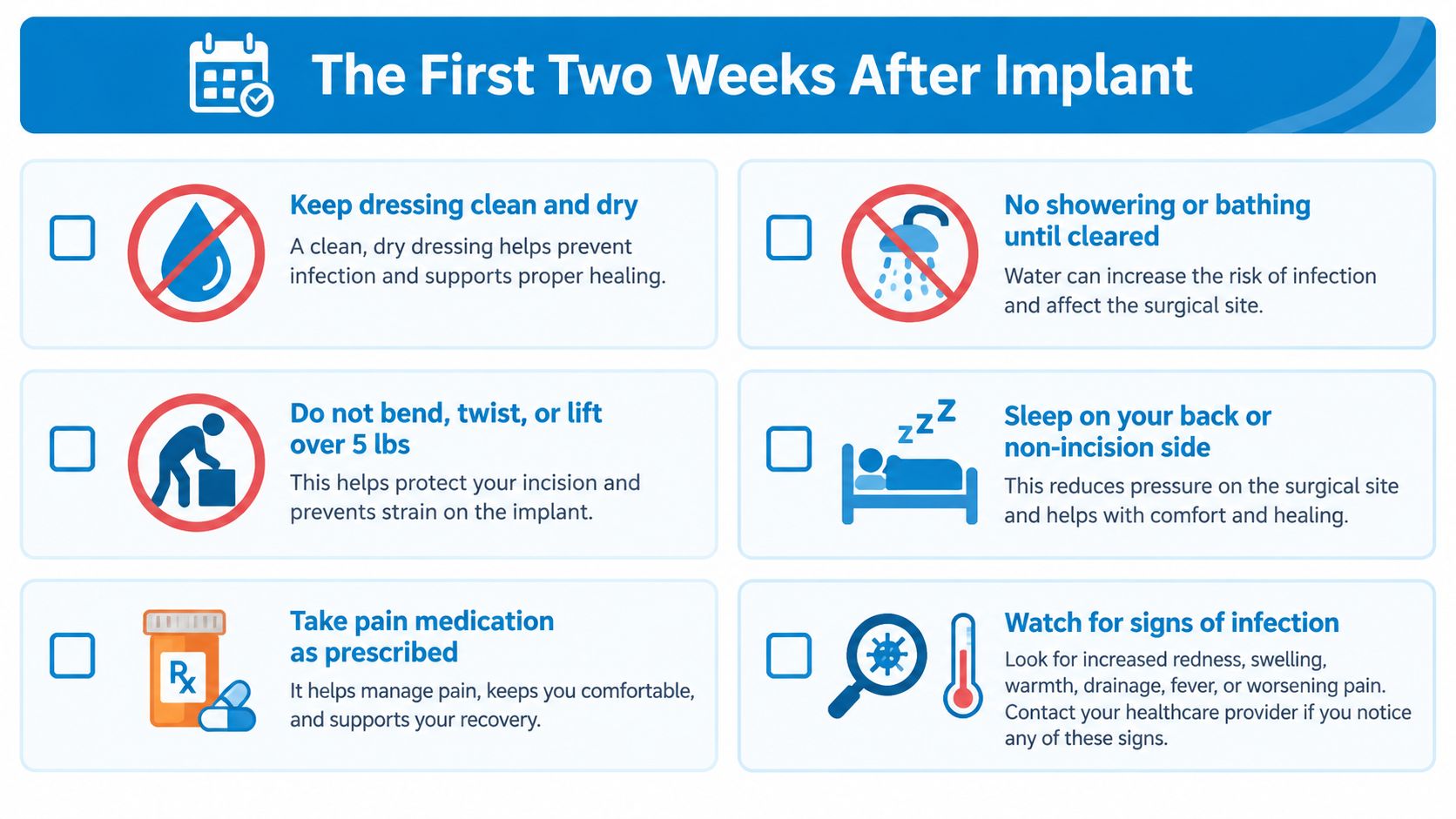
Prescribed pain medicine should be taken exactly as directed. Driving isn't safe while opioids, sedating muscle relaxants, or other medicines impair alertness, and the surgical team should confirm clearance before the patient gets behind the wheel. A prompt call is appropriate for fever, drainage, increasing redness, severe or escalating pain, new weakness, or new numbness.
Why the First Six Weeks Are About Lead Stabilization, Not Pain
Patients often judge recovery by pain alone. That can be misleading. The incisions may feel better while the leads still need protection, and a patient may have tolerable soreness but still risk stressing the implant with a deep bend, sudden twist, heavy lift, or overhead reach.
The complication logic behind restrictions
The conservative rules exist because hardware problems can change the entire recovery course. Reviews have reported overall spinal cord stimulation complication rates in the range of 30% to 40%, while a 2023 review cited 31.9% to 43%; a separate 2026 meta-analysis reported that 24% of patients experienced at least one adverse event and 3% experienced at least one serious adverse event, as summarized in this published complication review.
Lead migration is repeatedly identified as the most common complication. Infection, hematoma, cerebrospinal fluid leak, and neurologic injury occur less often but can be clinically important. These risks explain why early instructions focus on protecting the implant, not on making the patient comfortable.
Bending and twisting can transmit force through the spine and the lead pathway. Lifting adds trunk and shoulder effort, while overhead reaching can combine extension, rotation, and traction. Avoiding those movements gives the tissue around the leads time to heal and helps reduce the chance that the lead position changes before the implant is stable.
What to watch beyond pain relief
A 2026 systematic review and meta-analysis reported 34.5 adverse events per 100 patient-years overall, with lead migration occurring more often than infection, 7.05 versus 2.82 events per 100 patient-years, and revision procedures occurring more often than explantations, 6.31 versus 2.93 events per 100 patient-years. Those figures come from device-complication benchmarking data, and they show why follow-up must assess coverage and hardware, not just pain scores.
A separate cohort found device infection in 3.11% of patients within 12 months, and one review reported a median infection onset of 27 days after implantation, from the same source. In practical terms, a wound that becomes increasingly red, warm, swollen, painful, or wet deserves attention even if the patient initially felt well.
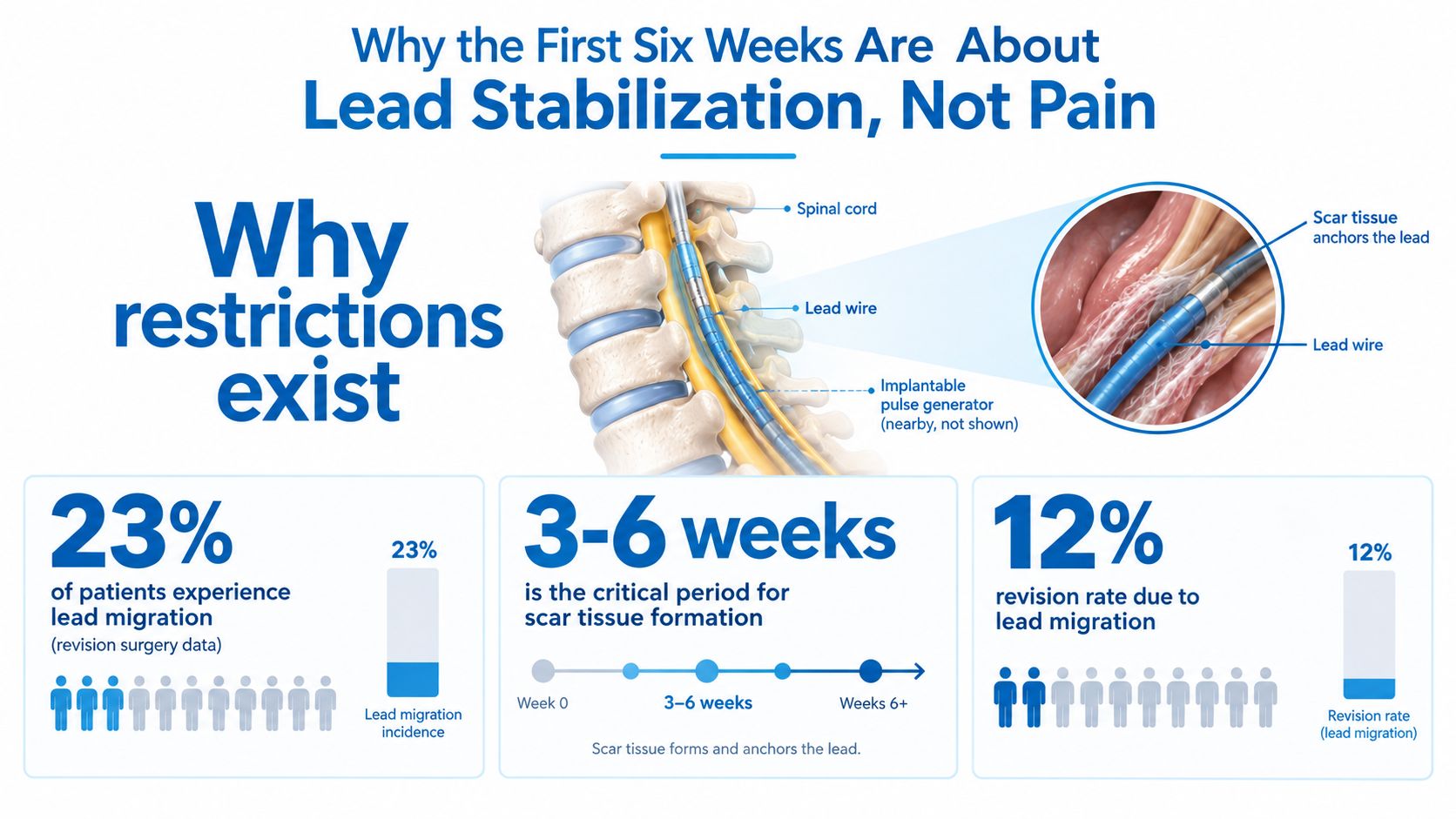
The purpose of the first six weeks isn't to test how much the patient can tolerate. It is to protect the implant while the care team identifies infection, migration, loss of coverage, or other problems early enough to address them.
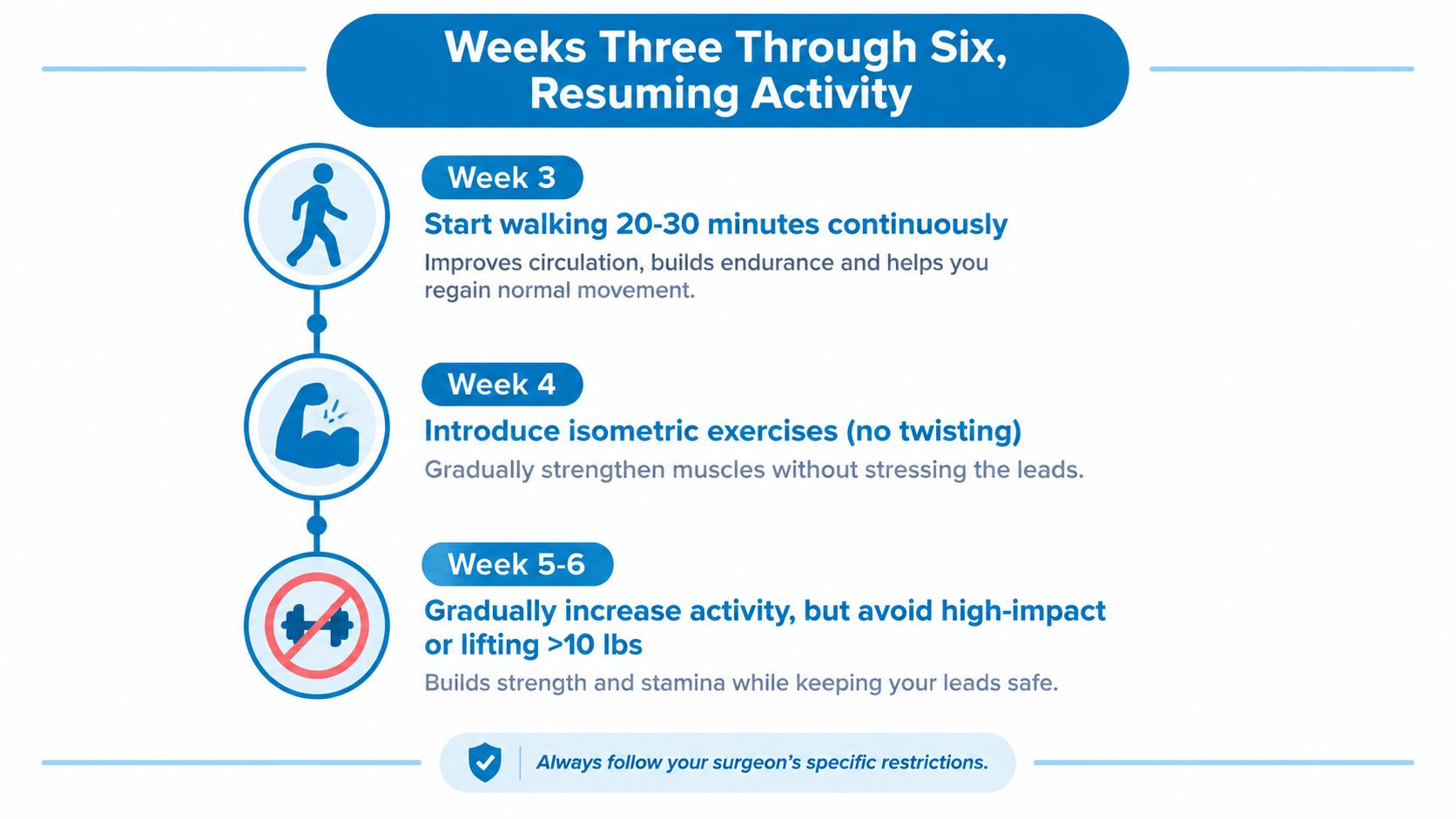
Weeks Three Through Six, Resuming Activity
Weeks three through six are when many patients feel tempted to accelerate. Incisional pain may be easing, sleep may be improving, and household tasks can seem harmless. The safer approach is to add one type of activity at a time, preserve neutral spinal movement, and treat a sudden pain increase or new stimulation pattern as a reason to pause.
A graded progression
During the third week, patients can often build walking gradually if the wound is closed and the clinician agrees. The focus should be on smooth, comfortable movement rather than speed, hills, or long outings. Gentle isometric activation may be appropriate when prescribed, but exercises involving spinal flexion, rotation, or forceful bracing should wait for clearance.
By the fourth week, a clinician may permit a stationary bike or similarly controlled low-impact activity, often with the stimulator managed according to the implant team's instructions. Short car rides may become reasonable when the patient can sit comfortably, turn safely, react quickly, and is no longer affected by sedating medicine. The calendar alone doesn't clear driving.
At the fifth and sixth weeks, activity can expand in carefully measured steps. Light resistance may be introduced only when the treating team permits it, and the patient should avoid assuming that a healed skin incision means the leads can tolerate heavy loads. Pool activity requires a fully sealed wound and explicit clearance because the risk relates to water exposure as well as exercise.
| Activity | What controls progression |
|---|---|
| Walking | Wound condition, balance, pain response, and fatigue |
| Core activation | Neutral spine, no twisting or deep flexion |
| Stationary cycling | Comfortable posture and clinician approval |
| Driving | Alertness, reaction time, medication effects, and safe trunk movement |
| Resistance exercise | Lead stability and the prescribed lifting restriction |
| Swimming or pool exercise | Complete wound closure and clearance |
A flare after a busier day doesn't always signal damage, but a sudden escalation in back or leg pain, new weakness, new numbness, or a change in stimulation coverage should stop the progression. The patient should contact the clinic rather than pushing through to preserve a planned milestone.
Device Programming and Follow-Up Appointments
A permanent stimulator isn't a set-it-and-forget-it treatment. The device may need programming changes as swelling settles, posture changes, pain patterns become clearer, and the patient resumes ordinary movement. Coverage that feels incomplete while sitting, standing, or walking can provide the programmer with useful information rather than proving that the implant isn't working.
Prepare information the programmer can use
A simple stimulation diary should connect symptoms with activities. The patient can record:
- Pain location: Note whether back, buttock, thigh, calf, or foot symptoms changed.
- Coverage quality: Record whether stimulation reaches the intended painful area and whether any region is missed.
- Posture effects: Compare sitting, standing, walking, and lying down.
- Unpleasant sensations: Describe new buzzing, painful stimulation, or coverage that shifts into an unwanted area.
- Function: List practical changes, such as walking farther, sleeping more comfortably, or completing a household task.
- Power needs: Bring charging questions and note any unusual battery behavior.
Specific descriptions help. “The device isn't working” gives the team little direction. “Coverage reaches the calf while standing but misses the foot while sitting” points toward a programming assessment and may help distinguish a setting issue from a hardware concern.
What follow-up is for
The first visits usually combine incision assessment, neurologic review, activity guidance, and programming. Patients should bring the remote or controller, medication list, symptom diary, and a short list of activities that remain difficult. Rechargeable systems should be charged as instructed before visits, and patients should ask the implant team about security screening, magnets, and device identification information before traveling.
The recovery process also benefits from coordinated pain management care, especially when the original pain condition, medication use, and rehabilitation plan all need review. Reprogramming may solve a coverage problem, but new weakness, fever, drainage, or sudden painful stimulation requires medical evaluation rather than a settings change alone.
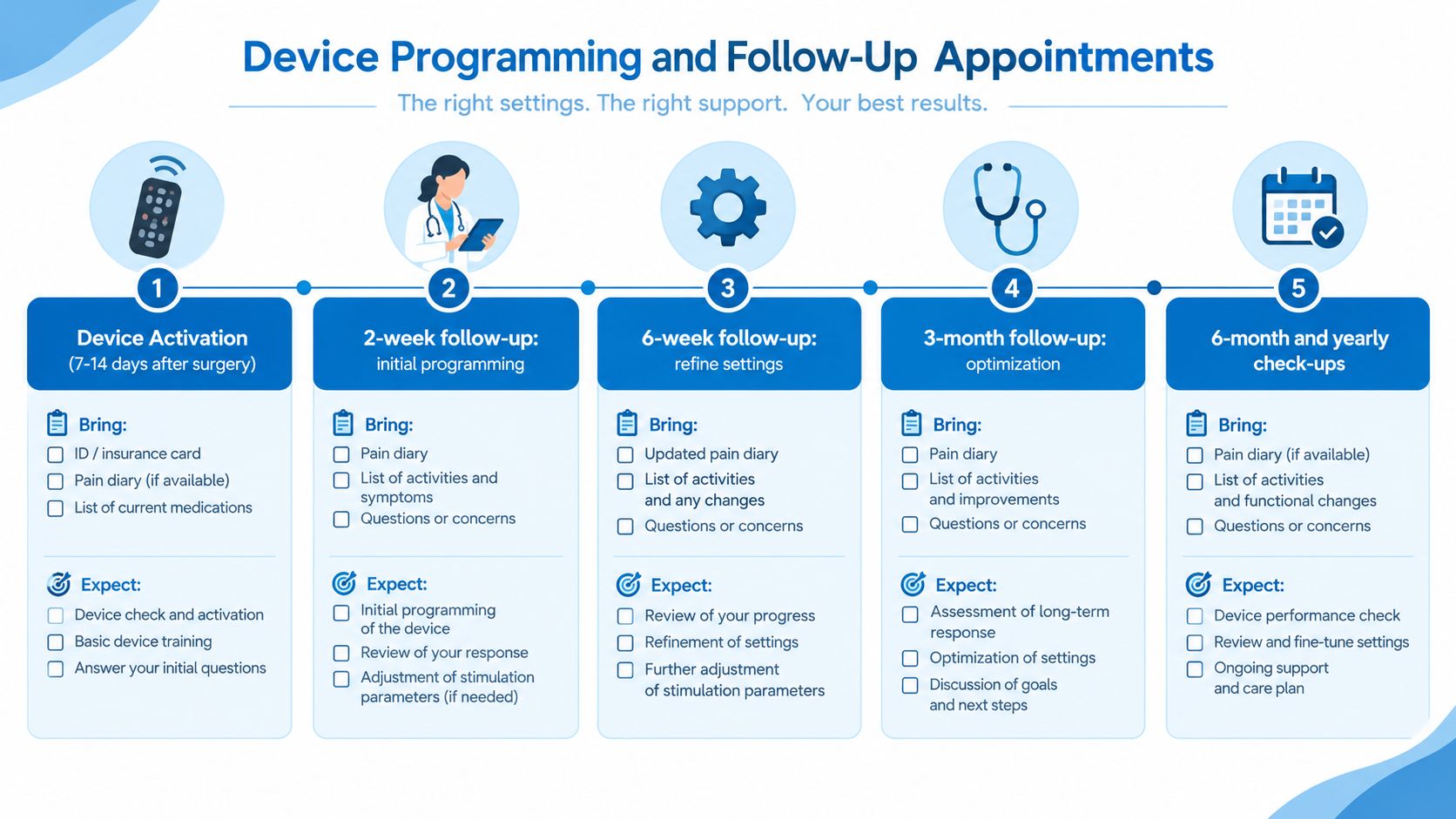
Bring function, not just a number: The most useful follow-up report explains what the patient can do, where symptoms remain, and how stimulation changes with posture.
Returning to Work, Driving, and Exercise Safely
Return-to-work decisions should match the physical job, not a generic recovery label. A desk employee may need only modified duties, frequent position changes, and strict avoidance of lifting or twisting. A worker who transfers patients, climbs, drives for long periods, uses vibrating equipment, or lifts repeatedly needs a more conservative plan because those tasks load the trunk and may challenge lead stability.
Match the ladder to the job
A practical work discussion separates four questions:
- Can the patient sit comfortably? Desk work still requires position changes and should not become uninterrupted sitting.
- Can the patient move without twisting? Reaching for files, checking blind spots, and entering a vehicle may expose restrictions.
- Can the patient meet the lifting rule? The assigned limit must include bags, tools, children, laundry, and work materials.
- Can the patient react safely? Driving and physical work require alertness, balance, and quick responses.
The treating surgeon or implant clinician should clear each stage. A patient shouldn't use a return-to-work date as permission to resume every duty in the job description.
Driving has two separate requirements. The patient must be free from medication-related impairment, and the patient must be able to sit, brake, turn, and check surroundings without unsafe pain or restricted movement. Even after sedating medicine has stopped, the surgical team should confirm that driving is appropriate.
Exercise and warning signs
Walking is usually the first exercise because it limits spinal loading. Controlled low-impact activity can follow when the wound is closed and the clinician approves it. Swimming must wait until the incision is fully sealed and cleared. Running, golf swings, yoga, contact sport, heavy resistance training, and vibration-heavy activity generally require a later individualized decision because they combine impact, rotation, flexion, or traction.
A same-day call is appropriate for sudden loss of stimulation coverage, new weakness or numbness, fever, wound drainage, or swelling that expands. Fever with concerning wound changes, loss of bladder or bowel control, or rapidly worsening neurologic symptoms may require emergency assessment. Device-related recovery can include troubleshooting or revision if hardware shifts or infection develops, so waiting for the next appointment isn't the safer choice when warning signs appear.
The useful question isn't “Which week is normal?” It's “Which task can be performed without medication impairment, wound stress, lead strain, or neurologic warning signs?”
A careful return protects the potential benefit of the implant. Patients should follow the written restrictions from their own surgical team when those instructions differ from general guidance, because lead location, generator position, procedure details, and job demands all affect clearance.
Interventional Pain Management offers evaluation, spinal cord stimulation care, and coordinated follow-up for patients who need a practical plan for wound healing, device programming, medication safety, and return to activity. Patients in New Jersey and Staten Island can visit Interventional Pain Management to request an assessment and discuss recovery guidance suited to their implant and daily demands.