

A patient with arthritis in both knees often reaches the same frustrating point: walking to the kitchen hurts, stairs require planning, and injections or physical therapy no longer provide enough relief. Both knees need replacement, but the harder question is whether to replace them together or schedule two operations. The answer isn't which procedure is “safer.” It depends on how much physiologic stress the patient can tolerate, what support exists at home, and whether one consolidated recovery is worth a more demanding early rehabilitation period.
Table of Contents
- Introduction to Bilateral Knee Pain and Your Surgical Options
- Understanding Bilateral Total Knee Arthroplasty and Its Two Timing Strategies
- Simultaneous vs Staged Bilateral Total Knee Arthroplasty Head to Head Comparison
- Recovery Differences Rehabilitation and Functional Outcomes
- Who Benefits Most From Each Approach Based on Patient Factors
- How to Decide Between Simultaneous and Staged Surgery With Your Care Team
- Next Steps and Personalized Guidance for Bilateral Total Knee Arthroplasty
Introduction to Bilateral Knee Pain and Your Surgical Options
Bilateral osteoarthritis can make every movement a negotiation. A patient may protect the right knee because it hurts more, only to overload the left knee and lose walking endurance altogether. When conservative treatment no longer controls pain or restores function, bilateral total knee arthroplasty becomes a reasonable surgical discussion. A broader overview of how osteoarthritis affects joints and mobility is available through this osteoarthritis resource.
The timing decision usually has two paths. Simultaneous bilateral total knee arthroplasty replaces both knees during one anesthetic and one hospitalization. Staged bilateral surgery replaces one knee first, then the other after an interval chosen around medical recovery, strength, mobility, and practical circumstances.
| Decision factor | Simultaneous surgery | Staged surgery |
|---|---|---|
| Anesthesia and admission | One anesthetic and one hospitalization | Two anesthetics and separate admissions |
| Early physical demand | Both knees recover together | One recovering leg can support the other |
| Rehabilitation | One concentrated, demanding phase | Two separate rehabilitation phases |
| Early medical stress | Greater overall surgical burden | Burden distributed between procedures |
| Hospital utilization | Often shorter total stay | More cumulative hospital exposure may occur |
| Best fit | Carefully selected, medically robust patients | Patients needing a more gradual recovery |
The trade-off is clear. Simultaneous surgery can consolidate rehabilitation and reduce total hospital time, but it places more demand on the heart, lungs, blood management, and mobility system at once. Staged surgery takes longer overall, yet it gives the care team an opportunity to assess recovery after the first operation before proceeding.
A patient should therefore avoid choosing based only on convenience or fear. The useful question is whether the individual profile supports a single intensive recovery or favors two controlled recoveries. By the end of a surgical consultation, the patient should be able to discuss cardiac and pulmonary history, clotting and anemia concerns, home assistance, work obligations, and rehabilitation goals with specific questions rather than general anxiety.
Understanding Bilateral Total Knee Arthroplasty and Its Two Timing Strategies
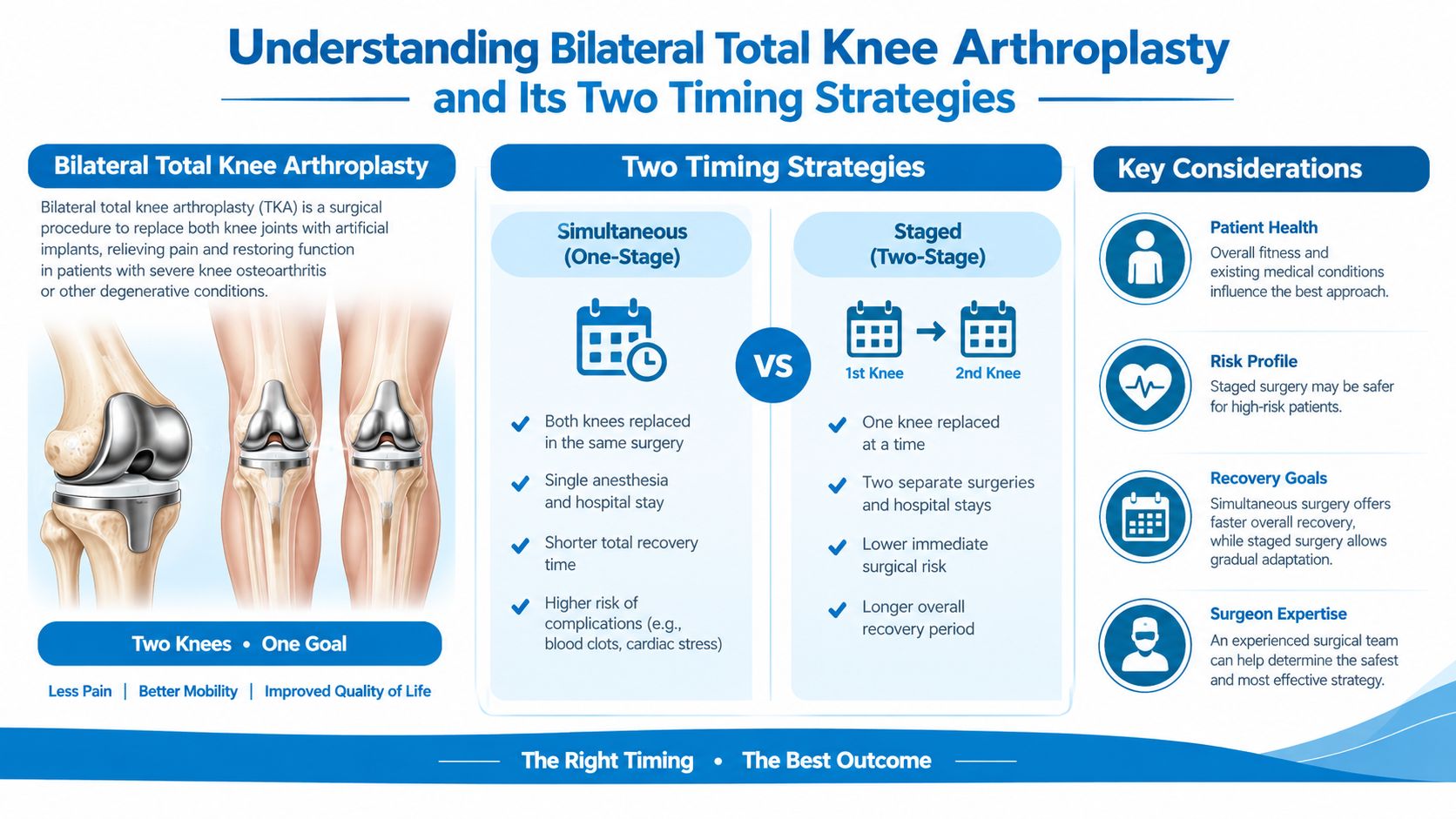
Bilateral total knee arthroplasty replaces damaged joint surfaces in both knees with artificial components. The surgeon removes diseased bone and cartilage, prepares the joint surfaces, and positions implants designed to restore alignment and movement. The operation is considered when both knees have advanced disease, pain limits ordinary activity, and nonoperative care no longer provides acceptable function.
The two timing strategies differ mainly in how the body absorbs the surgical burden.
- Simultaneous BTKA: Both knees are treated during one operative session under one anesthetic. The hospital team manages two surgical sites, blood conservation, pain control, mobility training, and discharge planning at the same time.
- Staged BTKA: One knee is treated first. The second operation is scheduled after the patient has regained enough strength and mobility and the medical team is satisfied with the first recovery.
How surgeons screen candidates
A surgeon doesn't decide timing from knee X-rays alone. The evaluation normally considers whether both knees create comparable disability, how much cardiopulmonary reserve the patient has, whether anemia or clotting concerns exist, and whether the patient can participate in intensive rehabilitation.
The medical history also matters because patient populations and surgical selection have changed over time. In a U.S. National Inpatient Sample analysis covering 153,259 bilateral TKA discharges from 1990 to 2004, bilateral TKA use more than doubled in the civilian population and almost tripled among women. Use declined by nearly 50% among patients aged 85 and older between the second and third study periods, illustrating how clinicians have increasingly treated age and medical risk as selection factors rather than afterthoughts, as described in the long-term analysis of bilateral TKA use.
What the logistics feel like
Simultaneous surgery simplifies scheduling, anesthesia coordination, and the overall treatment calendar. It also means the patient may need a walker, substantial assistance, and organized transportation while both legs are recovering.
Staged surgery creates two treatment episodes. The first recovery can reveal whether pain control, wound healing, cardiovascular stability, and physical therapy are progressing well before the second knee is addressed. Patients can review the broader surgical pathway through information on joint replacement surgery, but the final timing decision requires a patient-specific orthopedic and medical assessment.
Simultaneous vs Staged Bilateral Total Knee Arthroplasty Head to Head Comparison
A 72-year-old patient with controlled medical conditions, strong home support, and a goal of completing rehabilitation in one period may favor simultaneous BTKA. A patient with heart or lung disease, anemia, limited mobility, or little help at home usually fits staged surgery better. The decision is a selection problem based on medical reserve, age, and recovery goals, not a universal safety ranking.
Simultaneous BTKA reduces separate admissions, anesthetics, and treatment episodes, but places the full physiologic burden on the patient at once. Staged BTKA spreads that burden across two operations and lets the care team assess recovery after the first knee before scheduling the second.
A systematic review and meta-analysis reported higher pooled odds with simultaneous surgery for 90-day mortality, pulmonary embolism, venous thrombosis, and neurological complications. The cited odds ratios were 2.24, 1.69, 1.33, and 1.42, respectively. Mean hospital stay was 2.1 days shorter with simultaneous surgery.
| Outcome Measure | Simultaneous BTKA | Staged BTKA |
|---|---|---|
| Early mortality | Higher reported risk in pooled comparisons | Lower early mortality risk in pooled comparisons |
| Pulmonary embolism | Higher odds, OR 1.69 in the cited analysis | Lower comparative odds |
| Venous thrombosis | Higher odds, OR 1.33 in the cited analysis | Lower comparative odds |
| Neurologic complications | Higher odds, OR 1.42 in the cited analysis | Lower comparative odds |
| Ninety-day mortality | Higher odds, OR 2.24 in the cited analysis | Comparator strategy |
| Mean hospital stay | 2.1 days shorter in the cited analysis | Longer mean stay |
| Rehabilitation | One concentrated course | Two separate courses |
| Blood-loss burden | Greater bilateral exposure and transfusion concern | Burden distributed between operations |
| Infection and function | Often similar in pooled evidence | Often similar in pooled evidence |
Shorter hospitalization is an efficiency benefit, not proof that simultaneous surgery suits every patient. It favors patients who can tolerate a demanding early recovery and already have dependable postoperative support.
Blood loss also belongs in the decision. Reported perioperative transfusion rates were 33.2% for bilateral TKA versus 9.7% for unilateral TKA. Other cohort comparisons reported anemia from blood loss at 26.89% versus 14.86% and transfusion at 5.23% versus 0.67% for bilateral versus non-bilateral procedures, respectively, in the reported complication coverage. Patients with preoperative anemia or limited cardiopulmonary reserve should treat this burden as a major factor.
Staged surgery adds another operation, anesthesia, and recovery period. Some analyses also associate it with greater cumulative infection, mechanical-complication, readmission, and total-cost burdens. Its advantage is control: the first recovery provides information before the second knee is treated.
A 2023 published meta-analysis reported mortality of 0.66% for simultaneous BTKA versus 0.43% for staged BTKA, with a pooled mortality odds ratio of 1.55. Functional and infection outcomes were often similar. Choose simultaneous surgery for a medically fit patient who values one treatment calendar. Choose staged surgery when reducing the immediate physiologic load and testing recovery capacity matter more.
Recovery Differences Rehabilitation and Functional Outcomes
Recovery should guide the timing decision. After simultaneous surgery, both knees are painful, swollen, and weak together. Avoiding a second operation can simplify the overall treatment calendar, but the first days of walking, transfers, bathing, and stair use are harder because neither leg provides dependable support.
Staged surgery usually makes the first rehabilitation period easier to manage. The untreated leg can assist with transfers and walking while the operated knee regains motion and strength. The trade-off is a longer course with two preoperative preparations, two recovery plans, and a second interruption to work, travel, caregiving, or household responsibilities.
The practical differences at home
A patient choosing simultaneous surgery needs a discharge plan before the operation. Confirm these points with the care team and family:
- Caregiver availability: Who will help with meals, bathing, medications, and transfers while both knees recover?
- Transportation: How will the patient reach physical therapy and follow-up visits if driving is not possible?
- Home layout: Will stairs, narrow bathrooms, or low chairs create avoidable hazards?
- Therapy commitment: Can the patient complete frequent exercises and supervised rehabilitation despite soreness in both knees?
- Work demands: Does the job require standing, lifting, kneeling, or prolonged walking?
Staged surgery reduces the intensity of each individual recovery, yet it creates two periods away from work and two periods when family members may need to provide assistance. That difference matters for someone with limited leave, responsibility for another adult, or no one at home to help.
Function after healing
A difficult simultaneous recovery does not automatically mean worse final function. Functional outcomes have generally been similar between simultaneous and staged strategies in comparative evidence, even though the earlier mortality analysis favored staging.
The practical priority is completing rehabilitation safely and consistently. A physically active adult with dependable support may reasonably accept one demanding recovery to avoid repeating the process. A patient with frailty, impaired balance, or limited assistance may function better overall by preserving one stronger leg during the first operation.
The choice is therefore about recovery capacity, not scheduling convenience. Simultaneous surgery fits a patient who can manage bilateral weakness at home and wants one concentrated rehabilitation period. Staged surgery fits someone who needs a usable second leg during early therapy or wants the first operation to reveal how pain, mobility, and exercises are tolerated.
The best timing strategy is the one that allows the patient to complete rehabilitation safely, not the one that looks simplest on the scheduling calendar.
Pain management also needs a coordinated plan. Simultaneous surgery may require medication, icing, elevation, exercises, and monitoring for both knees at once. With staged treatment, the first operation gives the patient and clinical team a chance to adjust pain control and therapy instructions before the second recovery begins.
Who Benefits Most From Each Approach Based on Patient Factors
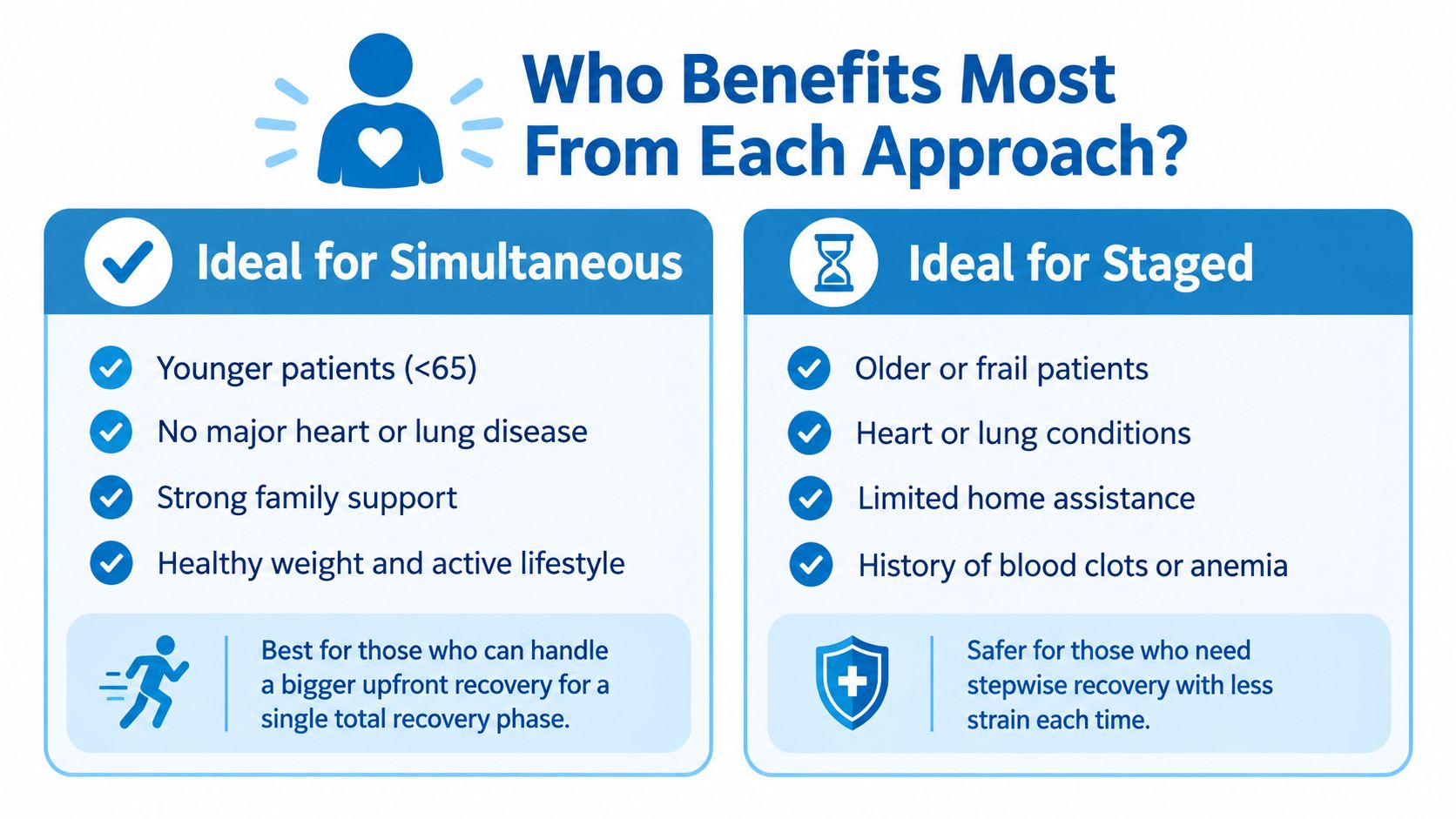
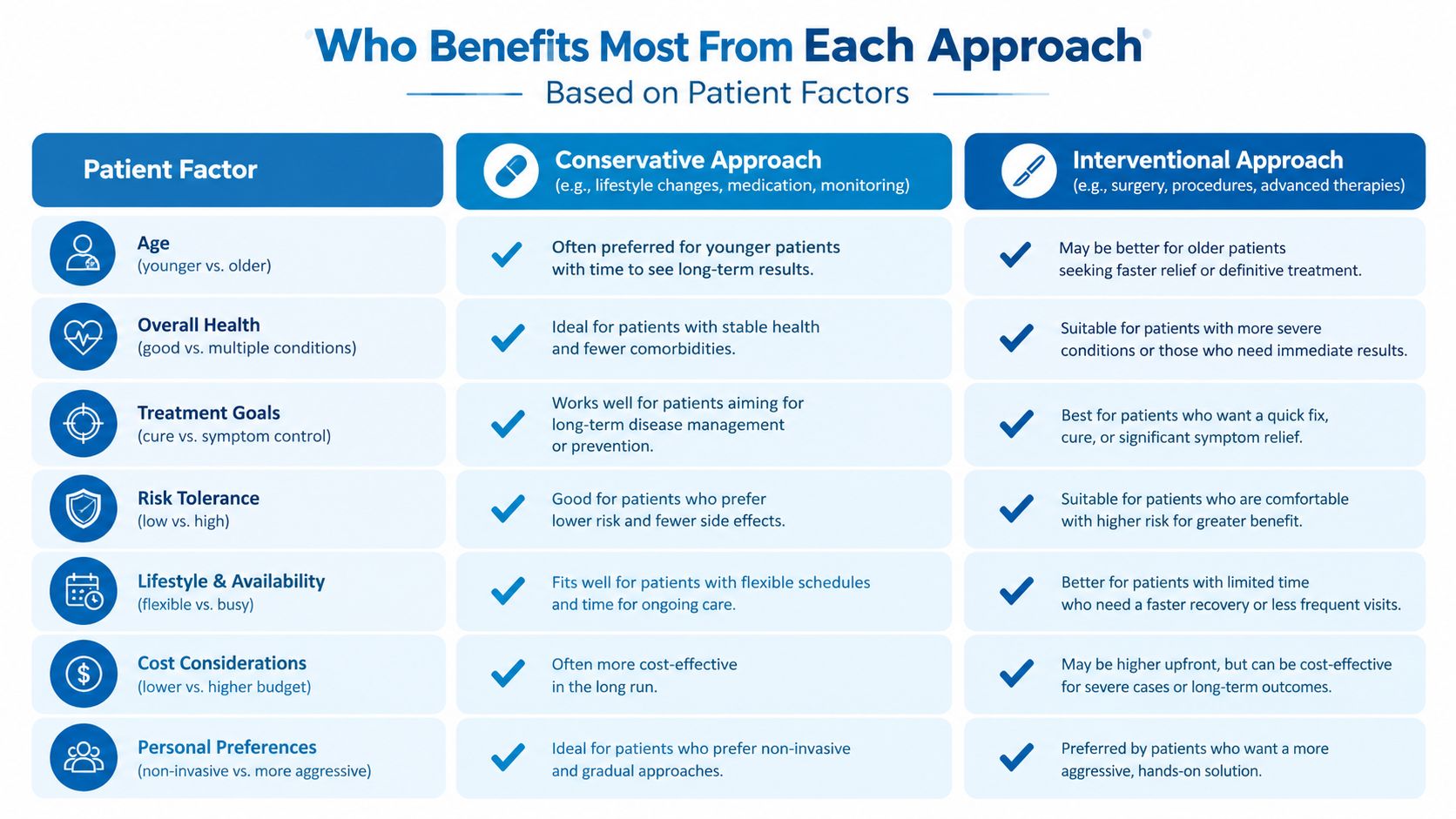
A simultaneous operation suits a patient who has strong physiologic reserve, severe disease in both knees, reliable help at home, and a clear preference for one concentrated recovery. Staged surgery is the better fit when medical conditions, frailty, limited assistance, or uncertainty about rehabilitation make bilateral weakness harder to manage.
Age matters, but it is not an automatic cutoff. A younger patient with significant heart or lung disease may be a poor candidate for one-session bilateral surgery. An older adult who remains active, medically stable, and well supported may still be considered. The decision should follow the patient's capacity, not age alone.
Use three primary axes: age and physiologic reserve, comorbidity burden, and recovery goals.
Profile favoring simultaneous surgery
A simultaneous approach is more reasonable when the patient has:
- Strong cardiopulmonary reserve: No major untreated heart or lung disease and enough capacity for a demanding bilateral recovery.
- Comparable disease in both knees: Both knees substantially restrict walking, work, sleep, or daily activities.
- Reliable support: Family or caregivers can assist with transfers, meals, transportation, and therapy.
- A clear preference for consolidation: The patient accepts greater early dependence to avoid a second operation and another separate recovery.
- A realistic rehabilitation plan: Adequate strength, balance, motivation, and access to therapy for bilateral exercises.
Consider the active adult whose two painful knees limit work and mobility, yet whose medical history and home support are dependable. This patient may benefit from completing treatment in one episode. The plan still requires blood-loss preparation, clot prevention, and close postoperative monitoring.
Profile favoring staged surgery
Staging is the stronger recommendation when the patient has:
- Frailty or limited reserve: Recovery from a major operation may be slow or unpredictable.
- Heart or lung disease: Existing cardiopulmonary conditions make concentrated physiologic stress less attractive.
- A clot or anemia history: Prior thrombosis, low blood counts, or bleeding concerns require particular caution.
- Limited home assistance: Living alone or lacking transportation can make bilateral impairment unsafe.
- A need to test recovery: The first operation shows how the patient handles anesthesia, pain, therapy, wound care, and daily mobility.
Blood management deserves attention because bilateral surgery can create a greater transfusion burden than unilateral treatment. Reported findings vary, but the coverage of bilateral TKA complications reinforces the value of assessing anemia before surgery.
The middle ground
A long delay is not always necessary. Short-interval staging can distribute the surgical burden while limiting the time spent with two painful knees. Set the interval according to wound healing, blood counts, mobility, medical stability, and available support.
The recommendation should change if the patient's profile changes. One patient may reasonably prioritize a single consolidated recovery, while another needs the first operation to preserve function, assess tolerance, and reduce the demands of the second.
How to Decide Between Simultaneous and Staged Surgery With Your Care Team
The consultation should produce a recommendation, not just a list of possibilities. A surgeon and medical team should identify the dominant risk in the individual case, then decide whether simultaneous surgery's efficiency outweighs its concentrated burden.
Patients should bring a complete medication list, prior surgical history, cardiac and pulmonary diagnoses, history of blood clots, prior anemia, and details about daily mobility. The team may also review imaging, physical examination findings, laboratory results, functional demands, and the home environment.

A decision checklist
- Medical reserve: Can the patient tolerate bilateral surgery, anesthesia, blood loss, and intensive early rehabilitation?
- Cardiac and pulmonary history: Are there conditions that make concentrated physiologic stress less attractive?
- Clotting and anemia risk: Has the team addressed prior thrombosis, low blood counts, or bleeding concerns?
- Home support: Who will help during the period when both knees are painful and weak?
- Functional priority: Does the patient need the fastest consolidated recovery, or a more predictable stepwise return to mobility?
- Work and caregiving: Would two recovery periods create an unacceptable burden, or would one intense recovery be impractical?
- Financial exposure: How will the patient manage separate admissions, rehabilitation, coverage rules, and potential readmissions?
- Surgeon and hospital capability: Does the treating center have the monitoring, rehabilitation coordination, and perioperative resources required?
A recent synthesis describes the central trade-off directly. Simultaneous BTKA may reduce hospital stay and total surgical time but has been associated with higher mortality, thromboembolic risk, neurologic complications, and transfusion. Staged surgery may carry higher infection, mechanical-complication, readmission, and total-cost burdens, so age, comorbidity burden, and recovery goals must drive the choice, as summarized in the recent synthesis of bilateral TKA timing.
Nonoperative care still has a role when surgery isn't immediately appropriate. Depending on the diagnosis and medical situation, a multidisciplinary practice may discuss rehabilitation, medication strategies, or interventions such as hyaluronic acid injections while the patient is optimized or deciding on timing.
Interventional Pain Management should be mentioned only as one possible care setting within that broader process. Its services include orthopedic evaluation, joint replacement care, pain management, anesthesiology, and coordinated review of medical history and imaging across New Jersey and Staten Island locations.
Next Steps and Personalized Guidance for Bilateral Total Knee Arthroplasty
There isn't one universally superior timing strategy for bilateral total knee arthroplasty. Simultaneous surgery can suit a medically fit patient with strong support and a clear preference for one concentrated recovery. Staged surgery usually deserves priority when age-related frailty, cardiopulmonary disease, clotting concerns, anemia, or limited home assistance makes bilateral early recovery harder to manage.
The next appointment should address four practical areas:
- Confirm the diagnosis: Review symptoms, examination findings, and imaging for both knees.
- Optimize medical risk: Identify correctable anemia, medication issues, uncontrolled conditions, and clotting concerns.
- Plan the recovery: Arrange therapy, transportation, caregiver help, equipment, and follow-up before the operation.
- Choose the interval: If staging is appropriate, base the second procedure on healing and function rather than an arbitrary calendar date.
A board-certified multidisciplinary team can connect noninvasive care, interventional treatment, orthopedic assessment, anesthesia planning, and joint replacement evaluation. Patients in New Jersey and Staten Island can seek a consultation that accounts for medical history, functional demands, lifestyle, and access to rehabilitation.
The right recommendation should leave the patient able to explain why a particular timing strategy fits the patient's health profile. That clarity is more valuable than choosing the shortest schedule.
Interventional Pain Management offers coordinated evaluation for joint pain, orthopedic conditions, and joint replacement planning, with care spanning conservative, interventional, and surgical pathways. Patients considering bilateral total knee arthroplasty can visit Interventional Pain Management to request a personalized consultation and discuss the timing strategy that fits their medical needs and recovery goals.