
A ride can feel perfect until the bike is back on the rack. Then the rider notices a hot ache behind the kneecap, a sharp spot on the outside of the knee, or stiffness that makes the walk to the car uncomfortable. By the next morning, stairs may hurt, yet the knee looked fine during the ride.
Knee pain after riding a bike is common, but it isn't explained by one universal mistake. The saddle, cleats, pedal technique, training load, hip control, ankle movement, and even the lumbar spine can all influence what the knee absorbs. A review of cyclist injuries found that the knee is the most affected joint in road-cycling overuse injuries, with published prevalence estimates ranging from roughly 36% to 62% among cyclists, while a study of 21,824 cyclists found that the knee represented 26.3% of reported overuse injuries and anterior knee pain represented 14.2% of all cycling-related overuse injuries (PubMed review and cyclist injury study).
The practical answer is rarely “stop riding forever” or “raise the saddle.” A sensible plan identifies the pain pattern, checks the kinetic chain, reduces the irritating load, makes measured fit changes, and adds rehabilitation when strength or control is part of the problem. Persistent symptoms may also require evaluation by a coordinated pain and orthopedic team, particularly when the knee is swollen, locking, unstable, or receiving pain signals from the hip or spine.
Table of Contents
- A Familiar Ride Home With an Unfamiliar Ache
- How the Knee Actually Behaves on a Bike
- The Five Culprits Cyclists Most Often Blame
- A Quick Self-Assessment You Can Do Tonight
- Bike Fit Tweaks That Actually Move the Needle
- Self-Care, Stretching, and Strengthening That Lasts
- Red Flags and the Diagnostic Pathway
- Putting It All Together and Choosing Your Next Step
A Familiar Ride Home With an Unfamiliar Ache
A cyclist finishes a long weekend ride, clips out, and expects the usual fatigue. Instead, the first few steps reveal a dull pressure under the kneecap. The pain isn't dramatic enough to stop the ride, so the rider assumes it will settle after a shower and a quiet evening.
Another rider feels a needle-like pain along the outside of one knee during a climb. The discomfort fades on the descent, then returns on the next hill. A third notices pain behind the knee after changing shoes or raising the saddle, while a fourth has no pain until the following morning.
These patterns matter because pain location and timing provide mechanical clues. Front-of-knee pain often behaves differently from lateral pain. Symptoms that appear only under climbing torque suggest a different load problem from pain that worsens after the ride or while sitting. Pain in one knee can also point toward asymmetry, pelvic control, or cleat rotation rather than a simple bilateral saddle error.
Practical rule: A knee that hurts repeatedly after riding is giving useful information, not merely asking for more patience.
Cycling places relatively little impact on the body compared with many running or jumping activities, but the pedal stroke repeats the same movement for a long time. A small tracking deviation, excessive knee bend, or sudden increase in resistance can become significant when repeated ride after ride. Biomechanical research has found that symptomatic cyclists can show greater ankle dorsiflexion and increased knee valgus or medial knee motion, which means the foot, knee, and hip may share the problem (controlled cycling kinematics study).
The most useful response combines self-assessment, conservative bike-fit changes, load management, and rehabilitation. If those measures fail, a New Jersey pain and orthopedic practice can assess the knee itself while also considering referred symptoms from the hip or lumbar spine. That broader evaluation prevents the common cycle of random adjustments, temporary rest, and recurring pain.
How the Knee Actually Behaves on a Bike
Think of one pedal revolution as a clock face. At 12 o'clock, the knee is relatively bent and the rider begins driving the crank forward. Around 3 o'clock, the foot moves through the strongest forward push. At 6 o'clock, the knee is near its most extended position, and the hamstrings, calf, ankle, and hip help control the transition into the upstroke.
The knee doesn't work alone. The quadriceps extend the knee, the hamstrings help control extension and contribute to the return phase, and the gluteal muscles stabilize the pelvis and assist with power. The ankle adjusts throughout the stroke, while the hip keeps the thigh aligned with the pedal. If the foot rolls, the knee drifts inward, or the pelvis shifts from side to side, the knee may absorb motion that another segment should control.
The front of the stroke
The kneecap, or patella, moves against the femur as the knee bends and straightens. When the knee is flexed near the top of the pedal stroke, the quadriceps pull across the patella and can increase patellofemoral compression. A saddle that's too low, a crank setup that demands excessive bend, or forceful pedaling in a heavy gear can make that position more irritating.
Pain may therefore appear at the front of the knee during climbs, acceleration, or prolonged efforts in a low position. The important question isn't only how far the rider went. It's which part of the stroke repeatedly provoked the tissue.
The bottom of the stroke
At 6 o'clock, the knee should extend without being forced into an uncomfortable reach. A saddle that's too high can encourage pelvic rocking, toe pointing, or overextension. Cleats positioned too far forward can also alter the lever arrangement and place more demand on the posterior knee and calf.
A clinician measures these relationships with more precision than a rider can usually achieve by sight alone. Useful observations include knee flexion at bottom dead center, hip stability, cleat rotation, ankle movement, and whether both knees follow a similar path.
The side-to-side path
Viewed from the front, the knee should move in a controlled line over the foot and pedal. It won't be perfectly vertical in every rider, but excessive medial motion, or a knee collapsing inward, can change load distribution. A controlled study of experienced male cyclists found that riders with symptoms differed from pain-free riders in the coronal plane and reached their most extreme medial knee position near extension (cycling biomechanics study).
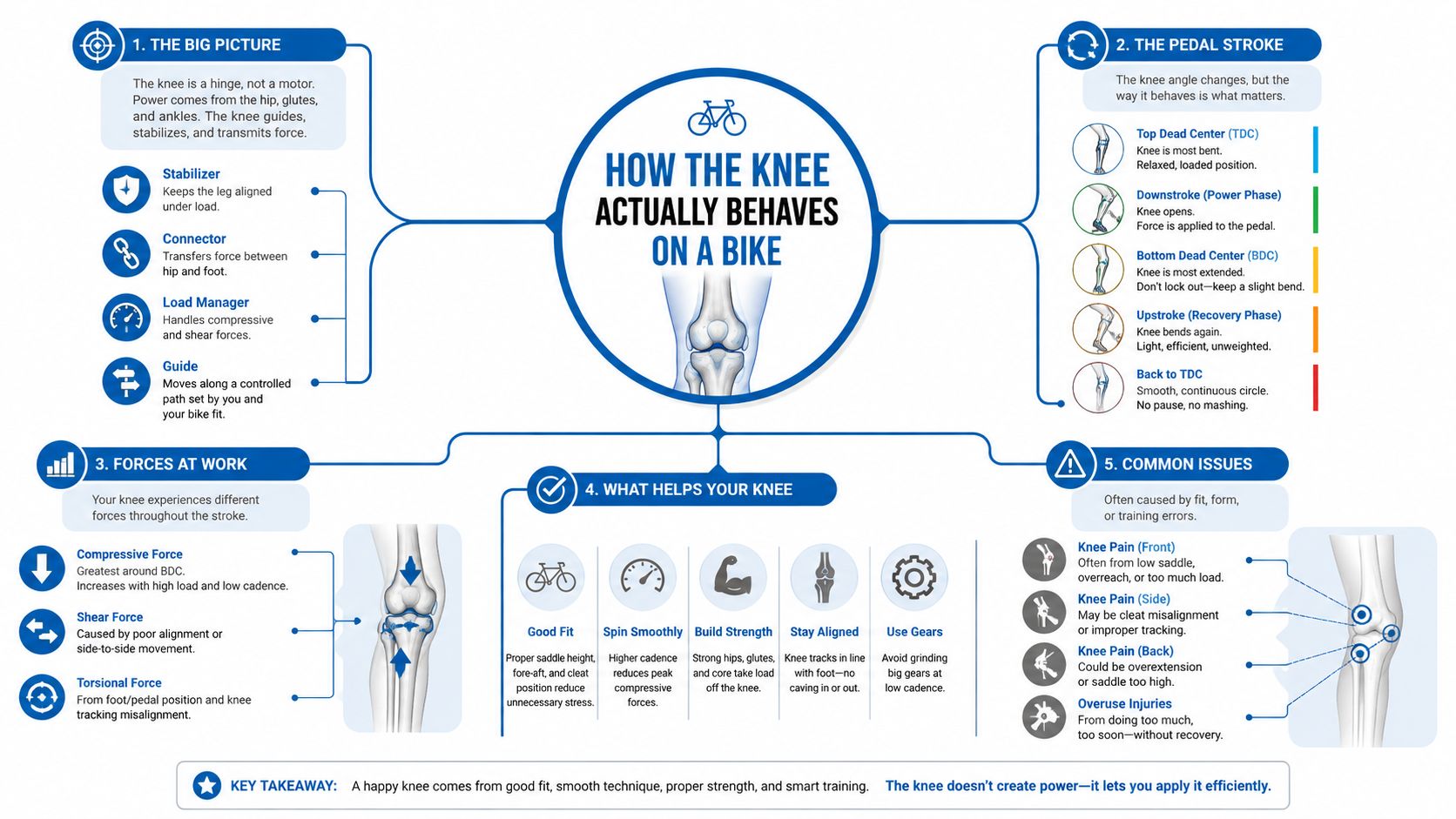
The takeaway is straightforward. Knee pain during or after riding usually reflects how the knee is loaded through the stroke, not the total distance. Fit and rehabilitation work best when they restore control across the foot, ankle, knee, hip, and pelvis.
The Five Culprits Cyclists Most Often Blame
A painful knee can feel nonspecific, but the pattern often narrows the possibilities. Patellofemoral pain usually sits behind or around the kneecap and worsens when the knee repeatedly works in a bent position. Iliotibial band irritation tends to affect the outside of the knee, particularly during forceful efforts or repeated flexion and extension.
Tendinopathy behaves differently. Patellar tendinopathy creates tenderness below the kneecap, while quadriceps tendinopathy sits above it. Hamstring tendinopathy may cause soreness behind the knee, especially when a high saddle or altered foot position repeatedly asks the posterior tissues to control extension.
Referred pain complicates the picture. The hip can send symptoms toward the thigh or knee, and irritation of a lumbar nerve can produce pain, numbness, tingling, or weakness that the rider interprets as a knee problem. A recent clinical commentary describes cyclist's knee as a multifactorial kinetic-chain condition involving the foot and ankle, knee, hip, and pelvis rather than only the patellofemoral joint (2025 cycling biomechanics commentary).
Common Cycling Knee Diagnoses at a Glance
| Diagnosis | Where It Hurts | Worse When | First Self-Care Step |
|---|---|---|---|
| Patellofemoral pain syndrome | Behind or around the kneecap | Climbing, heavy resistance, deep knee bend, stairs | Reduce painful torque and review saddle height |
| Iliotibial band syndrome | Outer side of the knee | Hard efforts, climbing, repeated one-sided loading | Ease intensity and check knee tracking and cleat rotation |
| Patellar or quadriceps tendinopathy | Below or above the kneecap | Forceful pushing, acceleration, repeated loading | Replace hard efforts with easier spinning and begin graded rehab |
| Hamstring tendinopathy | Back of the knee or lower thigh | Overextension, high saddle position, forceful extension | Stop the provoking setup and reduce extension demand |
| Referred hip or lumbar pain | Knee with possible thigh, hip, or back symptoms | Prolonged posture, nerve tension, mixed activities | Seek assessment if numbness, weakness, or back symptoms appear |
Cyclists can use the orthopedic evaluation and treatment resources when pain doesn't match a straightforward fit problem or when mechanical symptoms raise concern for a structural injury.
The table is a guide, not a diagnosis. Similar pain locations can arise from different tissues, and a rider can have more than one contributing factor. A careful examination becomes more valuable when symptoms persist despite sensible adjustments.
A Quick Self-Assessment You Can Do Tonight
Self-assessment should organize the history, not replace a clinical examination. The most useful starting point is a simple map. Use one finger to identify whether the pain is primarily front, inside, outside, or behind the knee, then note whether it feels aching, sharp, burning, or tight.
Next, record the timing. Does pain begin while pedaling, only during climbs, immediately after the ride, later that evening, or the next morning? Note whether walking downstairs, standing from a chair, or sitting for a long time reproduces it. Also check for swelling, catching, painful clicking, giving way, numbness, or weakness.
A controlled movement check
After a gentle warm-up, stand near a stable support and perform a slow single-leg squat to a comfortable depth. The goal isn't to push through pain. Watch whether the knee moves toward the second toe or collapses inward, whether the pelvis drops, and whether the rider shifts weight away from the painful side.
A step-down from a low step can reveal the same control problem with less overall movement. Stop if the knee feels unstable, sharply painful, or unable to support body weight. The test doesn't identify a specific diagnosis, but it can show why a bike-fit adjustment alone may not hold if the hip and quadriceps can't control the leg.
What to write down
- Pain map: Mark the exact area, not just “the knee.”
- Ride trigger: Record climbs, sprints, heavy gears, long seated efforts, or indoor sessions.
- Recovery pattern: Note whether symptoms settle quickly or remain into the next day.
- Mechanical signs: Record swelling, locking, catching, grinding, or giving way.
- Chain clues: Include hip, back, ankle, foot, tingling, numbness, or weakness.
Bring this information, along with recent changes in equipment or training, to a clinician or qualified bike fitter. If the pain is mild, predictable, and improving after load reduction, self-care may be reasonable. If it is worsening, repeatedly returning, or accompanied by neurological or mechanical symptoms, further evaluation is the safer choice.
Bike Fit Tweaks That Actually Move the Needle
Bike fit matters, but it works best as a targeted experiment rather than a series of random twists. The strongest practical starting point is saddle height and the amount of knee bend at the bottom of the stroke.
A recent biomechanical analysis reported substantially higher pain scores among cyclists with knee flexion greater than 40 degrees, compared with cyclists below that level, and found that setting the saddle to produce approximately 25 to 30 degrees of knee flexion at bottom dead center reduced discomfort and improved biomechanics (biomechanical saddle-position analysis). The useful lesson isn't that one angle suits every body. It is that a very bent knee deserves attention when front-of-knee pain increases with riding.
Make one change at a time
Lowering a saddle can worsen front-of-knee compression if the saddle was already low. Raising it too far can create posterior symptoms, pelvic rocking, or a reaching sensation. Make a small adjustment, test it under an easy ride, and record the response before changing another variable.
Cleat alignment deserves equal attention. The foot should sit in a position that doesn't force the knee to rotate inward or outward through every revolution. Check whether the cleat limits the rider's natural foot angle, whether the heel moves excessively, and whether one side behaves differently from the other.
Fore-aft saddle position and stance width can also alter knee and hip loading. A rider who moves the saddle without considering reach, pelvis position, or handlebar posture may trade knee discomfort for back or hip symptoms. Frontal-plane tracking should be observed while pedaling, preferably from the front and rear, because a stationary position can look acceptable while movement reveals the problem.
Adjustment rule: Change one fit variable, use an easy test ride, and judge the response during the ride and afterward. Multiple simultaneous changes erase the evidence.
A quick home check can identify an obviously low saddle or a cleat that has rotated, but persistent pain merits a professional assessment. A qualified fitter can evaluate the rider in motion, while a clinician can determine whether the pain reflects tendon irritation, patellofemoral pain, joint pathology, or referred symptoms. Riders replacing equipment can also use a guide to find bikes that fit your measurements before committing to a new frame or position.
Self-Care, Stretching, and Strengthening That Lasts
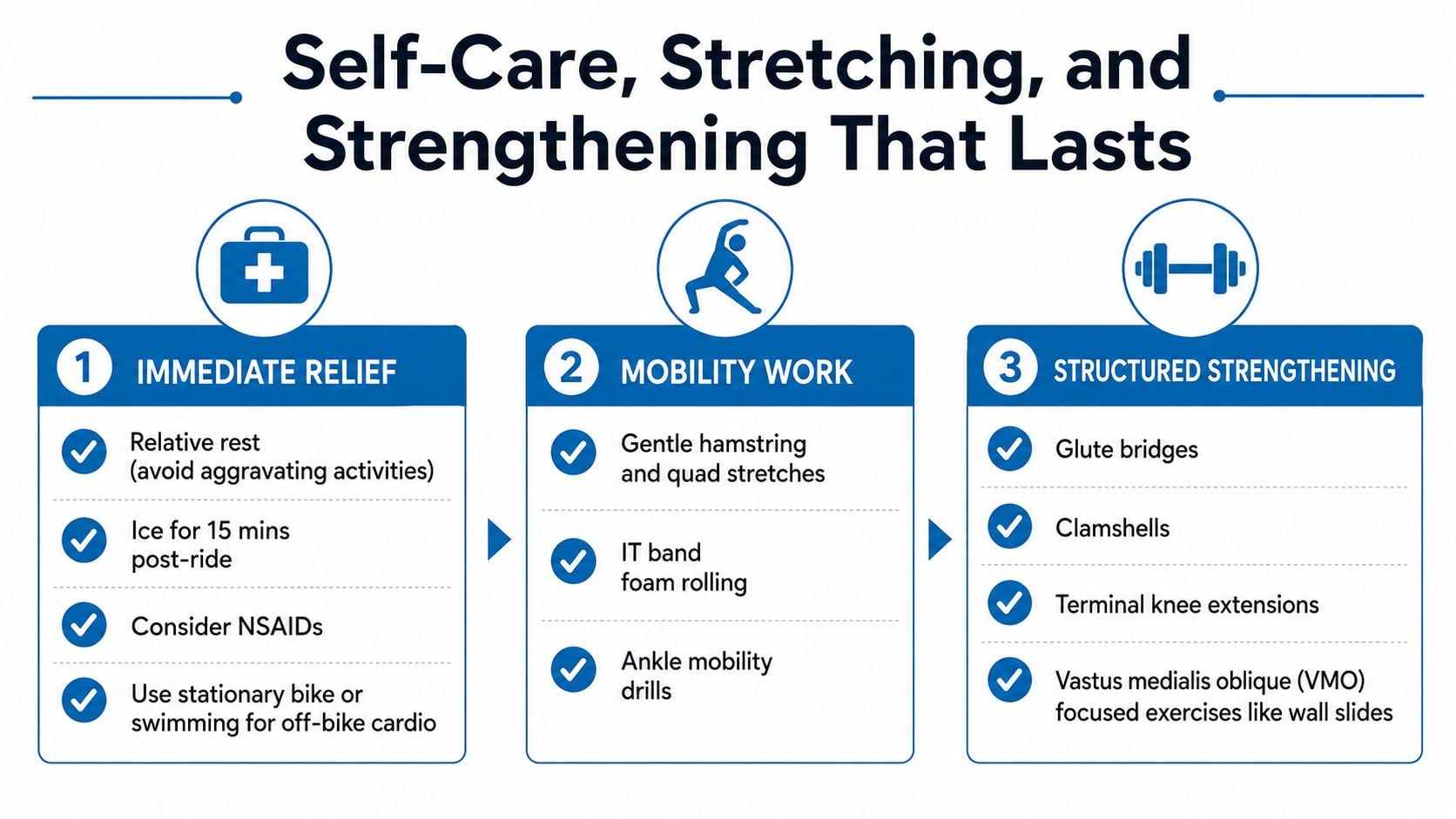
The first response to a flare should be relative rest, not complete inactivity by default. Remove the hill repeats, sprints, heavy resistance, or position that provokes symptoms. If easy pedaling doesn't increase pain during the ride or later that day, a shorter low-resistance session may preserve movement. If it does increase symptoms, choose another low-impact activity until the knee settles.
Ice can help with short-term soreness after a flare, while heat may feel better for stiffness before movement. Neither corrects the underlying load problem. Over-the-counter anti-inflammatory medication may be appropriate for some adults, but it can interact with medical conditions and other medicines, so a clinician or pharmacist should guide its use.
Restore motion across the chain
Gentle mobility work should target the areas that influence knee motion:
- Ankle mobility: Improve the ability to move through the ankle without forcing the knee to compensate.
- Quadriceps and hamstring flexibility: Use comfortable stretches without aggressive pressure on an irritated tendon.
- Hip mobility: Address stiffness that makes the pelvis rotate or the knee drift during the stroke.
- Soft-tissue work: Foam rolling may reduce the sensation of tightness, but it shouldn't replace strengthening or diagnosis.
Progression matters more than novelty. Begin with controlled glute bridges, side-lying hip work, or clamshells, then advance toward step-ups, split squats, and controlled single-leg movements as tolerance improves. Quadriceps work can include terminal knee extensions and wall-based movements, while hamstring and calf strengthening can restore support around the knee and ankle.
Match training to tissue tolerance
A rider doesn't need to chase a perfect cadence or follow a rigid progression rule. The safer approach is to reduce the variable that causes pain, then rebuild duration, resistance, and intensity separately. A session that feels fine at the start but causes a clear increase in symptoms later has exceeded current tolerance.
Bike fitting and rehabilitation are partners. A fit can reduce the repeated mechanical irritation, but strength and motor control help the rider maintain a better position when fatigue arrives. For tendon-related symptoms, an overview of tendinitis and bursitis care can help explain why gradual loading is usually more durable than repeated cycles of rest alone.
Red Flags and the Diagnostic Pathway
Self-care shouldn't continue indefinitely when the knee isn't improving. Arrange a clinical evaluation when pain persists for more than two to three weeks despite sensible adjustments, or sooner when swelling, locking, catching, instability, night pain, numbness, or weakness appears. A crash, sudden twist, inability to bear weight, or rapidly worsening pain also deserves prompt assessment.
A typical workup begins with the history. The clinician asks about riding position, training changes, pain timing, prior injuries, back symptoms, and daily activities. The physical examination then compares both legs, checks range of motion and strength, observes gait and single-leg control, and examines the hip, lumbar spine, ankle, tendons, and joint lines.
What imaging can clarify
- X-rays help assess bone alignment, joint-space changes, arthritis, and certain fracture concerns.
- Ultrasound can examine superficial tendons, fluid, and some dynamic soft-tissue problems.
- MRI provides a more detailed view of cartilage, menisci, ligaments, tendons, and other internal structures when the examination warrants it.
The purpose isn't to order every test. It is to choose the study that answers the clinical question. A rider with posterior knee pain and back-related tingling may need a different evaluation from someone with localized joint-line tenderness and catching. Persistent mechanical symptoms can warrant assessment for meniscal pathology, including the issues discussed in this resource on a torn meniscus.
A multidisciplinary pain and orthopedic setting can also coordinate care when symptoms cross regions. The knee may be the painful endpoint, while the hip, pelvis, or lumbar spine supplies part of the problem.
Putting It All Together and Choosing Your Next Step
Start with a pain map and ride log. Remove the specific aggravator, make one measured fit change, and test the result at an easier intensity. If symptoms improve but return with normal riding, add a structured rehabilitation plan addressing hip control, quadriceps capacity, hamstrings, calves, and ankle mobility.
If pain continues despite those steps, stop chasing saddle adjustments and schedule an evaluation. Population research suggests cycling may be knee-protective over the long term, with lifetime bicycling associated with lower adjusted risks of frequent knee pain, radiographic osteoarthritis, and symptomatic osteoarthritis compared with non-bicycling (2024 lifetime bicycling study). That long-term finding doesn't make persistent post-ride pain something to ignore.
A New Jersey and Staten Island interventional pain and orthopedic center can coordinate examination, imaging, rehabilitation, image-guided procedures, orthopedic care, or surgical evaluation when indicated. Board-certified specialists and seven-days-a-week scheduling can make that pathway more practical for active adults.
Interventional Pain Management evaluates persistent knee and musculoskeletal pain with coordinated pain-management, orthopedic, and spine expertise, including assessment for conditions that may be referred from the hip or back. Riders in New Jersey and Staten Island can visit Interventional Pain Management to request an evaluation and determine whether bike-fit changes, rehabilitation, an interventional treatment, or orthopedic care is the appropriate next step.