
Months into neck pain, a person may have already completed physical therapy, tried anti-inflammatory medication or muscle relaxants, and undergone an injection that helped briefly before the pain returned. The frustrating part is not only the pain itself. It's the uncertainty about what remains when familiar treatments haven't provided lasting relief.
Cervical nerve ablation can be a targeted option for a specific source of chronic neck pain, but it isn't a universal treatment for every painful neck condition. The key question is whether small nerves connected to the cervical facet joints are transmitting the pain. That answer usually comes from diagnostic blocks before anyone considers ablation.
Table of Contents
- When Nothing Sticks and the Pain Keeps Coming Back
- The Faulty Switch Behind Facet-Mediated Neck Pain
- Who Is a Good Candidate for Cervical Nerve Ablation
- How the Procedure Works Step by Step
- What the Outcomes Look Like in Real Patients
- Why Most Patients Need a Repeat and How That Works
- Risks, Recovery, and What to Expect After
- Deciding If Cervical Nerve Ablation Is Right for You
When Nothing Sticks and the Pain Keeps Coming Back
Persistent neck pain often behaves differently from an acute strain. It may flare when a person turns the head, looks upward, or rotates the neck while driving. Rest can help temporarily, yet ordinary movements bring the discomfort back. For people dealing with this pattern, a review of neck pain treatment options should begin with identifying the pain generator, not just adding another medication.
Facet-mediated pain is one possible explanation. The facet joints sit behind the cervical vertebrae and help guide movement. When these joints become irritated, the nearby medial branch nerves can carry repeated pain signals to the brain. Cervical nerve ablation targets those small signal-carrying nerves. It doesn't remove the joint, straighten the spine, or fuse the vertebrae.
That makes the procedure different from treatments that affect the whole body. Medication may reduce inflammation or dampen pain perception across multiple systems. An injection may calm irritated tissue for a period of time. Ablation takes a more selective approach, but that selectivity also creates a limitation. It can help only when the treated nerves are connected to the person's pain.
The pain pattern matters
The strongest starting pattern is chronic axial neck pain, meaning pain centered in the neck rather than pain traveling down an arm from a compressed nerve. Many patients describe aching near the back or side of the neck, worsened by extension and rotation. Some also have focal tenderness over the facet region.
A person with progressive weakness, significant numbness, spinal cord symptoms, or severe instability needs a different evaluation before considering ablation. Cervical nerve ablation isn't a substitute for urgent assessment when the symptoms suggest nerve-root or spinal-cord compression.
Practical rule: Ablation should be considered as a targeted treatment after the pain source has been tested, not as a general response to any neck pain that has lasted a long time.
The Faulty Switch Behind Facet-Mediated Neck Pain
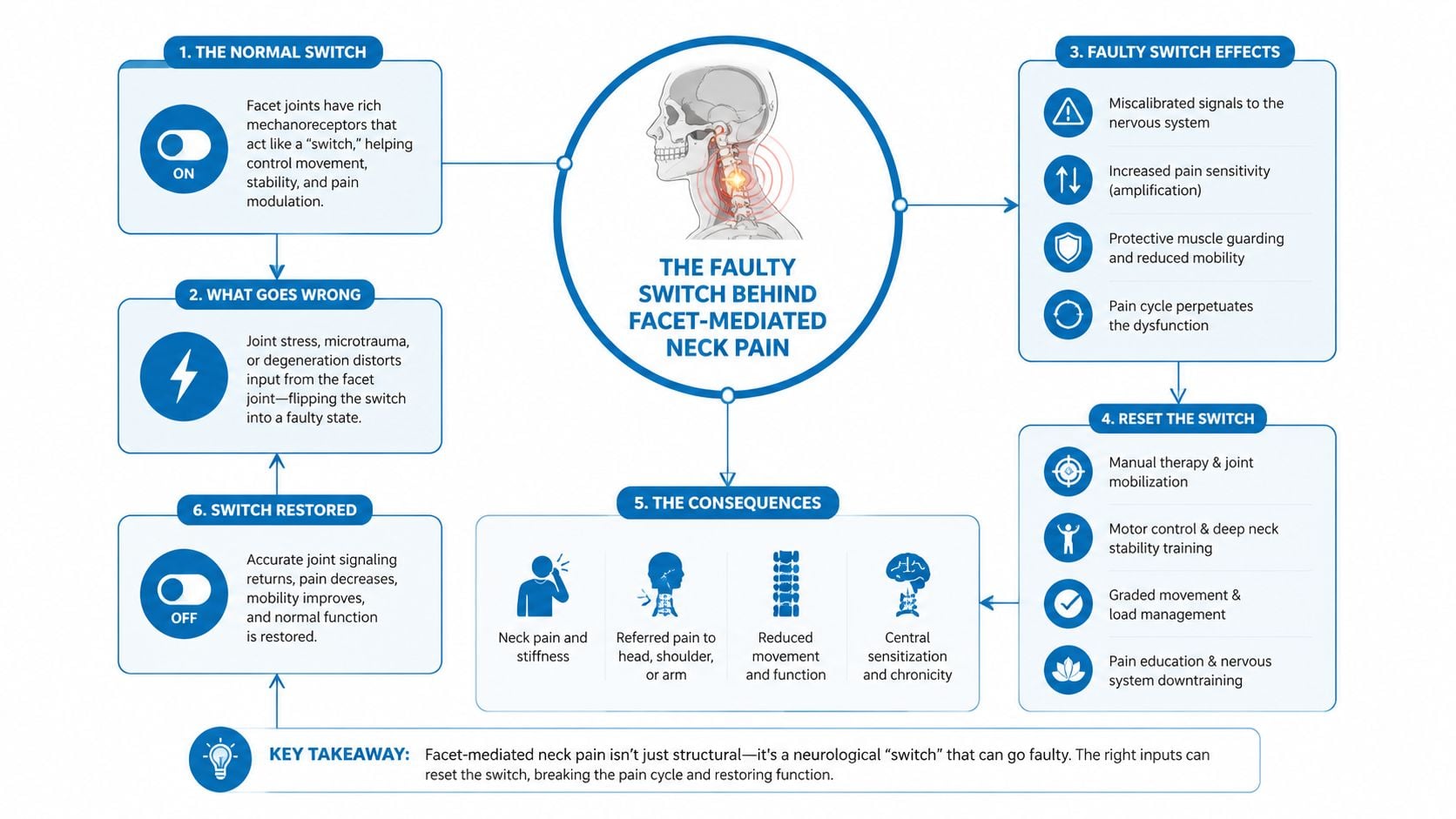
A useful way to understand facet pain is to think of a faulty light switch. The facet joint acts like the switch, while the medial branch nerve acts like the wire carrying the signal back to the brain. If the joint becomes arthritic, inflamed, or mechanically irritated, the switch may keep sending an unpleasant signal whenever the neck moves.
The joint itself isn't necessarily the only problem. The medial branch nerve reports sensations from the facet joint and nearby structures. When that nerve becomes the confirmed pathway for pain, radiofrequency energy can create a small lesion along the nerve. In plain language, the treatment interrupts the wire rather than destroying the entire electrical system.
What ablation changes, and what it doesn't
Cervical nerve ablation doesn't burn the facet joint. It doesn't remove cartilage, decompress a nerve root, or fuse two vertebrae. The joint remains in place and continues to contribute to neck movement. The intended change is that the treated medial branch nerve no longer carries the same pain message.
Doctors may use conventional radiofrequency ablation, which creates a focused lesion, or other radiofrequency approaches that create different lesion shapes. Pulsed radiofrequency uses energy differently from continuous thermal treatment. Cooled radiofrequency ablation circulates fluid around the active electrode, allowing a broader treatment field that may capture more of the target nerve tissue.
The technique must match the anatomy and the treatment goal. A broader lesion isn't automatically better, because the cervical region contains important nearby structures. Image guidance, careful needle placement, and stimulation testing help the physician balance coverage with safety.
The historical foundation for modern cervical medial branch ablation dates to the 1971 introduction of percutaneous radiofrequency neurotomy by Lord and colleagues, which later supported contemporary treatment of cervical facet pain. The procedure has therefore moved from an early neurotomy technique toward a more selective, diagnostic-block-driven intervention, as described in this review of cervical radiofrequency procedures.
Who Is a Good Candidate for Cervical Nerve Ablation
A neck MRI may show “facet arthropathy,” yet that phrase alone cannot identify the source of pain. A good candidate is someone whose symptoms, examination, and diagnostic testing point toward the same facet-related pain pathway. Imaging shows structural change. It does not prove that a particular facet joint is generating the pain.
The typical candidate has chronic, non-radicular neck pain that continues despite appropriate conservative care. Pain may increase when the neck extends or rotates, and examination may reproduce discomfort near the facet joints. Physical therapy, medication trials, activity changes, and other suitable treatments are generally tried first.
The two-block selection filter
The diagnostic medial branch block is the step that determines whether ablation is worth considering. A physician places a small amount of local anesthetic near the suspected medial branch nerves, using imaging for guidance. If the patient's familiar pain improves during the expected anesthetic window, the result supports those nerves as part of the pain pathway. Patients can read more about diagnostic nerve block information before discussing the test with their physician.
A single helpful block is usually not enough. Consensus guidance described in a 2024 clinical review supports performing cervical RFA only after two positive diagnostic blocks. The 2021 multispecialty guideline describes a positive prognostic block as at least 50% pain relief, although practices and coverage requirements may differ.
The blocks should also be separated by the interval required by the treating practice and its coverage rules. They are not paperwork before a procedure. During each anesthetic window, the patient should test familiar activities, such as turning the head, looking up, or working at a desk, and record whether the usual pain and function change.
Selection involves a real trade-off. Stricter relief thresholds may increase confidence that the correct nerves were identified, but they can also exclude patients who might still benefit. The physician therefore considers the pain pattern, examination, functional response, and both block results together.
| Indication | Evidence strength | Notes |
|---|---|---|
| Chronic axial cervical facet pain | Stronger | Best fit when examination and two positive medial branch blocks support facet-mediated pain. |
| Cervicogenic headache | Weaker | Evidence is less consistent, so headache-dominant symptoms require careful diagnosis. |
| Cervical radiculopathy | Weaker for facet ablation | Arm pain from nerve-root irritation usually requires evaluation of the nerve root rather than facet denervation. |
A different treatment pathway may be needed with infection, recent trauma, severe instability, progressive neurological deficit, or unresolved radicular symptoms. These findings can signal a structural or neurological problem that ablation will not correct.
How the Procedure Works Step by Step
A patient may arrive expecting the ablation to be the first procedure. In practice, the appointment usually follows diagnostic blocks. The blocks test whether the suspected medial branch nerves are carrying the facet-related pain. Ablation then aims to interrupt that pathway for a longer period.
The diagnostic visit
During a medial branch block, the patient lies in a position that lets the physician guide the needle with fluoroscopy. After cleaning and numbing the skin, the physician advances a thin needle near the medial branch nerves linked to the painful facet joints and injects a short-acting anesthetic.
The anesthetic window is a brief test, not a general comfort check. The patient should repeat familiar activities, such as turning the head, looking up, or sitting at a desk, and record whether the usual movement-related pain changes. That response helps the physician judge whether the targeted nerves are involved.
A second positive block is typically required before ablation, consistent with the selection approach described in the cervical RFA clinical review. The blocks must also be scheduled with the interval required by the treating practice and coverage rules. Relief thresholds and documentation requirements vary by setting, so the practice explains them before scheduling.
Two positive blocks increase confidence in the diagnosis, but stricter criteria can exclude some patients who might still benefit. The physician weighs the pain pattern, examination, activity response, and both block results together.
The ablation visit
For cervical nerve ablation, the patient generally lies face down. The physician numbs the skin and uses fluoroscopy to position a radiofrequency cannula alongside the selected medial branch nerve. A near-parallel posterior or slightly posterior-oblique approach, with sequential lesions close enough to cover the nerve's course, is recommended by the 2021 consensus guideline.
Before energy is delivered, sensory and motor testing helps confirm that the cannula is near the intended sensory pathway and away from motor fibers or other important structures. Contrast assessment, preferably with digital subtraction angiography when appropriate, helps identify intravascular placement before treatment.
Radiofrequency energy creates a controlled lesion in a small portion of the nerve. Device designs and treatment parameters differ. Patients may feel pressure, warmth, or brief stimulation. Many procedures use local anesthetic without sedation or with light sedation, allowing communication during positioning.
After treatment, the patient remains under observation until the clinical team considers recovery appropriate. The radiofrequency ablation service information explains how this procedure may fit into a broader pain-management plan.
What the Outcomes Look Like in Real Patients
A patient may still have neck discomfort after cervical nerve ablation and consider the treatment worthwhile. The meaningful question is what changes in daily life: sleep, driving, exercise, or participation in rehabilitation. Group averages describe patterns, not a guaranteed result for one person.
A 2024 retrospective series of cooled cervical RFA reviewed 298 procedures in 203 patients treated between 2015 and 2022. Average pain scores fell from 6.15 to 3.64, and 85.23% of procedures produced pain reduction, including 6% complete remission, according to the reported cooled-RFA outcome data. Among patients who improved, average pain reduction was 48.04%, with relief lasting an average of 6.67 months.
Those results do not mean every patient becomes pain-free. Someone whose pain is reduced by nearly half may still notice it, yet tolerate a longer drive, sleep with fewer interruptions, or complete strengthening exercises that were previously too painful. Another patient may experience only partial relief, or improvement that fades sooner.
A separate study screened 30 patients treated between September 2018 and February 2022. At 2 months, mean pain scores fell from 7.5 to 4.2. 58% achieved at least 30% pain reduction, and 88.2% reported improvement on the Patient Global Impression of Change, as summarized in the reviewed clinical outcome report.
| Study | Technique | Mean pain reduction | Duration of relief | Responder rate at least 50% |
|---|---|---|---|---|
| 2024 retrospective series | Cooled cervical RFA | Average scores fell from 6.15 to 3.64; improvement averaged 48.04% among responders | Average 6.67 months among responders | 85.23% of procedures produced pain reduction; the report also identified a 6% complete-remission group |
| Cervical RFA cohort summarized in 2024 | Cervical RFA | Mean scores fell from 7.5 to 4.2 at 2 months | Not established in the provided result | Responder rate at the 50% threshold wasn't provided |
The evidence is more favorable for axial neck pain than for cervicogenic headache. A 2022 systematic review and meta-analysis found Level II evidence for neck pain based on 5 randomized controlled trials and 15 observational studies. Evidence for cervicogenic headache was Level III to IV, according to the review summary. These findings also show why patient selection matters. Requiring two positive diagnostic blocks may improve confidence that the facet nerves are driving pain, but stricter criteria can exclude some people who might still benefit.
Why Most Patients Need a Repeat and How That Works
Cervical nerve ablation isn't a permanent cure. The treated nerve can recover or regrow, and the original pain pattern may gradually return. The goal is a period of improved function, not the promise that the facet joint or the underlying degeneration has been permanently repaired.
A repeat procedure should be based on the quality and duration of the first response, not solely on the passage of time. Consensus guidance says repeat cervical RFA may be considered when the first treatment produced at least 30% pain relief for 3 months or longer, and it shouldn't be performed more than twice per year, as outlined in the evidence review on cervical RFA selection and repetition.
A repeat is justified by a meaningful prior response, not by a calendar reminder alone.
The repeat procedure generally follows the same image-guided pathway as the first. Whether diagnostic blocks must be repeated depends on the clarity of the original response, the clinician's assessment, and the requirements of the treatment setting or payer. Documentation helps show what changed after the first ablation, including pain intensity, sleep, driving, work tolerance, and exercise capacity.
If the first treatment produced no meaningful benefit, repeating it without reconsidering the diagnosis makes little sense. The physician may instead reassess the pain source, review new symptoms, examine for radiculopathy, or consider a different non-invasive, interventional, or surgical option.
Risks, Recovery, and What to Expect After
The neck contains important nerves and blood vessels, so cervical RFA requires careful technique. Most patients tolerate the procedure, but the risk discussion should be specific rather than reduced to the phrase “minor procedure.”
Risks that deserve a direct explanation
Post-procedure neuritis: Irritation of the treated nerve can create temporary burning, tingling, or increased sensitivity. The symptom may settle as the nerve calms, but persistent or worsening discomfort should be reported.
Needle-site soreness: Local aching or bruising can occur after the cannula is removed. This discomfort is different from the deeper neck pain being treated and often improves with time.
Bleeding or infection: Any needle-based procedure can cause bleeding or introduce infection. Blood-thinning medication, immune problems, fever, or skin infection near the injection site should be discussed before treatment.
Vascular injury: The vertebral artery and other important structures lie near the cervical treatment zone. The consensus guideline emphasizes real-time fluoroscopic imaging, contrast assessment, and a careful needle trajectory to reduce intravascular risk, as detailed in the cervical facet intervention guideline.
Incomplete relief: Even technically successful ablation may not help if the facet joint wasn't the primary pain generator. Pain can also come from discs, muscles, nerve roots, the spinal cord, or several sources at once.
The recovery pattern
The first day may bring needle-site soreness or a temporary flare. Light activity can often resume gradually after the immediate recovery period, but the treating practice gives the final instructions based on the patient's procedure, medications, and health history.
Relief may not appear immediately because the treated area can remain irritated after the lesion is created. Patients should track function as well as pain, including whether the neck turns more easily, sleep improves, or ordinary activities become less demanding.
A physician should be contacted for fever, spreading redness, drainage, severe or worsening pain, new weakness, new numbness, difficulty walking, severe headache, or changes in bladder or bowel control. New neurological symptoms require prompt assessment rather than observation at home.
Medication instructions also need individual guidance. Some patients may use an over-the-counter pain reliever if their physician says it's safe, while others need different instructions because of kidney disease, stomach problems, blood thinners, allergies, or other conditions.
Deciding If Cervical Nerve Ablation Is Right for You
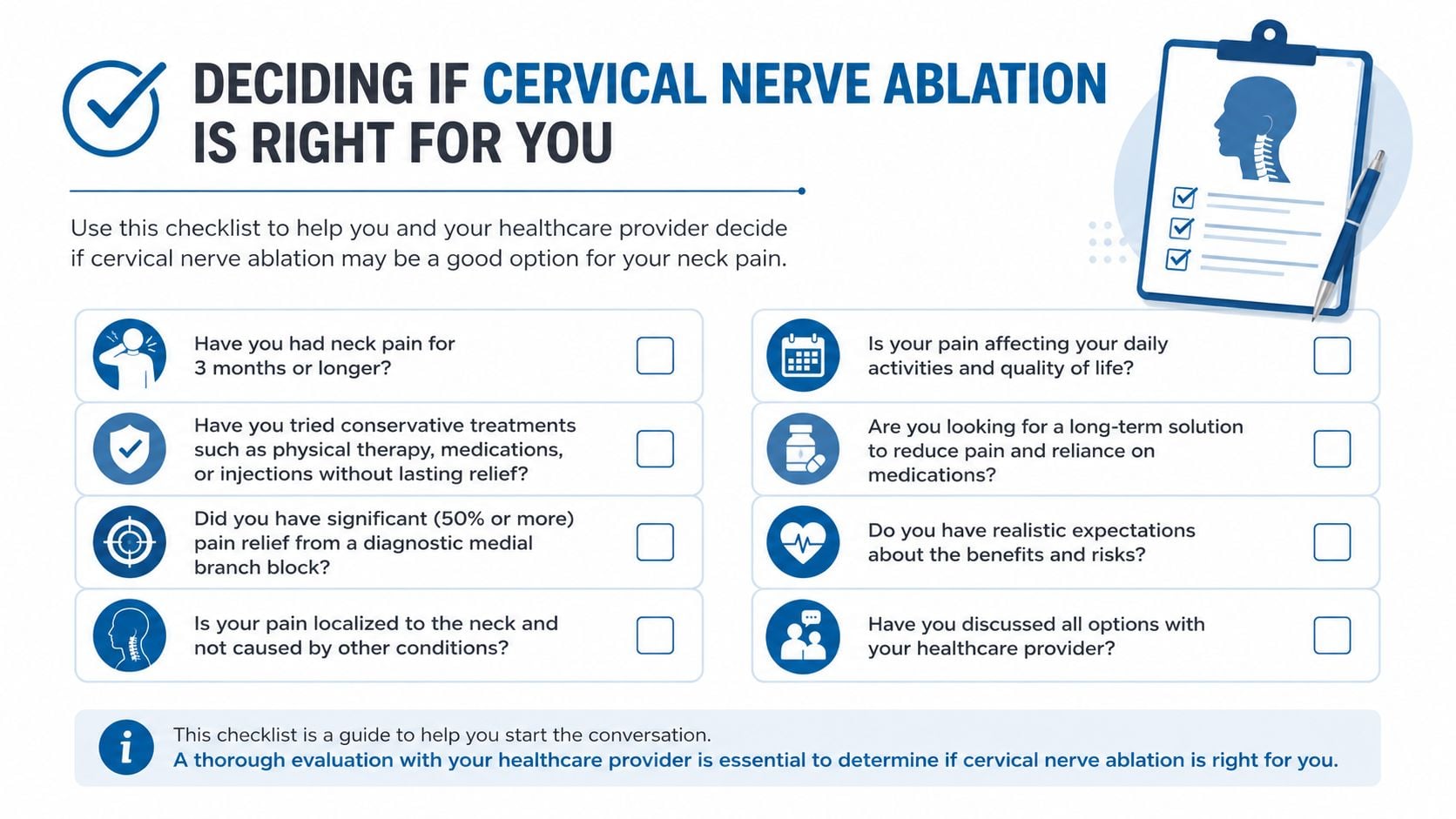
The decision comes down to a match between the pain pattern, the diagnostic evidence, and the patient's goals. A person may have facet changes on imaging and still have pain from another source. Another person may have modest imaging findings but a consistent examination and two positive medial branch blocks.
A useful consultation starts with practical information:
- Pain diary: Record pain levels, aggravating movements, sleep disruption, and activities that have become difficult.
- Treatment history: List physical therapy, medications, injections, home exercises, and the duration of benefit from each.
- Imaging and records: Bring prior scans and procedure reports when available.
- Functional goals: Define what improvement would matter most, such as turning the head while driving, sleeping through the night, returning to exercise, or participating in rehabilitation.
The consultation should address whether conservative care has been adequately optimized, whether the symptoms fit axial facet-mediated pain, and whether two positive diagnostic blocks have been completed or are planned. It should also establish what would count as a successful outcome and what the next step would be if relief is incomplete.
Questions worth asking
- What findings suggest that the facet joints are causing the pain?
- Which nerves would be tested with the diagnostic blocks?
- What response would make a block positive?
- Have two positive blocks been completed, or is another block needed?
- Which radiofrequency technique is being considered, and why?
- How will the physician protect nearby nerves and blood vessels?
- What functional improvement is realistic?
- What would make a repeat treatment appropriate?
- Which symptoms would indicate that another diagnosis needs evaluation?
Cervical nerve ablation is worth pursuing when the clinical pattern and diagnostic blocks identify a facet-mediated pain pathway and the patient understands that relief is temporary. Another path should be explored first when symptoms point to radiculopathy, spinal cord involvement, instability, infection, recent trauma, or a pain source that the blocks don't support.
Interventional Pain Management evaluates chronic neck pain through examination, medical history, imaging review, diagnostic blocks, and image-guided treatments when clinically appropriate. Patients who want to determine whether facet-mediated pain and cervical nerve ablation fit their situation can visit Interventional Pain Management to request an individualized evaluation.