
A hand that falls asleep during the night can seem like a minor inconvenience. Then the numbness starts interrupting driving, typing, cooking, or holding a phone. Some people shake the hand to restore feeling, while others notice that buttons, keys, or tools are becoming harder to manage. When symptoms progress this way, the central question is not which operation sounds most advanced. It is which treatment can safely restore function while matching the person's work and recovery demands.
Carpal tunnel release is designed to relieve pressure on the median nerve by opening the tight space at the wrist. The operation has a strong long-term record, but recovery speed, scar symptoms, and revision considerations can differ by technique and by patient. A practical decision starts with the severity of nerve compression, the condition of the hand, and the demands of the job.
Table of Contents
- Understanding Carpal Tunnel Syndrome and Surgical Release
- When Conservative Care Gives Way to Surgical Indications
- Comparing Open, Mini-Open, and Endoscopic Techniques
- Recovery Timelines and Return to Work Expectations
- Long-Term Outcomes and Durable Symptom Resolution
- Evaluating Risks, Recurrence, and Revision Realities
- Navigating Your Multidisciplinary Care Pathway
Understanding Carpal Tunnel Syndrome and Surgical Release
A person with carpal tunnel syndrome may first notice tingling in the thumb, index finger, middle finger, and part of the ring finger. Symptoms often worsen while sleeping because the wrist remains bent for long periods. Over time, the hand may feel clumsy, grip may weaken, and numbness may persist even after the wrist changes position.
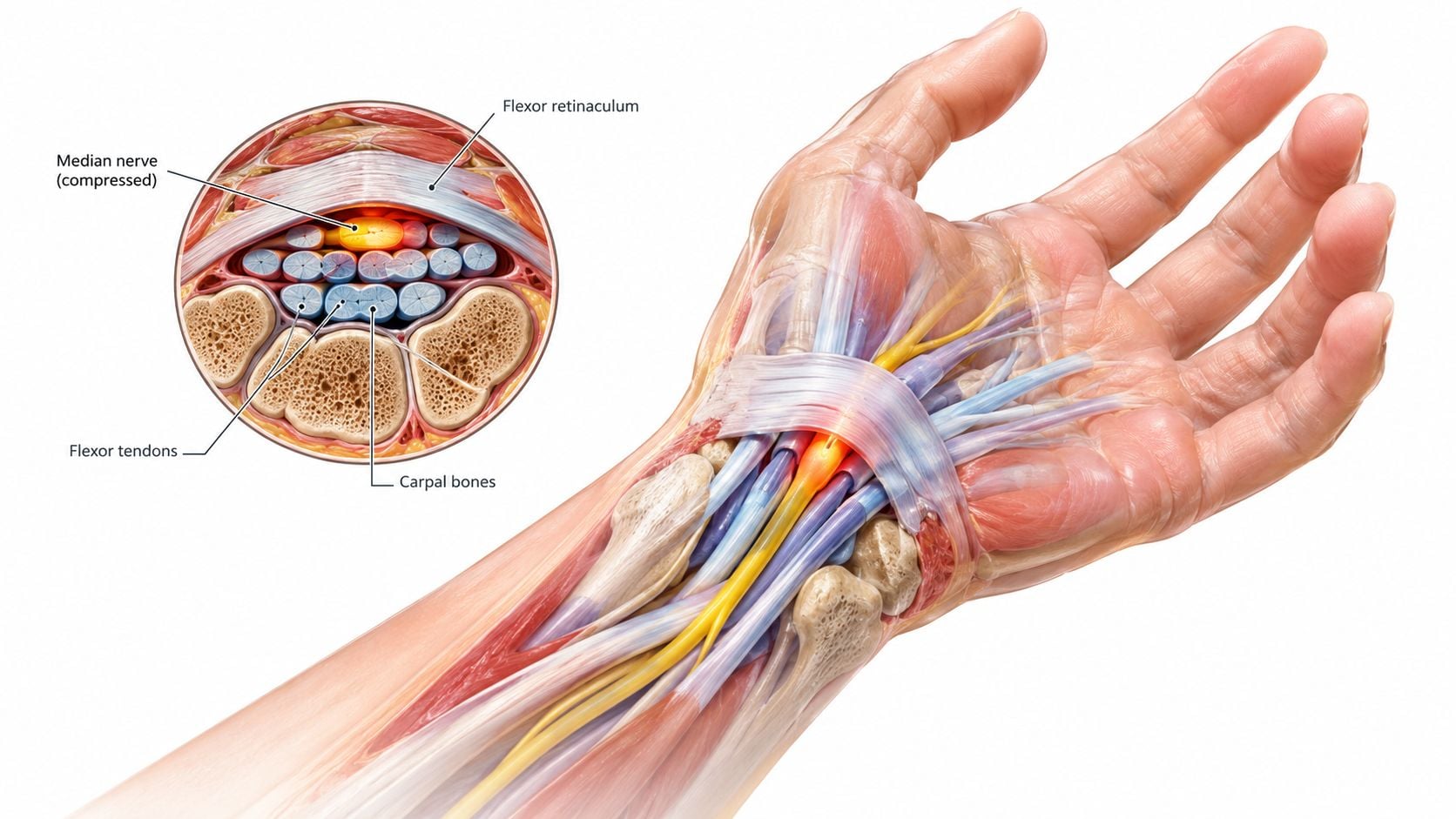
The median nerve travels through a narrow passage at the wrist called the carpal tunnel. The floor and sides are formed by wrist bones, while the transverse carpal ligament forms a firm roof. When swelling or other changes reduce the available space, the ligament leaves little room for the nerve to tolerate additional pressure.
Relief versus decompression
A night splint can keep the wrist in a neutral position and reduce irritation. Activity changes, medication, therapy, or an injection may also lessen symptoms. Those measures can be useful, but they don't permanently enlarge the tunnel.
Carpal tunnel release addresses the mechanical problem. The surgeon divides the transverse carpal ligament, creating more room for the median nerve. The ligament isn't removed from the wrist, and the aim isn't to “repair” the nerve directly. The aim is to stop the structure above it from maintaining excessive pressure.
Practical distinction: Conservative care can reduce irritation. Surgical release changes the space around the nerve.
The operation is among the most common hand surgeries in the United States. A 2026 review of Medicare data recorded 3,429,471 carpal tunnel release surgeries from 2000 through 2020, with annual volume increasing from 91,130 in 2000 to 183,911 in 2020, a 101.8% increase; Medicare payments to surgeons exceeded $1.23 billion over that period (review of Medicare carpal tunnel release data). Randomized trials cited in that review have reported success rates of up to 90%, helping explain why decompression has remained widely used.
The procedure isn't automatically necessary for every episode of tingling. It becomes more relevant when symptoms persist, testing confirms meaningful compression, or weakness signals that the nerve is struggling to function.
When Conservative Care Gives Way to Surgical Indications
Surgery usually follows a clinical decision rather than a single symptom. A clinician first considers the pattern of numbness, the duration of symptoms, hand strength, nighttime disturbance, work limitations, and whether another condition could be affecting the nerve.
Mild or intermittent symptoms may respond to wrist-neutral splinting, ergonomic changes, temporary activity modification, or supervised therapy. A corticosteroid injection can sometimes provide temporary relief and may help clarify whether symptoms arise from the carpal tunnel. Information about corticosteroid injections for pain relief should be considered alongside the limitations of temporary treatment, because an injection doesn't create lasting space around the median nerve.
Findings that change the discussion
Nerve conduction studies can show how effectively the median nerve transmits signals across the wrist. Ultrasound may help assess the nerve and surrounding anatomy. Neither test replaces a physical examination, but both can strengthen the diagnosis when the symptom pattern is unclear or severe.
A surgeon becomes more concerned when the hand shows evidence of ongoing nerve dysfunction:
- Persistent numbness: Feeling doesn't return reliably after changing wrist position or stopping an aggravating task.
- Thenar muscle wasting: The padded muscle at the base of the thumb becomes visibly smaller, suggesting prolonged median nerve dysfunction.
- Functional weakness: Pinching, opening containers, fastening clothing, or holding tools becomes difficult.
- Abnormal testing: Electrodiagnostic or ultrasound findings support significant compression.
- Failed nonsurgical care: Reasonable measures don't provide durable control or the symptoms keep limiting daily life.
Thenar atrophy and objective weakness deserve prompt attention because prolonged compression can limit the nerve's ability to recover fully. Surgery can remove the pressure, but it can't guarantee that a chronically injured nerve will return to normal.
Timing is individualized
A person with nighttime tingling and normal strength may have room to try conservative care under medical supervision. Someone with constant numbness, muscle wasting, or progressive weakness may need a faster surgical discussion. The decision also depends on diabetes, neck nerve problems, arthritis, prior wrist injury, and other possible causes of hand symptoms.
The practical threshold is not merely “pain that has lasted long enough.” It is evidence that the median nerve remains compressed and that waiting may allow functional loss to become harder to reverse.
Comparing Open, Mini-Open, and Endoscopic Techniques
For a graphic designer, an office worker, or someone who uses vibrating tools, the most useful question is not which operation sounds least invasive. It is which approach fits the job, the hand's early loading demands, and the surgeon's ability to release the ligament safely. All established carpal tunnel release techniques divide the transverse carpal ligament. Their differences involve the incision, visualization, tissue handling, and the likely location of early tenderness.
An open release uses a larger incision in the palm for direct exposure. A mini-open approach uses a shorter incision but also provides direct access. Endoscopic release uses a small access point or points and a camera-guided instrument to divide the ligament from inside the tunnel.
| Technique | Incision Profile | Early Recovery Pain | Best Suited For |
|---|---|---|---|
| Open | Direct palmar incision with broad exposure | May include more early palm or scar tenderness | Complex anatomy, prior trauma, or situations where direct visualization is preferred |
| Mini-open | Smaller direct incision | Often less early discomfort than conventional open surgery | Patients seeking direct release with a reduced incision |
| Endoscopic | Small access point or points for camera-guided release | Often less early scar discomfort and faster initial recovery | Selected patients who value earlier hand use and have suitable anatomy |
Open release
Open surgery remains dependable because the surgeon sees the ligament and nearby anatomy directly. That wider view can help when prior trauma, scar tissue, unusual anatomy, or a revision operation makes a limited approach less suitable.
The main occupational tradeoff is palmar tenderness during early healing. Pushing off a chair, gripping a tool, lifting, or resting the palm on a work surface may remain uncomfortable even as numbness improves. For a manual worker, the incision's location and pressure sensitivity may matter more than its appearance.
Mini-open release
Mini-open surgery aims to retain the direct view of open surgery while reducing the skin incision. A comparative review of mini-incision versus open release found lower pain and better patient-reported wrist and hand scores at 2 weeks with mini-incision surgery, although the differences were small and not clinically important by 1 to 2 months.
That evidence supports a practical expectation: a smaller incision may make the opening phase of recovery easier, without guaranteeing a lasting advantage. The technique should therefore match the person's anatomy, work tasks, and tolerance for palm pressure, rather than incision length alone.
Endoscopic release
Endoscopic surgery limits the skin opening and may reduce early scar-related discomfort for selected patients. Earlier hand use can matter to someone returning to keyboard work, light handling, or other tasks that do not place heavy pressure across the palm.
The approach still requires specialized visualization and suitable anatomy. A surgeon may prefer open or mini-open release when previous surgery has altered tissue planes, anatomy is unusual, or direct exposure provides a safer route. People considering endoscopic surgical approaches should ask how the method fits their wrist anatomy, job duties, and expected restrictions.
Technique affects the first part of recovery. Long-term symptom relief depends more broadly on complete decompression, nerve health before surgery, and the cause of the symptoms.
Recovery Timelines and Return to Work Expectations
A typist may manage light keyboard duties while a mechanic still cannot safely grip a tool. Both may have had the same operation, yet recovery depends on how the hand is used. Driving also requires comfortable grip, reliable reactions, a healing incision, no distracting medication effects, and the surgeon's clearance.
A 2025 meta-analysis found that open and endoscopic decompression both improved patient-reported outcomes over 12 weeks. Recovery at 4 weeks strongly predicted results at 12 weeks, while symptoms could continue improving for up to 104 weeks. An early plateau therefore does not necessarily represent the final result (2025 meta-analysis of recovery after carpal tunnel decompression).
A practical recovery framework
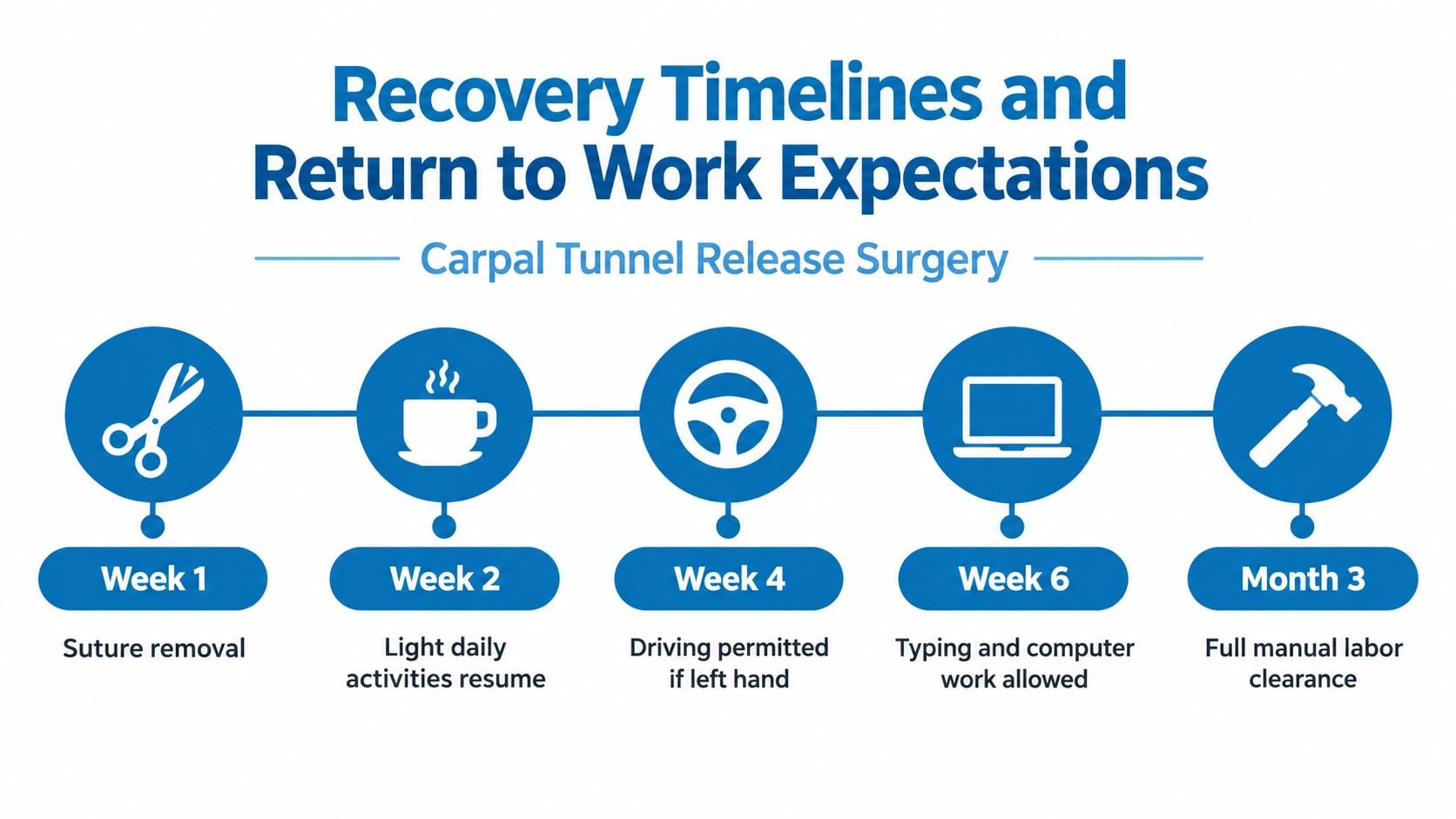
- First several days: Protect and keep the hand raised as directed, while moving the fingers and wrist gently within the surgeon's instructions. Swelling and soreness are common. Worsening symptoms should prompt a call to the care team.
- Early follow-up: The clinician checks the incision, sensation, and hand control, then adjusts restrictions according to wound healing and function.
- Around the first month: Desk work may resume before forceful gripping is safe. Driving depends on pain-free control and explicit clearance, not just the number of days since surgery.
- Later recovery: Strength and endurance return gradually. Repetitive force, vibration, lifting, and prolonged wrist positions usually need a slower progression than light daily activities.
A 2025 systematic review of return-to-work timelines reports ranges of 4 to 6 weeks for open release, 2 to 4 weeks for endoscopic release, and 10 to 21 days for ultrasound-guided procedures (2025 systematic review of return-to-work timelines after carpal tunnel release). The review also included a registry in which more than 90% of patients returned to work within 3 weeks. These figures describe study populations, not guaranteed deadlines.
Matching recovery to occupation
A desk worker may return to selected duties once keyboard use is comfortable and the wound can be protected. A warehouse worker, mechanic, hairdresser, or construction worker may need staged duties because gripping, lifting, palm pressure, and vibration load the healing hand differently.
A written plan should identify modified tasks, lifting limits, rest breaks, and the point at which forceful or repetitive work can resume. Clearance should reflect the operated hand, symptom severity, wound status, strength, and the actual demands of the job. Recovery planning works best when the calendar is adjusted to the occupation.
Long-Term Outcomes and Durable Symptom Resolution
The most useful measure of carpal tunnel release isn't only how the hand feels during the first postoperative week. It is whether numbness, functional limitation, and sleep disruption remain improved years later.
Long-term studies provide substantial reassurance. In one minimum-10-year follow-up study, 74% of patients reported complete symptom resolution, 72.5% were asymptomatic without functional impairment, and repeat surgery was uncommon at 1.8% (minimum-10-year follow-up study). In a separate severe-carpal-tunnel cohort, 93.8% reported complete resolution of numbness at a mean follow-up of 9.3 years, while 72% were asymptomatic without functional impairment, according to the same published source.
What durable improvement means
Nerve recovery isn't always immediate. A patient may notice nighttime relief first, followed by gradual improvement in daytime sensation, dexterity, and confidence with gripping. If the nerve sustained severe or prolonged injury before surgery, residual numbness can remain even after the operation successfully removes compression.
A multicenter ultrasound-guided release registry found significant improvements in symptom and function scores that persisted to a mean follow-up of 46 months, with 91.2% patient satisfaction and no revision surgeries reported in that registry (long-term outcomes after ultrasound-guided release). A separate surgical series found complete resolution of symptoms and functional limitations in 73.1% of patients at an average of 11 years, supporting lasting benefit after decompression.
Early technique differences do not define the endpoint
Open, mini-open, and endoscopic procedures can produce different early sensations, particularly around scar tenderness and hand use. Over the longer term, the central question is whether the ligament was fully released and whether the median nerve had enough remaining capacity to recover.
That distinction helps patients set realistic expectations. Surgery can provide durable decompression, but it can't erase every cause of hand weakness, restore nerve tissue that has been permanently damaged, or guarantee that unrelated neck or nerve conditions won't produce future symptoms.
Evaluating Risks, Recurrence, and Revision Realities
A smaller incision can make early hand use easier, but it does not remove surgical risk or guarantee the best choice for every wrist. Possible problems include infection, wound irritation, scar or pillar pain, incomplete release, nerve irritation, vascular injury, and symptoms that persist or return. The practical question is how those risks fit your work, anatomy, and tolerance for a slower recovery.
Modern carpal tunnel release is generally low-risk when the technique matches the patient and the surgeon has a clear view of the relevant anatomy. In a large mini-open series of 1,144 releases, complications occurred in 1.2% at final follow-up, with no major nerve or vessel injuries. A national administrative-database review reported serious complications requiring admission or reoperation at under 0.1%. These figures describe uncommon events, not a promise that every recovery will be problem-free.
Recurrence isn't the same as failed surgery
Returning symptoms can result from recurrent compression, incomplete release, scar formation, or a different diagnosis. Irritation of a nerve in the neck, ulnar nerve problems, arthritis, and generalized neuropathy may resemble carpal tunnel syndrome. Examination and, when appropriate, nerve testing help distinguish a persistent wrist problem from symptoms arising elsewhere before anyone assumes the first operation failed.
A 2025 longitudinal analysis found a higher endoscopic reoperation rate within 2 years than with open release, with a reported relative risk of 1.15. Beyond 5 years, revision rates were similar. The authors characterized the early difference as clinically small (2025 longitudinal analysis of reoperation and revision).
The same analysis reported cumulative revision incidence of around 1.06% at 5 years and 1.59% at 10 years. Revision is uncommon, yet your consultation should cover how incomplete release, recurrent symptoms, and persistent numbness would be evaluated and treated.
Decision point: Early recovery speed and long-term durability answer different questions.
Choose the technique by weighing work demands, early pain, visualization, anatomy, and the plan if symptoms persist or return.
Navigating Your Multidisciplinary Care Pathway
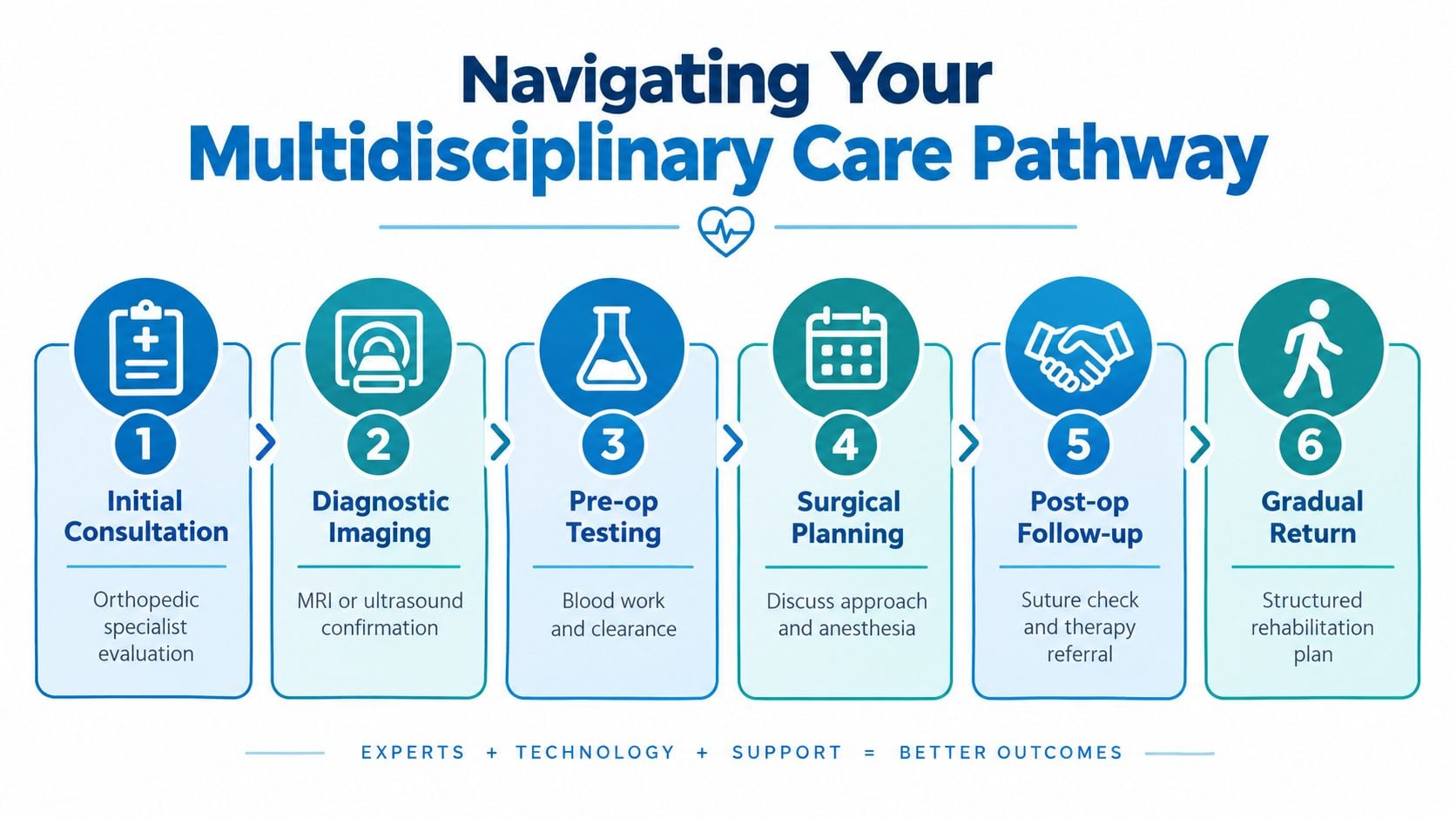
A productive consultation should produce more than a surgical date. It should clarify the diagnosis, identify factors that may limit recovery, and connect the chosen technique to the patient's actual life.
A coordinated evaluation may include medical history, sensory and strength testing, nerve studies, ultrasound or other imaging when appropriate, and review of work requirements. A multidisciplinary center can also coordinate nonsurgical treatment, surgical planning, rehabilitation, and insurance or workers' compensation questions when those issues affect timing.
Questions that improve the consultation
Patients should bring a symptom timeline and describe exactly what happens at work and at home. “Hand pain” isn't enough. The clinician needs to know whether the job involves typing, forceful pinching, lifting, vibration, or pressure through the palm.
Useful questions include:
- Diagnosis: Could the numbness come from the neck, elbow, or another nerve?
- Severity: Do examination findings or nerve testing show weakness or muscle loss?
- Technique: Why is open, mini-open, or endoscopic release appropriate for this wrist?
- Recovery: When can driving, typing, lifting, gripping, and vibration resume?
- Rehabilitation: Will hand therapy be needed, and what milestones determine progression?
- Durability: How would persistent or returning symptoms be evaluated?
A board-certified orthopedic specialist should explain why a particular method fits the anatomy rather than presenting one technique as universally superior. The care team should also discuss anesthesia, wound care, medication planning, follow-up, and the process for obtaining work restrictions.
Interventional Pain Management offers evaluation and treatment for carpal tunnel syndrome, from conservative care through surgical intervention, within a broader practice that includes orthopedic and pain-management services. Patients seeking coordinated guidance can review pain management services as part of the discussion with their treating team.
Preparing for a safer return
Before surgery, the patient should identify the essential tasks of the job and ask the employer about temporary modifications. After surgery, the care team can use wound healing, sensation, comfort, strength, and task tolerance to adjust restrictions.
The strongest plan is individualized. It recognizes that early recovery matters, but it also protects the hand while the nerve and surrounding tissues continue to recover. Adults in New Jersey and Staten Island who are experiencing persistent numbness, weakness, or work-limiting hand symptoms can schedule an evaluation with Interventional Pain Management to review diagnostic findings, nonsurgical choices, surgical technique, and a practical return-to-function plan. The team can help connect orthopedic assessment, pain care, rehabilitation guidance, and treatment coordination to the patient's specific needs.