
A scoliosis diagnosis often arrives after a routine check, an uneven shoulder noticed in a mirror, or an X-ray ordered for another reason. The immediate questions are usually practical: Does the curve need treatment now? Will a brace work? Could surgery be avoided? The answer depends less on the label alone than on the curve's Cobb angle, the patient's remaining growth, the pattern of the curve, and the willingness and ability to follow a demanding treatment plan.
| Treatment option | Usually considered when | Main purpose | Important trade-off |
|---|---|---|---|
| Observation | Smaller curves or stable curves with limited progression risk | Track change with examinations and imaging | Requires patience and reliable follow-up |
| PSSE and physical therapy | Mild to moderate curves, movement limitations, or rehabilitation needs | Improve posture, strength, body awareness, and function | Exercises don't replace mechanical correction when progression risk is high |
| Rigid bracing | Growing patients with moderate curves | Reduce progression while growth remains | Requires sustained wear, fitting, skin care, and emotional support |
| Nighttime or soft bracing | Selected curve patterns and lifestyle situations | Provide a more tolerable conservative option | May offer less consistent control for some curves |
| Spinal fusion | Larger or progressive curves, or failed conservative care | Correct and stabilize the deformity | Permanently limits motion in the fused segments |
| Vertebral body tethering | Carefully selected growing adolescents | Preserve more motion while using continued growth | Evidence, indications, and revision considerations differ from fusion |
Table of Contents
- The Evolution of Scoliosis Care Pathways
- How Curve Severity and Age Dictate Treatment
- Comparing Nonoperative Modalities and Brace Designs
- Bracing Burden and Adherence in Daily Life
- Surgical Interventions and Fusion Versus Motion Preservation
- Navigating Multidisciplinary Spine Care in New Jersey
- Preparing for Your Specialist Consultation
The Evolution of Scoliosis Care Pathways
A family may leave the first appointment with three unfamiliar words, observation, bracing, and surgery, and assume they represent a simple ladder. They don't. Each pathway answers a different clinical problem, and the correct choice can change as the spine grows or as a curve demonstrates progression.
Hippocrates described spinal traction in the 5th century BCE, and Galen later used the term scoliosis. The first posterior spinal fusion for scoliosis was performed in 1911 by Russell Hibbs. In North America, the modern brace era is generally associated with the Milwaukee brace in the 1950s, followed by underarm plastic designs such as the Boston and Wilmington braces. These milestones are documented in the historical review of scoliosis treatment.

Three pathways, different objectives
Observation isn't neglect. It means measuring the curve, assessing growth, reviewing symptoms, and identifying whether the spine is stable. A patient with a lower-risk curve may need surveillance rather than an intervention that creates discomfort or anxiety without a clear benefit.
Bracing aims to slow progression during growth. It doesn't permanently straighten the spine, and it isn't equally effective for every curve. The brace must be selected, fitted, worn, and reviewed as the child grows.
Surgery changes the mechanical structure of the spine. Fusion uses implants and bone healing to hold the corrected alignment, while newer motion-preserving procedures seek a different balance between correction and flexibility. Surgery is a serious option, not a routine response to every diagnosis.
Modern imaging, more refined biomechanics, and better patient selection have made those pathways more individualized. A specialist now considers curve magnitude, location, flexibility, skeletal maturity, symptoms, neurological findings, and functional goals rather than relying on a single visual impression.
Practical rule: The treatment decision should explain both the curve measured today and the risk of what may happen during the patient's remaining growth.
How Curve Severity and Age Dictate Treatment
The Cobb angle provides the central measurement. It quantifies the curve on a standing spinal X-ray, but the number only becomes clinically meaningful when paired with skeletal maturity. A curve that has little growth left to influence may behave differently from an apparently similar curve in a rapidly growing adolescent.
Guideline-based thresholds commonly place observation below 20°, bracing around 20° to 40° in skeletally immature patients, and surgical referral around 40° to 50° or above. Curves above 50° are often treated surgically because progression risk can remain substantial after maturity, as summarized in family medicine guidance on adolescent idiopathic scoliosis.
| Cobb angle | Skeletal maturity | Primary treatment pathway |
|---|---|---|
| Below 20° | Any stage, interpreted with progression risk | Observation and periodic assessment |
| Around 20° to 40° | Growth remaining | Bracing is commonly considered |
| 25° to 50° | Immature patient with meaningful progression risk | Active treatment, often bracing, with close review |
| Around 40° to 50° or above | Growing patient, progression, or high-risk pattern | Surgical consultation |
| Above 50° | Mature or near-mature patient with substantial curve | Surgery is often considered |
These are decision ranges, not automatic prescriptions. A specialist may recommend observation for a curve near a threshold if growth is nearly complete and imaging is stable. Conversely, a smaller curve may deserve close attention when growth is rapid, progression is documented, or the curve pattern carries higher risk.
Why growth changes the calculation
Residual growth supplies the time during which a curve can worsen. That is why a 30° curve in a growing adolescent can demand more active management than a similar curve in a fully mature adult. The assessment may include growth history, physical examination, standing radiographs, and maturity indicators visible on imaging.
A specialist also evaluates balance and flexibility. Two curves with the same Cobb angle may differ in rotation, trunk balance, pain, and response to correction. The useful question isn't "What degree is the curve?" It is, "How large is it, how flexible is it, how much growth remains, and has it changed?"
Comparing Nonoperative Modalities and Brace Designs
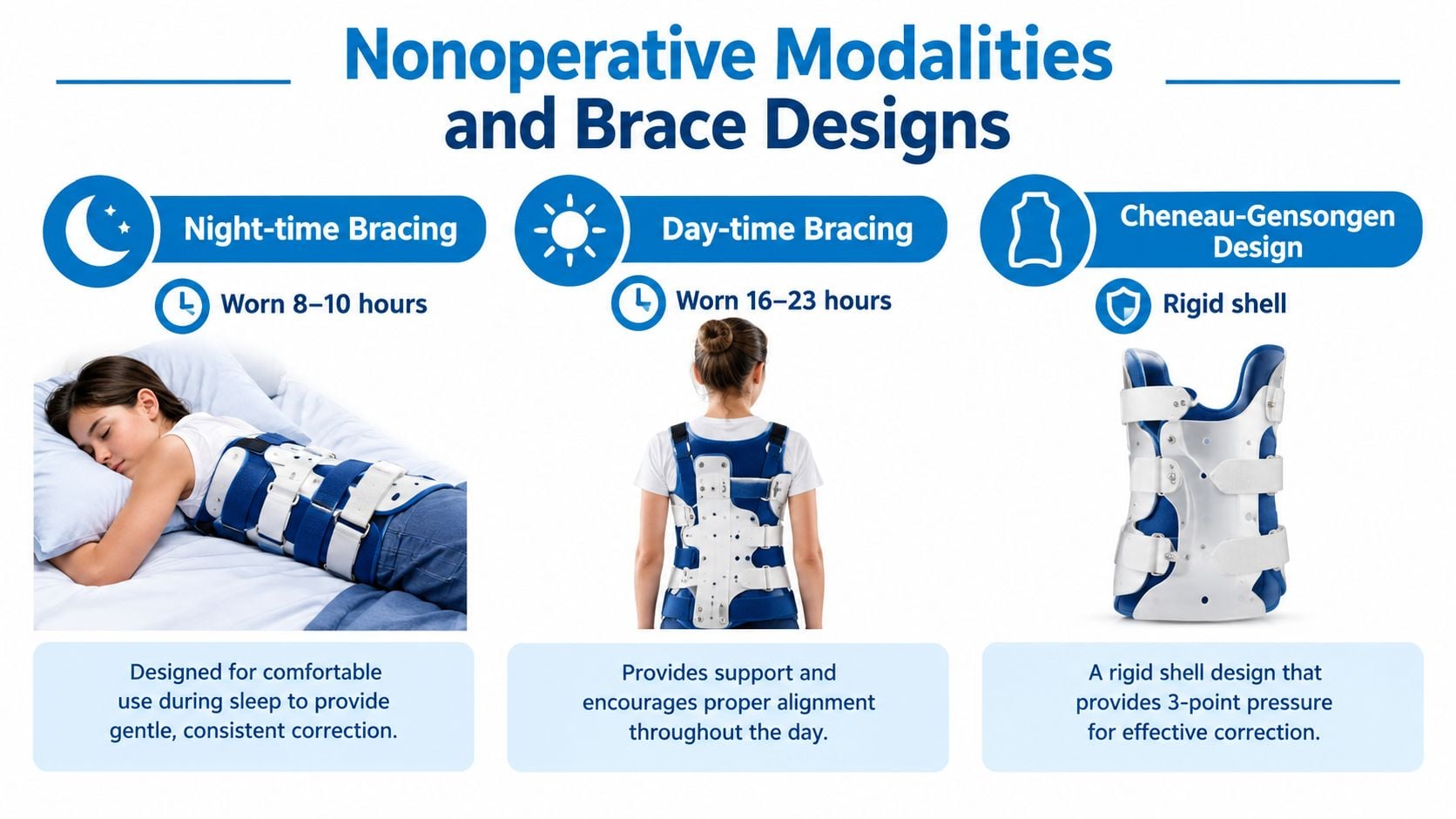
Nonoperative care includes more than a generic prescription to “wear a brace.” Physiotherapeutic scoliosis-specific exercises, rigid braces, nighttime braces, and soft or dynamic braces have different purposes and different adherence demands. A 2025 review describes PSSE and bracing as first-line conservative options for mild to moderate curves, while a 2026 narrative review distinguishes rigid, soft, and nighttime designs in its discussion of contemporary conservative care.
Exercises and mechanical correction
PSSE focuses on posture, trunk awareness, breathing mechanics, controlled movement, and strength. It may help a patient move more efficiently and participate in care, but exercise alone shouldn't be presented as a substitute for bracing when a growing patient has a curve with a meaningful progression risk.
A rigid brace applies targeted forces intended to influence spinal alignment during growth. Its success depends on the curve pattern, the quality of the fit, the correction achieved inside the brace, and actual wear. A nighttime brace can reduce the daytime burden, but it isn't suitable for every curve or every growth situation. Soft and dynamic designs may be more acceptable for some patients, although their corrective behavior differs from a rigid shell.
Before accepting a device, the family should ask:
- Curve fit: Which curve pattern is the brace designed to manage?
- Wear plan: Is it intended for nighttime use, daytime use, or near full-time wear?
- Correction target: What in-brace Cobb angle or alignment change is expected?
- Review schedule: How will the team adjust the brace as the patient grows?
- Exercise role: Should PSSE accompany the brace, follow brace removal, or support rehabilitation?
Patients and families seeking a broader clinical discussion can review scoliosis correction care, then use the specialist visit to ask why a specific design fits the measured curve.
Matching the device to daily life
A brace that looks excellent on an X-ray but remains unworn won't deliver its intended treatment. School clothing, sports, sleep, heat, skin sensitivity, body image, and family routines all affect whether a plan can be maintained. The best conservative plan is therefore a clinical compromise, not a contest to choose the most aggressive device in isolation.
Bracing Burden and Adherence in Daily Life
For a growing patient with a moderate curve, bracing can offer a meaningful advantage over observation. In the BrAIST-era evidence summarized by clinical guidance, more than 70% of brace-treated patients reached treatment success, defined as ending with a Cobb angle below 50°, compared with 48% of observed patients, according to the relevant clinical summary.
Those group results do not guarantee that an individual child will avoid surgery. Brace performance also varies by design and wear schedule. The same guidance reports success rates of 73.2% for rigid full-time braces, 78.7% for nighttime braces, and 62.4% for soft braces, with each outperforming observation in the cited review. The prescription must fit both the curve and the patient's ability to follow it.
The brace has to work in the patient's life
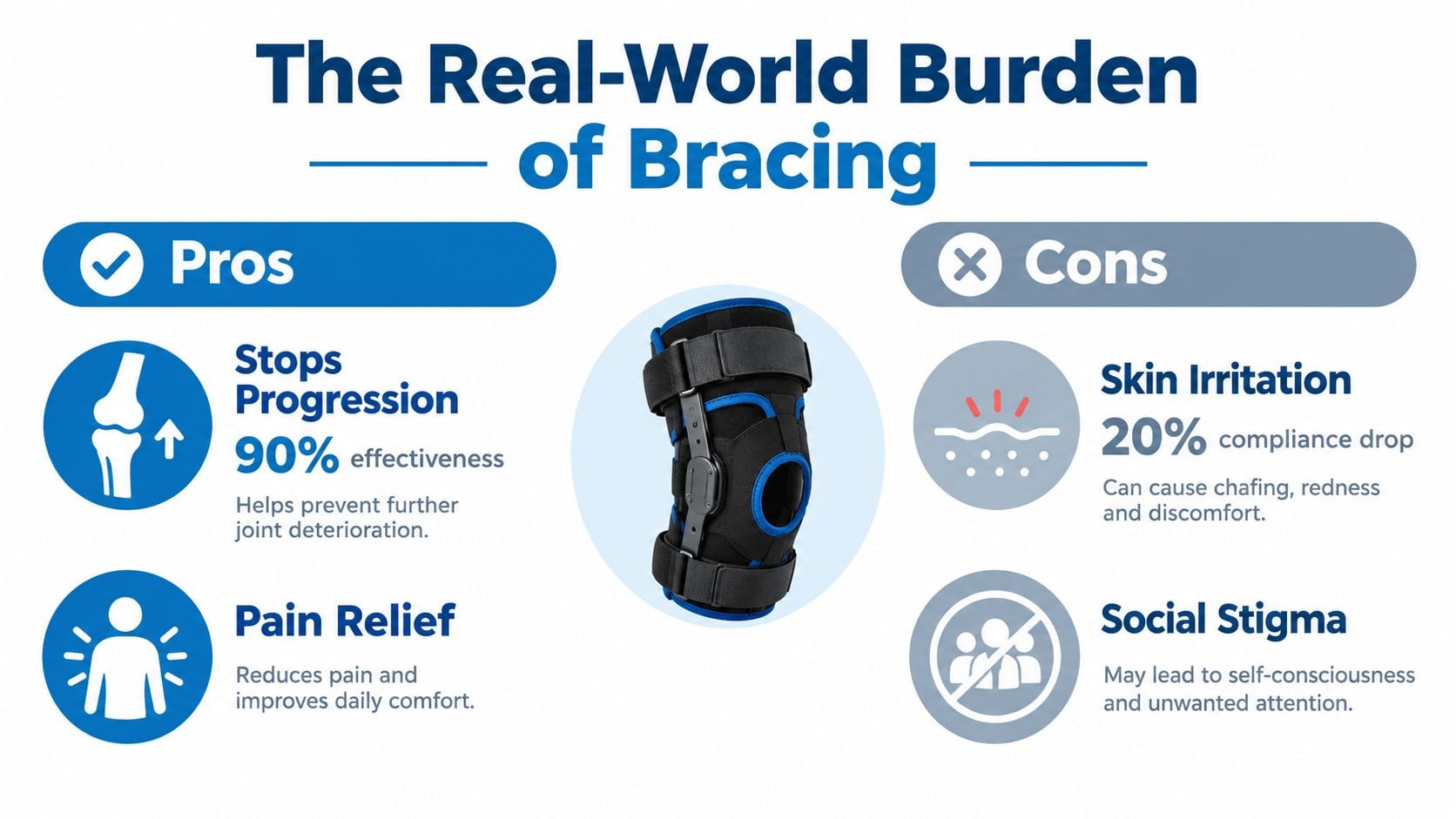
A rigid shell may cause pressure, heat, limited clothing choices, disrupted sleep, and self-consciousness. These problems become harder to manage when the prescription approaches near full-time wear. Families should arrange skin checks, gradual adaptation when appropriate, practical clothing options, school communication, and quick access to the orthotist if pressure points or discomfort develop.
Adherence is not just a matter of motivation. A child may avoid the brace because of body image concerns, teasing, sports limitations, pain, or frustration with family reminders. A plan that ignores those pressures can fail even when the device is technically well designed.
A 2025 review of brace and exercise combinations reported a 60% success rate and about a 50% reduction in surgery risk for moderate curves, while also reporting 30% skin irritation and 40% psychological distress associated with bracing. Those findings appear in the review of combined conservative care. Mechanical benefit and treatment burden can occur together, so follow-up should address both.
In-brace correction is a useful checkpoint
Clinicians assess how much the curve changes while the brace is worn. A reduction of more than 20% in the Cobb angle is associated with better long-term outcomes, and older predictor data associate an in-brace reduction of at least 25% with about a 73% success rate.
A poor in-brace correction should prompt refitting, a different design, or an honest discussion about whether the proposed wear schedule is realistic for this patient. The goal is not merely to prescribe a brace. It is to achieve useful correction with a plan the patient can sustain.
A brace succeeds only when its design corrects the curve and the patient can live with the plan.
Surgical Interventions and Fusion Versus Motion Preservation
Surgery generally enters the discussion when the curve is large, continues to progress, or remains high risk despite appropriate conservative care. For adolescent idiopathic scoliosis, surgical consideration commonly begins around 40° to 50°, while curves above 50° are often treated surgically because progression may continue after maturity. The decision also depends on balance, flexibility, symptoms, growth, and the patient's broader health.
Fusion offers established correction
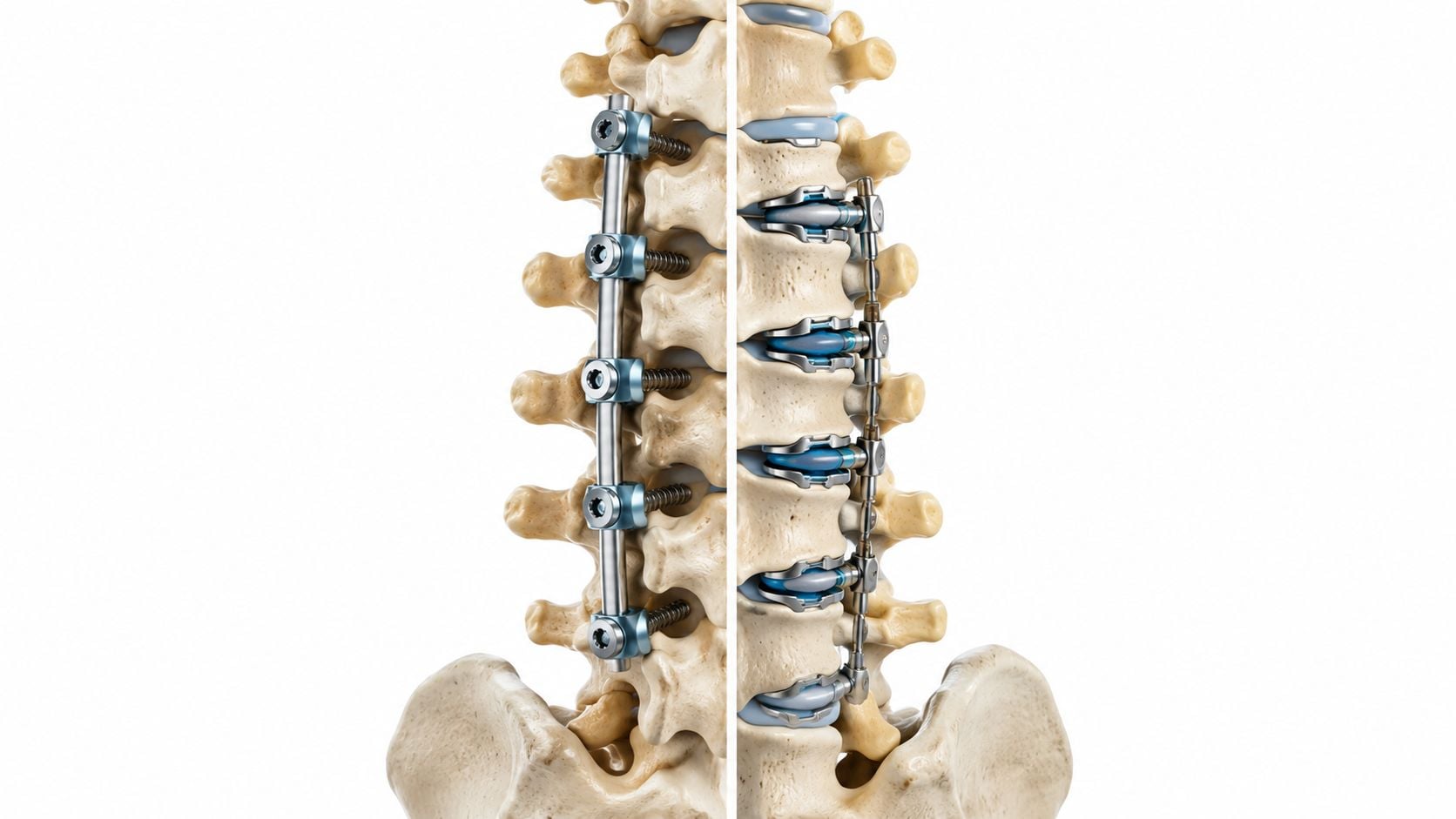
Posterior spinal fusion uses screws, rods, and bone graft to correct and stabilize selected spinal segments. It offers a durable structural strategy and a long-established role in deformity correction. The cost is permanent loss of motion in the fused segments, although the clinical effect on daily function depends on the levels treated, the residual flexibility of the unfused spine, and the individual's activities.
Fusion shouldn't be described as a simple cosmetic procedure. The operation requires careful planning, recovery, rehabilitation, and discussion of complications, including implant issues, nonunion, infection, and the possibility of future symptoms elsewhere in the spine. A surgeon should explain the planned levels, expected correction, recovery restrictions, and what success means functionally.
Tethering preserves a different possibility
Vertebral body tethering, or VBT, uses a flexible tether on the front of the spine and relies partly on continued growth to modulate the curve. It may appeal to selected growing adolescents who want to preserve more spinal motion, but it isn't a universal replacement for fusion. Curve type, flexibility, growth remaining, skeletal maturity, and the surgeon's assessment all matter.
The trade-off is uncertainty. Tethering can involve overcorrection, tether breakage, additional procedures, or revision, and its long-term evidence base differs from that of established fusion. A patient considering motion preservation should ask what happens if the tether fails, how often revision may be discussed in that surgeon's practice, and whether fusion would remain feasible later.
Information about motion-preserving spine procedures should remain distinct from disc replacement. The artificial disc replacement service addresses a different clinical problem and shouldn't be treated as a scoliosis-specific substitute for deformity correction.
| Question | Fusion | Vertebral body tethering |
|---|---|---|
| Main aim | Correct and stabilize | Correct while preserving more motion |
| Patient selection | Broad surgical role, based on curve and anatomy | Narrower, selected growing patients |
| Growth dependence | Not dependent on continued growth for correction | Uses continued growth as part of the strategy |
| Long-term trade-off | More established structural certainty, less motion in fused levels | More motion potential, different revision uncertainties |
Navigating Multidisciplinary Spine Care in New Jersey
Scoliosis care works best when one clinician isn't forced to answer every question alone. The pathway may begin with a primary examination and standing imaging, continue through orthopaedic or spine evaluation, and include physical therapy, brace management, pain care, surgical planning, and rehabilitation as the patient's needs change.
A coordinated team can assign each decision to the right discipline:
- Diagnostic review: The clinician examines the history, posture, neurological findings, symptoms, and available imaging.
- Growth and deformity assessment: A spine specialist interprets the Cobb angle, curve pattern, flexibility, and remaining growth.
- Conservative treatment: Physical therapists address movement, conditioning, body awareness, and safe activity. Orthotists manage brace design and fit.
- Symptom management: Pain specialists evaluate pain generators, nerve irritation, and functional limitations when symptoms are present.
- Surgical planning: An orthopaedic or spine surgeon discusses fusion, selected motion-preserving options, and recovery expectations when surgery is indicated.
- Rehabilitation: Post-treatment therapy helps restore strength, movement confidence, and safe participation in daily activities.
Interventional Pain Management and Ortho-Spine Center serves patients in New Jersey and Staten Island through board-certified physicians in pain management, anesthesiology, orthopaedics, and spine surgery. Its stated services span non-invasive care, interventional procedures, scoliosis correction, fusion, thoracoscopic release, and rehabilitation coordination, with seven-day scheduling and support for insurance navigation.
The practical value of a multidisciplinary setting is continuity. The patient shouldn't have to repeat the entire history at every stage or choose between symptom relief and deformity evaluation when both issues need attention. A clear plan should identify who reviews new imaging, who adjusts a brace, who manages pain, and who determines whether progression has changed the treatment pathway.
Preparing for Your Specialist Consultation
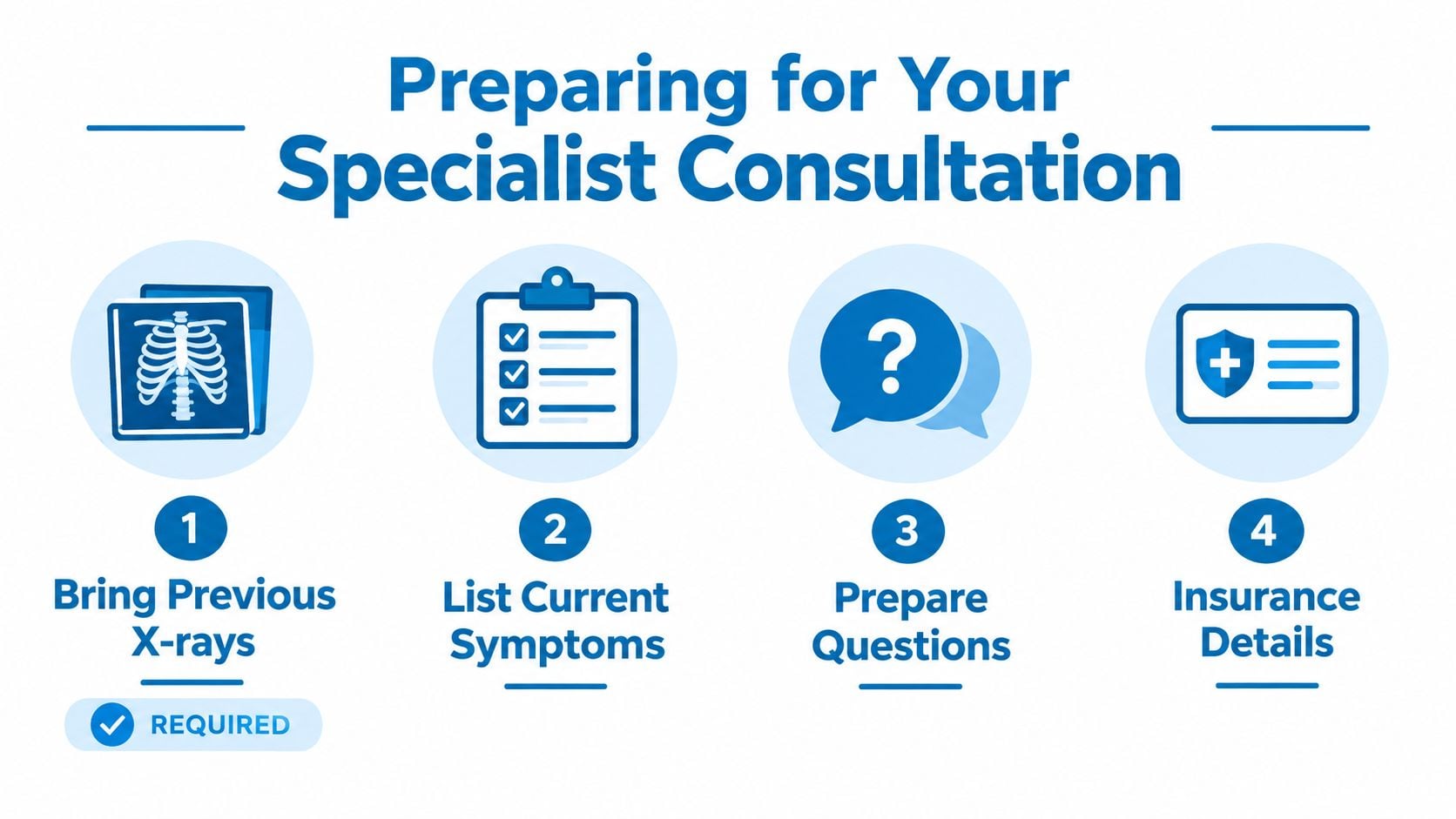
A productive consultation starts before the appointment. The patient or family should bring prior X-rays and reports, a medication list, a record of symptoms, information about growth and activity, and a short description of what the curve prevents or makes difficult. The purpose isn't to arrive with a diagnosis already chosen. It's to give the specialist enough context to match the treatment to the actual person.
Questions that clarify the decision
The following questions can turn a vague recommendation into a measurable plan:
- What is the Cobb angle and curve pattern? Ask which curve is primary, whether there is rotation, and whether the spine is balanced.
- How much growth remains? The answer helps explain why observation, bracing, or surgery is being considered.
- What is the progression risk? Ask what changes on follow-up imaging would trigger a different treatment.
- What is the exact brace prescription? Confirm the design, daily wear expectation, adjustment schedule, skin-care plan, and school or sports accommodations.
- How will success be measured? The team should identify whether success means stable Cobb angle, acceptable in-brace correction, symptom control, functional improvement, or avoiding surgery.
- If surgery is proposed, what levels will be treated? Ask about correction, flexibility after fusion, recovery, restrictions, complications, and revision planning.
- Is motion preservation appropriate? If VBT is discussed, ask why the curve meets the selection criteria and what the backup plan would be if growth or tether behavior doesn't produce the intended correction.
Bring practical concerns into the room
Families should mention embarrassment, sleep difficulty, clothing concerns, sports, school attendance, pain, and anxiety. These aren't secondary details. They can determine whether a brace plan is sustainable and whether a surgical recommendation aligns with the patient's goals.
Patients can also review appointment logistics and insurance questions through the specialist appointment page. A written plan should include the next imaging milestone, warning symptoms that require earlier contact, and the name of the clinician responsible for follow-up.
Before leaving: The patient should be able to explain the recommended pathway, the reason for it, the daily burden, the alternatives, and the specific event that would change the plan.
Interventional Pain Management evaluates spine conditions through coordinated history-taking, physical examination, imaging review, nonoperative care, interventional pain procedures, and surgical referral when clinically appropriate. Patients in New Jersey and Staten Island can visit Interventional Pain Management to request an appointment and discuss scoliosis treatment options matched to curve characteristics, growth or maturity, symptoms, and functional goals.