

Waking after surgery with an arm or leg that feels numb, heavy, warm, or strangely disconnected can be unsettling. A patient may look at the limb, try to move it, and immediately wonder whether the nerve block caused damage. In most cases, these sensations reflect the intended temporary effect of the anesthetic, but the pattern of recovery matters.
Nerve block side effects after surgery are easiest to understand as a timeline, not as a simple list of complications. Sensation may return gradually, tingling may replace numbness, and movement may improve in stages. A symptom that steadily fades is different from weakness that worsens, numbness that persists beyond the expected duration, or severe pain accompanied by swelling or fever.
This guide follows that recovery map. It explains how a block works, which effects are common, how block location changes the experience, and when a patient should contact the surgical or anesthesia team. It also covers rare emergencies, so concern can be matched to the actual warning signs rather than to the mere presence of numbness. General information about nerve blocks and their uses is also available in this patient guide to nerve blocks.
Table of Contents
- Introduction to Nerve Blocks After Surgery
- How Nerve Blocks Work and Why Temporary Effects Occur
- Common Side Effects and How Long They Last
- Uncommon and Rare Complications to Know
- How Side Effects Differ by Block Type and Surgery
- When to Contact Your Clinic and What Happens Next
- Key Takeaways for a Safe Recovery After a Nerve Block
Introduction to Nerve Blocks After Surgery
A nerve block places local anesthetic near nerves that carry sensation from the surgical area. The medication temporarily interrupts those signals, helping control pain while the body begins healing. Depending on the location and technique, the same interruption can also affect muscle movement or nearby automatic nerve functions.
That means a patient may wake with a hand that feels asleep, a leg that seems too heavy to lift, or a shoulder that feels different from the opposite side. These effects can be expected, especially while the anesthetic is active. They become more reassuring when the patient can see a gradual return of sensation and control.
A recovery story in real time
Consider a patient after knee surgery. During the first part of recovery, the leg may feel numb and difficult to move. Later, tingling may appear in the foot, followed by improving movement. Pain can then return as the block fades, which is why the prescribed oral pain plan should be followed before discomfort becomes difficult to control.
The same timeline can look different after shoulder surgery. A patient may notice arm weakness, altered sensation, hoarseness, or a feeling of changed breathing depending on the block used. The location determines which nearby nerves and muscles are temporarily affected.
The most useful question isn't “Do I feel numb?” It's “Is the symptom following the expected path toward recovery?”
Why early symptoms need context
Early sensory symptoms are common enough to deserve explanation, but lasting nerve injury is uncommon. A large prospective registry involving 12,668 ultrasound-guided peripheral nerve blocks reported postoperative neurologic symptoms lasting longer than 5 days in 1.8 per 1,000 blocks and symptoms lasting longer than 6 months in 0.9 per 1,000 blocks (registry and review data). The same registry reported unintended paresthesia during placement in 2.0 per 1,000 blocks, showing that an uncommon event still deserves careful assessment when it occurs.
The practical distinction is between an anesthetic effect that wears off and a neurologic symptom that remains, worsens, or interferes with function. The sections ahead use that distinction to help patients protect a numb limb, anticipate changing sensations, and recognize when a call is appropriate.
How Nerve Blocks Work and Why Temporary Effects Occur
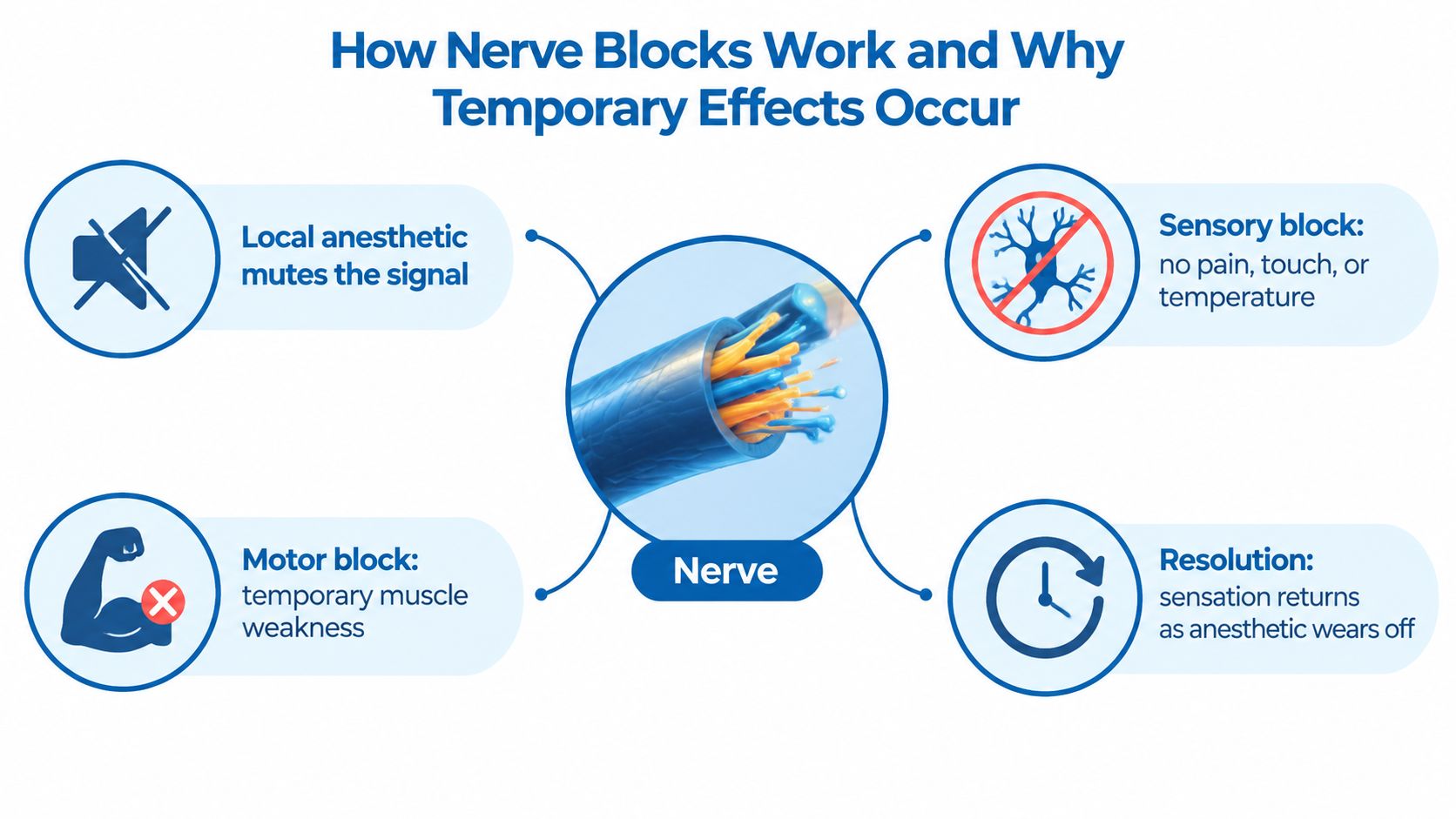
A useful analogy is a telephone wire. A nerve carries messages between the body and the brain, including messages about pain, touch, temperature, and muscle control. Local anesthetic temporarily mutes the wire, so the surgical area can remain comfortable without every pain signal reaching the brain.
The anesthetic doesn't usually remove the nerve. It changes conduction for a limited period. As the medication is absorbed and its effect declines, messages begin to travel again. That gradual return explains why tingling often appears before normal sensation and why movement may come back in stages.
Three kinds of temporary change
A sensory block reduces pain, touch, and temperature signals. Numbness is therefore an intended result, not proof that the nerve has been injured. A patient may touch the skin and feel little, or may not notice a hot or cold surface.
A motor block affects the signals that activate muscles. The result can be heaviness, reduced grip, difficulty lifting an arm, or trouble straightening a knee. This effect can be useful for comfort, but it can also limit safe walking and transfers.
A block can also influence sympathetic nerve activity, which helps regulate blood flow and some automatic functions. The skin may feel warmer, look different in color, or seem unusually dry or moist. The care team considers these findings alongside circulation, movement, pain, and the surgical site.
Why duration varies
The duration depends on the block's location, the medication used, the amount delivered, and whether a catheter continues to provide local anesthetic. Individual metabolism and the surrounding tissues also influence how quickly the effect fades. A patient shouldn't compare one person's recovery time with another's or treat a general timeline as a personal guarantee.
A block used near a major nerve may affect a broad region. A more targeted technique may create a narrower sensory area and less motor weakness. Patients can ask the anesthesia team which functions are expected to change, how the block will be supported with other pain treatments, and what instructions apply if sensation doesn't return as anticipated. Information about injection-based pain procedures is available in this overview of pain-management injections.
Common Side Effects and How Long They Last
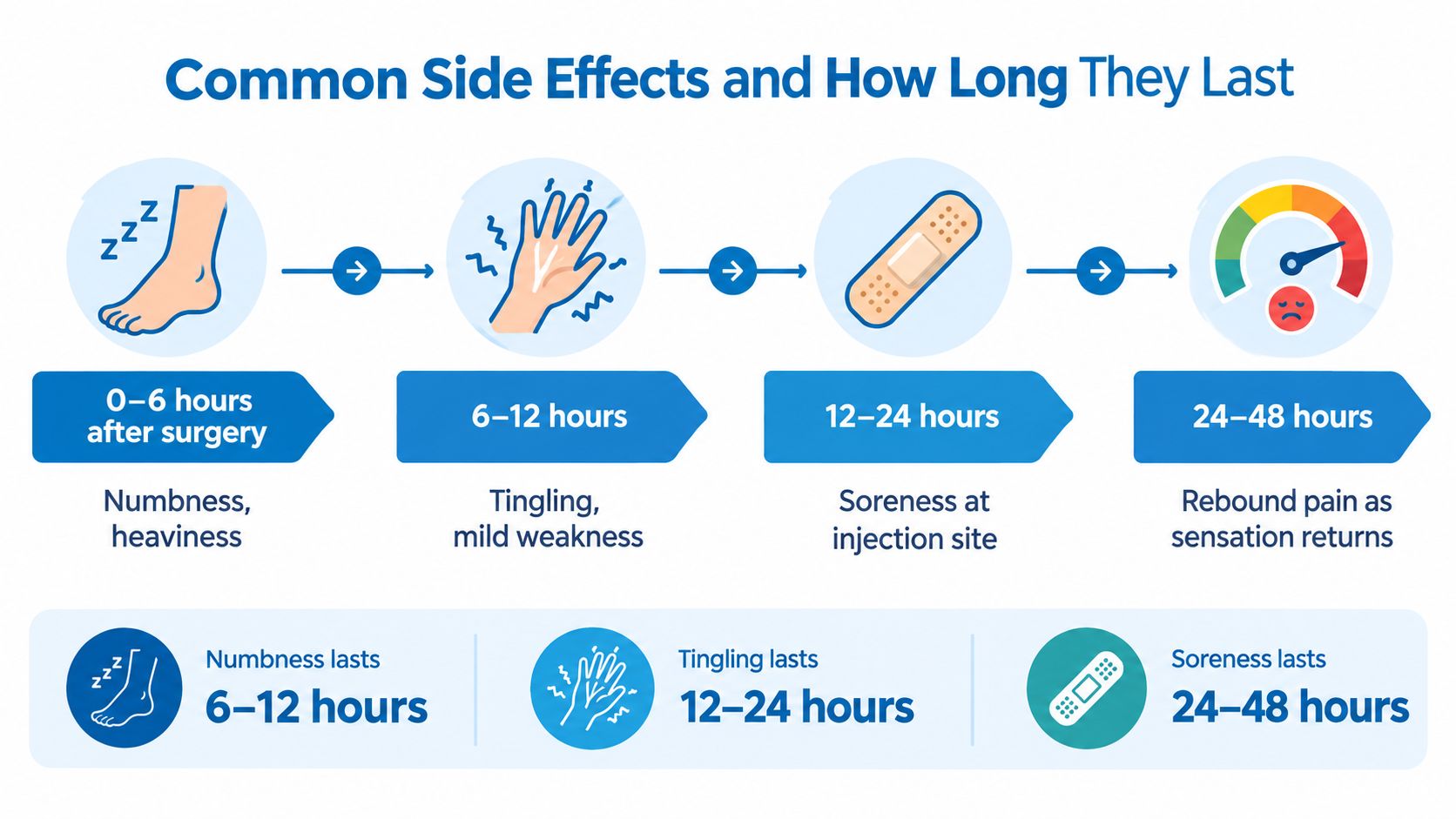
Most patients notice a changing pattern rather than one fixed sensation. The area may begin numb and heavy, develop pins and needles, and then regain more ordinary feeling. Mild soreness where the needle entered can occur, and pain may increase as the anesthetic effect recedes.
The exact timing varies by block and medication, so the discharge instructions take priority. A general sequence may still help a patient know what to watch for.
The usual wear-off pattern
Numbness and heaviness: The limb may feel disconnected or difficult to position while the block is active. A patient should protect it from heat, pressure, sharp edges, and accidental knocks because reduced sensation removes normal warning signals.
Tingling or pins and needles: Tingling often signals that nerve conduction is returning. It can feel unpleasant without representing damage, particularly when it gradually replaces numbness and is followed by improving sensation.
Temporary weakness: A weak hand, foot, arm, or leg can persist while motor fibers remain affected. Patients should follow instructions about walking, weight-bearing, braces, slings, and assistance rather than testing the limb alone.
Injection-site soreness: The needle path may feel tender or bruised. The surgical team's instructions should guide dressing care, activity, and use of cold therapy.
Rebound pain: Pain can return as sensation comes back. Prescribed oral medication is often intended to cover this transition, so patients should follow the agreed schedule rather than waiting until pain becomes severe.
Early tingling, numbness, and mild weakness usually describe a temporary conduction change. A steady return of feeling and control is more reassuring than a symptom that remains unchanged or progresses.
Protecting the limb during numbness
A numb limb needs supervision. The patient should check its position, avoid walking without the recommended support, and keep any sling, brace, or dressing correctly placed. Family members or caregivers can help inspect the skin when the patient can't reliably feel pressure or temperature.
Pain control should also be planned rather than improvised. The patient should use the discharge instructions, keep prescribed medications available, and contact the clinical team if pain is uncontrolled, arrives suddenly, or differs sharply from the expected surgical discomfort. Swelling, redness, or fever adds a reason to call rather than assuming the block is wearing off.
Uncommon and Rare Complications to Know
A nerve block has a strong safety record, but no procedure is risk-free. Serious concerns include prolonged neurologic symptoms, local anesthetic systemic toxicity, bleeding or hematoma, infection, and block-specific motor or breathing effects. Knowing these possibilities helps patients respond promptly without treating every episode of numbness as an emergency.
Persistent neurologic symptoms
A review summarized serious neurologic injury after peripheral nerve block at about 2.4 per 10,000 blocks, while permanent neurological injury was reported at approximately 0.02% to 0.07% overall (regional anesthesia complications review). The review also cited transient injuries across a broader range, from 0.01% to 0.8%. A pooled analysis found peripheral nerve injury rates ranging from 3.5 to 5.0 per 10,000 blocks, with a pooled mean of 4.0 per 10,000 (same review source).
These figures describe uncommon outcomes, not the expected experience of most patients. Risk can increase with an injection inside the nerve fascicle, excessive local anesthetic concentration or volume, or unsuitable patient selection. Persistent numbness, painful sensitivity, shooting pain, or weakness beyond the expected duration should prompt reassessment.
Local anesthetic systemic toxicity
Local anesthetic systemic toxicity, often called LAST, occurs when too much anesthetic reaches the bloodstream or affects the central nervous and cardiovascular systems. Early symptoms can include unusual central nervous system excitation, followed by seizures, breathing arrest, severe low blood pressure, arrhythmia, or cardiovascular collapse.
This is a time-critical medical emergency. Expert guidance recommends stopping local anesthetic delivery immediately, securing the airway and oxygenation, and using 20% lipid emulsion for severe hypotension or arrhythmia (major regional analgesia guidance). A patient at home with seizure, collapse, severe breathing difficulty, or altered consciousness needs emergency services, not routine clinic messaging.
Bleeding, infection, and nearby effects
Bleeding can form a hematoma that presses on nearby nerves. Infection may cause increasing redness, warmth, drainage, swelling, or fever at the injection site. These findings require clinical advice because the cause cannot be determined safely from sensation alone.
Some blocks affect nearby structures. A neck-based shoulder block may cause temporary voice changes or breathing sensations, while other techniques can involve pleural puncture or unintended spread toward the spine. The anesthesiology team should explain which effects fit the selected block and which require urgent attention.
How Side Effects Differ by Block Type and Surgery
Side effects depend on geography. A block near the shoulder can influence nerves that serve the arm and nearby breathing muscles, while a block near the thigh can weaken the quadriceps. The surgical procedure adds another layer because pain, braces, weight-bearing restrictions, and rehabilitation goals determine how much temporary weakness matters.
| Block Type | Typical Sensory Effect | Typical Motor Effect | Block-Specific Considerations |
|---|---|---|---|
| Interscalene | Reduced sensation around the shoulder and upper arm | Arm and shoulder weakness | Hoarseness, breathing changes, pleural puncture, or unintended neuraxial spread can occur |
| Femoral | Reduced sensation around the front of the thigh and knee | Quadriceps weakness | Weakness can increase fall risk and delay safe mobilization |
| Adductor canal | Reduced sensation around part of the knee and lower leg | Often less quadriceps impairment than a femoral approach, though movement effects vary | Rehabilitation goals and the exact surgical area determine whether coverage is sufficient |
| Truncal | Reduced sensation across the targeted abdominal or chest wall region | Usually limited to nearby muscles, depending on the technique | Patients should follow instructions for breathing, coughing, movement, and wound protection |
Upper-extremity considerations
After an interscalene block for shoulder surgery, the arm may feel heavy and difficult to lift. Temporary hoarseness or a changed breathing sensation can occur because nearby structures may be affected. Chest symptoms, significant breathing difficulty, or worsening distress should be reported urgently rather than dismissed as routine.
Lower-extremity considerations
A femoral block can reduce quadriceps strength. That matters during standing, transfers, and stair use, even when pain control is excellent. A patient may feel comfortable enough to walk while lacking the muscle control needed to prevent the knee from buckling, so assistance and prescribed mobility devices are important.
A review of adverse events after peripheral nerve blocks identifies this function-versus-comfort tradeoff, including quadriceps weakness and falls after femoral blocks. It estimated femoral nerve palsy at 2% to 2.7% in one review, with the cited discussion also noting that interscalene blocks were associated with more adverse events in some shoulder-surgery settings (review of postoperative nerve block complications).
The rehabilitation question
The best block for pain relief isn't automatically the best fit for every mobility plan. Patients should ask whether the block is expected to weaken a muscle needed for walking, whether a brace is required, and who should assist with the first transfers. That conversation helps the care team balance opioid-sparing pain control with safe function.
When to Contact Your Clinic and What Happens Next
The key decision is based on duration, direction, and function. Numbness that gradually recedes is different from numbness that remains complete beyond the expected block period. Mild weakness that improves is different from weakness that worsens or prevents safe movement.
A clinical review describes temporary postoperative neurologic symptoms as occurring in up to 15% of patients early after peripheral nerve block, with reported symptoms falling to 0% to 2.2% by 3 months, 0% to 0.8% by 6 months, and 0% to 0.2% by 1 year (review of postoperative neurologic symptoms). These figures don't replace individual advice, but they show why the recovery trajectory matters.
A practical call checklist
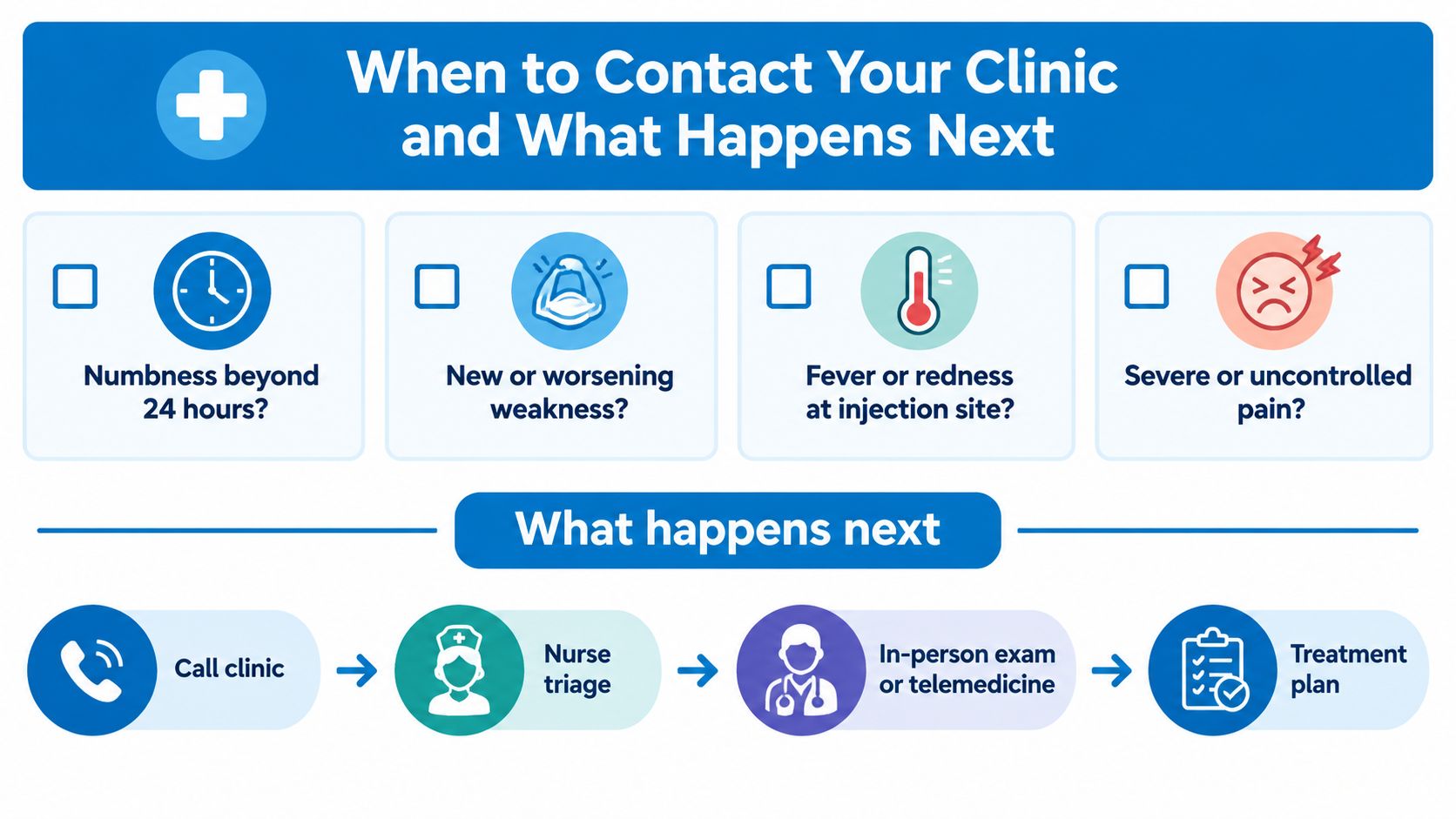
Contact the surgical or anesthesia team when any of the following applies:
Numbness lasts beyond the expected duration: Use the discharge instructions as the reference point. Symptoms that persist longer than expected deserve assessment, especially when there's no improvement.
Weakness is new or worsening: Worsening motor loss, inability to move the affected area, or unsafe walking requires prompt guidance.
Pain is severe, shooting, or uncontrolled: Pain that escalates sharply, feels electrically burning, or doesn't respond to the prescribed plan shouldn't be explained away as routine wear-off.
The injection site changes: Fever, increasing redness, warmth, drainage, marked swelling, or a growing tender lump can suggest infection or bleeding.
Systemic warning signs appear: Seizure, collapse, severe breathing difficulty, confusion, or a major change in consciousness requires emergency care.
What reassessment may involve
The clinician will ask when the block was placed, which areas are numb, whether sensation is changing, and whether movement is improving. A neurologic examination may compare strength, sensation, reflexes, circulation, and the distribution of symptoms with the intended block area.
The team may document the symptom course and arrange follow-up if the deficit persists. Clinical guidance supports escalation for progressive or painful deficits and neurologic testing when symptoms don't resolve as expected (patient-focused escalation guidance). Patients should keep a record of changes, including the time sensation returns, movements that become possible, and any new pain or swelling. For additional pain-related evaluation and treatment options, patients can review pain-management services.
Key Takeaways for a Safe Recovery After a Nerve Block
A nerve block temporarily changes nerve communication. Numbness, tingling, heaviness, and weakness can therefore be part of the intended treatment, especially early after surgery. The reassuring pattern is gradual improvement, with sensation and movement returning in stages as the anesthetic effect fades.
A safe recovery depends on protecting the affected area while sensation is reduced. Patients should avoid heat and pressure, follow weight-bearing instructions, use prescribed braces or slings, and ask for help with transfers when motor control is limited. Comfort can also change quickly during wear-off, so the prescribed pain plan should be followed rather than delayed until pain becomes intense.
The recovery map
While the block is active: Expect reduced sensation and possibly weakness in the targeted region. Protect the limb and follow mobility restrictions.
As the block fades: Tingling, warmth, sensitivity, and returning movement may appear. These changes are usually more reassuring when they progress toward normal function.
After the expected duration: Persistent numbness, dysesthesia, or weakness deserves a call, particularly if symptoms are painful, worsening, or interfering with walking or hand use.
At any point: Severe breathing difficulty, seizure, collapse, altered consciousness, rapidly increasing swelling, or signs of infection require urgent medical attention.
The distinction is not whether a patient feels something unusual. The distinction is whether the symptom follows a temporary recovery pattern or shows a concerning trajectory. Serious neurologic injury remains rare, but persistent or progressive symptoms shouldn't be managed with reassurance alone.
Patients should keep discharge paperwork and the anesthesia or surgical contact number accessible. A coordinated assessment may involve the surgical team, anesthesia clinicians, pain specialists, orthopedics, or neurology, depending on the symptoms and the procedure. Early communication gives the team a clearer picture and helps protect both comfort and function.
Interventional Pain Management offers evaluation and treatment for pain conditions, including nerve block injections, with care coordinated across pain management, anesthesiology, orthopedics, and spine services. Adults with persistent numbness, weakness, or post-surgical pain can visit Interventional Pain Management to request an evaluation and discuss appropriate next steps.