
You stepped off a curb, planted a foot during a tackle, or twisted while changing direction. The ankle swelled, but the pain felt higher than a typical rolled ankle. Days later, walking is possible, yet turning, pushing off, climbing stairs, or standing through a work shift still hurts. That pattern often reflects a high ankle sprain, and it shouldn't be managed like a minor lateral ankle injury.
Recovery depends less on a calendar date than on whether the ankle can tolerate the forces required by a specific job, sport, or daily routine. A person may walk comfortably while remaining unable to cut, pivot, jump, carry loads, or work on uneven ground. The safest approach combines protection early, progressive rehabilitation, and functional testing before full activity.
Table of Contents
- Understanding High Ankle Sprains and Why They're Different
- Acute Care and Initial Management Strategies
- Progressive Rehabilitation Exercises and Milestones
- Realistic Recovery Timelines and What Influences Them
- Return to Sport and Work Criteria
- Red Flags and When to Consult a Specialist
- Your Recovery Action Plan and Next Steps
Understanding High Ankle Sprains and Why They're Different
A recreational athlete may initially assume a standard ankle sprain after a collision or forceful twist. The swelling may be modest, and the person may even limp through the next day. Then a simple movement, such as rotating the foot outward or pushing off to climb stairs, produces pain above the ankle rather than only along its outer edge.
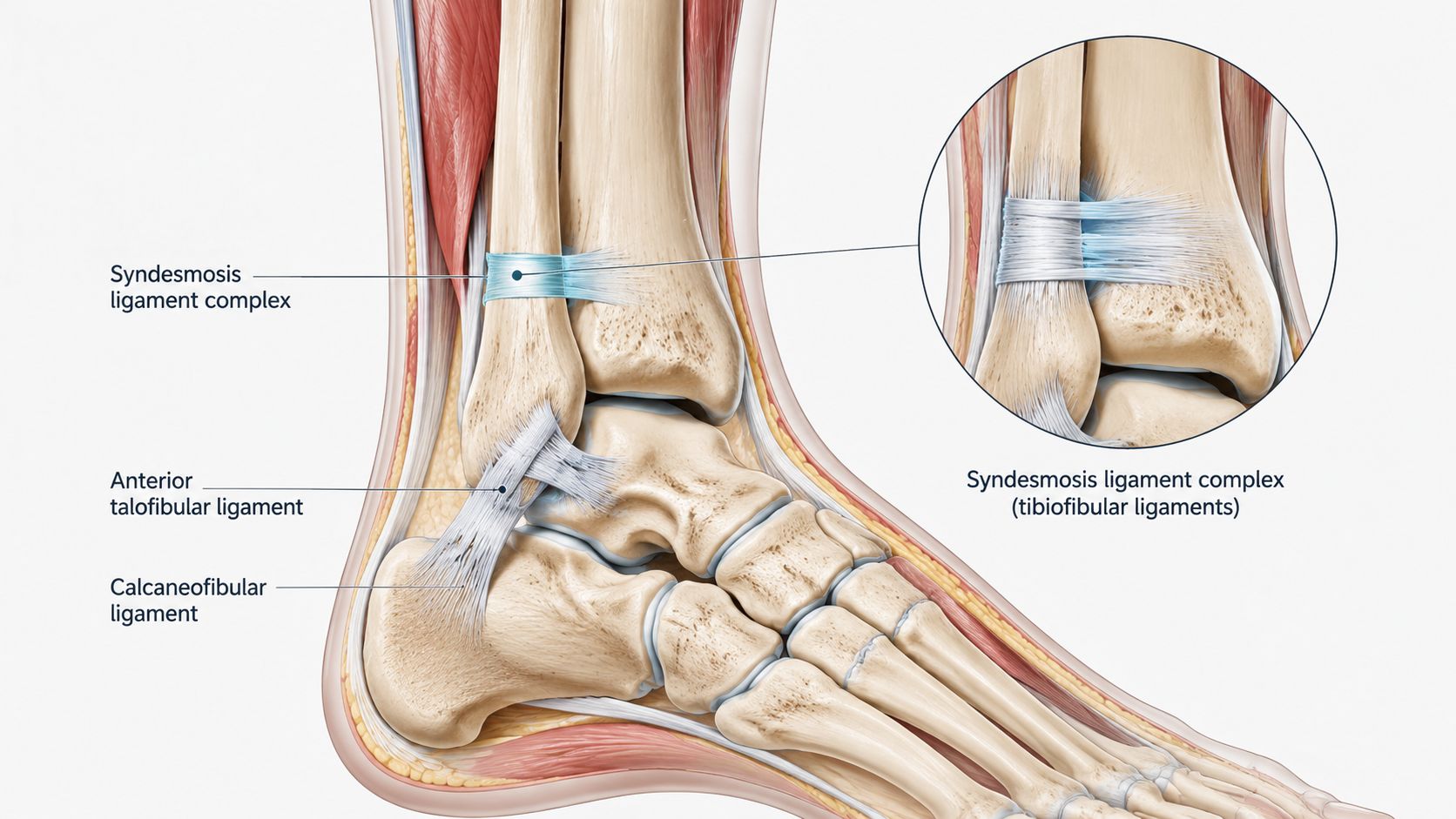
A high ankle sprain affects the syndesmosis, the ligament complex that connects the tibia and fibula just above the ankle joint. A lateral sprain usually involves ligaments on the outside of the ankle. The syndesmosis has a different job. It helps maintain the relationship between the two lower-leg bones while the ankle absorbs load and the foot rotates.
The usual mechanism involves the foot staying planted while the lower leg rotates outward, or the ankle being forced upward and outward during contact. That rotational stress can stretch or tear the syndesmotic ligaments. Because standing and walking continue to load this area, the injured tissue can remain irritated even when the ankle appears to be improving.
Signs that point above the ankle
Pain higher on the ankle, discomfort when the foot is rotated, pain during push-off, and difficulty bearing weight deserve more attention than a routine “rolled ankle” label. Symptoms can overlap with fractures and other ligament injuries, so an examination matters when the mechanism was forceful or progress stalls.
Practical rule: Pain-free walking is a useful early milestone, not proof that the syndesmosis is ready for rotational sport or heavy work.
Rest, ice, compression, and elevation can reduce symptoms, but they don't determine whether the tibia and fibula remain stable. A structured assessment and phased rehabilitation are more useful than repeating the same passive care while testing the ankle with demanding activity. General information about ankle and other sprains and their treatment can help patients prepare for that discussion.
Acute Care and Initial Management Strategies
The first days set the conditions for recovery. If walking produces a pronounced limp, sharp push-off pain, or a sense of instability, forcing full weightbearing can keep the syndesmosis irritated even though the calendar says healing should have begun.
Protect the ankle before testing it
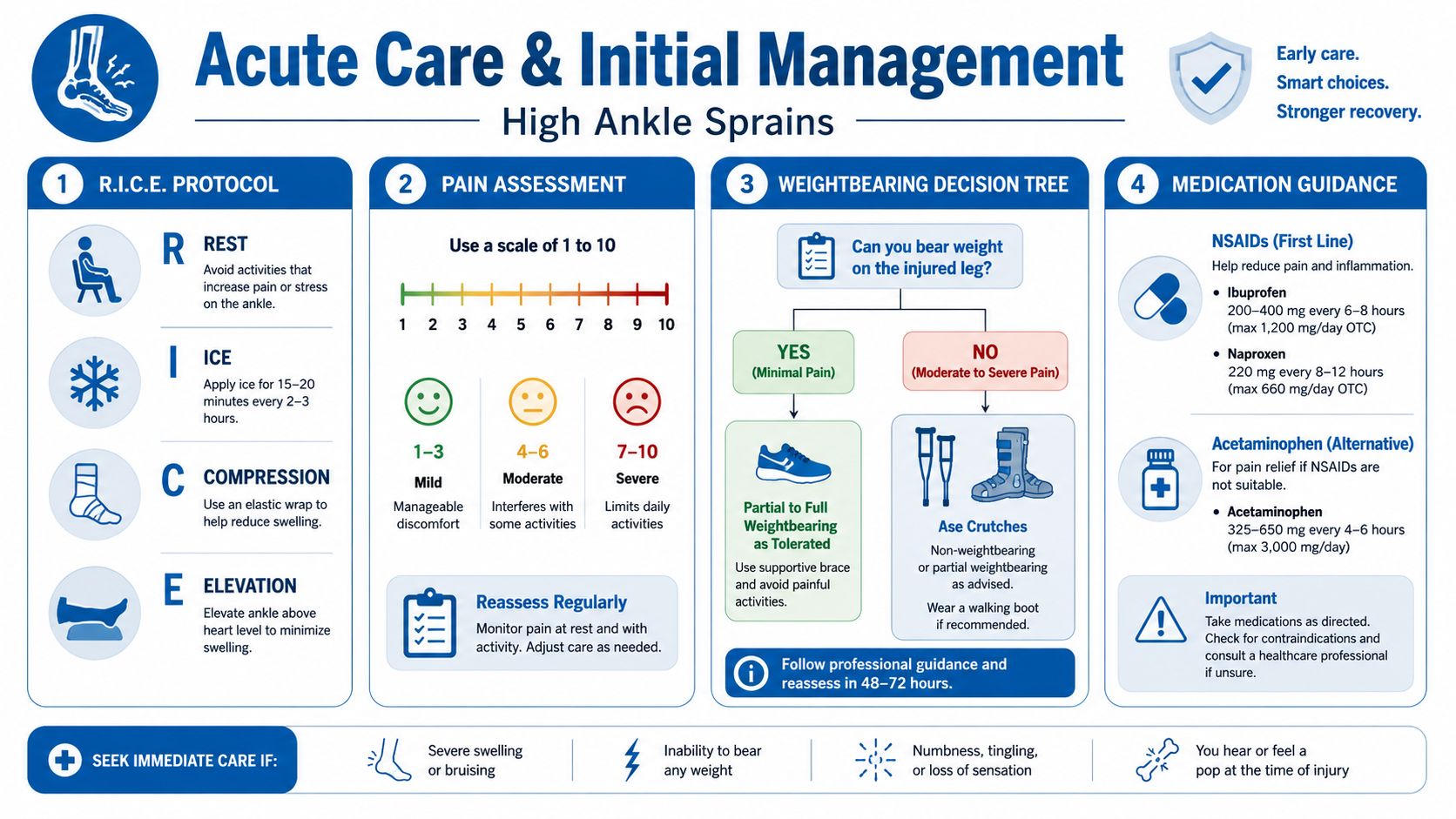
Use crutches when walking changes mechanics or causes sharp pain. Increase weightbearing only when the foot can contact the ground with control, pain remains mild, and symptoms do not worsen later that day or the next morning. A walking boot may provide needed stability when ordinary shoes are insufficient. A rigid brace can support the transition toward more normal walking. The choice should follow examination findings, suspected ligament disruption, and imaging when indicated.
A boot protects the injured area, but wearing it longer than needed can contribute to stiffness and weakness. Gentle movement within the clinician's permitted range is generally more useful than repeatedly provoking the injury with errands, workouts, or informal testing.
Reduce symptoms without masking deterioration
Cold therapy, raising the ankle, and comfortable compression may help control swelling. A pillow supporting the lower leg during sleep can keep the ankle raised, but excessive pressure from a wrap may cause numbness, color changes, or increasing discomfort. Medication choices must account for stomach, kidney, cardiovascular, bleeding, pregnancy, and other medical considerations. Follow a clinician's guidance instead of copying someone else's dosage.
Supportive habits such as sleep, nutrition, and daily activity can complement protection and rehabilitation. These holistic inflammation control tips may help manage symptoms, but they cannot stabilize an ankle with meaningful syndesmotic separation.
A rehabilitation review found that incomplete syndesmosis injuries averaged 55 days to return to full activity, nearly twice the recovery time of grade III lateral ankle sprains, in its review of ankle rehabilitation evidence. Time alone remains a poor clearance test. Pain may settle before the ankle can tolerate rotation, push-off, uneven ground, or job-specific loading.
Seek prompt evaluation for marked deformity, inability to bear weight, worsening swelling, numbness, or pain that seems disproportionate. Arrange reassessment when progress from protected walking toward normal movement stops. Repeating the same home routine will not resolve an unrecognized stability problem. Patients can review available orthopedic and pain treatment services when deciding where to obtain further evaluation.
Progressive Rehabilitation Exercises and Milestones
Rehabilitation should advance according to function, not an arbitrary date. The ankle needs to regain motion, strength, balance, and tolerance for rotation in a sequence that respects tissue healing.
Phase 1 focuses on motion and symptom control
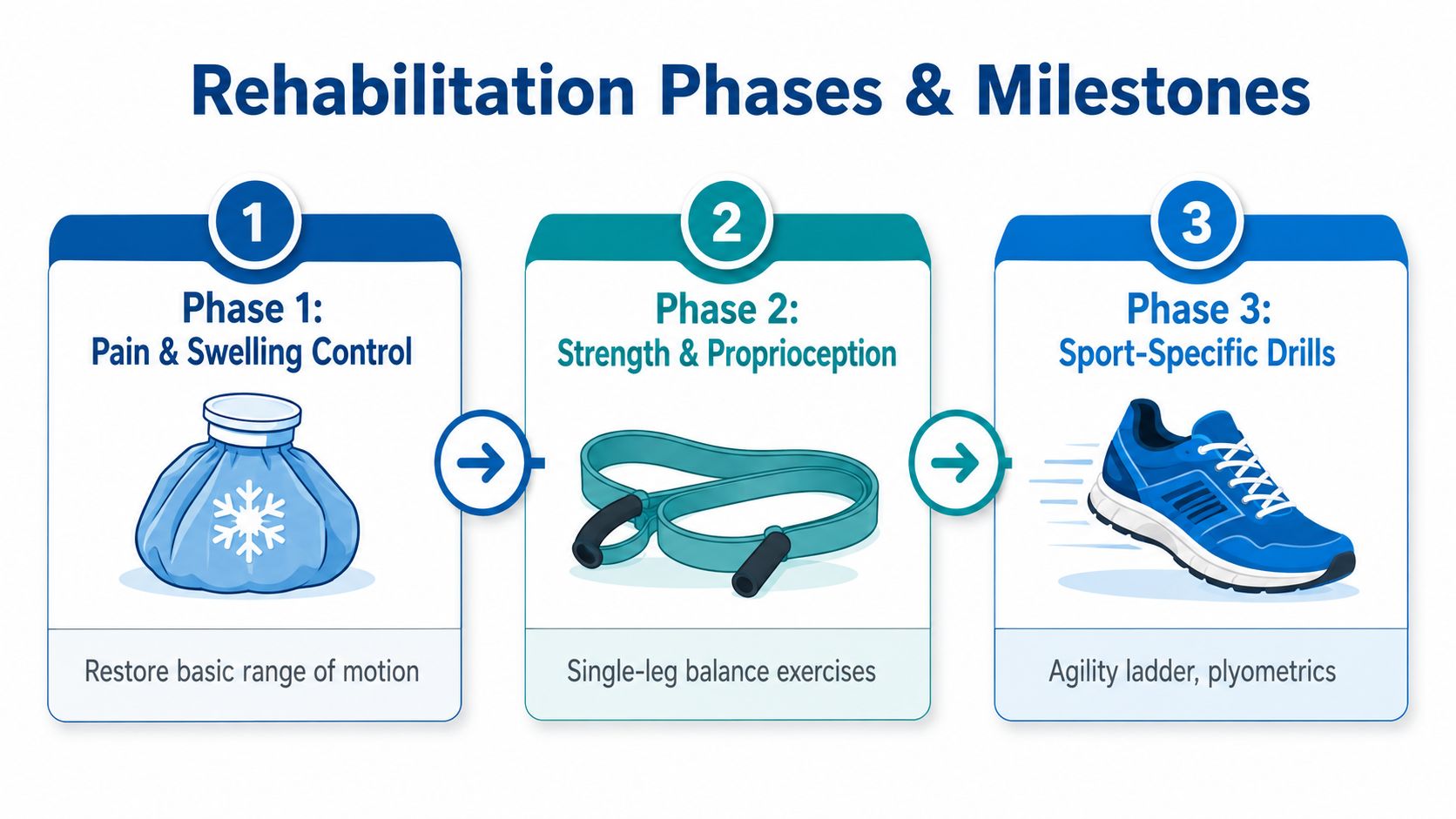
Early exercises may include gentle ankle pumps and tracing the alphabet with the foot, provided the treating clinician has allowed motion. These movements help prevent excessive stiffness without demanding forceful rotation. Swelling should trend downward, and walking should become more controlled rather than merely more frequent.
Progress when basic motion is tolerable, the resting pain response is settling, and the ankle handles necessary walking without a delayed flare. If an exercise causes sharp pain above the ankle or produces greater swelling later, reduce the range, lower the volume, or pause for clinical guidance.
Phase 2 rebuilds strength and control
Resistance-band work can target ankle movement in several directions, but the motion should stay controlled and within a comfortable range. Seated calf raises may come before standing calf raises, followed by supported single-leg loading as tolerated. The goal isn't to chase fatigue. It's to restore force production without shifting the workload into the knee, hip, or uninjured side.
A physical therapist can identify compensations such as turning the foot outward, collapsing the arch, or avoiding push-off. Those details matter because a patient may complete an exercise while still using a strategy that overloads another joint.
Phase 3 adds balance and movement awareness
Single-leg balance on a firm surface can progress to more challenging conditions when the ankle remains steady. Proprioception work teaches the body to recognize position and correct small losses of balance before they become a twist. Balance quality matters more than surviving the exercise.
Phase 4 prepares for real demands
Running, jumping, cutting, pivoting, and sport-specific drills belong near the end of progression. A worker may instead need repeated stepping, carrying, ladder use, uneven surfaces, or prolonged standing. Advancement requires quiet landings, controlled direction changes, and no meaningful pain or swelling response afterward.
A good session should build capacity, not create a new injury signal.
If strength or balance remains clearly limited, supervised therapy is preferable to improvising advanced drills. The patient should progress one demand at a time and track the ankle's response through the next day.
Realistic Recovery Timelines and What Influences Them
A patient may walk comfortably, feel nearly recovered, and still struggle with a pivot, uneven surface, or repeated push-off. That gap explains why high ankle sprain recovery often takes longer than expected. The injury spectrum is broad, and a calendar estimate cannot show whether the syndesmosis tolerates the demands of work or sport.
A 2022 systematic review of athletes reported an overall return-to-play rate of 99% and a pooled mean return-to-play time of 52.32 days, placing typical recovery around seven to eight weeks rather than a few days according to the systematic review. The same analysis reported a pooled mean return time of 39.33 days for nonsurgical cases and 70.94 days for surgically treated cases. Those figures describe groups, not individual clearance dates. Comparing your ankle with a teammate's can mislead when stability, injury severity, and treatment differ.
| Treatment type | Average recovery time | Key considerations |
|---|---|---|
| Nonsurgical care | 39.33 days in the cited systematic review | More suitable when stability is preserved and symptoms improve with protection and rehabilitation |
| Overall athlete population | 52.32 days in the cited systematic review | Represents a broad group, not a personal clearance date |
| Surgical treatment | 70.94 days in the cited systematic review | Often reflects more significant instability or injury complexity |
Older rehabilitation literature reported time lost from sport ranging from no time lost to 137 days, with average recovery periods spanning roughly 10 to 52 days across studies in a review of syndesmotic sprains. The wide range has a practical meaning: healing on schedule does not prove readiness for rotation, impact, or fatigue.
Severity, stability, treatment choice, baseline conditioning, work demands, and adherence all shape progression. A desk-based worker and a field athlete may need different functional benchmarks despite similar pain scores. Active adults often return during the “almost normal” stage, when walking is comfortable but twisting or repeated loading still provokes symptoms. Persistent pain, swelling, instability, or a stalled milestone deserves reassessment rather than another calendar-based delay.
Return to Sport and Work Criteria
A time-based clearance asks whether enough days have passed. A criteria-based clearance asks whether the ankle can perform the tasks that caused the original problem. The second approach is more clinically useful because basketball, construction, soccer, warehouse work, and ordinary walking place different demands on the syndesmosis.
Pain-free walking is necessary, but it doesn't prove readiness for cutting or pivoting. A patient should be able to complete daily activity without a significant symptom response, demonstrate stable single-leg control, and reproduce job or sport movements with good alignment. Strength should be compared with the uninjured side, and hopping or landing should not produce apprehension, a limp, or increasing pain.
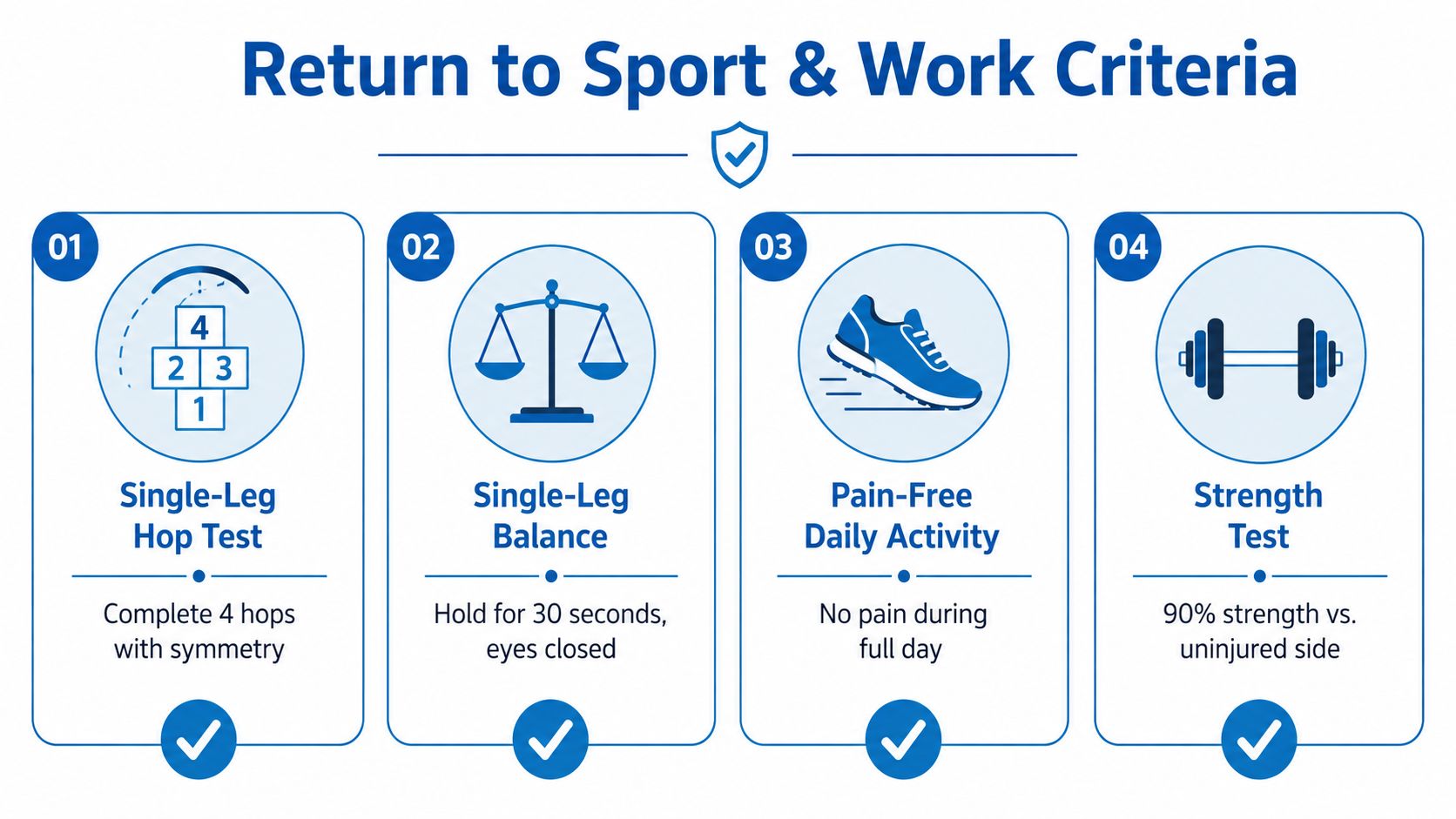
A practical readiness screen
A clinician may select tests based on the patient's goals, but the reasoning remains consistent:
- Daily activity tolerance: Complete an ordinary day without escalating pain, swelling, or limping.
- Single-leg control: Stand on the injured leg with the trunk and knee controlled, without repeatedly touching down.
- Strength comparison: Perform clinician-selected calf and ankle strength tests without substitution or pain.
- Impact tolerance: Progress from small hops to more demanding jumping only when landing mechanics remain quiet and controlled.
- Directional movement: Complete gradual cutting and pivoting drills without pain, instability, or hesitation.
- Task simulation: Rehearse job-specific demands, such as stepping, carrying, climbing, or prolonged standing, before resuming a full shift.
Some infographic checklists use specific targets, but those targets shouldn't be treated as universal clearance rules. The treating clinician must account for age, injury severity, imaging, occupation, sport position, and whether symptoms appear during or after activity.
Recent evidence highlights a clinically important gap. Elite athletes often return successfully, yet timelines vary substantially by treatment, and the literature still lacks a consensus return-to-sport protocol after syndesmotic injury as described in a recent systematic review. That uncertainty makes functional testing and shared decision-making more valuable than a generic “six to eight weeks” instruction.
A gradual return may begin with limited practice or modified duties, followed by increased speed, load, and unpredictability. Full clearance should follow demonstrated capacity, not eagerness or a single good morning.
Red Flags and When to Consult a Specialist
Persistent symptoms deserve a fresh diagnosis, not automatic reassurance. A high ankle sprain can appear to improve while the patient still lacks the stability needed for rotation, impact, or repetitive loading. Lingering disability may reflect incomplete healing, instability, an associated injury, stiffness, weakness, or a movement pattern that developed during protection.
Escalate when progress stops
A specialist assessment is appropriate when pain remains concentrated above the ankle, swelling repeatedly returns with ordinary activity, the ankle gives way, or rehabilitation cannot advance despite sensible protection. Inability to transition from basic walking to strengthening and balance work is also a reason to reassess the original diagnosis.
Imaging decisions depend on the examination. Weight-bearing radiographs can help assess alignment, while advanced imaging may be considered when ligament injury, occult bone injury, cartilage damage, or persistent instability remains uncertain. A clinician may also use imaging to determine whether the tibia and fibula maintain appropriate alignment under load.

Know when conservative care may not be enough
Surgical consultation becomes more relevant when there is diastasis, chronic instability, or failure of an appropriate nonsurgical program. Treatment discussions may include stabilization, fixation, or continued rehabilitation, depending on alignment, chronicity, tissue condition, and the patient's functional demands. Emerging discussions of dynamic fixation suggest that some athletes may return to sport in under two months, compared with three to six months after screw fixation, but that evidence remains uneven and focused largely on athletic populations as reviewed in the surgical literature.
Chronic cases require especially careful counseling because there isn't a universal return protocol. Some guidance recommends substantially longer restrictions in chronic situations, including periods extending to six months after dynamic fixation. The correct response to a stalled recovery isn't fear or impatience. It's a targeted examination that identifies whether the problem is pain, instability, weakness, or a structural issue.
Patients in New Jersey and Staten Island can also seek coordinated evaluation through orthopedic care for musculoskeletal conditions, particularly when persistent pain requires review by more than one specialty.
Your Recovery Action Plan and Next Steps
A practical recovery plan should answer three questions each week: Can the ankle tolerate current loading, is function improving, and does the next activity match the ankle's demonstrated capacity?
Use a simple progress checklist
- Protect early: Use crutches, a boot, or a brace when walking mechanics aren't controlled.
- Track response: Record pain, swelling, walking tolerance, and the next-day reaction after exercise.
- Advance gradually: Move from range of motion to strength, balance, impact, and job or sport drills.
- Test function: Assess single-leg control, strength, landing, direction changes, and task-specific endurance.
- Escalate intelligently: Arrange reassessment for instability, persistent pain, recurrent swelling, or failure to progress.
The most useful record is functional rather than numerical. Note whether stairs, uneven ground, a full workday, or a specific sport movement remains limited. That information helps a clinician distinguish a normal recovery phase from a problem requiring imaging, orthopedic review, physical therapy adjustment, or pain-focused care.
For patients with complex symptoms, Interventional Pain Management offers multidisciplinary evaluation across non-invasive, interventional, orthopedic, and surgical services, with treatment plans informed by clinical findings and functional demands. Seven-days-a-week scheduling is available across locations serving New Jersey and Staten Island.
Interventional Pain Management can evaluate persistent ankle pain, coordinate orthopedic assessment, and help identify whether continued rehabilitation or a more advanced intervention fits the recovery problem. Visit Interventional Pain Management to request an evaluation and discuss the next practical step toward returning safely to work, sport, and daily activity.