

A sudden pivot, an awkward landing, or a collision can leave the knee swollen within minutes. By the next morning, many patients are dealing with pain, a feeling that the knee may give way, and a difficult question: how to treat an ACL tear without making the wrong decision.
The answer isn't automatically surgery, and it isn't just rest. Effective care matches the tear pattern, knee stability, associated injuries, activity goals, and the patient's ability to complete structured rehabilitation. The treatment path may include surgery, but the operation itself is only one part of recovery.
Table of Contents
- What Treating an ACL Tear Involves
- Immediate Care and Accurate Diagnosis in the First Week
- Surgery or Structured Rehab How to Choose
- Inside ACL Reconstruction Grafts Timing and Newer Options
- Managing Pain Around Surgery and Recovery
- Rehab Milestones and Return to Sport Criteria
- Complications Prevention and Your Next Steps
What Treating an ACL Tear Involves
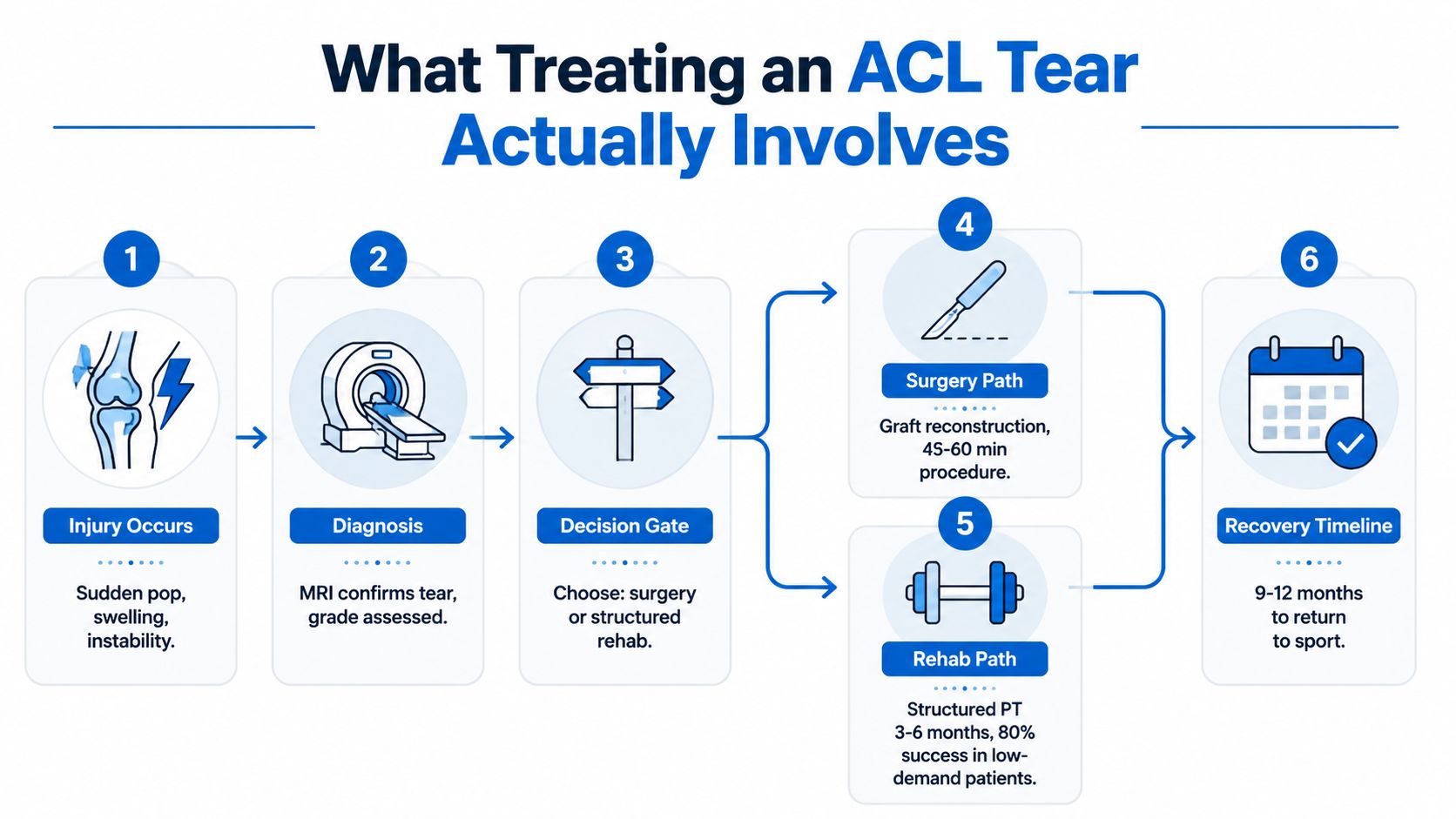
Treating an ACL tear is a sequence of clinical decisions, not a single procedure. Early care protects the knee, controls swelling, and limits movements that trigger instability. Examination and imaging then clarify the ligament injury and reveal associated meniscal, cartilage, or bone damage. The key decision is whether the knee can function safely with structured rehabilitation or whether reconstruction offers better stability for the patient's demands.
The pathway usually includes these stages:
- Acute care: Reduce swelling, protect weight-bearing, and restore comfortable motion as symptoms allow.
- Diagnosis: Combine the injury history with ligament testing, radiographs when appropriate, and MRI findings.
- Decision point: Compare reconstruction with structured rehabilitation according to instability, sport, work demands, age, and associated meniscal or cartilage injury.
- Chosen treatment: Proceed with reconstruction and graft selection when indicated, or begin a closely supervised rehabilitation program.
- Progressive loading: Rebuild extension, quadriceps and hamstring strength, balance, landing control, and confidence.
- Return-to-sport testing: Use objective strength, hop, movement, and psychological-readiness measures before clearance.
The clinical forks that change the plan
A young athlete who plays soccer, basketball, or another pivoting sport places different demands on the knee than an adult focused on walking, cycling, and daily activity. A complete rupture with repeated giving-way episodes also calls for a different discussion than a partial, non-retracted tear in a stable knee.
Meniscal, cartilage, or bone injuries may require faster orthopedic review. The American Academy of Orthopaedic Surgeons guideline update notes that, when reconstruction is indicated, delaying beyond 3 months can increase the risk of additional meniscal and cartilage injury.
Recovery is measured by function, not just by a healed incision. Rehabilitation commonly follows a 9 to 12 month window before return to high-intensity sport, although selected clinical pathways may use 6 months as an accelerated minimum threshold. Sports-medicine evidence reports that about 81% to 92% of patients return to some sport, but only 55% to 79% regain their pre-injury level, and roughly 55% return to full-capacity competition, as summarized in this ACL reconstruction rehabilitation review. A technically successful operation therefore does not guarantee athletic recovery. Clearance should follow demonstrated strength, control, and readiness.
Immediate Care and Accurate Diagnosis in the First Week
During the first 72 hours, the practical goals are protection, swelling control, and safe mobility. The PRICE-R approach is useful: protect the knee, use relative rest, apply ice for short intervals, use compression when appropriate, raise the leg, and obtain timely professional review. Crutches may be needed if weight-bearing increases pain or causes the knee to buckle.
A rapidly swollen knee deserves prompt assessment. Swelling that develops within roughly 2 hours can represent hemarthrosis, meaning bleeding into the joint, and in younger patients it strongly raises concern for ACL rupture. Repeatedly testing the knee at home, twisting to “see if it holds,” or returning to sport before diagnosis can provoke additional instability.
What the examination looks for
The clinician compares both knees and assesses effusion, range of motion, tenderness, gait, and collateral-ligament stability. The Lachman test is generally the most sensitive bedside maneuver for anterior instability. The anterior drawer test adds information, while the pivot-shift test evaluates rotational instability and may be performed under anesthesia when guarding prevents a reliable office assessment.
| Test | Sensitivity | Specificity | Best Use |
|---|---|---|---|
| Lachman | Generally highest among bedside tests | Supports ACL instability when clearly positive | Initial clinical assessment |
| Anterior drawer | Useful, particularly after acute guarding settles | Helps confirm anterior translation | Follow-up examination |
| Pivot shift | May be limited by pain and muscle guarding | Demonstrates functional rotational instability | Grading instability, sometimes under anesthesia |
Plain radiographs usually come first when fracture or avulsion is possible. They can identify a tibial eminence avulsion or a Segond fracture, findings that change the diagnostic picture even though an ACL itself isn't fully visible on an X-ray.
Why MRI changes the treatment conversation
MRI can confirm the tear, show whether it is partial or complete, and identify the location of the rupture. A proximal tear may be more amenable to repair in selected situations, while bone-bruising patterns can support the injury mechanism. MRI also detects meniscal and chondral injuries that may influence the timing and type of surgery.
At the initial visit, clinicians may record arthrometer measurements, such as KT-1000 results, along with patient-reported scores including IKDC or KOOS. These measures establish a baseline so progress is judged by function and stability, not only by pain.
Surgery or Structured Rehab How to Choose
The surgery-versus-rehabilitation decision should begin with one question: What must the knee reliably do after recovery? A patient who wants to return to cutting and pivoting sports has a different risk profile from someone whose priority is comfortable daily activity.
Structured rehabilitation can be reasonable for carefully selected adults. This pathway may fit a lower-demand recreational athlete, a patient with a stable knee, or someone with a partial tear and limited instability. It can also suit a person who passes “coper” screening, meaning functional testing suggests the knee can manage intended activities without repeated giving-way.
The Delaware-Oslo cohort illustrates the trade-off. Among highly active patients initially choosing rehabilitation alone, 52% to 56% had a successful outcome at 2 years, while 33% to 37% crossed over to delayed reconstruction during that period, according to the cohort study on nonoperative ACL treatment. The same evidence indicates that selected nonoperative patients can achieve at least 90% limb symmetry on strength and hop testing, and at 5 years progressive rehabilitation produced no significant differences from reconstruction in several functional and quality-of-life measures.

When reconstruction becomes more compelling
Repeated giving-way episodes, high athletic demand, a nonfunctional knee, or associated meniscal injury can shift the balance toward reconstruction. Younger athletes in pivoting sports often need a more stable knee to tolerate their sport, and recurrent instability can expose the meniscus to further injury.
A useful decision conversation includes:
- Activity demand: Does the patient need cutting, jumping, rapid deceleration, or contact tolerance?
- Instability: Has the knee buckled during ordinary walking, stairs, or turning?
- Tear pattern: Is the injury partial, complete, proximal, or associated with meniscal damage?
- Rehabilitation capacity: Can the patient attend therapy and complete progressive home loading?
- Personal priorities: Is avoiding surgery more important than pursuing high-level sport?
A dedicated MCL tear evaluation may also be relevant when the injury involves more than the ACL, because combined ligament damage changes bracing, examination, and rehabilitation decisions. Patients shouldn't choose treatment from MRI wording alone. The correct plan comes from matching the image to the knee's behavior and the patient's goals.
Inside ACL Reconstruction Grafts Timing and Newer Options
Reconstruction replaces the torn ACL with a graft. The surgeon does not select the strongest available tissue. Graft choice must account for sport, age, occupation, kneeling requirements, previous surgery, anatomy, and the consequences of taking tissue from another part of the body.
Surgery may be performed early when instability or associated injury makes delay undesirable. In other cases, prehabilitation is valuable. A knee with substantial swelling, limited extension, or poor quadriceps activation often benefits from restoring motion and muscle control before reconstruction, unless the surgeon identifies a reason to proceed sooner.
The graft decision
An autograft uses the patient's own tissue. Common options include the quadriceps tendon, bone-patellar tendon-bone, and hamstring tendons. An allograft uses donor tissue and may reduce harvest-site symptoms, but guideline summaries favor autograft in young or active patients because it can reduce graft-failure risk.
| Graft / Option | Donor Site / Source | Typical Candidate | Key Trade-off |
|---|---|---|---|
| Quadriceps tendon autograft | Quadriceps tendon | Active patients needing substantial graft tissue | Strong option, with temporary anterior-thigh or kneeling considerations |
| Patellar tendon bone-to-bone autograft | Patellar tendon and bone plugs | High-demand athletes when fixation and bone healing are priorities | May cause anterior knee or kneeling discomfort |
| Hamstring autograft | Hamstring tendons | Patients for whom avoiding patellar harvest is important | Hamstring strength and graft characteristics require careful rehabilitation |
| Allograft | Donor tissue | Selected lower-demand or revision situations | Avoids harvest morbidity, but isn't generally preferred for young, active patients |
| Bridge-enhanced repair | Preserves selected native ACL tissue | Carefully selected proximal tears in skeletally mature patients | Eligibility depends on tear location, tissue quality, and evolving evidence |
Where newer repair fits
Bridge-enhanced ACL repair, or BEAR, aims to support healing of selected proximal tears rather than replacing the ligament with a conventional graft. Reviews published in the 2025 to 2026 period describe early and mid-term outcomes comparable to reconstruction in selected patients, with aggregate re-tear rates of 15% across trials, as reported in the systematic review of newer ACL treatment options.
That option isn't suitable for every rupture. Tear location, remaining tissue quality, skeletal maturity, instability, and surgeon experience all matter. Patients should ask which procedure best restores stability for their knee, what donor-site symptoms to expect, and how the choice affects revision options if the graft or repair fails.
Managing Pain Around Surgery and Recovery
Pain control works best as a layered plan rather than a single medication. Before discharge, the surgical and anesthesia teams should explain which medicines are scheduled, which are taken only as needed, how constipation and nausea will be handled, and when the patient should call.
A typical multimodal approach may include acetaminophen, an NSAID when medically appropriate, cold therapy, elevation, and a limited opioid prescription for breakthrough pain. Patients with kidney disease, ulcers, anticoagulant use, liver disease, medication allergies, or other conditions need individualized instructions. Opioids should be used judiciously and tapered as pain allows.
Regional anesthesia and local treatment
A regional block can reduce pain during the early postoperative period. Depending on the surgical plan and anesthesia assessment, options may include a femoral or adductor canal block, sometimes combined with an IPACK block to address posterior knee discomfort. Patients should ask how the block may affect quadriceps control and fall precautions after discharge. A nerve block consultation can help clarify whether regional anesthesia fits the individual's operation and medical history.
Intra-articular medication may have a role in selected cases, but injections aren't a substitute for rehabilitation or a way to force the knee through painful motion. Cryotherapy can reduce discomfort and swelling, while elevation helps limit fluid accumulation. Early controlled range of motion, especially restoration of extension, protects function even when the knee remains sore.
Discharge question: Ask which symptoms are expected, which require urgent review, and exactly how the medication schedule changes over the first several days.
Patients sometimes ask about supplements during recovery. A neutral knee pain supplement guide from VitzAi.com can provide general information, but supplements shouldn't replace prescribed treatment or be started without checking for medication interactions.
Rehab Milestones and Return to Sport Criteria
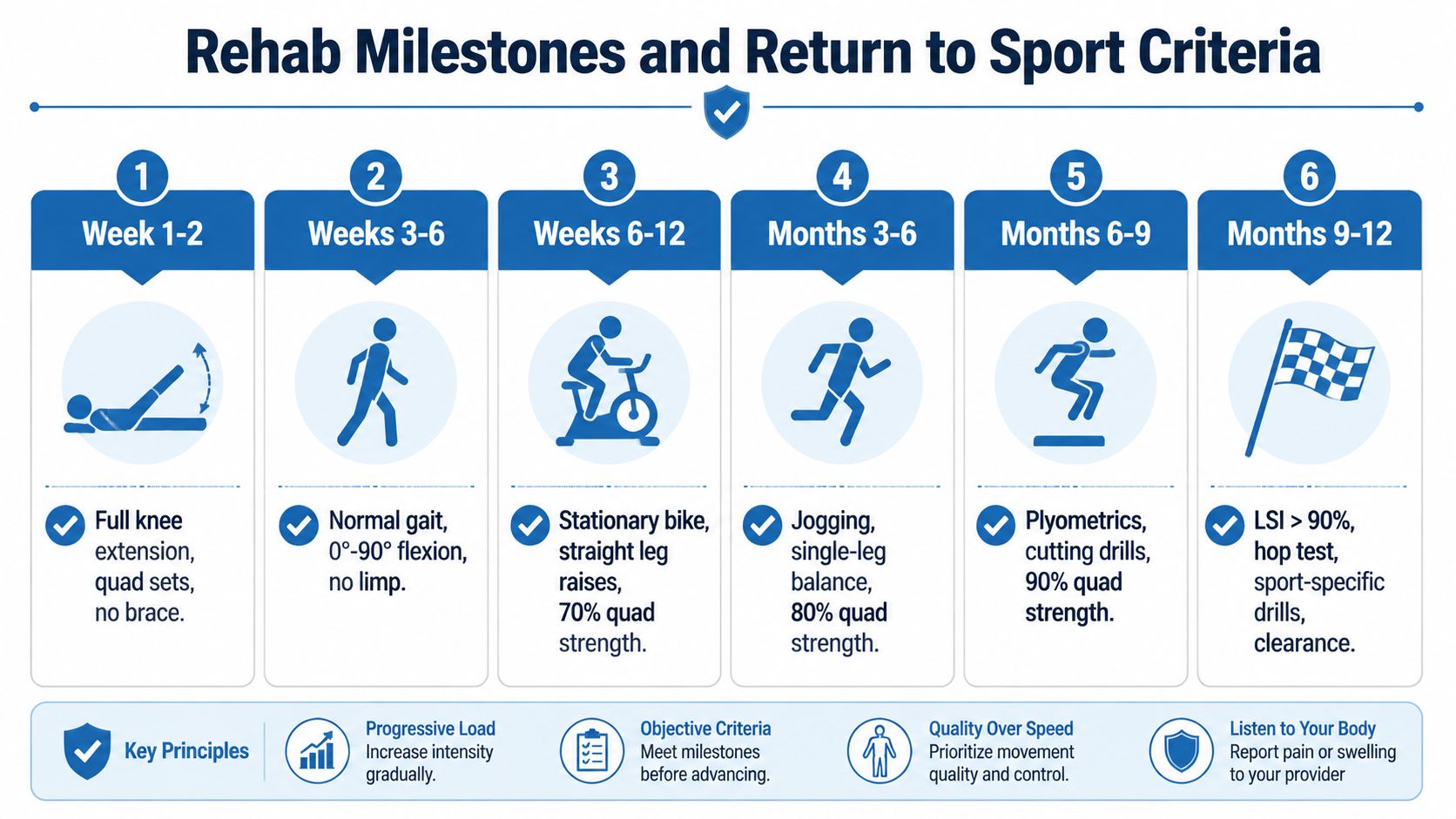
A patient may feel ready to jog while the knee still swells after a brisk walk. That mismatch is common. ACL rehabilitation should follow function and objective testing, not a calendar alone. Early goals include a quiet knee, full extension, controlled flexion, active quadriceps engagement, and a safe gait. Later work adds strength, single-leg control, running, jumping, deceleration, and sport-specific cutting.
The surgeon and physical therapist should adjust progression for graft choice, associated repairs, symptoms, and examination findings. Useful milestones include:
- Early protection: Restore full extension, reduce effusion, perform quadriceps sets and straight-leg raises, and use crutches or a brace as directed.
- Motion and gait: Improve flexion, normalize walking, and remove a limp before increasing loading demands.
- Strength foundation: Progress resistance for the quadriceps, hamstrings, hips, and trunk. Add a stationary bike when motion and swelling allow.
- Single-leg control: Train balance, step-down control, landing alignment, and tolerance for increasing load.
- Running and power: Start jogging only when strength, motion, swelling, and movement quality support it. Introduce plyometrics before cutting drills.
- Sport preparation: Rehearse acceleration, braking, lateral movement, reaction, and fatigue management under increasingly realistic conditions.
The clearance checklist
Before clearance, review the following:
- Extension and effusion: The knee reaches full extension and does not repeatedly swell after training.
- Quadriceps symmetry: Strength is within 10% of the uninvolved side, commonly expressed as at least 90% limb symmetry, consistent with historical return-to-sport criteria in the ACL rehabilitation literature.
- Hop performance: Single-leg hop testing and a hop battery show at least 90% performance compared with the opposite limb, with controlled landing mechanics.
- Movement quality: The athlete controls the hip, knee, and foot during squats, step-downs, jumps, and direction changes.
- Sport exposure: Drills advance from predictable patterns to reactive, pressured, and fatigued situations.
- Psychological readiness: ACL-RSI or a comparable assessment shows the patient trusts the knee and can respond to mistakes without protective hesitation.
Time remains part of the decision. Return before approximately 9 months has been associated with substantially higher reinjury risk in sports-medicine rehabilitation evidence, so meeting physical criteria does not make an early date safe by itself.
Meniscal symptoms require separate assessment. Locking, catching, joint-line pain, or recurrent swelling can indicate associated damage. If rehabilitation follows an unexpected course, arrange a torn meniscus evaluation rather than increasing exercise intensity.
Complications Prevention and Your Next Steps
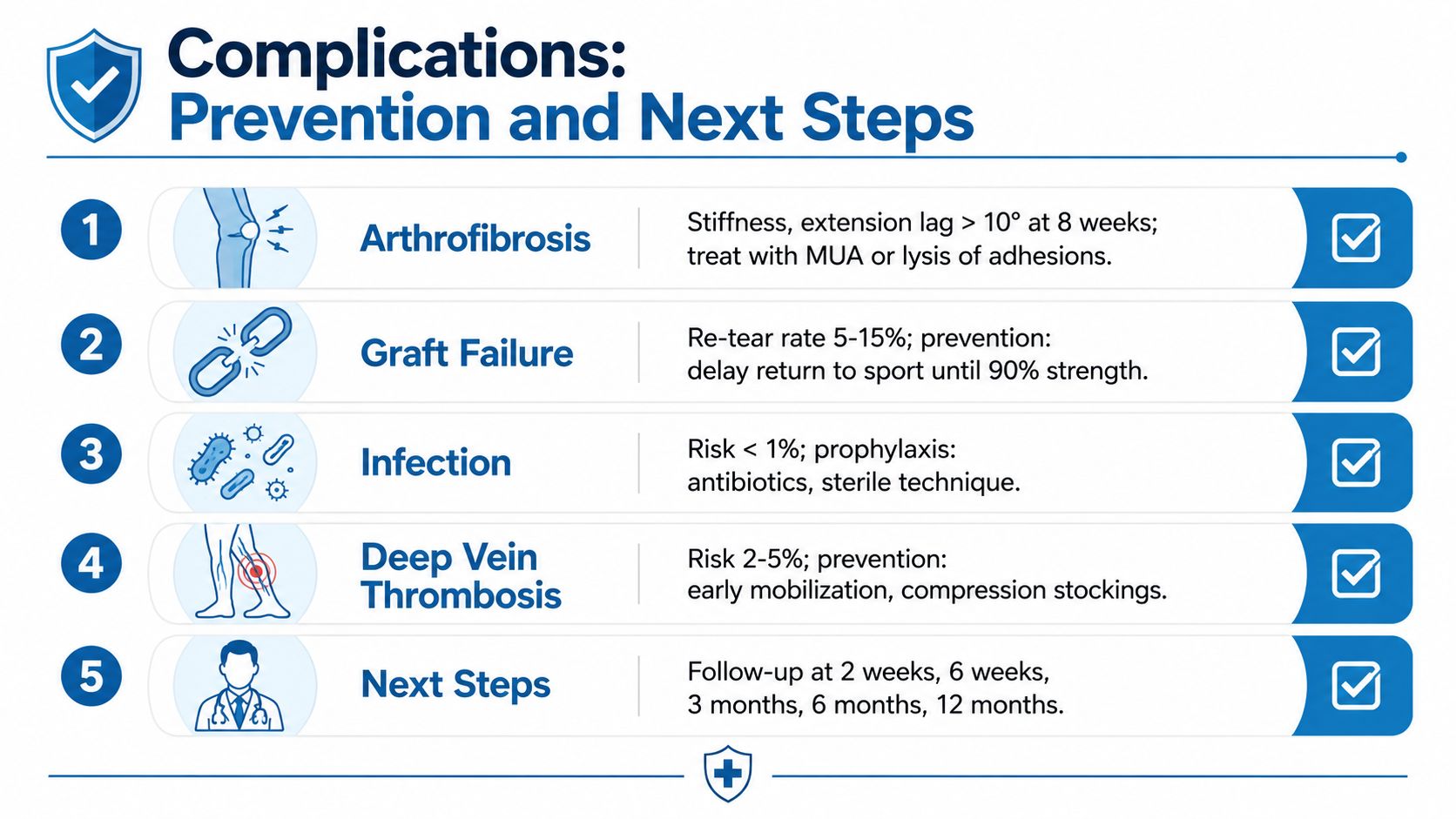
A knee that stays swollen, loses extension, or repeatedly gives way needs reassessment, not just harder exercises. Persistent loss of extension can contribute to arthrofibrosis. Returning too early to cutting and pivoting sports can expose a healing graft or recovering ligament to reinjury. Your clinician should review the plan when swelling persists, quadriceps control remains poor, or instability returns.
Prevention should match the problem:
- Stiffness: Work on controlled extension and flexion early in recovery. A persistent extension lag at follow-up warrants prompt assessment.
- Graft or ligament failure: Use strength, hop, movement-quality, symptom, and psychological-readiness criteria before returning to sport.
- Instability: Avoid pivoting activity while the knee buckles. Repeated episodes can increase the risk of secondary meniscal injury.
- Opposite-knee injury: Continue neuromuscular training, hamstring strengthening, landing practice, and trunk and hip-control work after clearance.
- Long-term joint health: Arrange periodic reviews if swelling, pain, stiffness, or activity tolerance changes.
Reconstruction does not guarantee a return to pre-injury performance. A population study reported that, 2.3 years after reconstruction, 62% of athletes had returned to participation, 50% had returned to sport, and 17% had returned to pre-injury performance, as described in the return-to-sport outcomes study. The findings support continued rehabilitation and injury-prevention training after formal clearance, rather than treating clearance as the end of care.
A usable decision plan
- Arrange assessment: Obtain a clinical examination and appropriate imaging after the injury.
- Protect the knee: Control swelling, avoid pivoting, and restore safe motion.
- Define the goal: Tell the orthopedic team whether the priority is daily function, work, recreation, or competitive sport.
- Choose deliberately: Compare reconstruction, structured rehabilitation, and suitable repair options according to stability and associated injuries.
- Track criteria: Progress through strength, hop, movement, symptom, and confidence milestones instead of relying on time alone.
Interventional Pain Management provides orthopedic evaluation, ACL injury care, perioperative pain management, and image-guided procedures within an individualized treatment plan. Patients in New Jersey and Staten Island can visit Interventional Pain Management to arrange an evaluation and discuss the next appropriate step for knee pain, instability, or recovery planning.