
Grade I MCL tears typically recover in 1–3 weeks, grade II tears in 4–6 weeks, and grade III tears in 6 weeks or longer. Full return to sport or heavy activity can take longer because the knee must regain strength, balance, and control, not just feel less painful.
An active adult may plant a foot during a weekend soccer game, feel a pop along the inner knee, and spend the next few minutes wondering whether the injury will interrupt work, exercise, or an upcoming match. The first answer usually comes from the injury grade, but the calendar alone can't determine when the knee is ready for twisting, sprinting, lifting, or contact.
The MCL, or medial collateral ligament, helps stabilize the inner side of the knee. It often heals well with protection and rehabilitation because it has a strong healing capacity compared with some other knee ligaments. Still, structural healing and functional recovery aren't identical. A knee may hurt less while remaining weak, hesitant, or vulnerable to inward stress.
Table of Contents
- Understanding Your MCL Tear Recovery Timeline
- MCL Tear Grades and Expected Healing Windows
- Rehab Phases From Immobilization to Strengthening
- Conservative Care Versus Surgical Recovery Timelines
- Return to Sport and Functional Readiness Criteria
- Why Healing Time Does Not Always Mean Full Recovery
- Red Flags and When to Seek Re-Evaluation
Understanding Your MCL Tear Recovery Timeline
An active adult may walk comfortably after a medial knee injury yet still struggle to pivot during soccer, climb stairs, or lift with confidence. That gap explains why an MCL tear recovery timeline is a guide, not a return-to-activity clearance.
Typical biological healing ranges are 1–3 weeks for grade I, 4–6 weeks for grade II, and 6 weeks or longer for grade III injuries, according to clinical MCL tear recovery guidance. These windows describe tissue healing. They do not confirm that the knee can tolerate cutting, sprinting, contact, or heavy loading.
Why the calendar can mislead
A recreational soccer player with a grade II tear may walk around the house without much discomfort before the knee can safely handle a hard plant or sudden change of direction. Daily walking follows a predictable path. Soccer repeatedly tests side-to-side stability, reaction speed, and control when the body is moving quickly.
The ligament may be repairing while the quadriceps, hip muscles, and balance system remain behind. Recovery works like rebuilding a bridge: the injured structure must regain strength, while the surrounding systems learn to carry changing loads again.
Swelling can slow that process. Fluid around the joint may restrict bending, reduce quadriceps activation, and make the knee feel unreliable. A plain-language discussion of swelling after injury is explained by Mattiacci Law. Persistent or worsening swelling still deserves medical review.
Structural healing versus practical readiness
The MCL often responds well to protection and rehabilitation, but early recovery still requires limiting valgus stress, the inward force placed on the inner knee. Controlled movement and progressive strengthening help preserve motion and reduce muscle loss while the tissue heals.
For an overview of MCL evaluation and treatment, see the MCL tear resource from Interventional Pain Management. The more useful question is whether the knee can complete the required task without pain, instability, compensation, or loss of control.
MCL Tear Grades and Expected Healing Windows
An MCL injury is graded by the amount of ligament damage and how stable the knee feels during examination. The grading system is useful, but it offers a healing range, not a return-to-sport clearance. A rope analogy makes the difference clearer: grade I is like surface fraying, grade II involves several disrupted strands, and grade III is a complete separation.
| Grade | Severity | Key Symptoms | Typical Healing Window |
|---|---|---|---|
| Grade I | Mild stretch with limited fiber damage | Localized inner-knee tenderness, mild pain, and little instability | 1–3 weeks |
| Grade II | Partial tear with increased laxity | More noticeable pain, swelling, tenderness, and a loose sensation | 4–6 weeks |
| Grade III | Complete rupture | Marked instability, difficulty loading the leg, and possible associated injury | 6 weeks or longer |
These ranges are commonly used clinical estimates (Cleveland Clinic). They describe tissue healing, not necessarily the time needed to walk confidently, change direction, or resume sport.
What each grade means in practice
A grade I injury may still allow comfortable walking, while turning or side-stepping causes discomfort. Because the ligament is stretched rather than completely disrupted, protection and activity modification may support recovery. A downward pain trend and improving motion matter more than reaching a calendar date.
A grade II injury includes a partial tear and usually produces clearer laxity. Straight-line movement may feel manageable, yet a lateral step or pivot can reveal instability. Bracing and guided rehabilitation can protect the ligament while the quadriceps, hip muscles, and balance system rebuild capacity.
A grade III injury is a complete rupture. The knee may feel distinctly unstable, and other structures may also be injured. Combined ligament or meniscal damage can alter treatment and delay functional progress, so examination findings should guide expectations rather than the grade alone.
Daily activity and sport have different demands. A person may walk before the knee can tolerate cutting, jumping, contact, or rapid deceleration. Repeated inward collapse, aggressive pivoting, or premature loading can irritate healing tissue. Prolonged immobilization can instead contribute to stiffness and weakness. The practical milestone is controlled movement under the demands of the intended activity, without pain, instability, or compensation.
Rehab Phases From Immobilization to Strengthening
An active adult may walk comfortably before the knee can tolerate a side-step, landing, or quick change of direction. MCL rehabilitation closes that gap by protecting the ligament first, then testing function under gradually greater demands. The grade matters, but examination findings, associated injuries, symptoms, and the person's goals determine the pace.
Early protection and motion
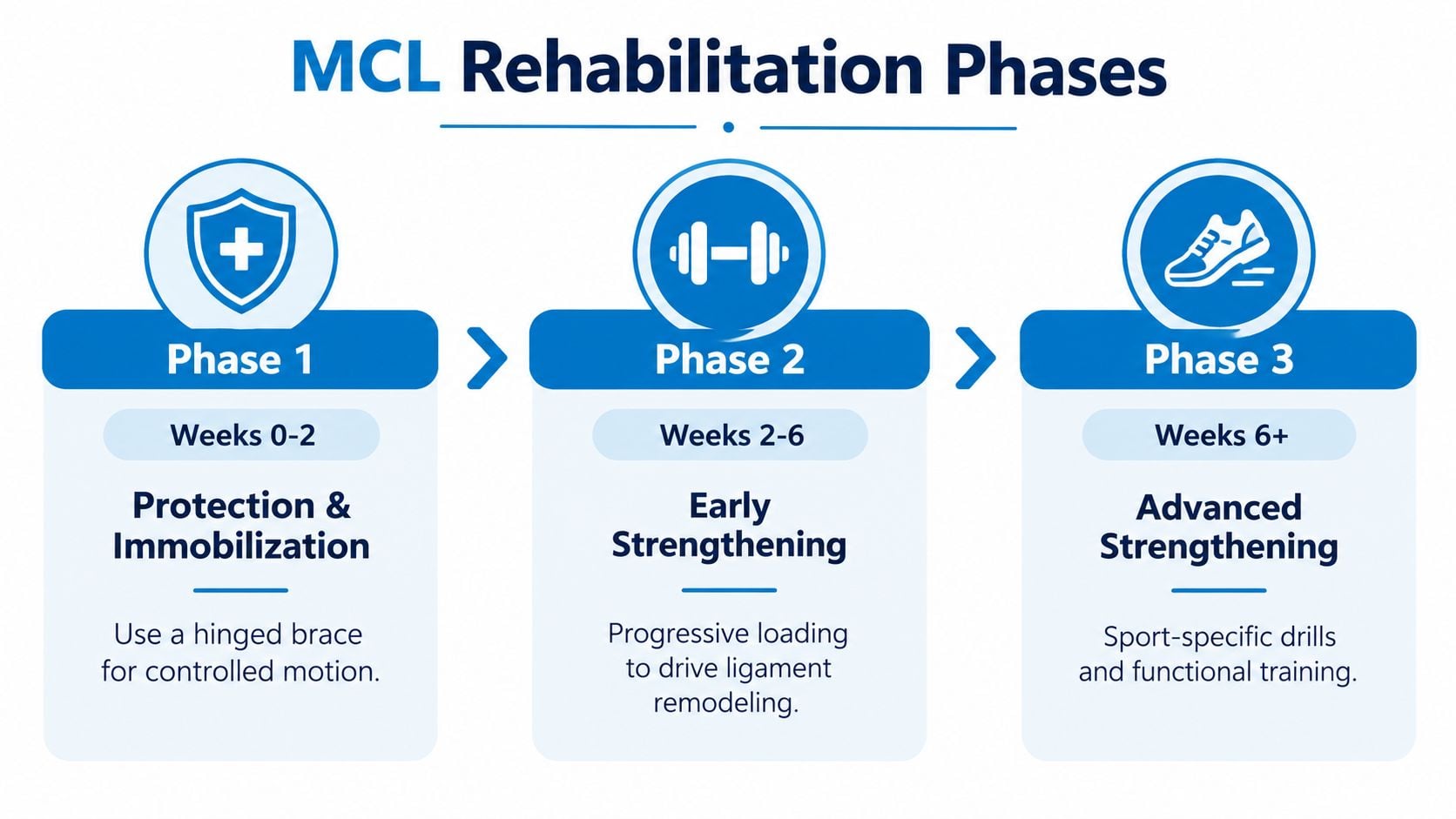
Early care reduces stress on the inner knee while preventing avoidable stiffness. A hinged brace can provide controlled support. Gentle range-of-motion exercises, swelling control, and protected walking help maintain basic function without asking the healing ligament to manage excessive inward force.
One MCL rehabilitation protocol describes physical therapy often beginning within 1–2 weeks, with an immobilizer used for about 2 weeks before strengthening advances. These timeframes are reference points, not automatic permissions. Pain, swelling, laxity, or another injury may require a slower progression.
Loading without provoking instability
As motion improves and symptoms settle, rehabilitation adds controlled loading. Supported squats, selected leg exercises, and stationary cycling may be appropriate when the treating professional has confirmed that the knee can tolerate them. The purpose is to rebuild quadriceps and hip control while keeping the knee aligned during each repetition.
Protective bracing is commonly used for 3–6 weeks, according to Brigham and Women's MCL rehabilitation guidance. People arranging post-surgery rehab at home may find general support information useful, although an MCL program still needs individual clinical direction.
Advanced strength and activity preparation
Later phases add single-leg balance, controlled agility, running preparation, and sport-specific drills. “Week six” alone does not establish readiness to run. The knee should show comfortable motion, improving strength, stable alignment, and a good response after each increase in demand, without renewed swelling.
Daily activity may return before sport because sport adds cutting, jumping, contact, and rapid braking. A practical milestone is controlled movement under the demands of the intended activity, without pain, instability, or compensatory movement. General information about ligament injuries is available in this guide to sprains. Loading too early can irritate healing tissue, while prolonged rest can leave the muscles unprepared.
Conservative Care Versus Surgical Recovery Timelines
An active adult may walk comfortably before the MCL is ready for cutting, contact, or heavy loading. That gap explains why a grade-based healing range is only a starting point. Recovery follows two clocks: tissue healing and functional readiness.
Most isolated MCL injuries are treated without surgery when protection and rehabilitation restore stable knee control. Bracing, modified activity, gradual motion, and progressive strengthening form the usual pathway. A grade III tear deserves specialist review if the knee remains unstable or other ligaments may be involved.
Surgery creates a different timetable. Repaired or reconstructed tissue needs protection while it heals, so limits on motion, weight-bearing, and strengthening can return. Recovery may extend further when several structures are injured. Brigham and Women's rehabilitation guidance describes selected nonoperative grade III injuries returning as early as 5–7 weeks, while surgically treated MCL injuries may require 6–9 months before return to play.
| Recovery Milestone | Conservative Care (Grade II–III) | Surgical Repair (Grade III / Multi-Ligament) |
|---|---|---|
| Early protection | Bracing and activity changes while motion returns gradually | More structured protection based on the repair and associated injuries |
| Motion | Advances as pain and swelling settle | May progress more cautiously to protect repaired tissue |
| Strength | Builds through supervised, progressive loading | Returns in stages after the surgical team permits loading |
| Functional training | Running, balance, and agility begin after stability and control improve | Sport-specific work follows later milestones and surgical clearance |
| Return to play | May occur around 5–7 weeks for selected nonoperative grade III injuries | May require 6–9 months after surgical treatment |
Surgery is generally considered when rehabilitation cannot restore stability, several ligaments are involved, or associated damage changes the mechanical problem. Brace selection should match the knee's stability needs and intended activity. A clinician can help assess options, including a hinged knee brace for physiotherapists.
Locking or pain along the joint line may point to additional internal damage rather than an isolated MCL problem. Evaluation can help distinguish an MCL limitation from a torn meniscus overview, especially when symptoms persist despite improving ligament stability.
Return to Sport and Functional Readiness Criteria
Pain-free walking is a useful checkpoint, not a finish line. A soccer player cutting around an opponent, a basketball player landing from a jump, or a tennis player braking into a corner places inward and rotational demands on the knee that ordinary walking does not test. Even a recreational runner must tolerate repeated impact without swelling or a changed stride.
The readiness checklist
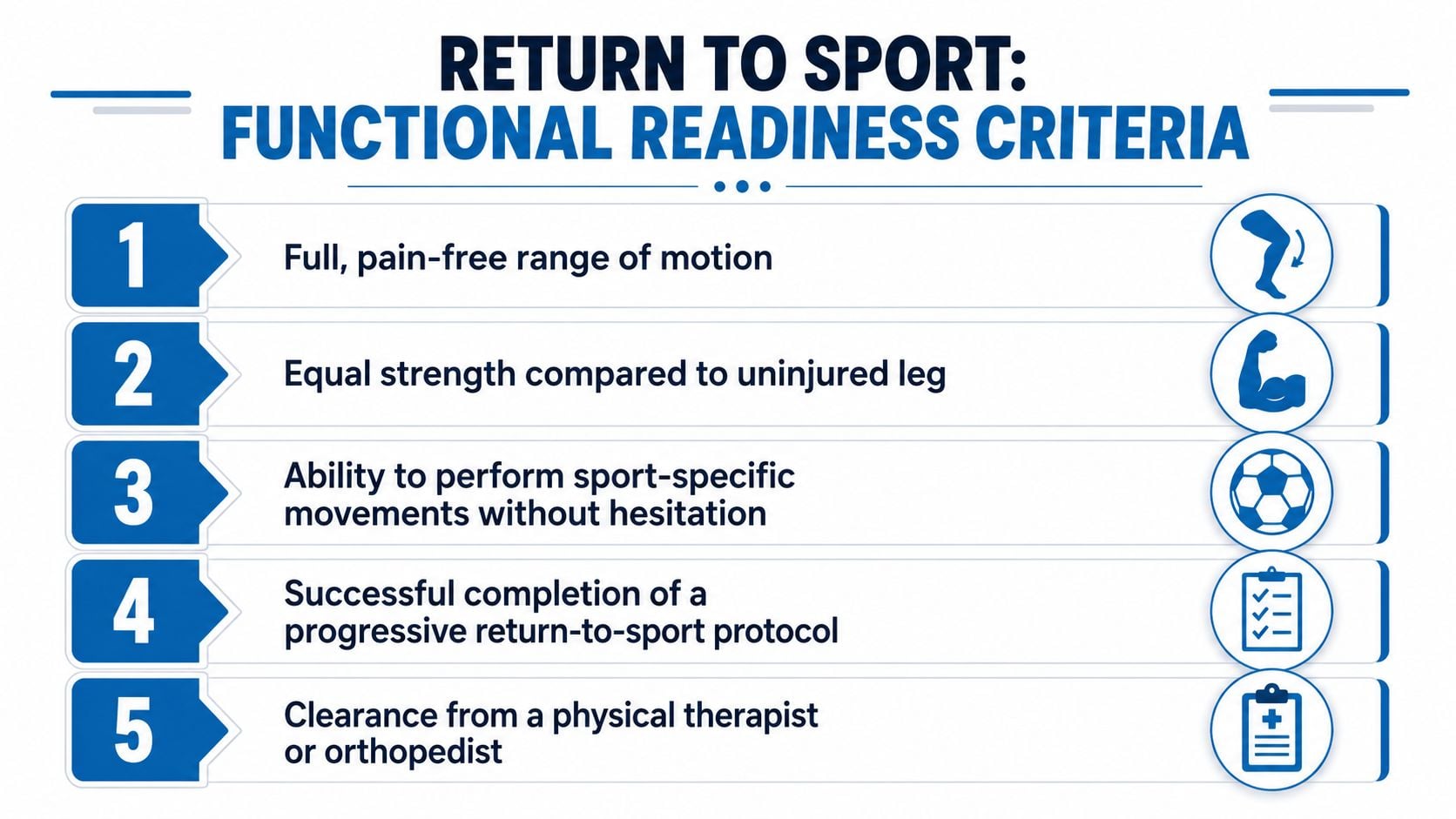
Return to sport depends on several findings working together:
- Motion: The knee should fully straighten and bend comfortably, without guarding.
- Strength: The injured leg should produce dependable force during resisted exercise and single-leg tasks.
- Balance: The pelvis, hip, and knee should stay controlled, without the knee drifting inward.
- Movement quality: Straight-line jogging should progress to braking, direction changes, jumping, and sport-specific patterns.
- Response afterward: Pain or swelling should not build after each training step.
The treating team may assess hopping, strength, balance, and movement while fatigue develops. The exact tests vary, so one pass-or-fail result should not replace a clinical examination. These tasks matter because the MCL must control sudden inward stress when the athlete plants, lands, or absorbs contact.
A staged return is safer than a single jump
Progression should match the knee's demonstrated control, not only the grade-based healing window. Start with low-risk movement, such as straight-line jogging. Add controlled acceleration, braking, direction changes, and jumping as symptoms remain settled. Later, introduce drills that reproduce the sport's speed, angles, and decision demands. Contact practice comes near the end because those forces cannot be fully predicted or controlled.
An MCL activity progression protocol recommends full activity only after cutting, sprinting, jumping, and carioca movements are comfortable and a physician has examined the patient. The practical question is whether the knee can repeat the required movements confidently, maintain alignment under fatigue, and remain calm afterward. Daily activities may return sooner, while sport readiness requires a higher standard of control.
Why Healing Time Does Not Always Mean Full Recovery
A healing window describes what the ligament may achieve biologically. Full recovery asks more demanding questions. Can the quadriceps produce force? Can the patient sense the knee's position during a quick landing? Can the hip and trunk control alignment when fatigue changes technique?
Research discussing MCL injuries emphasizes that return-to-activity demands vary widely, particularly after severe injury, surgery, or combined ligament damage. Some patients may return to controlled activity around 3 months, while contact-sport demands after more serious injuries can extend to 6–12 months (sports medicine review of MCL injury recovery). Those figures aren't a universal prescription, but they show why a basic grade range can't answer every patient's question.
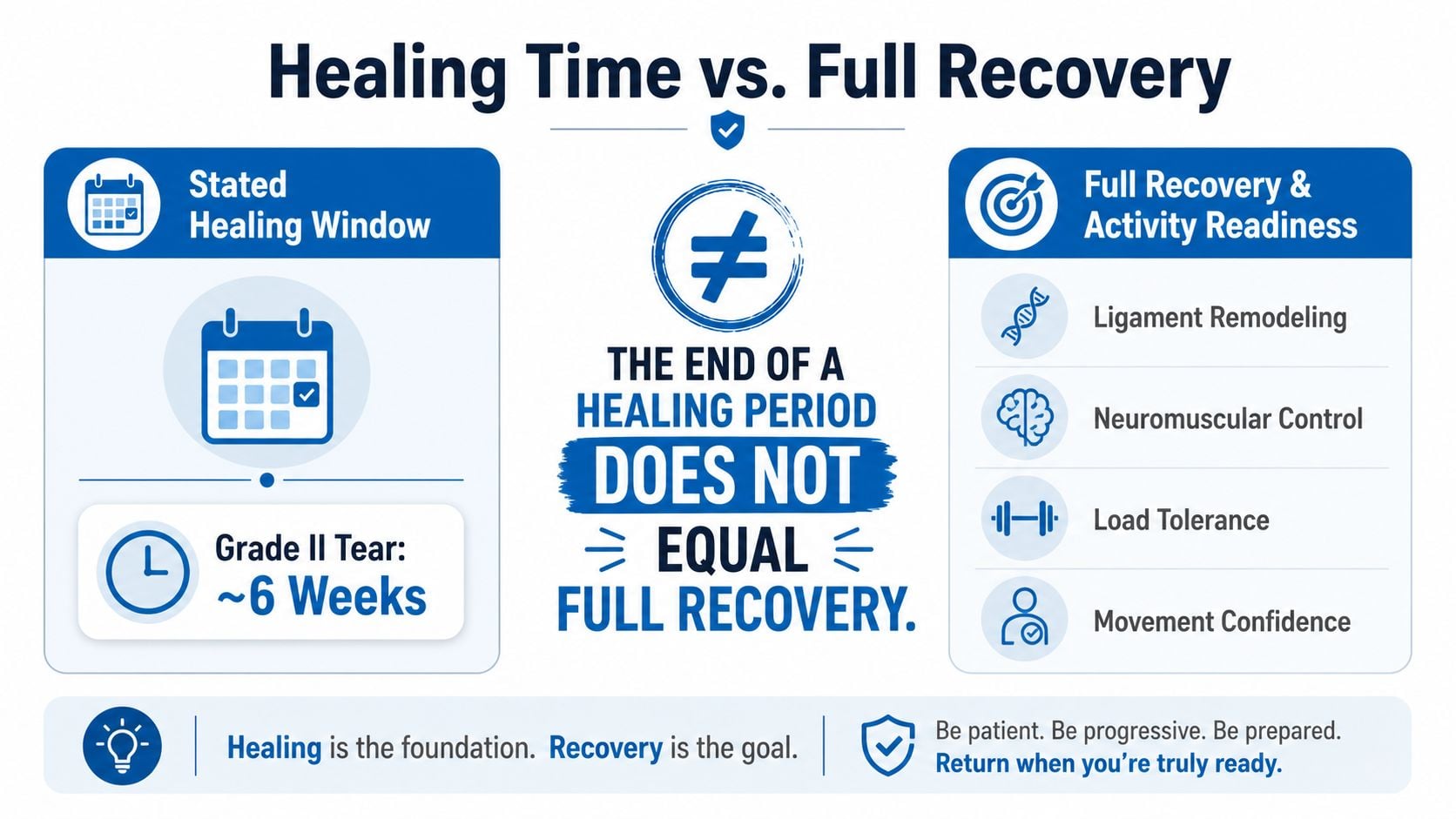
The hidden work after pain improves
Several problems can remain after symptoms settle:
- Quadriceps inhibition: Swelling and pain can reduce muscle activation, leaving the leg weaker even when walking feels normal.
- Proprioceptive loss: The patient may not sense knee position quickly enough during a landing or cut.
- Compensation: The hip, ankle, or opposite leg may absorb more force, creating an altered movement pattern.
- Reduced confidence: Hesitation can change foot placement and alignment, especially during unpredictable activity.
Non-elite adults often can't reproduce the repeated, closely supervised training environment available to high-level athletes. Work schedules, transportation, home responsibilities, and inconsistent access to therapy can all affect progression without meaning the patient is failing.
The end of the healing window is a checkpoint, not a permission slip for unrestricted activity.
A grade II tear might feel substantially better within its usual range while still needing progressive loading before the knee tolerates cutting or contact. The appropriate timeline is the one that matches the person's actual demands and objective recovery, not merely the earliest plausible date.
Red Flags and When to Seek Re-Evaluation
An MCL injury that isn't progressing should be reassessed rather than repeatedly tested at home. Persistent inner-knee pain, recurrent swelling after activity, or a knee that gives way during routine movement can indicate that the original injury is more complex than first thought.
Signs that deserve prompt review
- Persistent symptoms: Pain or swelling that doesn't follow the expected improving pattern deserves a clinical examination.
- Instability: Repeated giving-way sensations may signal residual laxity or another injured stabilizer.
- Restricted motion: Failure to regain comfortable movement during rehabilitation can reflect swelling, stiffness, or associated joint damage.
- Worsening with activity: Increasing pain after each exercise session suggests that the current load may be too high or the diagnosis may need review.
A specialist may recommend additional imaging when the examination suggests a combined ligament injury, meniscal involvement, or another cause of persistent symptoms. Patients should report what activity triggered the setback, how long symptoms lasted, whether swelling appeared, and which movements feel unstable. That information helps the care team adjust the rehabilitation plan and decide whether further evaluation is needed.
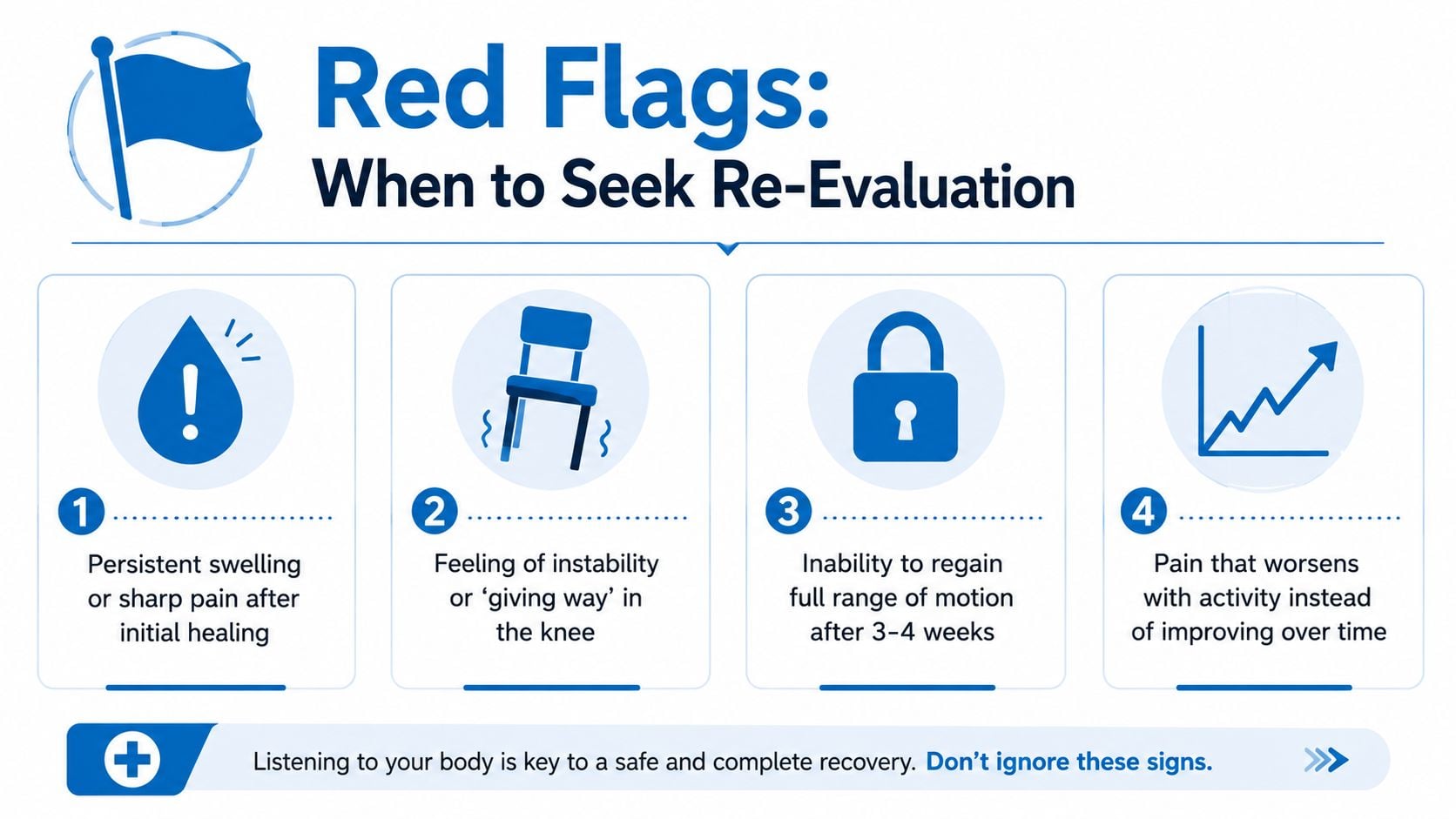
Re-evaluation isn't a failure. It's a practical step when the recovery pattern, examination findings, or activity goals no longer fit the original plan.
Interventional Pain Management evaluates joint and sports injuries, including MCL tears, and can coordinate examination, imaging review, nonoperative treatment, and orthopedic care when indicated. Adults in New Jersey and Staten Island can visit Interventional Pain Management to request an assessment based on the knee's symptoms, stability, and activity demands.