
The final whistle has gone at a Wednesday night pickup game. The knee felt normal while the game was moving, but two hours later on the couch it feels tight, achy, and reluctant to bend. By the next morning, stairs are uncomfortable and the thought of another run brings a familiar question: why does knee pain after basketball appear after the game instead of during it?
For many players, the answer isn't one unlucky collision. Basketball repeatedly asks the knee to absorb jumping, landing, cutting, pivoting, and abrupt stops. In New Jersey clinics, that pattern often points toward a chronic overload signal, especially when symptoms build gradually, settle between sessions, and return whenever the playing schedule intensifies. Acute injuries still matter, but pain that arrives after repeated play deserves more than a quick application of ice and a return to the same workload.
Table of Contents
- Why Basketball Loads the Knee So Hard
- The Four Most Common Causes of Knee Pain After Basketball
- How Cutting and Landing Mechanics Drive Symptoms
- What to Do in the First 72 Hours After the Knee Flares
- Warning Signs That Mean You Should See a Specialist
- Return to Play Based on Milestones, Not Just Pain
- Prevention Strategies That Actually Reduce Knee Pain
Why Basketball Loads the Knee So Hard
A basketball knee rarely gets a long, predictable break. During a single possession, a player may sprint, brake, land on one leg, turn around a planted foot, and jump again before the body has fully recovered from the previous landing. That sequence creates stress in several planes at once, particularly when fatigue changes trunk position, hip control, and knee alignment.
The injury profile reflects those demands. A systematic review of 12,960 basketball injuries found that 63.7% affected the lower limbs, while 17.8% of all injuries involved the knee. Among professional players, the knee accounted for 19.5% of injuries, according to the FIBA medical review. These figures don't mean every post-game ache represents structural damage. They do show that the knee is repeatedly exposed to sport-specific loading.
The end of the game is often the revealing part
A player may tolerate the first few possessions because the muscles are fresh and movement remains coordinated. Late in a run, the same player may land with less hip and knee flexion, let the knee drift inward, or brake with the trunk leaning away from the planted leg. Symptoms may appear after the game because the tissues have accumulated more load than they can comfortably recover from.
NBA analyses reported 697 knee injuries during the 2017 to 2021 period and found 740 knee injuries across 1,011 players, with 21% of players sustaining a structural knee injury and an overall rate of 5.42 knee injuries per 1,000 game exposures (FIBA medical review). Those numbers describe professional surveillance, not an individual recreational player's diagnosis. They nevertheless reinforce why recurring knee pain after basketball deserves pattern-based assessment.
Basketball activity changes the demand
| Activity | Typical ground reaction force | Average repetitions per game |
|---|---|---|
| Walking | Near body weight | Frequent |
| Jogging | Near body weight to moderately higher | Frequent |
| Jumping and landing | High and variable | Repeated |
| Cutting and pivoting | High, with twisting and braking | Repeated |
| Late-game deceleration | High, especially under fatigue | Repeated |
The important distinction is not one “bad” movement. It's the accumulation of ordinary basketball movements performed at speed, often on one leg and often while tired. Post-game pain frequently reflects how well the knee tolerated the total session, not a mysterious event that happened after the final whistle.
The Four Most Common Causes of Knee Pain After Basketball
Location and behavior usually offer better clues than a player's preferred diagnosis. A clinician asks where the pain sits, whether it started gradually or suddenly, what movement provokes it, and what the knee feels like the following morning.
Patellofemoral pain
A dull ache behind or around the kneecap commonly worsens with stairs, squats, prolonged sitting, or the first few minutes of the next run. The pain often builds over several practices rather than following one clear landing. When the knee feels stiff after sitting but loosens as movement begins, the pattern may fit irritation around the kneecap more than an acute tear.
Patellar tendinopathy
Pain at the lower edge of the kneecap points more toward the patellar tendon, particularly when repeated jumping and landing trigger a sharp, localized sensation. Players may notice tenderness when pressing the tendon and discomfort that lingers between sessions. A gradual increase in games, jumping drills, or hard-court play can exceed tendon capacity even without a single traumatic incident.
Meniscal injury
Pain along the inner or outer joint line is more concerning when it follows a twist, pivot, or awkward landing. Swelling may build over the following day, and clicking, catching, or locking can accompany the pain. Players who suspect this pattern can review the clinical signs in the torn meniscus guide, but self-labeling can't replace a physical examination.
Ligament sprain
A ligament injury tends to have a clearer event. A pop, sudden swelling, pain along the inner or outer side of the knee, or a feeling that the knee may give way during cutting raises concern for an ACL or collateral-ligament sprain. An NBA video-analysis study found that 97% of ACL injuries occurred without direct contact to the knee, which is why a non-contact landing or cut can still warrant prompt assessment (NBA ACL analysis).
Age, prior injuries, training volume, and movement quality all affect presentation. Patellofemoral and tendon overload can affect active players across age groups, while an acute ligament or meniscal injury can occur whenever force, rotation, and position combine unfavorably. Overlapping symptoms are common, so the morning-after pattern helps, but it doesn't establish a diagnosis by itself.
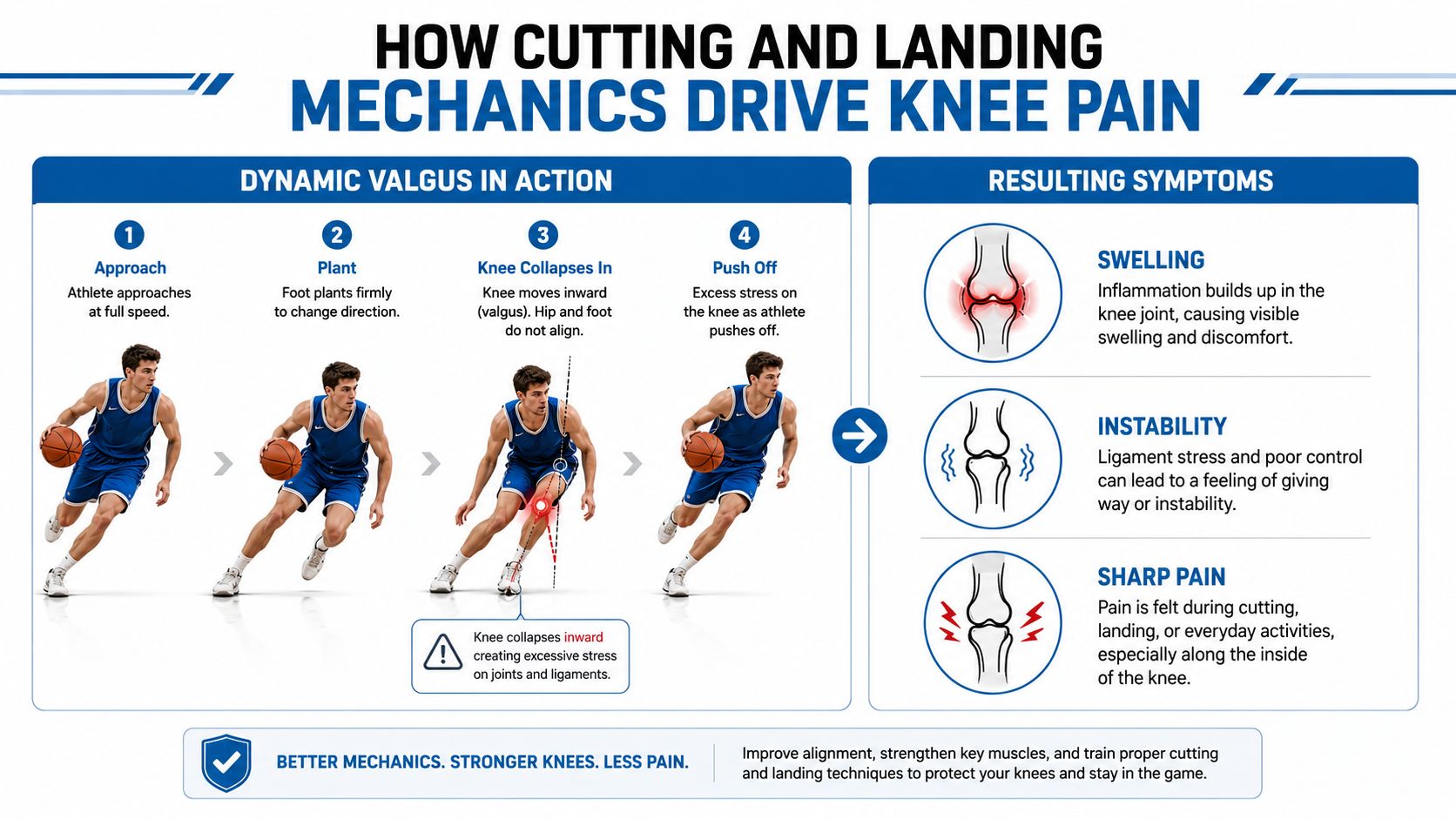
How Cutting and Landing Mechanics Drive Symptoms
Dynamic valgus is the useful movement concept here. It describes the knee moving inward relative to the foot during a cut, landing, or single-leg squat. The pattern often combines hip adduction and internal rotation, changes in tibial rotation, and a trunk position that shifts force away from the center of the planted foot.
During a full-speed sidestep cut, a player may plant the foot while the pelvis and trunk continue moving in another direction. If the hip doesn't control that motion, the knee can collapse inward. That position can increase stress around the kneecap and place demanding loads on the ACL, while rotation during the same maneuver may irritate the meniscus.
A rebound landing creates a similar opportunity. The player comes down with the knee drifting inside the midfoot instead of tracking toward the second toe. Repeated landings can irritate the patellar tendon and the soft tissues around the kneecap, especially when fatigue reduces the contribution from the gluteal muscles.
Practical rule: A quiet landing isn't necessarily a soft landing. The knee should bend, stay aligned over the foot, and share force with the hip.
A balanced landing uses controlled knee and hip flexion, a stable trunk, and a foot that remains connected to the floor. Players working on lower-body control may benefit from resources that explain how to improve squat mechanics with hip work. The same alignment principles apply to step-downs, box jump-downs, and deceleration drills.
A fast-break stop, a defensive slide, and a box jump-down each expose a different version of the same problem. The final ten minutes of a tired pickup game often matter more than the first ten because movement quality can deteriorate before the player consciously notices it. Anyone experiencing instability, a pop, or rapid swelling should also review the ACL tear information rather than treating the episode as routine soreness.
What to Do in the First 72 Hours After the Knee Flares
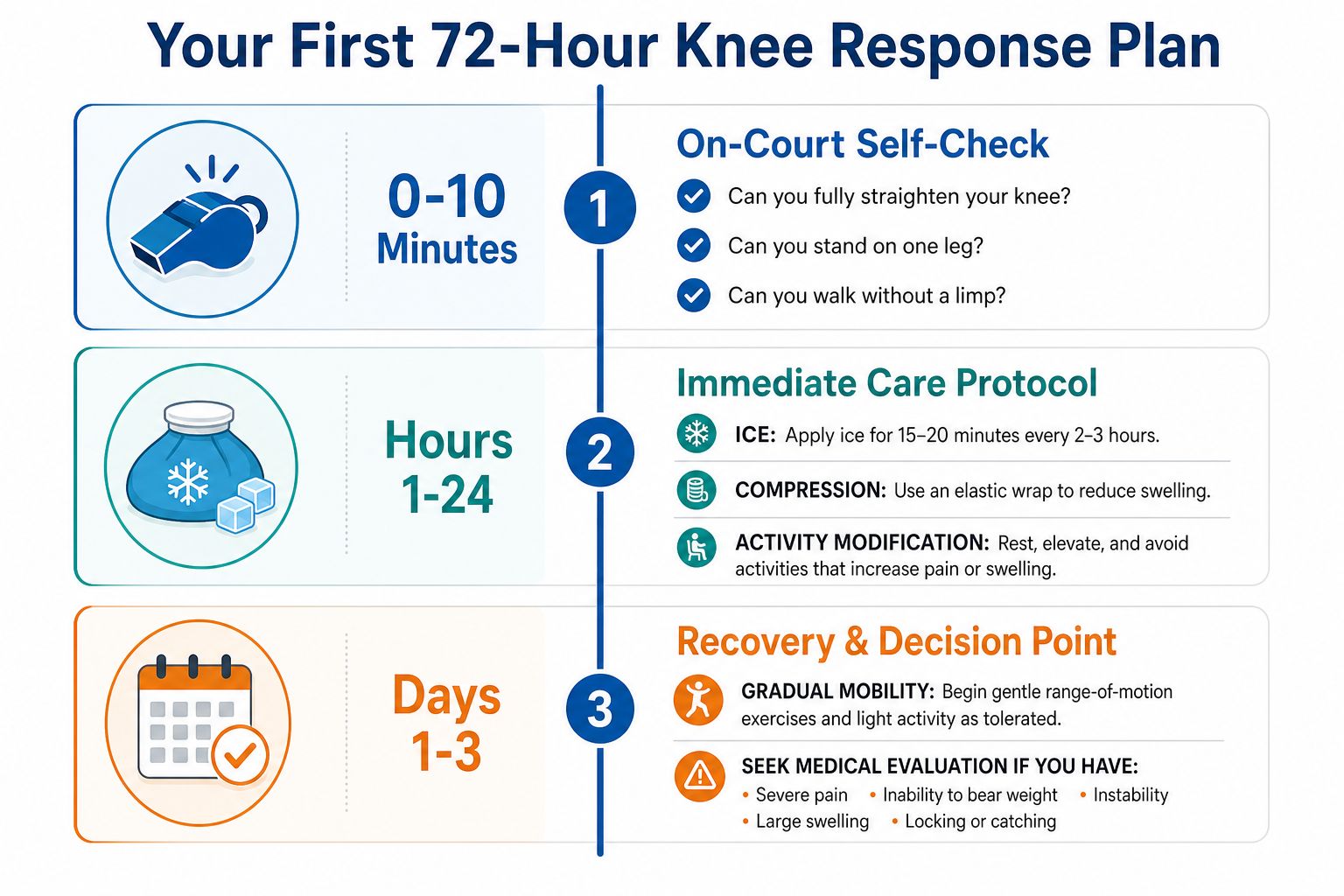
The first decision happens before any home treatment. On the court, or shortly afterward, a player should check whether the knee can fully straighten, support a single-leg stance, and permit walking without a limp. Failure in any of those basic tasks changes the situation from ordinary post-game soreness to a problem that deserves clinical attention.
The first day
For the first 24 hours, stop running and jumping, but don't assume complete bed rest is the answer. Relative unloading reduces the provocative force while ordinary, comfortable walking preserves basic movement. Compression can help control swelling, and brief icing intervals may ease discomfort. Heat and deep massage aren't useful choices while swelling is building.
If the knee feels unstable, a brace may provide temporary support, but it shouldn't create permission to continue cutting through pain. Players comparing brace options should use a professional knee brace guide as general education, then match the device to a clinician's findings.
The second day
Between 24 and 48 hours, the target is comfortable bending, straightening, and walking cadence. If pain permits, gentle quadriceps isometrics, quad sets, and straight-leg raises can maintain muscle activation without reproducing the impact of a game. Morning stiffness provides useful information. If the knee is more swollen or less mobile after ordinary activity, the load remains too high.
A mild flare without instability may improve with this structured approach, while a suspected knee sprain may need an examination to determine which tissue is involved. Medication decisions should account for medical history and other conditions, so players shouldn't treat anti-inflammatory drugs as a substitute for assessment.
The third day
From 48 to 72 hours, a player can test tolerance with controlled bodyweight squats and step-downs, provided walking is comfortable and swelling isn't increasing. The purpose is not to prove readiness for basketball. It's to see whether simple loading produces a delayed reaction.
Stop self-management and arrange a clinic evaluation if the knee locks, gives way, can't fully straighten, or becomes more swollen after light activity. The correct response to a warning sign isn't a tougher workout. It's a clearer diagnosis.
Warning Signs That Mean You Should See a Specialist
Knee pain after basketball doesn't require panic, but it does require triage. The combination of onset, swelling, mechanical symptoms, and walking ability gives a practical starting point.
Same-day evaluation
Inability to bear weight, an obvious deformity, a pop followed by rapid swelling within two hours, or a locked knee that won't fully straighten calls for prompt evaluation. Those findings can accompany a significant ligament injury, fracture, dislocation, or displaced meniscal problem.
A clinic visit this week
A knee that stays swollen three days after a game needs more than repeated icing. So does pain fixed along one joint line, recurrent giving-way during cuts, or stiffness that never warms up with gentle movement. These patterns may indicate meniscal, ligament, cartilage, or persistent overload problems and deserve an examination before the next hard session.
Monitorable soreness
Bilateral soreness under the kneecaps after a high-volume week, mild tenderness without swelling, and symptoms that resolve within 24 hours can often be monitored while the player reduces impact and improves recovery. The key condition is that movement remains normal and the symptoms don't escalate from session to session.
| Tier | Symptoms to watch for | Most likely concerns | Next step |
|---|---|---|---|
| Urgent | Can't bear weight, deformity, rapid swelling after a pop, locked knee | Major ligament injury, fracture, dislocation, displaced meniscal injury | Same-day medical evaluation |
| This week | Persistent swelling, joint-line pain, repeated giving-way, stiffness that doesn't warm up | Meniscal or ligament injury, cartilage irritation, unresolved overload | Schedule a sports-medicine visit |
| Monitor | Bilateral kneecap soreness, no swelling, normal movement, relief within 24 hours | Load-related anterior knee irritation | Modify activity and track symptoms |
Imaging isn't automatically the first move. A clinician's history and physical examination help determine whether an X-ray, MRI, or another step is appropriate. That avoids both extremes, dismissing a mechanical symptom and ordering tests without knowing what question the test needs to answer.
Return to Play Based on Milestones, Not Just Pain
Pain-free walking is a weak test of basketball readiness. Walking doesn't reproduce a hard deceleration, a reactive cut, a one-leg landing, or the repeated fatigue of a full game. A player can feel fine around the house and still lack the strength or control needed to protect the knee on the court.
A sports-medicine guideline emphasizes normal pain, swelling, range of motion, strength, balance, sport-specific function, and psychological readiness before full return. Strength is commonly targeted at 90% or more of the uninjured side, with functional testing before unrestricted sport (return-to-play guideline).
Four useful checkpoints
First, restore motion and settle swelling. The knee should straighten and bend comparably to the other side, with no visible swelling at rest. If a player still walks stiffly or protects the leg, court progression is premature.
Second, test strength. A clinician or physical therapist can compare quadriceps output with a single-leg press, leg-extension assessment, or another reliable test. The useful point isn't a pain score. It's whether the involved leg can produce force without compensation. The 90% symmetry target comes from the guideline above, not from a home guess.
Third, control single-leg tasks. Pain-free single-leg squats and step-downs should show the knee tracking over the foot rather than collapsing inward. A player who passes a two-leg squat but loses alignment on one leg hasn't completed this stage.
Fourth, reintroduce basketball gradually. Start with straight-line movement and controlled deceleration, then add planned cuts, reactive changes of direction, jumping, and eventually contact or competitive play. Each progression should take days rather than hours, and failing a later step means holding the current level.
Return-to-play standard: Pain relief opens the door. Strength, swelling, movement quality, and sport-specific tolerance decide whether the player walks through it.
The long-term reason for caution is substantial. Among retired elite players with career knee injuries, 72.5% reported pain persisting until retirement, and 67% still had knee pain at the time of survey (FIBA medical review). Those findings don't predict one recreational player's future. They do challenge the idea that returning as soon as pain fades is a complete clearance process.
Prevention Strategies That Actually Reduce Knee Pain
Prevention works best when it changes the weekly system, not when it adds a single heroic stretch before tipoff. Four drivers deserve regular attention: landing control, quadriceps capacity, total impact volume, and preparation before play.
Use a short neuromuscular warm-up
A five-minute routine can raise temperature and rehearse the positions the knee needs during basketball:
- Banded lateral walks: Keep the pelvis level and take controlled steps without letting the knees collapse inward.
- Glute bridges: Pause at the top and avoid arching through the lower back.
- Drop squats: Land softly with the knees tracking toward the second toes.
- Bodyweight squats: Use a comfortable depth and keep the feet stable.
- Low-intensity lateral movement: Begin with planned shuffles before adding speed or reaction.
The warm-up should feel like preparation, not conditioning. If it causes the same pain that appears during basketball, the player needs an assessment rather than a harder warm-up.
Build quadriceps and hip capacity twice weekly
The quadriceps help absorb landing and braking forces, while the hip muscles influence how the thigh and knee align over the foot. Spanish squats, slow-tempo split squats, controlled step-downs, and progressive single-leg work can build capacity when performed within tolerable limits.
The exercise choice matters less than the progression. A player who repeatedly rests until symptoms disappear but never rebuilds strength may return to the same overload threshold. Strength work should be consistent enough to prepare the tissues for the actual demands of cutting and jumping.
Count hard sessions, not just games
Recreational players often count only organized games and forget open gym, shooting sessions, conditioning, lifting, and outdoor runs. A simple calendar exposes the total impact load. For a practical starting point, players can avoid stacking hard sessions without recovery, insert easier days, and schedule periodic reductions when symptoms begin to rise.
Competitive youth players may have a particularly narrow recovery margin. Basketball-specific data found season prevalence of overuse knee injuries at 30.4% in female youth players and 27.8% in male youth players, with median symptom duration of 7 weeks in females and 4 weeks in males (basketball overuse injury data). The same source reported knee problems in 93.8% of highly trained adolescent players during a preseason study. Those findings make recurring symptoms a load-management issue, not something to dismiss as normal toughness.
Check equipment and recovery habits
Court shoes should feel stable and appropriate for the surface. Players who alternate between indoor and outdoor courts should notice whether the harder surface or worn traction changes landing confidence. A shoe replacement schedule should be based on visible wear, comfort, and loss of support rather than an invented universal hour limit.
Supplements shouldn't replace strength, sleep, food, or workload control. Players considering collagen or other joint-support products can compare Now Biocoll joint supplements, but the decision belongs after the fundamentals and should account for individual medical needs.
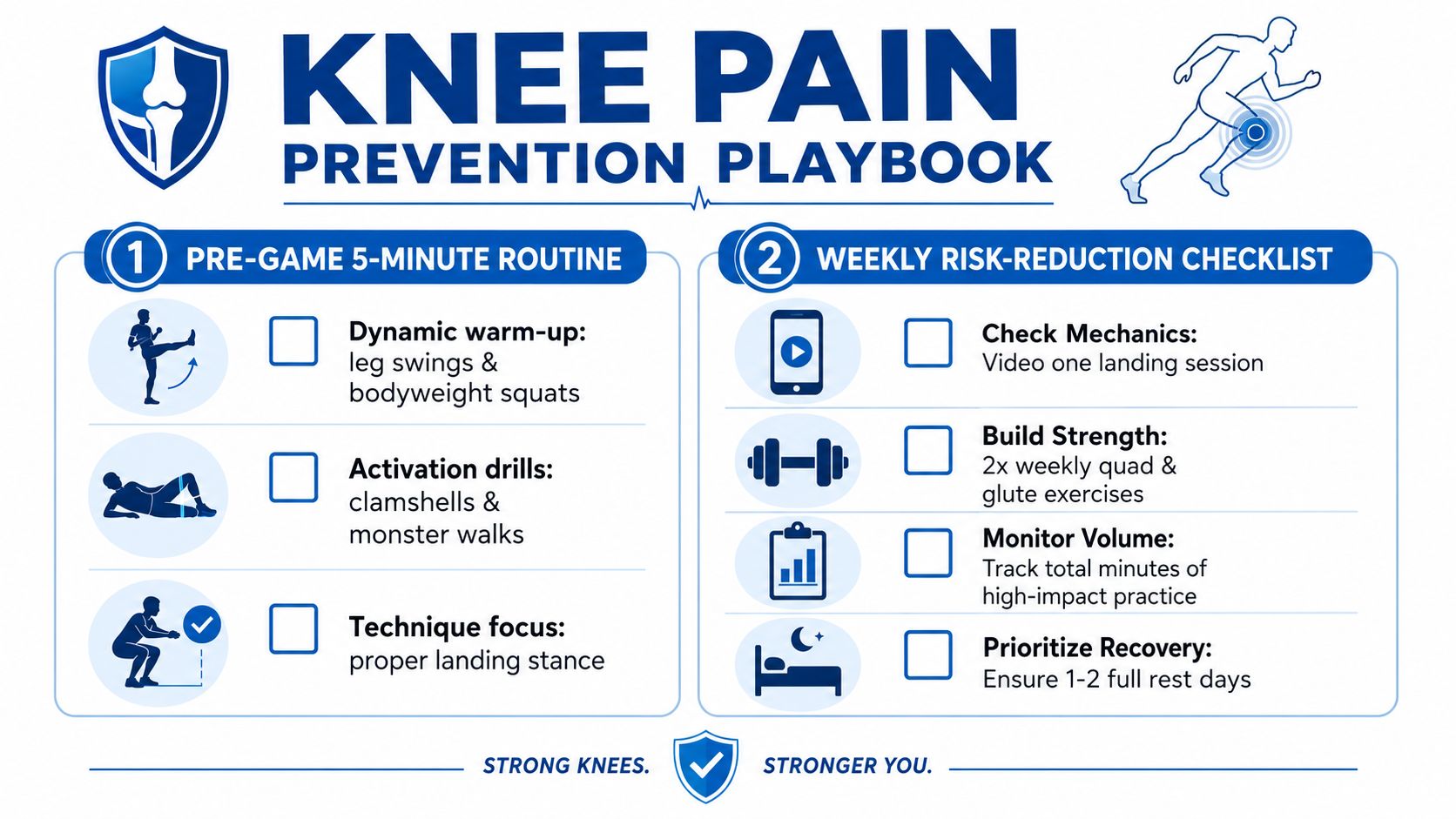
Before pickup, a player can run one checklist: no swelling, full comfortable motion, stable single-leg balance, a brief movement warm-up, and a plan to reduce minutes if symptoms increase. If knee pain after basketball keeps recurring despite these changes, Interventional Pain Management can evaluate joint and sports injuries, coordinate diagnostic review, and discuss non-invasive, interventional, or orthopedic treatment when clinically appropriate.
Visit Interventional Pain Management to arrange an evaluation for recurring knee pain after basketball, swelling, instability, or suspected sports injury. The practice can help identify whether the problem reflects overload, a ligament or meniscal injury, or another joint condition, then guide the next step toward a safer return to activity.