

You've been told that a fusion may be the next step, and the word itself can feel more alarming than the symptoms that brought you to the consultation. Many patients then hear “anterior” and assume the operation must be gentler because the surgeon approaches from the front. That assumption can create false reassurance. Anterior lumbar fusion is a carefully selected operation with a distinct mechanical advantage and a distinct risk profile.
The important question isn't whether the approach sounds less invasive. It's whether reaching the spine from the front gives the surgical team the best way to restore disc height, improve alignment, and stabilize the painful segment in that particular patient. Those benefits must be weighed against vascular, bowel, and clot-related concerns before a decision is made.
Table of Contents
- Why Anterior Lumbar Fusion Is Not What Most Patients Expect
- What Anterior Lumbar Fusion Actually Is
- How the Procedure Works Step by Step
- Anterior Fusion Compared to Other Spinal Fusion Approaches
- What Recovery from Anterior Lumbar Fusion Really Looks Like
- Risks and Complications to Understand Before Surgery
- Alternatives to Anterior Lumbar Fusion
- Frequently Asked Questions About Anterior Lumbar Fusion
Why Anterior Lumbar Fusion Is Not What Most Patients Expect
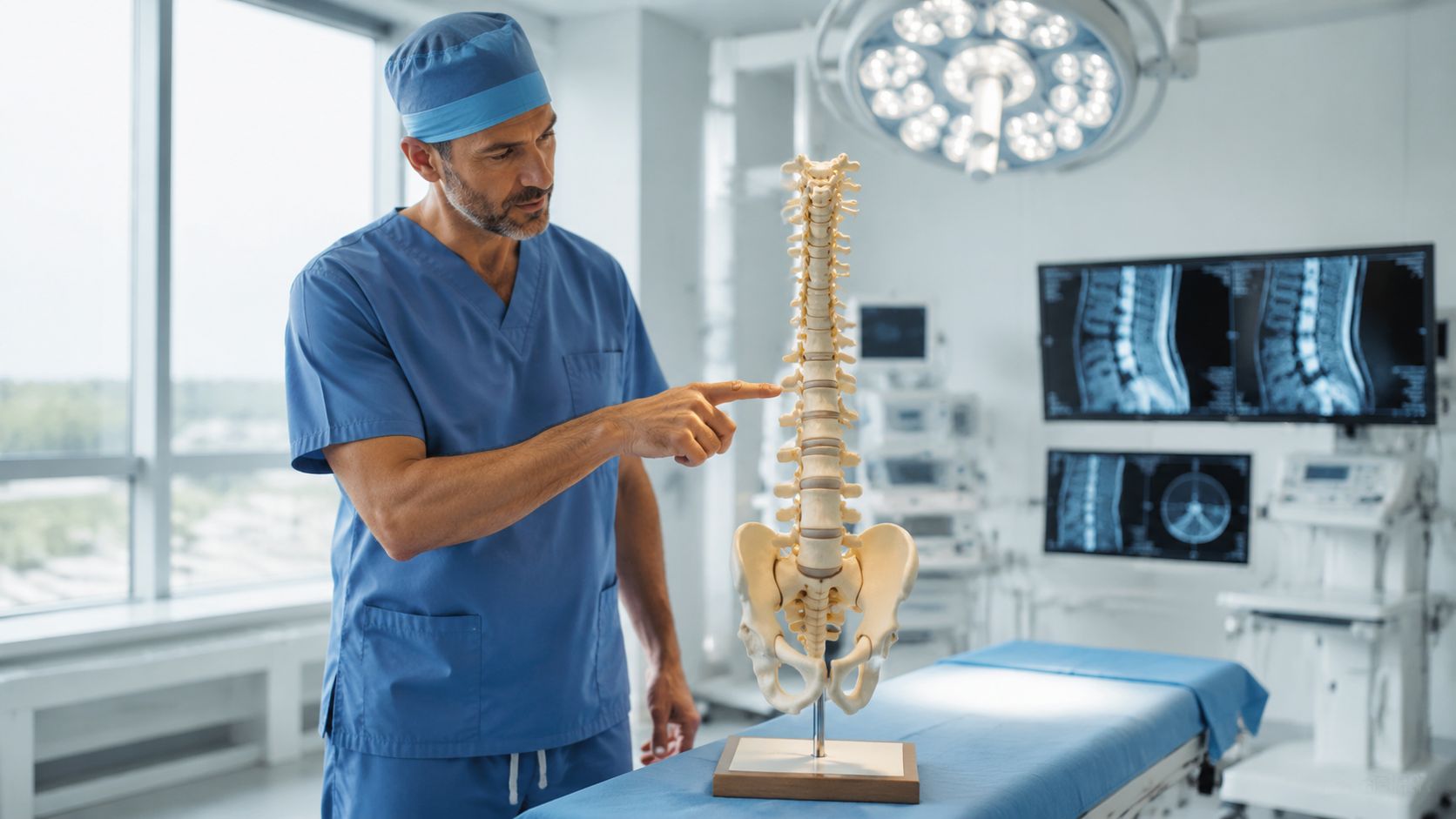
Anterior lumbar fusion, often called anterior lumbar interbody fusion, or ALIF, isn't just a less invasive version of fusion performed from the back. The incision is made in the lower abdomen, and the surgeon works around major blood vessels and abdominal structures to reach the front of the lumbar spine. That route avoids working directly through the muscles and nerves at the back, but it introduces its own technical challenges.
The approach is usually selected for a reason. A surgeon can access the disc space directly, remove a collapsed disc, and place a relatively large cage that supports the front of the spinal column. This can help restore lost disc height and improve the natural inward curve of the lower back, known as lordosis. A 2025 review reported stand-alone ALIF fusion around 88.6%, increasing to 94.2% with anterior fixation plates, and found that ALIF restored disc height and segmental lordosis more effectively than TLIF and XLIF in the reviewed comparisons (2025 review of ALIF alignment and fusion outcomes).
That mechanical benefit doesn't guarantee better pain relief for every patient. Comparative evidence has found that pain and disability outcomes can be similar between anterior and posterior fusion, even when alignment correction differs. The operation therefore makes the most sense when the structural objective, not just the desire for pain reduction, supports the anterior route.
Practical rule: A recommendation for ALIF should explain what needs to be corrected mechanically, not only which symptoms need to improve.
What Anterior Lumbar Fusion Actually Is
The lower spine can be compared with a building whose floors are separated by shock absorbers. The vertebrae are the floors, while the discs cushion movement and help maintain spacing. When a disc collapses, tears, or moves painfully, the affected segment may lose height and stability. Fusion removes the painful motion by allowing two neighboring vertebrae to heal into one solid unit.
During ALIF, the damaged disc material is removed from between the vertebrae. The surgeon prepares the space, restores its height with a cage or spacer, and places bone graft inside or around that implant. The graft provides a framework for new bone growth. As healing progresses, bone crosses the treated disc space and connects the vertebrae.
The cage also has a mechanical job. It supports the front of the spinal column, helps open a narrowed disc space, and can contribute to restoration of the lumbar curve. Screws, plates, or posterior fixation may be added when the segment needs more stability while the fusion matures. More detail about the broader role of spinal fusion is available in this overview of spinal fusion treatment.
Published results show why fusion is discussed as a measurable biological process rather than an instant repair. A 2024 systematic review of endoscopic anterior lumbar interbody fusion reported a pooled fusion rate of 78.9%, with a 95% confidence interval of 68.9% to 90.4%, across the included studies (2024 systematic review of endoscopic ALIF). The same review found substantial variation between studies, so a published fusion rate can't predict an individual patient's result.
The operation is therefore purpose-built. It may be considered when disc collapse, instability, foraminal narrowing, or loss of lordosis makes disc-height and alignment restoration central to treatment. It isn't automatically appropriate for every degenerative disc problem.
How the Procedure Works Step by Step
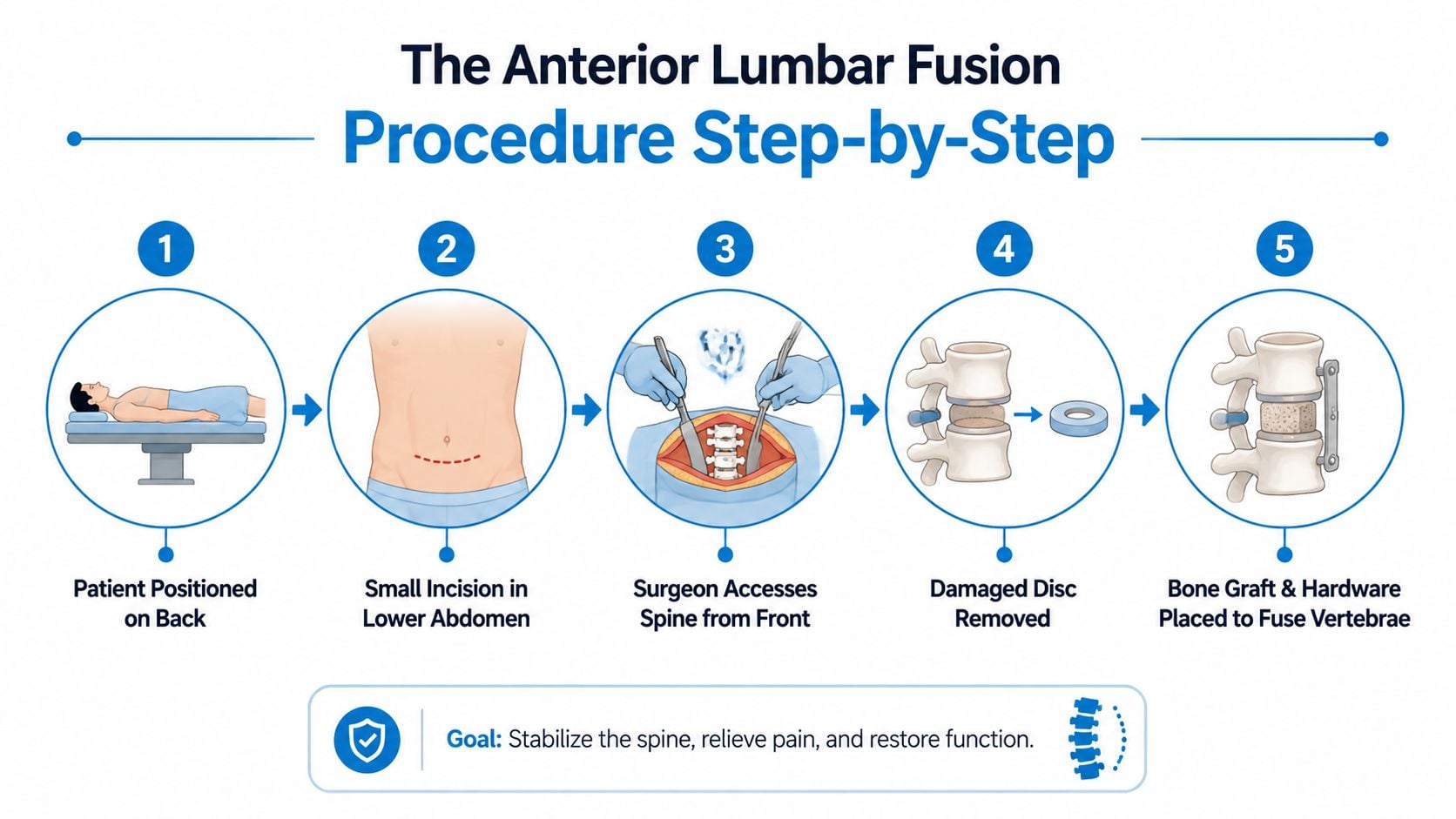
The operation begins with the patient positioned on the back. The incision is made in the lower abdomen, either horizontally or vertically depending on the level being treated, body habitus, prior abdominal operations, and the surgical team's preferred access route.
The access surgeon or spine surgeon carefully develops a path to the front of the lumbar spine. Major blood vessels and abdominal contents must be identified and moved safely aside. This exposure is what makes ALIF different from a posterior fusion. The surgeon isn't passing through the back muscles to reach the spine, but the front approach requires careful management of vascular anatomy.
Once the disc space is visible, the damaged disc is removed and the adjacent vertebral surfaces are prepared. The surgeon selects a cage that fits the space and helps achieve the planned height and angle. Bone graft is placed to encourage the vertebrae to grow together. When additional support is needed, fixation may be added through an anterior plate, screws, or a combined posterior construct.
Why planning matters
Preoperative imaging helps the team understand the relationship between the disc space and nearby vessels. The surgical plan also considers whether the patient has had abdominal surgery, has vascular disease, needs direct nerve decompression, or requires correction at more than one level.
Bone graft selection forms part of that plan. Patients can discuss graft options and the role of bone harvesting in spinal surgery before the procedure.
The anterior route is chosen when its access and implant advantages match the mechanical problem. A larger cage can help restore disc height and lordosis, particularly at L4–5 and L5–S1, but the approach isn't a shortcut around the complexity of fusion.
Anterior Fusion Compared to Other Spinal Fusion Approaches
ALIF is one option within a broader group of interbody fusion techniques. The differences matter because each route gives the surgeon access to different parts of the spine and creates different exposure risks.
| Approach | Access Route | Best For | Key Consideration |
|---|---|---|---|
| ALIF | Front of the lumbar spine through the lower abdomen | Disc-height restoration, anterior column support, and lordosis correction, particularly at L4–5 and L5–S1 | Requires planning around blood vessels and abdominal structures |
| TLIF | Posterior approach through one side of the back | Cases requiring posterior access and direct treatment of nerve compression | May provide less anterior disc-height and lordosis correction than ALIF |
| PLIF | Posterior approach through the back, generally toward the disc space from behind | Selected cases where a posterior route fits the anatomy and decompression plan | Posterior muscles and neural structures are part of the surgical corridor |
| XLIF | Lateral approach through the side of the body | Selected levels and alignment or disc-height goals suited to lateral access | The approach depends heavily on level-specific anatomy and nearby neural structures |
ALIF's strongest argument is mechanical. The anterior column can accept a large implant, and the surgeon can use the cage angle and position to help restore the lumbar curve. This can be valuable in deformity surgery or at the lumbosacral junction, where alignment affects the overall balance of the spine.
Posterior approaches may make more sense when direct decompression is the central objective, when vascular anatomy makes an anterior route unattractive, or when previous abdominal operations complicate access. The choice also depends on whether the patient needs posterior correction, nerve-root decompression, or additional fixation.
A posterior fusion isn't automatically safer, and ALIF isn't automatically superior. A patient considering a posterior alternative can review the details of PLIF surgery and spinal fusion, then ask the surgeon to explain how the proposed approach addresses the specific level, symptoms, and alignment problem.
What Recovery from Anterior Lumbar Fusion Really Looks Like
Recovery happens in layers. The incision may feel better before the fusion is biologically mature, so improving comfort doesn't mean the spine is ready for unrestricted lifting, bending, or twisting.
The first days
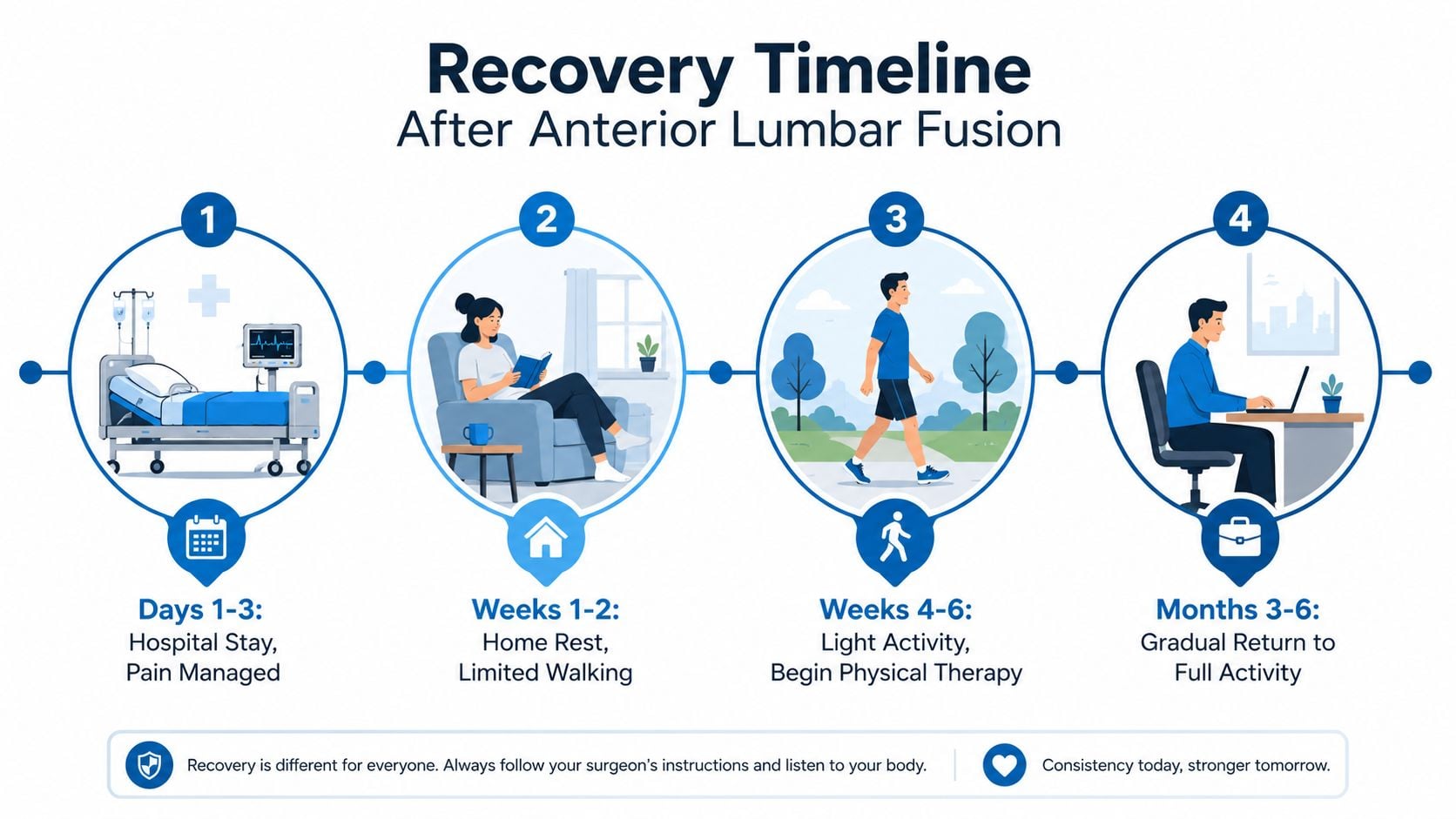
Many patients remain in the hospital until pain is controlled and standing and walking are safe. Early movement helps the care team assess strength, circulation, bowel function, and the ability to manage basic activities. The abdominal incision and the treated spinal segment can both contribute to discomfort at first.
The first weeks at home
During the first couple of weeks, walking is usually the main exercise. Short, frequent walks are more practical than trying to stay active for a long period. Patients often need help with shopping, laundry, meals, and tasks that require bending or lifting.
Driving should wait until the surgeon confirms that the patient can move safely, react quickly, and is no longer taking medicines that impair alertness. The timing varies with pain, mobility, medication use, and the patient's job.
The following months
Light activity usually expands gradually, often with structured rehabilitation once the surgeon confirms that healing is progressing. Walking may become more comfortable before endurance and trunk strength return. Work involving sitting, standing, driving, or lifting requires separate planning rather than a single universal return date.
Many patients notice meaningful improvement over three to six months, while some progress more slowly. The pace depends on the diagnosis, number of levels, fixation strategy, conditioning, smoking status, general health, and whether nerve symptoms were present before surgery.
Risks and Complications to Understand Before Surgery
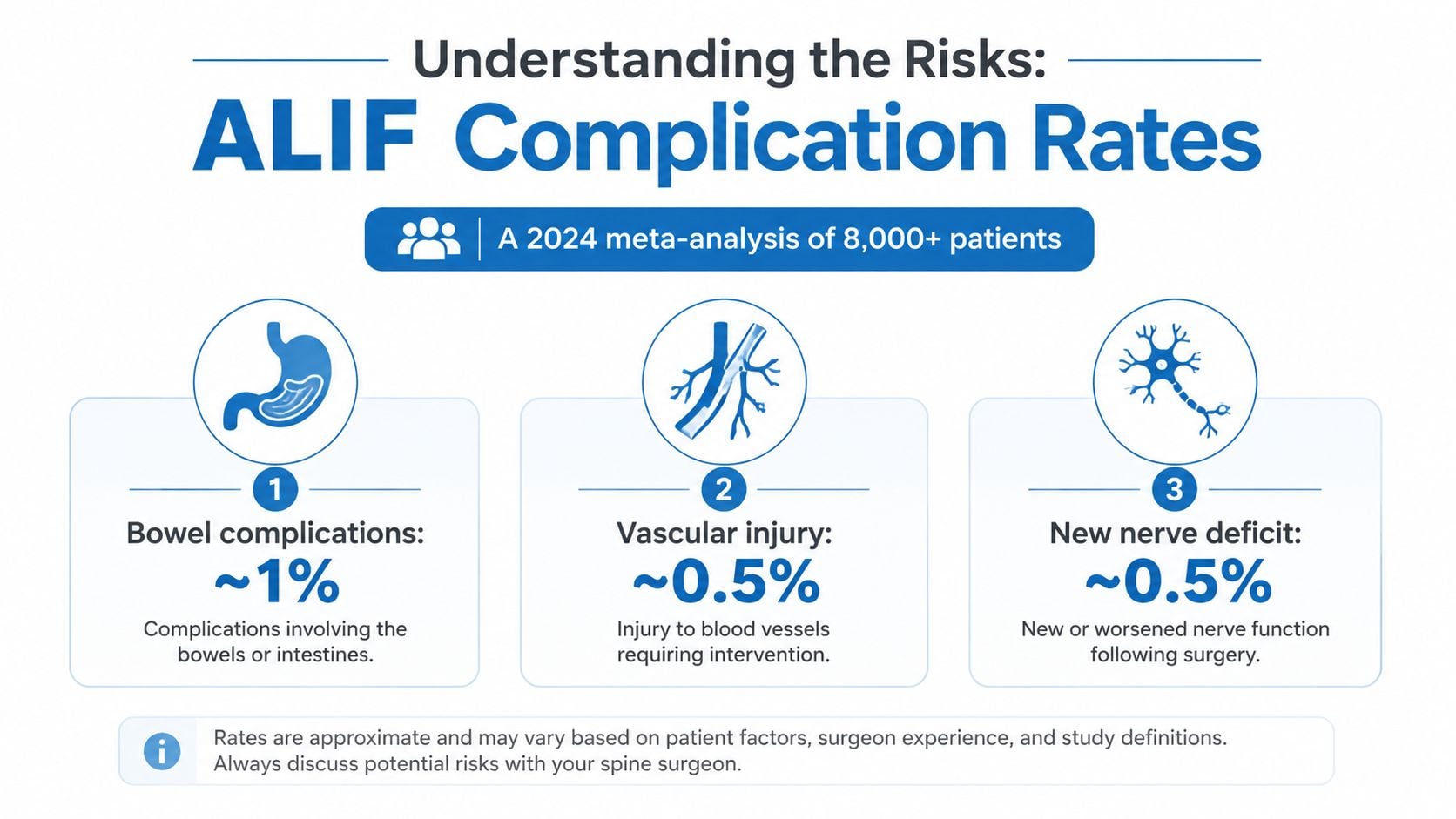
The anterior approach shifts the location and type of risk. A 2024 systematic review and meta-analysis covering 54 studies and 8,066 patients found an overall complication rate of 13.1%, including 3.8% intraoperative complications, 7.4% postoperative complications, 1.5% infection, and 1.7% reoperation (2024 systematic review and meta-analysis of anterior lumbar surgery complications).
Those figures describe groups of patients, not an individual prediction. They also show why ALIF shouldn't be presented as a lower-risk version of posterior fusion. The approach can involve vascular injury, bowel or ileus problems, blood clots, infection, implant issues, and the possibility of another operation.
What patients should clarify
- Vascular exposure: The surgeon must work near major vessels, and anatomy can vary substantially between patients.
- Bowel function: Temporary slowing of bowel activity can occur after abdominal exposure and anesthesia, so bowel preparation and postoperative monitoring matter.
- Thrombosis planning: The team should review clot risk, mobility, medication use, and prevention measures before surgery.
- Fusion biology: A technically successful implant still requires bone healing, and nonunion remains a relevant concern in selected patients.
The complication data support practical preparation rather than fear. Vascular imaging may help the team plan the access route, and medical optimization can address smoking, diabetes, nutrition, bowel function, and clot risk. Patients should ask who will perform the exposure, how vascular anatomy will be evaluated, and what symptoms after surgery require urgent attention.
Alternatives to Anterior Lumbar Fusion
Fusion isn't the automatic answer to degenerative disc disease, stenosis, or back pain. The correct treatment depends on the pain generator, the presence of instability, the degree of nerve compression, spinal alignment, and the patient's response to nonoperative care.
Non-surgical options may include targeted injections, physical therapy, medication adjustments, activity changes, and neuromodulation for selected chronic nerve-pain patterns. These treatments can be reasonable when symptoms are manageable, neurological function is stable, and imaging doesn't show a structural problem that requires stabilization.
A decompression alone may be sufficient when a nerve is compressed but the spinal segment remains stable and alignment doesn't need correction. In other situations, removing bone or disc material without stabilization could worsen instability or fail to address painful motion. That distinction requires a careful review of imaging alongside the examination, not a decision based on the scan alone.
Other fusion approaches may be considered when the surgeon needs direct posterior decompression, when the anterior vascular route is unfavorable, or when a lateral or combined approach better matches the deformity. Patient priorities also matter. Someone with prior abdominal surgery or substantial vascular risk may reasonably ask whether the alignment benefit of ALIF outweighs the exposure concerns.
A sound surgical recommendation should identify the structural problem, explain why fusion is necessary, and show why the chosen route fits the patient's anatomy.
Before consenting, patients can ask whether a diagnostic injection, rehabilitation program, decompression alone, or another fusion approach could address the same objective. A second opinion is particularly reasonable when the proposed operation is extensive, the symptoms are mainly back pain without clear instability, or the mechanical rationale hasn't been explained clearly.
Frequently Asked Questions About Anterior Lumbar Fusion
Is ALIF major surgery?
Yes. ALIF involves abdominal exposure, removal of a lumbar disc, placement of an implant and bone graft, and a period of protected healing. “Major” doesn't mean that complications are expected, but it does mean patients should plan for assistance at home, medication management, activity restrictions, and follow-up imaging.
How long do the cage and hardware last?
The cage, plate, screws, and rods are intended to remain in place for the long term. They don't have a routine replacement date. Removal or revision is considered only when a specific problem develops, such as infection, hardware failure, nonunion, or persistent symptoms linked to the construct.
Can ALIF cause sexual dysfunction?
It can. The front of the lumbar spine lies near nerves and vessels involved in sexual function, so patients should discuss this risk directly with the surgeon before consenting. The likelihood depends on the surgical level, anatomy, exposure, prior operations, and the technique used. A surgeon should explain the relevant risk for the proposed approach rather than offer a generic reassurance.
What does “success” mean in real-world practice?
Success isn't defined by fusion on an image alone. A 1996 long-term study reported complete fusion in 52%, questionable fusion in 24%, and definite pseudoarthrosis in 24%, while about 66% of patients reported functional success after a mean follow-up of 8 years (1996 study of long-term anterior lumbar fusion outcomes). These results show why radiographic healing, pain, function, and patient expectations must all be considered together.
Interventional Pain Management evaluates spine conditions through nonoperative, interventional, and surgical pathways, including ALIF when the clinical indication supports it. Patients in New Jersey and Staten Island can visit Interventional Pain Management to request an evaluation and discuss whether anterior lumbar fusion, another procedure, or a non-surgical plan fits their diagnosis.