
Months or years of burning leg pain, electric shocks in the back, or sensitivity that makes clothing unbearable can leave a person feeling trapped between medications, injections, physical therapy, and another operation. The question often becomes less about whether the pain is serious and more about whether there is a sensible next step that could restore sleep, walking, work, or ordinary independence.
A spinal cord stimulation procedure isn't a single event. It's a staged clinical pathway that usually begins with evaluation, continues through a temporary trial, and only then leads to permanent implantation if the trial demonstrates meaningful benefit. Understanding each decision point can make the process feel less like a leap and more like a measured test.
Table of Contents
- When Spinal Cord Stimulation Becomes the Next Logical Step
- How Spinal Cord Stimulation Interrupts Pain Signals
- The SCS Trial Phase and What It Actually Tests
- From Trial Success to Permanent Implant
- Comparing Today's SCS Device Options
- Risks, Revisions, and Long-Term Device Performance
- Recovery, Adjustments, and Life With an Implanted System
- Deciding Whether Spinal Cord Stimulation Fits Your Care Plan
When Spinal Cord Stimulation Becomes the Next Logical Step
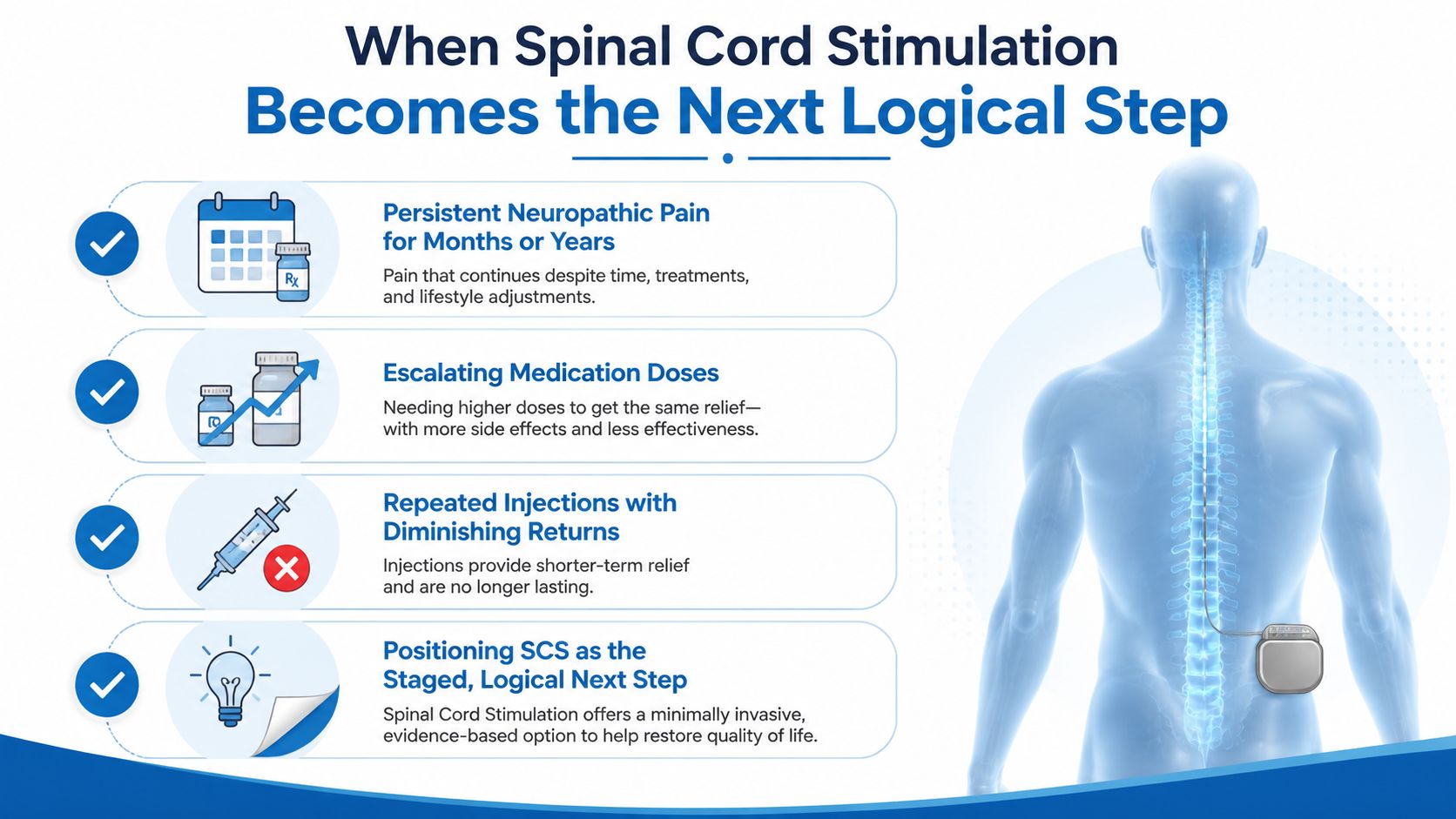
Spinal cord stimulation is generally considered after persistent neuropathic pain has resisted appropriate treatment. A person may have undergone medication management, physical therapy, targeted injections, and, where appropriate, corrective spine surgery, yet still experience disabling leg or back pain. Persistent pain after spine surgery is often discussed as failed back surgery syndrome, and patients can review related clinical context through this guide to pain after back surgery.
The decision shouldn't be based only on suffering or frustration. A pain specialist first asks whether the diagnosis is clear, whether the pain has a nerve-related pattern, and whether stimulation could reasonably address the painful area. Common clinical contexts include failed back surgery syndrome, complex regional pain syndrome, and selected refractory neuropathic conditions.
What the evaluation looks for
A structured assessment commonly includes:
- A documented pain generator: Imaging, examination, operative history, and symptom distribution should fit together.
- Reasonable treatment history: The team reviews medications, rehabilitation, injections, and surgical options rather than assuming SCS should replace them.
- Psychological readiness: The patient needs realistic expectations and must be prepared to participate in programming and follow-up.
- Medical safety: Active infection, untreated bleeding problems, and other procedural risks need attention before implantation.
- Functional goals: Better sleep, longer walking tolerance, improved sitting, or reduced reliance on medication gives the trial a meaningful target.
The field has changed substantially. Early dorsal column stimulation was described as limited and associated with poor outcomes, but a 2024 systematic review and network meta-analysis of 13 randomized clinical trials involving 1,561 patients found conventional and newer SCS approaches had superior efficacy versus conventional medical management after six months across five of six outcomes (JAMA Network Open evidence review).
Practical rule: The best consultation starts with the question, “What activity should become easier if this works?” rather than only, “How much pain might disappear?”
How Spinal Cord Stimulation Interrupts Pain Signals
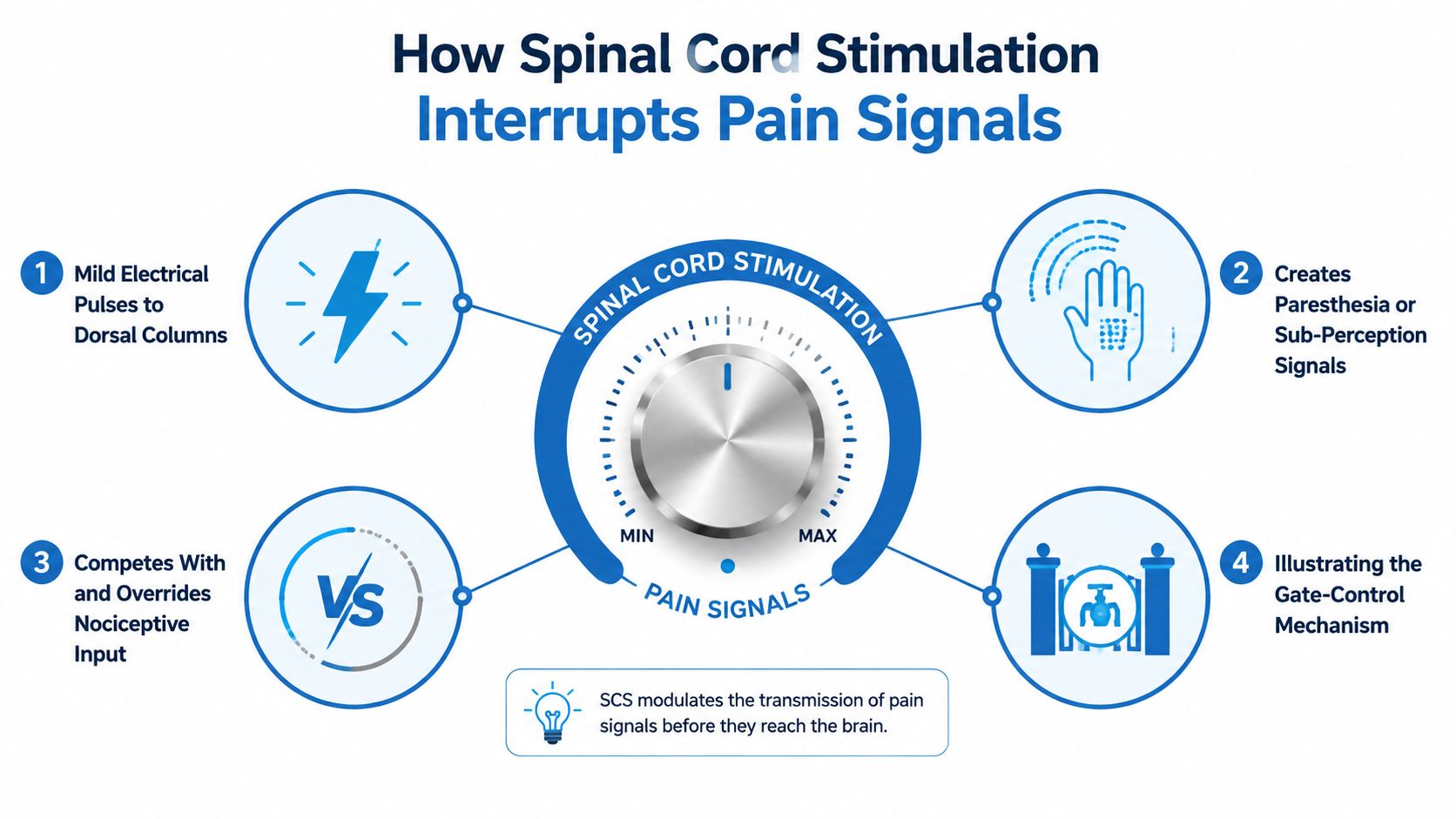
Pain signals travel through complex nerve pathways before the brain interprets them. An SCS system places leads in the epidural space near the spinal cord and delivers carefully programmed electrical pulses. The goal isn't to damage nerves or numb the body. Instead, stimulation changes how incoming signals are processed.
A thermostat offers a useful analogy. A thermostat doesn't remove heat from a room by destroying it. It senses conditions and adjusts the system so the room feels more comfortable. SCS works in a different biological way, but the comparison helps explain the clinical idea: programmed stimulation can modulate the messages competing for the brain's attention.
Paresthesia and newer stimulation patterns
Traditional tonic stimulation may produce paresthesia, often described as gentle tingling or vibration in the area where pain is felt. Newer programming approaches can reduce or eliminate that sensation, sometimes called sub-perception stimulation. The patient may not feel the pulses directly, yet the therapy can still alter pain processing.
The physician chooses a system and programming strategy according to the pain pattern, prior treatment response, anatomy, and practical needs. A patient with predominantly neuropathic leg pain may have different targets and expectations from someone whose main problem is axial low back pain.
Who may be considered
A specialist typically looks for:
- A consistent diagnosis involving neuropathic or otherwise suitable pain.
- Symptoms that remain functionally limiting despite appropriate care.
- The ability to understand and operate the patient controller.
- Stable psychological health and realistic expectations.
- No active infection or untreated medical issue that would make implantation unsafe.
- A device plan compatible with future imaging requirements.
SCS isn't a universal treatment for every type of back pain. It also isn't a cure for the original structural condition. The system aims to reduce the burden of pain enough to support meaningful function, while the underlying diagnosis continues to guide the broader care plan.
The SCS Trial Phase and What It Actually Tests
The temporary trial is the most important decision point in the pathway because it tests the patient's response before permanent hardware is implanted. A clinician usually places one or more temporary leads through a needle under fluoroscopic guidance, using local anesthetic and monitored sedation. The external generator remains outside the body and is secured so the patient can evaluate the therapy at home.
The trial commonly lasts several days. During that time, the patient should follow the activity restrictions carefully because excessive bending, twisting, or pulling can move a temporary lead and make the result harder to interpret.
What counts as a meaningful trial
Technical success is usually defined as at least 50% pain relief on a validated outcome instrument, while consensus guidance reports median trial success rates of 72% to 82% and therapy success around 61% to 65% at 12 months (consensus guidance on SCS trials). The percentage alone isn't enough. The clinician also wants to know whether the improvement changes daily life.
A useful trial diary can include:
- Pain intensity: Record pain at consistent times and during known triggers.
- Activity tolerance: Note walking, standing, sitting, stairs, and transitions from sitting to standing.
- Sleep: Track whether pain interrupts sleep and whether morning movement feels easier.
- Medication use: Record doses and timing rather than relying on memory.
- Coverage and sensation: Describe which painful areas improve and whether tingling is comfortable.
- Function: Write down one or two tasks that were previously avoided.
A patient who reports lower pain but still can't walk, sleep, or perform essential activities may not have achieved a useful result. Conversely, a person whose pain score changes unevenly but can sleep through the night or walk farther may have found a clinically meaningful response.
A trial is not a promise of permanent implantation. It is a controlled question: does this therapy provide enough relief and functional improvement to justify the next procedure?
At the end, the temporary leads are removed, usually without another surgical incision. The patient and clinician then review the diary, medication pattern, functional gains, side effects, and whether the stimulation covered the intended pain. A permanent system should proceed only when both agree the evidence supports it.
From Trial Success to Permanent Implant
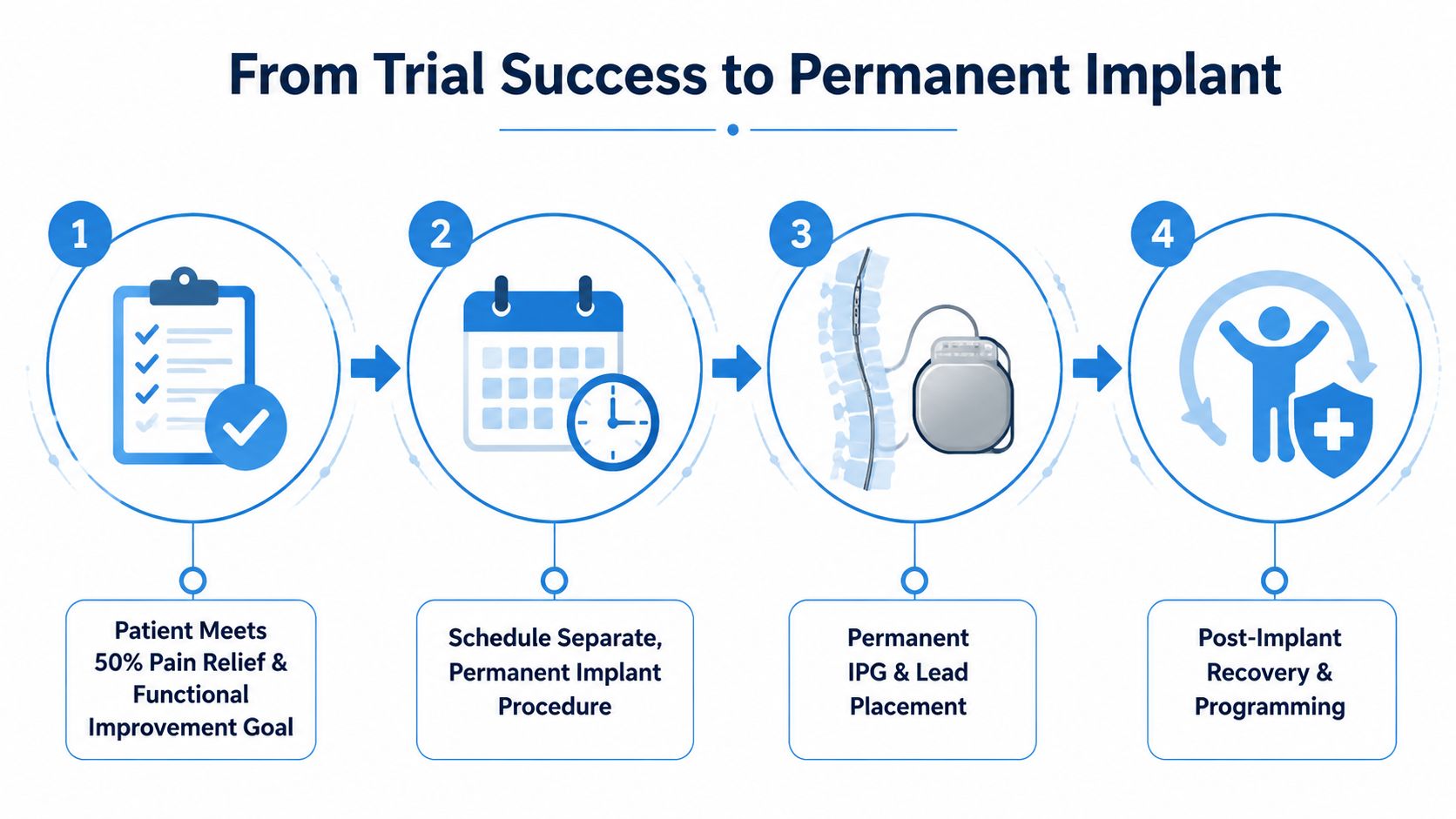
A successful trial doesn't automatically turn into a permanent implant on the same day. It creates a decision pivot. The patient has demonstrated meaningful relief and functional benefit, and the next procedure focuses on placing the leads and pulse generator fully beneath the skin.
The permanent operation takes place in a sterile operating-room environment. Compared with the temporary trial, it generally involves deeper sedation or anesthesia, incision-based lead anchoring, and creation of a pocket for the implantable pulse generator. The clinical team confirms lead position with imaging and secures the system to reduce movement.
What happens during implantation
The usual sequence is:
- Lead placement and confirmation: The physician positions the permanent leads in the epidural space and checks their location.
- Generator pocket creation: A small pocket is formed beneath the skin, often in the upper buttock or flank.
- Connection and tunneling: Extensions connect the leads to the generator beneath the skin.
- Closure and programming plan: The incisions are closed, dressings are applied, and later programming visits are arranged.
The operation itself may take 60 to 120 minutes, based on the surgical plan and system configuration. Patients may leave the same day or after a short observation period, sometimes described as a 23-hour stay. The exact discharge plan depends on anesthesia recovery, pain control, medical history, and local practice.
The patient generally feels soreness at the incision sites rather than stimulation-related discomfort during the operation. Initial programming may occur before discharge or at a follow-up appointment, depending on the system and the clinical workflow. The device then becomes a treatment that requires adjustment, not a set-and-forget implant.
Comparing Today's SCS Device Options
Device selection is less about choosing the most advanced label and more about matching the system to the patient's pain pattern, sensation preference, charging tolerance, imaging needs, and follow-up access. The physician may discuss tonic, high-frequency, burst, or other waveform categories, but the practical question is how each option fits everyday life.
| Device Category | Waveform / Frequency | Sensation During Use | Battery Life | MRI Compatibility | Best-Fit Patient Profile |
|---|---|---|---|---|---|
| Conventional tonic | Pulsed stimulation, commonly discussed in traditional frequency ranges | Tingling or paresthesia may be noticeable | Depends on programming and battery type | Device-specific and conditional | Patients comfortable with sensation-based coverage |
| High-frequency | High-frequency stimulation, including systems designed around 10 kHz | Often paresthesia-free | Depends on settings and charging design | Device-specific and conditional | Patients who prefer little or no perceived stimulation |
| Burst | Burst-pattern stimulation | May be subtle or paresthesia-free | Depends on programming and generator | Device-specific and conditional | Patients whose clinician considers burst programming appropriate |
| Differential or multiplexed waveforms | Multiple programmed patterns or targets | Varies by program | Depends on use and hardware | Device-specific and conditional | Patients needing flexible programming for changing pain patterns |
| Rechargeable generator | Rechargeable implantable pulse generator | Determined by waveform | Designed for repeated recharging rather than a fixed replacement interval | Must be confirmed for the exact system | Patients willing to maintain a charging routine |
| Non-rechargeable generator | Fixed-battery implantable pulse generator | Determined by waveform | Eventually requires generator replacement | Must be confirmed for the exact system | Patients who prefer less charging responsibility |
The battery discussion deserves practical attention. Rechargeable systems can reduce the need for replacement surgery but require regular charging and may be thicker or more noticeable beneath the skin. Non-rechargeable systems remove the charging routine but eventually reach battery depletion.
MRI safety isn't a generic feature of “having an SCS.” It depends on the exact implanted components, lead configuration, scan conditions, and current labeling. Patients should keep the device identification information and show it to imaging staff before any scan.
Spine surgery and neuromodulation can overlap in complex cases, so a consultation may also include review of spine surgery options. Device choice may be influenced by insurance coverage, physician familiarity, anatomical targets, and whether the pain is mainly in the back, limb, or both.
Risks, Revisions, and Long-Term Device Performance
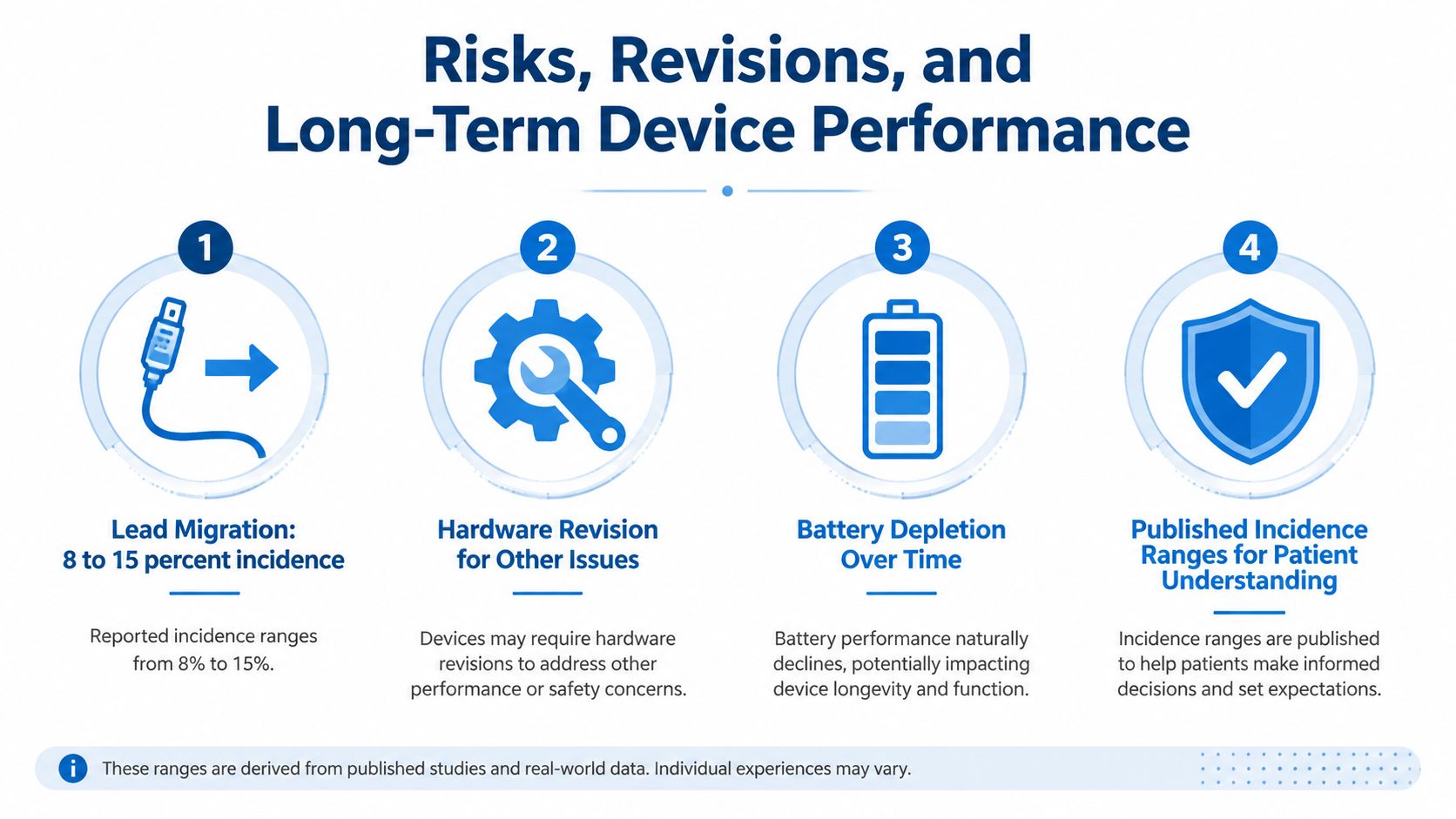
SCS complications are usually discussed in terms of hardware, wound healing, infection, programming, and the possibility of revision. Catastrophic neurologic injury is a serious concern, but modern complication discussions often center more on lead movement, loss of benefit, and procedures needed to maintain the system.
A 2026 systematic review and meta-analysis found a pooled adverse-event burden of 0.35 events per patient, with 34.5 events per 100 patient-years. Lead migration occurred more often than infection, at 7.05 versus 2.82 events per 100 patient-years, while revisions were more common than explantations, at 6.31 versus 2.93 events per 100 patient-years (SCS complication meta-analysis).
What may require intervention
- Lead migration: A lead can shift, changing the area of stimulation or reducing coverage. Reprogramming may help, but repositioning can be needed.
- Infection: Infection near the generator or leads may require antibiotics, drainage, or removal of the system.
- Hardware damage: Fracture, connector problems, or generator malfunction can interrupt therapy.
- Loss of efficacy: Pain can change, the disease can progress, or the nervous system can respond differently over time.
- Skin or pocket problems: Irritation, fluid collection, or discomfort over the generator may need assessment.
Across 13,026 permanently implanted patients in 25 studies, the overall explantation rate was 9.82% between 1984 and 2024. Lack of efficacy accounted for 38% of explants, lead failure for 15%, and infection for 14% (long-term SCS cohort and systematic review).
Those figures don't predict an individual result. They clarify why follow-up matters. A change in coverage doesn't always mean the therapy has failed, and removal isn't the first response to every problem. The team may begin with programming, then investigate imaging or hardware position, and reserve revision or explantation for a defined clinical reason.
Recovery, Adjustments, and Life With an Implanted System
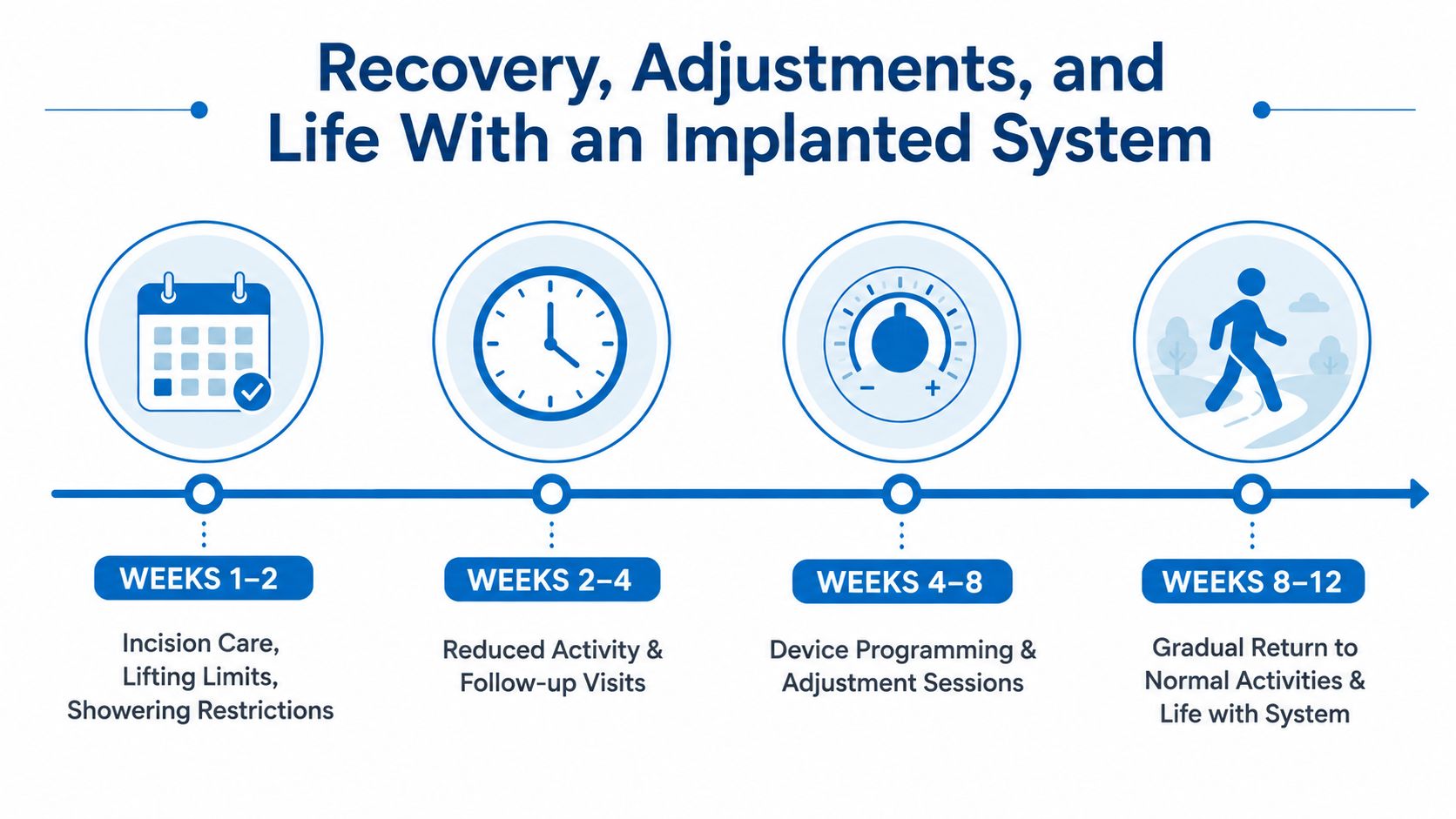
The first 8 to 12 weeks after permanent implantation are less about testing pain relief and more about protecting the incisions and allowing the leads to settle. Patients usually receive instructions about wound care, showering, lifting, bending, and twisting. The exact restrictions come from the implanting physician because incision location, anchoring method, and medical history matter.
The early checkpoints
During the first two weeks, patients generally focus on keeping dressings and incisions clean and following showering restrictions. A wound check often occurs around 10 to 14 days, while initial activation or programming may take place around weeks three to four. Later visits refine amplitude, frequency, and program selection around activities such as walking, sleeping, or sitting.
Desk work may resume around two to three weeks when healing and comfort permit. Physically demanding work may require six to eight weeks, and driving should wait until incisions have healed, movement is safe, sedating medication is no longer being used, and the treating clinician has approved it.
Daily life remains possible, but device-specific planning matters:
- Charging: Rechargeable systems require a routine that fits sleep, work, and travel.
- Security screening: Carry the device identification information and tell security personnel about the implant.
- MRI: Some newer systems are conditionally compatible, but the exact device, leads, scan, and settings must be checked before imaging.
- Sleep and clothing: Patients often experiment with positions and clothing until the generator pocket becomes less noticeable.
- Device control: The patient programmer allows approved adjustments, but unexplained changes in pain or stimulation should prompt clinical contact.
Deciding Whether Spinal Cord Stimulation Fits Your Care Plan
SCS is one tool within a broader interventional pain plan. A strong candidate often has persistent pain with a clear neuropathic or post-surgical pattern, has tried appropriate nonoperative care, and understands that the goal is improved function rather than a guaranteed cure.
The evidence supports meaningful benefit for many selected patients, but it isn't uniform across every diagnosis or time point. A 2025 meta-analysis found significant pain reduction, functional improvement, and quality-of-life gains versus conventional medical management at six months, while noting that stronger evidence was concentrated in post-surgical pain syndromes and that longer-term durability remains less certain for some groups (2025 SCS meta-analysis).
Questions for the consultation
A patient can bring a written list covering:
- Diagnosis: What specific pain mechanism is being treated, and what findings support it?
- Alternatives: Could continued medical management, rehabilitation, targeted injection, radiofrequency ablation, or another intervention address the problem?
- Trial design: How will the team define success, and what activities should be tested at home?
- Procedure details: Who performs the trial and implant, and what anesthesia and imaging guidance are used?
- Follow-up: Who handles programming, charging questions, wound concerns, and loss of coverage?
- Device logistics: Which scans remain possible, what identification documents are supplied, and how is future generator replacement handled?
- Failure planning: What happens if the trial doesn't help, or if permanent therapy later loses effectiveness?
Psychological screening isn't a judgment about whether pain is real. It helps identify untreated conditions, coping barriers, expectations, and practical challenges that could affect recovery or device use. Imaging review, medication history, physical examination, and a clearly explained staged plan should all be part of the evaluation.
Patients with complex regional pain syndrome can begin by reviewing complex regional pain syndrome care, then discussing whether neuromodulation belongs in the overall strategy. A careful consultation should leave the patient with a specific reason for the trial, measurable goals, and a clear alternative if SCS isn't appropriate.
Interventional Pain Management evaluates chronic neuropathic pain, post-surgical pain, and spine conditions through coordinated pain management, orthopedic, and spine services. Patients can bring their imaging, medication history, prior procedure records, and functional goals to a consultation by visiting Interventional Pain Management.