

A hand that tingles at night can make sleep feel like a series of interruptions. The person affected may shake the hand, change position, or rub the wrist, only to wake again with numbness in the thumb, index finger, or middle finger. During the day, the same problem may show up as a weak grip, trouble fastening clothing, or objects slipping from the hand.
The right choice among carpal tunnel treatment options depends less on finding a single “best” remedy and more on matching treatment intensity to nerve health, symptom persistence, and the durability the patient needs. A neutral wrist splint may be sensible for mild symptoms, while persistent numbness, weakness, or nerve impairment may call for a more definitive discussion.
Table of Contents
- Understanding Carpal Tunnel Syndrome and Why Treatment Timing Matters
- Conservative Carpal Tunnel Treatments That Reduce Pressure and Protect the Nerve
- Injections and Minimally Invasive Options and How Long Relief Lasts
- When Carpal Tunnel Surgery Is Recommended and What Release Involves
- Recovery Outlook and How Injections Compare With Surgery Over Time
- How to Choose Your Best Path and When to Seek Specialty Care
- Your Next Steps to Lasting Hand Comfort and Function
Understanding Carpal Tunnel Syndrome and Why Treatment Timing Matters
The carpal tunnel is a narrow passageway at the wrist. The median nerve travels through it alongside tendons that move the fingers. A useful analogy is a hallway with limited space. If the walls swell or the hand remains in a cramped position, the nerve has less room to function comfortably.
Nighttime symptoms often appear first because the wrist can bend during sleep. Repetitive hand use, sustained pressure, or swelling around the tendons can further irritate the nerve. A person may notice tingling in the thumb, index finger, middle finger, and part of the ring finger, although symptoms can feel less precise in everyday life.

Symptoms can signal different levels of urgency
Mild or intermittent tingling may improve when wrist pressure changes. Moderate symptoms tend to return more often, disturb sleep, or interfere with work and household tasks. Severe disease deserves faster attention, particularly when numbness becomes constant, thumb strength declines, the thenar muscles at the base of the thumb waste away, or nerve testing shows axonal loss.
These categories aren't perfect labels. A person with occasional symptoms may still have a different condition, and someone with substantial nerve compression may underestimate the problem because the hand has gradually adapted. An examination can assess sensation, thumb strength, reflexes, provocative findings, and whether electrodiagnostic testing is appropriate.
Why timing changes the decision
A compressed nerve can become less resilient over time. Early evaluation doesn't mean every patient needs a procedure. It means the clinician can identify whether a trial of pressure reduction is reasonable or whether delay could leave the nerve with less opportunity to recover.
A patient-friendly overview of symptoms, evaluation, and treatment is available through Interventional Pain Management's carpal tunnel syndrome resource. The central decision is practical: is the nerve irritated but functioning, or is it showing signs of injury?
Practical rule: Temporary relief can be useful, but a treatment plan should also identify what happens if symptoms return.
Conservative Carpal Tunnel Treatments That Reduce Pressure and Protect the Nerve
Conservative care works by giving the median nerve more room and less repeated irritation. It doesn't cut the ligament that forms the roof of the tunnel, so its role is usually greatest when symptoms are mild or moderate and nerve function remains preserved.
Start with wrist position
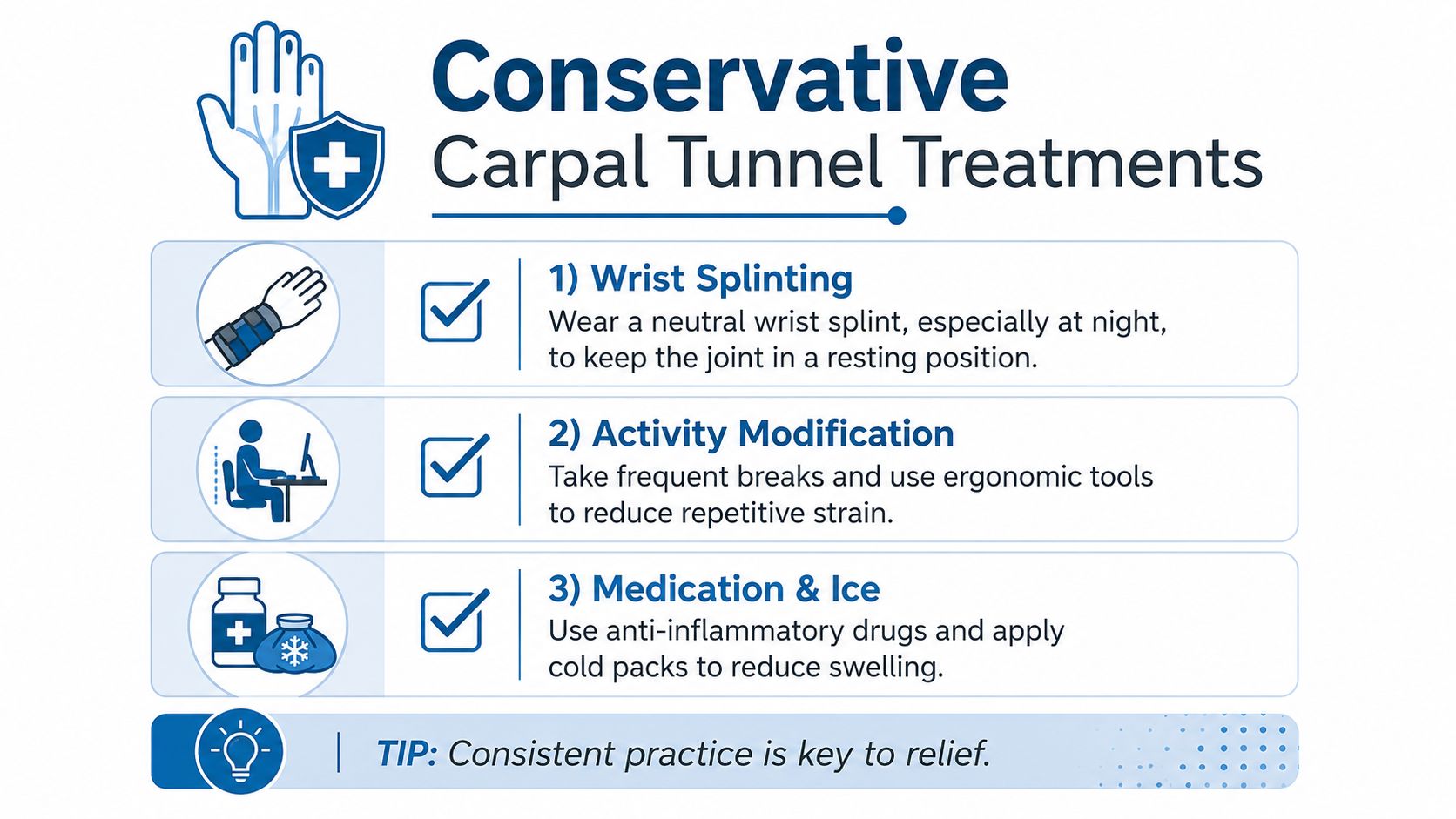
A nighttime orthosis that holds the wrist near neutral can prevent the prolonged bending that increases pressure inside the tunnel. Current orthopedic guidance supports nighttime splinting for mild to moderate carpal tunnel syndrome because a neutral position reduces intracarpal pressure and median nerve compression during sleep. The splint should feel supportive, not tight, and it shouldn't create new numbness or skin irritation.
A practical routine may include:
- Night protection: Wear the neutral wrist splint consistently during sleep rather than tightening it excessively.
- Task changes: Reduce prolonged wrist bending, forceful gripping, and direct pressure on the palm where possible.
- Work breaks: Alternate tasks and take brief breaks before symptoms build.
- Tool position: Choose handles and work surfaces that allow the wrist to stay closer to neutral.
- Symptom tracking: Record nighttime awakenings, tingling frequency, grip problems, and activities that trigger symptoms.
Medication and therapy have defined roles
A clinician may recommend a short course of an anti-inflammatory medicine when appropriate, taking into account stomach, kidney, blood pressure, blood thinner, and other health concerns. These medicines may ease pain, but they don't enlarge the tunnel or reverse established nerve damage.
Hand therapy can help patients modify movement, protect the wrist, and use nerve-gliding approaches when indicated. Exercises shouldn't reproduce significant tingling or leave symptoms worse afterward. A therapist can adjust the program when the nerve is highly irritable or when another diagnosis may be contributing.
Current guidance advises against routine use of low-level laser, iontophoresis, or magnet therapy for carpal tunnel syndrome. That doesn't mean every nonoperative intervention lacks value, but it does mean patients should ask what problem a proposed treatment addresses and what would trigger a change in strategy.
Reassess instead of drifting
The American Academy of Orthopaedic Surgeons guideline states that if symptoms aren't resolved within 2 to 7 weeks, another nonsurgical treatment or surgery may be considered, depending on the clinical picture. The same guideline identifies splinting or local steroid injection as options before surgery, while recognizing that early surgery is also an option when denervation is present or when the patient prefers it. See the AAOS evidence-based guideline discussion for the treatment milestones.
A splint trial shouldn't become an indefinite holding pattern. Persistent symptoms, worsening weakness, or abnormal nerve findings deserve a new assessment.
Injections and Minimally Invasive Options and How Long Relief Lasts
A corticosteroid injection can calm inflammation around the median nerve and create time for sleep, work, or a more informed treatment decision. It does not mechanically release the flexor retinaculum, the tissue forming the carpal tunnel's roof. Relief may therefore be temporary if pressure on the nerve continues.
A clinician may use physical landmarks or ultrasound guidance, depending on training, anatomy, and the case. Ultrasound helps show relevant structures and guide needle placement. Nerve hydrodissection uses fluid to separate tissue planes around an irritated nerve, while platelet-rich plasma is used in some practices as a biologic injection approach. These methods have different goals and evidence, so ask what outcome is expected, how long relief may last, and what happens if symptoms return. More background appears in this corticosteroid injection treatment resource.

Relief and durability are different questions
An injection can suit someone seeking short-term relief, wishing to avoid an operation for now, or still clarifying the diagnosis. The useful question is not whether symptoms improve. It is whether the improvement lasts long enough to support daily function and whether ongoing compression makes a different strategy more appropriate.
A 2025 systematic review found that 41.6% of patients eventually proceeded to carpal tunnel release after injection, 29% needed reinjection, and the median time to surgery ranged from 128 to 446 days. The authors emphasized substantial heterogeneity and the need for better trials, so these figures are not a personal forecast. They do show why an injection is often discussed as a bridge rather than a guaranteed substitute for decompression. The findings are summarized in this PubMed evidence summary on injection durability.
Questions that improve informed consent
Before choosing an injection, patients can ask:
- Purpose: Is the goal diagnostic information, symptom relief, or postponement of surgery?
- Time horizon: What duration of relief would make the treatment worthwhile?
- Repeat plan: What will happen if symptoms return?
- Nerve status: Do weakness, sensory loss, or test findings make waiting less appropriate?
- Escalation point: Which symptom or result would prompt release?
A minimally invasive option can reduce treatment burden and may fit a carefully timed plan. Less invasiveness does not automatically mean greater durability. The decision should connect expected relief with nerve status, recurrence, and the point at which another treatment becomes more appropriate.
When Carpal Tunnel Surgery Is Recommended and What Release Involves
Surgery becomes more compelling when the nerve needs space and temporary calming measures aren't addressing the underlying compression. Referral is commonly considered for symptoms that persist despite appropriate conservative care, documented nerve impairment, median nerve denervation, thenar atrophy, or a patient's preference for a more durable solution.
The standard operation is carpal tunnel release. The surgeon divides the flexor retinaculum, the tissue forming the tunnel's roof, so the median nerve has more room. The American Academy of Orthopaedic Surgeons identifies complete division of the flexor retinaculum as the standard release technique, as described in its clinical practice guideline update.

Mini-open and endoscopic release
Mini-open release uses a small incision that allows direct access to the ligament. Endoscopic release uses a camera and specialized instruments through a smaller access point. The choice depends on anatomy, surgeon experience, occupational demands, prior procedures, and the patient's preferences.
Evidence summarized in the AAOS update indicates that mini-open and endoscopic release have similar long-term outcomes. The smaller incision associated with an endoscopic approach may sound automatically superior, but incision size is only one part of the decision. The endoscopic surgery information page can help patients understand how minimally invasive techniques fit into a broader procedural discussion.
Anesthesia and therapy expectations
Local anesthetic alone can be used for carpal tunnel release, according to the guideline update. The operation is usually planned around the patient's health, anxiety level, surgical setting, and clinician recommendation.
Afterward, the hand is protected while the incision heals. Some patients need guidance for motion, wound care, or gradual strengthening, but supervised postoperative therapy shouldn't be prescribed routinely for every patient. A focused referral makes more sense when stiffness, weakness, complex work demands, or an unexpectedly slow recovery creates a specific rehabilitation need.
Recovery Outlook and How Injections Compare With Surgery Over Time
After carpal tunnel release, the skin may heal before the nerve feels normal. The incision and palm often settle first, while sensation, endurance, and thumb strength take longer, particularly when compression has lasted a long time. Nighttime tingling may ease early, but recovery speed depends on how much the nerve has been affected.
Patients usually receive instructions for dressing care and protection of the surgical site. Light hand use can return according to the surgeon's guidance. Forceful gripping, lifting, and pressure through the palm are added gradually, like increasing weight only after a healing joint can tolerate ordinary movement. Grip exercises should follow symptoms and wound healing rather than a fixed calendar.
The more useful comparison looks at durability, not only the first follow-up visit. A 2025 meta-analysis of 12 randomized trials involving 1,799 patients found similar results for injections and surgery during the first 6 months, with surgery showing better results at longer follow-up. The analysis also favored decompression for nerve-related outcomes. The long-term injection and surgery comparison provides the study details.
| Time Horizon | Corticosteroid Injection | Carpal Tunnel Release |
|---|---|---|
| Early period | May reduce symptoms without an incision, though the response differs between patients. | Requires wound healing and temporary activity limits while the tunnel is decompressed. |
| Around 6 months | May still help, but returning symptoms can prompt reinjection or a change in strategy. | Randomized evidence found greater symptom improvement than steroid injection at 20 weeks. |
| Longer follow-up | Often serves as a bridge, while persistent or returning symptoms may lead to release. | Addresses the physical narrowing, with better longer-term symptom and nerve outcomes in the cited analysis. |
What the outcome numbers mean
A 2018 systematic review found greater symptom improvement after surgery than conservative care at six months. The mean difference was 0.52 points on a five-point symptom severity scale, with a 95% confidence interval of 0.27 to 0.78. Surgery also improved distal motor latency by 0.31 and sensory nerve conduction velocity by 3.71 m/s. These findings support considering decompression when symptoms persist or testing documents nerve impairment, but they cannot predict exactly when an individual hand will recover. The systematic review of surgical and conservative treatment explains the evidence in detail.
The practical timing is straightforward: an injection can offer temporary symptom control, while release may provide more durable pressure relief but requires healing time. A local multidisciplinary evaluation can match symptom severity, nerve findings, work demands, and recovery expectations before deciding whether to repeat an injection, consider a minimally invasive pathway, or proceed with release.
How to Choose Your Best Path and When to Seek Specialty Care
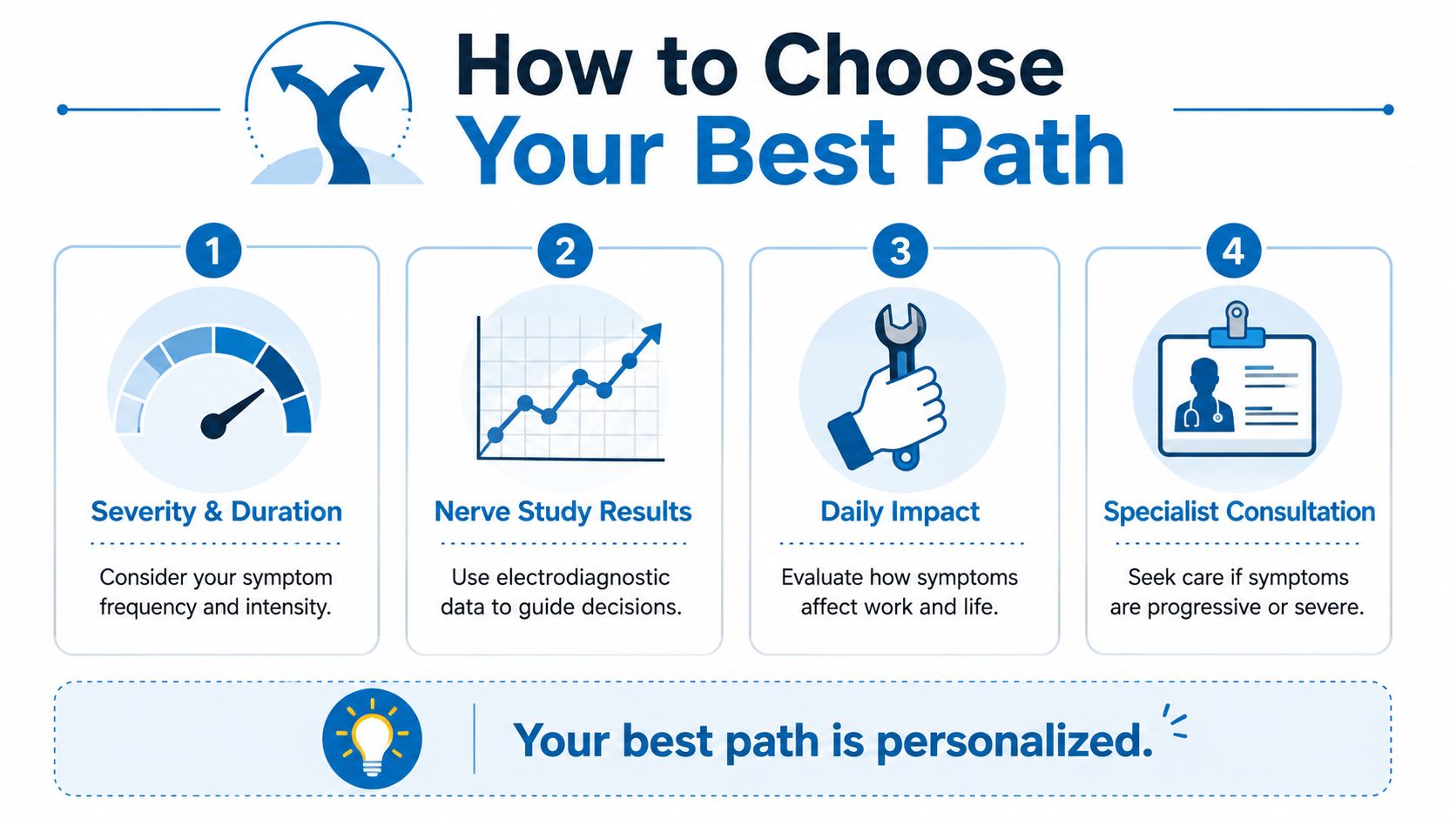
The most useful decision framework begins with the nerve, then considers the person attached to it. A patient with intermittent nighttime tingling and normal strength may reasonably begin with splinting and activity changes. A patient with constant numbness, thumb weakness, thenar wasting, or electrodiagnostic evidence of axonal loss needs a more urgent specialty discussion.
Four factors shape the choice
Severity and duration: Frequent symptoms, sleep disruption, and progressive loss of sensation make prolonged observation less attractive.
Nerve study results: Electrodiagnostic testing can help confirm the diagnosis and show whether the nerve is conducting poorly or showing more advanced injury. Results should be interpreted alongside the examination, not in isolation.
Daily demands: A person who relies on a strong grip for tools, caregiving, keyboard work, or fine hand movements may value durable relief differently from someone with fewer hand-intensive tasks.
Health and access: Diabetes, thyroid disease, arthritis, medication use, work requirements, insurance arrangements, transportation, and scheduling can all affect the practical plan.
Red flags should change the pace
Constant numbness, declining thumb strength, visible wasting at the base of the thumb, or abnormal nerve testing shouldn't be managed with repeated temporary treatments without reassessment. Severe carpal tunnel syndrome, particularly with thenar atrophy or electrodiagnostic evidence of axonal loss, is a reason for surgical consultation rather than prolonged conservative care, according to current orthopedic guidance at the Journal of Orthopaedic & Sports Physical Therapy.
A treatment plan should include an exit point. Relief that fades, weakness that progresses, or testing that shows nerve injury deserves a different conversation.
For adults in New Jersey and Staten Island, local multidisciplinary evaluation can bring pain management, orthopedic, and surgical perspectives into the same care pathway. Interventional Pain Management offers evaluation and treatment ranging from nonoperative care to minimally invasive and surgical options, with locations across the region, availability seven days a week, and assistance related to transportation, benefits navigation, workers' compensation, and motor vehicle cases. Those access details may matter when symptoms interfere with work or when repeated appointments are difficult to arrange.
Your Next Steps to Lasting Hand Comfort and Function
The practical sequence is straightforward, even though the final choice is personal. Pressure-reducing habits and neutral nighttime splinting can be appropriate when symptoms are mild or moderate. A corticosteroid injection may offer a time-limited bridge, but patients should discuss the possibility of reinjection and eventual release rather than assuming temporary improvement means the compression is gone.
Release becomes more compelling when symptoms persist, nerve function is impaired, or weakness and muscle wasting appear. The decision should account for symptom duration, examination findings, nerve study results, hand demands, medical risks, and the patient's preference for avoiding repeated treatment.
Before an appointment, a patient can record:
- Symptom timing: When tingling starts and whether it wakes the patient.
- Functional changes: Which objects, tools, or tasks have become difficult.
- Strength concerns: Whether grip or thumb movement feels weaker.
- Treatment response: What splinting, activity changes, medication, or injection changed, and for how long.
- Priority: Whether the main goal is immediate relief, avoiding surgery, or durable decompression.
Persistent tingling, sleep disruption, weakness, or visible thumb muscle loss deserves an evaluation rather than indefinite self-treatment.
Interventional Pain Management evaluates carpal tunnel symptoms and connects patients with nonoperative, injection-based, minimally invasive, and surgical pathways when clinically appropriate. Adults in New Jersey and Staten Island can visit Interventional Pain Management to request an evaluation and discuss a treatment plan centered on lasting hand comfort and function.