

A patient with persistent leg pain after back surgery may have already tried medication, physical therapy, injections, and perhaps another surgical opinion. The pain still interrupts sleep, limits walking, and makes ordinary plans feel uncertain. Searching for the best spinal cord stimulator can seem like a search for one winning brand, but that approach misses the central question: which system fits the patient's pain, anatomy, daily life, and willingness to manage implanted hardware?
No single device is right for every person. A system that suits widespread neuropathic pain may not be the natural choice for pain concentrated in one difficult nerve distribution. Rechargeable and non-rechargeable pulse generators create different ownership routines. MRI needs, the preferred sensation, lead placement, prior surgery, and access to programming follow-up can all change the decision.
This guide follows the patient journey from the basic mechanism of spinal cord stimulation, or SCS, through waveform choices, candidacy, temporary trialing, permanent implantation, and long-term maintenance. The aim isn't to promote a leaderboard. It's to give patients and families better questions for a pain-medicine consultation, so the final choice reflects a person rather than a marketing slogan.
Table of Contents
- Introduction Why Best Means Best for You
- How Spinal Cord Stimulation Works to Quiet Pain
- Types of Spinal Cord Stimulators and Waveforms Explained
- Who Is a Candidate and What the Trial Really Tests
- Benefits Risks and How Long Relief Lasts
- How to Choose the Best Spinal Cord Stimulator for You
- Next Steps With Interventional Pain Management
Introduction Why Best Means Best for You
A patient may arrive after lumbar surgery still coping with back and leg pain. One person may need broad coverage with little tingling, dependable MRI access, and fewer charging tasks. Another may have pain along one sharply defined nerve and value precise targeting with a different programming routine. In both cases, the best spinal cord stimulator depends on fit, not a universal ranking.
That fit begins with the pain phenotype, the pattern, location, quality, and likely nerve source of the pain. It also includes the patient's anatomy, imaging needs, daily activities, battery preference, and access to follow-up programming. These details shape the choice of waveform and device architecture, much as a properly fitted shoe must match both the foot and the miles it will travel.
SCS has a long clinical history. Wall and Melzack proposed gate control theory in 1965, and the first reported clinical application of dorsal column stimulation followed two years later, according to a timeline review of spinal cord stimulation. The field later reached a major U.S. regulatory milestone in 2000, when the FDA expanded market indications to include persistent spinal pain syndrome type 2, radicular pain syndrome, peripheral causalgia, and related conditions.
That history supports SCS as an established neuromodulation therapy, while response still varies by condition and patient. A consultation should therefore connect the pain pattern to a realistic treatment goal before discussing specific hardware.
Practical rule: The best system offers a reasonable chance of meaningful relief while fitting the patient's imaging needs, lifestyle, battery preferences, and long-term follow-up plan.
Families should separate trial success from permanent ownership. A successful temporary trial can show whether stimulation helps, but an implanted system also involves charging or battery decisions, programming visits, surgical risks, and possible revision. Durability matters because the treatment is a journey from trial to long-term ownership, not a one-time device purchase.
How Spinal Cord Stimulation Works to Quiet Pain
Pain signals can be understood as traffic moving along nerve pathways toward the brain. The spinal cord acts like a major junction, and SCS uses carefully programmed electrical pulses to influence how those signals travel. The goal isn't to repair every structural cause of pain. Instead, stimulation can change the way the nervous system processes painful messages.
The device has three working parts
Thin leads sit in the epidural space near the spinal cord. The leads contain electrodes that deliver programmed pulses. Extensions connect the leads to an implantable pulse generator, or IPG, which acts as the power source and control center. A handheld controller lets the patient adjust approved settings within the range programmed by the clinical team.
The physician uses imaging guidance during lead placement and selects a position intended to cover the painful areas. After implantation, programming can be adjusted as symptoms, activity, and comfort change. Follow-up isn't a minor detail. It's part of turning the hardware into a treatment plan.
Traditional stimulation may create paresthesia, often described as tingling or buzzing over the area where pain is felt. That sensation can reassure some patients that the painful region is being covered. Other programming approaches aim for sub-perception stimulation, meaning the patient may feel little or nothing while the system still modulates pain processing.

Why the “gate” analogy helps
The gate control theory proposed by Wall and Melzack provided the scientific origin for the idea that non-painful sensory input could influence pain transmission. SCS applies that concept through programmable stimulation rather than through a simple on-or-off switch.
SCS doesn't erase the underlying diagnosis. It changes how pain signals are handled, which can make movement, sleep, and daily activity more manageable for the right patient.
Programming may involve different pulse patterns, frequencies, amplitudes, and electrode combinations. The clinical team matches those settings to the patient's response rather than assuming that one waveform will work equally well for every pain pattern. That's why the temporary trial remains important. It tests the patient's real-world response before permanent implantation.
Types of Spinal Cord Stimulators and Waveforms Explained
A patient choosing an SCS system is choosing more than a waveform name. The practical questions are: What might the stimulation feel like? How much energy will it use? What will the patient need to do each day? Which pain pattern is the clinician trying to treat? The best system is the one that fits the patient's symptoms, trial response, imaging needs, charging preferences, and expected years of device ownership.
Comparing the major approaches
Conventional tonic stimulation sends a steady pattern that may create tingling over the treated area. Some patients find that sensation reassuring because it suggests the painful region is covered. Others find it distracting, particularly when changing position. It may suit someone who wants noticeable feedback and accepts paresthesia.
High-frequency stimulation at 10 kHz is designed to work without the typical tingling sensation for many patients. Because this approach can require substantial energy, the pulse-generator architecture deserves careful discussion. A review of device architecture notes that high-energy settings such as 10 kHz therapy have been available only in rechargeable systems in some markets (device architecture and battery review).
Burst stimulation arranges pulses into groups intended to resemble aspects of natural neural signaling. Depending on the programming, patients may feel little or nothing. The useful question is whether the patient's pain pattern and trial response support this approach, not whether the word “burst” sounds newer.
Dorsal root ganglion, or DRG, stimulation focuses on a specific nerve-root region rather than depending only on broader spinal coverage. That focused strategy may be considered when pain follows a defined distribution or when a wider lead arrangement does not cover the target area well.
Hardware changes daily life
Waveform and battery decisions belong in the same conversation. A non-rechargeable IPG reduces routine charging, but its battery will eventually require a replacement procedure. A rechargeable IPG asks the patient to charge the system regularly. In return, it may support energy-demanding programming and reduce how often the generator needs to be replaced.
One review reported mean battery longevity of about 82.7 months for rechargeable units versus 38.9 months for non-rechargeable units. Those figures describe groups, not a personal forecast. Actual longevity depends on programming demands, usage, device conditions, and how the system is managed over time.
Patients should also ask how MRI access, charging ability, hand function, work demands, travel, and follow-up availability affect ownership. A device that performs well during a trial can still be a poor long-term fit if its daily care conflicts with the patient's routine. Visual materials from a life sciences AI video platform may help a clinical team explain these choices, but they cannot replace individualized imaging review or a physician's recommendation.
| System Type | Sensation | Battery and Lifestyle Notes | Best Fit Example |
|---|---|---|---|
| Conventional tonic | Tingling may overlap painful areas | Less routine charging may appeal to some patients | A patient who prefers noticeable coverage feedback |
| High-frequency 10 kHz | Often designed for little or no paresthesia | Higher energy needs make rechargeable architecture important | A patient who wants sub-perception stimulation and accepts charging |
| Burst | May provide little or no noticeable sensation | Programming and follow-up remain important | A patient considering non-tingling stimulation |
| DRG-targeted | Usually focused on a defined painful region | Hardware choice still depends on energy use and lifestyle | A patient with a focal nerve-distribution problem |
The table gives a starting point, not a ranking. A waveform is not automatically better because it is newer, and a battery is not automatically better because it needs less daily attention. The better match is the one that covers the intended pain, fits the patient's MRI and lifestyle needs, and remains practical after implantation.
Who Is a Candidate and What the Trial Really Tests
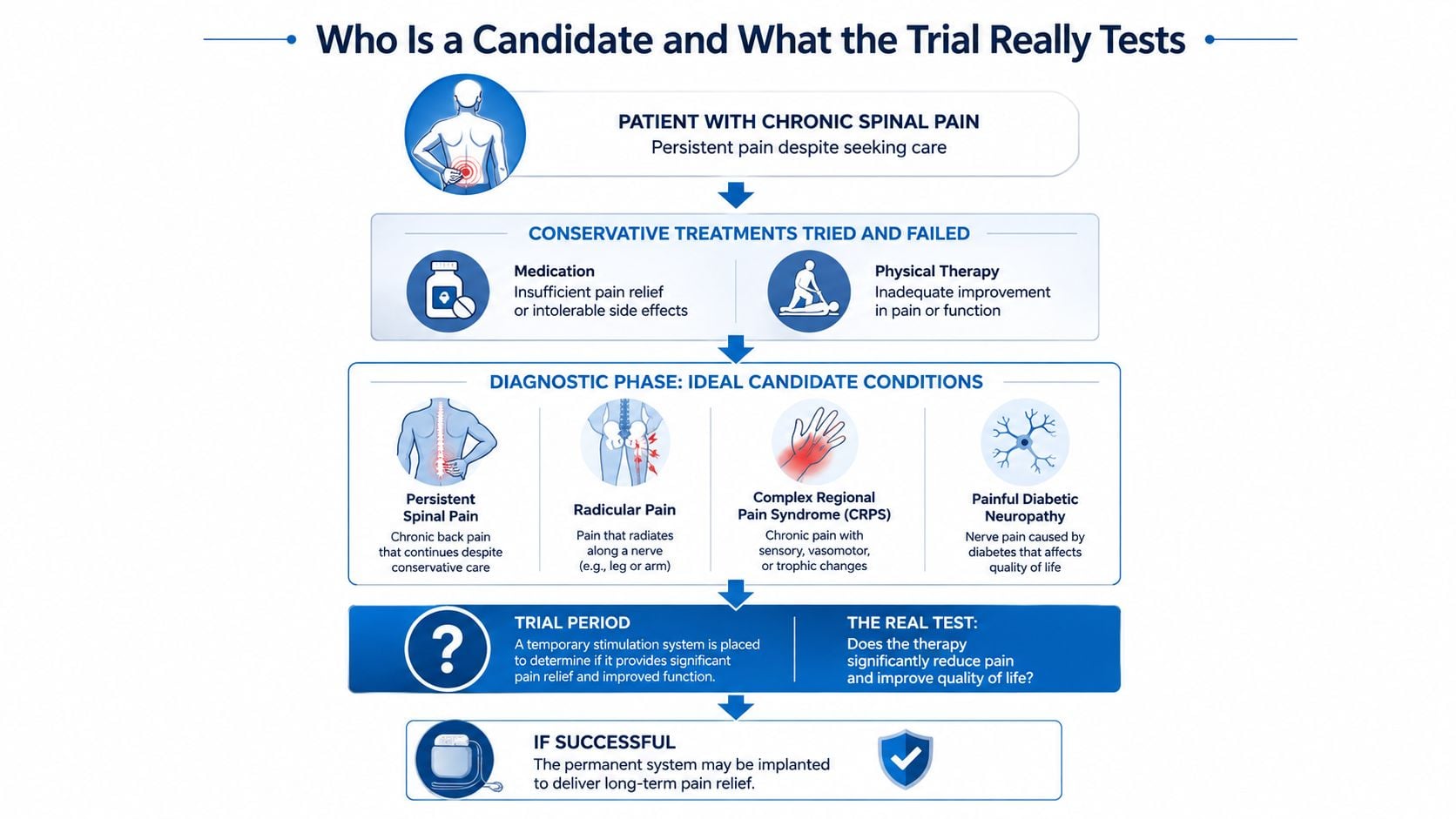
A patient may reach the SCS discussion after neuropathic or postsurgical pain continues despite appropriate conservative care. Common indications include persistent spinal pain syndrome type 2, radicular pain, peripheral causalgia, complex regional pain, and painful diabetic neuropathy. The diagnosis needs enough detail for the clinician to identify the pain pathway and choose a stimulation strategy that fits it.
A pain score is only one part of the decision. The evaluating team may review untreated mood symptoms, expectations, medication patterns, substance-use concerns, ability to follow wound-care and charging instructions, and access to follow-up. These questions do not dismiss the pain. They show whether an implanted therapy can be managed safely and whether its results can be judged realistically. Patients seeking condition-specific background can review complex regional pain syndrome before a specialist visit.
The trial is a functional test
During a temporary trial, leads are placed and connected to an external power source. The patient uses the system during ordinary activities while the clinical team assesses pain relief, coverage, comfort, movement, sleep, and medication needs. In practical terms, the trial asks: Does stimulation make the patient's actual life more workable?
An evidence-based SCS consensus guideline generally treats a successful screening trial as at least 50% patient-reported pain relief during normal activity, along with stable or reduced analgesic use and patient satisfaction. For paresthesia-based systems, lead placement should aim to capture at least 80% of the painful areas, because broader coverage can make the trial a better guide to long-term benefit.
The trial should include the movements and routines that matter to the patient, not only a quiet period in a clinic.
A trial that works only while the patient is lying still isn't the same as a trial that supports walking, sleeping, working, or caring for family.
What the numbers can and can't predict
A 2025 real-world study of 505 SCS trials reported an 86.1% trial success rate, defined as at least 50% pain relief at lead removal. 77.0% proceeded to permanent implantation, and 76.6% of implanted patients maintained significant improvement at follow-up (real-world SCS trial and implant data). These figures describe one real-world group, not a guarantee for an individual patient.
A separate consensus guideline found median trial success rates between 72% and 82%, with therapy success around 61% to 65% at 12 months across reported studies. Earlier nationwide U.S. data found that 4,842 of 7,667 patients, or 63.2%, underwent permanent implantation after the initial trial, while 36.8% failed trialing. Those figures come from different evidence sources and should not be treated as interchangeable.
The variation is the useful lesson. Patient selection, diagnosis, trial design, lead coverage, waveform choice, MRI requirements, follow-up, and long-term device ownership can all influence the result. The best system is therefore the one that remains appropriate from temporary testing through permanent implantation and later revision decisions.
Benefits Risks and How Long Relief Lasts
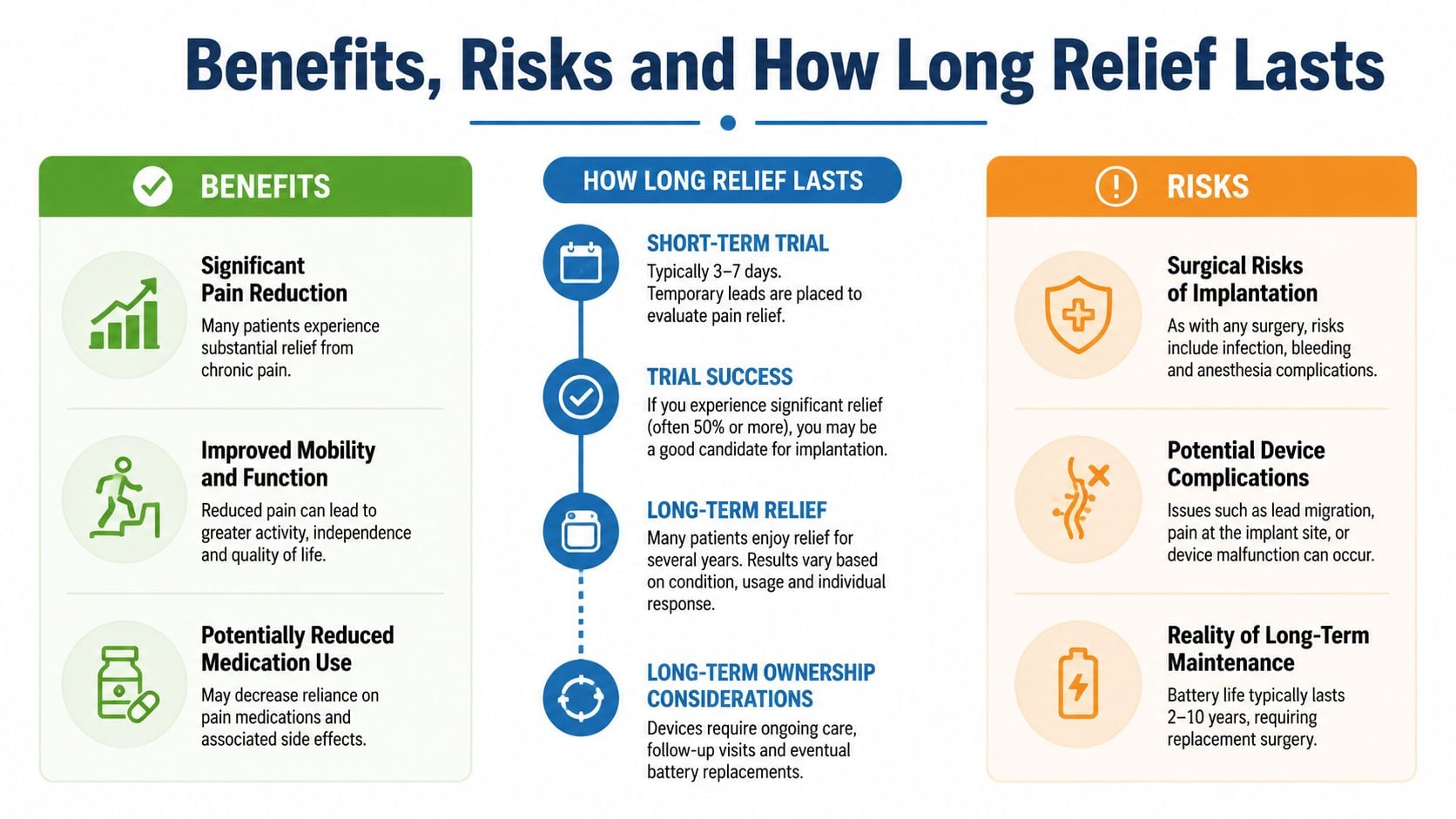
A patient may reach the point where pain determines when they walk, sleep, work, exercise, or take medication. The meaningful benefit of spinal cord stimulation is not a lower score on a pain scale. A successful system may widen those daily choices by reducing pain enough for valued activities to become more manageable. The 2024 meta-analysis in JAMA Network Open found conventional and newer forms of SCS superior to conventional medical management at six months across most measured outcomes (JAMA Network Open SCS meta-analysis).
Those findings support SCS as a treatment option, not a universal answer. The evidence is strongest for particular conditions, including failed back surgery syndrome and postsurgical pain, rather than every type of back pain. SCS may quiet neuropathic symptoms while leaving spinal instability, severe nerve compression, infection, or another structural problem unchanged. That separate problem may still require its own treatment.
Relief comes with ownership
An implanted system requires a procedure. Risks include infection, bleeding, discomfort, and wound problems. Hardware can also cause trouble. Leads may move or break, connections may fail, the battery may deplete, or the generator may feel uncomfortable. Depending on the cause, the response may involve reprogramming, revision surgery, or removal.
A July 2025 Australian insurer-data study reported that about one quarter of implanted patients needed invasive surgical reintervention for hardware problems, with most of those procedures occurring within the first three years (Australian insurer-data study on SCS reintervention). This finding challenges the idea of SCS as a simple “set-and-forget” treatment. It does not cancel pain and function improvements reported in other research. It does mean that durability belongs in the original decision, alongside pain coverage and waveform fit.
Long-term question: If the system helps, what level of charging, programming, monitoring, and revision risk is the patient willing to accept to keep that benefit?
Before implantation, ask how the clinic handles lost coverage, new pain areas, battery depletion, wound concerns, and possible revision. Follow-up access is part of long-term ownership. Patients can also review epidural steroid injection information to understand how other interventional options may fit before or alongside neuromodulation.
How to Choose the Best Spinal Cord Stimulator for You
A useful consultation turns “Which device is best?” into a series of narrower questions. The answers should come from the patient's records, examination, imaging, trial experience, and daily priorities.
Start with the pain map
The first issue is distribution. Is the pain mainly in the back, down one leg, in a foot, across several limbs, or concentrated in a small region? Burning, electric, stabbing, numb, and shock-like symptoms may suggest a neuropathic component, but the clinician still needs to identify the underlying diagnosis.
Prior spine surgery changes the planning conversation. Scar tissue, altered anatomy, residual nerve compression, and postsurgical pain can affect lead placement and expectations. A patient shouldn't choose a system before the team reviews prior operative reports and current imaging.
Match the system to daily life
Some patients prefer to feel stimulation because the sensation helps them understand coverage. Others want minimal sensation. Some can manage regular charging, while others want the least demanding routine possible. Neither preference is medically superior in every case.
MRI compatibility also deserves a direct question. Patients should ask whether the proposed system is MRI-conditional, what restrictions apply, and how future imaging needs could affect the choice. The same discussion should cover generator location, activity limits during healing, remote-control use, programming access, and the clinic's process for troubleshooting.
A practical checklist includes:
- Pain phenotype: What diagnosis and nerve pattern is the system intended to address?
- Coverage goal: Which painful regions must respond during ordinary activity?
- Sensation preference: Would tingling be acceptable, or is sub-perception stimulation preferred?
- Energy needs: Does the proposed waveform make a rechargeable generator more practical?
- Imaging plans: Are future MRI studies likely, and what conditions would apply?
- Follow-up access: Who will reprogram the device when symptoms or coverage change?
- Ownership tolerance: Is the patient comfortable with charging, maintenance, and possible revision?
Two patients can answer those questions differently and both make reasonable choices. A person with focal pain and little interest in charging may prioritize simplicity. A person with broader symptoms and high energy needs may accept rechargeable maintenance for greater programming flexibility.
The physician should also explain what the trial can test and what it can't. A successful trial supports the decision to implant, but it doesn't guarantee permanent relief or eliminate the need to treat other pain generators. Patients should leave the consultation knowing the expected follow-up schedule, warning signs, insurance process, and alternatives if the trial fails.
Next Steps With Interventional Pain Management
A sensible SCS pathway begins with diagnosis, not device selection. The clinical team reviews the pain history, prior treatments, neurological findings, imaging, medications, functional limitations, and goals. If SCS appears appropriate, the team can discuss trial planning, lead coverage, waveform preferences, battery architecture, MRI considerations, and long-term follow-up.
Interventional Pain Management provides pain-management, orthopedic, anesthesiology, and spine-surgery care through a multidisciplinary practice serving New Jersey and Staten Island. Its services include spinal cord stimulation, diagnostic review, image-guided procedures, surgical evaluation, insurance navigation, and support for workers' compensation and motor-vehicle cases. Patients can review the broader pain-management services while considering whether neuromodulation belongs in their treatment plan.
Patients may also encounter educational materials created with outside communication specialists. For practices developing patient-facing health content, practice marketing services can support clearer explanations, but treatment decisions still belong in a clinical consultation.
Before scheduling, patients should prepare:
- A pain map showing location and changing symptoms.
- A treatment history covering medications, therapy, injections, and surgery.
- Imaging and operative records when available.
- Daily goals such as walking farther, sleeping better, or returning to specific activities.
- Questions about charging, MRI access, programming, complications, and revision.
Interventional Pain Management evaluates whether spinal cord stimulation fits the patient's diagnosis, goals, anatomy, and long-term preferences, then discusses trial and follow-up options when appropriate. Patients and families can visit Interventional Pain Management to request an individualized evaluation and take the next step toward a device decision based on personal fit rather than brand rankings.