
The alarm goes off, the feet swing over the edge of the bed, and the first step lands like a sharp pin under the heel. After a few minutes of walking, the pain may fade enough to continue the morning, only to return when the person stands after sitting at a desk or riding in a car. Foot pain after waking up often follows this predictable pattern, but the timing alone doesn't identify the cause.
Plantar fasciitis is the most common explanation for heel pain in adults, and clinical reviews describe roughly 1 million patient visits per year in the United States, a lifetime incidence of about 10%, and approximately 10% of the general population affected (clinical overview of plantar fasciitis). Other problems can create similar morning discomfort, including Achilles tendon disorders, heel fat pad changes, joint inflammation, stress injuries, and nerve irritation. The most useful early clue is whether pain improves after a few steps or stays present and becomes worse with loading.
Table of Contents
- Why Your Feet Hurt When You Get Out of Bed
- The Mechanics of Morning Foot Pain
- Identifying the Source of Your Discomfort
- Effective Self-Care and Stretching Routines
- Red Flags and When to Seek Clinical Evaluation
- Moving Beyond Conservative Treatment
Why Your Feet Hurt When You Get Out of Bed
The first step out of bed can reveal how your foot responds to load. With plantar fasciitis, pain often peaks during the first few steps after sleep, eases as the foot warms up, and returns after sitting or lying down. Clinical reviews describe this “first-step” pain as a useful distinguishing feature of plantar fasciitis.
Pain can appear even when the previous day included no workout, long walk, or obvious injury. Standing, running, footwear, calf tightness, or a recent activity change may irritate the tissue gradually. After hours of rest, that sensitive area must suddenly support your body weight.

The timing offers an early clue
A sharp sensation beneath the heel or along the arch that eases with movement fits a load-sensitive soft-tissue problem, especially plantar fasciitis. A deep, bruised feeling in the center of the heel that worsens on hard flooring may point toward fat pad changes, where the natural cushioning no longer absorbs pressure as well. Burning, tingling, numbness, swelling, or pain that stays severe at rest suggests another source, such as nerve irritation, joint inflammation, or a bone injury.
The pattern can affect both active and sedentary adults. Population research has documented pain on rising or after standing from rest. One analysis found diagnosed plantar fasciitis with current pain in 0.85% of the population. In a separate survey, 45.80% of participants reported early-morning stabbing heel pain, according to population research on plantar fasciitis symptoms.
Practical rule: Ask not only “Where does it hurt?” Ask, “What happens after the first few steps?”
Pain that quickly settles points more toward a predictable mechanical response. Persistent or worsening pain deserves a broader assessment for nerves, joints, bones, fat pad atrophy, or inflammatory arthritis. Note the location, intensity, and behavior of the pain, then share that pattern with a clinician. It provides more useful information than just calling the feet sore.
The Mechanics of Morning Foot Pain
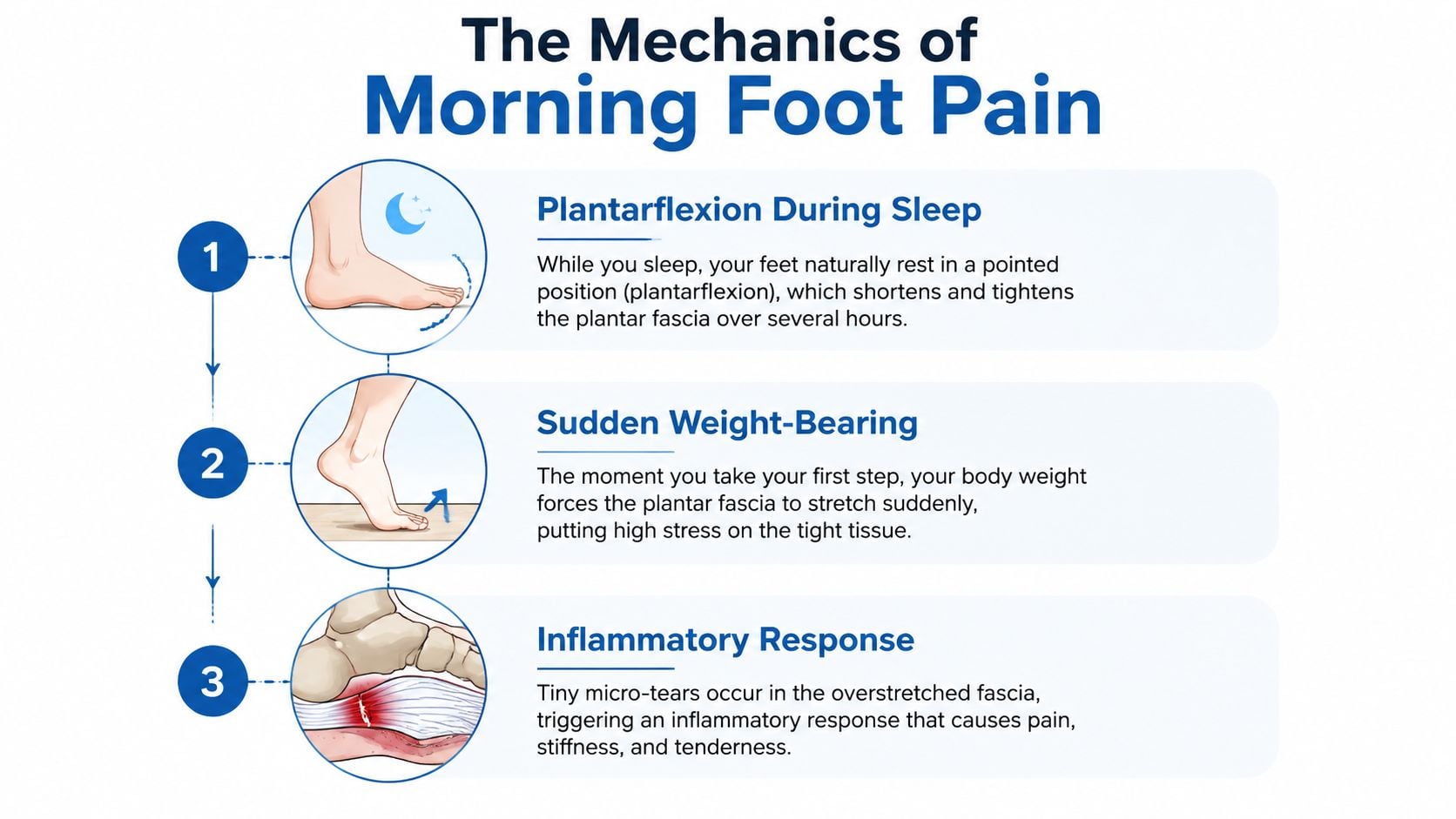
During sleep, the ankle often rests with the toes pointing slightly downward. The calf muscles, Achilles tendon, and plantar fascia remain in a relatively shortened position. At the bedside, the foot must quickly lengthen while supporting body weight. If the plantar fascia is irritated, that change can create a sharp pull beneath the heel.
This mechanical explanation complements the symptom pattern described earlier. The earlier pattern helps distinguish pain that settles from pain that persists. The mechanics explain why a load-sensitive tissue may react during the transition from rest to standing.
The plantar fascia is a strong band running along the sole. It supports the arch and contributes to the windlass mechanism. As the toes extend, the fascia tightens, helping the foot become a stable lever for push-off. If the tissue is sensitive or does not glide normally, moving from a relaxed position to a loaded, lengthened position can hurt.
Why early loading can feel so sharp
The first loading period combines limited movement with an immediate demand for tension, compression, and body weight. Walking can then improve tissue mobility and spread force more gradually, so discomfort may ease while the underlying irritation remains.
Calf flexibility also affects this process. Limited ankle dorsiflexion can place more demand on the plantar fascia during early stance. A clinical study reported a strong association between gastrocnemius tightness and heel-pain severity, with R = 0.757 for first-step pain and R = 0.781 for worst weekly pain, both with P < .001. For a broader explanation of the tissue and its mechanics, see Mayo Clinic research on plantar fasciitis mechanics.
Overnight rest can also change how a sensitive foot responds to pressure. Fluid redistribution and temporary stiffness may make loading feel more uncomfortable, particularly after a day of repeated strain. Sleep does not necessarily cause a new injury. It may reveal irritation that accumulated during the previous day.
Where related soft tissues fit
The Achilles tendon joins the calf muscles to the heel and works with the plantar fascia during walking. Pain near the back of the heel can therefore resemble plantar fascia pain, although its location and response to activities often differ.
Tendon irritation and bursitis are assessed by their precise location, response to loading, and examination findings. Background information on tendinitis and bursitis care may help explain these neighboring soft-tissue problems. A morning pattern alone, however, cannot establish the diagnosis.
Identifying the Source of Your Discomfort
早晨腳痛的判斷,先看三件事:位置、感覺和活動後的變化。例如,腳跟底部在落地第一步出現刺痛,通常不同於腳趾灼熱、麻木,或多個關節同時腫脹僵硬。疼痛是在第一步最明顯,還是走動後仍持續,往往比「早上痛」本身更有辨識價值。
| Condition | Pain Location | Pain Quality | Morning Stiffness Duration | Key Distinguishing Feature |
|---|---|---|---|---|
| Plantar fasciitis | Underside of heel or along arch | Sharp, stabbing, pulling | Often brief and most intense on first steps | Improves after movement, then may recur after rest |
| Achilles tendinopathy | Back of heel or along Achilles tendon | Stiff, aching, sometimes tender | Often brief after inactivity | Pain centers on the tendon and may increase with push-off |
| Heel fat pad atrophy | Center of the heel | Deep, bruise-like, pressure-sensitive | May be present on initial loading | Often worsens with hard surfaces or prolonged standing |
| Inflammatory arthritis | Multiple foot joints, sometimes other joints | Aching, swollen, stiff | Can persist beyond 30 minutes | Multiple joints or systemic symptoms may be involved |
| Stress fracture | Pinpoint area over a bone | Focal, progressively painful | May not ease normally with walking | Weight-bearing and impact increase symptoms |
| Nerve entrapment | Arch, heel, sole, or toes | Burning, tingling, electric, numb | Variable | Sensory changes or radiating symptoms are prominent |
足底筋膜或阿基里斯腱
足底筋膜炎通常在腳跟下方或內側足弓出現壓痛。典型情況是下床,或久坐後重新站起時,前幾步特別刺痛,走動後暫時減輕,但休息後可能再次出現。研究資料顯示,足底筋膜炎患者常見早晨第一步疼痛,也常在坐起站立時感到疼痛,詳情可參考早晨腳痛的臨床說明。
阿基里斯腱問題的位置則偏向腳跟後方或腳踝後側。剛開始走路時可能僵硬,但壓痛通常沿著肌腱分布,而不是集中在腳跟底部。若疼痛在蹬地、上樓或活動增加時更明顯,醫療人員會進一步檢查肌腱本身、附著點,以及周圍結構。阿基里斯腱炎的相關資訊可協助理解這類疼痛的常見表現。
走動後仍未改善
腳跟脂肪墊萎縮容易與足底筋膜炎混淆。它通常造成腳跟中央深層、像瘀傷般的疼痛,踩在硬地面或長時間站立時更明顯。相較之下,足底筋膜炎常在第一步最痛,活動後會出現部分緩解。一項比較研究發現,足底筋膜炎病例常有早晨第一步疼痛,而雙側疼痛、夜間疼痛,以及久站後加劇,較提示腳跟脂肪墊萎縮。足底筋膜炎與腳跟脂肪墊萎縮的比較研究
發炎性關節炎呈現的範圍更廣。晨間僵硬可能超過 30分鐘,同時影響多個足部關節,並伴隨發熱、腫脹、疲倦或其他身體症狀。壓力性骨折則常在某一點出現明確骨性壓痛,承重或衝擊會讓疼痛逐漸加重。若有灼熱、麻刺、麻木或像電流放射的感覺,神經受壓的可能性較高。
晨起第一步痛、走動後減輕,與持續性疼痛是兩條重要線索,但不能單靠症狀自行確診。疼痛位置改變、程度持續上升,或影響正常承重時,應接受臨床評估。
Effective Self-Care and Stretching Routines
The first few minutes of the day should reduce the jump from rest to full loading. A gentle routine can prepare the ankle and sole before the feet touch the floor, then add controlled weight-bearing once the tissues have started moving.
Before standing
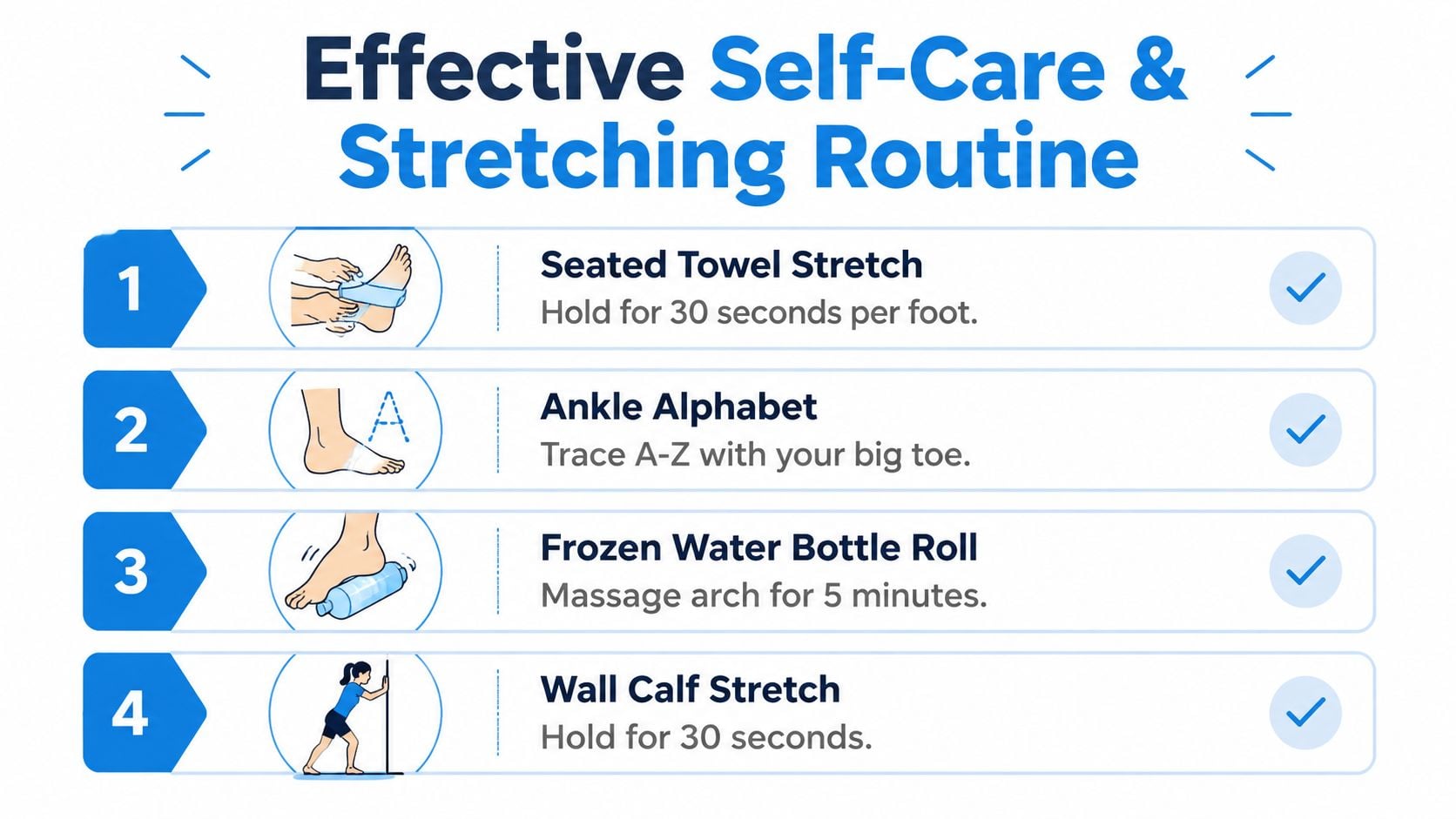
Ankle alphabet: While lying or sitting, lift one foot slightly and trace the alphabet with the big toe. One complete sequence gently moves the ankle through several directions without forcing a painful stretch.
Plantar fascia stretch: Cross one leg over the other, hold the toes, and draw them gently toward the shin until a mild stretch is felt along the sole. Hold for 30 seconds per foot, repeating the stretch several times if it remains comfortable. The common error is pulling hard enough to create sharp pain.
Towel calf stretch: Loop a towel around the forefoot and gently draw the toes toward the body while keeping the knee relaxed. Hold for 30 seconds, then release slowly. The towel should guide the foot, not jerk it.
Toe and foot contractions: Gently spread the toes, relax them, and perform a few controlled ankle pumps. These movements help the foot transition from stillness to activity without demanding a full stride immediately.
Afterward, the person should stand slowly and place the feet into supportive slippers or shoes rather than walking barefoot across a hard floor. A stable sole and comfortable arch support can reduce the abrupt load that triggers the first-step response.
Once standing
A wall stretch can target different parts of the calf depending on knee position. With the back knee straight, the gastrocnemius receives more of the stretch. With the back knee slightly bent, the soleus contributes more. Each position can be held for 30 seconds, but the heel should stay grounded and the stretch should remain steady rather than forceful.
A frozen water bottle may provide soothing compression and cooling under the arch. Rolling should be gentle and limited to about 5 minutes, stopping if numbness, bruising, or sharper pain develops. The bottle shouldn't be used to aggressively “break up” tissue.
Managing the day
Sharp pain is a signal to reduce load, not an invitation to push harder. Activity can be modified by shortening walks, reducing impact, choosing cycling or another low-impact option, and avoiding sudden increases in standing or running. Footwear should be checked for a compressed sole, poor stability, or uneven wear.
A night splint may help selected patients by holding the ankle in a more neutral position during sleep. It can be uncomfortable, so gradual use and professional fitting are sensible, especially when symptoms involve the Achilles tendon, nerves, circulation, or skin sensitivity.
Consistent conservative care should be judged by trend rather than by one morning. If the pain remains unchanged, spreads, or interferes with normal walking, a clinician can adjust the diagnosis and treatment rather than adding more stretching.
Red Flags and When to Seek Clinical Evaluation
Not every case of foot pain after waking up is harmless overuse. A predictable sharp heel pain that eases with movement can support a mechanical explanation, but symptoms that break that pattern deserve a closer assessment.
| Symptom | Typical Mechanical Pain | Red Flag Requiring Evaluation |
|---|---|---|
| Timing | Worst on first steps, then partially eases | Persistent or progressively worsening pain |
| Location | Localized heel, arch, or tendon area | Multiple joints, diffuse swelling, or spreading symptoms |
| Sensation | Sharp or tight with loading | Burning, numbness, tingling, or electric pain |
| Weight-bearing | Walking remains possible | Inability to bear weight |
| Appearance | No major visible change | Swelling, redness, bruising, or deformity |
| General health | No systemic symptoms | Fever or unexplained weight loss |
Symptoms that shouldn't be watched indefinitely
A sudden onset without a clear activity explanation, visible swelling, deformity, or pinpoint bone tenderness may indicate an injury that needs imaging. Pain that doesn't improve with sensible load reduction and home care also warrants evaluation, particularly when normal walking becomes difficult.
Numbness, tingling, radiating pain, or weakness shifts concern toward nerve irritation. Symptoms behind the inner ankle and into the sole can occur with tarsal tunnel involvement, while weakness that causes the front of the foot to catch may require assessment for foot drop. A clinician may also consider referred nerve pain from the lower back when foot symptoms accompany back or leg complaints.
Fever, unexplained weight loss, marked warmth, or swelling in several joints calls for prompt medical attention. Persistent morning stiffness lasting beyond 30 minutes can be more consistent with inflammatory disease than with an isolated plantar fascia problem, especially when the hands, knees, ankles, or other joints are also affected.
What an evaluation may involve
A podiatrist or orthopedic foot and ankle clinician can examine gait, footwear, ankle motion, tendon strength, nerve sensation, and the exact point of tenderness. Weight-bearing X-rays may help assess bone alignment or other structural concerns. MRI can be considered when a stress injury, tendon disorder, or soft-tissue problem isn't clear from the examination.
Nerve conduction studies may be appropriate when numbness, tingling, or weakness suggests nerve compression. A rheumatology referral may be useful when multiple joints, prolonged stiffness, or systemic symptoms point toward inflammatory arthritis.
Moving Beyond Conservative Treatment
Most mechanical morning foot pain is approached first with load management, supportive footwear, stretching, strengthening, and a careful review of ankle and foot mechanics. When symptoms remain persistent, an evaluation can identify whether the original assumption was incomplete or whether the tissue needs a more targeted intervention.
Clinical options may include custom orthotics based on gait findings, structured physical therapy, or shockwave treatment for selected chronic plantar fascia disorders. Injections can be considered for specific inflammatory or degenerative conditions, but the risks and expected benefits depend on the tissue involved. Platelet-rich plasma may be discussed for selected tendon problems, while surgery, such as partial plantar fascia release or gastrocnemius recession, is generally reserved for refractory cases after appropriate nonoperative care.
Professional assessment isn't a failure of self-care. It's the next step when the pain pattern, examination, or recovery course suggests that a more precise plan is needed.
Interventional Pain Management evaluates musculoskeletal and nerve-related conditions through medical examination, imaging review, and treatment planning that may include noninvasive or minimally invasive care. Readers with persistent foot symptoms, weakness, or related spine and joint pain can visit Interventional Pain Management to request an evaluation and discuss appropriate next steps.