
The incision may look small, but the first night home can feel surprisingly demanding. A patient may be standing with a walker, wondering whether the swelling is normal, how much pain is too much, and when driving, work, stairs, or sleep will feel manageable again. Minimally invasive knee replacement recovery usually offers a smoother early window, not an effortless one.
The useful question isn't whether the operation was “minimally invasive.” It's whether the knee is gaining motion, the quadriceps is waking up, swelling is controlled, and walking is becoming safer. Major orthopedic guidance describes short hospital stays and early mobilization after less invasive knee replacement, while rehabilitation guidance makes clear that strength and function continue improving for months. The incision matters, but disciplined recovery matters more.
Table of Contents
- What “Minimally Invasive” Really Changes About Recovery
- The First 72 Hours After Surgery
- A Phased Rehab Plan From Week 1 to Month 4
- Pain Control and Swelling Management That Work in Practice
- Driving, Work, and Daily Tasks by Milestone
- Honest Expectations vs Marketing Claims
- Your 12-Week Recovery Checklist
What “Minimally Invasive” Really Changes About Recovery
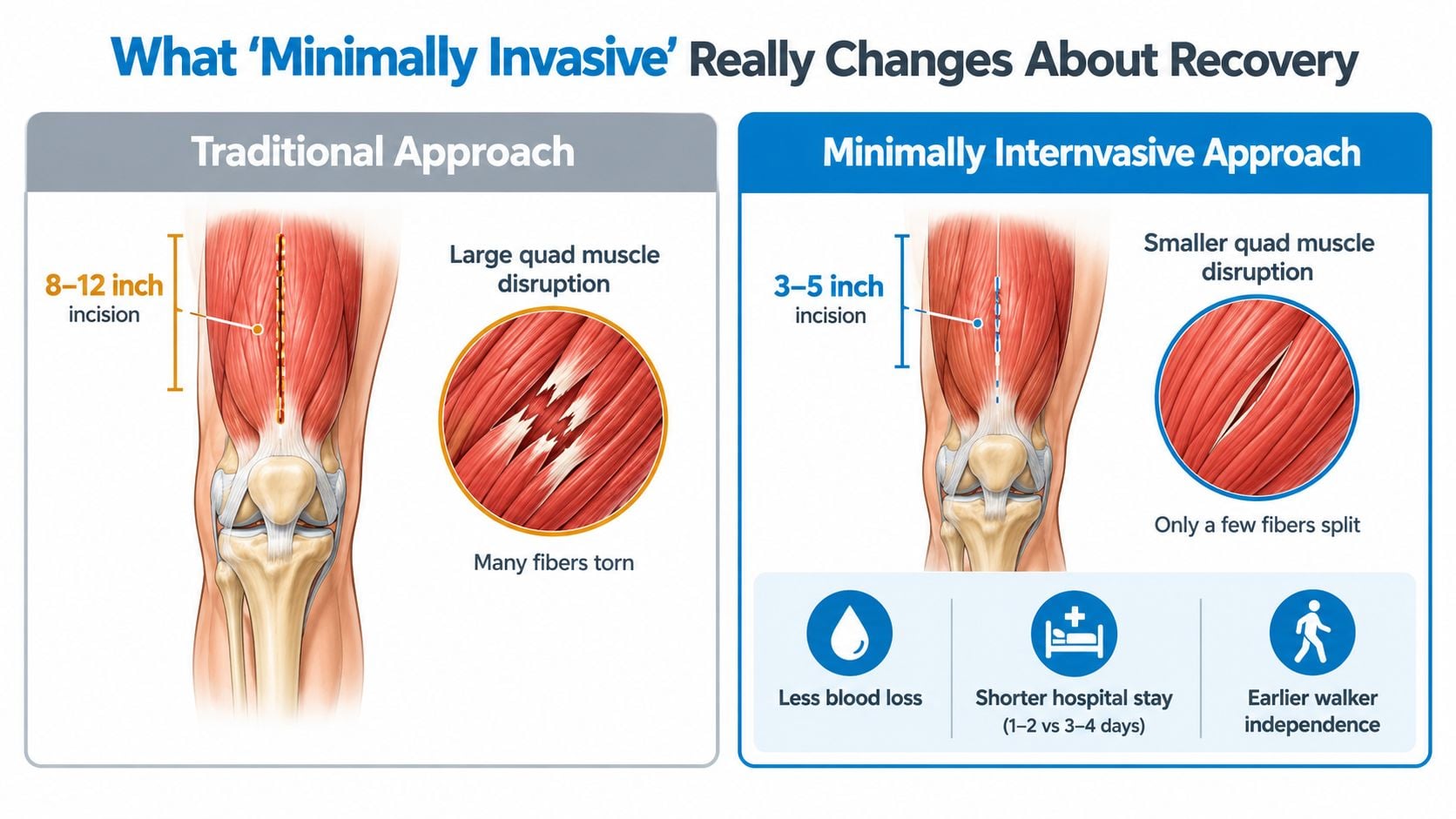
The advantage of a minimally invasive approach is less disruption around the knee during surgery. Quadriceps-sparing and related muscle-preserving techniques aim to reduce trauma to tissues used for straightening the leg. That can make early muscle activation, walking, and basic transfers feel more manageable than patients expect after traditional knee replacement.
A University of Washington patient guide to quadriceps-sparing knee replacement reports a typical hospital stay of about 48 hours, with some patients staying a third day. It also notes that many patients go directly home without inpatient rehabilitation. Stanford guidance similarly describes 1–2 days in the hospital for less invasive joint replacement and faster recovery during the first 2–4 weeks, including less blood loss, less pain medication use, and earlier walking with a cane or without an assistive device.
The head start has limits
The early benefit doesn't erase the biology of healing. A review of randomized trials on minimally invasive total knee arthroplasty found earlier gains in knee function and range of motion, with benefits in Knee Society scores at 6 and 12 weeks, but not at 6 months. In other words, the early curve can be better without producing a permanent advantage.
Patients still need regular exercises, swelling control, gait training, and follow-up assessment. The joint replacement surgery information from IPMC Health can help patients understand how surgical planning fits into broader orthopedic care, but the surgeon's own protocol remains the controlling plan.
The practical takeaway is simple. A smaller soft-tissue footprint may buy an earlier start with walking and motion. It doesn't guarantee faster final recovery, eliminate stiffness risk, or replace physical therapy.
The First 72 Hours After Surgery
The first three days should be treated as a sequence of small objectives, not a test of toughness. Early movement helps reduce stiffness and restores confidence, but the knee will be swollen, the quadriceps may feel unreliable, and pain often rises when the initial anesthetic effect fades.
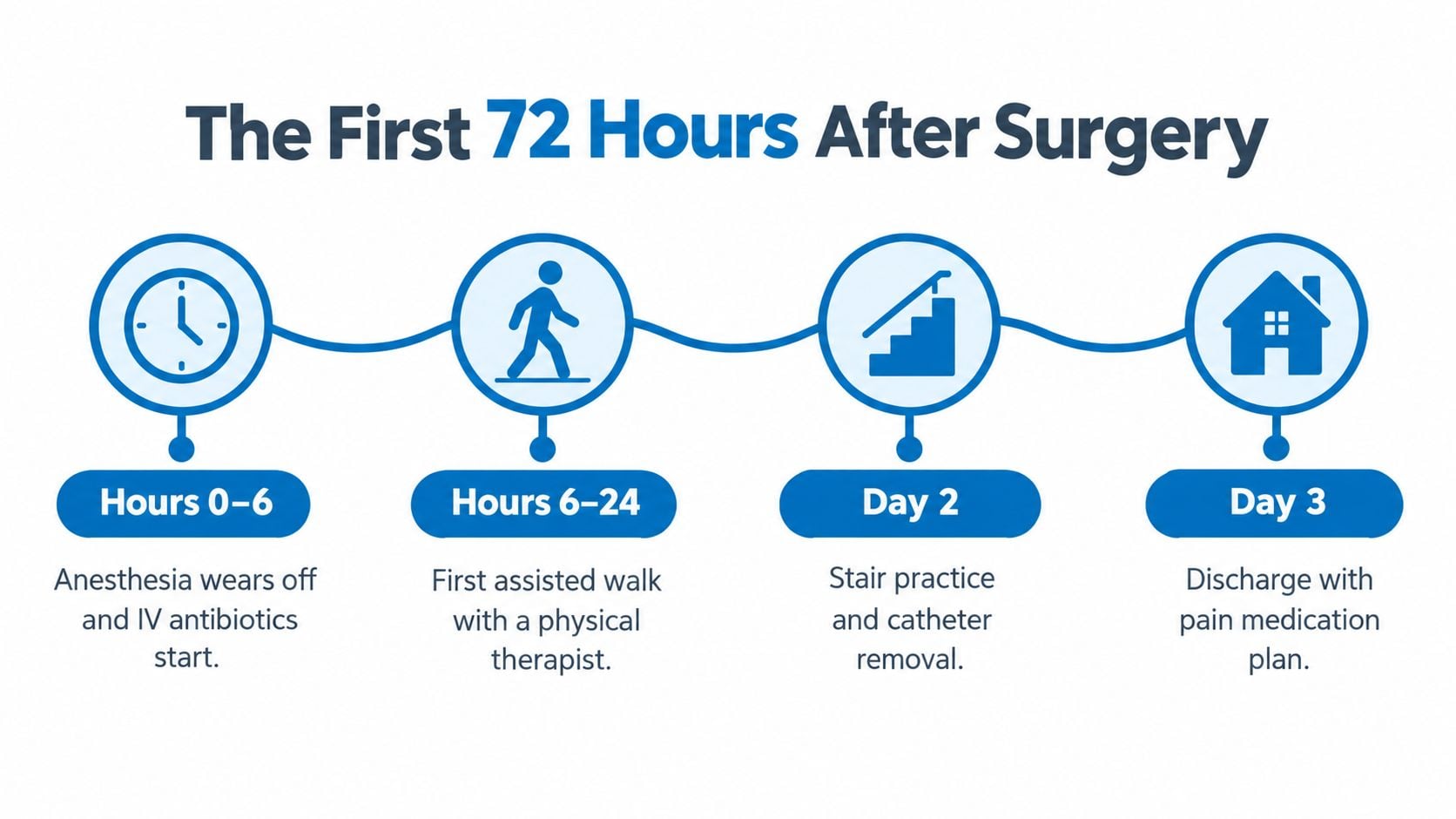
Hours 0 through 6
As spinal or general anesthesia wears off, the clinical team begins the prescribed pain plan and monitors circulation, sensation, the incision, and vital signs. Ankle pumps and quadriceps contractions usually begin in bed. Many patients stand with assistance on the day of surgery, and a therapist may supervise the first transfer and short walk.
The first walk isn't a fitness session. The purpose is to test safe weight bearing, teach the correct walker sequence, and identify dizziness or weakness before discharge planning advances.
Hours 6 through 24
Patients commonly transition toward oral medication and walker ambulation as tolerated. Ice, elevation, and rest periods should be balanced with brief walks and the exercises prescribed by the surgical team.
A mildly blood-tinged dressing or drainage can occur early, but the care team should explain what is expected for that specific operation. Patients shouldn't change dressings, remove drains, or shower based on general internet advice. Incision instructions vary.
Day 2 and day 3
By the second day, therapy often includes bed exercises, transfers, bathroom mobility, and stair practice when needed for home access. The team may review showering, dressing, compression, bowel care, and the medication schedule. A bowel regimen should begin with the prescribed pain medicines rather than waiting for constipation to develop.
Discharge may occur after the patient can transfer safely, walk with the recommended device, manage basic toileting, and understand the home plan. A NIH-hosted review of minimally invasive knee replacement pathways describes same-day mobilization and the broader shift toward earlier ambulation and discharge.
Before leaving, the patient should have written instructions for:
- Medication timing: Know which medicines are scheduled and which are reserved for breakthrough pain.
- Walking limits: Use the walker until gait is controlled, even if the incision feels better.
- Wound monitoring: Follow the exact dressing and shower instructions.
- Urgent symptoms: Call the surgical team for fever above 101.5°F, calf swelling or pain, increasing wound drainage, or new shortness of breath.
A Phased Rehab Plan From Week 1 to Month 4
Rehabilitation works best when progression depends on control, not optimism. A patient who can bend farther but has escalating swelling may need to hold the current level rather than add resistance. The following framework should be adapted to the surgeon's restrictions and the physical therapist's findings.
Phase 1, protect and restore
During weeks 1–2, the priorities are full knee extension, controlled swelling, safe transfers, and short-distance walking with a walker. Common exercises include ankle pumps, quadriceps sets, straight-leg raises when the leg can be lifted without lag, and heel slides. The exercise guide from OrthoInfo on total knee replacement recovery emphasizes continued walking and prescribed strengthening because functional gains continue well beyond the first days.
A typical early routine may include short exercise sessions several times daily, with heel slides performed gently rather than forced. Progression requires improving extension, manageable swelling, and a walking pattern that doesn't buckle.
Phase 2, build control
During weeks 3–6, therapy can add a stationary bicycle without resistance, shallow mini-squats, low step-ups, and supported single-leg balance. A cane becomes appropriate when the gait is symmetrical, the knee doesn't buckle, and the trunk isn't leaning to compensate.
Pain that settles after exercise is different from pain that worsens each day. Persistent swelling, new pain at the patellar tendon, or a sudden decline should prompt a therapist review rather than complete inactivity.
Phase 3, restore strength
During weeks 7–10, the emphasis shifts toward controlled closed-chain loading, lateral band walks, pain-free resisted knee extension, and progressive walking. Stair reciprocity becomes a useful functional marker. Flexion beyond 110 degrees and the ability to negotiate stairs with less compensation may support progression, but measurements alone don't justify advancing if swelling remains high.
Phase 4, return to life
During weeks 11–16, exercises can become more job-specific or activity-specific. Elliptical training, light hiking, and controlled lifting may be considered when strength, balance, and symptoms support them. Kneeling and impact activities require an explicit conversation with the surgeon or therapist.
| Phase | Timeframe | Key Exercises | Progression Criteria |
|---|---|---|---|
| Protect and restore | Weeks 1–2 | Ankle pumps, quadriceps sets, heel slides, straight-leg raises, short walker walks | Controlled swelling, active extension, safe transfers |
| Build control | Weeks 3–6 | Resistance-free bicycle, mini-squats, low step-ups, balance work | Symmetrical gait, less reliance on the cane, no buckling |
| Restore strength | Weeks 7–10 | Closed-chain loading, band walks, resisted extension, progressive walking | Flexion past 110 degrees, improving stair control |
| Return to life | Weeks 11–16 | Elliptical, light hiking, job-specific and activity-specific drills | Stable symptoms, functional strength, clinician clearance |
Pain Control and Swelling Management That Work in Practice
By the evening after surgery, many patients face a choice: take enough medication to walk and exercise safely, or avoid it and guard every movement. The practical rule is direct: a knee that hurts too much will not move well, and a knee that stays still becomes stiff. Pain relief should support necessary activity, not encourage pushing past the treatment plan.
| Method | What It Does | When To Use | Cautions |
|---|---|---|---|
| Scheduled acetaminophen or prescribed anti-inflammatory medicine | Reduces baseline pain and inflammation | Use only according to the discharge plan | Kidney, liver, stomach, bleeding, and medication-interaction risks require clinician review |
| Short-course opioid medicine | Treats breakthrough surgical pain | Use when prescribed pain exceeds the planned baseline control | Causes sedation, nausea, constipation, and unsafe driving |
| Ice with leg raised | Reduces swelling and makes motion easier | Use brief sessions repeatedly during the day, with the leg raised above heart level as directed | Protect the skin and avoid prolonged direct contact |
| Compression stockings | May support swelling control and circulation | Wear according to the surgical team's instructions | Check for skin pressure, numbness, or circulation changes |
Combine these measures with short walks and prescribed exercises. Resting all day because the incision feels vulnerable can increase stiffness. Taking too little medication can lead to skipped therapy, shallow breathing, poor sleep, and guarded movement. Short, frequent activity is usually easier to tolerate than one demanding session.
Opioids are often tapered during the early postoperative period, commonly around days 4–14, but the schedule depends on pain, medical history, and the prescribed drug. Start constipation prevention on day one with fluids when permitted, gentle movement, and bowel medicines recommended by the clinical team. A nerve block overview from IPMC Health explains one interventional option used in pain care, but it does not replace the surgeon's medication plan.
CBD creams, TENS units, and arnica may appeal as add-on measures, yet evidence for these options is not established enough to treat them as substitutes for prescribed care. Ask the clinical team about calf tenderness, sudden one-sided swelling, or swelling that remains unusually severe beyond week three, especially when symptoms are new or worsening. Sudden breathing difficulty or chest pain requires urgent medical attention.
Driving, Work, and Daily Tasks by Milestone
Incision length doesn't determine whether someone is ready to drive. The decision depends on medication use, reaction time, leg strength, knee control, and the vehicle itself. An academic recovery guide notes that patients shouldn't drive while taking narcotic pain medicine and that driving is often possible around 2–4 weeks after surgery, while broader guidance places many usual activities around 6 weeks. These ranges are not automatic clearances.
Driving safely
The patient should be able to enter and exit the vehicle, sit comfortably, turn the leg as needed, and perform a firm emergency stop without hesitation. The person should be off narcotic pain medicine and have enough control to respond quickly. A right-knee operation generally creates more concern with braking and accelerator control, while a left-knee operation may be easier in an automatic vehicle but more demanding in a manual transmission.
The surgeon's clearance and local driving rules still apply. A passenger should handle transportation until those conditions are met.
Work and household tasks
Desk work may be possible when the patient can sit, stand, use prescribed medication without sedation, and travel safely. Frequent position changes are usually more realistic than sitting continuously. Light-duty work requires better walking tolerance, while heavy labor, ladder climbing, kneeling, and repeated lifting demand greater strength and explicit clearance.
Stairs should be taken one step at a time while strength is limited. The usual teaching is up with the stronger leg first and down with the operated leg first, using a rail and the prescribed device. Reciprocal stairs should return only when the operated knee can control the body during both ascent and descent.
Kneeling and intimacy
Kneeling may remain uncomfortable for months because scar sensitivity and pressure around the front of the knee can persist. A thick cushion, gradual exposure, and avoidance of prolonged kneeling can help, but discomfort doesn't necessarily mean the implant is failing.
Intimacy can resume when pain, balance, and positioning are comfortable. Side-lying positions may reduce pressure and twisting, while abrupt kneeling, deep flexion, or positions that force the operated leg into an awkward angle should be avoided until strength and confidence return.
Honest Expectations vs Marketing Claims
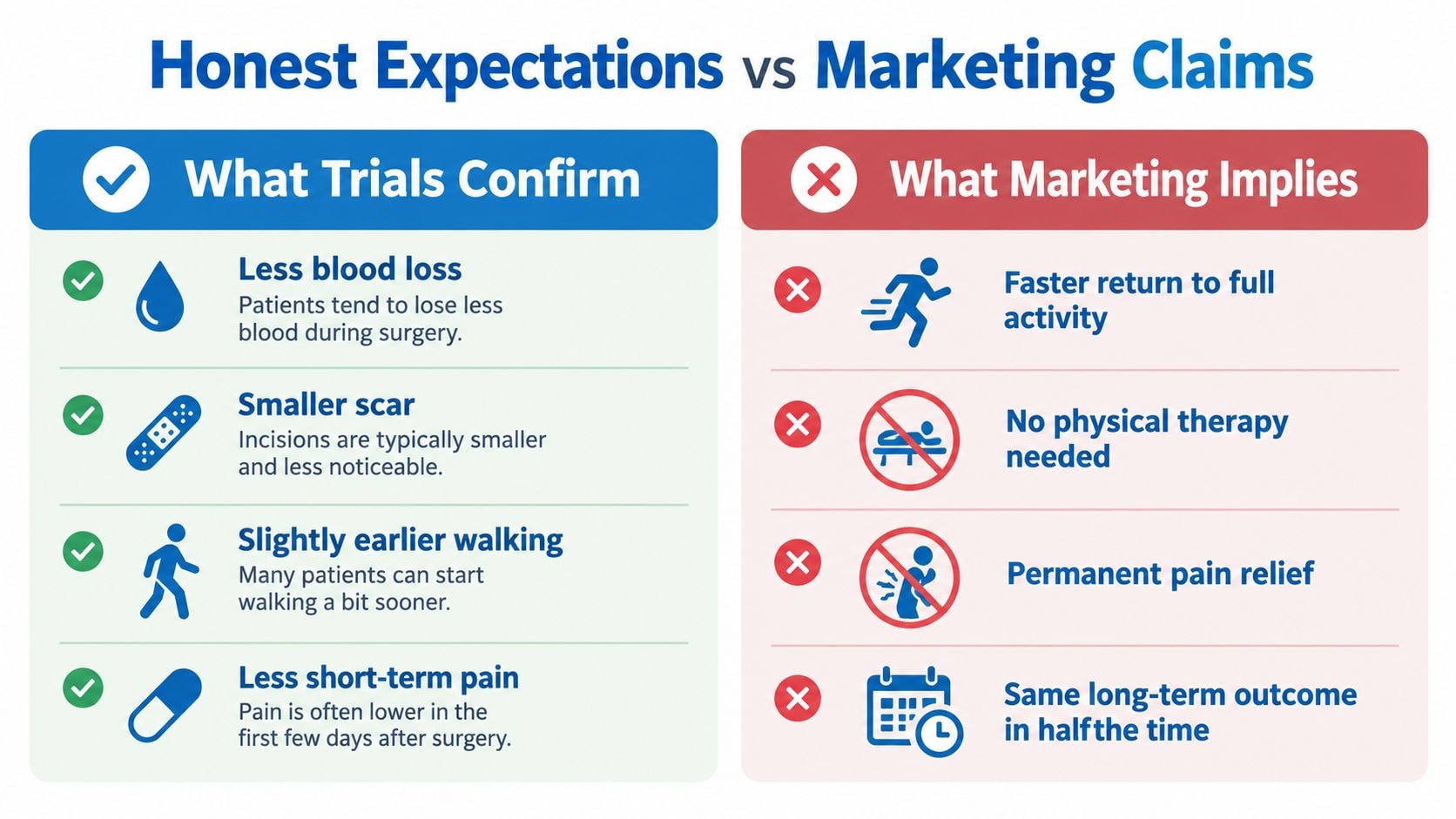
A smaller incision can help during the early recovery window, but it does not remove the work of rehabilitation. The OrthoInfo explanation of minimally invasive total knee replacement describes possible short-term benefits while explaining that long-term results may resemble those of traditional replacement. The approach may reduce soft-tissue disruption, pain medicine use, blood loss, or hospital time for selected patients. Those advantages vary with the surgeon's technique, the patient's health, and the rehabilitation plan.
Marketing claims often turn an early advantage into a promise of painless walking, no therapy, or a rapid return to running. Recovery evidence supports a narrower conclusion: some patients regain function sooner at first, while stiffness, weakness, swelling, and balance still require treatment. Long-term function depends on implant positioning, quadriceps recovery, general health, and consistent rehabilitation. Care for underlying osteoarthritis, including guidance from IPMC Health's osteoarthritis resource, also shapes the longer-term trajectory.
Practical rule: Protect the wound, move the knee consistently, and follow the therapy plan. The minimally invasive label is not permission to skip exercises or increase activity faster than strength allows.
Running and other high-impact activities need separate discussion with the surgical team. Incision healing does not prove that the knee is ready for impact, twisting, or repetitive loading. Activity clearance depends on strength, motion, symptoms, balance, and the surgeon's protocol.
At home, track practical warning signs:
- Incision: Report increasing redness, separation, drainage, or worsening tenderness.
- Motion: Work toward full extension and the flexion goals prescribed by the clinical team.
- Exercise: Complete short sessions consistently rather than occasional strenuous efforts.
- Swelling: Expect fluctuations, but report sudden or progressively worsening swelling.
- Therapy: Attend appointments and ask for a plan adjustment if progress stalls.
Your 12-Week Recovery Checklist
A checklist turns recovery into observable tasks rather than a daily argument with pain and uncertainty. The milestones below are practical reference points, not promises. Some patients move faster, others need more time, and the surgeon's protocol always takes priority.
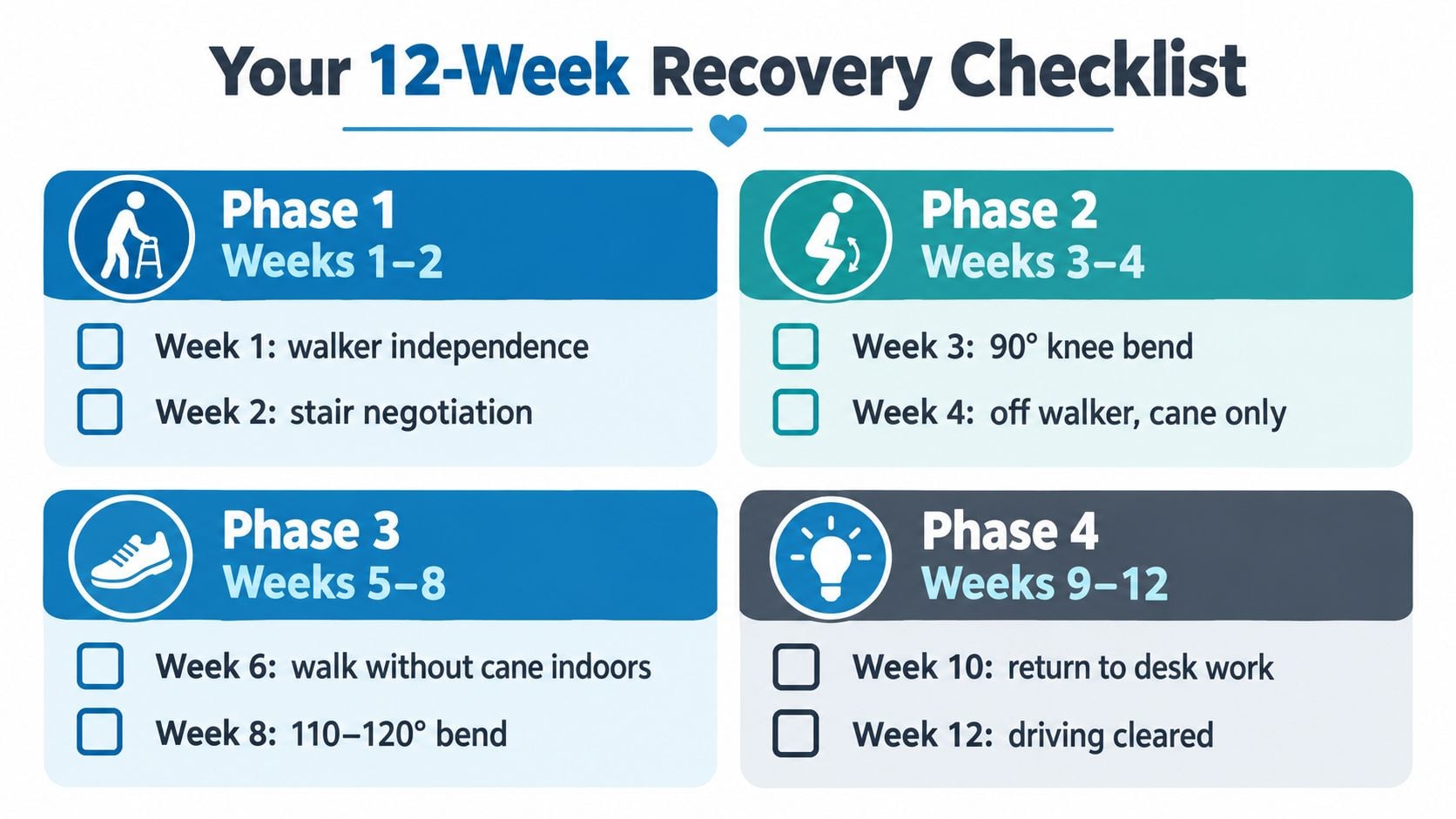
Weeks 1 and 2
- Exercises: Perform ankle pumps, quadriceps sets, heel slides, and other prescribed movements in short sessions.
- Swelling habits: Use ice, elevation, compression when directed, and scheduled medication safely.
- Mobility: Work toward safer walker use, transfers, and stair negotiation with a rail.
- Watch closely: Report fever above 101.5°F, increasing drainage, calf symptoms, or breathing difficulty.
Weeks 3 and 4
- Exercises: Add the therapist-approved bicycle, shallow strengthening, and balance work.
- Swelling habits: Reduce activity when swelling escalates, but don't stop all movement.
- Mobility: Consider cane transition only when gait is controlled and symmetrical.
- Motion: A 90-degree bend by week 4 may be used as a clinical reference, but the therapist should interpret the full pattern of motion and swelling.
Weeks 5 through 8
- Exercises: Progress strengthening, step-ups, controlled closed-chain loading, and walking tolerance.
- Daily habits: Keep changing positions, protect sleep, and avoid twisting or heavy lifting until cleared.
- Mobility: Driving may be considered when the patient is off opioids, has adequate reaction control, and receives clearance.
- Work: Desk duties may be possible when sitting, standing, transport, and medication effects are manageable.
Weeks 9 through 12
- Exercises: Add functional drills for work, recreation, balance, and endurance as approved.
- Mobility: Aim for a smoother gait, safer stairs, and longer walks without compensatory movement.
- Function: Kneeling may still be uncomfortable, and impact activity requires specific guidance.
- Call the team: Report flexion loss after prior gains, new calf pain or swelling, wound drainage beyond the expected period, fever, or shortness of breath.
This checklist supplements, never replaces, the surgical team's instructions. Minimally invasive knee replacement recovery can feel easier at the beginning, but the durable result comes from the twelve-week pattern of safe movement, swelling control, strengthening, and consistent therapy.
Interventional Pain Management evaluates joint and postoperative pain and coordinates orthopedic, interventional, and rehabilitation-focused care according to individual needs. Patients in New Jersey and Staten Island can visit Interventional Pain Management to request an evaluation and discuss practical next steps for persistent knee pain or recovery concerns.