
A patient with persistent back and leg pain may reach the same difficult appointment after exhausting physical therapy, medications, injections, and even additional surgery. The pain still interferes with sleep, walking, work, or basic independence. Then two implantable options enter the discussion: a spinal cord stimulator or an intrathecal pain pump.
The choice isn't about which device is more powerful. A spinal cord stimulator changes how electrical pain signals are processed. A pain pump delivers medication directly into the fluid around the spinal cord. Those are different treatments for different pain mechanisms, and both create long-term responsibilities, including considerations if spine surgery becomes necessary later.
Table of Contents
- Navigating Advanced Options for Refractory Chronic Pain
- How Neuromodulation and Targeted Drug Delivery Differ
- Matching the Device to Your Specific Pain Phenotype
- The Trialing Process and Path to Permanent Implantation
- Downstream Surgical Risks and Long-Term Device Management
- Evaluating Modern Efficacy and Opioid Reduction Outcomes
- Making the Right Choice with a Multidisciplinary Pain Team
Navigating Advanced Options for Refractory Chronic Pain
A patient with burning pain traveling down one leg after lumbar surgery may still struggle despite medication, injections, and further operations. If the dominant problem is nerve-generated pain, a spinal cord stimulator may be appropriate. It changes how pain signals are processed rather than repairing the spine.
A different pattern calls for a different discussion. Widespread back and joint pain, substantial tissue-related pain, or severe symptoms despite prolonged medication exposure may lead to consideration of an intrathecal pain pump. Also called an implanted pain pump, it delivers selected medication into the intrathecal space, the fluid-filled area surrounding the spinal cord.
The practical question is:
Which treatment mechanism matches the pain generator, medication history, future surgical plans, and functional goals?
Spinal cord stimulation has a clinical history extending more than 50 years, beginning with the first stimulator implanted by Dr. Norman Shealy. A clinical review of SCS history and evidence describes SCS as an established option for chronic refractory pain, particularly when the goals are lower pain intensity and better function rather than correction of a structural spinal problem.
Pain pumps represent a separate treatment pathway. Clinicians may consider them when severe refractory pain remains inadequately controlled or systemic medication causes unacceptable effects. The pump does not stabilize an unstable spine, remove a disc fragment, or decompress a compressed nerve. Its role is targeted drug delivery.
The decision requires more than a pain score
The assessment should identify whether pain is burning and electric, aching and mechanical, deep and tissue-based, medication-dependent, or mixed. Imaging, surgical history, neurological findings, opioid tolerance, and the patient's capacity to attend device follow-up also affect the decision.
The downstream surgical plan deserves specific attention. Leads, catheters, and the implanted generator or reservoir can complicate later spine operations, revisions, imaging decisions, and infection management. A device may control symptoms while leaving the underlying structural problem unchanged.
Neither implant is a universal cure. SCS may provide limited benefit when untreated compression or instability drives the pain. A pump may reduce severe symptoms while creating continuing medication-management, refill, and surgical obligations. The safest choice starts with an accurate diagnosis, realistic functional goals, and a clear plan for future procedures.
How Neuromodulation and Targeted Drug Delivery Differ
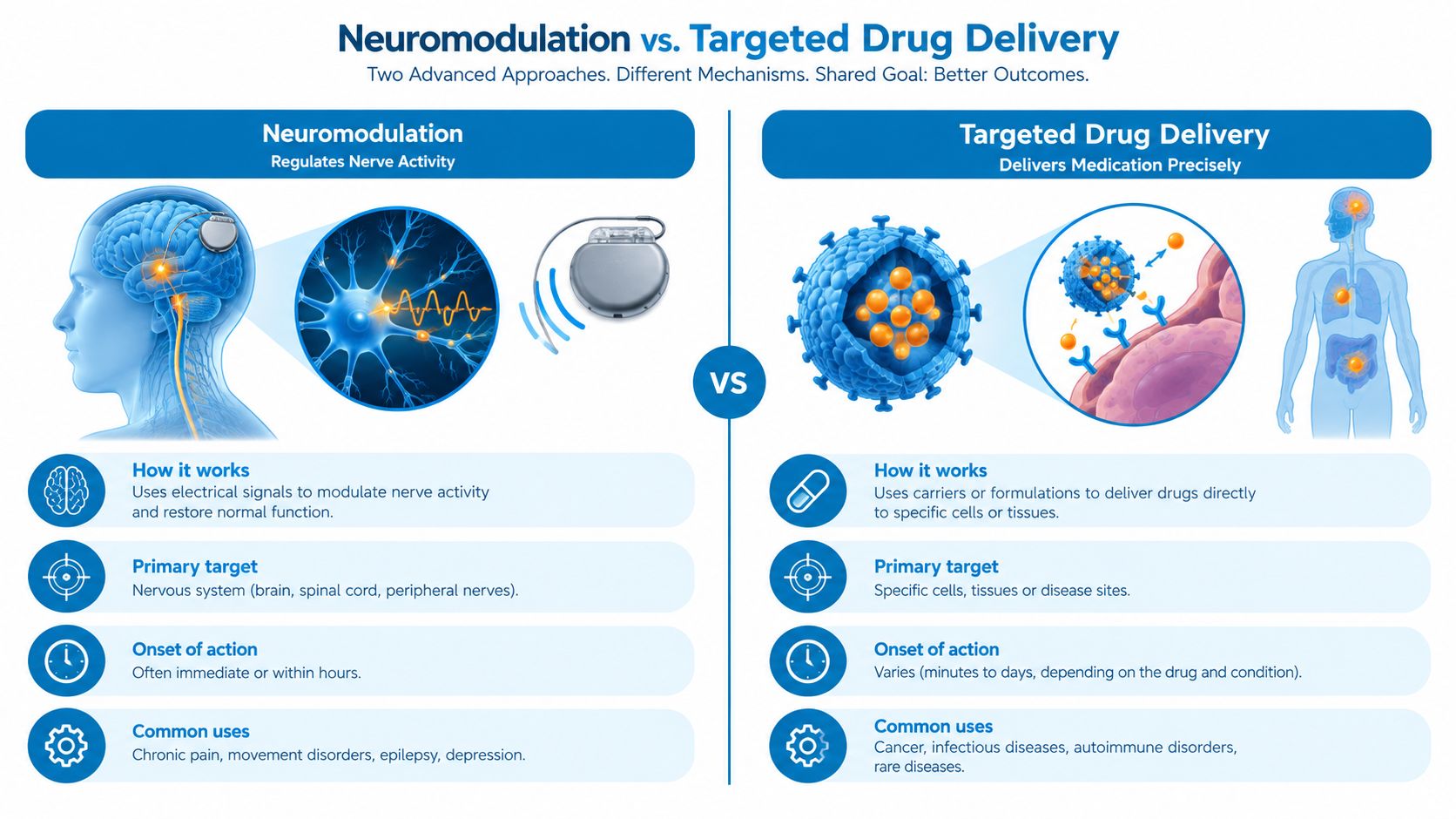
The simplest distinction is electricity versus medication.
A spinal cord stimulator places leads in the epidural space near the spinal cord. An implanted pulse generator sends controlled electrical signals through those leads. Depending on the technology and programming, the stimulation may produce a sensation that overlays painful signals or may use forms of stimulation designed to reduce pain without noticeable tingling. The device doesn't remove a herniated disc or repair damaged tissue. It modifies pain processing.
An intrathecal pain pump uses a catheter connected to a medication reservoir. The system delivers medication directly into the cerebrospinal fluid, allowing treatment close to spinal pain pathways. Because the medication bypasses the digestive tract and much of the systemic circulation, clinicians can pursue targeted delivery when systemic therapy isn't adequate or causes unacceptable effects.
Patients seeking a straightforward explanation of SCS components and treatment principles can review spinal cord stimulation treatment information, then discuss whether those principles apply to the individual diagnosis.
Why the mechanism changes the decision
SCS is a neuromodulation strategy. It aims to influence the nervous system's handling of pain without continuously administering an analgesic. That makes it particularly relevant when nerve signaling is the central problem and reducing systemic medication is a major goal.
An intrathecal pump is a drug-delivery strategy. It may be more appropriate when pain is severe, widespread, mixed, or closely tied to medication response. The clinician must select the medication, assess tolerance, monitor side effects, and maintain the system over time.
The distinction also affects failure patterns. SCS may fail because the pain pattern changes, stimulation no longer reaches the relevant region, leads move, hardware malfunctions, or the original pain generator remains untreated. Pump therapy may fail because the medication doesn't provide enough benefit, side effects limit dosing, the catheter develops a problem, or the patient requires a medication plan that the system can't safely support.
Both devices remain invasive
Neither option should be presented as a casual substitute for routine care. Each involves implantation, infection risk, device maintenance, and potential revision. Each also requires a clinician who can manage complications and reassess the diagnosis if symptoms evolve.
The right comparison is therefore not “device versus no treatment.” It's one invasive strategy versus another, selected according to pain biology and long-term priorities.
Matching the Device to Your Specific Pain Phenotype
Pain phenotype often predicts the direction of the discussion better than the location of pain alone. Two patients may both report low back pain, yet one may have nerve-root pain and the other may have facet, joint, muscular, or structural pain. Their implant options shouldn't be treated as interchangeable.
When SCS fits neuropathic pain
Spinal cord stimulation is commonly considered for burning, shooting, electric, or pins-and-needles pain, especially when symptoms follow a nerve distribution. Failed back surgery syndrome is a frequent setting. Persistent pain after lumbar surgery occurs in an estimated 10% to 40% of cases, according to a clinical review of SCS evidence and history (review of SCS in chronic refractory pain).
In failed back surgery syndrome, the pain pattern matters. An algorithm of care recommends considering conventional SCS early when neuropathic buttock and leg pain predominates. The same publication describes SCS as effective in about 50% of FBSS patients, reinforcing that selection by pain phenotype is central rather than incidental (FBSS treatment algorithm).
SCS may also enter the discussion for regional neuropathic syndromes, including complex regional pain syndrome. It's less likely to solve pain caused by an untreated fracture, severe instability, or ongoing compression that requires structural treatment.
When a pump may fit better
An intrathecal pump may be considered when pain is severe, refractory, and inadequately controlled by systemic therapy, particularly when medication tolerance or side effects limit conventional treatment. It can be relevant to mixed pain, substantial nociceptive pain, cancer-related pain, spasticity-related treatment needs, or complex medication-dependent cases.
A retrospective series involving patients with failed back surgery syndrome who had both therapies found that 55% reported superior relief from the intrathecal opioid pump, 36% found both therapies equally effective, and 9% preferred SCS. The sample was small, so it shouldn't be treated as a universal ranking, but it illustrates an important clinical point: intrathecal delivery may be favored when pain has a meaningful nociceptive or mixed component (dual-implant FBSS series).
A clinician will also ask whether the primary goal is changing nerve signaling or delivering medication with less systemic exposure. That answer may matter more than the label attached to the diagnosis.
The Trialing Process and Path to Permanent Implantation
A permanent implant should follow evidence that the therapy helps the specific patient. Trialing provides that evidence, but the two trials test different things.
SCS trial
During an SCS trial, temporary leads are placed near the spinal cord and connected to an external generator. The patient then evaluates the system during ordinary activities, such as walking, sleeping, sitting, or completing household tasks. The important question isn't whether a device feels interesting. It's whether the patient can do more with less pain.
A useful trial assessment tracks:
- Pain distribution: Does stimulation reach the painful leg, buttock, foot, back, or other intended region?
- Function: Can the patient walk, sleep, work, or participate in rehabilitation more consistently?
- Medication needs: Has the patient been able to use less rescue medication under medical supervision?
- Quality of relief: Is the improvement steady and meaningful, or does it occur only in a controlled setting?
Specialists commonly use meaningful pain reduction and functional improvement as practical thresholds, but the exact standard varies by diagnosis, payer policy, and physician judgment. A trial can be technically successful yet clinically disappointing if the patient reports coverage without better sleep, mobility, or daily function.
Intrathecal pump trial
A pump trial may involve a single intrathecal injection or a short-term catheter. It evaluates the response to a selected medication and allows the team to observe sedation, nausea, breathing concerns, weakness, itching, or other adverse effects. The trial is therefore both an efficacy test and a safety screen.
A patient who reports less pain but is excessively sedated hasn't demonstrated a satisfactory long-term result. The medication must provide useful relief without undermining alertness, mobility, or safety.
What a good trial should answer
Before permanent implantation, the patient and clinician should know what improvement is expected, how it will be measured, and what would make the treatment unacceptable. A successful trial means more than a temporary change in a numeric pain score. It should demonstrate a practical benefit that justifies long-term device care.
Downstream Surgical Risks and Long-Term Device Management
Many patients ask whether choosing an SCS or pain pump will “lock” them out of future spine surgery. The answer is more nuanced. Neither device automatically prevents later decompression or fusion, but the implant becomes part of the surgical plan.
A large database study found that patients who later underwent lumbar fusion after having either an SCS or intrathecal pain pump had higher revision rates than patients without those devices. At one year, revision occurred in 7.3% versus 5.0%, and at two years, the rates were 10.8% versus 7.0%; the study also reported higher odds of instrumentation failure and some postoperative complications (database study of lumbar fusion after SCS or pump implantation).
Those figures don't prove that an implant alone caused every unfavorable outcome. Patients who receive implants may already have more complex pain, prior operations, medication exposure, or medical comorbidity. Still, the findings matter because future surgery can require careful positioning, lead or catheter management, imaging review, and coordination between the device specialist and spine surgeon.
Removal isn't automatically safer
The same study didn't establish that removing the device clearly improves fusion outcomes. That means explantation shouldn't be treated as a routine solution. The surgical team must determine whether the leads, generator, catheter, or pump interferes with the planned operation and whether removal itself creates additional risk.
A patient considering implantation should disclose possible future surgical needs, especially when imaging shows progressive stenosis, instability, deformity, or another condition that may eventually require reconstruction.
Practical rule: An implant should be selected with the next several years of care in mind, not only the next several weeks of pain relief.
Maintenance differs by device
An SCS may require charging, programming adjustments, and eventual generator management. A pump requires scheduled refills and continuous medication oversight. Missed appointments can create serious problems because the reservoir and catheter are part of an active drug-delivery system.
Both devices can require revision for infection, hardware failure, lead or catheter problems, or loss of benefit. The patient should leave the consultation knowing who will manage refills, programming, emergencies, imaging questions, and future operations.
Evaluating Modern Efficacy and Opioid Reduction Outcomes
A patient with burning leg pain after spine surgery may hear that an SCS can reduce pain and medication use, while another patient with severe mixed pain may be offered intrathecal therapy. Those options should not be judged by a single success percentage. They act through different mechanisms, and the relevant outcome depends on the pain phenotype, treatment goal, and ability to manage the implanted system.
Modern SCS systems are not limited to producing tingling over the painful area. Feedback-based programming can adjust stimulation as conditions change. A recent evidence review reported pooled rates of 90% for pain response, 90% for functional improvement, 84% for quality-of-life improvement, and 77% for opioid reduction or elimination (evidence on closed-loop SCS outcomes). These pooled findings do not predict an individual result. Diagnosis, pain distribution, prior surgery, psychological health, lead placement, and follow-up all influence the outcome.
Targeted drug delivery addresses a different problem. A pump places medication into the intrathecal space, which can provide analgesia for carefully selected patients with severe, mixed, or medication-responsive pain. The approach requires ongoing drug management and does not replace the need to identify structural disease or a treatable pain generator.
Modern outcomes comparison
| Outcome metric | Closed-loop SCS | Intrathecal pump |
|---|---|---|
| Pain response or relief | 90% pooled pain-response rate | 63.8% reported good-to-excellent pain relief |
| Functional improvement | 90% pooled rate | 75.0% reported improved physical functioning |
| Quality-of-life improvement | 84% pooled rate | 89.7% reported better quality of life |
| Opioid reduction or elimination | 77% pooled rate | 78.5% discontinued or substantially reduced systemic opioids |
| Satisfaction | Not reported in the cited pooled figures | 80.7% reported satisfaction |
The figures in this table are not from a head-to-head trial. The patient populations, study methods, and definitions of response differ, so direct ranking is unreliable. Opioid reduction also requires careful interpretation. Lower systemic opioid use can reflect improved pain control, medication intolerance, a planned taper, or several factors together.
Match the goal to the mechanism
SCS deserves consideration when the dominant problem is neuropathic limb pain, such as burning or electric pain, and the goals include better mobility and less reliance on systemic medication. A pump may warrant discussion when severe pain remains medication-responsive and controlled intrathecal delivery offers a reasonable balance between benefit, monitoring, and procedural risk.
Neither device guarantees restored function. The appropriate choice follows the pain mechanism, realistic goals, trial response when applicable, and the patient's willingness to attend long-term programming or refill visits. Some patients may require more than one treatment strategy, but combining devices increases procedural exposure and management demands.
Making the Right Choice with a Multidisciplinary Pain Team
The safest decision begins with a full diagnostic review, not an implant preference. A multidisciplinary team should examine imaging, prior operative reports, neurological findings, medication history, physical function, sleep, mood, and the patient's expectations.
What the evaluation should include
- Pain mapping: The team should document where pain starts, where it travels, and whether it feels burning, shooting, aching, deep, cramping, or mixed.
- Structural review: Imaging should be checked for stenosis, recurrent disc disease, instability, deformity, hardware problems, or another condition that may require structural treatment first.
- Medication assessment: The clinician should review benefit, tolerance, side effects, dependence concerns, and the patient's willingness to follow a long-term monitoring plan.
- Psychological preparation: Psychological clearance can identify untreated depression, anxiety, unrealistic expectations, or barriers that may affect recovery and device use.
- Future planning: Potential spine surgery, MRI needs, work demands, travel, refill access, and caregiver support should be discussed before implantation.
A pain specialist shouldn't recommend SCS just because a patient has had back surgery, and a pump shouldn't be selected just because medications have failed. The decision should follow the pain mechanism and the patient's measurable goals.
Patients in New Jersey and Staten Island can review pain management services that span diagnostic evaluation, interventional procedures, spinal cord stimulation, orthopedic care, and spine surgery coordination. Interventional Pain Management offers care through board-certified physicians across pain management, anesthesiology, orthopedics, and spine surgery, allowing device planning to be considered alongside noninvasive treatment and possible future surgical needs.
A consultation should end with specific answers: What pain is being targeted? What treatment must occur first? What will count as a successful trial? Who will manage the device afterward? How could the implant affect future imaging or spine surgery?
Interventional Pain Management evaluates complex chronic pain with attention to pain mechanism, prior surgery, medication tolerance, functional goals, and downstream surgical planning. Visit Interventional Pain Management to request an individualized assessment and discuss whether spinal cord stimulation, targeted drug delivery, or another treatment pathway fits the patient's needs.