
An epidural steroid injection typically provides relief for several weeks to a few months, with some patients experiencing benefits that extend to six months or longer, depending on the diagnosis and other factors. The local anesthetic may help for hours, while the steroid often takes 2 to 7 days to begin working and up to 14 days to assess properly.
A patient may feel hopeful immediately after leaving the clinic, then become confused when the early numbness fades later that day. Another patient may notice little change for several days before nerve pain gradually eases. Both experiences can be normal. The answer to “how long does epidural injection last” isn't one fixed number because pain relief, walking ability, sleep, and participation in rehabilitation can each follow a different schedule.
Table of Contents
- Understanding What to Expect After an Epidural Injection
- Typical Duration Ranges from Clinical Evidence
- How Diagnosis and Injection Type Affect Your Timeline
- Key Factors That Influence How Long Relief Lasts
- Recognizing Meaningful Benefit Versus Limitations
- Planning Your Next Steps and Follow-Up Care
- Putting It All Together for Informed Decisions
Understanding What to Expect After an Epidural Injection
A patient with leg pain from an irritated nerve may leave the appointment feeling better, then feel the original pain return later that day. The local anesthetic can quiet symptoms quickly, but it wears off before the steroid has had time to calm inflammation. Early relief is therefore a snapshot, not a reliable forecast of the complete response.
As noted earlier, the steroid response takes days to weeks, so patience matters. That waiting period can feel difficult for someone hoping to sleep normally, return to work, or begin physical therapy. The useful question is not only whether pain changes, but whether sleep, walking, standing, and daily activity gradually become easier. A guide to epidural steroid injections can help patients prepare questions for their clinician.

Why the first day can mislead
The injection contains a local anesthetic and a corticosteroid, and each has a different job. The anesthetic may cause short-lived numbness or pain reduction. The steroid is intended to reduce inflammation around an irritated spinal nerve, so its effect follows a slower timetable. Clinical guidance describes this distinction in its clinical overview of epidural steroid injections.
Injection-site soreness can also obscure changes in the original symptoms. Record leg and back pain alongside sleep quality, standing tolerance, walking, and daily tasks. This broader record works like a dashboard: one measure may improve before another, showing progress that a single pain score would miss.
Practical rule: The first day reflects the anesthetic more than the final steroid response.
Results still vary by diagnosis, nerve irritation, and the outcome being measured. Pain relief may appear before improved function, while better activity tolerance may become the more meaningful sign over time. A realistic expectation is a range, not a promise, with follow-up focused on how symptoms and function change together.
Typical Duration Ranges from Clinical Evidence
The broadest evidence points to a modest short-term effect lasting less than 3 months for well-selected patients receiving epidural steroid injections. The same evidence review found that support for benefits beyond 12 months was insufficient, so long-lasting improvement shouldn't be treated as the standard expectation (evidence review of epidural steroid injections).
A clinician may still discuss a longer possible benefit because targeted studies don't all measure the same patients, diagnoses, injection routes, or outcomes. In one lumbar transforaminal injection study, the most effective post-injection period averaged 5.11 ± 3.07 months, while the reported mean duration of effect was 12.46 ± 7.24 months (Society guidance and evidence discussion). Those findings describe a specific study population and shouldn't be converted into a universal forecast.
Pain and function don't follow identical clocks
A 2025 systematic review from the American Academy of Neurology reported that epidural steroid injections may modestly reduce pain for up to 3 months in radiculopathy, while disability improvement may last up to 6 months or longer in spinal stenosis (American Academy of Neurology review). This distinction matters. A patient may still report some pain but walk farther, sit longer, sleep better, or participate more fully in rehabilitation.
Clinical guidance also describes practical duration as ranging from hours for local anesthetic effects to months for steroid-related relief. Some selected cases show effects reaching 6 to 12 months, but those longer windows coexist with broader evidence showing that the most dependable benefit is usually measured in weeks to a few months.
For a patient considering an injection, three questions are more useful than asking for one average:
- What condition is being treated?
- Is the goal pain reduction, improved function, or both?
- How long must the relief last to support rehabilitation or another treatment decision?
A discussion of corticosteroid injections can help patients understand why medication choice, treatment purpose, and follow-up timing influence expectations.
How Diagnosis and Injection Type Affect Your Timeline
The same injection can feel like a short bridge for one patient and a longer period of relief for another. The diagnosis sets the starting point. Nerve-root pain from a herniated disc often follows a different course from symptoms caused by narrowing around several nerves. The injection route also shapes the timeline because it determines where the medication is delivered in relation to the suspected pain source.
For lumbar radiculopathy and disc herniation, the most dependable relief is commonly assessed over 4 to 12 weeks. A meaningful response may include at least 50% pain reduction lasting 6 weeks or longer, although an individual result can be shorter or longer. Those time ranges describe how outcomes are evaluated, not a promise that every patient will follow the same schedule.
A practical comparison
| Condition or approach | What the evidence suggests | What patients should track |
|---|---|---|
| Lumbar radiculopathy | Pain relief is most reliably assessed in the 4 to 12 week range. | Leg pain, numbness, sitting, standing, and walking tolerance. |
| Herniated disc with nerve irritation | Relief may create a temporary window while the irritated nerve settles. | Whether leg symptoms decrease and rehabilitation becomes possible. |
| Spinal stenosis | Pain and disability may improve on different schedules, with functional improvement potentially lasting longer. | Walking distance, balance, daily activity, and rest needs. |
| Transforaminal injection | Medication is directed toward a particular nerve root, so the timeline depends heavily on whether that root is generating the pain. | Changes in the specific pattern of radiating pain. |
| Interlaminar injection | Medication enters the epidural space through a broader approach, with results shaped by the distribution of inflammation and compression. | Overall back and leg symptoms, not just one location. |
These categories describe different clinical situations. A person with one irritated nerve may define success as less shooting leg pain. A person with spinal stenosis may care more about walking farther, standing longer, or needing fewer rest breaks, even if some pain remains.
The route also needs to match the suspected source. Sciatica and a pinched nerve can produce a recognizable pattern of radiating symptoms, but imaging findings alone do not prove which structure is causing every symptom. Ask the specialist why that approach fits the diagnosis, what improvement should appear first, and whether success will be judged by pain relief, better function, or both.
Key Factors That Influence How Long Relief Lasts
Two people can have similar imaging findings and very different responses because an injection doesn't act on an image alone. It acts on inflamed tissue, irritated nerves, movement patterns, and the demands placed on the spine after treatment.
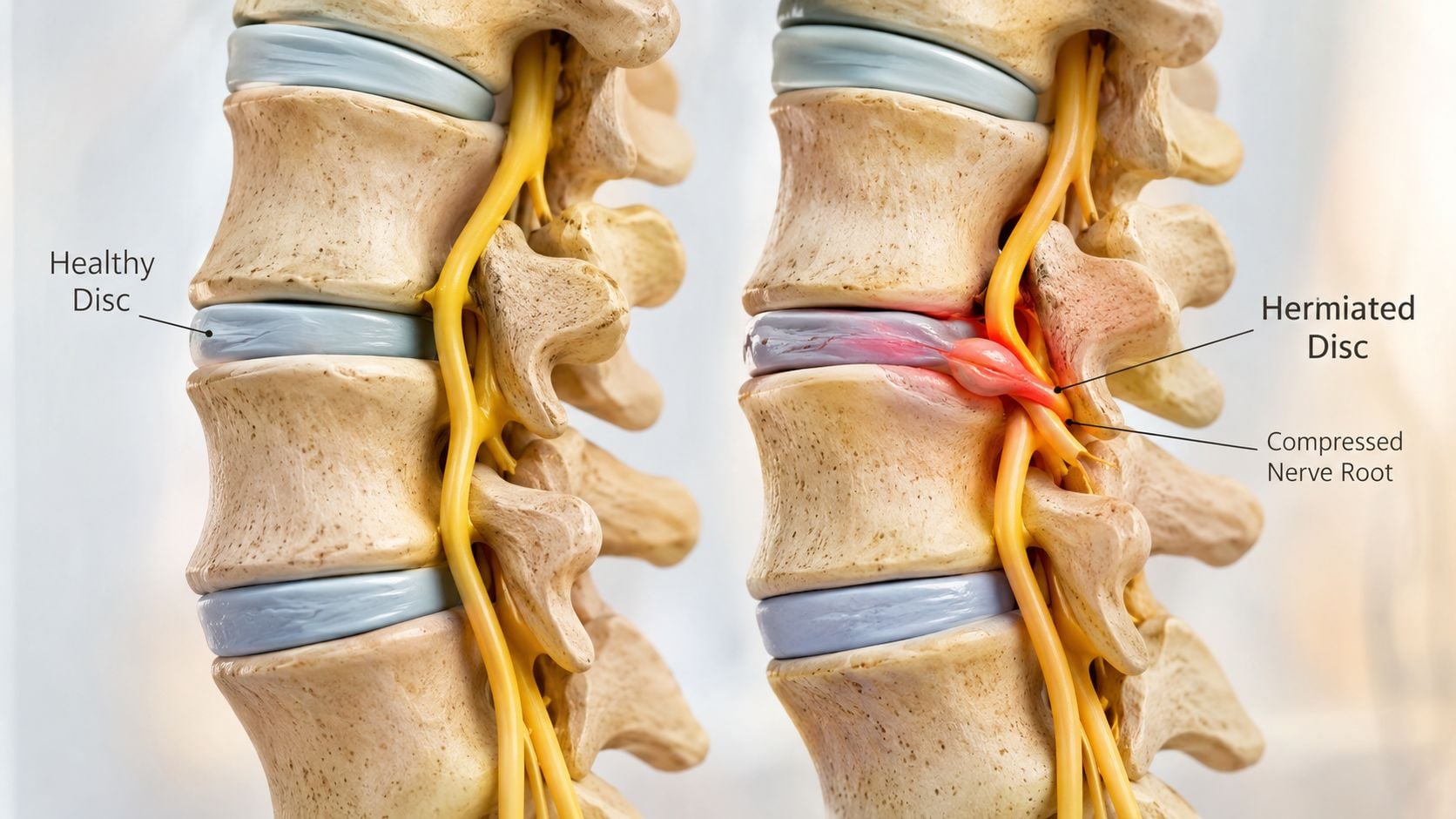
A herniated disc may irritate one nerve root, while spinal stenosis may leave less room for several nerves. The first problem may settle as inflammation decreases, whereas ongoing narrowing can continue to provoke symptoms during standing or walking. The structural cause doesn't determine the outcome by itself, but it strongly shapes how durable relief can be.
The treatment variables
- Injection route: A transforaminal approach targets medication near a particular nerve root, while an interlaminar approach uses a broader epidural pathway.
- Image guidance: Accurate placement helps the clinician connect the medication to the suspected pain source.
- Medication selection: The anesthetic and steroid components have different roles and different time courses.
- Dose and clinical judgment: The treating physician selects the medication plan according to the diagnosis, anatomy, and safety considerations.
The patient variables
Overall health, activity level, work demands, and rehabilitation participation can change what happens after pain improves. A patient who uses the lower-pain period to restore movement and build strength may gain more functional value from the injection than someone who remains inactive because symptoms feel temporarily better.
That doesn't mean a shorter response reflects poor effort. Persistent nerve compression, severe functional limits, or another untreated pain generator can restrict progress even when a procedure is technically appropriate. Duration is best understood as the combined result of pathology, precision, medication, and recovery behavior, rather than as a personal score or a guaranteed medication effect.
Recognizing Meaningful Benefit Versus Limitations
An injection has meaningful value when it restores an activity that pain had taken away. A patient may still report some back or leg pain, yet sleep with fewer interruptions, walk farther, complete prescribed therapy, return to necessary work tasks, or rely less on other pain measures.
Consider a patient whose pain improves only modestly. Before the injection, leg symptoms made physical therapy impossible. Afterward, the patient can perform the exercises safely and build strength. That functional change may matter more than a larger pain reduction that fades quickly while normal movement remains difficult.
Pain scores still provide useful information, but they are only one measurement. Function shows whether the change affects daily life.
Relief is not the same as repair
Epidural steroid injections reduce inflammation around irritated spinal nerves. They do not reverse a herniated disc, remove a bone spur, or permanently widen a narrowed spinal canal. Because the underlying condition may remain, symptoms can return after an initial improvement.
Clinical evidence describes responses lasting for several months in some patients, while other observations extend longer. CMS evidence language notes that studies report benefit lasting 3 to 6 months, with some describing effects at 1 to 2 years (CMS evidence language on duration). These ranges describe what has been observed, not a promise for one individual, and longer follow-up does not prove that relief will remain permanent.
A successful injection can be temporary and still be clinically valuable if it helps a patient regain movement or complete rehabilitation.
Judge the result by the goal agreed on with the treating clinician. If symptoms return, the procedure may have reduced inflammation without changing the condition causing it. That pattern calls for reassessing symptoms, function, and available care options rather than treating duration alone as a pass-or-fail score.
Planning Your Next Steps and Follow-Up Care
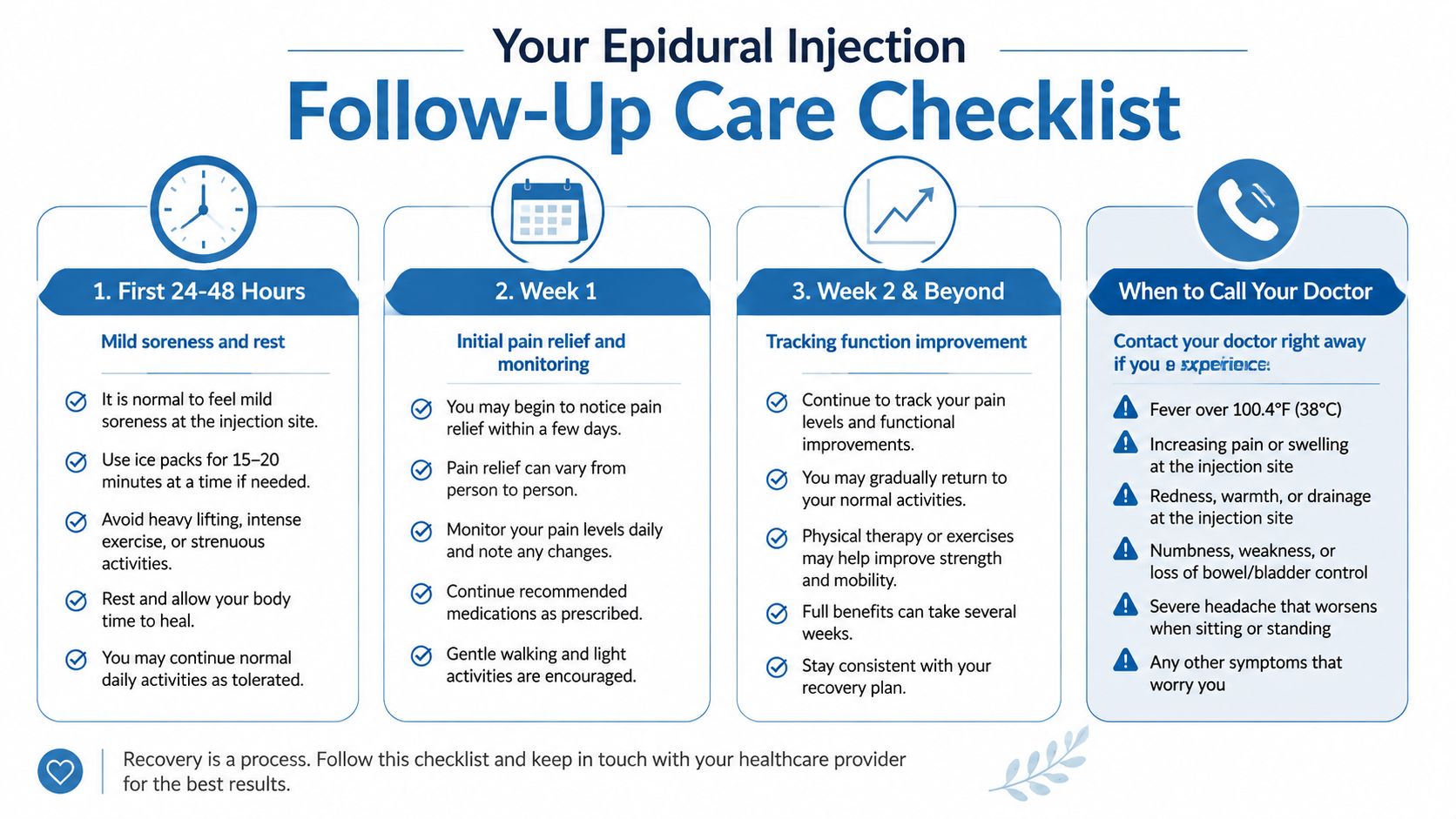
A patient may wake after an injection with less pain, then feel sore again that evening. That short-term fluctuation does not determine the final result. As covered earlier, meaningful assessment begins around day 2 to 7 and requires up to 14 days. During this window, track pain, sleep, sitting and walking tolerance, medication use, and activities that become easier.
A simple monitoring plan
- Early recovery: Follow the treating clinician's instructions about soreness, rest, and activity. Temporary numbness or changing pain is an early signal, not a final verdict.
- First week: Record changes in radiating pain, tingling, and movement limits. Improvement may arrive gradually, like a dimmer switch rather than an on-off button.
- Second week and later: Compare daily function with the period before treatment. Returning to physical therapy or completing ordinary tasks may show meaningful progress even when pain remains.
A repeat injection should be discussed only after the first response has been evaluated. The decision depends on what changed, how long that change lasted, and whether it supported the treatment goal. A brief reduction in pain with no improvement in movement may call for a different plan than pain relief that allows rehabilitation to begin.
The purpose is not to schedule injections indefinitely. Each treatment window should support a broader approach, which may include rehabilitation, strengthening, activity changes, or assessment of another intervention when symptoms persist. Contact the pain management team about worsening symptoms, new neurological changes, fever, or other concerns instead of waiting for the expected recovery window to pass. That follow-up connects the duration of pain relief with the more useful question, whether function and daily life are improving.
Putting It All Together for Informed Decisions
There isn't one universal answer to how long an epidural injection lasts. The most dependable expectation is relief lasting weeks to a few months, while selected patients may experience benefits that extend to 6 months or longer. The diagnosis, injection route, severity of nerve irritation, health status, and rehabilitation plan all influence the result.
Pain reduction and disability improvement deserve separate attention. A patient with radiculopathy may focus on radiating leg pain, while a patient with spinal stenosis may judge success by walking and daily function. Those outcomes can improve and fade on different schedules, so a single duration estimate can leave important questions unanswered.
Before treatment, patients can ask the clinician:
- What diagnosis is the injection targeting?
- Which symptom should improve first?
- When should the response be assessed?
- What activity or rehabilitation plan should begin if pain decreases?
- What would the next step be if relief is brief or absent?
An epidural injection can be one component of a long-term plan, not a promise that structural spine disease has been corrected. A personalized timeline gives patients a clearer basis for deciding whether the procedure's expected treatment window matches their goals.
Interventional Pain Management evaluates spine and nerve-related pain and offers image-guided epidural injections alongside non-invasive, interventional, orthopedic, and spine care when clinically appropriate. Patients in New Jersey and Staten Island can visit Interventional Pain Management to discuss diagnosis-specific expectations, follow-up timing, and a treatment plan focused on meaningful function.