
You've just left the clinic after radiofrequency ablation, and the questions often begin once the monitoring ends. Is soreness expected? Can normal movement make the treatment less effective? Is returning to work tomorrow reasonable, or should the body have more time? The procedure may be over, but radiofrequency ablation recovery time is still unfolding.
For most outpatient procedures, the immediate course is brief, while the transition back to unrestricted activity takes longer. The practical distinction matters: leaving the clinic is only one milestone. The body may need several days for treated nerves and surrounding tissues to settle, and transient soreness can remain within the normal recovery pattern.
Table of Contents
- Understanding Your Immediate Recovery Window
- The Data Behind Radiofrequency Ablation Recovery Time
- Navigating the First Week of Symptoms
- Pain Management and Activity Guidelines
- Returning to Work and Daily Activities
- Putting It All Together for Your Recovery
Understanding Your Immediate Recovery Window
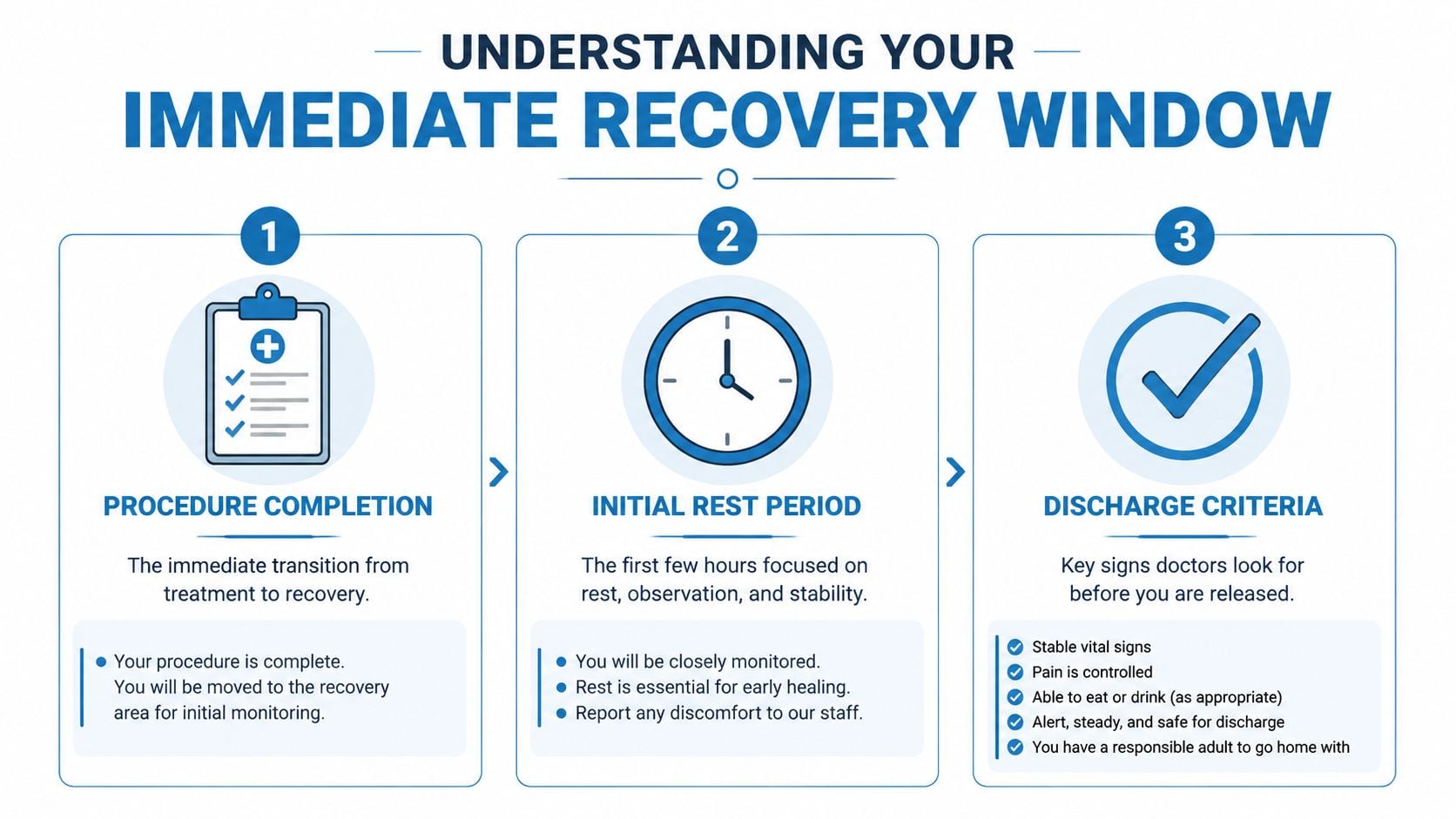
The end of the procedure can feel surprisingly anticlimactic. A patient may spend more time preparing, positioning, and being monitored than receiving the radiofrequency treatment itself. Once the needle is removed and the treatment area is covered, the clinical team shifts attention to alertness, movement, pain, and safe discharge.
The patient generally remains under observation for an initial rest period. Sedation, if used, can affect reaction time and judgment even when the person feels awake. That's why driving immediately afterward isn't considered safe, and why a responsible adult should accompany the patient home rather than treating discharge as a return to ordinary independence.
What the first hours are for
The first hours are less about testing whether the ablation worked and more about preventing avoidable problems. The team checks that the patient is sufficiently alert, can move safely, and has no concerning change requiring additional assessment. Mild tenderness at the treatment site can occur, but severe or rapidly worsening symptoms should be reported before leaving.
A quiet remainder of the day is usually the sensible choice. Patients can arrange easy meals, keep essential items within reach, and avoid commitments that require driving, heavy lifting, or quick decisions. Cleveland Clinic describes RFA as involving little to no recovery time, while still recommending a 24-hour activity restriction because sedation and post-procedure discomfort can create risk (Cleveland Clinic's radiofrequency ablation guidance).
Practical rule: Feeling capable of more activity doesn't mean the body has finished its immediate recovery.
The first day should be treated as protected downtime, not lost time. Patients who follow the written instructions from their treating team, including guidance available through radiofrequency ablation care at Interventional Pain Management, have a clearer framework for deciding what's reasonable at home. Individual instructions take priority, especially when the treatment site, sedation plan, or medical history changes the usual course.
The Data Behind Radiofrequency Ablation Recovery Time
The most useful recovery discussion separates discharge, normal activity, and return to work. These milestones are related, but they aren't interchangeable. A patient can go home the same day and still need several days before sitting, standing, lifting, or concentrating feels routine.
A 2019 systematic review and meta-analysis of prospective studies provides concrete benchmarks. The mean procedure time was 49 minutes, the mean time to discharge was 8.2 hours, the mean time to normal activities was 5.2 days, and the mean time to return to work was 5.1 days (the prospective-study systematic review and meta-analysis).
Average Recovery Metrics
| Metric | Average Duration |
|---|---|
| Procedure time | 49 minutes |
| Time to discharge | 8.2 hours |
| Time to normal activities | 5.2 days |
| Time to return to work | 5.1 days |
These averages explain why “same-day procedure” shouldn't be interpreted as “back to everything the same day.” The treatment itself has a relatively brief procedural footprint, but functional recovery commonly extends beyond discharge. The patient may be home that afternoon yet still need a gradual return to ordinary movement.
The figures also provide context for other interventional procedures. Patients considering a different treatment for spine-related pain can review how their symptoms and functional goals are assessed through epidural steroid injection care, but recovery instructions must always match the specific procedure performed.
Average values aren't promises. They can't account for the treated region, baseline pain, job demands, sedation response, or an individual clinician's restrictions. Their value is practical: they replace the vague expectation of “quick recovery” with a timeline measured in hours for discharge and days for function.
Navigating the First Week of Symptoms
The first week is often where uncertainty peaks. The patient may expect the original pain to disappear immediately, then become concerned when the treated area feels tender, warm, tight, or unusually sensitive. Those sensations can fit the expected healing pattern, particularly when they remain localized and gradually settle.
A recognized post-procedure symptom is transient soreness with a sunburn-like neuritis sensation. StatPearls describes soreness lasting 3 to 14 days and recommends restricting activity for 24 to 48 hours (StatPearls clinical reference on radiofrequency ablation). The sensation reflects irritation and recovery around the treated nerve, not automatically a sign that the procedure caused damage or failed.
Comparing the first 48 hours with the next two weeks
During the first 24 to 48 hours, the emphasis is protection. Heavier activity, strenuous exercise, and unnecessary pressure on the treatment area should be avoided according to the treating clinician's instructions. Mild soreness during this period is usually managed through the prescribed or approved plan, rest, and careful movement.
Over the following days, the emphasis changes from protection to observation. The patient can gradually resume ordinary movement as tolerated, while tracking whether discomfort is easing, staying stable, or worsening. A wider recovery window can extend to 14 days, but the overall pattern should move toward settling rather than escalating.
| Recovery phase | What may be normal | What deserves a call |
|---|---|---|
| First 48 hours | Local soreness, tenderness, or temporary sensitivity | Severe, rapidly worsening, or unexplained symptoms |
| Days 3 to 7 | Gradual improvement, with occasional residual irritation | Symptoms that are intensifying instead of settling |
| Days 8 to 14 | Continued resolution for patients with lingering neuritis-like discomfort | Persistent concern, new functional problems, or symptoms outside the written instructions |
The treating team should be contacted when symptoms feel substantially different from the discharge instructions, especially if they worsen rather than improve. Patients shouldn't attempt to diagnose complications from internet descriptions. The safest response is a direct call to the clinician who knows the treatment site and medical history.
Pain Management and Activity Guidelines
A smooth recovery usually depends less on doing something dramatic and more on avoiding predictable mistakes. Patients tend to struggle when they either test the treated area too aggressively or remain completely still for too long. The practical target is relative rest followed by gradual movement, guided by symptoms and the clinician's instructions.
Use the first 48 hours deliberately
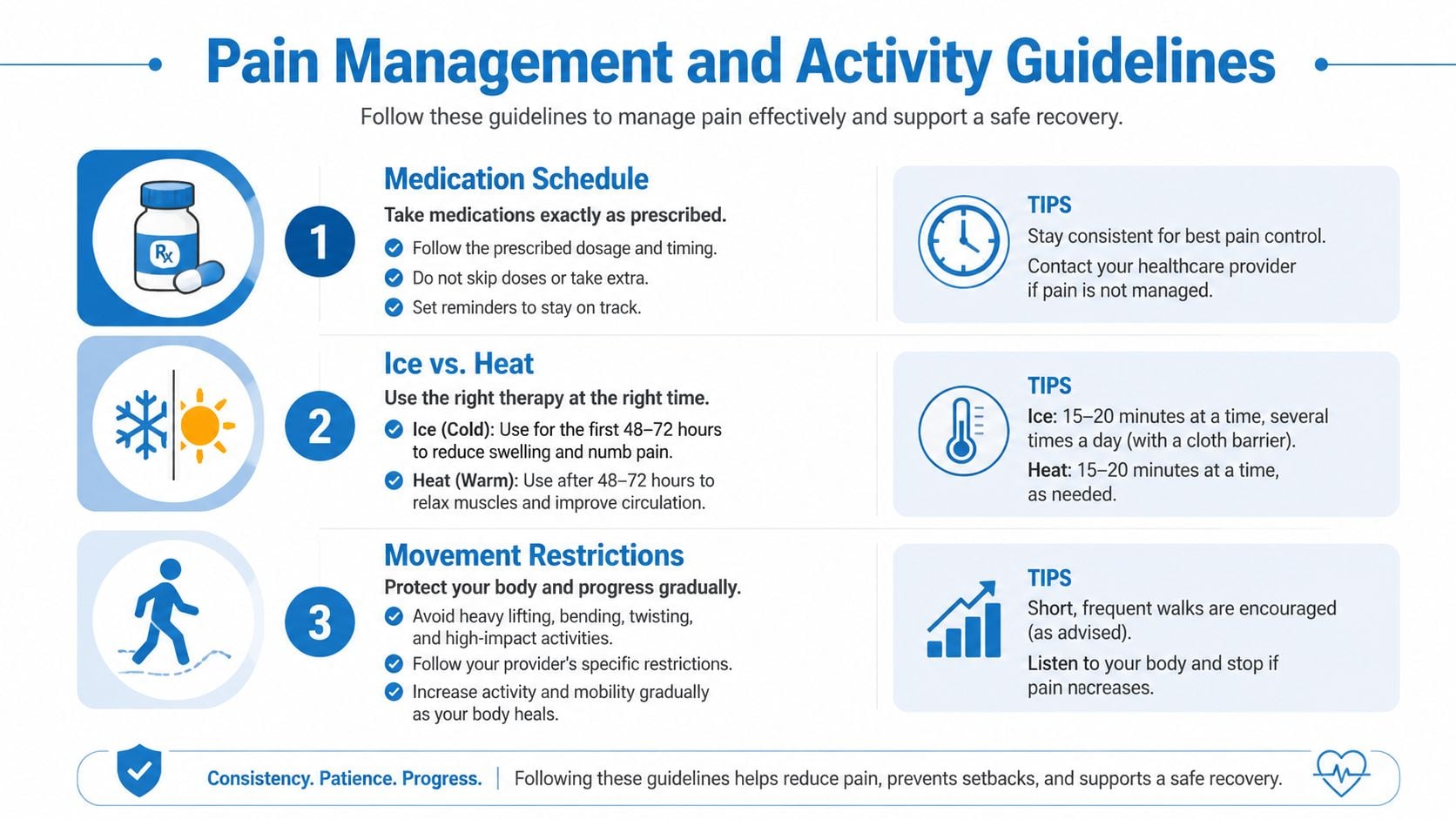
Follow the medication plan. Take only medications approved by the treating clinician, at the prescribed dose and timing. Patients shouldn't add an over-the-counter medicine without checking for interactions, kidney or stomach concerns, blood-thinning effects, or other contraindications.
Protect the treatment area. Avoid heavy lifting, strenuous exercise, and movements that provoke sharp or escalating pain during the initial restriction period. The purpose isn't to immobilize the entire body. It's to reduce unnecessary stress while the local irritation settles.
Keep movement gentle. Short, easy walking and routine positional changes may be appropriate when permitted. Movement should remain comfortable and controlled, not a test of endurance.
Adjust comfort measures to the symptom
Cold or warmth may help some patients, but the choice should follow the clinician's instructions and the location of treatment. A cold compress can be useful for localized tenderness early on, while gentle warmth may feel better for muscle tightness later. Neither should be applied in a way that irritates the skin or masks a symptom that needs medical review.
Recovery works best when comfort measures support movement, not when they're used to push through worsening pain.
After the initial restriction, activity can increase in small increments. If a normal task produces a clear flare that lasts, the patient has probably progressed too quickly and should scale back. Guidance from a broader pain management program can help connect symptom control with rehabilitation and functional goals.
Administrative questions can also affect continuity of care. Clinics and practices handling procedure claims may benefit from knowing how to choose a pain billing specialist when billing complexity distracts from patient follow-up. For the patient, the essential point is simpler: keep the discharge instructions available, record questions as they arise, and contact the care team before changing medication or activity limits.
Returning to Work and Daily Activities
A patient may feel ready to leave the clinic yet remain unsure about a normal workday. The right return date depends on the job's demands, transportation, sitting tolerance, and how symptoms behave during the following hours. Someone answering emails from a supportive chair faces different demands from a person who lifts, climbs, drives for long periods, or repeatedly bends and twists. Different timelines can therefore reflect different workloads, not an abnormal recovery.
A prospective-study meta-analysis reported a mean return-to-work time of 5.1 days (see the systematic review cited above). This is a planning reference, not a required absence period. It becomes more useful when work involves sustained posture, physical exertion, or limited opportunities to change position.
Match the plan to the job
Desk work may be possible sooner if sitting remains comfortable and concentration is intact. A phased return, shorter workstation periods, or remote work can reduce strain during the uncertain window between the first two days and the second week.
Physically demanding work calls for a more cautious plan. Lifting, repetitive bending, climbing, operating machinery, and prolonged standing can aggravate a tender treatment area even when the patient otherwise feels well. The clinician should identify which duties may resume first and which require more time.
Sport follows the same principle. Walking and light daily movement may return before running, contact activity, heavy resistance training, or repeated spinal rotation. Severe pain does not need to be present for an activity to exceed current tolerance.
Use function, not the calendar alone, to judge readiness:
- What can be done comfortably? Identify tasks that do not increase symptoms during the activity or later that day.
- What triggers symptoms? Record positions, loads, and movements that produce a flare.
- Can duties be modified? Temporary changes may allow work without exceeding restrictions.
- What has the clinician authorized? Written instructions take priority over assumptions based on averages.
A practical progression is one that the patient can complete without escalating symptoms and the treating clinician considers appropriate. If a workday or exercise session causes a sustained flare, reduce the next demand and seek guidance before advancing again.
Putting It All Together for Your Recovery
A patient leaving the procedure room may feel ready to resume normal life, yet the next 48 hours to 14 days often bring the most uncertainty. Recovery is better understood as a sequence: safe discharge, protected rest, gradual movement, and a measured return to work, exercise, and ordinary responsibilities.
The procedure itself may take 49 minutes on average, but discharge, normal activity, and work follow different timelines, as noted earlier. Feeling well enough to go home does not mean the treatment area is ready for a physically demanding shift. Temporary soreness during the first week also does not, by itself, indicate treatment failure.
A practical recovery checklist
- Before discharge: Confirm transportation, medication instructions, activity restrictions, and the number to call with concerns.
- The first day: Rest, avoid driving, and follow the clinician's guidance about movement and medication.
- The first two days: Avoid heavier activity. Continue only the gentle movement permitted by the care team.
- The first week: Watch the direction of symptoms. Gradual settling is reassuring, while worsening symptoms require attention.
- Through the second week: Lingering neuritis-like soreness may still fit the expected recovery window. Contact the treating team if symptoms become concerning or the pattern is unclear.
A realistic expectation is short downtime, not instant recovery.
Write down the questions that affect daily decisions. Ask when driving can resume, how to take medications, which work duties are appropriate, when exercise may progress, how long symptoms may last, and when the office wants a call. Clear communication is more useful than comparing one patient's recovery with another's.
Radiofrequency ablation recovery time describes a range, not a guarantee. The treating physician's instructions take priority because they account for the treatment site, health history, response to the procedure, and functional demands. If symptoms steadily worsen or a planned activity causes a prolonged flare, pause the progression and contact the care team.
Interventional Pain Management evaluates chronic spine and joint pain and offers image-guided interventional treatments, including radiofrequency ablation, when clinically appropriate. Patients seeking a personalized recovery plan can visit Interventional Pain Management to request an evaluation and discuss next steps with the care team.