
You've probably had the same thought a lot lately: why does a pain in the middle of the back feel so confusing, so stubborn, and so hard to pin down? A band of aching between the shoulder blades can make sitting, twisting, deep breathing, or sleeping feel wrong in a way that a simple sore muscle usually doesn't. Thoracic spine pain treatment works best when the cause is identified first, because the middle back has more possible pain sources than one might expect, and generic advice often misses the underlying problem.
That's why a structured approach matters. Thoracic spine pain is less common in clinical practice than neck or low-back pain, with one practice-based report describing about 4 thoracic spine pain patients per week compared with 12 lumbar and 8 cervical cases, and population studies putting lifetime prevalence in the 13% to 17% range, with a review reporting 15.6% to 19.5% (thoracic spine prevalence and management review). That combination matters because thoracic pain is common enough to deserve careful workup, but not so common that every clinic sees a lot of it every day.
The safest path usually follows four layers: diagnosis first, then conservative care, then procedures if needed, then escalation only when the evidence points there. A pain clinic upper and middle back pain resource can be helpful, but the core question is never just what treatment exists. The core question is what structure is sending the pain signal.
Table of Contents
- When Mid-Back Pain Becomes Hard to Ignore
- What the Thoracic Spine Does and What Can Go Wrong
- How a Clinician Narrows Down the Real Pain Generator
- The Conservative Care Layer Most Patients Start With
- Image-Guided Injections and Nerve Procedures
- Spinal Cord Stimulation and Surgical Options
- Choosing a Specialist and Planning Your Next Visit
- Questions Patients Ask After the Appointment
When Mid-Back Pain Becomes Hard to Ignore
The complaint usually starts with something small, a tight stripe between the shoulder blades, a nagging ache that shows up after desk work, or pain that makes a deep breath feel guarded. Then it stops acting like a simple strain. The pain lingers when rest should have helped, wakes the person at night, or spreads around the ribs in a way that feels oddly mechanical.
That uncertainty is exactly why thoracic pain gets misread so often. People assume it's “just posture” or “just muscle,” but the middle back sits in a crowded neighborhood, with joints, ribs, discs, muscles, and even referred pain from non-spinal sources all able to mimic each other. A thoughtful thoracic spine pain treatment plan starts by resisting the urge to label it too quickly.
Practical rule: if the pain keeps changing the way the body moves, breathes, or sleeps, it deserves more than a generic stretch-and-wait plan.
The rest of the process is a sequence, not a menu. First, identify the most likely pain generator. Then use conservative care to calm the tissue and restore motion. If that stalls, use targeted procedures. Only after that does surgery enter the conversation, and only for the right diagnosis.
What the Thoracic Spine Does and What Can Go Wrong
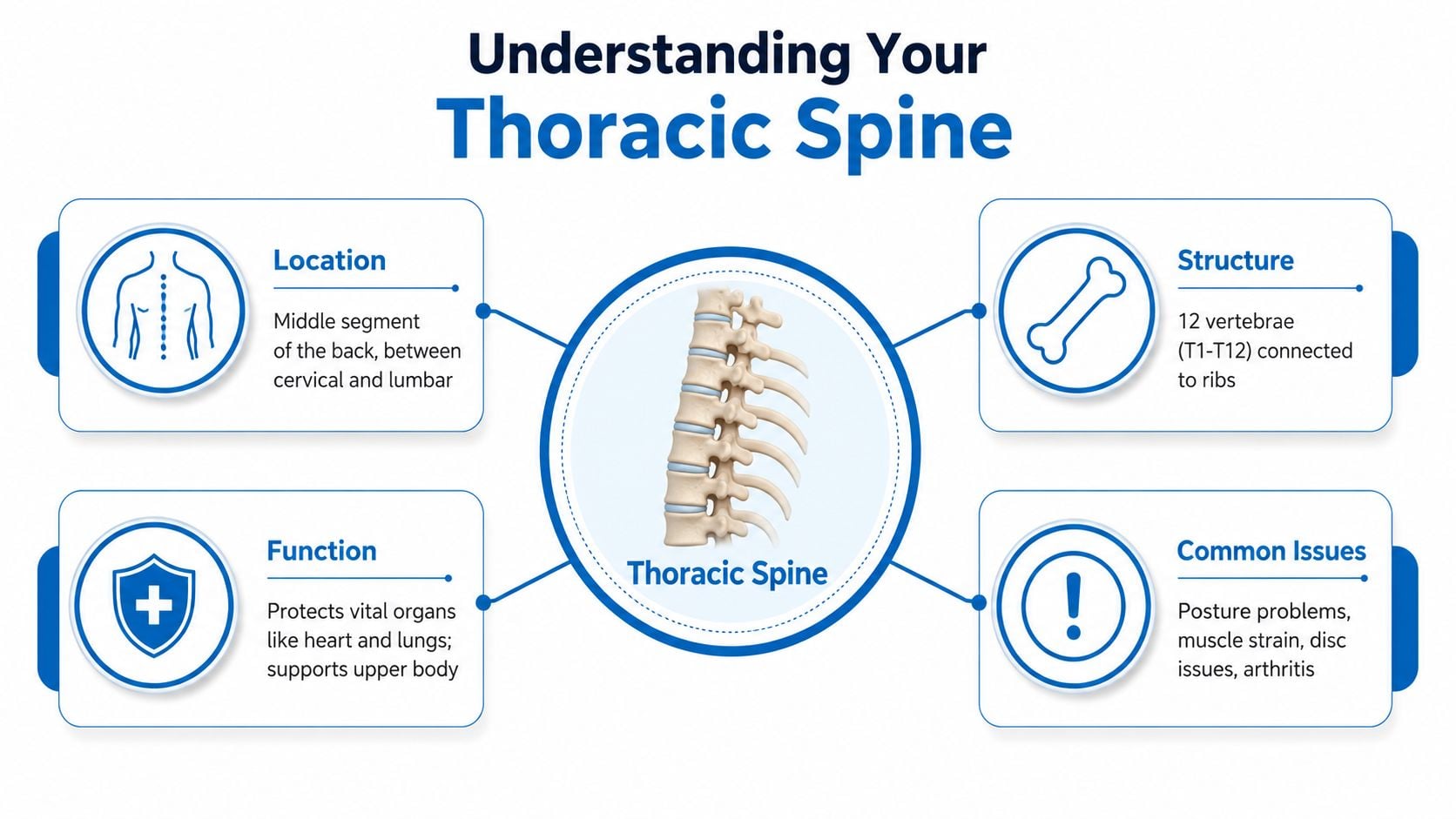
The thoracic spine is the middle part of the back, tied to the ribs and built more for stability than for broad motion. That structure shapes the pain pattern. The ribs protect the heart and lungs, while the thoracic vertebrae support the upper body and allow rotation, so symptoms often show up as stiffness, a band-like ache, or pain that worsens with twisting and breathing rather than the more familiar low-back pattern.
The main pain sources clinicians consider
A middle-back pain pattern can come from the facet joints, intervertebral discs, the costovertebral joints where the ribs meet the spine, the paraspinal muscles, or a vertebral fracture. Less commonly, pain is referred from nearby organs. That is why the same complaint can reflect something simple, like a mechanical strain, or something more serious that needs urgent attention.
The thoracic spine also deserves careful diagnostic thinking because many cases improve without procedures if the underlying problem is handled correctly. The California Division of Workers' Compensation ACOEM guideline notes that more than 90% of cervical and thoracic spine pain resolves without any specific therapies. That is reassuring, but it does not mean every case should be treated casually. It means the first job is to identify the likely pain generator, protect the area while it settles, and avoid chasing the wrong structure.
Red flags that change the plan
Certain features shift the plan away from routine care. Trauma, osteoporosis risk, unexplained weight loss, fever, night pain, neurological deficits, pain that worsens with breathing, and pain that worsens with swallowing all call for a broader workup. Those signs do not automatically mean something dangerous is present, but they do mean the middle back should not be treated like a simple muscle problem.
Pain between the shoulder blades is not a diagnosis. It is a signal that has to be decoded.
How a Clinician Narrows Down the Real Pain Generator
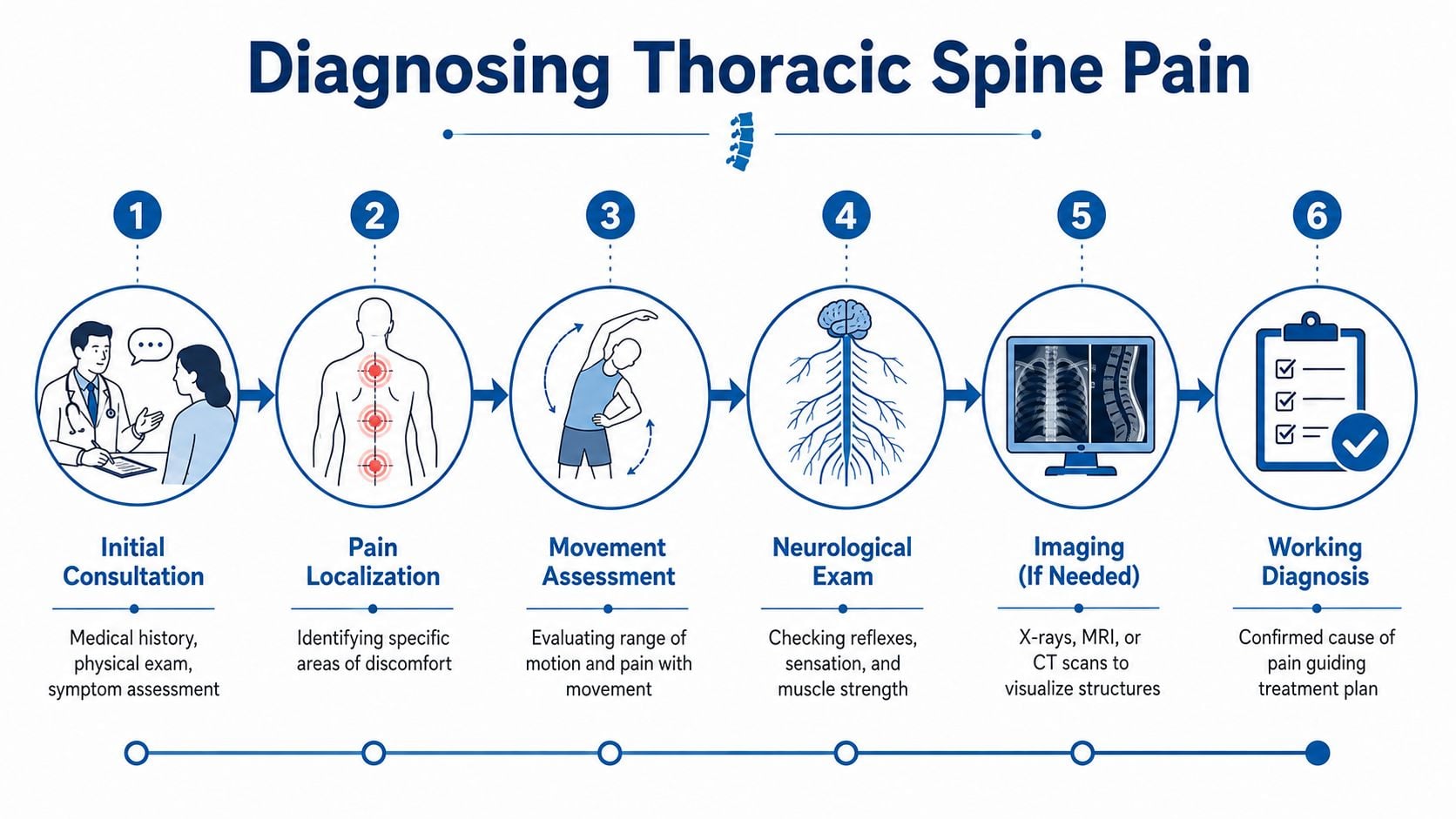
The first visit should feel more like detective work than a quick prescription. A clinician listens for where the pain sits, whether it wraps around the ribs, what movements make it worse, and whether anything eases it. The physical exam usually looks at rotation, extension, rib motion, posture, and a neurological screen for the legs, because the thoracic spine can irritate nearby structures in ways that don't always stay local.
History, exam, and imaging each answer different questions
An X-ray can show alignment, obvious fracture, and some degenerative change. MRI is better for discs, nerves, marrow, infection, and soft tissue. CT shows bony detail clearly, which is useful when the question is a subtle fracture or complex bone anatomy. None of those tests replaces the exam, because imaging only becomes useful after the suspected pain generator has been narrowed.
The next step, when needed, is an image-guided diagnostic block. That means a small amount of anesthetic is placed near a joint or nerve to see whether numbing that structure changes the pain. It's a process of elimination for the spine, almost like turning off one circuit at a time to find the faulty one.
Why the diagnosis comes before the procedure
That order protects patients from random treatment. If the pain is coming from a rib-spine joint, a disc, or a facet joint, the target changes. If the pain is referred from outside the spine, the plan changes even more. The patient who asks, “Which procedure should come first?” is usually better served by asking, “Which structure is causing this?”
A 2023 review noted that thoracic pain management is still dominated by conservative care because the evidence base remains thin, and clinical practice varies because the thoracic spine has been relatively neglected in research (thoracic pain management review). That makes diagnostic precision even more important, because the fewer broad treatment studies exist, the more valuable a targeted working diagnosis becomes.
The Conservative Care Layer Most Patients Start With
A person with thoracic spine pain often wants the strongest treatment first, but care usually works better when it begins with the least disruptive layer. Conservative care is not a vague instruction to rest and hope. It is a way to reduce strain, restore motion, and calm irritated tissues long enough for the body to settle. In practice, that usually means activity modification, posture and ergonomics changes, physical therapy, and medication when appropriate.
The details matter because the pain generator still shapes the plan. A desk worker may need a raised monitor, a better chair setup, and regular standing breaks so the mid-back is not held in one flexed position all day. Someone who lifts, twists, or reaches overhead at work may need temporary restrictions and a home program that emphasizes thoracic mobility and scapular control. Physical therapy should feel active, not passive, with exercises matched to movement limits and the symptom pattern in front of you.
What the typical first-line toolkit looks like
- Activity modification: reduce repeated bending, twisting, or prolonged slumped sitting while symptoms are irritable.
- Physical therapy: focus on thoracic mobility, posture, and shoulder blade control, then progress to loading and endurance.
- Medications: NSAIDs, short courses of muscle relaxants, and neuropathic agents when nerve-type symptoms are part of the picture.
- Manual therapy: mobilization or manipulation can be used as an adjunct, but not as the whole plan.
The evidence should be stated plainly. A recent systematic review found that manual therapy alone was not superior to placebo for thoracic pain relief, while manual therapy combined with exercise appears more promising (2024 IASP thoracic pain systematic review). That fits the clinical logic. Hands-on care may help loosen stiffness, but active rehabilitation is what keeps the gains from fading once the visit is over.
Practical takeaway: the exercise plan matters more than the “one perfect adjustment,” because the body has to relearn motion between visits.
For readers who want a safe, spine-friendly movement framework, Telomyx osteoporosis exercise advice is a useful reminder that gentle, structured exercise is often safer than complete rest when the spine is sensitive. The same principle applies here. Movement should be scaled, not avoided.
Many patients also worry that pain means the spine has to be protected from all load. That is usually too blunt. The California Division of Workers' Compensation ACOEM guideline notes that thoracic spine pain often resolves without specific therapies, which supports a conservative start when the diagnosis is sound and the home program is followed consistently.
Image-Guided Injections and Nerve Procedures
When the pain plateaus, the next step is usually targeted rather than broad. The procedure choice should match the generator, because a disc problem, a facet problem, and a myofascial pain problem don't respond to the same needle target. Thoracic spine pain treatment works best when the procedure is used to confirm or calm the right tissue, not to chase symptoms blindly.
A thoracic epidural steroid injection is often used when the pain pattern suggests disc-related inflammation or nerve irritation. Medial branch blocks help determine whether the facet joints are the source, and radiofrequency ablation can be considered when those blocks point to facet-mediated pain. Costovertebral or rib-spine joint injections fit pain that seems to track with the rib junction, while trigger point injections are reserved for tight, focal muscle bands that haven't responded to stretching or manual work.
Matching interventional procedures to thoracic pain generators
| Pain Generator | Targeted Procedure | Typical Relief Window |
|---|---|---|
| Disc-related or nerve-irritation pain | Thoracic epidural steroid injection | Often temporary, used to calm inflammation and create a window for rehab |
| Facet-mediated pain | Medial branch blocks, then radiofrequency ablation if the block is positive | Blocks are short acting, ablation aims for longer relief |
| Rib-spine or costovertebral pain | Image-guided joint injection | Usually diagnostic and therapeutic, with relief that may be limited or temporary |
| Myofascial pain | Trigger point injection | Short-term relief to reduce spasm and restore movement |
A patient usually arrives for these procedures awake or lightly sedated, depending on the clinic and the procedure. The day is often simpler than expected, a check-in, local numbing medicine, image guidance, a brief recovery period, then a plan for the next few days. The procedure should not replace rehab. It should make rehab possible.
For a thoracic epidural injection overview, the clinic's epidural steroid injections resource can be helpful in understanding how image-guided spinal injections are used diagnostically and therapeutically. In this setting, the goal is often to break the pain cycle long enough for movement to become tolerable again.
A general note about procedures and safety belongs here too. A resource on bloodborne pathogens training for dental teams highlights how seriously procedural settings treat infection control. That same discipline matters in pain care, where sterile technique, imaging guidance, and careful patient selection all reduce unnecessary risk.
Spinal Cord Stimulation and Surgical Options
Only a minority of patients reach this stage, but a complete thoracic spine pain treatment guide has to address it. These options are not first-line answers, and they aren't appropriate for every pain pattern. They enter the picture when the diagnosis is clear, conservative care has been exhausted, and injections no longer provide enough benefit.
When neuromodulation fits
Spinal cord stimulation is usually considered for chronic neuropathic pain that hasn't responded to less invasive care, including some post-surgical pain syndromes. A thin lead is placed near the spinal cord, a trial is done first, and only if the trial meaningfully helps does permanent implantation get discussed. Patients often describe the stimulation as a new sensation that competes with pain signals rather than eliminating the spine problem itself.
When surgery becomes the right tool
Surgery is for structural problems, not for vague discomfort. Thoracic decompression may be used when stenosis or a herniated disc is compressing the spinal cord or nerves. Fusion is considered when instability or deformity is driving the pain or the neurologic risk. More specialized approaches, including thoracoscopic release and endoscopic spine procedures, may be used in selected cases.
The trade-off is straightforward. Surgery can address the structure directly, but it also brings recovery time, infection risk, hardware issues, and the possibility of adjacent segment problems later. A realistic goal is meaningful improvement, not a promise that every trace of discomfort disappears.

For readers considering neuromodulation, the clinic's spinal cord stimulation page is a natural next stop because it explains how chronic pain can sometimes be managed without more destructive surgery. That option is usually reserved for the people who have already worked through the lower tiers and still need another way to control pain.
Choosing a Specialist and Planning Your Next Visit
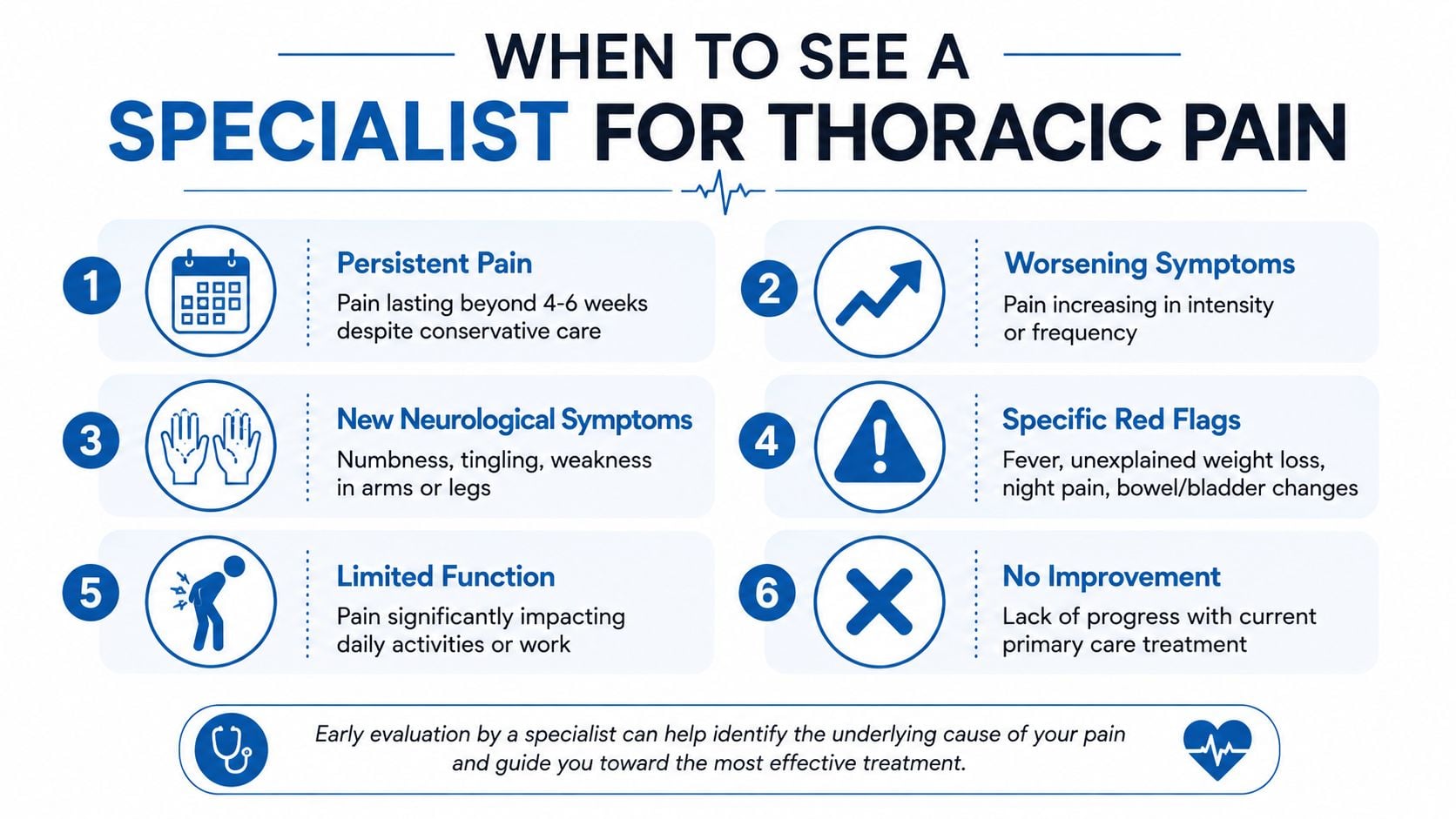
It's time to move beyond primary care when pain keeps going past the usual recovery window, keeps escalating, or starts bringing in numbness, weakness, fever, weight loss, or balance problems. Persistent thoracic pain is not something to ignore just because it's in the middle of the back. The right specialist can help decide whether the problem is muscular, joint-based, disc-related, or something outside the spine entirely.
What to look for in the next appointment
A good consultation should include a careful history, a focused exam, and a plan that explains why a specific treatment is being recommended. A board-certified pain management physician working with orthopedic spine surgery and rehabilitation is ideal when the diagnosis is not straightforward. Multidisciplinary care matters because thoracic pain often needs more than one lens, especially if the problem spans movement, inflammation, and procedural decision-making.
For patients in New Jersey and Staten Island, logistics matter too. Seven-day scheduling can make care realistic for working adults, and transportation assistance can be the difference between missing care and getting to follow-up. Workers' compensation and out-of-network cases also need early coordination so the treatment plan doesn't stall while paperwork drags on.
A practical checklist helps make the next 48 hours easier to decide:
- Book a specialist visit soon if pain is persistent and daily life is being limited.
- Ask for imaging review if prior scans exist but no one has tied them to the symptoms.
- Seek urgent evaluation if red flags are present, especially fever, weight loss, or neurological change.
- Bring records and a symptom diary so the clinician sees the pattern, not just the worst day.
The right next step is usually not “try everything.” It's “identify the generator, match the treatment, and keep moving in the least invasive direction that still makes sense.”
Questions Patients Ask After the Appointment
Relief usually doesn't happen all at once. Some people feel change after the first few visits, while others need several weeks of conservative care before the body settles enough to show progress. Repeat injections may be considered in selected cases, but only when the first one clearly helped and the diagnosis still fits.
If the pain turns out to be referred from the stomach, lungs, heart, or another non-spinal source, the plan changes completely. That's not a failure of treatment. It's a sign the spine was only part of the story.
Normal post-procedure soreness usually improves steadily over a short period. Call the clinic if pain sharply worsens, new weakness appears, or anything feels very different from the aftercare instructions. The safest rule is simple, expected soreness should trend down, not up.
If thoracic pain is still interfering with breathing, work, sleep, or movement, Interventional Pain Management can help identify the pain generator and match it to the right next step, from diagnostic evaluation to injections, neuromodulation, or surgical coordination. Visit Interventional Pain Management to arrange a consultation and get a thoracic spine pain treatment plan that's built around the structure causing the pain.